❌

Reading view

Innovative Tool Enhances Collaboration Among Schools and Universities

In an era where education continually evolves through collaboration, the partnership between schools and universities represents a crucial frontier for innovation and professional growth. Yet, despite the increasingly common alliances forged between these educational institutions, evaluating their efficacy and sustaining them over time remains a complex challenge. Addressing this gap, a pioneering doctoral thesis from Tallinn University introduces a robust framework designed to monitor and enhance school–university partnerships systematically.

Edna Milena Sarmiento Marquez, PhD in Educational Sciences, has contributed a transformational approach to understanding how educational collaborations can thrive. She emphasizes that strong partnerships catalyze professional development for educators, enrich the practical application of research within classrooms, and ultimately, elevate student learning experiences. More than just administrative or academic joint ventures, these partnerships can ignite educational innovation, blending theoretical insights with lived classroom realities to the benefit of all stakeholders.

However, despite such promise, many partnerships falter due to a lack of clear indicators for progress, and the difficulty in sustaining engagement over extended periods. This represents a critical obstacle, as partnerships often involve diverse participants—teachers, researchers, administrators—each with differing expectations and needs. Without structured methods to assess their collaboration, these alliances risk stagnation or dissolution.

To navigate this intricate landscape, Sarmiento Marquez developed the SUP.ME (School–University Partnerships) framework. This innovative tool acts as both compass and map, guiding partners through the lifecycle of their joint ventures. SUP.ME moves beyond traditional evaluation metrics—such as goal achievement alone—and integrates qualitative measures like mutual trust, effective communication, and the partners’ capacity to learn collaboratively and adapt to evolving conditions. It transforms assessment into an ongoing, reflective learning process where each participant shares responsibility for monitoring progress.

The conceptual underpinning of SUP.ME is the recognition that partnerships function as dynamic ecosystems. They evolve through a continual exchange of knowledge and experiences among partners who bring complementary perspectives. This iterative process supports collective decision-making that is informed by real-time insights rather than distant or static assessments. By embedding evaluation within partnership activities, SUP.ME ensures that feedback loops remain immediate and actionable.

From a methodological standpoint, the framework demands active engagement with observational data, gathered through interactions, meetings, and cooperative initiatives within the partnership. Utilizing this data, partners collaboratively analyze outcomes and challenges, fostering an adaptive environment. Such an approach aligns with contemporary educational theories emphasizing reflective practice and experiential learning, which acknowledge that collaboration itself can be a transformative pedagogical tool.

Sarmiento Marquez’s research highlights that successful partnerships often manifest flexibility—adjusting goals, roles, and strategies as situations evolve. This adaptability is underpinned by the strength of interpersonal relationships and the development of trust. Partnerships that sustain themselves are not merely about completing tasks but about cultivating a shared vision and mutual respect that motivates continued engagement despite inevitable challenges.

This research adds a critical new dimension to partnership studies by situating evaluation as an integral, continuous component rather than a periodic, external audit. In doing so, it disrupts traditional views on educational collaboration and suggests that long-term sustainability emerges through mutual growth and learning. The framework’s practical application promises to provide schools and universities with a much-needed mechanism to quantify and qualify their joint efforts meaningfully.

Equally important is how SUP.ME emphasizes inclusivity and co-ownership of the evaluation process. It eschews hierarchical models where evaluation is imposed by one institution over the other. Instead, it encourages a democratic evaluation culture, promoting transparency and shared accountability. This shift resonates with broader educational trends aiming to democratize knowledge and empower practitioners at all levels.

The broader implications of this work extend beyond school–university partnerships. The principles of collaborative, embedded evaluation may influence how other cross-sectoral educational initiatives are designed and sustained, including community engagement projects and interdisciplinary research programs. By modeling how partnerships can tactically and effectively self-monitor, SUP.ME offers a blueprint for multifaceted educational transformation.

Reflecting on the metaphor provided by Sarmiento Marquez, managing a partnership without structured evaluation is akin to undertaking a trek through challenging terrain without navigational aids. The SUP.ME framework serves as that critical navigation system, enabling partners to map their journey, recognize landmarks of success, and recalibrate their route in response to unforeseen obstacles.

In essence, this doctoral research contributes not just a theoretical model but a functional toolkit aimed at bridging the often elusive gap between partnership aspirations and tangible outcomes. It empowers educational institutions to harness the full potential of collaboration, nurturing an environment where teachers, researchers, and students collectively thrive through shared knowledge, reflective practice, and adaptive strategy.

The significance of this work lies in its potential to reshape educational collaboration worldwide. As schools and universities confront unprecedented challenges—from digitization and shifting pedagogical paradigms to socio-economic disparities—the capacity to build and maintain vibrant partnerships becomes increasingly critical. SUP.ME offers a beacon of guidance for those navigating this demanding yet rewarding path of joint educational advancement.

By integrating observational data, ongoing reflective dialogue, and adaptive learning cycles, Sarmiento Marquez’s framework transcends traditional boundaries of partnership evaluation. It positions collaboration not merely as a strategic imperative but as a living, evolving practice anchored in trust, communication, and mutual growth. This perspective is not only innovative but essential for fostering the sustained success of educational partnerships in the 21st century.

Ultimately, the SUP.ME framework invites education professionals to embrace partnerships as reciprocal journeys of learning and innovation. It challenges institutions to reconceptualize evaluation from a retrospective checkpoint to a real-time compass guiding continuous improvement. As this approach gains traction, it promises to enhance educational ecosystems, ensuring that collaborations realize their full transformative potential.


Subject of Research: People
Article Title: Available from DOI link
Web References: http://dx.doi.org/10.60518/etera/148
Image Credits: Edna Milena Sarmiento Marquez and Tallinn University
Keywords: Educational Partnerships, School–University Collaboration, SUP.ME Framework, Collaborative Learning, Evaluation Framework, Professional Development, Educational Innovation, Reflective Practice

  •  

Neuromorphic Networks Co-Designed with Dual Memory

In a groundbreaking development that could revolutionize the field of artificial intelligence and neuromorphic computing, researchers have unveiled a novel algorithm–hardware co-design approach featuring neuromorphic networks supported by dual memory pathways. This innovative framework, recently published in Nature Machine Intelligence, promises to overcome longstanding challenges in efficiently mimicking brain-like processing in silicon hardware. The fusion of algorithmic design and hardware architecture epitomizes a synergistic leap forward for neuromorphic systems, which strive to emulate the efficiency and adaptability of biological neural networks.

Neuromorphic computing, inspired by the structure and function of the human brain, seeks to replicate neural dynamics through specialized hardware that inherently supports parallel and event-driven processing. Unlike traditional von Neumann architectures, which segregate memory and processing units, neuromorphic systems integrate these functions, drastically reducing latency and energy consumption. However, a persistent limitation in current neuromorphic implementations lies in their constrained memory capacity and difficulties in sustaining stable learning over time. The new co-design method directly confronts these issues by introducing a dual memory pathway mechanism akin to the human brain’s approach to memory storage and retrieval.

The dual memory pathways conceptualized by the research team separate short-term and long-term memory processing within the neuromorphic network. Short-term memory pathways facilitate rapid, flexible adaptation to incoming data, echoing the brain’s working memory functions. Concurrently, long-term memory pathways enable the consolidation and retention of learned information over extended periods. This bifurcation fosters an architectural efficiency that mitigates memory interference and catastrophic forgetting—two notorious hurdles in neuromorphic learning systems and artificial intelligence at large.

Fundamentally, the innovative algorithm tailors synaptic plasticity dynamics to the hardware substrate, leading to more stable, biologically plausible learning rules. The researchers employ spike-timing-dependent plasticity (STDP) paradigms adjusted dynamically by the dual pathways, allowing the system to adapt continuously yet retain core learned information without overwriting. This hybrid plasticity approach is supported by circuits that facilitate separate yet interactive memory stores, closely emulating the hippocampus-neocortex complementarity observed in mammalian brains.

Critically, the design is optimized to leverage emerging non-volatile memory technologies such as resistive RAM (ReRAM), which afford dense, low-power synaptic implementation. The team’s hardware prototype integrates these resistive elements into the dual memory architecture, striking a delicate balance between speed, retention, and energy efficiency. By co-optimizing the algorithmic parameters with hardware constraints, the design attains a level of performance and scalability previously unattainable in neuromorphic networks.

Extensive benchmarking on machine learning tasks highlights the superiority of this co-design approach. Tasks demanding continual learning and domain adaptation—traditionally challenging due to interference effects—exhibit enhanced stability and precision. Notably, the dual pathways enable the neuromorphic system to segregate novel information from prior knowledge efficiently, supporting lifelong learning scenarios critical for real-world AI applications such as robotics, autonomous systems, and adaptive sensory processing.

The implications of this breakthrough extend beyond traditional AI. By more faithfully replicating the brain’s memory consolidation processes, these neuromorphic networks could yield insights into neurological disorders characterized by memory dysfunction. Additionally, the modularity of the dual memory pathways invites future customization and specialization for domain-specific tasks, envisioning a new class of adaptive hardware that evolves alongside its operational environment.

Moreover, the research addresses the formidable challenge of hardware variability and noise—a persistent bottleneck in neuromorphic device deployment. The co-designed algorithm inherently compensates for device-level imperfections through adaptive learning thresholds and redundancy in memory representations. This robustness not only ensures reliable operation over extended periods but also enhances manufacturability and cost-effectiveness for large-scale silicium implementations.

This co-design paradigm exemplifies a pivotal shift in neuromorphic engineering, moving away from generic algorithm deployment on fixed hardware towards integrated development of systems where both hardware and software are mutually optimized. This approach reflects an emerging philosophy in AI hardware: embracing the interdependence of physical substrate and algorithmic function to unlock previously constrained capabilities.

Such a sophisticated neuromorphic platform provokes exciting questions regarding the future landscape of artificial intelligence. Could dual memory pathways represent a standard architectural motif underpinning all next-generation AI chips? Might this design accelerate the creation of truly autonomous systems capable of continuous, context-aware learning within dynamic environments? The potential scale and impact of these mechanisms suggest transformative ripples across industry sectors reliant on AI, from healthcare and finance to autonomous vehicles and beyond.

While promising, challenges remain. Scaling the dual memory network to extremely large, brain-scale systems presents engineering complexities necessitating further innovations in materials, circuit design, and integration techniques. Additionally, fine-tuning the balance between memory consolidation and plasticity, ensuring both adaptability and stability, demands deeper theoretical understanding informed by neuroscience. Continued collaboration between multidisciplinary teams of neuroscientists, material scientists, electrical engineers, and computer scientists will be pivotal to this endeavor.

Looking ahead, this work may catalyze the proliferation of neuromorphic devices poised to operate at unprecedented energy efficiencies while offering continuous learning capability. By taking inspiration from the brain’s memory architecture and rigorously co-designing compatible hardware, the research ushers in an era where artificial intelligence systems can remember, adapt, and grow with a natural fluidity previously attainable only in biological organisms.

The dual memory pathway design stands as a milestone demonstrating that bridging the algorithm–hardware gap is an indispensable strategy for advancing neuromorphic computing. Its capacity to resolve persistent issues such as catastrophic forgetting and memory interference attests to an elegant merging of biological principles with cutting-edge technology. As AI advances toward greater autonomy and contextual sophistication, innovations like these could form the foundational building blocks of truly intelligent machines.

In sum, the synergy achieved by this algorithm–hardware co-design exemplifies the future of neuromorphic architectures — dynamic, adaptive, and deeply integrated with the physical medium of computation. It heralds a pivotal moment where the dream of brain-inspired computing inches closer to reality, promising devices that do not merely process information, but learn and remember in a resilient and energy-efficient manner akin to the human mind.


Subject of Research: Algorithm–hardware co-design in neuromorphic networks incorporating dual memory pathways to enhance learning stability and efficiency.

Article Title: Algorithm–hardware co-design of neuromorphic networks with dual memory pathways.

Article References:
Sun, P., Su, Z., Achterberg, J. et al. Algorithm–hardware co-design of neuromorphic networks with dual memory pathways. Nat Mach Intell (2026). https://doi.org/10.1038/s42256-026-01255-3

Image Credits: AI Generated

DOI: https://doi.org/10.1038/s42256-026-01255-3

  •  

Scientists discover invisible hardware trojans lurking inside computer chips

Every day, people rely on computer chips to keep sensitive information safe. These tiny pieces of hardware help protect everything from online banking details and personal data to government and military secrets. But new research suggests that some chips could contain hidden threats that are almost impossible to detect using current security methods. Researchers from […]

The post Scientists discover invisible hardware trojans lurking inside computer chips appeared first on Knowridge Science Report.

  •  

Up, Up, and Away With Weather Balloons 

By Erica McNamee of NASA’s Goddard Space Flight Center in Greenbelt, MD 

As a kid, you were always taught to hold tight to balloons—tie them around your wrist, even, to keep them close. This week, a group of a dozen undergraduate students participating in NASA’s 2026 Student Airborne Research Program (SARP), unlearned old balloon-wrangling habits—and let go. 

Their purpose:  to collect data about the atmosphere with the help of a weather balloon. For this fieldwork day, in a windy area on the Texas Gulf Coast, the group released an ozonesonde, a small instrument attached to a weather balloon that measures ozone concentrations as it rises through the atmosphere.   

“I’ve never done any atmospheric fieldwork outside like this, so this has been an awesome new opportunity for me,” said Marin Stevens, SARP intern and chemistry student from the University of Colorado at Colorado Springs.  

With the support of program mentors and faculty, and aboard the University of Houston’s Mobile Air Quality Laboratory (MAQL), the SARP interns participated in every step of the process.  

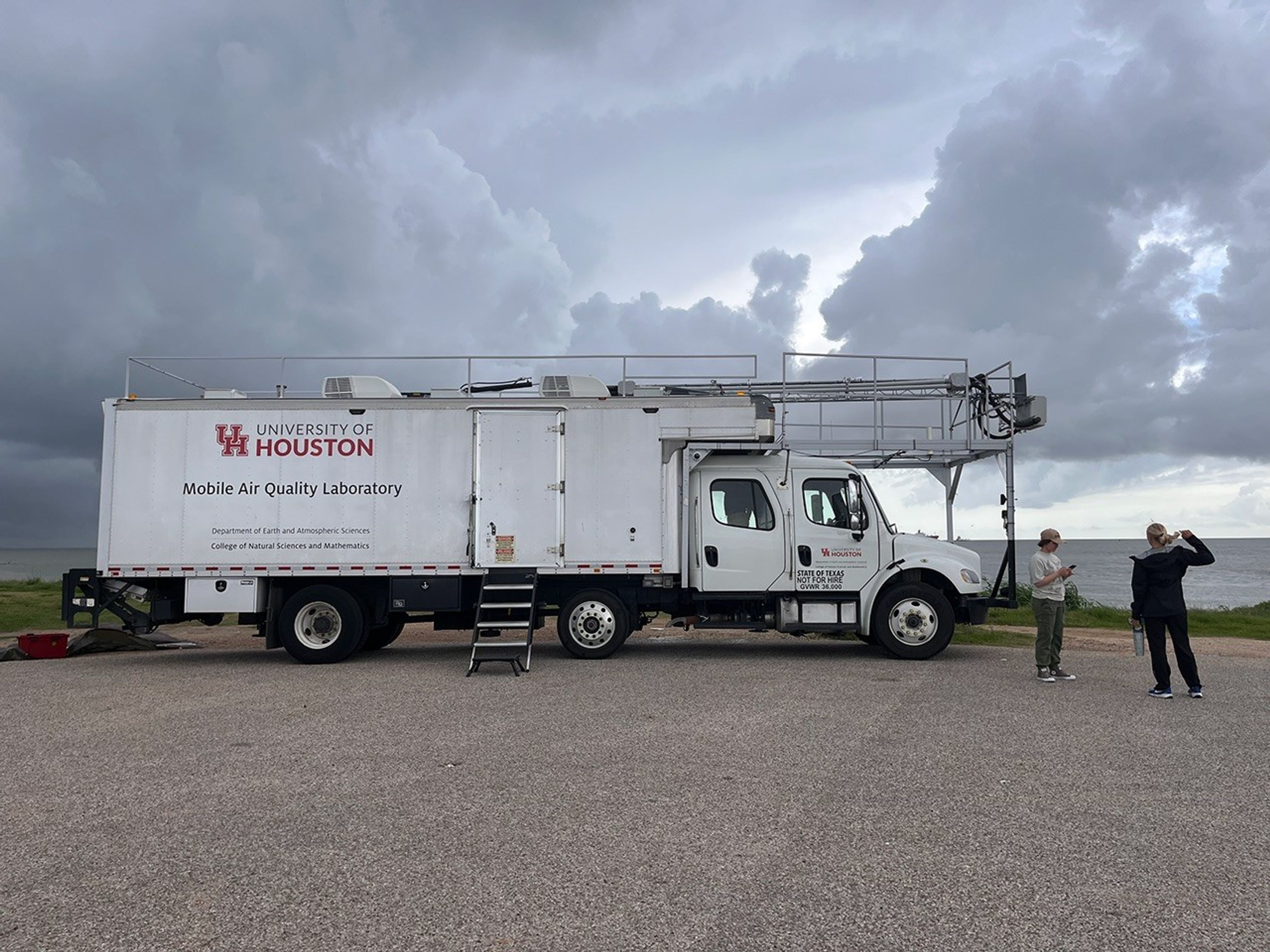
A large white truck is centered in the image. Stairs lead up to the back end of the truck, up to a currently closed door. The truck has a label on the back saying “University of Houston Mobile Air Quality Laboratory”. Two people are standing to the right of the image. Dark clouds billow in the background of the image.
The Mobile Air Quality Laboratory (MAQL) stands ready for some fieldwork.
NASA/Erica McNamee

Let’s set the scene: About 45 minutes away from this year’s SARP home base at the Lone Star Flight Museum in Houston, the MAQL drove down the Texas City Dike, a long strip of land jutting into the Texas Gulf Coast—an open space perfect for releasing the weather balloon. Among the 45 total students in the program, this group was assigned to meet the mobile lab at the balloon release location at  8 a.m. Central Time, just after a rainstorm rolled through. 

Inside the lab, the students prepared ozonesondes for takeoff, completing the final steps that include measuring and pipetting cathode and anode solutions into the instrument cells attached to the sensor and testing each instrument’s response and baseline. 

Outside the mobile laboratory, gusts of wind made it difficult to keep the balloon still while it was being filled with helium. Four students donned leather gloves to minimize oils from their fingers touching the balloon, which can make it pop faster after deployment. They wrangled the balloon while faculty advisor Travis Griggs, instructional assistant professor of atmospheric science from the University of Houston, filled it.  

The center of the image shows a large white balloon. Beneath the balloon are five people in a circle, gently holding at the bottom of the balloon to keep it upright. In the background of the image, other people watch.
SARP students prepare the weather balloon for takeoff by filling it up with helium, while making sure it doesn’t pop or fly away.
NASA/Sofie Bates

Five students worked together to keep the balloon from flying away as they strung it to the ozonesonde, protected in a small foam container. 

After confirming the launch location, time, and expected flight path with the Federal Aviation Administration (just a phone call away), it was time to set the weather instrument free.   

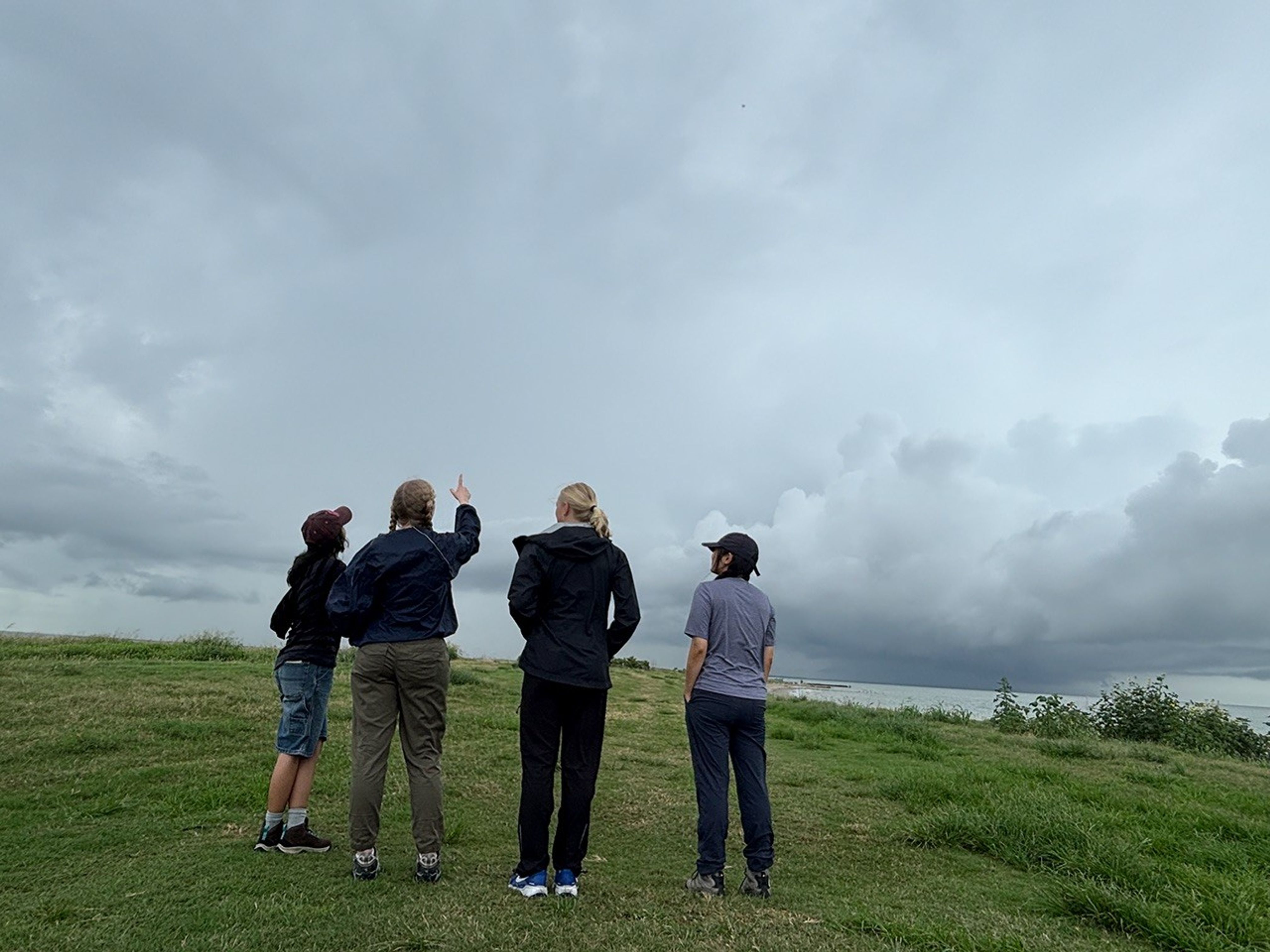
Four students stand in a line centered in the image facing away from the camera. They’re looking up at the sky — a dark and cloud filled sky — and standing on dark green grass. One student, second from the left, points up at the sky.
Even though it’s hard to see, there’s a tiny dot up in the sky—that’s the weather balloon! These students are admiring their work, watching their science experiment float up into the atmosphere to collect data.
NASA/Sofie Bates

“It was like a fight to stay on the ground, with the balloon whipping around in the wind,” said Zayna Haider, SARP intern and atmospheric and climate science student from the University of Washington. “It just flew away as soon as we let it go.” 

But the work had only just begun. The students huddled back inside the MAQL, monitoring data as long as the balloon kept sending it—until it popped or landed, whichever came first. Throughout the day, they repeated this process with two other balloons.  

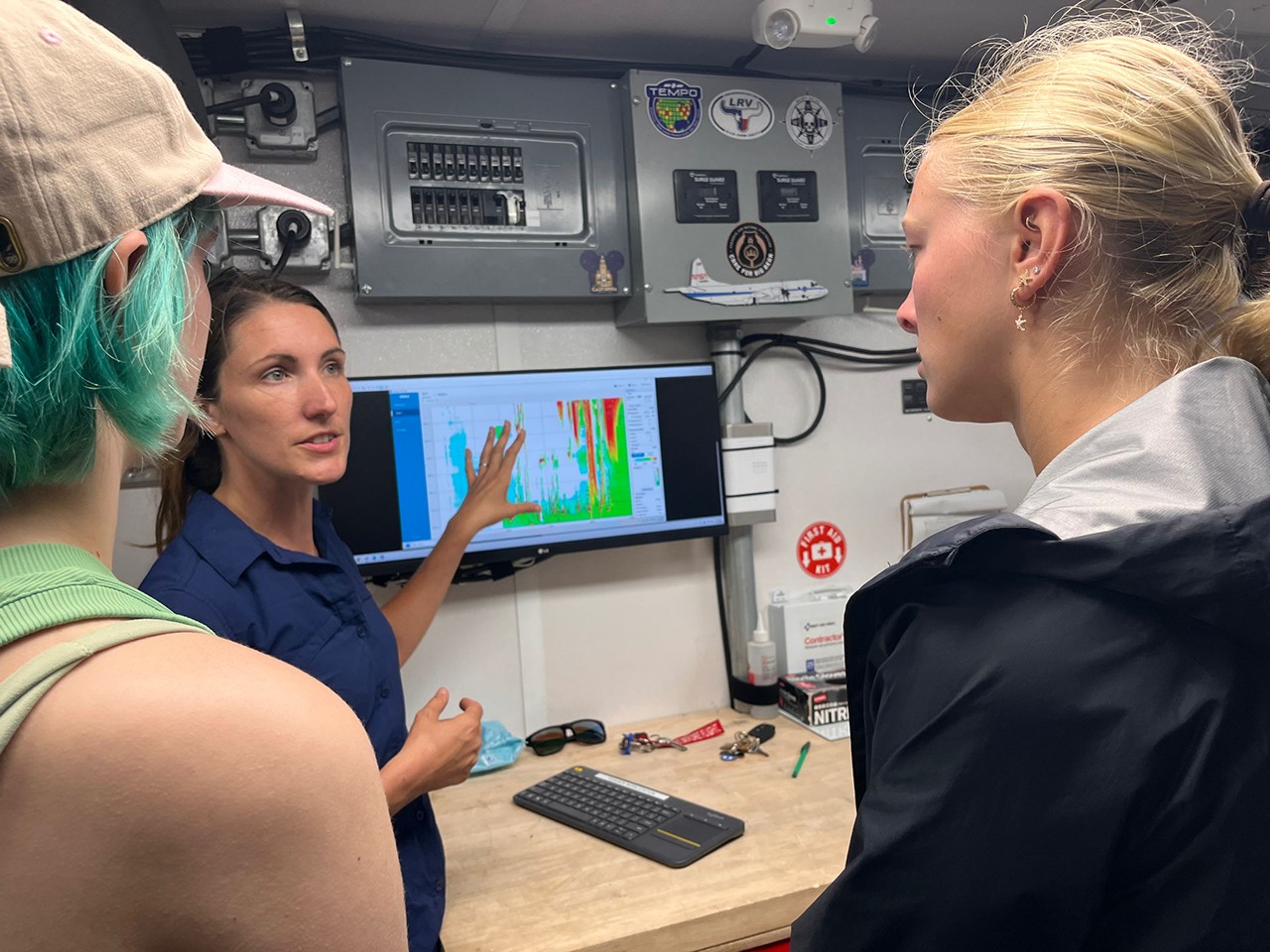
In the background of the image is a computer screen showing science data in green, orange, and red colors. Two students, in the foreground of the image, are looking at the screen, while a woman stands in front of it, looking at the students and pointing at the screen.
Students inside the Mobile Air Quality Laboratory reviewed the data from the weather balloon they had just launched.
NASA/Erica McNamee

This day gave many SARP participants, just starting their science careers, their first glimpse at hands-on fieldwork that reached the edges of the atmosphere. Next, they would use this data and what they learned from the experience for their end-of-internship research presentation.  

“This is beyond what I ever thought it could be,” Stevens said. “I’m super excited for the next seven weeks.” 

The post Up, Up, and Away With Weather Balloons  appeared first on NASA Science.

  •  
  •  
❌