MIT’s new two-in-one space engine could turn tiny satellites into surprisingly capable deep-space explorers. Researchers at MIT are testing a new propulsion technology that could give small satellites a major boost in capability. The system combines two very different forms of spacecraft propulsion in a single package, allowing satellites to perform both rapid maneuvers and [...]
O Trump Phone não é o que parece e uma nova desmontagem da iFixit confirma o que muitos suspeitavam. Afinal, o smartphone é quase idêntico ao HTC U24 Pro, lançado em 2024.
The unveiling of the new garment by Prada and Axiom Space took place at Prada’s SoHo location in Manhattan just days before the announcement of the Artemis III crew, according to the New York Timesfashion desk. With black-clad waiters circulating champagne and healthy juices through the Rem Koolhaas-designed venue, the intersection of fashion and space exploration was once again on full display.
“The future of space exploration will not be built by any one entity alone, and our partnership with Prada is proof of that,” said Dr. Jonathan Cirtain, Axiom Space CEO and President, in a statement.
“By bringing together the best in both aerospace engineering as well as luxury craftmanship and advanced product development, we have developed a garment that neither company could have created independently, and that is exactly the kind of cross-industry thinking that will define the next era of human spaceflight,” Cirtain added.
Some might be surprised to learn this is not the first time NASA has collaborated with a fashion house. The first modern spacesuit was designed and crafted by a group of international designers at the Latex Corporation (ILC). In the 1960s, this company was best known for manufacturing bras and girdles.
Notably, a version of its A7L spacesuit was worn by Neil Armstrong during the Apollo 11 mission. Designers developed the A7L to protect astronauts from the harsh conditions of space and the lunar surface.
The suit was constructed using materials such as neoprene, Beta cloth—which helped protect astronauts from extreme temperatures—and aluminized Mylar. Overall, it was a highly complex, multilayered design.
The new LCVG collaboration draws on Prada’s expertise in knitting, craftsmanship, and advanced design. The resulting garment is a next-generation system developed using sophisticated 3D modeling techniques.
The suit is designed to maintain cooling and ventilation while remaining comfortable during spacewalks lasting up to eight hours. Thanks to its high-performance materials, it can also be worn repeatedly during long-duration missions.
“When we unveiled the AxEMU, we announced that the collaboration between Prada and Axiom Space would continue beyond that first milestone,” said Lorenzo Bertelli, Prada Group Chief Marketing Officer and Head of Sustainability, in a statement.
“Today, we are proud to present a new achievement born from the unique combination of Axiom Space’s pioneering expertise and Prada’s know-how in design, patternmaking, and advanced materials, ahead of humanity’s return to the lunar surface,” Bertelli added.
In 2024, Axiom Space and Prada unveiled the AxEMU’s outer layer, designed to withstand the harsh conditions of the lunar South Pole. Their latest collaboration on the Liquid Cooling and Ventilation Garment builds on that partnership, focusing on astronaut comfort, thermal regulation, and reliability inside the spacesuit.
“We look forward to continuing this collaboration with Axiom Space, pushing boundaries and exploring new frontiers together,” adds Bertelli.
The LCVG keeps astronauts cool during spacewalks by circulating chilled water through tubes woven into the garment, removing body heat and venting it through the spacesuit. It also delivers fresh oxygen and removes carbon dioxide, helping astronauts remain safe and comfortable in the harsh environment of space.
“Every minute astronauts spend outside their vehicle, the LCVG is working to keep them safe,” said Russell Ralston, Axiom Space Senior Vice President of Spacecraft Development.
“It manages their thermal environment, supports their breathing, and does it all while they’re pushing their bodies to the limit,” Ralson added. “The work we have done with Prada has taken that capability to a level we could not have achieved alone.”
Chrissy Newton is a PR professional and the founder of VOCAB Communications. She currently appears on The Discovery Channel and Max and hosts the Rebelliously Curious podcast, which can be found on YouTube and on all audio podcast streaming platforms. Follow her on X: @ChrissyNewton, Instagram: @BeingChrissyNewton, and chrissynewton.com. To contact Chrissy with a story, please email chrissy @ thedebrief.org.
One of the world’s most active ransomware groups exploited a critical vulnerability in Oracle’s PeopleSoft software suite and used it to target about 100 customers and extort at least one of them to pay up in exchange for not leaking stolen data, researchers said.
The group, tracked as ShinyHunters, had been exploiting the PeopleSoft vulnerability for more than two weeks before Oracle flagged it. CVE-2026-35273, as the vulnerability is tracked, carries a severity rating of 9.8 out of 10, making the former zero-day one of the year’s most critical vulnerabilities to be exploited.
Google’s Mandiant security team said it’s an SSRF (server-side request forgery), a vulnerability that allows attackers to send requests from a susceptible server to systems used by the targeted organization. Oracle said the SSRF is remotely exploitable, and the company has issued a stopgap mitigation but has yet to fully patch the flaw. Google has confirmed that victims are receiving extortion demands.
Portugal reforçou a sua presença na edição de 2025 do Technology Fast 500 EMEA. com 18 empresas distinguidas. A melhor classificação portuguesa pertence à Bloq.it que ocupa novamente o segundo lugar no ranking da Deloitte.
A conferência anual da Agência Espacial Portuguesa regressa a Lisboa este mês e segue o tema "A Arquitetura do Poder: Geopolítica na Segunda Era da Exploração Espacial”. A participação é gratuita, com inscrição obrigatória.
Celestron's iconic orange NexStar series is on sale on Amazon and includes the smallest of the set, the NexStar 4SE, a perfect first telescope for new stargazers. It has a 4-inch aperture and go-to technology for easily finding night sky objects.
Apesar dos progressos significativos na conectividade de fibra de alta velocidade em Portugal, um novo estudo mostra que que muitos utilizadores continuam a enfrentar problemas de latência, bloqueios, paragens de carregamento e quebras de ligação.
Labour’s goal of 'dynamic alignment' with the EU is bad news for the party's beloved Net Zero, says Ben Pile. Even more than in Britain, the backlash in Europe against ruinous climate policies is gathering steam.
Physicists at the University of Oxford have engineered a new class of ‘cat states’ -- quantum superpositions constructed not from ordinary wave packets, but from deeply exotic, nonclassical components -- opening unexpected paths toward more resilient quantum computers.
The team behind the novel propulsion technology said that electrospray thrusters could allow mission planners to design smaller, more nimble satellites and spacecraft capable of performing faster, more powerful maneuvers or slower, more precise adjustments, depending on mission requirements.
Electrospray Combines the Best of Chemical and Electric Propulsion
Launching rockets into space still requires chemical thrusters, but once spacecraft and satellites reach orbit, engineers continue to develop novel propulsion methods that are more efficient than chemical propulsion technologies. Given the strict weight requirements of spacecraft launches, finding alternatives to chemical propellants has opened up a wider range of mission profiles.
Among the most common alternatives to chemical thrusters are designs that combine electrical energy with small amounts of propellant to produce small but sustainable thrust. Although electric thruster designs require less fuel, saving significantly on launch weight, they also lack both the power and the rapid, quick burst performance of chemical thrusters.
According to study author Amelia Bruno, a former postdoc in MIT’s Department of Aeronautics and Astronautics (AeroAstro), combining chemical and electrical propulsion into a single system is “the best of both worlds.”
“This opens the door for small satellites to do even more science, more observations, and more interesting missions, all on a smaller and cheaper platform,” Bruno explained to MIT News.
Study co-author Paulo Lozano, the Miguel Alemán Velasco Professor of Aeronautics and Astronautics at MIT, agreed, noting that combining both technologies could enable a CubeSat mission to Mars “where they could make the journey slowly, using electrospray thrusters.”
“You could then use your chemical thrusters to quickly move to look at interesting features,” the professor added. “You could have a lot more flexibility to do a lot more things.”
ASCENT Rocket Fuel as the Thruster’s Ionic Liquid Propellant Enables Hybrid Design
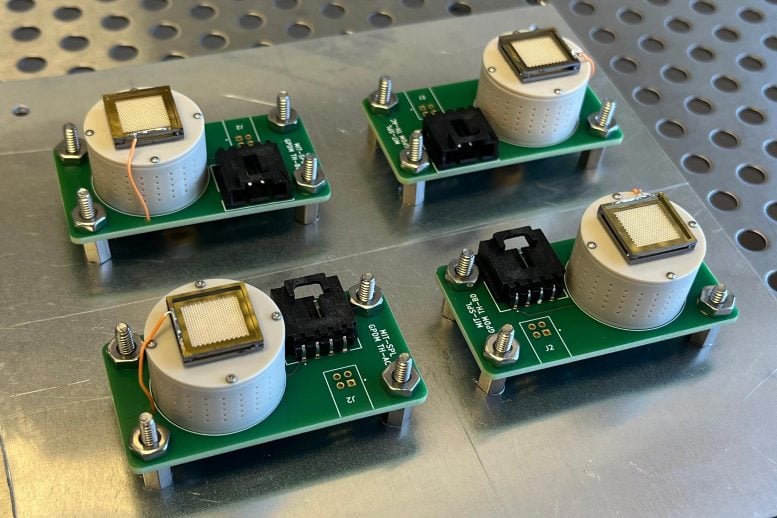
According to a statement detailing the new electrospray thruster’s design, the ones developed by the MIT team are about the size of a thumbnail. Each thruster is also placed directly above a small fuel reservoir. For the MT electrospray thrusters, the fuel is an ionic liquid propellant, a liquid composed of salts that remain dissolved in a solution.
These four flight-unit electrospray thrusters were delivered by the MIT Space Propulsion Laboratory to NASA for the upcoming Green Propulsion Dual Mode (GPDM) mission. Image Credit: Amelia Bruno
“Ionic liquids are very stable and can even remain a liquid in space, which not a lot of materials can do,” Bruno explained. “And it’s basically a sea of ions, which is why we base our technology around it, so we can pull those ions out into an electrospray.”
When a spacecraft’s battery delivers an electric charge to the fuel reservoir, the ions within the fuel also become charged. The thruster’s design channels the charged particles from the reservoir and through the thruster tips, expelling them into space.
Although the team has tested several types of ionic propellant in its electrospray propulsion thrusters, Bruno and Lozano have collaborated with the U.S. Air Force to synthesize an all-new ionic liquid propellant, which they are calling the Advanced SpaceCraft Energetic Non-Toxic propellant, or ASCENT.
Originally designed as a “green” alternative to extremely hazardous hydrazine rocket fuel that has been the staple in the rocket industry for decades, Bruno notes that ASCENT “happens to be an ionic liquid mixture.”
“And we said, hey, that’s the stuff we typically use,” the researcher added. “Theoretically, this should work. Let’s go figure out how.”
Tests: Chemical Propellant Equally Efficient as Conventional Ionic Liquids
To test their electrospray design, each tested thruster was attached to a small reservoir about the size of a single Lego brick, and then the reservoir was filled with ASCENT. Next, electrospray thrusters were mounted on opposite sides of a traditional CubeSat.
To simulate the microgravity environment of Near-Earth Orbit, the team placed the thruster-equipped CubeSat on a MagLev stand. The team noted that the MagLev in Lozano’s lab is installed inside a large vacuum chamber. This design allows the researchers to fine-tune the environment to best mimic the conditions in space.
During a series of tests, the team applied varying voltage levels to the electrospray thrusters. As expected, the reaction produced a spray from the thruster nozzles, which spun the CubeSat around on the MagLev stand like a freely spinning top.
During each thruster firing, the team measured the amount of thrust produced. This data, combined with the voltage and fuel data, allowed the team to calculate ASCENT’s fuel efficiency during continuous operation. Some tests lasted up to 100 hours.
When the MIT group evaluated the results, they first determined that the choice of ASCENT was correct, as it successfully fueled each electrospray thruster. Even more significantly, the tests revealed that the readily available chemical propellant was equally efficient as conventional ionic liquids.
“Compared to our normal electrospray propellants, ASCENT can provide similar performance in terms of thrust,” Bruno explained. “Now that we know our thrusters work with ASCENT, we can start thinking of all the ways we can make them even better.”
Testing Electrospray Thrusters on NASA’s Green Propulsion Dual Mode Mission
When discussing the benefits of their successful electrospray thruster tests, Lozano noted that a spacecraft with electric and chemical thrusters can share a single fuel tank. Due to its compact design, this hybrid electrospray thruster could be mounted on a small satellite.
Fortunately, the team won’t have to wait long to see their thruster in action. According to the research team, whose work was partially supported by NASA, their design will be incorporated into NASA’s upcoming Green Propulsion Dual Mode mission scheduled to launch in November. The Green Propulsion Dual-Mode mission will carry a briefcase-sized CubeSat with a primary chemical thruster and specially designed electrospray thrusters, making it the first attempt to combine electrical and chemical propulsion in a small spacecraft.
“This will be the first time that a satellite will have a shared propellant tank,” Lozano explained.
Although a large portion of proposed electric propulsion missions that might employ the new electrospray thruster are designed to explore deeper into the Solar System and beyond, Lozano also highlighted the technology’s possible applications closer to home. For example, satellites equipped with both technologies could rapidly respond to environmental or climate changes in real time with a speed and efficiency unavailable with current propulsion options.
“Say there’s a storm coming, and you’d want to deploy your constellation of small satellites to observe over one location,” the researcher explained. “You could choose to send them quickly or slowly, depending on the nature of the observation.”
“And the only way to do that is if you have two propulsion systems, which is now possible,” he added.
Although the mission will not launch before November, Bruno noted that a successful test could allow engineers to consider missions they never thought possible.
“Now that we know our thrusters work with ASCENT, we can start thinking of all the ways we can make them even better,” the researcher explained.
Christopher Plain is a Science Fiction and Fantasy novelist and Head Science Writer at The Debrief. Follow and connect with him on X, learn about his books at plainfiction.com, or email him directly at christopher@thedebrief.org.
Microsoft on Tuesday released fixes for two high-severity zero-days that were disclosed by a researcher who has been locked in a testy beef with the software giant.
Nightmare Eclipse, the pseudonym the researcher goes by, released a handful of high-severity vulnerabilities in recent months, making them zero-days that had the potential to be exploited in the wild. The researcher has said the disclosures, which included proof-of-concept code, came after Microsoft reneged on an arrangement the two made regarding vulnerabilities they had discussed.
Disclosure drama
“But someone violated our agreement and left me homeless with nothing,” Nightmare Eclipse wrote in March. “They knew this will happen and they still stabbed me in the back anyways, this is their decision not mine.”
Researchers have analyzed a high-severity vulnerability in Linux that’s able to escalate untrusted users to root by exploiting a bug you don't often see: a single errant character inside the kernel.
The vulnerability, tracked as CVE-2026-23111, is located in nf_tables, a subsystem of the Linux kernel that provides packet filtering capabilities. It’s used to manage firewall rules and replaces older subsystems such as iptables, ip6tables, arptables, and ebtables.
!!!WTF!!!
The presence of a single mis-issued exclamation point in code implementing nf_tables introduced a use-after-free, a class of vulnerability that corrupts memory by placing malicious code at memory addresses that haven’t been properly freed of their previous contents. CVE-2026-23111 can be exploited by an unprivileged user or process to elevate system rights to root.
Years ago, right-wingers coined the phrase “Trump Derangement Syndrome” (TDS) to describe people who hate US President Donald J. Trump. (I think it better describes the president’s outlandish, truth-challenged statements and the followers who think he can do no wrong.) What’s really deranged is his recent AI executive order.
Then, a little thing called Anthropic Mythos came along — and scared the pants off even AI’s biggest fans. Seemingly in response, someone in the federal government decided that letting AI companies do whatever they want might not be the brightest policy.
Or, did they?
True, the new order creates a process under which AI companies can give US government access to “covered frontier models” for up to 30 days before public release so experts can probe for vulnerabilities and test how the systems could be abused. It also directs agencies to set evaluation standards, establish an “AI cybersecurity clearinghouse,” and harden federal networks against rapidly advancing AI‑enabled attacks.
Some people, like Graham Brookie, vice president for technology programs and strategy at the Atlantic Council, think the order is great. “The administration’s executive order on Advanced AI Innovation and Security is a serious policy with support from necessary stakeholders across party lines and industry to ensure the government is evaluating the cybersecurity risks posed by frontier AI models. It’s a policy that can be built on.”
Really? I’m not sure Brookie read the same document I did — if, indeed, he read it at all.
I quote:
“Nothing in this section shall be construed to authorize the creation of a mandatory governmental licensing, preclearance, or permitting requirement for the development, publication, release, or distribution of new AI models, including frontier models.
“In addition, ‘This order is not intended to, and does not, create any right or benefit, substantive or procedural, enforceable at law or in equity by any party against the United States, its departments, agencies, or entities, its officers, employees, or agents, or any other person.’”
In other words, AI companies won’t be required to do much of anything. And if they do submit a project for review, get the government’s blessing for it, and something goes badly wrong, it’s not the government’s fault.
So, exactly why would AI companies even mess with this performative AI security theater?
Beyond those concerns, who exactly will be judging AI projects in 30 days? In theory, it would be a cybersecurity clearinghouse made up of people from the National Security Agency, the US Treasury Department, and the Cybersecurity and Infrastructure Security Agency (CISA). Most likely, CISA would do the bulk of the heavy-lifting — it’s their job, after all. But there’s this wee problem; Trump’s so-called Department of Government Efficiency (DOGE) last year gutted CISA. There’s virtually no one left to do the work, and certainly not in 30 days.
There’s also the question of funding for the new initiative. According to the order, “The Director of OMB, in coordination with the National Cyber Director and the Director of CISA, shall determine whether any Federal grant programs have available and relevant funding that can be directed toward applicants developing advanced AI vulnerability detection.”
Spoiler: There’s no money set aside for this purpose.
Leaving aside whether the Executive Order has any teeth at all — the Brennan Center for Justice argued that under the Constitution, it doesn’t; the closer you look at the document, the less substance you’ll find.
Besides, in an industry where success is all about releasing the latest Large Language Model (LLM) as fast as possible to garner attention and investor dollars, who exactly would want to put their AI models on ice for even 30 days? (Short answer: No one.) These companies are always going to be focused first on getting the word out about their latest model as fast as humanly — Uh, AI-ly — possible.
Still, some people seem to think this executive order really will make a difference. For example, Paul Benda, the American Bankers Association executive vice president for risk, fraud, and cybersecurity, sees it “as a constructive step toward strengthening the nation’s approach to managing the cybersecurity risks and opportunities associated with advanced artificial intelligence [because it ] can help better protect critical infrastructure, including the financial sector.”
Oh, please. I’m so tired of people who skim the titles of Trump’s executive orders and then assume there’s anything real about them.
This AI order is meaningless garbage, and anyone telling you otherwise is either lying or wants to be on the Trump regime’s good (?) side. Or, both — it could always be both.
Dozens of cryptographically verified open source packages from Microsoft were compromised late last week to add advanced credential-stealing code that was triggered when developers opened them in AI coding agents.
In all, multiple researchers said, 73 packages were flagged as malicious when automated systems on GitHub blocked them on the platform. Rather than noting they are malicious—and that developers who used AI agents to work with them should assume their systems are compromised—the Microsoft-owned GitHub said it disabled the packages “due to a violation of GitHub's terms of service.” The text went on to encourage the package owner to contact GitHub.
Devs: Assume compromise and proceed accordingly
It wasn’t until Monday that Microsoft even raised the possibility the packages were infected. In an email, the company stated: “We have temporarily removed some repositories as we investigate potential malicious content.”

 Login

 MIT’s new two-in-one space engine could turn tiny satellites into surprisingly capable deep-space explorers. Researchers at MIT are testing a new propulsion technology that could give small satellites a major boost in capability. The system combines two very different forms of spacecraft propulsion in a single package, allowing satellites to perform both rapid maneuvers and [...]