On June 14, 1949, a rhesus monkey named Albert II was launched into space aboard a V-2 rocket from White Sands, New Mexico. Prior to Albert II, animals including fruit flies, mice, and another monkey (Albert I) had been launched in rocket and balloon flights as part of American space biology research, but Albert II’sContinue reading "June 14, 1949: The first mammal in space"
Pioneer 10 holds the titles for many “firsts”: It was NASA’s first mission to the outer planets, the first spacecraft to fly beyond Mars, the first to traverse the asteroid belt, and the first to fly past Jupiter. It was also the first spacecraft placed on a trajectory to escape the solar system into interstellarContinue reading "June 13, 1983: Pioneer 10 leaves solar system"
Does the fact that we see light from very distant galaxies prove that the one-way speed of light is finite? Dr. Jason Lisle responds to this question. The conventionality thesis plays a critical role in understanding the issue, suggesting that measurements usually assume an isotropic light speed.
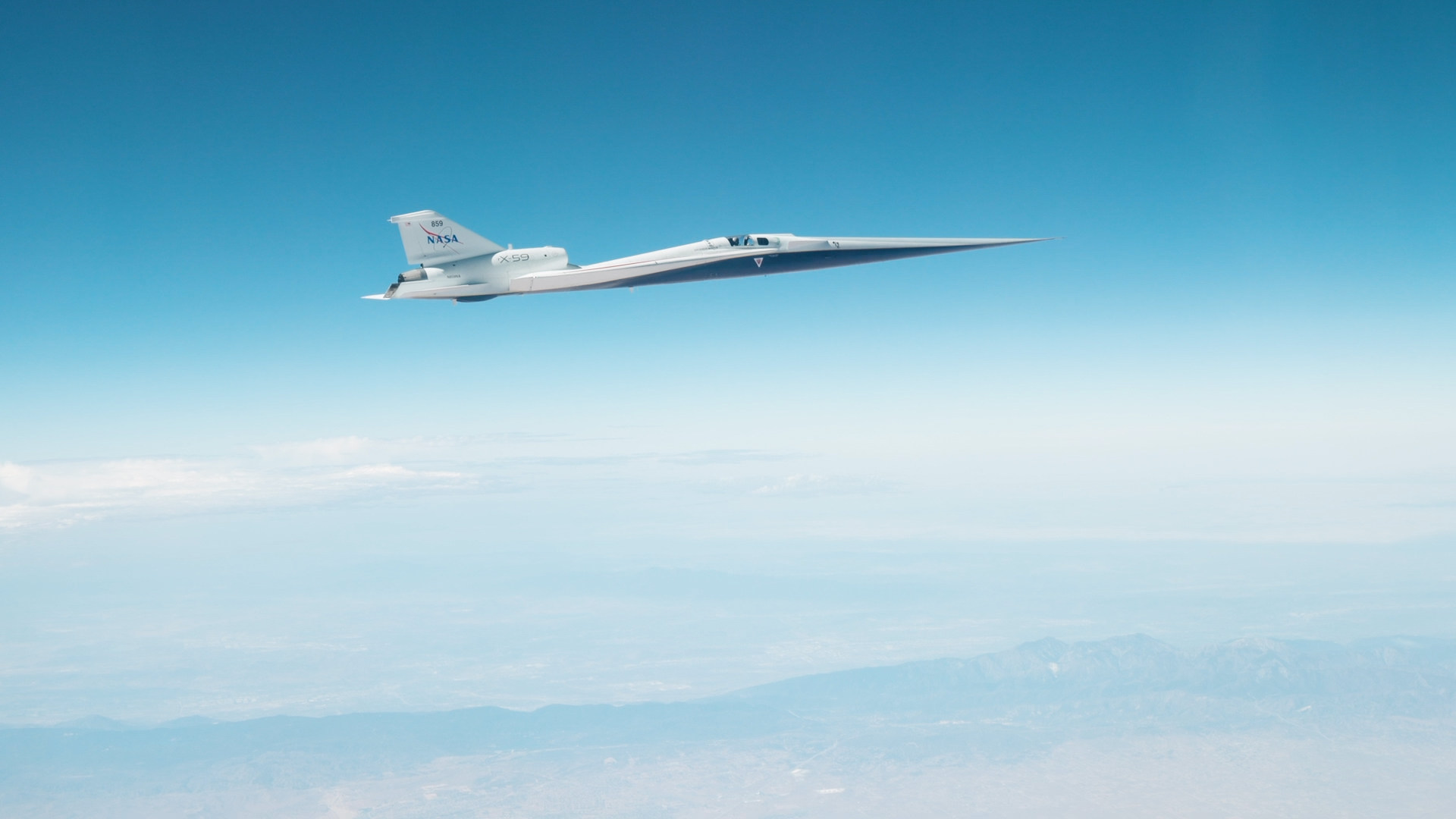
NASA’s X-59 quiet supersonic research aircraft reached its target speed and altitude for future community overflights for the first time during a flight on Friday, June 12, 2026. The milestone marked the first time the aircraft flew at Mach 1.4 and 55,000 feet — conditions it will fly when gathering community response data to its quiet sonic thump.
NASA/Lori Losey
NASA’s X-59 experimental aircraft reached a major milestone Friday, June 12, flying Mach 1.4 (about 924 mph) and an altitude of 55,000 feet, the conditions required for the aircraft to make future flights critical to its mission.
The X-59 still has months of performance testing ahead, but after those are complete, NASA’s Quesst mission will fly the aircraft over several U.S. communities to collect data on public perception of the quiet sonic thump it will make at supersonic speeds. Those community overflights will include flights at Mach 1.4 and 55,000 feet.
The milestone comes just days after the X-59’s first supersonic flight. That flight showed the aircraft performed as expected at Mach 1.1, but Friday’s mission conditions flight was an even more critical step for NASA.
NASA’s X‑59 eXternal Vision System (XVS) shows Mach 1.4 at 55,030 feet on Friday, June 12, 2026 during the aircraft’s first mission conditions flight, the approximate conditions it will fly when gathering community response data to its quiet “sonic thump.” The milestone marks the first time the aircraft flew at its designed speed and altitude.
NASA/Lori Losey
The X-59 was designed to fly supersonic without causing a loud sonic boom. However, for these early supersonic flights it has been accompanied by a NASA F-15 research aircraft, a traditional supersonic jet that causes booms obscuring any noise the X-59 makes. During upcoming flights, a shock-sensing probe mounted to the F-15 will gather measurements of the X-59’s shock wave signature, an early measure of its supersonic performance.
After the team conducts more tests at a variety of altitudes and conditions to complete envelope expansion, the X-59 will enter the acoustic validation phase of Quesst. During this phase, researchers will thoroughly measure the aircraft’s supersonic acoustic signature — the quiet thump it’s designed to make — to confirm it is performing as intended.
Each flight brings NASA one step closer to flying the X-59 over communities and gathering feedback that could help shape the future of commercial supersonic flight over land.
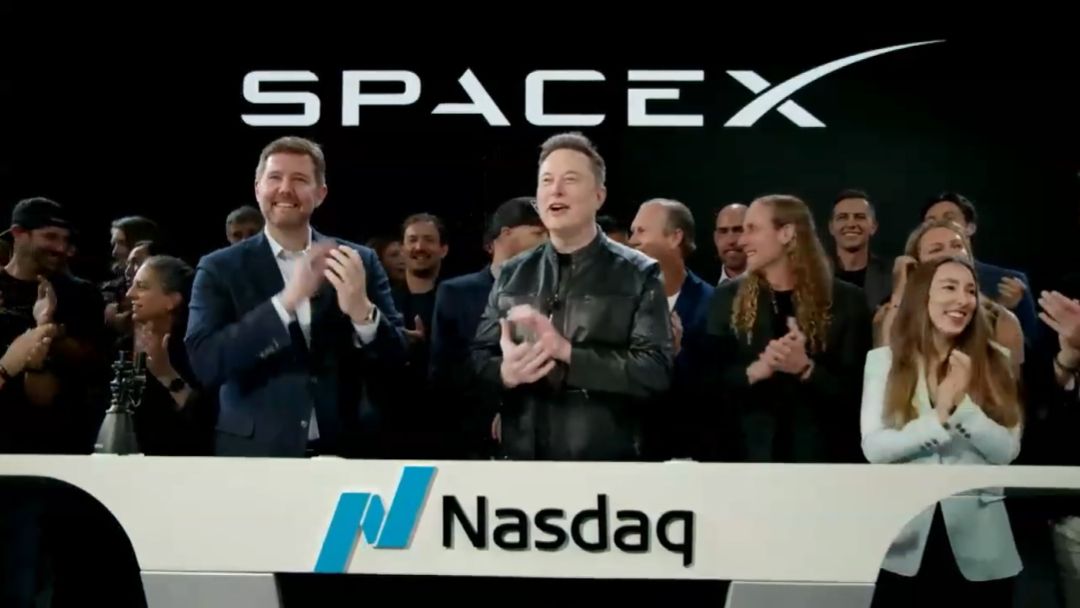
The blockbuster stock market debut of Elon Musk’s rocket company paves the way for a wave of enormous offerings that are coming from OpenAI and Anthropic.
Elon Musk’s rocket company said it would sell more than 555 million shares at $135 each in its blockbuster initial public offering, which is set to begin trading on Friday.
Two Times tech reporters and their editor talk about assessing the sky-high valuation of the rocket and satellite maker, the potential economic impact of its public debut and the role of the world’s richest man in it all.
Elon Musk’s rocket company is spending big and losing money. That has raised questions about whether it can justify its valuation for its blockbuster initial public offering.
Born in 1888, artist and illustrator Chesley Bonestell became famous for his realistic paintings of space. His work spanned decades and many formats and publications; perhaps most influential was his collaboration with Wernher von Brain on the 1952–54 Collier’s series, “Man Will Conquer Space Soon!” By making the stuff of science fiction seem achievable, his artwork helpedContinue reading "June 11, 1986: Chesley Bonestell dies"
Investors who bought the automaker’s shares in its initial public offering became rich. As a result, many have a deep faith in Elon Musk, the chief executive of Tesla and SpaceX.
When NASA added a low Earth orbit test flight to the Artemis program in February, pushing the lunar landing from Artemis 3 to Artemis 4, it left the details sparse. On Tuesday, the agency filled them in. At a press conference, NASA named the four-person crew for Artemis 3, a 2027 Earth-orbit test flight thatContinue reading "Meet the astronauts flying on Artemis 3"

 Login