 Login

SpaceX Stock Jumps 19% in Record Nasdaq Debut as Value Passes $2 Trillion
SpaceX’s $2 Trillion Nasdaq Debut SpaceX shares jumped 19% in their Nasdaq debut on Friday, lifting the company’s



In 2026, Marvel and Mattel are both releasing projects designed to capitalize on people's love for iconic animated heroes from their childhoods. Masters of the Universe has put a live-action He-Man on the big screen, and the second season of X-Men '97 is about to fling some of Charles Xavier's mutants into an apocalyptic future. Both projects were clearly made by people who love the source material, and they are similarly filled with nerdy Easter eggs meant to get hardcore fans hyped up. X-Men '97 and Masters of the Universe are both nostalgia plays, but the biggest difference between the two - and arguably the reason one of them hasn't been …
 A newly discovered genetic clock acts as the body’s developmental timekeeper, coordinating the bursts of gene activity needed for growth. Scientists found that when this clock breaks down, development comes to a halt. Think about a train sitting at a station. Passengers have boarded, conductors are checking tickets, and everything is ready to go. But [...]
 Detached sea cucumber tissue survived, healed, and grew for years in natural seawater, revealing a remarkable new model for regeneration and biomedical research. A chance observation has led scientists to a discovery that challenges one of biology’s most basic assumptions: that detached animal tissue eventually dies. Instead, researchers found that tissue removed from a sea [...]
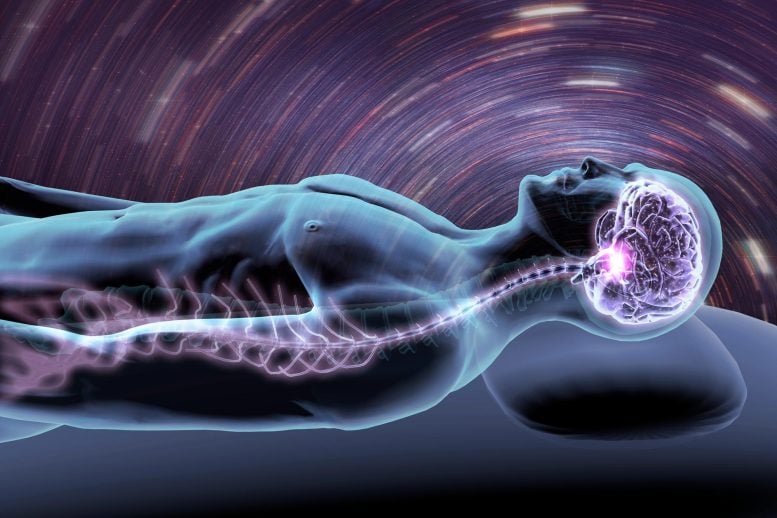 A new study suggests that reproducing a crucial sleep-like brain pattern in awake animals may help preserve memory and learning abilities. What if part of the brain could get some of the benefits of sleep without the rest of the brain ever going offline? A new NIH-funded study suggests that may be possible. Researchers found [...]



The James Webb Space Telescope (JWST) has revealed a cosmic catastrophe, as winds extinguished a star-forming galaxy in the early universe, offering new insight into earlier strange observations.
Cosmic winds may destroy entire galaxies, according to new JWST research exploring the lingering mystery of why certain parts of the universe are unexpectedly devoid of growth.
The findings were published in a recent paper in the Monthly Notices of the Royal Astronomical Society, revealing galactic-scale death in a universe just one billion years old, and potentially answering questions about previous troubling JWST observations.
Observations made by the JWST revealed cold gas, an essential star-forming material, blowing out of the CRISTAL-2 galaxy in a massive plume, severely degrading its ability to produce new stars. According to the researchers, it would take less than 50 million years for the galaxy to be completely dead if this activity keeps up, a mere blink in the scheme of a 13.8 billion-year-old universe.
Astronomers consider galaxies to be “dead” if they are no longer capable of producing fresh stars. Traditionally, astronomers expected that it would take billions of years for an old galaxy to slowly run out of fuel and burn out. However, JWST observations have continually captured events in the early universe that were not expected to occur until much later.
One of these was finding a host of dead galaxies in the early universe shortly after it first became operational in 2022. How galaxies could die so close to the beginning of the universe, without sufficient time to burn through their cold gas supplies, has long perplexed scientists.
As researchers began considering various explanations for the phenomenon, they initially settled on dark energy, essentially explaining one unknown with another. Dark energy is a theoretical substance that scientists believe drives the expansion of the universe and was once a stronger force than it is now. While the Dark Energy Spectroscopic Instrument survey revealed last year that dark energy appears to be weakening over time, an exotic galaxy-killer is not required, according to this latest research.
Instead, researchers offer a much simpler explanation of powerful cosmic winds in the remote past. Conventional thinking has it that such powerful winds could only be generated by a supermassive black hole, yet these new observations challenge that assumption.
CRISTAL-02 is a galaxy still in the making, composed of several smaller galaxies in the final stages of merging into a single system. Because the early universe was far denser than it is today, such collisions were much more common. During these mergers, gravitational forces funnel vast amounts of gas toward the galactic centers, triggering intense bursts of star formation.
Observations of CRISTAL-02 by the James Webb Space Telescope and the Atacama Large Millimeter/submillimeter Array (ALMA) revealed a star formation rate roughly twice that of similar galaxies. Ironically, this extraordinary burst of stellar activity is also generating a powerful cosmic wind that is stripping away the very gas needed to form new stars.
Compounding the effect, many of the newly formed stars rapidly exhaust their fuel and end their lives as supernovae, producing additional outflows that further deplete the galaxy’s star-forming material.
Together, these processes appear capable of shutting down star formation far more quickly than astronomers previously believed possible. Going forward, ongoing JWST observations are likely to continue challenging astronomers’ assumptions, as more evidence indicates that nearly half of the early universe’s massive galaxies were interacting—a finding which also suggests early “galactic deaths” like these may not be all that rare, after all.
The paper, “Multiphase Images of a Powerful Supernova-Driven Wind in the Early Universe,” appeared in Monthly Notices of the Royal Astronomical Society on June 10, 2026.
Ryan Whalen covers science and technology for The Debrief. He holds an MA in History and a Master of Library and Information Science with a certificate in Data Science. He can be contacted at ryan@thedebrief.org, and follow him on Twitter @mdntwvlf.
 EEG studies suggest caffeine can reduce deep, restorative sleep even when sleep duration appears normal. Its effects vary by individual, and relying on caffeine for energy may come at the cost of nighttime recovery. Evening coffee has long been debated. Some people can drink it and fall asleep with no trouble, while others struggle to [...]

 It’s not easy to tell if someone has it.
 Terror in the skies.