Login

Cobra 600: Germany’s 620mph jet drone interceptor with IRIS-T and 155-mile range
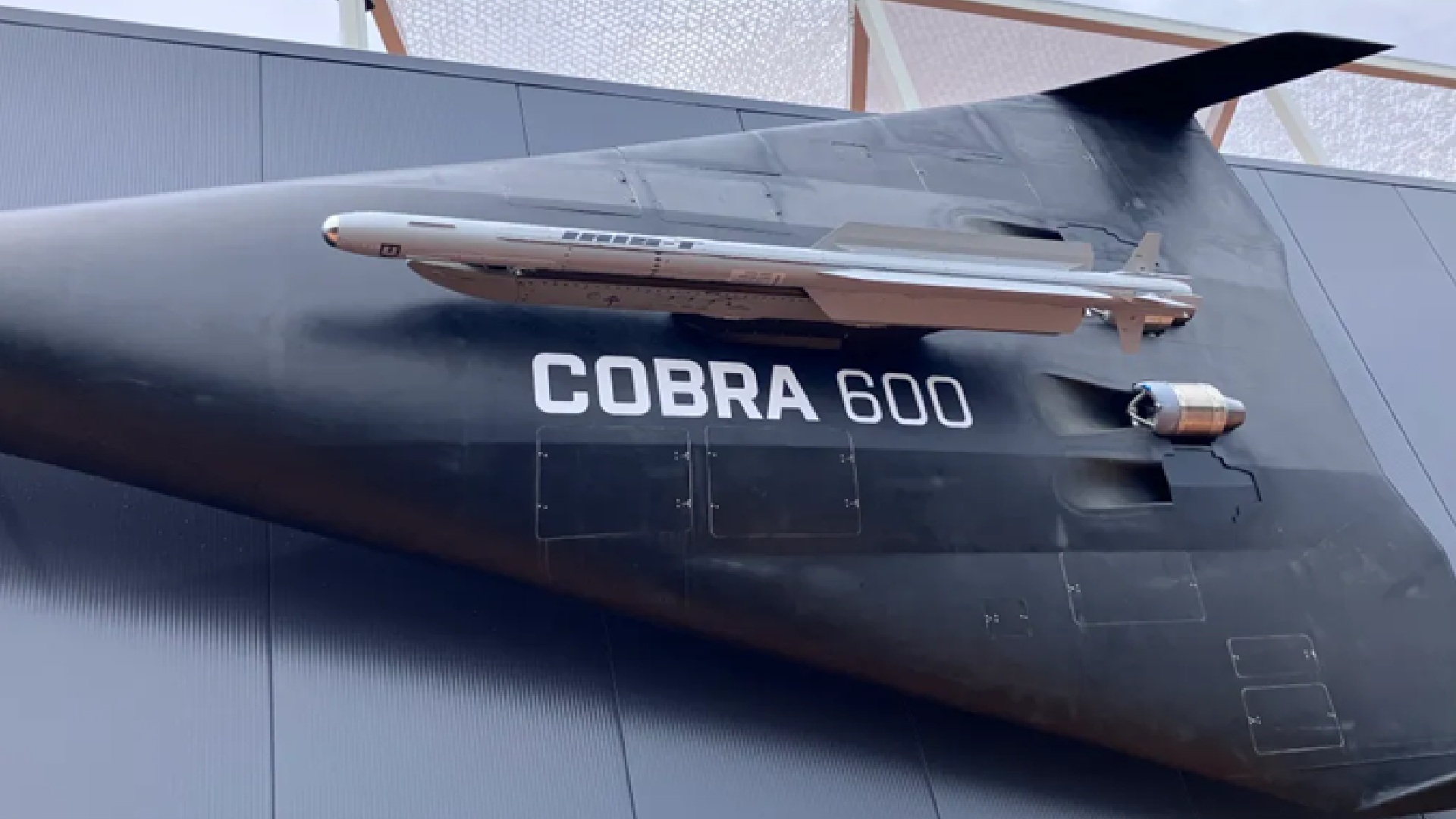
German weapon manufacturer Diehl Defence has developed a jet-powered interceptor drone called the Cobra 600, designed to carry and fire the IRIS-T short-range air-to-air missile against aerial threats including unmanned systems, cruise missiles, and low-altitude manned aircraft.
The system represents a specific response to the growing volume and diversity of airborne threats that conventional ground-based and crewed interceptors may struggle to address cost-effectively at scale.
Airframe and propulsion
The Cobra 600 is a purpose-built unmanned aerial vehicle powered by a small jet engine, giving it the speed and altitude performance needed to pursue fast-moving aerial targets. Its designation references a 600-kilogram class platform, placing it in a weight range that can accommodate meaningful payload capacity while remaining operationally agile.
The jet propulsion distinguishes it from propeller-driven loitering munitions, providing the kinetic energy necessary to reach and intercept time-sensitive targets before they close on defended assets.
The airframe integrates a single IRIS-T missile — a German-developed, infrared-guided weapon with all-aspect engagement capability and a range of several kilometers. The IRIS-T was originally designed for crewed fighter aircraft, so adapting it for autonomous drone carriage required engineering the release and guidance interfaces into a platform without a human pilot onboard.
Autonomous engagement and fire control
One of the more technically demanding aspects of the Cobra 600 concept is the fire control architecture. The drone must receive targeting data, prosecute an intercept geometry, and release the missile — either under remote operator authorization or through a higher degree of autonomous decision-making.
The precise rules of engagement and human-machine teaming protocols for such a system carry legal and ethical weight under international humanitarian law, particularly regarding the degree of human control over lethal force decisions.
The system is intended to operate within a broader integrated air defense network, receiving cueing from ground-based radars or other sensors rather than relying solely on its own onboard detection capability.
This makes the quality of the data link and network integration central to its operational effectiveness — a vulnerability if those links are jammed or spoofed by an adversary using electronic warfare.
Countering drone swarms and low-cost threats
The tactical logic behind fielding an armed interceptor drone, rather than using expensive surface-to-air missiles or diverting crewed fighters, is economic and capacity-driven.
Drone swarms and low-cost one-way attack munitions have repeatedly strained conventional air defense inventories in recent conflicts. A relatively lower-cost interceptor that can be produced and expended at volume offers a more sustainable exchange ratio against cheap threats.
That said, the Cobra 600 itself carries an IRIS-T — a missile that is not inexpensive. The cost calculus improves only if the drone airframe is significantly cheaper than a crewed interceptor sortie, or if it can successfully engage threats that would otherwise require multiple surface-to-air missile shots.
Pairing an IRIS-T with an unmanned platform also raises questions about what happens when the drone misses or the missile fails to guide — issues well understood in crewed aviation but more complex when remote human oversight is limited.
Development status and German defense context
The Cobra 600 emerges at a time when Germany is under sustained pressure to rebuild and modernize its defense industrial base following years of underinvestment. The country is a co-developer and major operator of the IRIS-T missile family, making it a logical choice for domestic integration.
According to reporting by The War Zone, the Cobra 600 concept has been publicly presented as part of Germany’s broader push to field layered air defense solutions capable of handling the evolving threat spectrum seen in contemporary conflicts.