AAS Nova launched in 2015, and what has followed since is a remarkable encapsulation of 10 years of astronomy. Today, for our 2,000th post, we’re looking back on some of the discoveries we shared in the first year of AAS Nova and how far the astronomical community has come since then.
The Solar System, Exoplanets, and Astrobiology
The very first post published on AAS Nova discussed
evidence for two planets hiding in the dusty protoplanetary disk around the star HD 100546. Protoplanetary disks are still hot topics — we’ve published almost 90 posts about them — and researchers continue to unveil new complexities like
dust traps,
crescents,
shocks,
spirals,
jets,
circumplanetary disks,
gaps, and
even more evidence for baby exoplanets blanketed with gas and dust.
Exoplanets are by far the most frequently featured topic on AAS Nova, with more than 300 posts mentioning these distant worlds. Almost exactly 10 years ago, NASA reported that the number of known exoplanets was over 1,800 — and now that number has surpassed 6,000. Researchers continue to discover planets that are smaller, colder, and found in more extreme locations than ever before (even right next door). On the habitability side of the equation, researchers continue to make headway on critical questions, such as whether the multitude of small, rocky exoplanets around M-dwarf stars are likely to have atmospheres.
Back in our solar system, the past decade has brought a bevy of firsts, such as the first measurement of the wind speed on another planet using an aircraft and the first definitive detection of water on an asteroid. Though controversial, researchers reported the first detection of phosphine in the atmosphere of Venus, a possibility that could have implications for life on our planetary neighbor but is complicated by many factors including the possible existence of active volcanoes on Venus. The search for life beyond Earth goes on, with researchers continuing to devise new ways to detect it, if it exists.
High-Energy Phenomena and Fundamental Physics
Gravitational wave astronomy started with a bang 10 years ago when the Laser Interferometer Gravitational-Wave Observatory (LIGO) first detected colliding black holes (a discovery that we covered in our first year!). Since then, LIGO, the Virgo interferometer, and the Kamioka Gravitational Wave Detector (KAGRA) have detected about 300 black hole mergers, and the explosion of gravitational wave data has enabled population-level studies of compact objects across the universe. This era also brought about the first detection of merging neutron stars, which was also studied across the electromagnetic spectrum; the first detection of a merger between a black hole and a neutron star; and the detection of mysterious objects in the “mass gap” between the lightest black holes and the heaviest neutron stars. New techniques for detecting gravitational waves have been demonstrated since they were first recorded in 2015; in 2023, international pulsar-timing collaborations around the globe announced that they’d found significant evidence for the gravitational wave background.
In 2019, AAS Nova covered the release of
the first image of a supermassive black hole. Since then, researchers have
traced the magnetic fields around a supermassive black hole and
taken a snapshot of the black hole at the center of the Milky Way. Considerable intrigue surrounds our galaxy’s central supermassive black hole, with recent research exploring
whether it had a short-lived companion in the past and
whether a collision with such a companion could explain the properties of the stars that orbit closest to our galaxy’s center.
In other high-energy astrophysics news, our ability to detect fleeting astronomical events has never been better, thanks to facilities like the Canadian Hydrogen Intensity Mapping Experiment, the Zwicky Transient Facility, and, most recently, the Vera C. Rubin Observatory. Astronomers have caught flares from stars totally, partially, and repeatedly torn apart by black holes, homed in on the host galaxies of fast radio bursts, explored the sources of gamma-ray bursts, and even discovered entirely new classes of transients. (And as a little preview of what you can expect in the next 10 years, here’s a refresher on just how much Rubin will reveal about the transient sky.)
The Sun and the Heliosphere
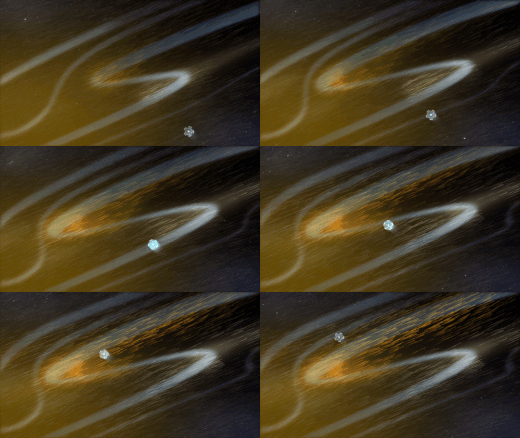
The past decade has brought remarkable data about our home star from instruments on Earth and in space. The
Parker Solar Probe and
Solar Orbiter joined the fleet of Sun-studying spacecraft in 2018 and 2020, respectively. Solar Orbiter watches the Sun from within the orbit of Mercury, while the Parker Solar Probe ventures even closer to our home star, getting within 4 million miles of the Sun’s surface and flying through its corona. From these incredible vantage points, the Parker Solar Probe and Solar Orbiter are increasing our knowledge of the Sun and capturing never-before-seen solar phenomena like
switchbacks and
Sun dots.
Ten years ago, solar physicists were tackling the tricky problem of how to forecast damaging space weather events like solar flares and coronal mass ejections. Today, that work continues, increasingly aided by machine-learning techniques that make handling mountains of solar data more tractable. (The growth of machine learning in astronomy isn’t limited to solar physics; there were only 468 peer-reviewed astronomy research articles published in 2015 that mentioned machine learning, and more than 3,400 articles mentioning machine learning were published in 2024 alone.)
Researchers have also made headway on other persistent challenges like the open flux problem, the coronal heating problem, and how to handle sparse solar data sets.
Stars and Stellar Physics
An early AAS Nova post asked if we’ve finally found Population III stars, the first stars to light up the universe. Through observations and simulations, astronomers are still asking that question, probing whether Population III stars with masses lower than 0.8 solar mass could have formed, as these low-mass stars would still be present in the universe today; whether JWST could detect Population III stars during the epoch of reionization; and whether the first stars were solely massive stars that formed alone. While the first stars themselves may still elude detection, astronomers are gaining confidence that they’ve discovered stars born from the gas enriched by just a single member of the first stellar generation, getting us closer to understanding the first stars in the universe.
Other stellar astronomy discoveries from the past decade involved stars that are less exotic than the first stars in the universe but no less exciting. Take Betelgeuse: we’ve shared
studies of its Great Dimming episode, discussed
the possibility that it’s the product of a merging binary system, and reported on
the likely detection of its long-sought-after stellar companion.
This decade also brought the discovery of double-faced white dwarfs, a turnover of the initial mass function of a star cluster, and strange brown dwarfs like “The Accident.”
Interstellar Matter and the Local Universe
There’s been plenty to learn in our cosmic backyard: researchers have discovered a potential “feather” in the Milky Way, tracked the rapid evolution of a gas cloud in the galactic center, found the faintest known satellite of our galaxy, and found evidence for structures within our galaxy that existed before it gained its disk or spiral arms. They’ve even solved the 50-year mystery of the Milky Way’s unexpectedly slow star formation.
In the space between the stars, we’ve seen many interstellar molecular firsts, like the first detection of an isomer of glycine, the simplest of the amino acids necessary for life on Earth, the first detection of ionized buckyballs, and the detection of complex organic molecules in the Large Magellanic Cloud. At the same time, other molecular breakthroughs were called into question. In addition to interstellar molecules, humanity has now also confirmed the first interstellar objects that have roamed into our solar system: 1I/ʻOumuamua in 2017, 2I/Borisov in 2019, and 3I/ATLAS in 2025.
Laboratory Astrophysics, Instrumentation, Software, and Data
Not all of astronomy happens at a telescope: lab work on Earth has shown how laboratory studies can help identify mystery spectral lines in the interstellar medium, explored how magnetic fields affect the formation of planets, and even examined the possibility of growing crops in asteroid soils.
New instruments bring new understanding of the universe, and we’ve welcomed missions like the
Imaging X-ray Polarimetry Explorer, which has made
transformative measurements of polarization from sources like X-ray binaries. On the software side, we’ve seen
updates to one of the most beloved astronomical software tools, Astropy, introduced its solar-physics counterpart,
SunPy, and described algorithms that do everything from
classify galaxies to
sort Hubble proposals.
Astronomers are concerned not just with the outcomes of their research, but also how outside factors affect their ability to do research in the first place. As the number of Earth-orbiting satellites has exploded and the sources of light pollution have continued to grow, researchers have investigated the effects of light pollution on dark-sky sites and sought to understand the impact of satellite trails and space debris on astronomical observations.
Galaxies and Cosmology
In the broader universe, researchers continue to discover galaxies that are fainter and farther away than ever before. Both ultra-diffuse galaxies and ultra-faint dwarf galaxies have been in the spotlight. JWST, which finally began observations in 2022, has provided an incredible amount of data on galaxies both near and far. JWST revealed surprisingly massive galaxies in the first few hundred million years of the universe, creating challenges for models of galaxy formation and evolution. In 2015, the record holder for most distant known object was the galaxy EGSY8p7 at a redshift of z = 8.68. A decade later, that honor goes to the galaxy MoM-z14, at a redshift of z = 14.44 — an enormous leap that demonstrates how our view of the universe has expanded.
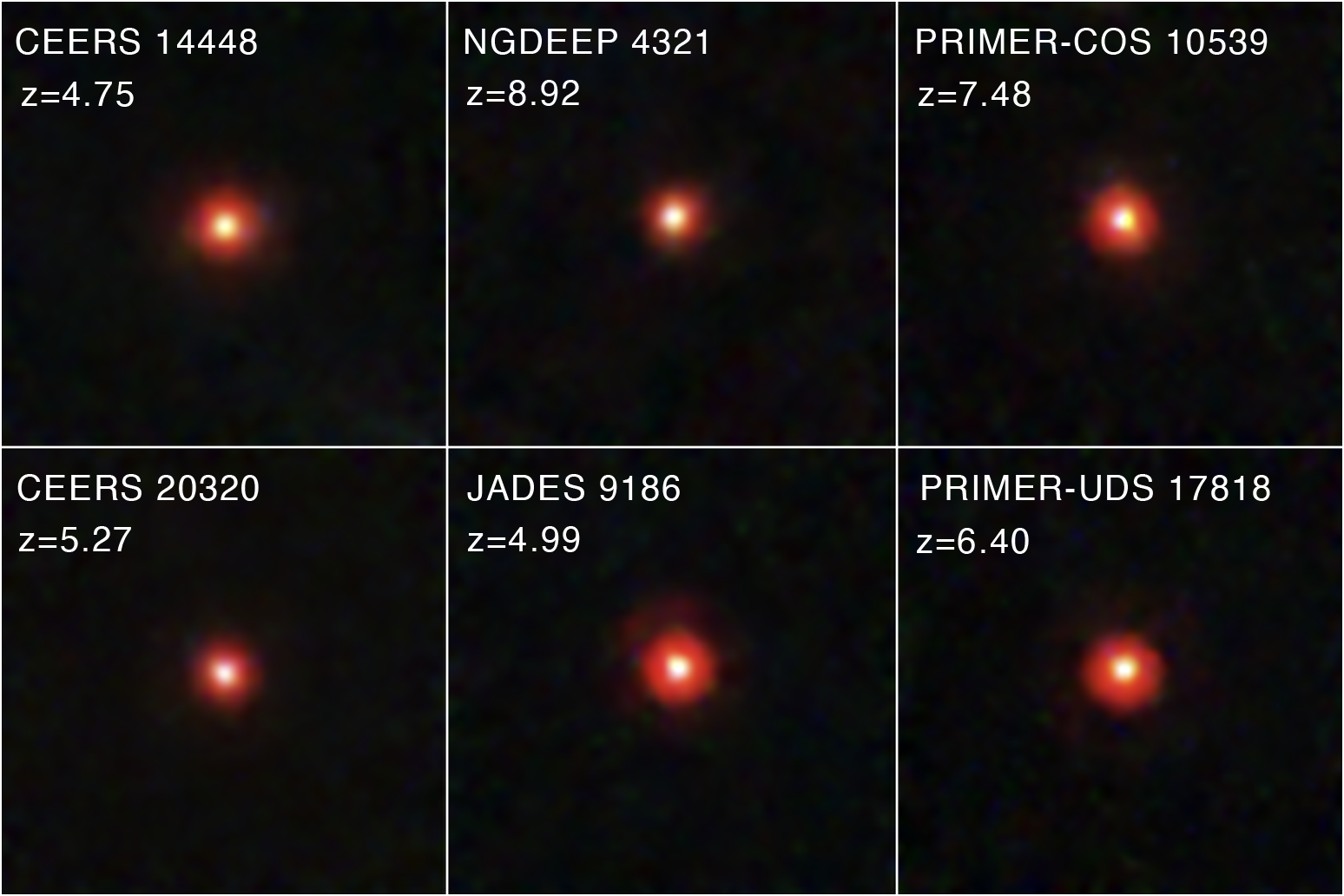
No roundup of galactic and cosmological discoveries from the past decade would be complete without a mention of little red dots: high-redshift sources spotted by JWST that are characterized by their reddish color, small sizes, and “V”-shaped spectral energy distributions. We’ve shared new developments about little red dots 10 times in the past year and a half (most recently discussing
sources that seem to require no active galactic nucleus component to explain their properties), but we’ve covered only a small fraction of the scientific discourse that surrounds them: at the time of this writing, the phrase “little red dots” appears in 122 published AAS journal articles.
On the cosmology side of things, the Hubble tension — the apparent disagreement between the universe’s expansion rate measured in the local universe and the rate extrapolated forward from early universe measurements — continues to grow. Another less-well-known tension, in measurements of the S8 or “clumpiness” parameter, has also inspired scientists to propose tweaks to our leading cosmological model. On top of all this tension, measurements from the Dark Energy Spectroscopic Instrument have provided mounting evidence that dark energy, the largest chunk of the mass–energy budget of the universe, changes over time.
Here’s to 10 More Years
In addition to sharing a curated selection of astronomy news, AAS Nova has also brought you summaries of 30 AAS, Division, and topical meetings over the past decade. When the AAS and the Astrobites collaboration formalized their partnership in 2016, we expanded our coverage of astronomy news by sharing Astrobites articles on AAS Nova. In 2017, we launched the AAS Media Fellowship, a quarter-time position that enables an astronomy graduate student to build a portfolio of writing and gain experience working in the press office. Since then, we’ve featured nearly 180 articles written by our five Media Fellows, several of whom have gone on to careers in science writing and policy. We’ve also shared news and updates from the AAS journals, including the transition to open access, the release of new versions of AASTeX, interviews with publishing staff, and the celebration of the Astronomical Journal‘s 175th anniversary.
We hope you’ll join us as we continue our efforts to bring you short, approachable summaries of recent research in astrophysics and planetary science, amplifying the reach of researchers worldwide who continue to discover what’s new in the universe.
The post AAS Nova Celebrates 10 Years of Astronomy Research News appeared first on AAS Nova.

 Login