❌

Reading view

US firm unveils 26-cell battery monitor that detects faults before batteries fail

Semiconductor maker Texas Instruments has introduced a new battery monitoring chip designed to give electric vehicles and energy storage systems earlier warning of battery failures while reducing the number of components required inside battery packs.

The company announced the BQ79826Z-Q1 on Tuesday, calling it the industry’s highest-cell-count battery monitor with an integrated electrochemical impedance spectroscopy (EIS) engine. The device is designed to provide real-time insight into battery health and detect conditions that could lead to failures such as thermal runaway.

The new monitor supports up to 26 battery cells per device, allowing engineers to track more cells with fewer monitoring chips. According to TI, the device can monitor up to 44 percent more channels than previous-generation solutions, helping reduce system complexity, board space requirements, and overall battery pack costs.

The launch comes as automakers and energy storage developers look for ways to improve battery safety, extend battery life, and lower system costs while scaling production of EVs and large-scale storage systems.

Early fault detection

A key feature of the BQ79826Z-Q1 is its integrated EIS engine. The technology measures a battery’s electrochemical behavior in real time, giving engineers a view into changes occurring inside individual cells.

“Just as an electrocardiogram (EKG) monitors the heart, EIS monitors a battery,” the Dallas-based company said in a release.

The company says the technology can identify fault conditions earlier than conventional monitoring approaches by detecting changes from within battery cells. This could help battery management systems flag safety risks before they develop into more serious issues.

“The electrification of transportation and the rapid expansion of energy storage are redefining what battery performance must deliver, and as a leader in battery management technology, TI is uniquely positioned to meet that challenge,” said Wenjia Liu, vice president and general manager of battery management systems at TI.

Liu added that the technology helps “shine a light” inside battery cells and provides chemical-state data that software can use to make real-time decisions on battery safety and performance.

Fewer chips required

Beyond safety, TI says the higher cell count could simplify battery pack architecture. By supporting 26 cells per device, the monitor can reduce the number of monitoring components needed across a battery pack.

The company claims the chip supports eight more cells than competing solutions, enabling designers to lower bill-of-material costs while maintaining reliability.

The monitor can also be paired with TI’s BQ79881-Q1 pack monitor and communications bridge, allowing developers to use the same architecture across different battery chemistries, module sizes and mechanical designs.

TI says the device delivers voltage accuracy of less than 2 mV across temperatures ranging from -40°F to 257°F. The company also claims its EIS measurements are five times faster than previous solutions, helping improve state-of-charge calculations and battery health monitoring.

The BQ79826Z-Q1 complies with Automotive Safety Integrity Level D requirements and ISO 26262 functional safety standards. TI is showcasing the technology at the Power Conversion, Intelligent Motion Expo and Conference (PCIM) 2026 in Nuremberg, Germany.

  •  

Florida Coal Plant Keeps Running Past 2025 Closure, Decade of Wildfires Erases US Air Quality Gains — Today’s Environmental Briefing for Tue, Jun 9 2026

Coal-fired power plant with smokestacks emitting steam against cloudy sky

Across the stories today, a common thread emerges: the growing tension between our rapidly expanding digital world and the natural systems struggling to sustain it. From AI data centers planned for drought-stricken regions to coal plants getting emergency extensions, we’re witnessing the collision between technological acceleration and environmental limits.

The numbers tell a stark story. Two-thirds of new AI data centers are slated for areas already grappling with water scarcity, while these facilities demand massive amounts of both electricity and cooling water. Meanwhile, Florida’s coal plant—scheduled for retirement as part of a clean energy transition—gets an emergency lifeline to keep the lights on. It’s a reminder that progress and pressure often arrive together, forcing difficult choices between immediate needs and long-term sustainability.

The day’s coverage points to growing momentum around accountability, particularly in how we fund and regulate resource-intensive industries. Australian lawmakers are pushing for fair taxation of AI infrastructure, determined not to repeat what they see as mistakes with gas exports. North Carolina legislators face their own paradox, crafting bills that simultaneously curb data center expansion while boosting fossil fuel development. These policy tensions reflect a broader reckoning: how do we harness technological progress without overwhelming the ecosystems that support us?

Yet signs of genuine environmental recovery punctuate today’s more challenging headlines. Water voles have returned to an English nature reserve after four decades, while marine protected areas now cover 10% of the world’s oceans—a significant milestone toward the 30% goal by 2030. In Sumatra’s hills, coffee farmers like Sri Atmiatun are proving that conservation and community prosperity can grow together, restoring forests while securing livelihoods through innovative social forestry programs.

Behind the numbers are real communities adapting in real time. Alaska’s fishing industry faces uncertainty as critical ocean monitoring systems face budget cuts, while Arizona’s San Carlos Lake sits closed indefinitely after drought and dam releases killed all fish life. These aren’t abstract environmental statistics—they’re disruptions to ways of life, forcing entire communities to reimagine their relationships with changing landscapes.

The financial flows reveal where power and priorities truly lie. The world’s largest banks poured a record $906 billion into fossil fuels despite climate commitments, an 8% increase that environmental researchers call “unfathomable.” Meanwhile, China launched the world’s first wind-powered underwater data center, signaling that sustainable technology infrastructure is possible when political will aligns with innovation.

Perhaps most troubling is what we’re losing while focused on these larger battles. Wildfire smoke has erased four years of air quality progress across the United States, while sea levels are now rising at twice the rate recorded just a decade ago. Scientists are racing to record forest sounds before wild spaces fall silent—a poignant reminder that some losses can’t be reversed.

The day’s stories also illuminate the gap between good intentions and effective action. Louisiana legislators unanimously approved expanding their wood pellet industry despite the bill’s sponsor admitting he knows little about the sector. FIFA appears unprepared for wildfire smoke threats at upcoming World Cup venues. These moments reveal how quickly environmental challenges can outpace institutional readiness.

As the week unfolds, all eyes will be on whether emerging solutions—from underwater data centers to marine protection expansions—can scale fast enough to match the magnitude of the challenges. The central question remains: can we innovate our way toward sustainability, or will the pace of environmental change force more fundamental reckonings with how we live and build in a resource-constrained world?

The post Florida Coal Plant Keeps Running Past 2025 Closure, Decade of Wildfires Erases US Air Quality Gains — Today’s Environmental Briefing for Tue, Jun 9 2026 first appeared on EnviroLink Network.

  •  

Emergency Order Extends Florida Coal Plant Operations Despite Planned 2025 Retirement

Emergency Order Extends Florida Coal Plant Operations Despite Planned 2025 Retirement

A Florida coal-fired power plant scheduled for closure in 2025 will continue operating under a federal emergency order, disrupting the Orlando Utilities Commission’s transition to renewable energy. The utility had planned to retire the facility as part of its commitment to achieve net zero emissions by 2050, replacing coal generation with solar and other clean energy sources.

The emergency directive cites energy supply concerns linked to a shortage of power generation facilities and the rapid expansion of data centers throughout the region. This growing digital infrastructure has significantly increased electricity demand, creating strain on the existing power grid. Data centers, which house the servers powering cloud computing and internet services, require massive amounts of continuous electricity for both operations and cooling systems.

The decision represents a setback for Florida’s clean energy goals and highlights the tension between immediate energy security needs and long-term climate commitments. The Orlando Utilities Commission ranks as the state’s second-largest municipal utility, making this coal plant extension particularly significant for regional emissions targets.

The emergency order reflects broader challenges facing the energy sector as electricity demand surges due to technological growth while utilities simultaneously work to phase out fossil fuel generation. This situation underscores the complex balancing act between maintaining reliable power supplies and meeting environmental objectives, particularly as data center development continues accelerating across the Southeast.

The post Emergency Order Extends Florida Coal Plant Operations Despite Planned 2025 Retirement first appeared on EnviroLink Network.

  •  

‘Electrify daily life’, urges Cop31 host

Third of world’s energy needs should come from electricity by 2035, says Murat Kurum, as priorities set out for this year’s UN climate summit

The world should aim to meet a third of its energy needs from electricity within a decade to cut greenhouse gas emissions, the host of the next UN climate summit has said.

While about a third of global electricity generation already comes from renewable sources, other energy-intensive sectors – chiefly transport, heating and industries – have lagged behind. Close to four-fifths of final energy still comes from fossil fuels, as a result.

Continue reading...

© Photograph: Images By Tang Ming Tung/Getty Images

© Photograph: Images By Tang Ming Tung/Getty Images

© Photograph: Images By Tang Ming Tung/Getty Images

  •  

Australian Lawmakers Push for Fair Taxation of AI Data Centers to Avoid Repeating Gas Industry Mistakes

Australian Lawmakers Push for Fair Taxation of AI Data Centers to Avoid Repeating Gas Industry Mistakes

A growing grassroots movement in Australia is demanding that technology companies pay their fair share of taxes if they plan to establish energy-intensive AI data centers across the country. The campaign draws parallels to Australia’s experience with gas exports, where critics argue the nation failed to capture adequate revenue from companies extracting and exporting natural resources.

Over recent months, tens of thousands of Australians have contacted their representatives advocating for a 25% tax on gas exports, with more than 2,200 citizens funding billboard campaigns to promote the initiative. This momentum reflects broader concerns about ensuring foreign corporations contribute appropriately to public coffers when utilizing Australia’s natural resources and infrastructure.

The debate now extends to artificial intelligence infrastructure, as tech giants eye Australia for data center expansion. These facilities require enormous amounts of electricity, water for cooling systems, and land – all drawing heavily on public resources and utilities. Environmental advocates worry that without proper taxation frameworks, Australia could repeat past mistakes where resource extraction generated substantial corporate profits while providing minimal returns to taxpayers.

Proponents argue that fair taxation of AI data centers would not only generate revenue for public services and infrastructure but also ensure that the environmental costs of these energy-intensive operations are properly accounted for. As the AI industry continues rapid expansion globally, Australia faces a critical decision about how to balance economic opportunities with fair compensation for the use of national resources.

The post Australian Lawmakers Push for Fair Taxation of AI Data Centers to Avoid Repeating Gas Industry Mistakes first appeared on EnviroLink Network.

  •  

Commercial launch providers shortlisted for China’s low-cost cargo spacecraft

A wide aerial view of a rocket launch site in a desert landscape at sunset. A tall white rocket stands vertically on a launch pad near the center-right, surrounded by service towers and low buildings. A long rectangular assembly building and crane structure sit nearby, connected by paved roads. The surrounding terrain is flat, sandy, and sparsely developed, with distant mountains visible on the horizon under a warm orange sky.

China is expanding the role of its commercial rocket companies by shortlisting four such entities for launches of a new space station cargo transport system.

The post Commercial launch providers shortlisted for China’s low-cost cargo spacecraft appeared first on SpaceNews.

  •  

World’s first wind-powered underwater datacentre starts operating in China

Datacentre off Shanghai coast uses less power and water than land-based equivalent

The world’s first wind-powered underwater datacentre has started operations off the coast of Shanghai, as China presses forwards with solutions for energy challenges created by the country’s artificial intelligence boom.

The Shanghai Lingang undersea datacentre demonstration project, which launched in May, has a capacity of 24 megawatts. It is a joint effort between HiCloud Technology and China Communications Construction, a state-owned company.

Continue reading...

© Photograph: AFP/Getty Images

© Photograph: AFP/Getty Images

© Photograph: AFP/Getty Images

  •  

Australian homes lead the world in solar. But businesses are falling behind

Australia leads world in residential solar per capita with 22GW installed but commercial and industrial sector has deployed only a quarter of that

Australia’s revolution in rooftop solar has left behind commercial and industrial buildings, where installations have lagged far behind homes, according to new analysis.

Australia leads the world in residential solar on per capita terms, with 22GW installed as of last December. But businesses have only installed about a quarter of that – 5.6GW – despite consuming more electricity than households, a report from the Institute for Energy Economics and Financial Analysis (IEEFA) has found.

Continue reading...

© Photograph: Bloomberg/Getty Images

© Photograph: Bloomberg/Getty Images

© Photograph: Bloomberg/Getty Images

  •  

If Australian data centres are going to power the AI revolution, we deserve a fair return | David Pocock

We cannot afford to make the same mistake as we did with gas. If tech companies are going to use our land, energy and water for AI, they must pay their fair share of tax

Over the past few months, tens of thousands of Australians have emailed their local MP calling for a 25% tax on gas exports. More than 2,200 people have even chipped in their own money to fund billboards promoting the idea.

Why?

Continue reading...

© Photograph: Lukas Coch/AAP

© Photograph: Lukas Coch/AAP

© Photograph: Lukas Coch/AAP

  •  

The Iran War is Forcing Energy-Importing Countries to Turn Inward

The Iran war is pushing countries to prioritize domestic energy in order to protect themselves from volatile oil and natural gas markets.

© Jes Aznar for The New York Times

The president of Solaric, a rooftop-solar installer based near Manila, said people were now seeing the technology as “a way to survive this new age.”
  •  

Dead Sloths at Florida Wildlife Facility Reveal Trade Dangers While Iowa Farmers Break Ranks on Water Regulations — Today’s Environmental Briefing for Mon, Jun 8 2026

Deceased sloth being examined by veterinary pathologist in laboratory setting

**

Across the stories today, a common thread emerges: the gap between environmental promises and practice is forcing communities to take matters into their own hands, even as powerful interests dig in their heels.

The day’s coverage points to growing momentum around local action filling spaces where larger systems have failed. In Iowa, farmer James Hepp is breaking ranks with agricultural tradition, calling for mandatory water quality standards after voluntary programs fell short on his 1,600 acres. Meanwhile, in Ghana, marine biologist Issah Seidu has convinced fishing communities to trade endangered guitarfish for giant snail farming—creating economic opportunity that doesn’t depend on depleting the ocean.

These grassroots shifts are happening against a backdrop of institutional retreat. The aviation industry quietly admitted its 2050 net-zero pledges will likely miss the mark, just five years after making them. Democratic politicians are avoiding climate messaging despite electoral benefits, a phenomenon researchers call “climate hushing.” And the Trump administration invoked wartime powers to pour $700 million into coal revival, framing fossil fuels as national security.

Yet nature itself is sending mixed signals that complicate neat narratives about environmental decline. UK waters are experiencing an unprecedented octopus population boom that’s reshaping marine ecosystems from England to Scotland. Tuna populations are showing remarkable recovery through strict international fishing regulations. But for every success story, there’s a reminder of fragility: critically endangered Chinese pangolins discovered thriving in Nepal’s community forests, or 119 sailors’ graves from 1801 now threatened by Norfolk’s rising seas.

It’s a reminder that progress and pressure often arrive together. The same regulatory changes that created UK electric vehicle loopholes will pump an extra 17 million tonnes of carbon into the atmosphere by 2030. North Carolina legislators are simultaneously curbing data centers’ massive electricity consumption while boosting fossil fuel incentives—an environmental paradox wrapped in a single bill.

Behind the numbers are real communities adapting in real time. Over 600 Thai residents just completed a 42-mile “peace walk” demanding government action on heavy metal river pollution. In the Dominican Republic, 65-year-old Leoncia Ramos wants to leave the home she’s known her entire life, fleeing gold mine pollution while Canada’s corporate watchdog office sits empty. Long Island residents in Brookhaven are discovering that decades of landfill contamination now threatens their groundwater.

These stories reveal something crucial about this environmental moment: when institutions fail or retreat, communities don’t wait. They organize marches, develop alternative livelihoods, break with traditional alliances, and demand accountability. Whether it’s Michigan’s farm training program addressing agricultural crisis through hands-on education, or Malawi’s Elephant Marsh feeding thousands while facing conservation pressures, local knowledge and local action are filling critical gaps.

The tension between extraction and protection remains fierce—Shell operated leaking Nigeria pipelines for years despite knowing the risks to mangrove forests, while Colorado opens 156,000 acres of critical wildlife habitat to oil drilling. But today’s coverage also suggests that the most durable environmental progress might be happening at smaller scales, in communities that can’t afford to wait for global agreements or corporate promises.

As the week unfolds, all eyes will be on whether these grassroots innovations can scale up fast enough to match the challenges revealed in today’s headlines.

The post Dead Sloths at Florida Wildlife Facility Reveal Trade Dangers While Iowa Farmers Break Ranks on Water Regulations — Today’s Environmental Briefing for Mon, Jun 8 2026 first appeared on EnviroLink Network.

  •  

“SpiderCam, SpiderCam, Does Whatever a Spider Can?” 3D Camera Inspired by Jumping Spider is First to Operate Below One Watt


Northwestern University engineers have unveiled an extremely energy-efficient 3D camera, called SpiderCam, inspired by how jumping spiders judge depth before making a calculated leap.

The research team behind the novel device said their technology could help engineers build wearable technologies, assistive devices, robots, drones, and other futuristic technologies that benefit from quickly and efficiently gauging their surroundings.

How Jumping Spiders Inspired Energy-Efficient SpiderCam

According to a statement announcing SpiderCam, 3D cameras typically estimate image depth in two ways. The first approach involves captured images from multiple viewpoints and comparing them, and the second involves projecting a light source, often an infrared (IR) laser, and then measuring the reflection.

Although both methods can produce realistic three-dimensional images, they can require significant computing power, additional operational energy, and often expensive hardware such as lasers.

Fortunately, millions of years of evolution have resulted in a creature that possesses a hyper-efficient way of estimating depth: the jumping spider.

“Jumping spiders jump to catch prey, to avoid predators and to get around, and that requires excellent vision,” said Northwestern’s Emma Alexander, the study’s corresponding author and an expert in bio-inspired computer vision. However, the researcher notes that their brains are extremely small, requiring the ability to calculate distances in an energy- and computationally efficient way.

According to Alexander, jumping spider eyes have multiple layers of retinas in each eye, rather than just one as in human eyes. When measuring distance, each retina focuses on an image at a slightly different distance, resulting in some images being blurrier than others.

“They see multiple levels of focus at all times,” Alexander explained. “So, they are always collecting pairs of images.”

After collecting these images in real time, the fly’s poppyseed-sized brain compares their sharpness, yielding a surprisingly accurate depth estimate, as evidenced by the creature’s ability to jump with precision.

Prototype Captures Images at Two Distances and Compares Their Blurriness

Inspired by nature’s hyper-efficient, extremely accurate depth estimation method, Alexander’s team decided to build a 3D camera using the same basic approach.

“We wanted to understand whether we could borrow some of the same principles to create an extremely energy-efficient depth sensor that could be used in resource-constrained situations where users don’t have unlimited access to power,” Alexander explained.

SpiderCam camera jumping spiders
Called SpiderCam, the new device senses depth the same way that jumping spiders judge distances before making a high-precision hop. The camera produces real-time 3D maps while consuming less than a watt of power. That’s less energy than used by a standard nightlight. Image Credit: Emma Alexander/Northwestern University.

Instead of capturing images at multiple distances, as the jumping spider’s eye does, the Northwestern team’s initial design captures two images of the same scene at different focal lengths. Next, the system uses a custom algorithm to analyze the sharpness of the edges and textures captured in each image. The team said this analysis acts as a “translator between blur and distance” in the fly’s brain, resulting in “depth measurements in real time.”

To best approximate the naturally evolved energy efficiency of a jumping spider’s eye, Alexander’s team built the algorithm directly into a customizable computer chip specifically optimized for energy efficiency called a field-programmable gate array (FPGA).

The final prototype integrating the team’s dual-lens system generates depth maps at 32.5 frames per second. Critically, it generates this level of accurate 3D maps while consuming 624 milliwatts of power. For comparison, the team notes that 624 milliwatts is “less energy than used by a standard nightlight.”

Future Versions Could be Even More Energy Efficient

Although the team said that the current version of the SpiderCam is the “first passive FPGA-based 3D camera system to operate below one watt,” they hope to improve its optics and expand its field of view. Once they have a commercial-grade version, the team hopes to integrate SpiderCam into wearable devices and small robots.

Beyond proposed applications, the Northwestern team said that they “envision” a future, ultra-energy-efficient version  of the chip capable of “bringing 3D vision to applications where conventional depth sensors are impractical.”

“I’m very interested in settings where you’re very resource constrained and can’t just plug a camera into a wall,” Alexander explained. “For example, it could be deployed in field settings with limited power.”

“Separately, I also think it’s particularly exciting for applications like augmented reality where you’re interfacing with the physical world and need to know the locations of objects around you,” the researcher added.

The study’s co-first authors, Marcos Ferreira and Tianao Li, presented this work at the Computer Vision Foundation’s Conference on Computer Vision and Pattern Recognition (CVPR) in Denver. Complimentary registration is available for members of the media.

Christopher Plain is a Science Fiction and Fantasy novelist and Head Science Writer at The Debrief. Follow and connect with him on X, learn about his books at plainfiction.com, or email him directly at christopher@thedebrief.org.

  •  

Northern Thai residents march for action on polluted rivers. ‘This is an emergency’

BANGKOK — More than 600 residents of Chiang Mai and Chiang Rai provinces embarked May 31 on a roughly 68-kilometer, six-day ‘peace walk’ to demand the Thai government take action on the river pollution crisis that has seen Thai rivers polluted with heavy metals. The ensemble of affected residents, civil society groups, monks and students marched from Tha Ton subdistrict in Chiang Mai to the city of Chiang Rai in northern Thailand, reaching their destination on June 5, World Environment Day. For more than a year, Thailand’s Pollution Control Department has reported dangerous levels of arsenic, mercury, cadmium and other heavy metals in rivers across northern Thailand, with mining operations across eastern Myanmar suspected to be responsible for the pollution. “We are walking because our rivers are slowly dying,” Pianporn Deetes, executive director of the Rivers and Rights Foundation, which helped to organize the peace walk, told Mongabay by phone. “Toxic contamination from unregulated mining upstream is already affecting water, fish, food, livelihoods, and public health. We do not want to wait until more people become sick. This is an emergency.” Pianporn said the walk (42 miles) was about taking collective action to share information, document impacts and build public pressure in a bid to force the government to address the issue, which Pianporn said has, so far, been lacking. “Monitoring has improved, but action has not matched the scale of the crisis,” she said. “We need urgent diplomatic engagement with neighboring countries, stronger health monitoring, transparency, and action to…This article was originally published on Mongabay

  •  

UK Electric Vehicle Loopholes Add 17 Million Tonnes CO2 While Coastal Erosion Threatens 200-Year-Old Sailors’ Grave — Today’s Environmental Briefing for Sun, Jun 7 2026

Electric vehicles charging at station with emissions visualization showing carbon dioxide impact

Across the stories today, a common thread emerges: the growing tension between ambitious climate goals and the messy realities of making change happen on the ground. From Colorado’s largest-ever oil lease sale to federal subsidies flowing toward aging coal plants, the gap between environmental necessity and economic momentum has rarely felt more stark.

The day’s coverage points to growing momentum around innovation, but also the persistent pull of established systems. While virtual power plants gain traction in Massachusetts and Minnesota as states seek clean energy solutions, the federal government simultaneously allocated $700 million to support the struggling coal industry through the Defense Production Act. It’s a reminder that progress and pressure often arrive together, creating policy landscapes that can feel contradictory but reflect the complex economics of energy transition.

Perhaps most telling are the stories of communities caught between these larger forces. In Colorado’s northwestern wilderness, the Bureau of Land Management is opening 156,000 acres of critical wildlife habitat — including migration corridors for the nation’s largest elk herd — to oil and gas drilling. Meanwhile, in the Dominican Republic, 450 families near the Pueblo Viejo gold mine are demanding relocation from what they describe as dangerous pollution, while Canada’s corporate watchdog office remains unstaffed and unable to respond.

These human-scale impacts reveal how environmental challenges increasingly operate across borders and timescales. The Middle East conflict now threatens global food security through fertilizer trade disruptions, while mangrove forests — nature’s carbon guardians for tens of millions of years — face existential pressure from rising seas happening faster than these resilient ecosystems can adapt.

Behind the numbers are real communities adapting in real time. In Nepal’s fertile southern plains, farmer Dhruba Prasai stands guard over his crops every night as wildlife emerges from nearby forests, highlighting the complex relationship between conservation success and agricultural livelihoods. In Norfolk, authorities must consider exhuming a 200-year-old mass grave of sailors as coastal erosion — accelerated by climate change — threatens this historic site.

Yet today’s stories also showcase remarkable resilience and ingenuity. A Kent village transformed itself into a living solar system model to inspire environmental awareness. The stunning turquoise dwarf gecko has rebounded from near-extinction thanks to trade bans and conservation efforts. Amazon communities are pioneering new models for sustainable resource management while protecting some of the world’s last intact forests.

The juxtaposition feels particularly acute in water policy, where federal officials prepare to impose Colorado River management plans if seven states can’t reach agreement, while a Labour politician calls for public ownership of Thames Water amid ongoing environmental concerns. These parallel struggles — one over scarcity, another over stewardship — underscore how water governance has become a defining issue for both climate adaptation and democratic accountability.

As the week unfolds, all eyes will be on whether the Biden administration’s mixed signals on energy policy — supporting both clean innovation and fossil fuel infrastructure — represent a pragmatic transition strategy or a failure to fully commit to climate goals. The stories emerging from frontline communities, from Nepal’s fields to Colorado’s wilderness, suggest that the window for managed, equitable change continues to narrow, making each policy choice increasingly consequential for both people and planet.

The post UK Electric Vehicle Loopholes Add 17 Million Tonnes CO2 While Coastal Erosion Threatens 200-Year-Old Sailors’ Grave — Today’s Environmental Briefing for Sun, Jun 7 2026 first appeared on EnviroLink Network.

  •  

UK Electric Vehicle Rules Weakened Despite Climate Concerns as PHEVs Loophole Creates Major Emissions Gap

UK Electric Vehicle Rules Weakened Despite Climate Concerns as PHEVs Loophole Creates Major Emissions Gap

British vehicles are projected to release an additional 17 million tonnes of carbon dioxide into the atmosphere by 2030, primarily due to regulatory changes made last year that created loopholes in the country’s electric vehicle transition rules. The staggering emissions increase stems largely from provisions that allow manufacturers to sell more plug-in hybrid electric vehicles (PHEVs) while still meeting their clean car quotas.

Environmental campaigners are now pushing back against renewed industry pressure to further weaken these electric vehicle mandates. The current rules require car manufacturers to sell increasing percentages of electric vehicles each year, designed to accelerate the UK’s transition away from fossil fuel-powered transportation. However, automotive industry representatives are lobbying for a second round of regulatory rollbacks, arguing the targets are too aggressive.

The 17 million tonne emissions gap represents a significant setback for the UK’s climate goals, equivalent to the annual carbon footprint of several million households. Critics argue that the PHEV loophole undermines the environmental benefits these policies were meant to deliver, as plug-in hybrids still rely heavily on gasoline engines and often operate in conventional mode rather than electric-only driving.

This development highlights the ongoing tension between automotive industry concerns about market readiness and environmental advocates pushing for more aggressive decarbonization timelines. As the UK works toward its net-zero commitments, the effectiveness of current electric vehicle policies remains under intense scrutiny from both climate scientists and industry stakeholders.

The post UK Electric Vehicle Rules Weakened Despite Climate Concerns as PHEVs Loophole Creates Major Emissions Gap first appeared on EnviroLink Network.

  •  

Federal Agency Opens 156,000 Acres of Colorado Wildlife Habitat to Oil and Gas Drilling in Largest Modern Land Sale

Federal Agency Opens 156,000 Acres of Colorado Wildlife Habitat to Oil and Gas Drilling in Largest Modern Land Sale

The Bureau of Land Management will lease 156,000 acres of northwestern Colorado wilderness to oil and gas companies in what marks the state’s largest such sale in modern history. The land sale encompasses critical migration corridors and winter habitat for the nation’s largest elk herd, along with habitat for pronghorn and mule deer that extends into southern Wyoming.

Located primarily in Moffat County—known as the “Elk Hunting Capital of the World”—about two-thirds of the acreage sits just south of Dinosaur National Monument, one of only 40 certified International Dark Sky Places in the country. Tourism officials worry that the bright lights and heavy truck traffic associated with fossil fuel extraction could jeopardize this prestigious designation and harm the local economy that depends on hunting and dark-sky tourism.

The lease sale directly contradicts recent habitat protection strengthening measures and puts at risk 17 rare plants and endangered species, including black-footed ferrets, wolverines, boreal toads, and Colorado pikeminnow. Conservation groups compiled evidence showing that species of special concern—including Columbian sharp-tailed grouse, greater sage-grouse, and swift fox—could face significant habitat disruption.

This sale represents one of four large Colorado lease offerings mandated by recent federal legislation that requires minimum lease sales across nine western states while reducing royalty rates and shortening public comment periods. The policy shift stands in stark contrast to previous years when only several hundred acres were offered annually, and comes despite polling showing a majority of western voters prefer conservation over energy development on public lands.

The post Federal Agency Opens 156,000 Acres of Colorado Wildlife Habitat to Oil and Gas Drilling in Largest Modern Land Sale first appeared on EnviroLink Network.

  •  

Monthly Roundup: Updates on Three Notable Transients

AT 2024wpp

Across the universe and across the electromagnetic spectrum, flares, bursts, and waves are making their mark on the sky. Today, we’re giving an update on three exceptional transients that have been discussed previously on AAS Nova: AT 2024wpp, GRB 250702B, and GW231123.

The Most Luminous Known Fast Blue Optical Transient, AT 2024wpp

Discovered in September 2024, AT 2024wpp burst onto the scene as the most luminous example of a fast blue optical transient (FBOT) — a growing class of events that are more luminous, more rapidly evolving, and bluer than supernovae. In October 2025, astronomers published their findings on AT 2024wpp’s X-ray and radio evolution. Just last month, a research team led by Natalie LeBaron (University of California, Berkeley) described the results of a complementary investigation of the transient’s ultraviolet, optical, and near-infrared behavior.
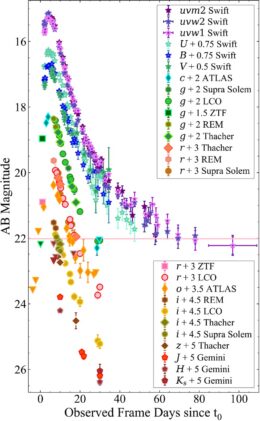
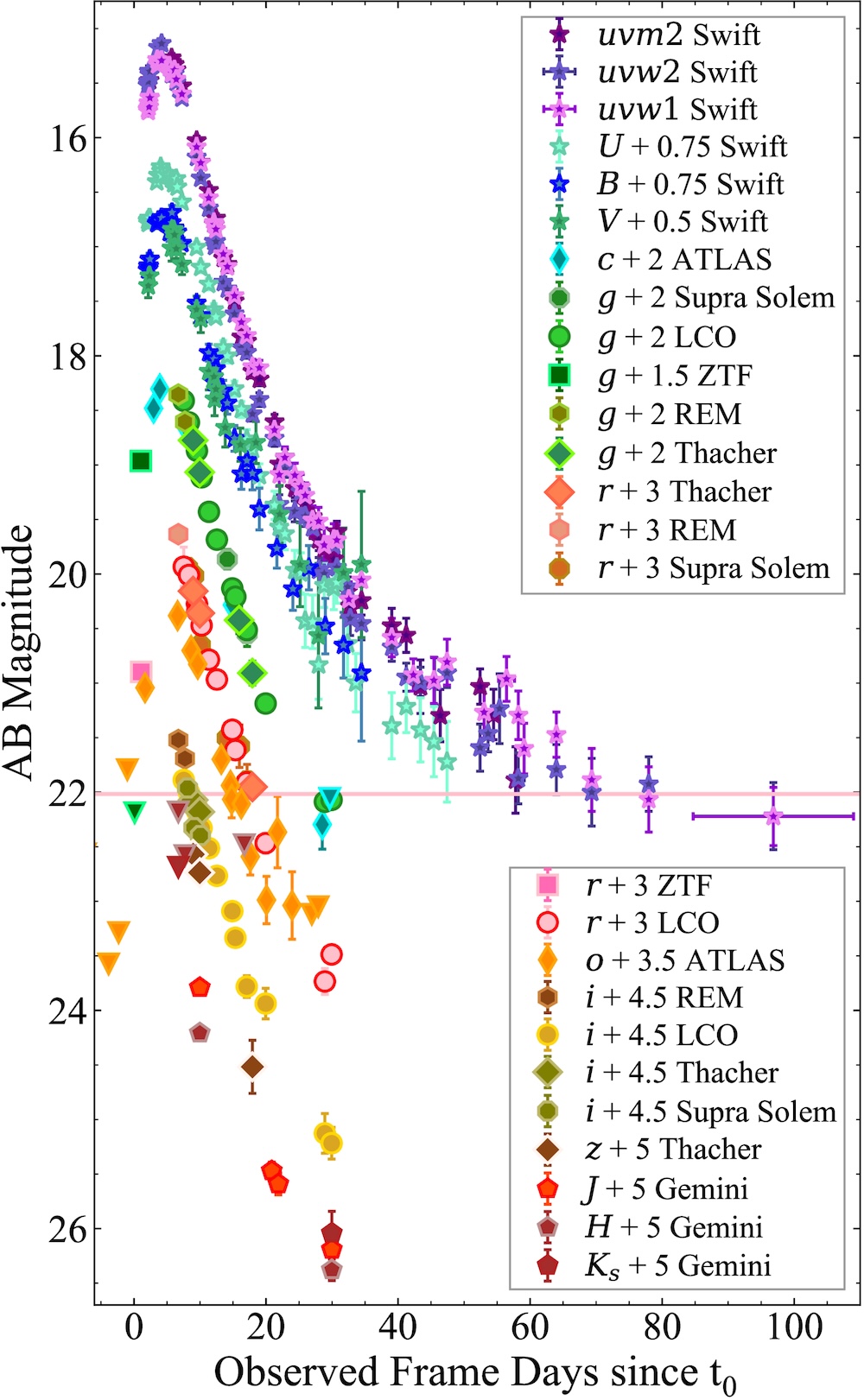
AT 2024wpp light curves

The ultraviolet through infrared light curve of AT 2024wpp. Results from different filters are offset vertically for clarity. [LeBaron et al. 2026]

LeBaron and collaborators collected ultraviolet through infrared photometry as well as optical and infrared spectroscopy to characterize the event. These efforts led to the first-ever collection of ultraviolet data during the rising period of an FBOT. Overall, the data reveal an almost featureless spectrum from the optical through the near-infrared and a persistent, weeks-long thermal continuum, both of which seem to be common for FBOTs.

The observations point to a luminous central energy source that continuously injects energy into its surroundings, powers multiple outflows, and ionizes the ejected material. These features can be explained by the rapid accretion of material by a neutron star or a black hole, in which the accreted material forms a disk and is ejected in both a fast-moving polar outflow and a slower-moving equatorial outflow.

Though the exact nature of the central object powering AT 2024wpp’s intense radiation isn’t known — the extreme luminosity of this event points to a stellar-mass black hole as the central object, but a neutron star cannot be ruled out — the overall picture of this event matches what has been found for previous FBOTs. Upcoming instruments and surveys will discover more FBOTs and spot them earlier in their evolution, transforming our understanding of these rare transients.

An Ultra-Long X-Ray and Gamma-Ray Transient, GRB 250702B

GRB 250702B is an exceptional gamma-ray burst: an intense flash of gamma rays lasting anywhere from a few milliseconds to several hours. GRB 250702B is unprecedented among events in this class because it features several bursts arising over the course of roughly 7 hours, plus X-ray precursor emission going back 24 hours before discovery. We’ve previously covered JWST follow-up observations of GRB 250702B, and today we’re taking a look at its high-energy evolution.

Swift and Chandra observations of GRB 250702B

Swift (black circles) and Chandra (blue circles) observations of GRB 250702B. Click to enlarge. [Adapted from O’Connor et al. 2025]

Brendan O’Connor (Carnegie Mellon University) and collaborators collected observations of GRB 250702B from the Neil Gehrels Swift Observatory, the Nuclear Spectroscopic Telescope Array (NuSTAR), and the Chandra X-ray Observatory, stretching from just half a day after the transient was discovered to 65 days later. The team aimed to determine whether GRB 250702B fit the profile of an ultra-long gamma-ray burst accompanying a star’s collapse into a black hole or a relativistic tidal disruption event, in which a star is ripped apart by a massive black hole.

O’Connor’s team found that GRB 250702B didn’t fit neatly into either category. While many of the event’s properties closely resembled those of ultra-long gamma-ray bursts, the hours-long gamma-ray emission and the precursor X-ray emission were outliers. Certain features are more easily reconciled with the tidal disruption of a main-sequence star by an intermediate-mass black hole, but others are similarly hard to account for. Finding the smoking gun for a tidal disruption event — an abrupt shutoff to the X-ray emission — will require long-term X-ray monitoring.

Because GRB 250702B has features that align with both ultra-long gamma-ray bursts and tidal disruption events, O’Connor and coauthors proposed scenarios that combine aspects of both possibilities: either a stellar-mass black hole tidally disrupting a star or the merger of a helium star with a stellar-mass black hole.

The Most Massive Gravitational Wave Source, GW231123

When compact objects like neutron stars and black holes merge, their collisions produce ripples in spacetime that are accessible to detectors on Earth. One of the most exciting events so far from the fourth gravitational wave transient catalog is GW231123, which appears to be caused by the merger of two black holes, each at least 100 times the mass of the Sun. The LIGO, Virgo, and KAGRA (LVK) collaborations reported a total mass of 238 solar masses for the event, which would make it the most massive binary black hole merger yet observed.

In a recent article, Ilya Mandel (Monash University and OzGrav) urged caution when interpreting seemingly extreme events like GW231123. Mandel’s argument is a statistical one, highlighting how certain aspects of the Bayesian techniques used to estimate GW231123’s mass could have skewed that estimate toward an artificially high value.
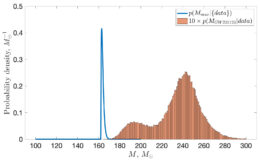
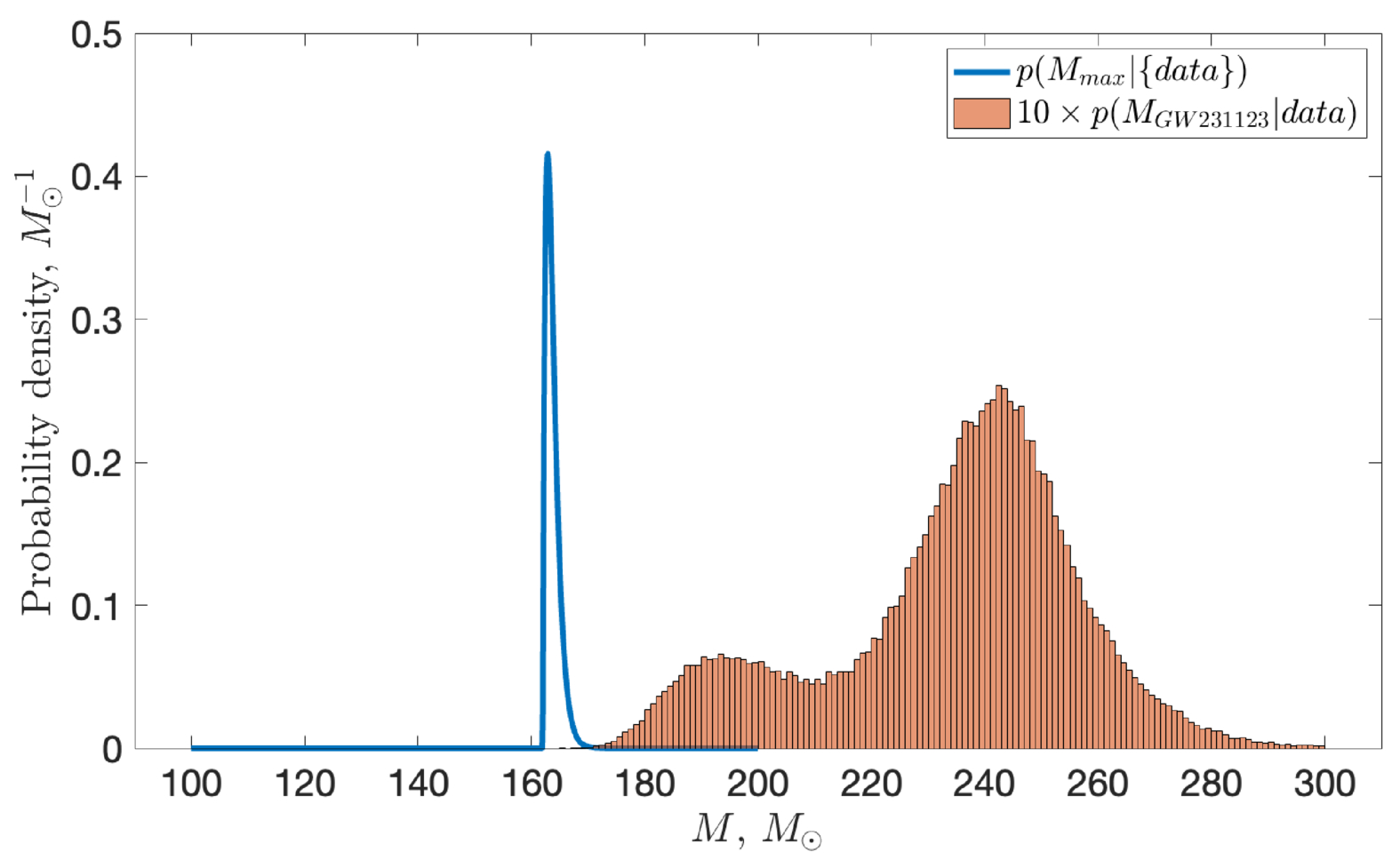
posterior probability distributions for maximum mass of GW231123 and all gravitational wave events seen by LVK

The posterior probability distribution on the maximum mass as derived from the total LVK catalog (blue), compared to the posterior for GW231123 (orange; multiplied by 10 for visibility). Click to enlarge. [Mandel 2026]

In general, Mandel points out, events that appear extreme are simply more likely to be statistical fluctuations. As an example, consider a large group of people having their heights measured, but with very large measurement uncertainties. The highest reported height in this situation is likely to be associated with a reasonably tall person whose height had a large upward measurement error, not necessarily someone who is exceptionally tall. Similarly, the reported most massive gravitational wave source is likely not quite as massive as claimed.

Mandel also demonstrated how considering the population of black hole mergers detected by LVK as a whole can provide a different perspective on GW231123’s likely mass. By analyzing this entire sample together, Mandel showed that the maximum mass for the population of merging black holes appears to be considerably lower than the mass estimated for GW231123, again raising the possibility that the true mass of the event is lower than the current estimate.

Ultimately, Mandel pointed out that at present it’s impossible to distinguish between three possibilities: that GW231123 is a true outlier among the population of merging black holes, representing a member of a new, unexplored population; that it’s a member of the same population as other black hole mergers seen by LVK but inhabits an extreme high-mass tail; or its high mass estimate is a statistical artifact.

Citation

“The Most Luminous Known Fast Blue Optical Transient AT 2024wpp: Unprecedented Evolution and Properties in the Ultraviolet to the Near-Infrared,” Natalie LeBaron et al 2026 ApJL 997 L10. doi:10.3847/2041-8213/ae2910

“Comprehensive X-Ray Observations of the Exceptional Ultralong X-Ray and Gamma-Ray Transient GRB 250702B with Swift, NuSTAR, and Chandra: Insights from the X-Ray Afterglow Properties,” Brendan O’Connor et al 2025 ApJL 994 L17. doi:10.3847/2041-8213/ae1741

“What Is the Most Massive Gravitational-Wave Source?” Ilya Mandel 2026 ApJL 996 L4. doi:10.3847/2041-8213/ae278d

The post Monthly Roundup: Updates on Three Notable Transients appeared first on AAS Nova.

  •  

Do Black Hole Flares Generate Neutrinos?

illustration of a tidal disruption event

Where do the mysterious cosmic messengers called neutrinos come from? Researchers search for a connection between neutrinos and accretion flares from black holes.

Seeking Connections

A photograph of the IceCube Neutrino Observatory

The IceCube Laboratory at the Amundsen-Scott South Pole Station in Antarctica. [Felipe Pedreros, IceCube/NSF]

Neutrinos — neutral, nearly massless elementary particles — are generated by natural particle accelerators across the universe. Facilities like the IceCube Neutrino Observatory, which employs detectors buried a mile deep in Antarctic ice, spot neutrinos from distant astrophysical sources, but matching these neutrinos to their sources is no easy task.

Thus far, researchers have discovered a compelling connection between neutrinos and distant active galactic nuclei, which are powered by the accretion of gas onto supermassive black holes. The active galactic nucleus phase of a black hole tends to be long lived, with activity lasting hundreds of thousands of years or more, making these nuclei lasting sources of neutrinos.

Sampling Flares

Recently, researchers have found tentative evidence for coincident neutrinos from short-lived accretion events like tidal disruption events, in which a star is torn apart and accreted by a black hole. These studies have uncovered a potential connection between neutrinos and tidal disruption events with mid-infrared echoes, signaling the presence of obscuring dust.

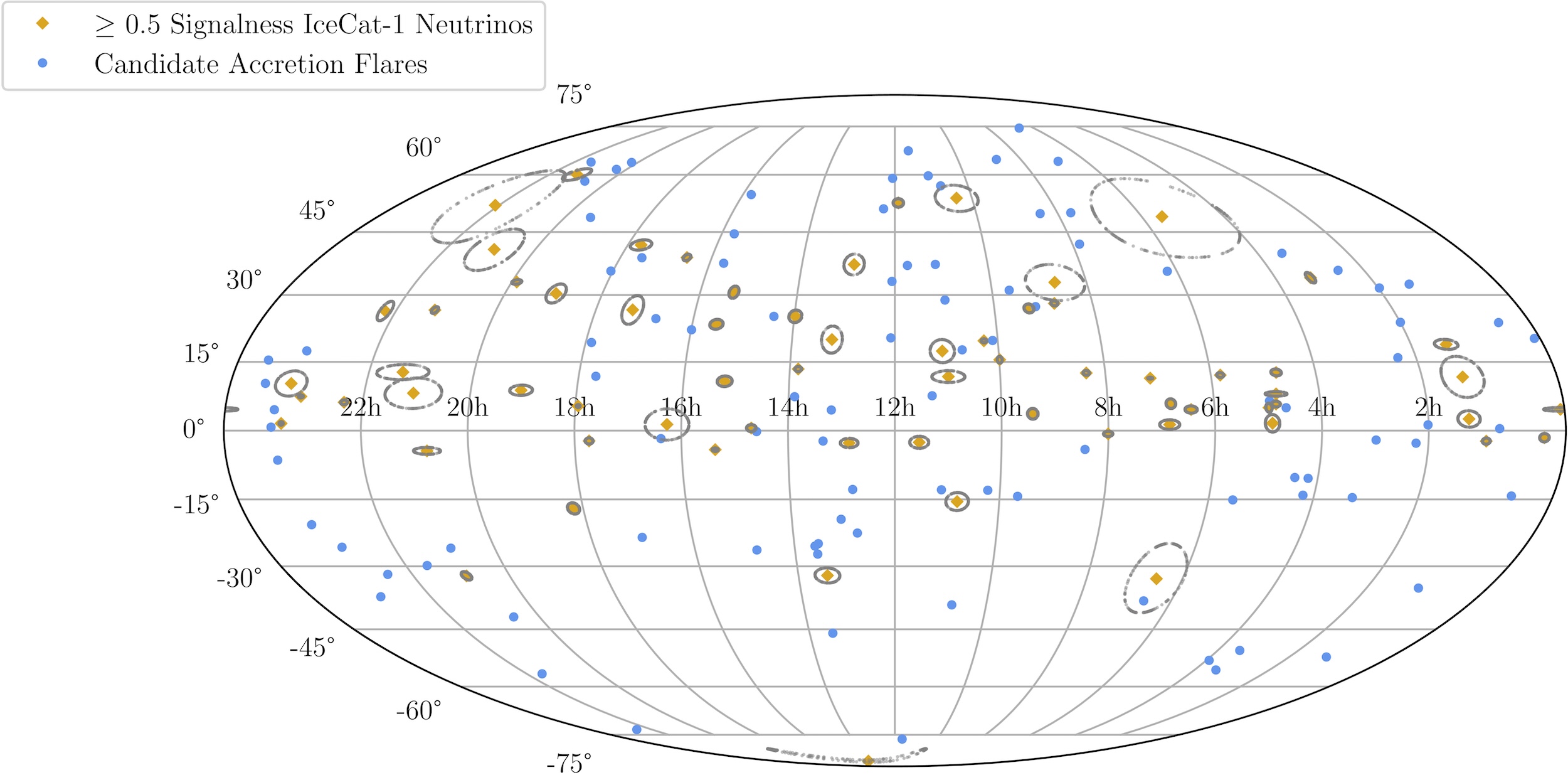
map of sampled black hole flares and neutrinos

A map of the locations of the neutrinos (yellow diamonds) and black hole flares (blue circles) on the sky. Click to enlarge. [Wang et al. 2026]

To investigate whether there is any connection between neutrinos and short-lived accretion events, Megan Wang (Massachusetts Institute of Technology) and collaborators first compiled a sample of 99 black hole flares observed by NEOWISE. These flares were selected for their strong mid-infrared emission, location in the nuclei of galaxies, and a fast rise and slow decline. The team applied additional selection criteria to remove other bright transients, such as supernovae, and retain only tidal disruption events and active galactic nucleus accretion flares.

For the neutrino side of the equation, Wang’s team turned to IceCube’s most recent catalog of neutrino events from astrophysical sources. In total, they compiled a sample of 68 events for which the odds of the source being astrophysical was greater than 50%, and for which the directional uncertainty was below 50.

No Coincidences

For a flare and a neutrino to be considered spatially and temporally coincident, the neutrino must arrive within one year of the flare, and the flare must fall within the 90% certainty contours of the neutrino. Ultimately, Wang’s team found no neutrinos that fulfilled both criteria and only one that was spatially but not temporally coincident with a black hole flare.

This result appears to be at odds with previous studies that found several neutrinos that were coincident with tidal disruption events. Wang and collaborators noted that while this work finds no association between neutrinos and black hole flares, it’s possible that the team is studying a different population of accretion events.

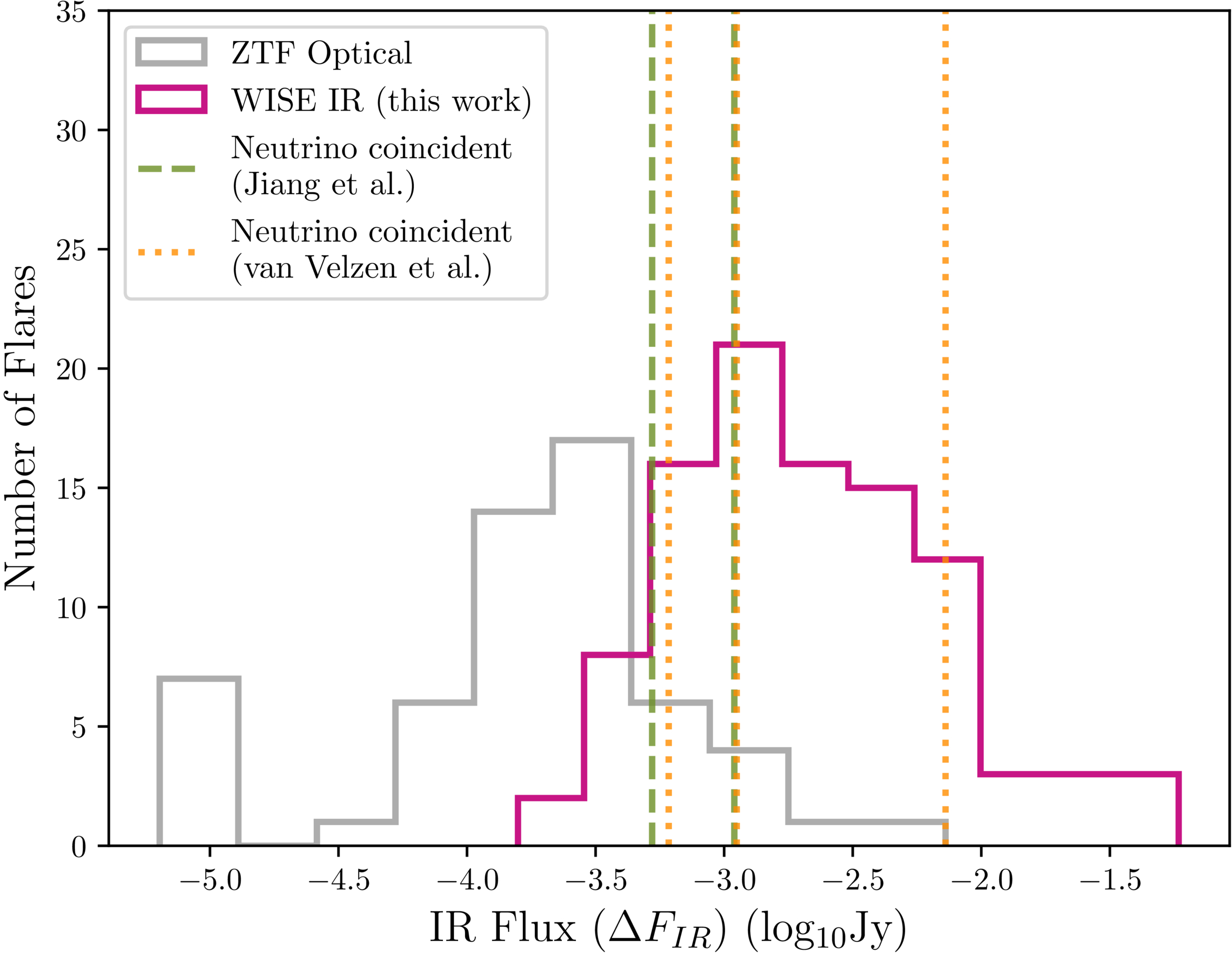
infrared fluxes of black hole flares

Infrared fluxes of the flares sampled in this study (magenta), optically identified flares (gray), and the tidal disruption events thought to have coincided with neutrino detections (green and gold dashed lines). [Wang et al. 2026]

For example, while the previous neutrino-associated flares were flagged for having strong mid-infrared emission, they differ from the current sample in that they were detected at optical wavelengths. The flares sampled in this work were detected in the mid-infrared and have little to no optical emission, potentially highlighting intrinsic differences compared to previous samples.

Future work, including studies that leverage upcoming datasets from the Vera C. Rubin Observatory, the Roman Space Telescope, and the NEO Surveyor, can address this question further and search for connections with specific populations of black hole flares.

Citation

“Testing the Association of Supermassive Black Hole Infrared Flares and High-Energy Neutrinos,” Megan Wang et al 2026 ApJL 998 L29. doi:10.3847/2041-8213/ae3f90

The post Do Black Hole Flares Generate Neutrinos? appeared first on AAS Nova.

  •  
❌