❌

Reading view

Gemini 3.5 and Antigravity come to Google NotebookLM

Google's NotebookLM was one of the company's first forays into generative AI technology, and in un-Googley fashion, it hasn't been shut down yet. In fact, NotebookLM is getting one of its biggest updates, ever, today, moving to the latest Gemini 3.5 model, support for more file types, and streamlined web source integration. Google also says NotebookLM will be able to do more with all those queries thanks to embedded support for Antigravity.

Gemini 3.5 Flash debuted at Google I/O this year, promising much faster and more efficient processing. Google has claimed that companies worried about token costs can save big by moving their projects to the new Flash model while also getting outputs that are of similar or better quality. Those improvements are now filtering down to other Google products. NotebookLM, which launched in 2023 at the very beginning of the AI boom, lets you analyze specific sources like documents and webpages with Google's latest AI models.

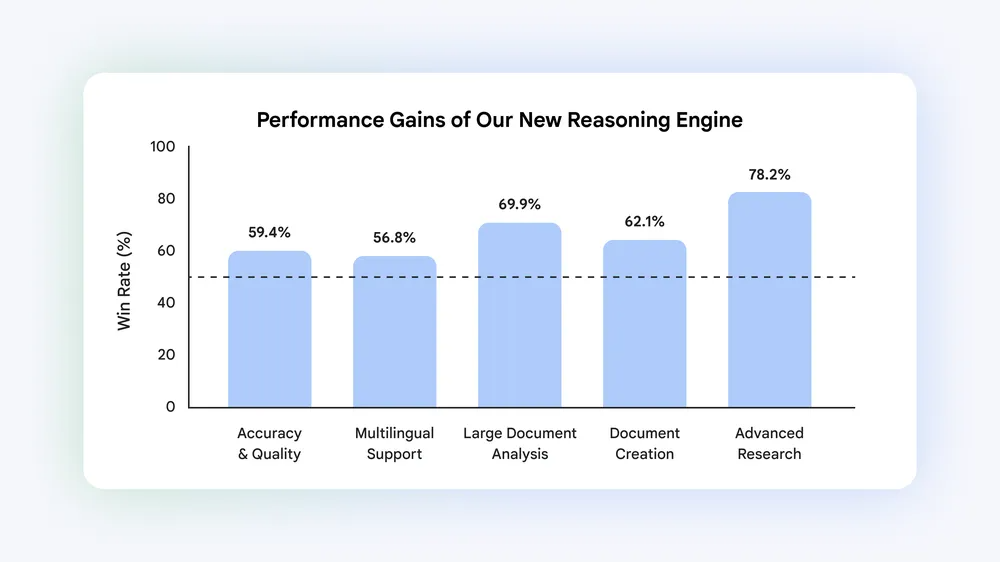
NotebookLM evaluation graph The upgraded NotebookLM beats the old version in all of Google's "core evaluation dimensions." Credit: Google

Google conducted side-by-side evaluations of NotebookLM on the old Gemini 3.1 branch and with the updated 3.5. The company is being somewhat vague about the nature of the tests, breaking things up into "top five core evaluation dimensions," which are Accuracy and Quality, Multilingual Support, Large Document Analysis, Document Creation, and Advanced Research. In these tests, Google says NotebookLM averaged a 65 percent win rate versus the older model.

Read full article

Comments

© Google

  •  

Apple's iOS 27, macOS 27 Golden Gate, and other updates focus on refinement

Apple has taken the wraps off of its next-generation operating system updates at its Worldwide Developers Conference today, including iOS 27, iPadOS 27, and macOS 27 Golden Gate. And while the long-awaited Siri AI update is the headliner, Apple also emphasized its efforts to optimize its software, improving its performance and reliability.

For starters, the company is continuing to refine the Liquid Glass design language that it introduced last year. A slider in the Settings will allow users fine-grained control over the translucency of the Liquid Glass effect, ranging from maximally transparent and glassy to fully tinted. Last year's redesigned icons are also being re-redesigned with more glass layers, which Apple says will make them sharper and more distinctive.

On macOS, Apple has also changed the way app toolbars and sidebars work, making toolbars more distinct, making the contents of sidebars extend all the way to the edge of the window, and reintroducing color to sidebar icons. Mac windows are also getting a "tighter corner radius," to address complaints about the way window resizing works in macOS 26 Tahoe.

Read full article

Comments

© Apple

  •  

Big tech faces UK child safety ultimatum

The UK government gave technology companies three months to switch on device-level tools blocking children from taking, sending or viewing nude images, warning action will be taken if they fail to do so.

The UK Home Office said companies including Apple and Google must implement built-in protections across smartphones and tablets used by children in a move it claimed would make Britain “the first country in the world where it is impossible for children to take, share or view naked pictures on their devices”

If tech companies do not act within the deadline, the government plans to enforce legislation mandating the activation of the technology. Proposed penalties could include fines, with criminal liability for tech bosses under consideration “as a last resort”.

On privacy, the government framed the proposal as on-device blocking, stating there would be “no data collection, no monitoring and no reporting”. Users over the age of 18 would still be able to access adult content by providing proof of age.

The initiative aims to stop predators from exploiting underage victims through their devices and limiting children’s access to pornography. The Home Office noted 91% of online child sexual abuse reports recorded in 2024 contained self-generated content, adding children as young as five were being groomed or coerced into creating explicit images.

Speaking at London Tech Week, Prime Minister Keir Starmer (pictured) said the industry must address the issue as a matter of urgency. “If we are serious about unlocking the opportunities that tech can bring, then we must also be serious about preventing our children from those who look to abuse it – the online predators,” he explained, arguing technology should “adapt to the needs of society, not the other way round”.

Starmer warned if technology players “choose not, then we will act and we will change the law”.

The post Big tech faces UK child safety ultimatum appeared first on Mobile World Live.

  •  

AT&T scales cloud RAN as open RAN swap passes 50%

Interview: AT&T completed a controlled introduction phase of its cloud RAN deployment, with roughly 25 sites running live traffic on Intel’s Sapphire Rapids processors as it plans to aggressively scale deployment when Intel’s next-generation Granite platform arrives over the coming months.

The Sapphire deployment is currently handling the TDD layers of the network, which represent the largest share of traffic, but not yet the full stack.

Rob Soni (pictured), VP of the operator’s RAN architecture, told Mobile World Live (MWL) Granite, which is already in AT&T’s labs, will enable a full stack covering FDD, TDD, NR and LTE from a single server design.

“This is all coming in phased pieces through the fall and early next year,” he said. “We plan to scale more aggressively on Granite than we did on Sapphire.”

He said AT&T expects to move from a few hundred Sapphire sites to thousands on Granite through 2026 and into 2028.

Performance on the Sapphire sites is matching traditional RAN on call drop rates and throughput, Soni said, and the team is beginning to utilise the platform’s promise of faster feature delivery.

The leading example is AI-driven link adaptation, developed with Ericsson, which replaces rules-based scheduling algorithms with a deep neural network.

Trials are showing roughly 10% gains in spectrum efficiency and 15% improvements in individual user throughput, with further benefits expected as AT&T tunes the global Ericsson model to its own network morphology.

“We’ve done a lot of trailing with the kind of global model of Ericsson,” Soni explained. “We’re now in the process of tuning the model to the AT&T morphology, the AT&T usage. That will change the nature, and we expect there to be more gain.”

Halfway point

In cellular networks, Soni stated a base station must determine on every transmission frame which users to serve, what modulation and coding scheme to use and how to balance competing demands across the spectrum.

It is a computationally intense optimisation problem, and the traditional approach has been to encode engineering judgment into static rule sets. The AI model Ericsson developed learns from network behaviour and adapts more fluidly to changing conditions.

Link adaptation is a critical algorithm for determining the overall multiple user performance in a cellular network,” he stated.

Rival T-Mobile US stated in May 2026 it is also trialling Ericsson’s AI-native scheduler with link adaptation on live 5G-Advanced traffic, but Soni noted AT&T has been trialling it since December 2025.

Soni told MWL AT&T is just past the halfway point for switching out Nokia’s RAN gear for Ericsson’s as part of a five year plan to transition 70% of its network traffic to run on open platforms by end of year.

The post AT&T scales cloud RAN as open RAN swap passes 50% appeared first on Mobile World Live.

  •  

“SpiderCam, SpiderCam, Does Whatever a Spider Can?” 3D Camera Inspired by Jumping Spider is First to Operate Below One Watt


Northwestern University engineers have unveiled an extremely energy-efficient 3D camera, called SpiderCam, inspired by how jumping spiders judge depth before making a calculated leap.

The research team behind the novel device said their technology could help engineers build wearable technologies, assistive devices, robots, drones, and other futuristic technologies that benefit from quickly and efficiently gauging their surroundings.

How Jumping Spiders Inspired Energy-Efficient SpiderCam

According to a statement announcing SpiderCam, 3D cameras typically estimate image depth in two ways. The first approach involves captured images from multiple viewpoints and comparing them, and the second involves projecting a light source, often an infrared (IR) laser, and then measuring the reflection.

Although both methods can produce realistic three-dimensional images, they can require significant computing power, additional operational energy, and often expensive hardware such as lasers.

Fortunately, millions of years of evolution have resulted in a creature that possesses a hyper-efficient way of estimating depth: the jumping spider.

“Jumping spiders jump to catch prey, to avoid predators and to get around, and that requires excellent vision,” said Northwestern’s Emma Alexander, the study’s corresponding author and an expert in bio-inspired computer vision. However, the researcher notes that their brains are extremely small, requiring the ability to calculate distances in an energy- and computationally efficient way.

According to Alexander, jumping spider eyes have multiple layers of retinas in each eye, rather than just one as in human eyes. When measuring distance, each retina focuses on an image at a slightly different distance, resulting in some images being blurrier than others.

“They see multiple levels of focus at all times,” Alexander explained. “So, they are always collecting pairs of images.”

After collecting these images in real time, the fly’s poppyseed-sized brain compares their sharpness, yielding a surprisingly accurate depth estimate, as evidenced by the creature’s ability to jump with precision.

Prototype Captures Images at Two Distances and Compares Their Blurriness

Inspired by nature’s hyper-efficient, extremely accurate depth estimation method, Alexander’s team decided to build a 3D camera using the same basic approach.

“We wanted to understand whether we could borrow some of the same principles to create an extremely energy-efficient depth sensor that could be used in resource-constrained situations where users don’t have unlimited access to power,” Alexander explained.

SpiderCam camera jumping spiders
Called SpiderCam, the new device senses depth the same way that jumping spiders judge distances before making a high-precision hop. The camera produces real-time 3D maps while consuming less than a watt of power. That’s less energy than used by a standard nightlight. Image Credit: Emma Alexander/Northwestern University.

Instead of capturing images at multiple distances, as the jumping spider’s eye does, the Northwestern team’s initial design captures two images of the same scene at different focal lengths. Next, the system uses a custom algorithm to analyze the sharpness of the edges and textures captured in each image. The team said this analysis acts as a “translator between blur and distance” in the fly’s brain, resulting in “depth measurements in real time.”

To best approximate the naturally evolved energy efficiency of a jumping spider’s eye, Alexander’s team built the algorithm directly into a customizable computer chip specifically optimized for energy efficiency called a field-programmable gate array (FPGA).

The final prototype integrating the team’s dual-lens system generates depth maps at 32.5 frames per second. Critically, it generates this level of accurate 3D maps while consuming 624 milliwatts of power. For comparison, the team notes that 624 milliwatts is “less energy than used by a standard nightlight.”

Future Versions Could be Even More Energy Efficient

Although the team said that the current version of the SpiderCam is the “first passive FPGA-based 3D camera system to operate below one watt,” they hope to improve its optics and expand its field of view. Once they have a commercial-grade version, the team hopes to integrate SpiderCam into wearable devices and small robots.

Beyond proposed applications, the Northwestern team said that they “envision” a future, ultra-energy-efficient version  of the chip capable of “bringing 3D vision to applications where conventional depth sensors are impractical.”

“I’m very interested in settings where you’re very resource constrained and can’t just plug a camera into a wall,” Alexander explained. “For example, it could be deployed in field settings with limited power.”

“Separately, I also think it’s particularly exciting for applications like augmented reality where you’re interfacing with the physical world and need to know the locations of objects around you,” the researcher added.

The study’s co-first authors, Marcos Ferreira and Tianao Li, presented this work at the Computer Vision Foundation’s Conference on Computer Vision and Pattern Recognition (CVPR) in Denver. Complimentary registration is available for members of the media.

Christopher Plain is a Science Fiction and Fantasy novelist and Head Science Writer at The Debrief. Follow and connect with him on X, learn about his books at plainfiction.com, or email him directly at christopher@thedebrief.org.

  •  

Analysis: How the Agentic AI Foundation is mobilising an agent army

The Linux Foundation launched the open-source Agentic AI Foundation (AAIF) six months ago to ensure protocols are standardised across enterprises, hyperscalers, and telecommunications companies.

The December launch spanned 49 companies, including co-founders Anthropic, Block, and OpenAI, with additional support from Google, Microsoft, AWS, Cloudflare and Bloomberg.

As of 3 June, it now has more than 200 member companies and is growing at twice the pace of the Linux Foundations CNCF Kubernetes project, AAIF executive director Mazin Gilbert told Mobile World Live.

“I think what is new that I have not seen before is that in every foundation I’ve been part of before, we used to go and ask, convince companies to join,” Gilbert said. “The phenomenon we’re seeing here is the opposite.

“Companies are coming on their own accord,” he added. “No outreach. They all want to have a say in this ecosystem.”

Being open source, all the members of AAIF benefit from the development of the tools and interfaces.

As the industry moves beyond chatbots and LLMs, Gilbert explained stakeholders need to agree on standard protocols and interfaces to deliver on agentic AI’s value.

Gilbert, whose career includes 22 years at AT&T and over four at Google, said there are roughly two million open-source models currently available, with open variants now only four months behind closed ones.

The infrastructure to run them is maturing fast but connecting those models to real applications, such as to self-healing networks, customer care systems and robotic platforms, requires standardised plumbing which nobody has built to date in a neutral, durable way.

“This foundation was created to ensure that the tools, the plumbing, the protocols are standardised,” Gilbert explained.

“I don’t need to know which language model out of the two million I should use,” he added. “I should be able to plug and play into any of them without any additional new code.”

He stated the real breakthrough will come from creating standard interfaces which enable AI agents to connect consistently with networks, databases, applications, microservices, other agents, and development tools.

When the plumbing is standardised, it will unlock a new ecosystem of interoperable agent-based systems, much like common internet protocols enabled the modern internet.

“We call it the internet of agents because now, suddenly, just like the internet, you can start to communicate, you can work with each other,” he said.

agentgateway
With the focus on plumbing, the AAIF welcomed agentgateway as its fourth hosted open-source project.

It is built on the A2A and MCP protocols and functions as what Gilbert calls a traffic light: routing agent-to-LLMa and agent-to-microservice communications, enforcing authentication, tracking token usage, and monitoring inter-agent channels.

For telcos, it offers a concrete path toward agentic network management without rebuilding their existing microservice estates from scratch.

“As far as the agents and the LLMs are concerned,” Gilbert said, “they look at the gateway as the endpoint.”

AI market
Setting aside the user application layer, Gilbert frames agentic AI as a four-layer stack: starting with AI-optimised hardware such as GPUs, TPUs and NPUs: moving up to AI-native infrastructure with Kubernetes, containers, service mech and data bases: then to foundation models, inference and model serving: and finally to the fourth agent applications layer where planning, reasoning and self-healing functions are expected to develop quickly over the coming months.

“We need to start populating what layer four is,” he said. “I expect the key work that we are doing now and over the next six months is to really make sure that we are looking at the agentic AI stack end-to-end.”

The roadmap for the next six months includes scaling 10 to 15 projects, a doubling of the working groups from the current eight, and the first production-scale deployments from member companies.

“We’re already starting to see some companies talking about thousands of agents already in production,” added Gilbert.

The post Analysis: How the Agentic AI Foundation is mobilising an agent army appeared first on Mobile World Live.

  •  

Menaces invisibles et protection discrète : Bitdefender agit sans perturber l’utilisateur

Les menaces numériques ne prennent plus forcément la forme d’attaques visibles. Elles s’installent parfois silencieusement, via un lien frauduleux, un fichier piégé ou une connexion détournée. Dans ce paysage où les risques évoluent constamment, Bitdefender adopte une approche différente :...

  •  

Penser l’intelligence artificielle autrement, par Jean-Claude Heudin

Régulièrement, je vais publier ici, sur Futura, un court article sur l'intelligence artificielle ou sur un sujet scientifique qui me tient à cœur. Aujourd'hui : la voie empruntée pour l’intelligence artificielle par les géants de la tech est-elle la seule possible ?

  •  

VivaTech 2026 : l’innovation ouverte au grand public et notamment aux jeunes

Pour son 10e anniversaire, VivaTech 2026 ne se contente plus d’être un rendez-vous incontournable pour les quelque 180 000 visiteurs professionnels. Le salon s’ouvre au grand public pour démocratiser l’innovation, attirer les jeunes talents et prouver que la tech n’est pas réservée à une...

  •  

Éviter les pièges en ligne avant qu’ils n’apparaissent : Avast anticipe les risques

Sur Internet, les menaces ne se présentent plus toujours sous la forme d’alertes évidentes. Elles s’invitent discrètement, parfois avant même qu’un site ne semble suspect ou qu’un fichier ne paraisse dangereux. Phishing, arnaques en ligne, liens frauduleux ou logiciels malveillants circulent...

  •  

The Fitbit Air is a good wearable weighed down by a chatty AI "coach"

Smartwatches can track your health stats, but they also do a lot of other things you might not always want or need. The $100 Fitbit Air tracker ditches the screens that have become common on people's wrists, leaving behind a tiny puck of health sensors you can often forget you're wearing. You will not, however, forget that Google's new health platform is built around AI.

The Air has no speaker, and there's only one LED on the side to indicate battery level. You can double-tap the tracker to check the level, and that's about the end of on-device features. The vibration motor is only for alarms—it can't sync with notifications on your phone. That makes sense, given there is no screen to tell you what that buzz was all about.

Fitbit Air side view The Fitbit Air doesn't have a display or buttons—just a small LED on the side for battery status. Credit: Ryan Whitwam

The stock Performance Band is simple, consisting of a smooth polyester yarn with small velcro pads and a metal loop. It's durable but does seem to absorb a bit of moisture. For swimming or heavy workouts, you'll probably want the silicone active band. This one hides the Air puck a bit more effectively, and it looks good in a sporty way.

Read full article

Comments

© Ryan Whitwam

  •  

Review: AMD's Radeon RX 9070 GRE is a disappointing way to spend $549

At some point during the fog of 2021 or 2022, I noticed that my son's preferred brand of fruit snacks had switched from including 0.9 ounces per pouch to 0.8 ounces per pouch. Most shrinkflation is meant to fly under the radar, but in this case, I just happened to notice it. It felt bad! It's tangible evidence that your money is not going as far as it did in the very recent past.

A little over a year ago, AMD launched the Radeon RX 9070 for a suggested retail price of $549. This month, it's launching the similarly named Radeon RX 9070 GRE for a suggested retail price of $549. This new card (actually the US launch of a GPU that's been available in China for a year or so) has 85 percent as many GPU cores, 75 percent as much memory, and 66 percent as much memory bandwidth as the regular RX 9070.

We'll evaluate the RX 9070 GRE in the context of the current GPU market, where prices have been edging upward due to the same AI-driven RAM shortages and price hikes that have made PC building and buying such a miserable experience for the last few months. But it's hard not to be a little upset about such a clear example of GPU shrinkflation—the same money for a markedly inferior product.

Read full article

Comments

© Andrew Cunningham

  •  

Amazon to pump €10B into European robotics

Amazon committed to invest more than €10 billion on upgrading its facilities in Europe with next-generation robotics, part of a wider push to modernise and expand its operations network in the continent.

Announced at the company’s Delivering the Future event in London, the technology giant stated it plans to create more jobs across the region, while using robotics to expand ultra-fast delivery options to more international cities and invest in employee upskilling.

Its pledge reflects a broader push to use AI and robotics to support its workforce, taking aim at “repetitive and physically demanding tasks”, freeing up employees to focus on higher skilled roles while customers get better service.

As part of its next-generation robotics development, Amazon introduced Proteus, an upgraded autonomous robot that is able to move items across different sites. Through AI advances, employees can apparently direct Proteus with plain, conversational text-based prompts without the need for technical commands or programming interfaces.

According to Amazon, once an employee instructs Proteus on what needs to be done, the robot figures out the priority, route and timing.

Proteus is designed to take on physically demanding tasks, move heavy carts and cover long distances. It is currently being piloted in Amazon labs, with deployment planned for the first half of 2027.

Through its €10 billion commitment, Amazon added it will expand Vulcan, its first robot with a sense of touch and STARK, a new robotics system that works alongside employees. STARK will be deployed across 15 sites in Europe by 2027.

This week, Nvidia CEO Jensen Huang also talked up the robotics opportunity within industry, as he unveiled work on a new model for academics using hardware from Unitree and Sharpa.

The post Amazon to pump €10B into European robotics appeared first on Mobile World Live.

  •  

Garantir la disponibilité d’un site en toutes circonstances : IONOS mise sur une infrastructure robuste

Un site qui tombe au mauvais moment peut coûter cher, surtout lorsqu’il sert à vendre, informer ou capter des demandes de contact. IONOS met donc l’accent sur un point souvent décisif mais peu visible : la disponibilité. Avec une infrastructure européenne géo-redondante, une promesse de...

  •  

T-Mobile US turns to AI to tackle event congestion

T-Mobile US unveiled an AI-enhanced network optimisation capability aimed at keeping customers connected during high-density events including at packed stadiums, festival grounds and in post-concert taxi queues.

The mobile operator’s Dynamic CX is built on its self-organising network (SON) platform, which is also used to allocate network resources during natural disasters.

Operators have been using centralised self-organising network (C-SON) tools since 2010. In 2015, machine learning algorithms were introduced and blended with SON algorithms, which led to the first iteration of AI-for-RAN.

It is another feature built on the operator’s nationwide 5G-Advanced network which sits on its standalone 5G architecture.

Dynamic CX’s AI-driven automation adapts to network conditions in near real time, marking a meaningful step beyond traditional SON optimisation, which has historically been more reactive in nature.

The AI-enabled network optimisation capability continuously monitors and tunes network performance.

Dynamic CX scans publicly available event information, schedules and online activity to identify upcoming mass gatherings before they happen, allowing the network to begin preparing capacity adjustments in advance rather than scrambling to react once congestion hits.

Once an event is underway, Dynamic CX shifts into continuous monitoring mode, tracking how demand evolves as crowds move, stream and share throughout venues and surrounding areas.

T-Mobile is positioning the launch ahead of the FIFA World Cup, which starts this month and uses 11 US host cities. It is expected to draw millions of international visitors over several weeks.

CTO John Saw framed Dynamic CX as part of a longer arc of event-readiness investment to improve customer experience.

T-Mobile pointed to broader World Cup operational preparations including coordination with public safety agencies, staged deployable network assets and heightened cybersecurity posture across event-related infrastructure.

The post T-Mobile US turns to AI to tackle event congestion appeared first on Mobile World Live.

  •  

New social features further Plex’s evolution from media server business

Plex is adding new social features to the platform.

As of today, users can make and share "personalized lists on Plex of any movie, show or episode," the company said in an announcement. Later this year, users will be able to import lists from other streaming services and react to other people's lists.

This month, Plex will also launch a community forum that will allow people to "post and comment directly on any movie, show, season, or episode." Later this year, Plex will introduce "Match Scores" based on a viewer's history and past ratings to predict how much they'll like a show or movie, Plex said.

Read full article

Comments

© Plex

  •  

Why Some Cancers Turn Deadly: Researchers Uncover a Hidden Trigger

Cancer Cell Spread Abnormal GrowthA closer look at cancer cells with extra chromosomes uncovered surprising traits linked to faster-growing, more dangerous tumors, pointing to potential new indicators of disease severity. Cancer cells are notorious for breaking the rules of biology. One of the most dramatic violations occurs when a cell suddenly doubles its entire genetic library, creating a chromosome-packed [...]
  •  

Feature: Wirtgen Group paves the way for autonomous road building

Wirtgen Group is actively developing automated road construction vehicles as stepping stones for full autonomy using some of the same technology stack as parent company John Deere.

During a recent demonstration of its roadbuilding machinery at the company’s North American headquarters in the US state of Tennessee, company executives outlined the benefits of its specialised heavy machinery for road building.

Demand for roads and infrastructure keeps rising while contractors juggle labour shortages, climbing material costs, tighter project timelines and shorter paving seasons.

In the US alone, the construction industry is expected to need nearly 700,000 additional workers by 2031 just to keep pace with demand.

About 40% of the four million miles of roadways across the US are currently rated in poor or mediocre condition.

“As we talked with our customers, we learned a few things about some of their business challenges, which is simply to do more with less,” said Craig Lamarque, VP and head of digital products at Wirtgen America. “Every day our customers are responsible to ensure the safety of every person on absolutely every job site”.

“And they have to do that with increasingly less skilled and less experienced personnel.”

Lamarque explained customers must complete a greater number of projects on tighter timelines to stay profitable while coping with issues with materials, sustainability pressures, labour shortages, and the need to stay on budget and on schedule.

Wirtgen Group responded by introducing digital tools to help address those challenges.

He said Wirtgen’s digital strategy centres on three pillars: connected support to maximize uptime, job site intelligence to expose inefficiencies and improve decision-making, and smart automation to boost machine performance.

Those capabilities are embedded across its road construction equipment lineup and are supported by hardware and software in collaboration with John Deere.

A legacy built on family names

The Wirtgen Group was a privately held German company before it was acquired by John Deere in 2017.

Earlier in its history, the Wirtgen Group bought asphalt paving company Vogele (in 1996) ahead of purchasing soil and asphalt compaction company Hamm three years later. Vogele was established in 1836, one year prior to John Deere.

Kleemann was acquired in 2006, which expanded Wirtgen’s reach into mineral processing with mobile crushing and screening plants.

The Wirtgen Group bought a 70% stake in Benninghoven in 2014, adding asphalt mixing plants to the ecosystem and enabling Wirtgen to offer the entire cycle of road construction equipment from mixing and paving to milling and recycling.

Wirtgen America was established in 1984 and now includes 300 employees across the Tennessee campus.

“Every one of those names of the brands is a family name, much the same as Deere,” said Wirtgen America president and CEO Jim McEvoy. “From that standpoint, we have a long legacy of being early in these markets, being leaders in these markets and being very innovative in these product spaces.”

Here’s a look at three of the roadbuilding machines and technologies showcased in Tennessee across asphalt milling, paving and compaction.

Wirtgen milling machine
The milling machine removes old asphalt or concrete surfaces while using automation and digital guidance technologies to improve precision, efficiency and performance tracking. It is designed for high-output work on freeways, highways, airports and other major infrastructure projects.

The W210XF is equipped with a 2.5 metre-wide cutter drum which removes asphalt and concrete prior to loading the material into a truck. It uses automation and digital guidance technologies across eight cameras to improve precision, efficiency and machine performance tracking.

“Simple diagnostics, intuitive instructions on the display and backup components built into the machine make it easy to keep going,” Lamarque said.

WPT Milling documents job and machine data for billing and emissions tracking. Smart Level Pro is a fully integrated differential milling system which scans the surface about to be milled.

The process begins with a high-speed survey scan of the existing road surface, either by the customer or a third-party surveyor, without closing the road. The resulting digital model is then georeferenced and logged using GNSS.

After scanning, the road profile is refined to meet specifications, then uploaded to the John Deere Operations Centre and Work Planner, where cutting depths can be checked in advance which saves time compared with milling first and verifying later.

Utilising two John Deere StarFire receivers connected by cellular service, Lamarque said the mill goes to work, “precisely milling the design depth and slope, leaving the best possible surface”.

StarFire GNSS Guidance is Deere’s satellite technology which helps machines maintain highly accurate positioning, alignment and paving guidance throughout the roadbuilding process.

Mill Assist is an automated system on the milling machine that uses real-time machine data to optimise performance, improve efficiency, and reduce fuel consumption and emissions.

Vogele asphalt paver
The asphalt pavers are packed with highly specialised automation, levelling and material handling technologies.

Smart Pave is an advanced digital control and automation system developed by Vogele for its asphalt road pavers. AutoTrac technology helps the paver hold its direction of travel and paving width with precision.  

RoadScan is Vogele’s proprietary, non-contact thermal imaging and temperature measurement system mounted directly to the asphalt paver.

Hamm asphalt roller
The double-drum asphalt roller machine compacts fresh asphalt to the target density required for long term durability, using real-time density monitoring and intelligent compaction technology to hit the mark.

It focuses on preventing over-compaction, maximising operator efficiency and providing proof of compaction quality to contractors, state and federal authorities.

The roller uses a combination of vibration and oscillation to compact material to the desired density. Smart Compact Pro and Track Assist help road crews compact more efficiently, cost-effectively and safely while also meeting intelligent compaction specifications.

Intelligent compaction is data collection of the roller using GPS compact mapping, temperature sensors which map and report asphalt surface temperature and an accelerometer sensor that reports stiffness.

From automation to autonomy
Jason Ambroson, VP and managing director of Wirtgen International, explained running the same technologies, connectivity and data sensors across the various roadbuilding machines enables customers to be more productive using fewer employees and fewer resources.

“We are moving from automation to autonomy,” he said.

That trajectory of connecting machines, data and operators into a single intelligent system was what the Tennessee demonstration was ultimately built to show.

The post Feature: Wirtgen Group paves the way for autonomous road building appeared first on Mobile World Live.

  •  
❌