 Login

Apple Reveals New A.I.-Powered Version of Its Siri Digital Assistant
The iPhone maker revealed its new artificial intelligence products at its developer conference, the last with Tim Cook as chief executive.


Rocket launches this week According to tracking from Next SpaceFlight, Chinese aerospace firm Landspace’s ZhuQue-2E Block 2 is scheduled to lift off from the Jiuquan Satellite Launch Center in China at 4:20 a.m. EST on Tuesday, June 9. The ZhuQue-2E is a medium-lift rocket powered by liquid oxygen and methane — the first methane-fueled vehicleContinue reading "SpaceX and Rocket Lab set for liftoff this week"
The post SpaceX and Rocket Lab set for liftoff this week appeared first on Astronomy Magazine.
When 'BeKind' counter-protesters in Crowborough were invited by protesters against the town's migrant camp to join in a clap to remember Henry Nowak their nasty core was revealed, says Madeleine Gillies.
The post When ‘BeKind’ Protesters Were Invited to Join a Clap to Remember Henry Nowak Their Nasty Core Was Revealed appeared first on The Daily Sceptic.
A University of Oxford professor has cancelled a series of lectures discussing gender law after pro-trans activists interrupted the first two talks and hurled abuse at him.
The post Oxford University Professor Forced to Cancel Lectures After Pro-Trans Activists Call Him a “Bigot” and “Transphobic” appeared first on The Daily Sceptic.
In his recent resignation speech, Wes Streeting attempted to merge Reform, the SNP, Plaid Cymru and Sinn Fein into a mega-threat of "nationalism" to which he was the antidote. But it fell flat, says Dr Nicholas Tate.
The post Wes Streeting’s Attempt to Merge Reform With the SNP, Plaid Cymru and Sinn Fein into a Mega-Threat of “Nationalism” Falls Flat appeared first on The Daily Sceptic.
Police forces are hiring diversity officers on £75,000 a year while crime rates in their areas rise.
The post Police Hire £75k Diversity Officers While Crime Soars appeared first on The Daily Sceptic.
Firefighters in Manchester have been warned over support for Reform UK – and Andy Burnham is the Fire Commissioner. The Free Speech Union has written to him, demanding an explanation.
The post Firefighters in Greater Manchester Have Been Warned About Support For Reform UK – and Andy Burnham is the Fire Commissioner appeared first on The Daily Sceptic.
In charge for 14 years at the Home Office and 10 at Hampshire police, the Tories co-authored the Henry Nowak tragedy, says Clive Pinder. But Kemi Badenoch has shown she is determined to do something about it.
The post The Tories Co-Authored The Henry Nowak Tragedy. Can Kemi Badenoch Tear up the Script? appeared first on The Daily Sceptic.


SAN FRANCISCO – NewOrbit Space, a UK startup developing satellites for very low Earth orbit (VLEO), has raised $18.5 million in a Series A investment round. With the funding, announced […]
The post UK startup NewOrbit raises $18.5 million in Series A round appeared first on SpaceNews.


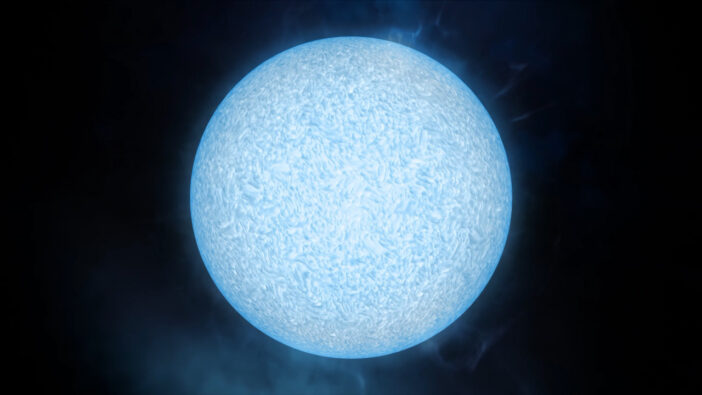
Prior to exploding, massive stars advance through action-packed evolutionary stages that are exciting but often difficult to fully decipher. A recent study focuses on a unique late-stage star to better understand its properties and evolution.
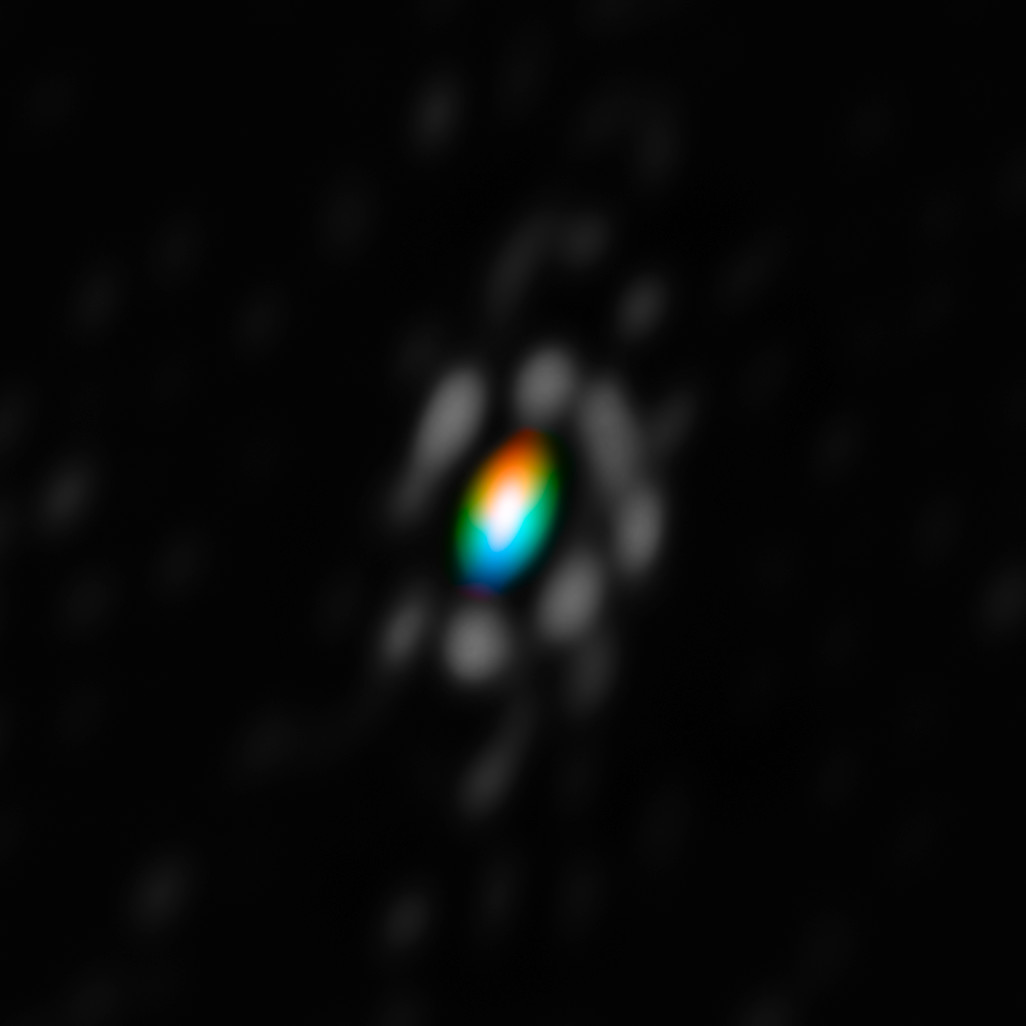
Very Large Telescope Interferometer image of the circumstellar disk around the B[e] supergiant star HD 62623. The colors indicate the rotation of the disk with blue coming toward us and red going away. [ESO/F. Millour; CC BY 4.0]
One particularly interesting B[e] supergiant, LHA 115-S 18, has been the subject of numerous studies but remains poorly constrained. The star exhibits significant variability both in brightness and emission features on timescales of days to years, and previous works have suggested that the star may have an as-yet unconfirmed binary companion. Molecular line emission from CO and TiO have been identified in LHA 115-S 18, indicating a circumstellar disk, but to date, water vapor emission has not been identified in any B[e] supergiant. Identifying more complex oxygen-bearing molecules like water will further reveal the physical properties and possible binary companion of LHA 115-S 18.
To characterize the emission around LHA 115-S 18, María Laura Arias (Institute of Astrophysics La Plata; National University of La Plata) and collaborators obtained high-resolution near-infrared spectroscopy of the star using the Immersion Grating Infrared Spectrometer on the Gemini South telescope. From the high-resolution spectra, the team identified several atomic emission lines indicative of the star’s gaseous envelope, revealing the structure of material around the star: an inner hot disk of ionized material and an outer cool disk of neutral material. Looking at molecular emission from carbon monoxide — a tracer of both gas motions and stellar age — the authors confirmed the presence of a rotating ring of gas around LHA 115-S 18 and determined that the star is an evolved, post–red supergiant object.
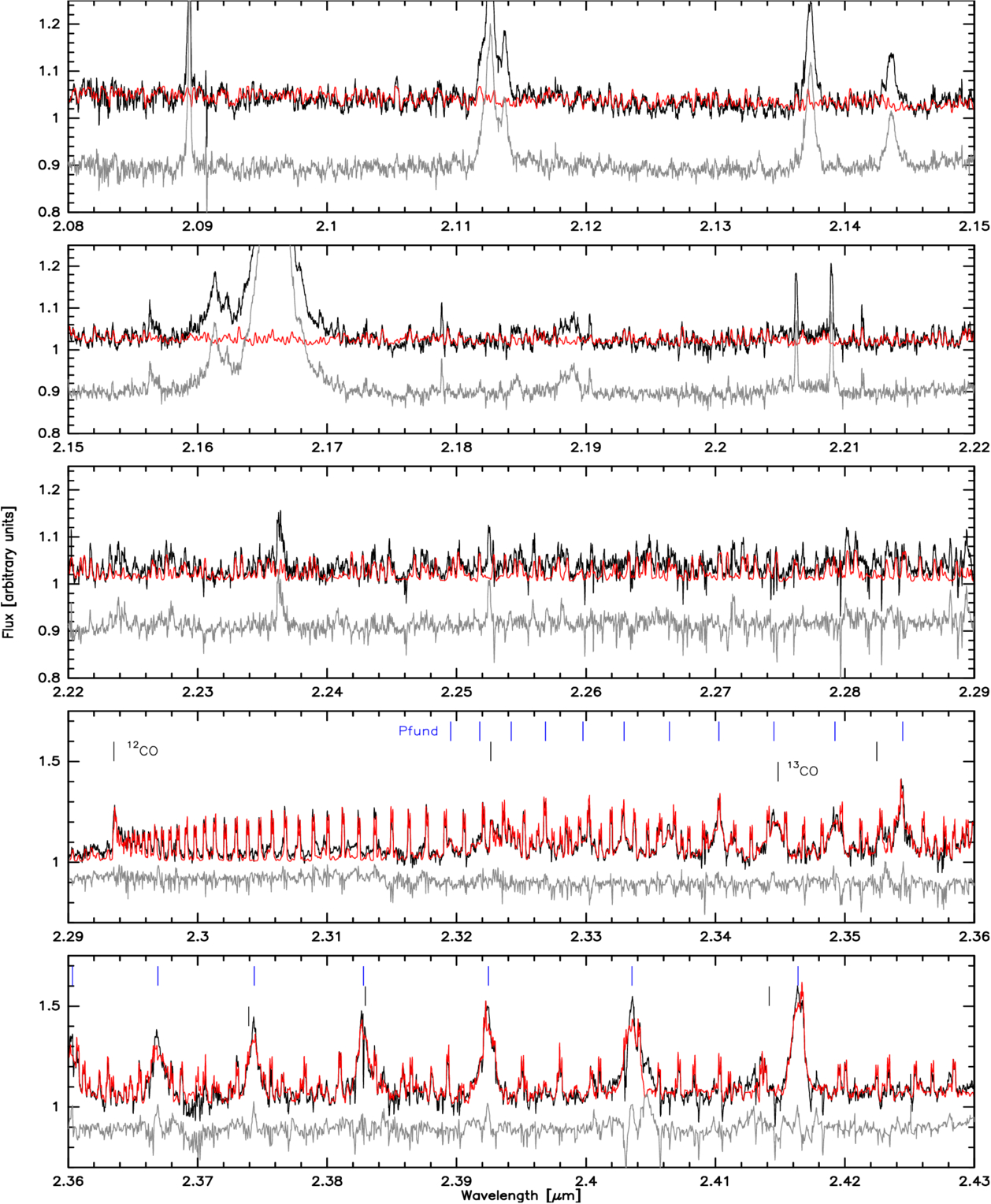
Spectrum of LHA 115-S 18 (black) with the model spectrum composed of water vapor (red, top three panels) and water vapor, CO, and hydrogen emission (red, bottom two panels) overplotted as well as residuals (gray). [Arias et al 2026]
Sustaining a cool disk around such a hot star indicates that the circumstellar environment around LHA 115-S 18 is complex and likely shaped by binary interaction. With emission features characteristic of both cool and hot evolved stars, this particular B[e] supergiant presents itself as a unique object holding critical insights into the late-stage evolution of massive stars. Further multiwavelength observations of LHA 115-S 18 will constrain its potential binarity and reveal a possible evolutionary link between B[e] supergiants and other late-stage evolutionary phases of massive stars.
“High-resolution Near-Infrared Spectroscopy of the B[e] Supergiant LHA 115-S 18: Discovery of Hot Water Vapor Emission,” María Laura Arias et al 2026 ApJL 1000 L49. doi:10.3847/2041-8213/ae524a
The post Water Vapor Around a Sizzling Supergiant: High-Resolution Spectroscopy of B[e] Supergiant LHA 115-S 18 appeared first on AAS Nova.
Editor’s Note: Astrobites is a graduate-student-run organization that digests astrophysical literature for undergraduate students. As part of the partnership between the AAS and astrobites, we occasionally repost astrobites content here at AAS Nova. We hope you enjoy this post from astrobites; the original can be viewed at astrobites.org.
Title: ALMA Reveals an Eccentricity Gradient in the Fomalhaut Debris Disk
Authors: Joshua B. Lovell et al.
First Author’s Institution: Center for Astrophysics | Harvard & Smithsonian
Status: Published in ApJ
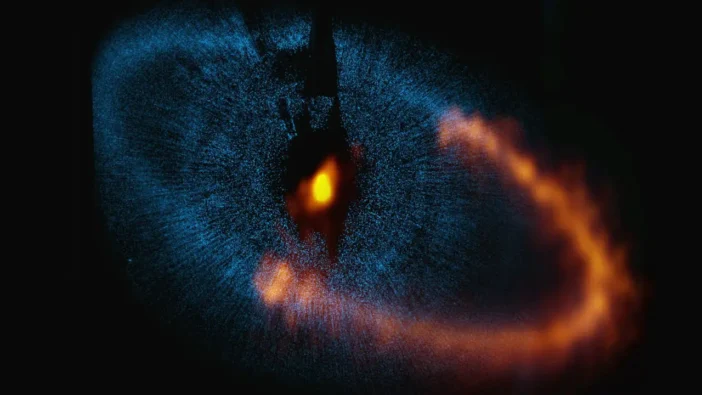
Let’s start with our solar system: the Kuiper belt, a large ring of icy asteroids, is believed to have been sculpted into its current shape by Neptune. Neptune may have previously scattered objects in the Kuiper Belt through gravitational interactions, but some of them (like Pluto) remain in an orbital resonance with Neptune. In the same way that Neptune shapes the Kuiper Belt, today’s authors believe a planet could be shaping an exo-Kuiper Belt around the star Fomalhaut.
What on Neptune is an orbital resonance, though? A planet orbiting a star has an orbital period, and the gravitational forces between nearby (astronomically speaking) objects can push these objects into a state where their orbital periods are multiples of each other. For example, Pluto and Neptune have a 2:3 orbital resonance, meaning Pluto completes two orbits for every three that Neptune does. The same can happen for the asteroids and planetesimals in the Kuiper Belt, so the same should happen in other star systems!
If we understand how debris disks carved by exoplanets look — and we think we do — then we should be able to infer the existence of exoplanets! Today’s authors have used observations from the Atacama Large Millimeter/submillimeter Array (ALMA) of the debris disk around Fomalhaut and made some very clever calculations. We’ve known about this disk for a while, which is why today’s authors have studied it with a new analysis technique they developed.
Planeteismals — basically big rocks from a few to hundreds of kilometers across — that orbit in this disk do so with a certain eccentricity, and typically things in the same orbit would have the same eccentricity. But today’s authors were clever — they checked if there was an eccentricity gradient, meaning the planetesimals’ eccentricities depend on their semi-major axis (i.e., the mean orbit radius); we would typically not expect any eccentricity gradient for bodies orbiting a star unperturbed. The authors discovered that the gradient for planetesimals around Fomalhaut is negative, which implies the presence of a planet when you look at the maths behind gravitational interactions between planets and planetesimals.
A negative eccentricity gradient means the planetesimals gather up at the point on the orbit farthest from the star (the apocenter), and since there are more planetesimals in that region, they appear brighter in the ALMA data (see Fig. 1 left); the ring also appears slightly wider. If the eccentricity gradient were positive, the same thing would happen at the point on the orbit closest to the star (the pericenter). The authors term this phenomenon the “eccentric velocity divergence.”
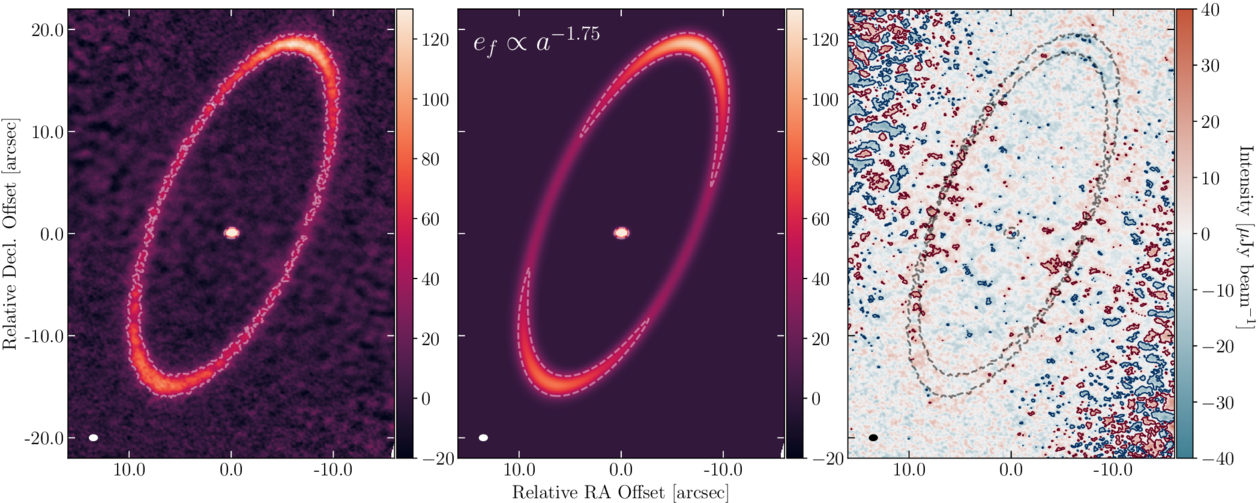
Figure 1: Left: The observed intensity of the Fomalhaut debris disk with ALMA. Middle: the authors’ model that fits the ALMA data the best. Right: The residual (data – model) between model and data. White means there is a close match to the data (which is better). [Lovell et al. 2025]
The authors tested other scenarios with different gradients and allowed for the planetesimals to oscillate their eccentricity around their orbit, but they didn’t find a better-fitting scenario.
Okay, so those were the details. The authors investigated a few scenarios to see what could be causing the observed debris disk and its negative eccentricity gradient, as well as an intermediate ring sitting between the main disk and the star that recently was seen with JWST. The authors tested two scenarios: one where a planet sits between the rings and evacuates the nearby region, and another where a planet is interior to the inner ring and clears the gap through orbital resonances (kind of like Neptune!). An illustration can be seen in Figure 2.
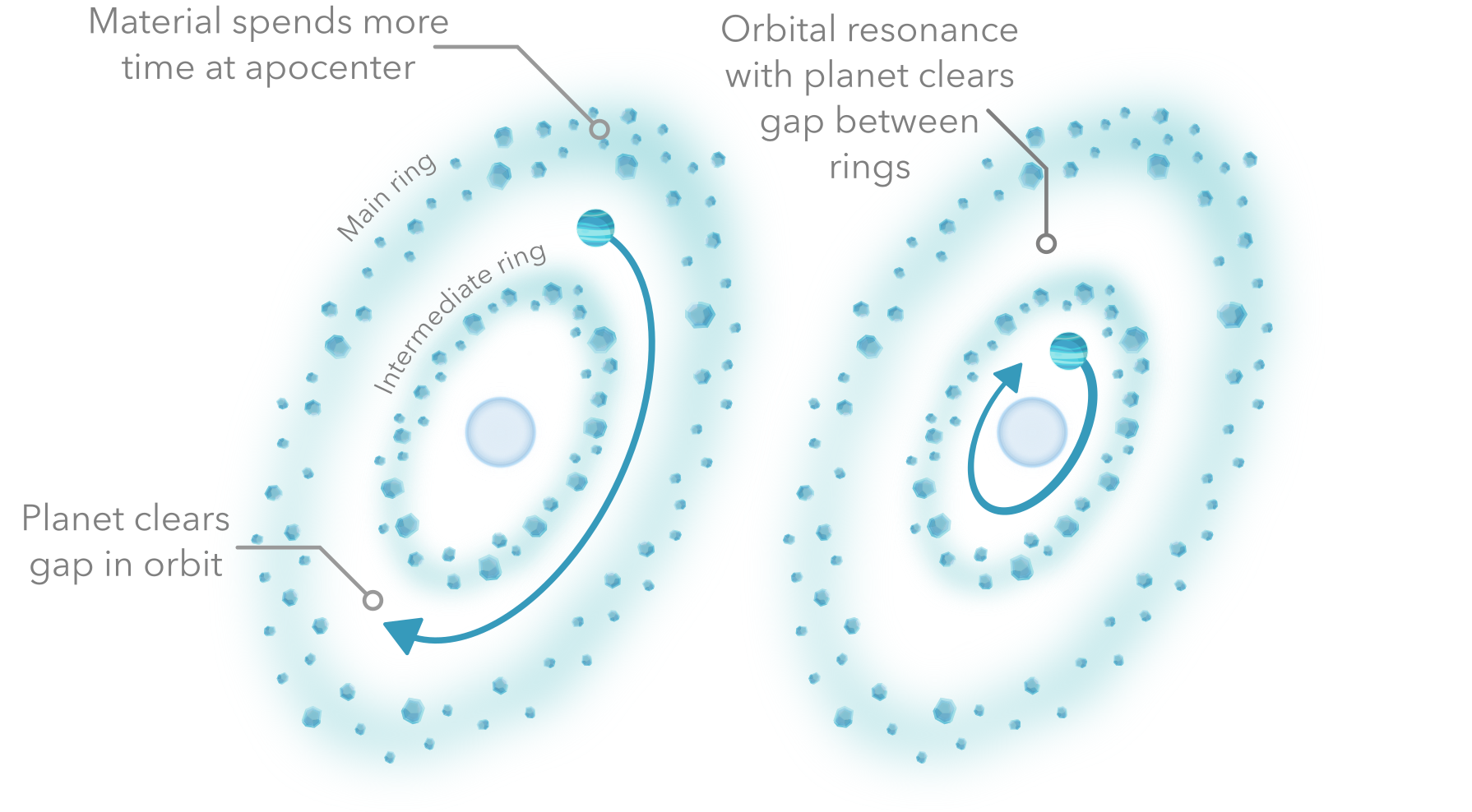
Figure 2: Illustration of possible planet-based scenarios that could create the observed debris disk around Fomalhaut. One features a planet between the observed debris disk rings, and another is where the planet is interior to both and carves the gap with orbital resonances. [J. Williams]
Finally, the authors stress, however, that it might not be a planet causing the observed structure — it could instead be the gravity of the planetesimals in the disk. Unfortunately, existing models are not equipped to explore this scenario, which is why the authors are planning to develop tools to investigate this next.
Original astrobite edited by Sandy Chiu.
About the author, Joe Williams:
I’m a third-year PhD student at the University of Exeter in the UK, and I study protoplanetary discs — mainly the tiny dust grains and their ices! In my spare time, I’m a climber, crocheter, and reader of sci-fi and fantasy books. My favourite sci-fi series is The Expanse!
The post Michelangelo in Space: A Planet Carving the Fomalhaut Debris Disk? appeared first on AAS Nova.
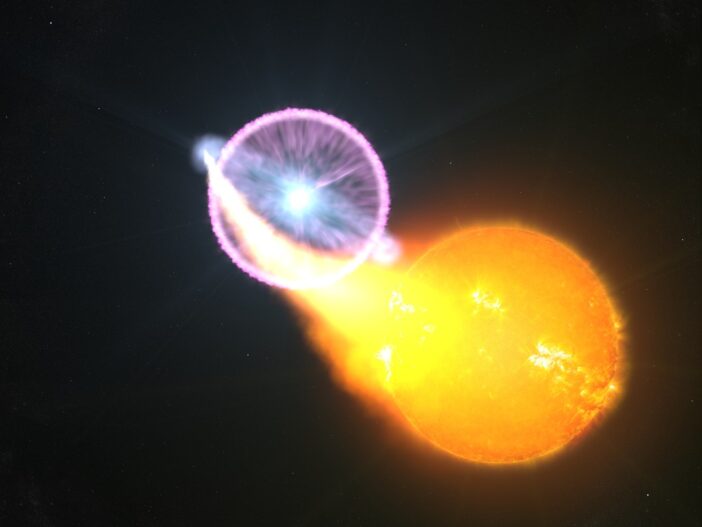
Flashing on and fading quickly, recurrent novae are captivating astronomical phenomena. A recent study identifies one system that challenges our current understanding.
When a white dwarf — the white-hot remnant of a dead star — has a close binary companion, the white dwarf can pull material from the companion star onto its boiling surface. Ignited in a bright flash, the accreted material is blown out from the white dwarf in a nova explosion that gradually expands and fades over time. Some novae, known as recurrent novae, repeat on observable timescales, creating a “new” star in the sky on periods ranging from one to one hundred years.
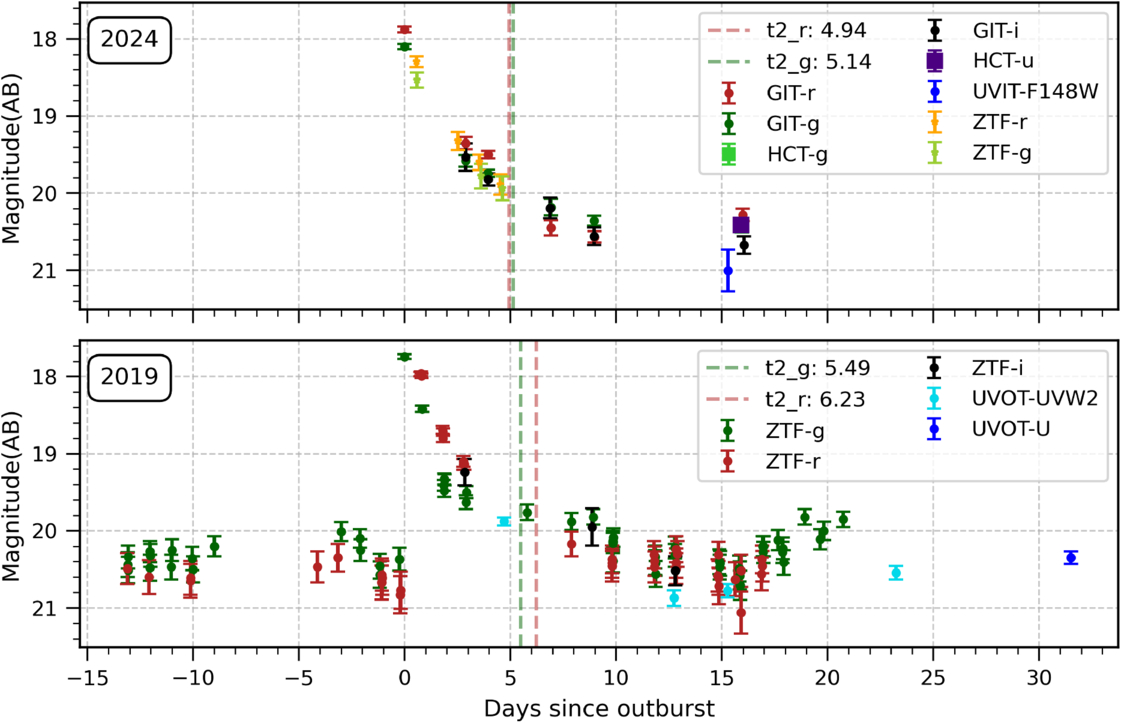
Two light curves of M31N 2017-01e outbursts from 2024 (top) and 2019 (bottom) showing how the light evolves over time. Click to enlarge. [Chamoli et al 2025]
Discovered in 2017, the second-shortest-period nova M31N 2017-01e has an outburst about every 2.5 years. This nova has sparked intrigue among researchers due to its low-amplitude outbursts and rapid evolution compared to other recurrent novae. While M31N 2017-01e exhibits some emission features typical for recurrent novae, recent studies have suggested that the system’s companion star may be a moderately young, blue B-type star. Most novae occur in systems where the white dwarf’s companion is a late-type main-sequence, subgiant, or giant star, making M31N 2017-01e an unusual case requiring further investigation.
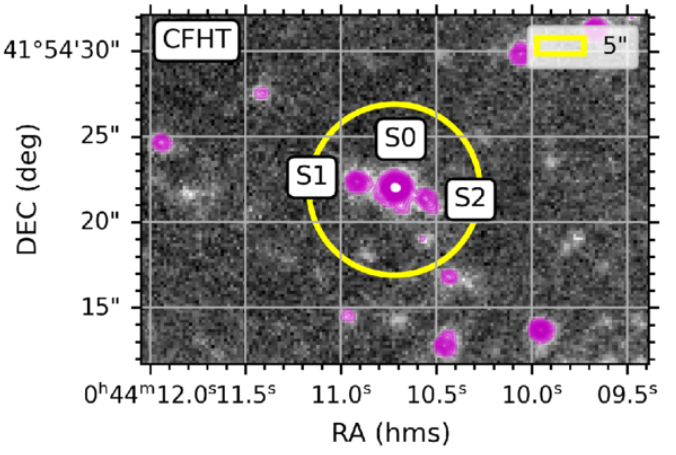
Optical image showing the location of sources near the location of M31N 2017-01e. The yellow circle corresponds to a radius of 5 arcseconds and is centered on the nova. Labeled S0, the source coincides with the location of the nova with sub-arcsecond resolution. Click to enlarge. [Modified from Chamoli et al 2025]
Aiming to constrain the nature and companion star of the nova, Shatakshi Chamoli (Indian Institute of Astrophysics and Pondicherry University) and collaborators performed a multiwavelength analysis using ultraviolet and optical observations of M31N 2017-01e.
In monitoring the nova during and in between outbursts, the authors identified a source at the reported location of M31N 2017-01e that exhibited variability and color consistent with previous observations of the system. Through a detailed photometric analysis, the authors found that the color and emission properties of the source are consistent with a hot, early-type star as was previously suggested. Though all the observational signs point toward a B-type companion, there’s one glaring obstacle to that scenario: such a massive star would typically be unable to transfer the amount of mass necessary to fuel the nova’s frequent eruptions without the accretion becoming unstable.
What else, then, could the companion be? The authors considered another stellar companion known as a Be star — a rapidly rotating, early-type star that occasionally hosts a disk of loose stellar material. With a blue color and spectral features similar to B-type stars, a Be star could match the observational properties of the nova’s companion while solving the problem of its accretion. Outbursts of M31N 2017-01e likely arise due to the white dwarf lying very near or within the Be star’s circumstellar disk, siphoning material and adequately fueling the system’s recurring eruptions. To confirm this hypothesis, researchers will need to perform follow-up infrared observations to search for the tell-tale signs of a dusty disk around the companion star.
This system is rare and challenges the assumed properties of recurrent novae. From this study, it is clear that nova progenitors are potentially quite diverse and require further multiwavelength observational programs to identify more systems like M31N 2017-01e.
“Challenging Classical Paradigms: Recurrent Nova M31N 2017-01e, a BeWD System in M31?” Shatakshi Chamoli et al 2025 ApJ 991 174. doi:10.3847/1538-4357/adf843
The post Rapid Recurrent Nova May Be Challenging Perceptions appeared first on AAS Nova.
