❌

Reading view

How the ‘first bird’ leapt into the sky and soared above the dinosaurs

Archaeopteryx is an icon of evolution and is often called the first bird. Scientists have long debated just how it took off from the ground but a recent study published by my colleagues and I has brought new insights to the mystery.

Our study compared Archaeopteryx with the anatomy of modern birds, and our findings suggest it generated the force needed to take off by taking several jumps forwards.

Archaeopteryx, a fossil uncovered from the Jurassic rocks of Germany, dates back 150 million years. It was covered in feathers and it had wings. But it retained a number of distinctly dinosaur features such as a long bony tail, claws on separate fingers and teeth in a beakless jaw.

Charles Darwin predicted, in the first edition of On the Origin of Species published in 1859, that fossils would later be found linking major groups of animals. A year after publication a feather, and within two years, an entire skeleton of Archaeopteryx had been discovered, showing clear links between birds and the dinosaurs. Archaeopteryx is one of those transitional forms that links one group to another.

The “first bird” was not perfectly developed, as birds have evolved to be today. We would not expect them to be. It had relatively weak flight muscles, with no keeled sternum for strong muscle attachment, and could not have raised its wings above the horizontal.

Rather than call it the first bird, it is better to describe it as the earliest branching species, yet known, on the lineage of birds after the whole bird group split from non-avian dinosaurs some time more than 150 million years ago.

In 2016 my friend Colin Palmer asked a colleague, Markus Heller (professor of biomechanics) and me to join him in exploring a tricky problem: how did early birds slip the bonds of Earth and take to the sky?

Palmer had been working on the flying cousins of dinosaurs, the pterosaurs for over a decade, and also a peculiar (although now one among several known) four-winged, feathered and flying dinosaur called Microraptor. However, pterosaurs are not dinosaurs and Microraptor is a dinosaur closer to Velociraptor (small meat-eating dinosaurs) than to birds.


Read more: How ancient flying reptiles ruled the skies – new research


There have been a number of suggested mechanisms for the evolution of flight and takeoff, quite literally from the ground up, or the trees down, to flapping while running to climb a slope. The problem is that these are difficult to test experimentally. So we turned instead to the best example of takeoff there is: birds themselves.

Palmer had already filmed a number of birds, out of curiosity. As some other scientists had observed, but had never followed up, Palmer saw that they all showed the same sort of pre-takeoff behaviour. Two leg jumping. The wings appeared to do little in getting the bird off the ground, and this opened up some possibilities for research into the earliest of birds.

The ancestors of birds, the theropod dinosaurs, had powerful legs. They could definitely jump, and jumping could provide an important evolutionary advantage. Being able to get out of the way of a hunter, and maybe adding in a flap of your feathered arms to extend your leap, might just save your life.

The first bit of this research, which we carried out with then undergraduate student Erik Meilak, was developing a means to see how much force the hindlimbs of birds generate in getting off the ground. We used a force plate (a modified kitchen scale) and a Raspberry Pi computer controlling some high-speed photography, along with CT scanning of the skeleton to see exactly how bones were articulated. We worked out how magpies got off the ground. They used their legs as the primary generator.

This undergraduate summer project became a fully-fledged PhD project, with Meilak looking at several birds such as starlings and crows. We worked with evolutionary biologist Pauline Provini in Paris who had done work with doves and finches, demonstrating how all of these birds used their legs in takeoff.

And with detailed kinematics, all of the forces and moments generated by the muscles around the hindlimb joints, we fitted the model to Archaeopteryx and looked to see if the first bird could get into the air in a similar way to modern birds.

Archaeopteryx is by definition 150 million years behind the “leaps” of modern birds, and couldn’t take off as we had observed modern birds do when startled, explosively, with a single jump and then add flapping into the sky. Archaeopteryx couldn’t do that, and as I said couldn’t rely on its wings for powerful flaps. So we had asked what its legs could do. And like birds today, when taking off more leisurely, we demonstrated that Archaeopteryx could have got into the air with two leg leaps. Archaeopteryx could have used three jumps increasing in velocity, and once airborne its flapping wings could have maintained a flight speed of 7 metres per second.

However, if Archaeopteryx had added in a flap, it would have got to that speed – jump-flap-jump – with just two leaps. And all this without the highly evolved and flight-adapted anatomy of pigeons, crows, hawks and even chickens.

In the future we may find a fossil that is still a bird rather than a non-avian dinosaur, but is less, well, “birdy” than Archaeopteryx, and then that would become the earliest branching taxon. But we haven’t yet. So Archaeopteryx still sits on its perch as the first bird that we know of.

The Conversation

Neil J. Gostling is an Associate Professor in the School of Biological Sciences at The University of Southampton. The work described here was funded by the Natural Environment Research Council (grant number NE/L002531/1).
  •  

Fly-tipping: here’s what is missing from Andy Burnham’s plan to tackle waste dumpers

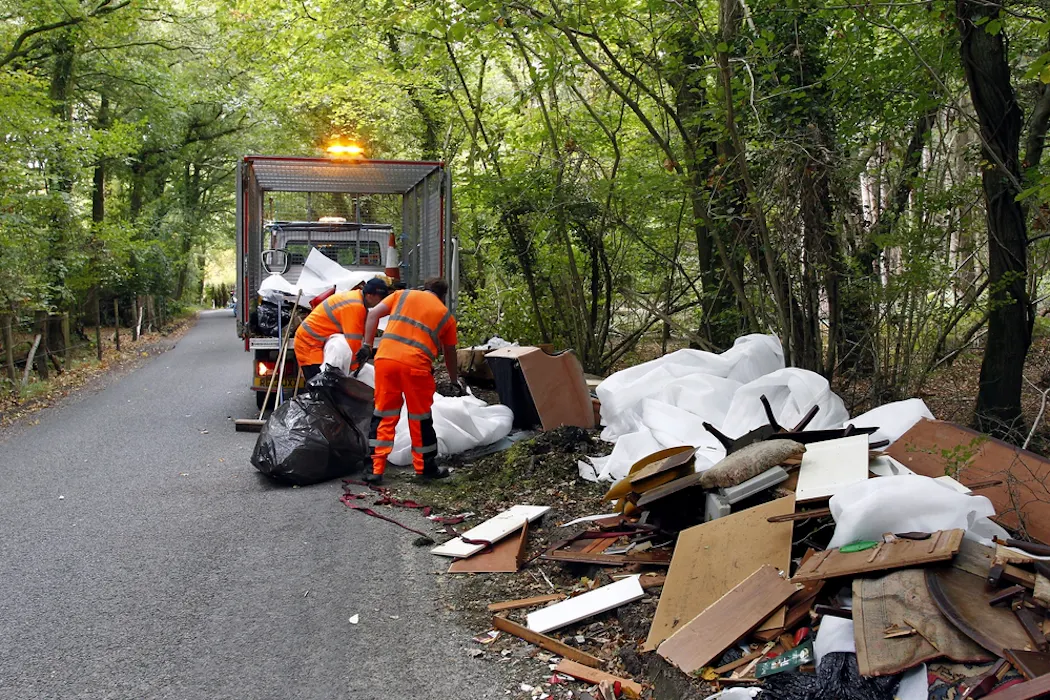
Large fly-tipping dumps are an increasing problem. Sean Aidan Calderbank/Shutterstock

UK prime minister Andy Burnham has promised to clean up three of the worst illegal waste dumps in England and sign off new measures to tackle the problem more widely.

The pledge is bold, but it is also unlikely to solve the problem on its own.

Illegal waste sites and fly‑tipping is now widespread in the UK, and globally.

They are not just local eyesores. They are public health hazards, environmental damage, and a symbol of organised criminal activity. They cost councils millions. They poison soils and waterways. They also erode trust in government. Any plan that ignores the full picture will fail.

What Burnham has proposed

Burnham’s announcement commits resources to clear three of the worst sites and to work with councils and police to tackle the problem. The aim is immediate clean‑ups and stronger local coordination. This is welcome. Quick action on visible sites helps communities and restores confidence. But the plan as described lacks the scale and tools needed to stop the flow of illegal waste in the long term.

Fly‑tipping is the illegal dumping of waste on land without a licence. Illegal waste sites are larger, often semi‑permanent locations where waste is stored, processed or burned outside regulatory control. These activities range from small household dumping to organised operations run by criminal networks. The latter are the most damaging and the hardest to stop.

English local authorities dealt with 1.26 million fly-tipping incidents in 2024-25, a 9% increase from the previous year.

For decades, local authorities have borne the cost of clearing dumped waste. Budget cuts since 2010 reduced council capacity for enforcement and waste services.

At the same time, regulatory gaps and weak sentencing created an environment where organised waste crime could flourish. Criminal groups exploit low enforcement, transport networks and demand for cheap disposal. The result is more illegal sites and higher clean‑up bills for councils.

Fly-tipping is often organised by criminals gangs.

What Burnham needs to add

Burnham’s current approach treats symptoms, not causes. Cleaning up three sites is necessary but not sufficient. Without cutting off the supply chain – illegal collection, transport and disposal – new sites will appear.

But the current plan lacks sustained funding. Effective action needs long‑term investment in enforcement teams, surveillance, legal support and prosecution. Short‑term funding can clear sites but cannot sustain the multi‑year operations needed to dismantle organised waste crime. Councils already report rising costs and limited budgets for pursuing fly-tippers.

Enforcement is currently fragmented. Responsibility is split across councils, the Environment Agency as well as the police and private sector actors. Burnham has said the National Crime Agency will work more closely with the Environment Agency in England, but this could still create gaps that criminals exploit.

Successful disruption requires a single, well‑resourced taskforce with investigative powers and rapid legal follow through. Past local initiatives without national backing have struggled to keep pace.

Sentences for serious waste crime are often too light to deter organised groups. To help tackle this Burnham has said fines will rise from £300 to a maximum of £5,000. But prosecutions are complex and slow. Without tougher, faster legal consequences, the economics could still favour illegal operators.

Tougher sentencing and fast‑track courts should be put in place. Pushing for tougher sentencing guidelines for serious waste crime and specialist courts to speed cases is needed. Swift, certain punishment deters more than occasional heavy fines.


Read more: Criminal fly-tipping gangs are costing governments millions – AI and drones can help track waste dumpers


What would work?

A national waste‑crime taskforce with investigative powers, forensic capability and a legal team to secure rapid prosecutions could reduce offending. This could be modelled on successful multi‑agency units used against other organised crimes.

The government should target the money being made by these gangs. This could include freezing or seizing profits from illegal operations. These recovered funds could be used for clean‑ups and community prevention. Greater financial consequences for the criminals are likely to deter organised fly tipping.

Investment is also needed in understanding behaviour, prevention and legal disposal. Subsidising safe, low‑cost waste disposal options for households and small businesses would also help as well as licensing and tracking of waste carriers. When legal disposal is affordable and traceable, illegal options are likely to shrink.

Funding local rapid‑response teams and anonymous reporting lines would be another means of attacking the problem. Community intelligence often leads to the best leads. This should be combined with AI, drones, CCTV and vehicle tracking to catch offenders in the act.

There are some pilot schemes that show success. The Keep Britain Tidy group worked with Newham council in London to add stickers to illegally dumped waste and bring it to public attention. This resulted in an average 64% reduction in fly-tipping incidents, with over half of residents reporting they had noticed the intervention.

Burnham’s pledge to clear three sites is a good start. It will help communities and draw attention to a national crisis. But it will not halt the problem.

The question now is whether political plans will match the scale of the crime. If it does, a successful national model could emerge. If it does not, the clean‑ups will be temporary – and the next illegal site will already be being planned.

The Conversation

Ian Williams receives funding from UK Research Councils, including the Engineering and Physical Sciences Research Council (EPSRC) and its Impact Acceleration Account.

  •  

The death of dark energy is a false alarm – the universe is still accelerating

A 2025 study by South Korean researchers caught the attention of the astronomy community when it suggested that the evidence behind dark energy could be wrong. Dark energy makes up about 70% of the universe but nobody knows what it is. This makes it a frequent target for scepticism.

Scientists had long known that the universe was expanding. But in the late 1990s, researchers discovered that this expansion was accelerating. Astrophysicists concluded that something must be driving the acceleration. They named this unknown quantity “dark energy”.

The 2025 re-analysis, by a team at Yonsei University in Seoul, suggested that the expansion of the universe was not in fact accelerating.

Our team at the University of Southampton has now gone through the Yonsei team’s findings. Our results, published in Monthly Notices of the Royal Astronomical Society (MNRAS), suggest that the results were a false alarm.

However, the Yonsei University team have said they stand by their results and that a follow up study supports their finding that the universe may not be accelerating.

What is dark energy?

In the late 1990s, cosmology was upended by a startling discovery. Scientists knew the universe was expanding, but they had assumed that gravity was gradually slowing down this expansion.

However, by observing incredibly bright, thermonuclear explosions of white dwarf stars, two independent teams of astronomers found the opposite. Because these explosions, known as Type Ia supernovae, have almost the same intrinsic brightness, comparing how bright they appear gives a precise distance.

In 1998, data revealed that distant supernovae were fainter than they should have been in a slowing universe. Because faintness implies distance, the observations placed these supernovae farther away than expected, and implied that the cosmic expansion was not slowing.

In fact, when the calculations were run, it was clear that the expansion of the universe was actually speeding up.

There was no convincing physical explanation for this “cosmic acceleration”. Physicists labelled the mysterious, repulsive force that causes the acceleration “dark energy”.

Cosmic calibration

To understand the Yonsei University group’s claims, we must understand how astronomers use supernovae as “standard candles” to measure cosmic distances. Type Ia supernovae are remarkably alike, but they are not identical.

Cosmologists correct for these differences. They use subtle calibrations to account for relationships between the brightness of the supernovae and measurements like their colour, the duration of their light curves, and the type of galaxies they explode in.

One of those corrections is well known but subtle. It links the brightness of a supernova to the size of the galaxy it exploded in. Big galaxies hold more stars, and so more mass. After the standard corrections, supernovae in those big (massive) galaxies come out a few per cent brighter than ones in small galaxies. Nobody knows why.

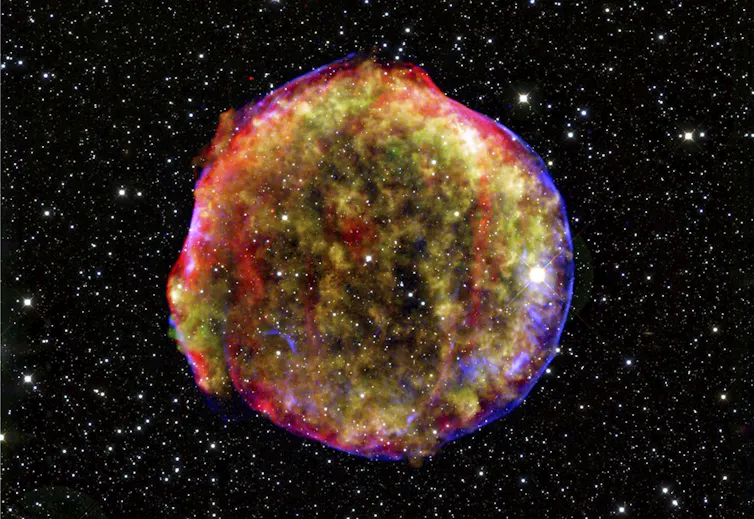
SN 1572 is the remnant of a Type Ia supernova. Nasa / JPL-Caltech / CXC / Calar Alto O. Krause /MPIA

But bigger galaxies typically have older stars that are made up of heavier elements, which could in turn influence the properties of the supernovae that some of those stars become. The authors of the 2025 study proposed a far bigger evolutionary effect. They argued that the brightness of Type Ia supernovae changes significantly as the universe ages.

Specifically, they claimed that older white dwarf stars, which are more common in the nearby, present-day universe, produce brighter explosions. That would mean today’s supernovae are inherently much brighter than their distant, early-universe counterparts.

If true, the faintness we observe in distant supernovae would not be a result of their being further away, a relationship that is in turn driven by dark energy, but rather an evolutionary trait of the stars themselves. This claim threatened to dismantle almost three decades of progress in astronomy.

Addressing the claims

Extraordinary claims need careful testing. At the University of Southampton we embarked on an audit of the data, using observations from the Dark Energy Survey (DES), an astronomy project designed to constrain dark energy’s properties, alongside the same dataset used by the authors of the 2025 work. In doing so, we sought to replicate and test their conclusions.

Our re-analysis revealed what we saw as two problems in the Yonsei study: a technical omission and a flawed assumption about stellar populations. Once corrected, the data fell back in line with standard cosmological results, including those of DES.

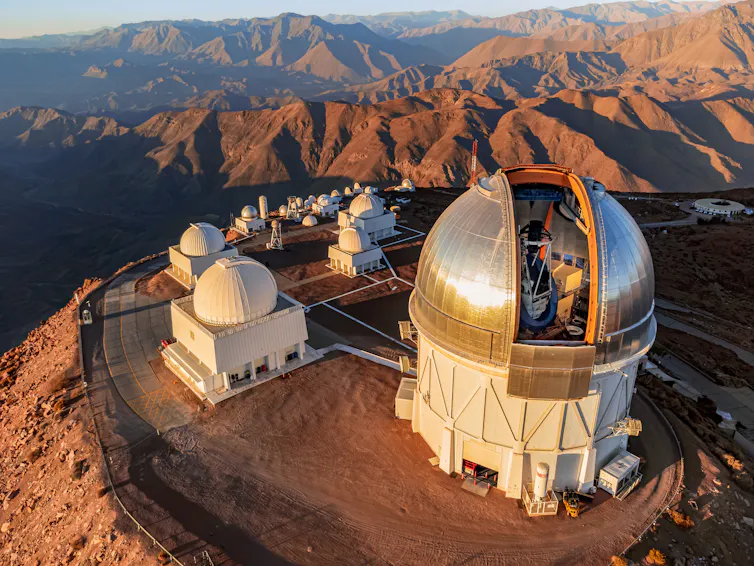
Victor M Blanco telescope in Chile.
The Dark Energy Survey gathered data using a wide-field camera mounted on the Victor M Blanco telescope in Chile. CTIO/NOIRLab/NSF/AURA/T. Matsopoulos, CC BY

Crucially, the 2025 study did not account for how supernovae in big galaxies come out a few per cent brighter than ones in small galaxies. When our team reapplied this correction to the same dataset, the correlation between a supernova’s brightness and galaxy age – presented by the Yonsei team in their paper – became far weaker.

This doesn’t mean that the age of a white dwarf star has no effect on the brightness of a resulting supernova. Indeed, most researchers in the field would likely accept that the brightnesses of supernovae are more affected by the age of the stars that explode than by the mass of the galaxy that it is in.

However, measuring a galaxy’s mass is far less expensive in terms of telescope time and requires fewer technical assumptions than measurements of the ages of galaxies, which are challenging. What we showed is that the galaxy mass calibration is adequate to the accuracy required to constrain dark energy.

The bright dot of a Type Ia supernova (supernova 1994D) appears next to galaxy NGC 4526. Nasa, Esa, The Hubble Key Project Team, and The High-Z Supernova Search Team

Secondly, the 2025 analysis relied on a flawed proxy, incorrectly assuming that the overall age of a host galaxy is identical to the specific age of the star that exploded. But galaxies are not uniform like this: even large, ancient galaxies contain localised pockets of young stars.

By overestimating the difference in age between the stars that explode nearby and those that explode in the distant universe, by a factor of three to five, the Yonsei University study overestimated the amount by which the age-brightness calibration could bias supernova distance measurements.

Once these omissions were corrected, the data behaved as expected under the standard model of cosmology. As such, evidence for an accelerating universe remains secure.

Science friction

While the 2025 study turned out to be incorrect, the challenge it posed was valuable. Challenging accepted ideas and rigorously testing our observations is fundamental to scientific progress.

Their claims provided an opportunity for cosmology teams to return to their baseline data, interrogate their core assumptions, and test different ways of calibrating the measurements. When measuring distances, however, the age effect and the mass effect are highly correlated, and therefore we (the Southampton team) believe it is incorrect to make a full age-based adjustment to distances that have already been corrected for the mass effect.

The Southampton team was invited, among others, to a workshop at Yonsei in June 2026, where we discussed our methods and talked about ways to include both stellar mass and stellar ages into the brightness corrections.

In a follow up study, recently accepted by MNRAS, the Yonsei University team maintain that the ages of stars have an important effect on the supernovae they produce. They say that two methods used in earlier studies have suppressed the importance of this phenomenon.

When these effects are accounted for consistently, they explain, it leads to results similar to those in the 2025 study. “We therefore continue to find evidence that stellar-population age is an important factor in Type Ia supernova standardisation,” authors Junhyuk Son and Hyejeon Cho, told The Conversation.

“Because the typical ages of supernova host populations change with cosmic time, understanding this effect is important for precision measurements of the Universe’s expansion history.”

Future measurements will depend on understanding supernova explosions better. It is a job we hope the community can take on together. But none of this removes the need for dark energy: it is still there, and still unexplained.

Ultimately, we have shown that existing measurements of dark energy are robust. Rather than debating whether cosmic acceleration exists, the astrophysical community can return to the exciting task of figuring out what dark energy actually is and how we best measure it.

Over the next 10 years, the Vera C. Rubin Observatory in Chile will carry out a project known as the Legacy Survey of Space and Time, which will produce a sample of supernovae 20 times larger than the DES sample used in our analysis. There is no better time to be investigating the mysteries of dark energy.

The Conversation

Dr Phil Wiseman receives funding from the Science and Technology Facilities Council.

Mark Sullivan receives funding from the Science and Technology Facilities Council.

  •  

Smart clothes will soon be on sale. But regulations are needed to prevent a new waste mountain

When you think of advanced futuristic clothing, what comes to mind?

Perhaps shirts that can detect and alert users to low blood glucose levels or socks that can track your running form, step count and speed? What about pyjamas that observe subtle bodily changes while you sleep leading to early detection of cancer or warn carers of imminent seizures? Imagine if all these were items that required no external power source, just the energy generated by your own body.

Although these products are not in the shops yet that day is not far off.

Researchers are already designing advanced textiles that look exactly like regular clothes or fabrics but come with with embedded electronic functions. These are referred to as electronics textiles, e-textiles or smart fabrics.

E-textiles integrate sensing, computation and power into fabrics so that the threads themselves become the sensors and the stitches become the circuits. These textiles can monitor health, temperature, motion and air quality. They can communicate wirelessly and harvest various forms of energy.

University and industry prototypes are currently progressing through clinical trials and are being tested outside labs. The global market for e-textiles is projected to reach over US$15 billion (£11.14 billion) by 2028.

Developments in e-textiles will revolutionise the way humanity views clothing; but at what cost?

A new type of waste

Electronic waste is the fastest growing EU waste stream with a record 62 million tonnes discarded in 2022.

Another 92 million tonnes of waste is generated globally from textiles; a figure expected to reach 134 million by 2030. Textiles alone account for 6.7% of global greenhouse gas emissions with the average European discarding a staggering 11kg of textiles per year.

Electronic textiles will bring a new kind of hybrid waste. E‑textiles commonly use mixed polymers, metal nanoparticle inks, and include components that create fire hazards within conventional textile recycling.

They can release toxic residues if incinerated or landfilled. This results in hazardous and precious materials becoming trapped within garments, leading not only to environmental and health problems, but to a loss of vital resources such as graphene and rare-earth elements. Silver, for instance, is used in conductive yarns, antimicrobial coatings, sensors and electrodes. We need to work out how to recover it because it is valuable as well as toxic to aquatic life in some forms.

Smart clothing will be on sale soon.

So, it’s currently very difficult to recover the valuable materials used in smart clothing, after the shirt or socks are discarded.

At the current rate of e-textile growth, current disposal methods will need to change to cope with these new materials; particularly in the areas of reusability and recyclability.

The EU’s sustainable and circular textiles strategy is part of the EU’s plan to become the first climate-neutral continent. Regulators are now demanding clearer rules on recyclability, chemical safety and product lifespans, and starting to ask how e‑textiles will meet these requirements.

Industry practice is catching up more widely, and placing more responsibility on clothing producers. Digital product passports (these carry information about the materials and their environmental impact) and new recycling technologies are scaling up. These shifts mean manufacturers could face legal and commercial risk if they don’t consider the long-term impact of these products.

Preventing more waste

The good news is that sustainable e‑textiles are an engineering problem with practical solutions. Key measures that industry and funders could adopt now include:

  1. design for disassembly. Removable electronic parts help separate electronics from textiles for recycling

  2. material passports and transparency. Digital records of various components (such as polymers, inks and batteries) that enable safe sorting and recovery

  3. biodegradable and recyclable conductors. Prioritising conductors free from precious metals and using alternatives such as screen printable carbon paste and recyclable conductive inks and yarns

  4. energy-first design. Integrating textile energy harvesting (for instance, solar, thermoelectric, piezo/triboelectric nanogenerators) to reduce or eliminate batteries. Some garments embed antennas and wireless power receivers to avoid bulky batteries

  5. standards for washability, durability and end-of-life testing. To ensure products survive real-world use and can be repaired rather than discarded.

None of these are optional extras: they determine whether e‑textiles become a public good or a new environmental liability. University research groups and industry consortia are starting to demonstrate printable, stretchable components and trial wireless power that reduce battery dependence, for instance. Printable, stretchable components are flexible electronic parts printed onto fabric that keep working as the textile bends and stretches. They make smart clothing comfortable, lightweight, washable and able to move naturally with the body.

Unless policymakers and industry players adopt sustainable design now, e-textiles could add a dangerous new layer to our global electronic waste mountain.

Governments need to set clear rules on recyclability and chemical safety for e‑textiles. University researchers must find methods to make e-textiles functional, affordable, sustainable and safe. Brands must publish material details and repair guides and ensure sustainable practices are being adhered to throughout their supply chain.

Investors should not fund throwaway novelty. Standards bodies must define test methods for washing, wear and end‑of‑life recovery.

These steps will steer the market toward durable, repairable and recyclable products that could change lives for the better.

The Conversation

Ian Williams receives funding from UK Research Councils, including the Engineering and Physical Sciences Research Council (EPSRC) and its Impact Acceleration Account.

Christina Webb receives funding from UK Research Councils, including the Engineering and Physical Sciences Research Council (EPSRC).

Stephen Beeby receives funding from UK Research Councils, including the Engineering and Physical Sciences Research Council (EPSRC).

  •  

Scientists Solve the Mystery of Why Antarctica Froze Before the Arctic

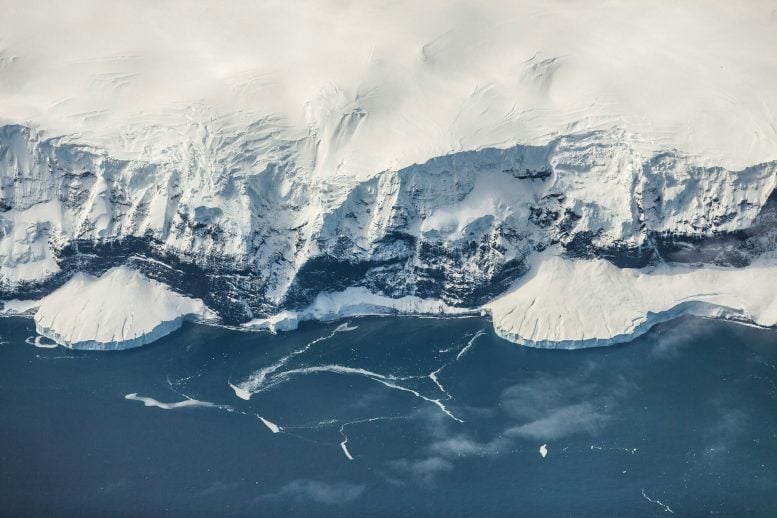
Antarctica CoastlineAntarctica’s first ice sheet may have begun with a geological head start hidden deep beneath the continent. Millions of years before thick ice spread across the Northern Hemisphere, forces inside Earth lifted East Antarctica into a vast region of mountains and plateaus. The higher terrain became cold enough to preserve snow even when the planet [...]
  •  

Why Antarctica froze millions of years before the Arctic – new research

East Antarctica hosts the largest ice sheet on Earth, containing enough water to raise global sea levels by 52 metres, were it to fully melt. Yet it has puzzled scientists for decades how and why this ice sheet formed.

In fact, there are two interlinked mysteries. First, Antarctica became covered in ice around 34 million years ago – a period known as the Eocene-Oligocene transition – while the Arctic region stayed largely ice-free for another 25 million years or so.

Carbon dioxide levels in the atmosphere were falling dramatically at the time, and played an important role in falling temperatures. But if that was the sole factor behind the transition, both poles should have cooled together. They didn’t.

This means that something else was probably giving Antarctica a head start.

The second mystery is that sea-surface temperatures in the Southern Ocean remained unexpectedly warm for 10 million years or so after the East Antarctic Ice Sheet formed. This is not what we’d expect to see if the ice sheet had formed purely in response to global cooling, in which case the surrounding oceans should have cooled considerably too.

My new study with colleagues based in the UK and Germany, published in Science, points to an answer buried deep below the ice sheets: Antarctica’s mountains, and the slow motion geological forces that built them.

A continent on the move

This story begins around 170 million years ago, when Antarctica and Africa were last joined together as part of the supercontinent Gondwana. Their split sent Antarctica on a trajectory toward the South Pole – and this massive rupture also set off a chain of events far below the surface.

Africa and Antarctica broke apart during the Jurassic period, around 170 million years ago.

When continents break apart, hot material from Earth’s mantle wells up beneath them, cools and then sinks. This swirling motion destabilises the base of the neighbouring continent, triggering a series of lava lamp-like instabilities that remove chunks of its deep roots, one by one.

These disturbances, called “mantle waves”, sweep below continents over millions of years, travelling more than 1,000 kilometres as they ripple through the hot, sticky rock beneath the landmass.

My research team discovered this phenomenon several years ago. In two Nature papers, we pieced together multiple independent lines of evidence that all pointed to the same conclusion: mantle waves can trigger diamond-bearing volcanic eruptions – violent explosions that rocket magma from the deep roots of the continents, more than 150 kilometres below the surface.

We also found these mantle waves can generate unexplained pulses of uplifting land far from the rift zones where the continent originally broke.

Using computer models that simulate how landscapes evolve over tens of millions of years, we have now traced the effect these waves could have had in East Antarctica. Near the coast, the rifting formed a towering cliff-like feature, called an escarpment, more than two kilometres high.

Hundreds of kilometres inland, the mantle wave stripped away rock deep beneath the continent. Like a hot air balloon rising after dropping its ballast, the land above slowly lifted, creating a vast plateau and triggering a wave of erosion across the landscape.

The uplift didn’t stop there. It kept migrating inland, taking roughly 100 million years to reach the Gamburtsev mountains, over 1,500km from the coast. This range is now buried under 3km or more of ice.

How East Antarctica’s landscape changed over a period of 125 million years up to 34 million years ago, the point at which a continent-wide ice sheet first formed.

Elevation matters enormously for ice. Air temperature drops by roughly 1°C for every 100 metres of elevation gained, so even a modest additional uplift can tip a mountain range from losing its snow each summer to keeping it year round.

Until around 50 million years ago, most of the Gamburtsev mountains sat below 1.5km, too low for much snow to survive the summer. But our models show that from around this time, the wave of uplift (see video above) reached this mountain region and pushed much of the range above 2km. At this elevation, snow and ice could persist and start building up.

According to our calculations, by around 45 million years ago, enough of East Antarctica’s landscape had crossed this threshold for mountain glaciers to take hold and begin spreading.

According to another strand of our analysis, the ice sheet started to form at precisely this time. By the point of continental glaciation, the global temperatures had fallen from a high of around 30°C 50 million years ago, to closer to 20°C.

Once glaciers formed on the highlands, two feedback loops took over. First, ice and snow reflect far more sunlight than bare rock, so as the ice sheet grew, it cooled the surrounding region further. Our modelling suggests this alone lowered global temperatures by around 1°C.

Second, as the air over Antarctica cooled, it held less water vapour, which is a powerful greenhouse gas. Drier air meant a weaker insulating blanket over the region, allowing temperatures to fall further still.

Together, these feedback loops let the ice sheet expand from its mountain strongholds down to the coast, eventually merging into the single ice sheet we see today.

Crucially, the global cooling of roughly 1°C was not enough to freeze the Arctic, as northern hemisphere landmasses didn’t have the elevation to cross this threshold. It would take another 25 million years or so, and much lower CO₂ levels and global temperatures, before major ice sheets could build up there too.

The temperature change that came from ice sheet formation was not enough to make temperatures plummet in polar oceans around Antarctica either, reconciling both mysteries surrounding the origin of its ice sheet.

Setting the stage for ice ages

Our work shows how geology sets the stage for ice ages. The height of the land determines whether a given climate is cold enough to grow ice.

This concept is important for other climate events in Earth’s past. If deep Earth processes can condition a landscape for ice long before the climate cools enough for ice sheets to form, they may too have contributed to earlier ice ages.

Understanding the growth of past ice sheets can also give us clues about the future. Our study shows that the conditions required for a continental ice sheet to form are extraordinarily specific, and took geological timescales to assemble.

When ice sheets melt, however, they disappear much faster than they formed. And once lost, they cannot simply grow back.

The Conversation

Thomas Gernon receives funding from the WoodNext Foundation, a fund of a donor-advised fund program. Gernon is a Visiting Professor at the GFZ Helmholtz Centre for Geosciences in Potsdam, Germany.

  •  

Astronomers Confirm Dark Energy After Shock Challenge Rocked Cosmology

Supernova Purple Starburst in SpaceA major challenge to dark energy, the mysterious force believed to be driving the universe’s accelerating expansion, has been overturned by a new study. Astronomers say a new analysis has reinforced one of the most important discoveries in modern cosmology, finding that the universe is still expanding at an accelerating rate. The result counters a [...]
  •  
❌