 Login

Trees Can Tell When They’re Crooked and Grow Special Wood to Straighten Themselves
 New experiments reveal a sophisticated posture-control system hidden inside living wood.
 New experiments reveal a sophisticated posture-control system hidden inside living wood.
 The loss of one ancient Alerce tree could wipe out centuries of fungal diversity.
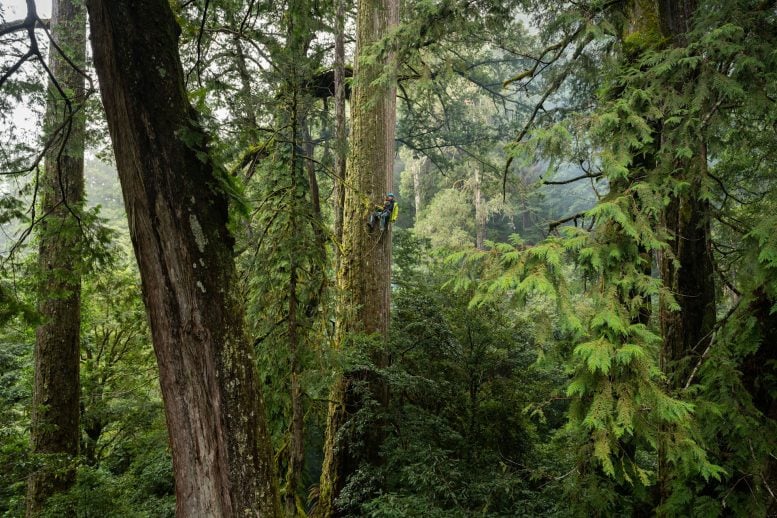
After ten years of fieldwork in Taiwan’s remote mountain regions, researchers have identified an 84.1-meter (276-foot) Taiwania fir, now recognized as the tallest tree documented in East Asia. The team also found dense forests containing dozens of giant Taiwania firs, suggesting that other giant trees may remain hidden in Taiwan’s rugged interior.
The study, published in Frontiers in Forests and Global Change, was conducted by a team led by Rebecca Chia-Chun Hsu of the Institute of Taiwan Forestry Research, in collaboration with researchers Chi-Kuei Wang and Chung-Cheng Lee of National Cheng Kung University. Starting in 2014, the group, known as the Taiwan tree seekers, located and measured trees that had previously gone unrecorded by combining traditional field surveys with laser-based mapping and the help of citizen scientists.
The researchers found that the giant trees generally grow at elevations of about 2,087 meters and on slopes with an average inclination of 40 degrees. This combination of elevation and rugged terrain makes conventional tree surveys extremely difficult.
In August 2014, a systematic search began when scientists from the Taiwan Forestry Research Institute visited the Cilan conservation area to measure the ‘Chilan Three Sisters’, a group of Taiwania firs known locally but not formally recorded. The tallest tree was 69.3 meters high and had a trunk almost three meters wide. The Tree Project, a group of professional climbers from Australia, photographed the trees in 2017 and helped draw greater attention to Taiwan’s giant forests.
During a subsequent expedition near Mt. Benya and Great Ghost Lake, the team hiked for four days with their equipment to reach the study area. This experience showed how difficult it is to estimate the height of giant trees from the ground, since visual estimates can be unreliable in densely wooded, multi-layered old-growth forests. Although the team measured one tree at 71.7 meters, they concluded that ground-based surveys alone would not be sufficient for such a large and complex landscape.
To improve their search, Hsu’s team collaborated with Wang and Lee’s remote sensing group at National Cheng Kung University and adopted LiDAR technology. LiDAR uses laser pulses from aircraft to create three-dimensional models of the forest, including estimates of tree height. However, Taiwan’s rugged topography caused the automated software to misinterpret cliffs and abrupt elevation changes as extremely tall trees.
Human reviewers proved more effective than the automated software at identifying these geological false positives. In 2020, hundreds of citizen scientists began examining the LiDAR profile images manually to distinguish real cases from artifacts. By the end of 2022, the Taiwan Giant Tree Map had identified 941 trees taller than 65 meters.
The researchers concluded that combining airborne laser scanning with crowdsourced image reviews and expert analysis can greatly reduce terrain-related errors in estimating tree heights.
In 2023, the mapping project led the team to a candidate for Taiwan’s tallest tree, which could be reached after traveling 20 kilometers down a river and then spending two days climbing. A direct measurement established the tree’s height at 84.1 meters, making it the tallest tree ever documented in Taiwan and East Asia. The team called it the ‘Heaven Sword of the Da’an River’. The Indigenous Rukai people have a name for trees of this kind and describe them as ones that ‘hit the moon’. By early 2026, researchers had documented 10 Taiwania firs taller than 70 meters, including two that exceeded 80 meters.
The mapping effort also brought the team back to the Great Ghost Lake region, nearly ten years after their initial visit. There, they identified about 30 large Taiwania firs growing together in an ancient stand, which the team began calling ‘temples of giants.’ In a hectare of forest near Mt. Benya, they recorded 11 individual trees exceeding 65 meters in height.
The importance of these forests goes beyond their height. In 2024, Hsu’s team, in collaboration with 15 citizen scientists, surveyed Tao Tree Valley, home to Taiwan’s third-tallest tree, to determine how much carbon the forest stores. They found a carbon density of 1,384.5 megagrams per hectare, without including the root systems. The estimate is comparable to carbon-storage densities reported for some of the world’s most carbon-rich forests, including giant eucalypt forests in Tasmania. The researchers noted that their estimate did not include root systems and may have underestimated the forest’s true carbon storage.
The researchers still do not know how many other giant trees remain hidden in Taiwan’s mountains. However, the combination of LiDAR mapping, citizen science, and field verification gives them a way to search terrain that would otherwise be nearly impossible to survey systematically.
Austin Burgess is a writer and researcher with a background in sales, marketing, and data analytics. He holds an MBA, a Bachelor of Science in Business Administration, and a data analytics certification. His work focuses on breaking scientific developments, with an emphasis on emerging biology, cognitive neuroscience, and archaeological discoveries.
 A decade-long search through Taiwan’s remote forests led to the discovery of East Asia’s tallest tree and hundreds of other towering giants. An 84-meter-tall tree is surprisingly easy to miss. Hidden within Taiwan’s steep mountains and dense old-growth forests are some of the tallest trees on Earth, including giant conifers that rise higher than a [...]
 A new study reveals that oak trees can keep photosynthesizing for months after growth ends, challenging assumptions about how effectively forests convert absorbed carbon into long-term storage. A tree can look busy long after it has stopped building itself. Its leaves may still be absorbing sunlight and pulling carbon dioxide from the air, but deep [...]
 Oak trees fight caterpillars by delaying spring just long enough to leave them hungry. In spring, forests usually burst to life right as insects hatch. Caterpillars, in particular, emerge when fresh leaves are young, soft, and packed with nutrients. This timing provides them with an immediate food supply and allows them to begin feeding right [...]

Brown rot is a common fungal disease in the Southeastern United States that affects stone fruits like peaches, cherries, and plums. Monilinia fructicola is a tan, fuzzy fungus that grows on tree flowers, twigs, and fruit, and is the most common cause of brown rot. Once brown rot infects a tree, the damage is irreversible, causing significant crop losses in commercial orchards. Farmers try to control the spread of M. fructicola by applying chemical sprays, called fungicides, to fruit trees in the spring.
In M. fructicola, a biosynthesis gene named MfCYP51 encodes a major protein critical to the fungi’s survival. Certain fungicides, called demethylation inhibitor (DMI) fungicides, stop M. fructicola from growing by targeting this protein. Over the last 20 years, DMI fungicides have become less effective against brown rot as M. fructicola becomes more resistant.
Living microorganisms and their metabolites can control fungal diseases as an alternative to chemical fungicides, known as biofungicides. Many bacteria produce compounds like hydrogen cyanide and pyrrolnitrin that damage fungal cells. However, scientists have not found a biofungicide suitable for commercial production. A group of researchers at Clemson University in the USA and Huazhong Agricultural University in China set out to test whether the soil bacteria Pseudomonas chlororaphis and Bacillus subtilis could be effective biofungicides against brown rot.
The researchers performed an incubation experiment to analyze how the fungal cells make their critical protein from the MfCYP51 gene, a process called gene expression, under different fungicide treatments. They used 3 M. fructicola strains sensitive to traditional DMI fungicides and 3 resistant strains. They tested these with 5 different fungicide treatments: a DMI fungicide, a mixture of P. chlororaphis metabolites, a mixture of living B. subtilis cells, a DMI fungicide + P. chlororaphis metabolites, and a DMI fungicide + B. subtilis cells. They also set up a control treatment with sterile water instead of fungicide.
After 6 hours, the researchers extracted the molecule that measures gene expression, called RNA, from the fungi. They found that both the P. chlororaphis treatment and the DMI fungicide + P. chlororaphis treatment substantially reduced MfCYP51 expression in both the sensitive and resistant isolates compared to the controls. In contrast, the DMI fungicide, B. subtilis, and DMI fungicide + B. subtilis treatments increased MfCYP51 expression in the resistant isolates. The researchers concluded that P. chlororaphis has a unique ability to reduce gene expression, unlike other biofungicides.
To further investigate how the biofungicide treatments work, the team tested whether P. chlororaphis and B. subtilis produced the anti-fungal metabolite pyrrolnitrin. They added 1 milliliter of each treatment to a machine that separates and identifies liquid compounds using high pressure, called a high-performance liquid chromatograph. They found that the P. chlororaphis treatment contained pyrrolnitrin, so they hypothesized that it was responsible for reducing gene expression.
Additionally, the researchers tested their 5 treatments on brown rot in fruit. For each treatment, they took 10 Gala apples, washed and sterilized their surfaces, and sprayed them with the fungicides. After 24 hours, they poked holes in the apples with toothpicks and added 20 microliters of liquid containing M. fructicola cells to the poked holes. They placed the apples in a humid chamber for 5 days and measured the number and size of brown rot spots that developed on their surfaces.
Despite decreasing MfCYP51 expression, the researchers found that P. chlororaphis treatment alone didn’t reduce brown rot disease compared to the control, but the DMI fungicide and B. subtilis treatments did. The mixed treatments of DMI fungicide + P. chlororaphis and DMI fungicide + B. subtilis both reduced brown rot disease compared to the control, but only the DMI fungicide + P. chlororaphis treatment prevented it.
The researchers concluded that although biofungicides may not be fully effective on their own, commercializing them could allow farmers to use less DMI fungicide. They explained that scaling back the use of DMI fungicides would slow M. fructicola resistance. Finally, they proposed that future researchers test biofungicide mixtures containing pyrrolnitrin in the field to observe real-world effects on stone fruit trees.
The post Using bacteria to fight fungal brown rot appeared first on Sciworthy.
