
❌

Reading view

Newly Discovered Object is So Close to the Milky Way’s Central Black Hole it’s Experiencing Warped Spacetime

An international team of astronomers led by the Infrared/Submillimetre Group at the Max Planck Institute for Extraterrestrial Physics (MPE) has announced the discovery of a star so close to Sagittarius A*, the Milky Way’s centrally placed supermassive black hole, that it is experiencing warped spacetime.

With a highly elliptical orbit around Sagittarius A* of only 8.7 years, the newly named S301 comes as close as Saturn does to our Sun during its nearest approach. The research team said this close approach makes it the star with the shortest recorded orbital period and the tightest ever observed in the galaxy’s center.

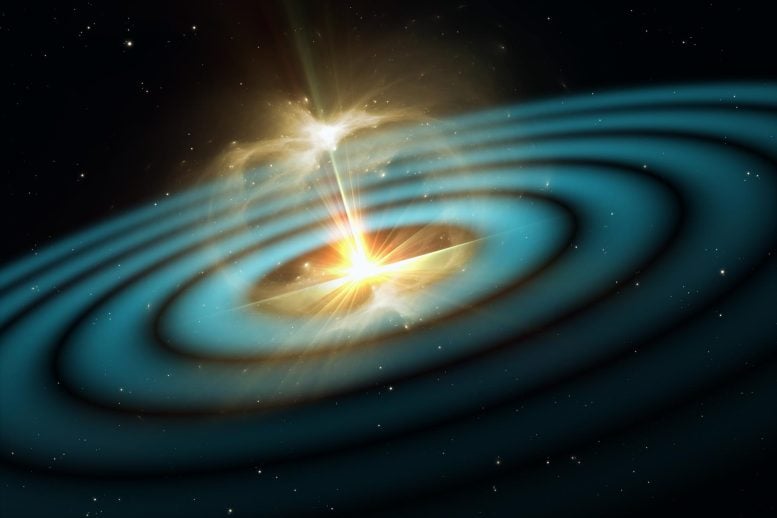
Black Hole-Orbiting Star Experiencing Warped Spacetime

In a statement emailed to The Debrief, Reinhard Genzel, Director at MPE and Nobel Laureate for Physics in 2020, noted that S301’s historically tight orbit around Sagittarius A* is ten times closer to the Galactic Center than “our previous best star.”

warped spacetime
The above image shows all known stars in the Galactic Center orbiting the central massive black hole Sgr A*. The central region is dominated by young, hot stars (blue), and a couple of cooler stars (orange/red). One of the cooler stars, S301, is approaching Sgr A* very closely, about the distance from the Sun to planet Saturn. Sgr A* itself is surrounded by hot plasma, the light of which is warped due to the black hole’s strong gravity (Credit: MPE).

Along with that record, the team said the star’s tight orbit also moves it through a region of space where the black hole’s extreme gravitational pull “drags spacetime itself.”

Genzel noted that “S301 probes spacetime in the Galactic Center,” a phenomenon that astrophysicists believe only occurs in the immediate vicinity of a massive, spinning object like a black hole.

According to the MPE team, the evidence for this warped spacetime shows up in the star’s orbital path. Specifically, they said the star’s path “deviates significantly” from the path predicted by Newton’s classical theory of gravitation.

“This is a clear sign of relativistic effects that occur only in the vicinity of a massive, rotating black hole,” the researchers explained.

warped spacetime
Image of the Galactic Center in July 2025. The highly eccentric, tight orbit of S301 around Sgr A* (colored in white), and the orbits of five other stars in the Galactic Center are shown (Credit: MPE).

The Physics Behind the Phenomenon

To explain the evidence of warped spacetime, the MPE team said two scientific principles are at work. The first, called Schwarzschild Precession, occurs when space itself is curved around a central mass. In the case of S301, the object creating an extended field of warped spacetime around it is the supermassive black hole Sagittarius A*.

“The Schwarzschild solution of general relativity remains a useful approximation to explain the orbit of S2, even for a spinning black hole at the center of the Galaxy,” they explained.

warped spacetime
This image shows the path of the S301 star around Sagittarius A*, the supermassive black hole at the center of our galaxy. The diamonds show measurements performed with the GRAVITY instrument at ESO’s Very Large Telescope Interferometer (VLTI). The size of Neptune’s orbit is shown as a reference. Credit: MPE

The second relativistic mechanism causing the warped spacetime drag on S301 is called the Lense-Thirring effect. Specifically, the massive black hole exerts a separate force from Schwarzschild Precession due to its rotation.

“A rotating mass, in a sense, drags the surrounding space-time along with it – much like a rotating spoon setting the water in a cup in motion,” the MPE team explained.

Unlike the more powerful effect of gravity, the team said the effect on the star caused by the rotation of Sagittarius A* is “significantly weaker and therefore more difficult to detect.” This rarity marks the team’s observation of the effect, another historic first.

“S301 is the first star to orbit directly in the region around Sagittarius A* where the frame-dragging effect is extreme,” explained Felix Mang, PhD student at MPE and corresponding author of the study. “We’re not just measuring spacetime curvature; we are measuring how it gets distorted by the rotation of the black hole itself. That is unique.”

“Explore Strange New Worlds, Seek Out New Physics, and See What Nobody Has Seen Before”

Astronomers first identified S301 in spring 2023 using the GRAVITY instrument at the Very Large Telescope Interferometer (VLTI) of the European Southern Observatory (ESO) in Chile. Unlike conventional observatories, GRAVITY observes targets simultaneously with four 8-meter telescopes. The light is then combined into a single image, resulting in an angular resolution 40 times sharper than images captured by a single telescope.

“GRAVITY’s exceptional resolution makes it possible to observe stars at the center of the Milky Way on scales comparable to the size of our solar system, even when they are extremely faint,” the MPE team explained, adding that “this unprecedented combination of precision and sensitivity has made it possible to detect S301, a new and extremely faint star.”

warped spacetime
ESO’s Very Large Telescope in front of the Galactic Center in the Milky Way. Four powerful lasers are shot into the night sky to remove disturbances of the atmosphere. These lasers are the Laser Guide Star (LGS) system as part of the GRAVITY+ project, the upgrade of GRAVITY. Credit: MPE

When discussing the next steps in the investigation of the star experiencing warped spacetime, the MPE team noted that a recent upgrade to the facility, GRAVITY+, which includes a new adaptive optics system and laser guide stars, “has increased the instrument’s sensitivity by a factor of 10 to 100.” Genzel said the upgrade will lead to even more discoveries in a relatively short time.

“Within the next decade, we will measure the black hole’s rotation directly — a milestone for general relativity,” The researcher explained.

Frank Eisenhauer, director at MPE and Principal Investigator of the GRAVITY and GRAVITY+ projects, said the opportunity to discover “the beauty of nature” in the form of S301 “is truly a dream come true.” The researcher also pointed to future observations and the new tools that will make them possible, while seemingly harkening back to a popular 1960s TV show introduction championing the exploration of space.

“GRAVITY+ and the upcoming MICADO instrument, currently being developed in an international consortium led by MPE for the ESO Extremely Large Telescope [will help us] to explore strange new worlds, seek out new physics, and see what nobody has seen before.”

The study “Discovery of a star sensitive to the spin of Sagittarius A*” was published in Nature.

Christopher Plain is a Science Fiction and Fantasy novelist and has spent the last six years as Associate News Editor and Head Science Writer at The Debrief. Follow and connect with him on X, learn about his books at plainfiction.com, or email him at christopher@thedebrief.org.
  •  

Unveiling the Source of Freely Adjustable Parameters in Nature’s Fundamental Equations

In a groundbreaking advancement poised to redefine core principles in theoretical physics, researchers from Kyushu University and esteemed international collaborators have unveiled insights into the nature of continuous parameters within quantum gravity. This study challenges the long-standing assumption that such parameters are freely adjustable external inputs by demonstrating—under particular theoretical conditions—that they inherently originate from operators embedded within the physical theory itself. This resolution not only revitalizes Albert Einstein’s century-old assertion regarding the intrinsic completeness of physical laws but also propels forward our comprehensive understanding of the quantum structure of spacetime.

Central to this revelation is the concept of exactly marginal operators within the framework of conformal field theory (CFT), a pivotal branch of modern physics that explores systems invariant under scale transformations. CFT serves as a formidable bridge between quantum theory and gravitational physics, especially through the lens of the anti-de Sitter/conformal field theory (AdS/CFT) correspondence. This correspondence posits a deep equivalence between gravitational theories in a curved AdS spacetime and lower-dimensional CFTs residing at its boundary, rendering CFT an indispensable tool to probe quantum gravity’s elusive traits.

At the heart of the research lies the structure known as the conformal manifold—an abstract space parameterizing a continuous family of CFTs interconnected via exactly marginal deformations. These deformations represent operators that tweak a theory’s parameters without sacrificing its conformal symmetry. The pressing theoretical puzzle was whether the existence of such a manifold necessarily implies that continuous variations in the theory’s parameters emerge from operators already encoded within the theory, rather than arbitrary, external parameters appended to the formalism.

To rigorously examine this, the interdisciplinary team led by Associate Professor Yuya Kusuki embraced an innovative approach involving conformal interfaces, mathematical constructs that serve as boundary layers interpolating between two related CFTs situated on a conformal manifold. The researchers posited that as two nearby CFTs approach equivalence, the conformal interface connecting them should become trivial. Under the plausible assumption that certain correlation functions transition smoothly as this interface dissolves, they utilized the interface’s displacement operator—which quantifies the response of the interface to infinitesimal positional shifts—to reconstruct an exactly marginal operator governing motions on the manifold.

This reconstruction represents a monumental stride because it conclusively ties continuous parameters characterizing a family of theories not to arbitrary external dials but to concrete operators intrinsic to the theory’s internal dynamics. By examining the perturbative behavior of the conformal interface, the team effectively identified the fundamental origin of parameters that might otherwise have seemed freely tunable.

What does this imply for the broader quest of quantum gravity? Through the prism of AdS/CFT duality, the intimate relationship between conformal manifolds in CFT and the moduli space of vacua in quantum gravity theories becomes transparent. This newly established principle supports the profound conjecture that quantum gravity forbids arbitrary external parameters, with all continuous couplings traceable to internal degrees of freedom—a concept resonant with a widespread expectation but hitherto unproven with such clarity.

Importantly, the present findings apply specifically to two-dimensional CFTs, a fertile domain where theoretical control is well established. Nevertheless, the researchers have expressed optimism that their methods and conceptual revelations will motivate extensions to higher-dimensional CFTs and more general quantum gravity landscapes. Extending these results could illuminate the landscape of string theories and the parameters governing candidate quantum gravity models.

Moreover, these results have significant implications for the so-called “Swampland program,” a burgeoning field striving to delineate which consistent-looking effective field theories can be embedded into quantum gravity. By constraining continuous deformations to those generated by internal operators, this study offers fresh constraints on the space of viable theories and sharpens the boundaries between the “landscape” of consistent theories and the “swampland” of inconsistent ones.

The research underscores an increasingly vital notion: the parameters defining fundamental physics are not arbitrary selections but emergent phenomena anchored within the theory’s operator framework. This insight advances a vision in which the fabric of physical law is self-contained, avoiding unexplained fundamental constants, and aligning with Einstein’s aspiration for a theory without ad hoc inputs.

Led by Kusuki alongside collaborators Shota Komatsu of CERN, Marco Meineri from the University of Turin, and Hirosi Ooguri of the California Institute of Technology, the project utilized sophisticated computational simulations combined with analytic operator algebra techniques to bring these abstract mathematical objects into clearer physical focus.

Published in the prestigious journal Physical Review Letters on June 16, 2026, the paper titled “Continuous Family of Conformal Field Theories and Exactly Marginal Operators” delineates these technical breakthroughs and their broader theoretical implications, offering a compelling blueprint for future explorations in the intersection of quantum theory and gravity.

As the physics community absorbs the ramifications of this breakthrough, it heralds a renewed momentum for using conformal field theory and holographic dualities as guiding principles to unravel the enigmatic quantum nature of gravitation, spacetime, and the universe’s foundational constants.

—

Subject of Research: Not applicable

Article Title: Continuous Family of Conformal Field Theories and Exactly Marginal Operators

News Publication Date: 16-Jun-2026

Web References: Kyushu University Institute for Advanced Study, Kyushu University

References: Shota Komatsu, Yuya Kusuki, Marco Meineri, and Hirosi Ooguri, Physical Review Letters, 16 June 2026.

Image Credits: Yuya Kusuki/Kyushu University


Keywords

Quantum Gravity, Conformal Field Theory, Exactly Marginal Operators, Conformal Manifold, Quantum Moduli Space, AdS/CFT Correspondence, Operator Reconstruction, Displacement Operator, Conformal Interface, Fundamental Constants, Theoretical Physics, Swampland Conjecture

  •  

This Philosopher Thinks Physics May Be Asking the Wrong Question About Space-Time


Einstein’s equations have withstood every experimental test for more than a century. However, according to one philosopher, they have not withstood careful scrutiny of the language used to describe them.

Daryl Janzen, an astronomer and instructor at the University of Saskatchewan, recently published a philosophical challenge in The Conversation. Janzen’s critique does not question the mathematics but instead focuses on how physicists and philosophers describe the nature of space-time itself. He argues that over the past century, the language used to describe space-time has gradually merged two separate concepts into one.

Existence vs. Occurrence

The main focus of this argument is the idea of the “block universe.” In this view, also known as eternalism, space-time is a fixed, four-dimensional structure. All past, present, and future events are equally real within this block, according to this interpretation. Time does not flow, and there is no single present moment. The block contains everything that has ever occurred.

Janzen does not object to the geometry itself. His concern lies with the way the word “exists” is used in this context.

Janzen distinguishes between existence and occurrence. Objects exist because they endure through time. Events occur at a specific place and moment, and then they are over. For example, an elephant standing in a room exists. A cross-sectional snapshot of that elephant, representing a single instant removed from its timeline and frozen in place, does not exist in the same way; it only occurs.

In the block universe model, space-time holds every moment of the elephant’s existence as a four-dimensional world line. This world line shows the animal’s full path through space and time. A single cross-section, or one slice of that path, is not the elephant itself; it is only a record of what the elephant was doing at a certain moment. Janzen says the block is better understood as a representational framework rather than a physical object in the usual sense.

A Problem of When

This confusion leads to a fundamental problem. The entire block universe is said to exist, but it is unclear when it exists. A timeless structure that never unfolds cannot endure as the elephant endures from moment to moment. Meanwhile, if the whole block occurs at once, like a single flash, there is no internal experience of time that could be considered an illusion. 

To keep the sense of time passing in a block universe, the four-dimensional structure would need to endure in some sense. This would mean adding a fifth dimension, a second time axis outside the block, for the block itself to exist within; however, this extra axis is not part of Einstein’s original theory.

Janzen uses a simpler analogy. He compares the situation to describing a song that exists all at once, complete but unperformed. A song only becomes a song when it unfolds over time.

Austrian-British philosopher Ludwig Wittgenstein warned that philosophical problems arise when “language goes on holiday.” Janzen argues that physics has been in this situation for decades, reusing words such as “timeless,” “exist,” and “become” in technical senses without considering their everyday connotations.

Implications for Physics and Philosophy

One of the biggest unsolved problems in physics is how to bring together general relativity, which explains gravity and the large-scale universe, with quantum mechanics, which describes matter at the smallest scales. These two frameworks do not fit together, and every real attempt to unify them demands a clear definition of what space-time actually is.

If the language physicists use to describe space-time has been internally inconsistent for more than a century, Janzen suggests the resulting confusion may extend beyond philosophy. Clarifying what physicists mean when they talk about space-time could influence how researchers think about attempts to reconcile general relativity and quantum mechanics.

Janzen does not propose a replacement for the current framework but instead suggests that the fundamental question is not how space-time curves, but how to properly define them in the first place.

Austin Burgess is a writer and researcher with a background in sales, marketing, and data analytics. He holds an MBA, a Bachelor of Science in Business Administration, and a data analytics certification. His work focuses on breaking scientific developments, with an emphasis on emerging biology, cognitive neuroscience, and archaeological discoveries.

  •  

Scientists Develop a New Way To Measure Gravitational Waves in the Expanding Universe

Astrophysics Gravitational Waves Spacetime VibrationsA new detector-based method clarifies how gravitational waves should be measured in an evolving universe. Imagine trying to measure a ripple on the surface of a pond while the pond itself is slowly changing shape. That is the challenge scientists face when they study gravitational waves not as isolated signals from colliding black holes, but [...]
  •  

The Strange “Spacetime Crystal” That Can Suddenly Turn Into a Black Hole

Black Hole Accretion Disc IllustrationA new mathematical breakthrough sheds light on how tiny black holes could emerge from critical states of spacetime. Black holes are often portrayed as cosmic giants, swallowing stars and shaping entire galaxies. But some of the most intriguing black holes predicted by physics could be far smaller than an atom. For decades, scientists have known [...]
  •  

Revisiting the Velocity-Time Function

Kinematics: The Velocity-Time Function Author’s Preface: A Collaborative Approach to Lesson Development The intention behind what I hope will be a series of articles on Kinematics (this one being the first) is to begin an open, collaborative process of lesson development on Physics Forums. In order to expedite this workflow, I am making deliberate use...
  •  

Open, Flat, or Closed Universe: What Curvature Tells Us

Direct answer: Cosmologists classify the universe as open, flat, or closed based on spatial curvature. Current cosmic microwave background (CMB) measurements indicate the universe is very close to flat, but small curvature remains observationally allowed. Whether the universe is ultimately finite or infinite cannot be settled by theory alone, since all three curvature types are...
  •  
❌