
❌

Reading view

How Squished Is That Planet? Astronomers Measure Oblateness of a Sub-Neptune
Jupiter

Exoplanet transit observations are now sensitive enough to detect when a planet is flattened slightly by its rotation. Using a new code tailor-made for the purpose, researchers have placed constraints on the rotation period of a cold, puffy exoplanet.

(Don’t) Assume a Spherical Planet

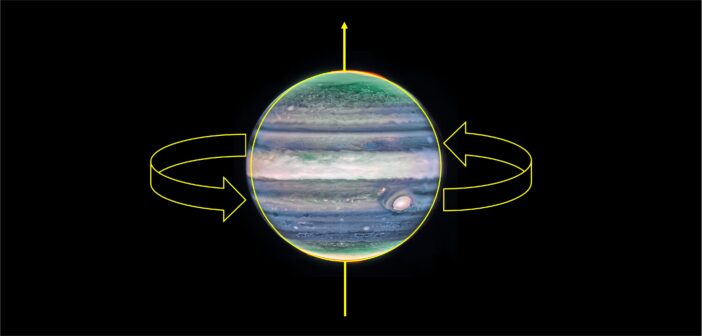
Though countless astronomy problem sets have asked students to consider planets to be spheres, not all planets are so perfect. Rapid rotation turns gaseous planets into slightly squished, or oblate, spheroids. Measurements of this subtle departure from a perfect sphere have the potential to reveal the rotation rates of distant exoplanets and the amount of angular momentum they carry, helping to disentangle how these planetary systems formed.

However, measuring this subtle signal is hard, and so far oblateness has been measured for only a handful of planets. Transiting planets can reveal themselves to be slightly squished only when crossing in front of the edge of their host star, requiring sensitive, high-time-cadence observations — and the right software to analyze the signal.

greenlantern Lights the Way
comparison of flux during the transit of a spherical planet and an oblate planet

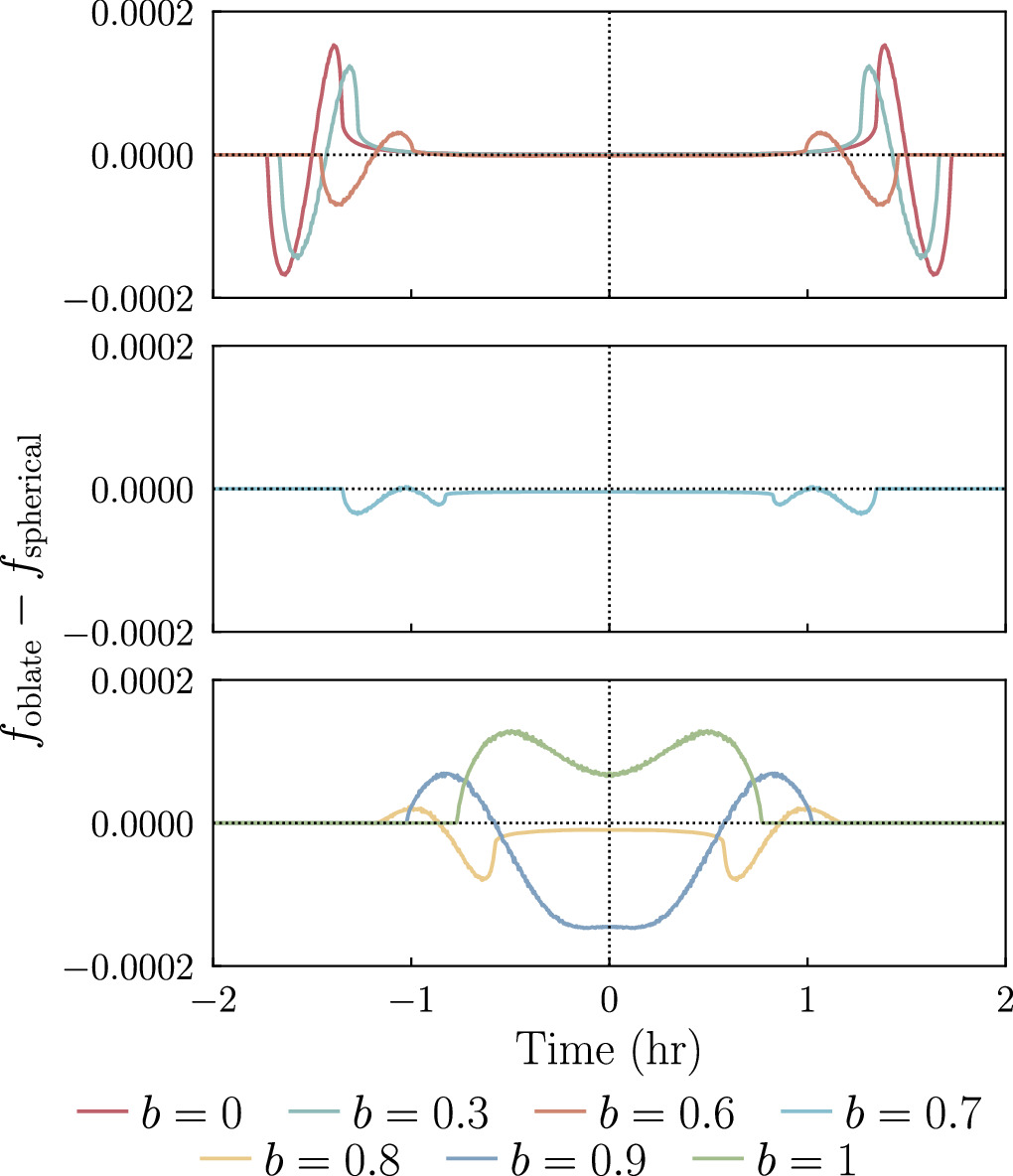
Examples of how the flux during a planetary transit differs between an oblate planet model and a spherical planet model. For all of the examples plotted, the oblate planet and its comparison spherical planet cover the same area of their host star mid-transit. The line color signifies the impact parameter. [Price et al. 2025]

Recently, Ellen Price (University of Chicago) and collaborators introduced new software that models the light curves of oblate planets transiting their host stars. The software, named greenlantern, isn’t the first or only code to tackle the problem of modeling transits of oblate planets. greenlantern‘s advantage comes in its efficiency, which minimizes its computational cost, and its public availability. (You can check it out here!)

After walking through the technical aspects of the model, Price’s team introduced their test subject, the sub-Neptune exoplanet HIP 41378f. HIP 41378f is notable for being the outermost of five known planets in its star system, for having an extremely low bulk density of just 0.09 gram per cubic centimeter, and for having a long, chilly, 542-day orbit around its host star.

Price’s team used their code to fit Kepler space telescope data of HIP 41378f and constrain the planet’s oblateness and, by extension, its rotation rate. They determined that the planet’s rotation period is at minimum 15.3 hours, making it a slower rotator than either Jupiter (10 hours) or Saturn (10.5 hours).
joint probability distribution of flattening and projected obliquity

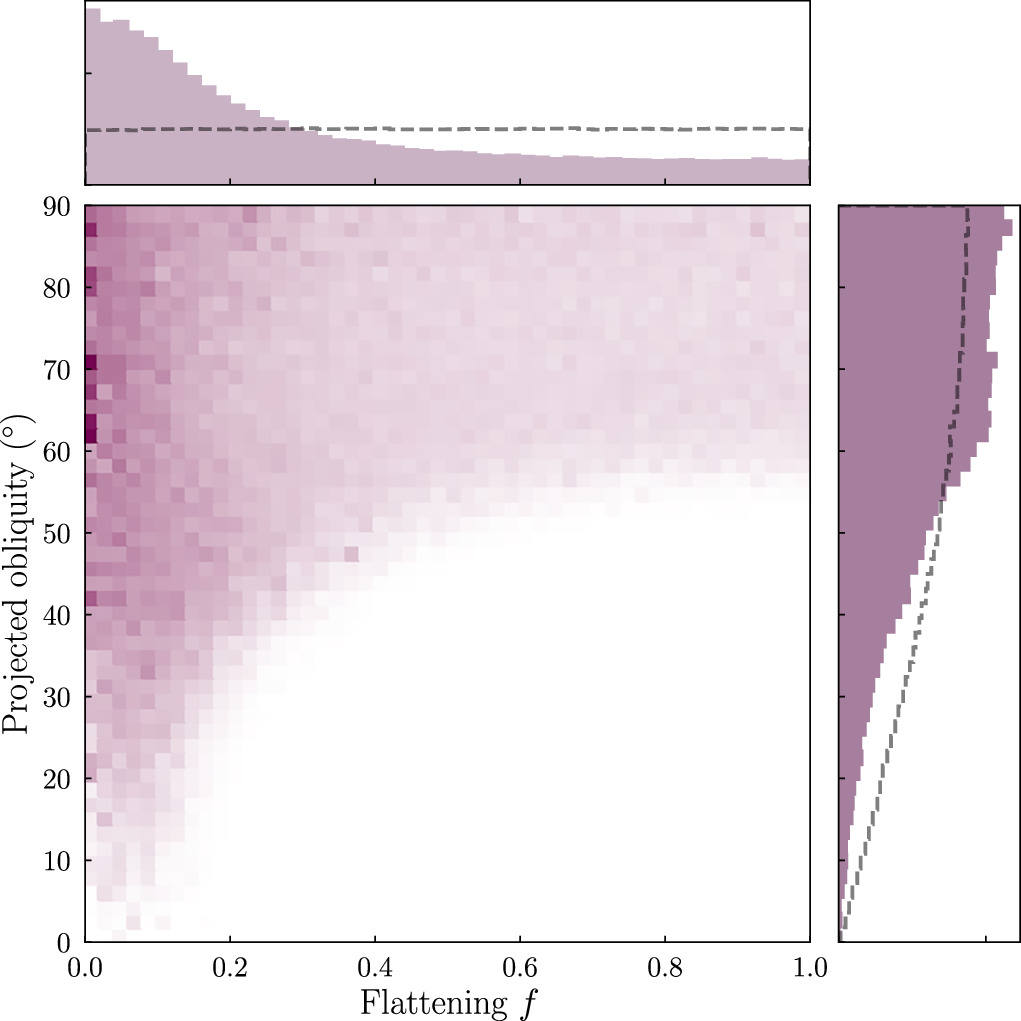
Joint probability distribution for the flattening and projected obliquity (axial tilt) of HIP 41378f. [Price et al. 2025]

Rotating Through the Possibilities

In addition to constraining the rotation rate, this work also showed that current observations of HIP 41378f are consistent with a broad range of axial tilts. What does this mean for how HIP 41378f formed? Given the planet’s mass — 12 Earth masses, give or take a few — a large axial tilt could arise in a variety of ways, including gravitational interactions between the planets in the system. However, with HIP 41378f orbiting quite far from its siblings, it’s not clear why it would be so tilted, and more data are needed to pin down HIP 41378f’s axial tilt.

Finally, Price’s team interpreted the results in the context of HIP 41378f’s possible ring system. Given the planet’s extremely low bulk density, it’s possible that a system of rings has artificially inflated the planet’s apparent radius. In this case, the measured oblateness would reflect the influence of the ring system and could not be used to constrain the planet’s rotation rate.

Citation

“A Long Spin Period for a Sub-Neptune-Mass Exoplanet,” Ellen M. Price et al 2025 ApJL 981 L7. doi:10.3847/2041-8213/adb42b

The post How Squished Is That Planet? Astronomers Measure Oblateness of a Sub-Neptune appeared first on AAS Nova.

  •  

To Be or Not to Be Aligned: Exploring Spin–Orbit Alignment Trends for Exoplanetary Systems

hot jupie

Understanding exoplanetary system architectures is crucial to uncovering how planetary systems form and evolve. A recent study homes in on the XO-3 system to explore how planets orbit their host stars and what that may mean for their formation pathways.

Alignment Trends

Observations of exoplanetary systems have unveiled multiple interesting properties and characteristics that have expanded our understanding of planet formation beyond our solar system. One such property is the spin–orbit alignment — the direction a planet orbits its host star with respect to the star’s spin. In our solar system, the planets orbit in the same direction the Sun is spinning, but for many exoplanets, this is not the case.

stellar obliquity diagram

Star–planet systems demonstrating spin–orbit alignment and an example of a 40 degree spin–orbit misalignment. Click to enlarge. [AAS Nova/Lexi Gault]

Over the last few years, researchers have noticed a trend in which systems with high planet-to-star mass ratios tend to be more aligned, while planets with smaller mass ratios tend to exhibit larger spin–orbit misalignment. For example, hot Jupiters orbiting small, cool stars tend to remain aligned, while hot Jupiters orbiting massive, hot stars often are misaligned. 

There’s one exception to this trend: planet XO-3b. Orbiting a hot star and within a high planet-to-star mass ratio system, XO-3b was the first exoplanet observed with a high spin–orbit misalignment and has thus been the subject of multiple studies. However, its orbital angle is still uncertain. If this planet is truly an outlier, this would further complicate our understanding of planet formation mechanisms.

Getting to Know XO-3b 

To confirm whether XO-3b is a true outlier and understand why this planet does not bend to the trend, Jace Rusznak (Indiana University) and collaborators acquired new observations of the XO-3 system with NEID, a radial velocity instrument on the WIYN 3.5-meter telescope. By observing how the star’s radial velocity changes as the planet passes in front of the star, they can precisely determine the spin–orbit alignment of the planet as well as measure the properties of the XO-3 system.

Combining the new radial velocity measurements with previous Transiting Exoplanet Survey Satellite (TESS) data for XO-3b, the authors determine that the planet has a spin–orbit misalignment of 40.2 degrees. To confirm that this planet is truly an outlier, the team constructs a sample of single-star exoplanetary systems using the NASA Exoplanet Archive. They find a statistically significant difference in the alignment of systems with planet-to-star mass ratios above and below 2×10⁻³. With a high planet-to-star mass ratio of 9×10⁻³, the XO-3 system is unusually misaligned compared to other systems with similar planet-to-star mass ratios. 

spin orbit misalignment

Spin–orbit angle distribution for cool-star systems (top) and hot-star systems (bottom) as a function of planet-to-star mass ratio. The location of the XO-3 system is labeled, showing its high misalignment compared to other systems of similar planet-to-star mass ratios. Click to enlarge. [Rusznak et al 2025]

Undetected Companion

Now left with the conundrum of how XO-3b wound up misaligned, the authors consider the possibility of an undetected stellar binary companion that could have pulled the planet out of line. Previous observations of XO-3 did not directly observe a physically associated stellar companion, but errors in the Gaia astrometry of the star are atypically high for a single-star system. These errors could be the result of an undetected stellar companion gravitationally interacting with both XO-3 and its planet. 

Further observations of the XO-3 system are required to confirm that the system is actually a stellar binary, but if a second star is found, XO-3b would no longer be an outlier in the spin–orbit alignment versus planet-to-star mass ratio trend. This would increase the significance of the emerging relationship that, for single-star systems, planets with high planet-to-star mass ratios tend to be aligned even around hot stars, suggesting that planets in such systems are born aligned and stay that way.

Citation

“From Misaligned Sub-Saturns to Aligned Brown Dwarfs: The Highest Mp/M* Systems Exhibit Low Obliquities, Even around Hot Stars,” Jace Rusznak et al 2025 ApJL 983 L42. doi:10.3847/2041-8213/adc129

The post To Be or Not to Be Aligned: Exploring Spin–Orbit Alignment Trends for Exoplanetary Systems appeared first on AAS Nova.

  •  
❌