❌

Reading view

A London doctor traced hundreds of cholera deaths in 1854 to one neighborhood water pump and persuaded the parish to remove its handle — months later he mapped the outbreak, years before contaminated water was widely accepted as a cause of cholera

A mother rinsed her baby’s dirty nappy in a bucket and tipped the water into the cesspool outside her front door. Within ten days, more than 500 of her neighbours were dead. If Henry Whitehead’s later reconstruction was right, hers was where it started.

The baby was five months old and lived at 40 Broad Street, Soho, in a district of tenements chopped into cheap rented rooms. Her death, on 2 September 1854, went into the records as diarrhoea rather than cholera, so she never appeared in the tally that made the street famous, as Gavi’s account of the outbreak notes.

Ten minutes’ walk away in Sackville Street lived a physician named John Snow, who had spent five years arguing that cholera travelled in water and getting nowhere. His 1849 essay on the subject was largely ignored by the medical profession. Respectable opinion held that epidemic disease rose off rotting matter as a poisonous vapour, a theory called miasma. Under miasma, the smell was the disease.

The map was made of black bars

Snow got the addresses of the dead from the General Register Office and walked them. He knocked on doors, asked survivors where they drew their water and worked out that the deaths clustered overwhelmingly around one public pump on Broad Street.

Months later he turned that investigation into the map that became famous, marking each known death as a short black bar at the address where it happened. By December he had tracked down 616 deaths, though only 574 could be placed on the map itself, the rest belonging to people who had died away from the district with no address on record. He published it in the second edition of On the Mode of Communication of Cholera in 1855.

He had no germ, no culture and no microscope image worth anything, only addresses.

The strongest evidence came from people who survived

Seventy men worked at the brewery on Broad Street and not one of them died. They drank a daily beer allowance, used a private well and never touched the public pump, per the Science History Institute’s account of the investigation. A workhouse squarely inside the death zone held over 500 people, lost only a handful and had its own supply.

Then there was the widow. A woman in Hampstead, miles to the north, died on 2 September, her visiting niece the day after. Neither had set foot in Soho for years. Snow went up to interview her son and learned she had once lived on Broad Street, liked the taste of the water and kept a servant carting bottles of it north. Her last delivery arrived on 31 August, the night the outbreak began.

Geography was the wrong variable and plumbing was the right one.

The parish agreed and the government did not

On the evening of 7 September, Snow put his case to the Board of Guardians of St James parish. They were sceptical of the theory and impressed by the arithmetic, and the handle was unscrewed the following morning.

Deaths were already falling by then, as Snow himself acknowledged. Thousands had fled the neighbourhood, and the contamination that triggered the outbreak had probably washed through days before.

The national verdict was blunter. England’s General Board of Health reviewed Snow’s theory through its Committee for Scientific Inquiries and rejected it outright: “After careful inquiry we see no reason to adopt this belief.” That committee, as Nigel Paneth and colleagues documented in the American Journal of Public Health, spent roughly a third of its 352-page scientific appendix on barometric pressure, wind direction, cloud cover and ozone levels. One of its own inspectors had handed Snow the Hampstead evidence.

The curate who found the first case

Henry Whitehead, assistant curate of St Luke’s on Berwick Street, had spent the outbreak climbing those stairs with food and last rites. He thought Snow was wrong, and joined the parish inquiry committee partly to clear the pump’s name. Snow gave him a copy of the monograph and he read it and stayed unconvinced, so he went out to disprove it. In April 1855, seven months after the last death, he traced the chain back to the baby at number 40, a case Snow had never counted, as S.P.W. Chave set out in Medical History.

The parish surveyor dug up the well and found the cesspool brickwork rotted through, inches from the well lining.

Whitehead also worked out what taking the handle off achieved. The baby’s father came down with cholera on 8 September, the morning the parish disabled the pump, and his waste would have gone the same way his daughter’s had.

Snow died in 1858, aged 45, with the profession still against him. In Florence that same autumn of 1854, an anatomist named Filippo Pacini had put cholera discharges under a microscope, seen comma-shaped organisms swarming in them and published. Italian medicine believed in bad air too, and Pacini’s finding went unnoticed by Snow, by Robert Koch and by almost everybody else until long after his death. Bacteriologists made it official in 1965, naming the organism Vibrio cholerae Pacini 1854.

Two men landed on the answer in the same year, in two cities, and the medical establishment believed neither of them. The handle came off anyway.

The post A London doctor traced hundreds of cholera deaths in 1854 to one neighborhood water pump and persuaded the parish to remove its handle — months later he mapped the outbreak, years before contaminated water was widely accepted as a cause of cholera appeared first on Space Daily.
  •  

The U.S. government accidentally sold an Apollo 11 bag still carrying traces of moon dust for just $995 in 2015 — the Illinois woman who bought it survived a legal fight with NASA, then sold the same bag at Sotheby’s two years later for $1.8 million

For $995 you could buy a decent second-hand lawnmower, a mid-range mattress, or, if a government spreadsheet has a bad day, a piece of Apollo 11 with moon dust still caught in its seams.

That last one happened. In February 2015, an online auction held on behalf of the US Marshals Service listed a white zippered pouch stamped “Lunar Sample Return”. Nancy Lee Carlson of Inverness, Illinois, bid $995 and won. She knew it had flown on something. What she did not know was that it had ridden along on the first crewed landing on the Moon.

How a moon bag ended up in a garage in Kansas

Blame starts with Max Ary, who ran the Kansas Cosmosphere and Space Center in Hutchinson from 1976 to 2002 and was convicted in November 2005 on twelve federal counts, including theft of government property, wire fraud and money laundering. Investigators searching his garage two years earlier had found a box, and the bag was inside it. As documented by The Hutchinson News, Ary was ordered to pay more than $132,000 in restitution for the space artefacts he had taken, a mix of property belonging to NASA and the museum itself. He always maintained he had simply muddled his own collection with theirs.

His forfeited property went to auction to cover the bill. That is where the mix-up happened. Per the Associated Press, government officials later said two lunar bags had been merged into a single entry when their inventory numbers were combined on spreadsheets. One was from Apollo 17. The other had been to the Sea of Tranquility, and nobody caught the difference before the gavel came down.

What the fabric was hiding

Carlson did the sensible thing and posted the pouch to NASA’s Johnson Space Center for authentication.

Terrible idea, as it turned out. Curators tested the cloth, found lunar material embedded in the fibres, and established that the pouch had served as the outer decontamination bag around the first rocks Neil Armstrong scooped up during the Apollo 11 moonwalk. Then NASA kept it, arguing the bag was government property that should be on public display, not sitting in someone’s living room, and asking the Justice Department to reverse the forfeiture.

Carlson sued. Twice, in two states.

The ruling nobody at NASA wanted

In December 2016, Judge J. Thomas Marten of the US District Court for Kansas ruled that Carlson was “a good faith purchaser, in a sale conducted according to law,” as reported by Robert Pearlman at collectSPACE. Marten went out of his way to say NASA had done nothing wrong here, and that the bag only mattered at all because of what NASA’s own people had pulled off in 1969. He also said he had no power to unwind a sale that had already gone through. Space.com later reported that NASA handed the bag back in February 2017.

Sold at Sotheby’s, well short of the estimate

Sotheby’s offered the pouch on 20 July 2017, 48 years to the day after Armstrong used it. NPR put the hammer price at $1.5 million, or $1,812,500 once Sotheby’s premium was added, which sounds enormous until you notice the house had estimated $2 million to $4 million. The buyer stayed anonymous.

Plenty of people thought the sale should never have happened at all. Michelle Hanlon of For All Moonkind, a group campaigning to protect the Apollo landing sites, said in a statement carried by Smithsonian magazine that the bag belonged in a museum where the world could share in the achievement it represents. Carlson told CBS News she decided to sell because she no longer felt it was safe in her home.

The dust went on to have its own career

NASA’s testing had lifted particles off the bag onto carbon tape mounted on aluminium stubs, and the agency held on to them after returning the pouch. collectSPACE reported that Carlson sued again in January 2019, claiming the testing had damaged the bag, dragged down its market value and caused her real distress, and demanding the return of the lunar material itself. That dispute settled out of court, and the samples went to her.

Which is how, in April 2022, five aluminium stubs, each topped with a 10-millimetre disc of carbon tape, came up in a New York saleroom. Bonhams sold them for $504,375, well under a pre-sale estimate of $800,000 to $1.2 million. Bidding opened at $220,000, seven bids came in, and the hammer fell at $400,000. Independent testing found four of the five stubs carried particles matching Armstrong’s first sample.

NASA still holds almost all of the 382 kilograms of rock, dust and core material brought home by the six Apollo landings. Its position on the rest hasn’t shifted in half a century: this material belongs to the public, not to private collectors. That stance holds up fine, right until two rows get merged on a spreadsheet.

Somewhere out there is a collector nobody can name, holding a cloth bag worth more than most houses, backed by a government receipt for $995 confirming the sale was done by the book.

The post The U.S. government accidentally sold an Apollo 11 bag still carrying traces of moon dust for just $995 in 2015 — the Illinois woman who bought it survived a legal fight with NASA, then sold the same bag at Sotheby’s two years later for $1.8 million appeared first on Space Daily.
  •  

Sweden is moving parts of an Arctic city because decades of iron mining are deforming the ground beneath it — in 2025 a 672-ton church was placed on giant transporters and rolled five kilometers to the new city center

Kiruna’s church went for a walk in August 2025, at half a kilometre an hour, on 224 wheels.

The trip took two days and included a daily stop for fika, the Swedish afternoon coffee break, because some traditions outrank engineering schedules. One driver steered the entire building with a handheld control box across roughly twelve hours of travel, along a route crews had spent months preparing. The Associated Press, in coverage carried by CTV News, reported that a main road was widened from nine metres to 24 and a viaduct was dismantled to clear a new intersection. State-owned mining company LKAB, which paid for the whole performance, lists the church at 672.4 tonnes and 40 metres across. Thousands of people stood in the wind to watch a building do the one thing buildings are designed never to do.

Norwegian contractor Veidekke built the road the church rolled along and the foundations waiting at the far end, as documented by Dezeen. It was not the first tenant to make the trip. By July, AP counted 25 buildings already jacked onto beams and wheeled east, with 16 still queued behind them.

Why the ground is giving way

Beneath the town sits the largest underground iron ore mine on the planet. White Arkitekter, the practice behind the masterplan for the new city, describes daily extraction as the equivalent of six Eiffel Towers of ore, and notes that two thirds of Kiruna’s residents depend on the mine for work. Digging began in 1910. The church was completed two years later, a gift from the company, built on a hill so the congregation could look out over the town the company had also built.

Take enough rock out from under a place and the rock above fractures, sags and follows the hole down. Crews are now working towards a main level 1,365 metres deep, and the surface has been reporting back for years in split walls and buckled roads. In 2004 LKAB told the municipality that the centre would have to be picked up and shifted east, since the alternative was to stop mining.

Sweden chose the mine.

What it costs to relocate a town centre

The company’s own accounting is blunt about the scale. LKAB estimates that at least 3,000 dwellings are affected, 6,000 residents must move and 450,000 square metres of floor space stands in the way, with roughly a third of the urban centre inside the affected zone. The replacement centre opened in September 2022. Per France 24, shifting the church alone carried a price tag of 500 million kronor, about 52 million US dollars.

Then came the sequel. LKAB has since published an expanded impact area that adds a further 6,000 people and 2,700 homes to the queue over the next decade, and CNBC has put the company’s estimated compensation costs across that period at 22.5 billion kronor, roughly 2.4 billion dollars.

Not all of it reads as loss. The Institution of Civil Engineers treats the relocation as a rare chance to redraw a city from scratch: a denser centre planned around good lighting through the long polar dark, 3,000 new homes, and streets arranged so nobody lives more than three blocks from open country. The same assessment records that the rebuild has squeezed Sami reindeer herders, who were working the land long before LKAB arrived.

The residents who cannot be loaded onto trailers

Lars-Marcus Kuhmunen chairs Gabna, the reindeer-herding Sami community whose grazing corridors have already been carved up by the mine, the railway and the town. Speaking to Swedish public broadcaster SVT, he said a new mine at the Per Geijer deposit would mean the end of reindeer herding as they know it, because the ore sits beneath the last narrow passage his herds use between seasonal pastures.

Per Geijer is the reason the arithmetic keeps changing. A report by the Stockholm Environment Institute, covered by ArcticToday, found the project carries significant risk of breaching the Indigenous rights of Sami community members, in the words of senior research fellow Rasmus Kløcker Larsen. That is one institute’s assessment rather than a court ruling, and permitting has years to run. The deposit holds 1.2 billion tonnes of mineral resources including 2.2 million tonnes of rare earth oxides, which is why the European Union has flagged it as strategically important for cutting its dependence on Chinese supply.

Reindeer, unhelpfully, cannot be rerouted by memo.

What happens to the building

Henning Larsen’s circular town hall anchors the relocated core, and the church is due to reopen at its new address, between the cemetery and the new town centre, in 2026. Parts of the stone wall that ringed the old site will be moved across to join it. Where it used to stand becomes a mining town park, kept as a quiet green space until the ground beneath it is needed, at which point the fences go up and the park goes the way of the neighbourhood.

Kiruna has become very good at a peculiar skill: treating permanence as a logistics problem with a budget attached. Beams, jacks, 224 wheels, a control box and a coffee break. A church can be lifted onto a trolley and driven down the road. A migration route cannot.

The post Sweden is moving parts of an Arctic city because decades of iron mining are deforming the ground beneath it — in 2025 a 672-ton church was placed on giant transporters and rolled five kilometers to the new city center appeared first on Space Daily.

  •  

That salmon on your sushi plate feels like an ancient Japanese tradition, but it isn’t — until the 1990s the Japanese didn’t eat raw salmon at all, and the reason they do now traces back to a Norwegian marketing campaign

Somewhere in Tokyo in the mid-1980s, a Norwegian marketing strategist stood in front of a room of Japanese seafood executives, served them raw salmon, and watched the room politely fall apart. The colour was wrong, they told him. Its smell, they said, had a river-like quality. Someone objected to the shape of the fish’s head.

I think about that meeting every time I sit at a conveyor belt and watch the orange slabs go past. Salmon nigiri has the settled look of something that was always there, parked next to the tuna and looking as venerable as a prawn tempura. It has been on Japanese menus for about thirty years.

What Japan actually ate before

Japanese cooks have used salmon for centuries. They grilled it, salted it, flaked it into rice balls and packed it into lunchboxes. Nippon.com describes grilled salmon and salmon flakes as fixtures of home cooking, with a hard line drawn between that cooked fare and anything sliced raw. The domestic workhorse was chum salmon: lean, firm, nobody’s idea of sashimi.

So the fish was there. The appetite for raw fish was very obviously there. Those two facts never met.

The parasite question, answered properly

There was a real reason for the line, and fussiness was not it.

Wild Pacific salmon carry Anisakis simplex, a nematode larva that causes a thoroughly miserable illness called anisakiasis if you swallow it alive. Heat kills it. Deep freezing kills it. Slicing the fish fresh and eating it does not, which is why generations of Japanese cooks treated raw salmon as a hazard to be cooked out.

Farmed Atlantic salmon raised on heat-treated pellets is a different animal. The Norwegian Food Safety Authority exempts farmed salmon and rainbow trout from the freezing rule that otherwise applies to fish destined to be eaten raw, on the grounds that the fish eat nothing but dry feed containing no viable parasites and barely graze on wild organisms in the pen. That exemption tracks a 2010 European Food Safety Authority opinion and its 2024 re-evaluation.

A survey published in the Italian Journal of Food Safety put numbers on it: 270 slices of smoked farmed Atlantic salmon examined, zero anisakids found, against ten positives out of thirteen slices of wild sockeye. One paper on one processed product, not a settled literature, but it points the same way the regulators do.

Norway had too much fish

Norway started farming salmon commercially in the 1970s, then watched its own population drift towards chicken and red meat.

Freezers filled up.

The Norwegian Seafood Council, which has every commercial reason to tell this story well, dates the campaign to 1985, when a delegation led by former fisheries minister Thor Listau flew to Tokyo. Their figures: two tonnes of Norwegian salmon went to Japan in 1980, and twenty years later the annual number was above 45,000 tonnes.

Underneath all of it sat one piece of arithmetic. Fish sold for the grill competes on price with every other cheap protein, while fish accepted for sashimi could fetch up to ten times more, as Bjørn Eirik Olsen, who ran market research for the project, later told The Japan Times.

A name change, then a decade of nothing

“We couldn’t just say that our fish doesn’t have parasites,” Olsen said in that interview. Walking into a foreign industry and announcing that its national fish is wormy tends to close doors rather than open them.

So he went after the word instead. The Japanese for salmon is sake, and sake carried every association he was trying to escape: grilled, salted, cheap, the thing in the lunchbox. Olsen borrowed the English word and pushed the katakana sāmon, the term still stamped on essentially every sushi menu in the country. Same animal, different shelf.

Then came the advertising, all clean fjords and clear arctic water, and it achieved almost nothing for years. Olsen told NPR that pressure from home to abandon the sushi idea and dump the stock into the grill market was relentless.

The deal that broke it open

In 1992, Olsen offered the frozen food giant Nichirei 5,000 tonnes of salmon at close to giveaway prices, with one condition written into it: the fish could only be sold as sushi. Nichirei said yes.

That was the crack in the wall. Through the 1990s, Iron Chef and celebrity chefs including Yutaka Ishinabe put Norwegian salmon onto national television, and appetite did the rest. Olsen has said he knew the campaign had landed when he started noticing plastic salmon nigiri in restaurant window displays.

Where salmon sits now

Salmon has topped Japan’s biggest conveyor-belt sushi survey for fifteen consecutive years. In the 2026 round, run by Umios (the company known as Maruha Nichiro until March), 47.7 per cent of respondents named it as the topping they eat most often, more than eleven points clear of lean tuna in second place. The split runs along age lines: older diners tend to open with lean white fish and work up to tuna, while younger ones go straight for the orange.

Norway built something very large on the back of it. The seafood council reckons roughly 30 per cent of all Norwegian salmon now ends up raw in sushi, and that Norway supplies a little over half the global salmon market across 113 countries.

The high end went too. That’s the part I still find slightly hard to credit. Iwasa-zushi in Toyosu used to turn away customers who asked for salmon back when the market was at Tsukiji, and now has it on the board. Yamagata Tadashi, whose family has run a Nihonbashi sushi restaurant since 1887 and who chairs the Japan Sushi Environmental Health Federation, expects salmon to become a staple of Edomae sushi, arguing that clinging to wild domestic fish alone will empty the sea.

What a tradition is made of

The reasoning that lost for a decade turned out to be correct. Cold water, controlled feed, negligible parasite risk, safe raw. Olsen simply had no way to prove it to a room that had already decided, and no vocabulary that did not sound like an insult.

The argument never won anyone over. A discount and a shipping container did.

What gets me is how completely the seam has vanished. A teenager ordering sāmon at a kaiten place in Osaka is not participating in a trade negotiation or performing globalisation, any more than an Indian cook reaching for a chilli is. Thirty years is apparently long enough for a foreign product, sold under an English name at a loss by a government agency with a warehouse problem, to become simply what people like. Every cuisine anybody calls ancient is carrying a few of these, quietly, with the receipts thrown out.

The post That salmon on your sushi plate feels like an ancient Japanese tradition, but it isn’t — until the 1990s the Japanese didn’t eat raw salmon at all, and the reason they do now traces back to a Norwegian marketing campaign appeared first on Space Daily.

  •  

South Korea was producing very little internationally recognised music in 1995 — within three decades it was topping the global album charts and had climbed into the world’s largest music markets, a rise seeded by a post-1997 government bet on culture as an export and built by the record labels that bet alongside it

In 1995, South Korea’s recorded music business was, commercially, a domestic one. Seo Taiji and Boys were selling in the millions at home and registering nowhere abroad. The country had no act on a major Western album chart and no meaningful export line for music.

Three decades on, the Korea Customs Service logged US$301.7 million in K-pop album exports for 2025, the first year the figure passed US$300 million. Japan took US$80.6 million of that, China US$69.7 million, the United States US$64 million. In the IFPI’s 2025 Global Music Report, covering 2024, South Korea ranked as the seventh largest recorded music market in the world.

Those are physical album shipments alone. Streaming, publishing, touring and merchandising sit outside that customs line.

What the 1999 statute created

What the law actually did is less sweeping than the retellings suggest. The Framework Act on the Promotion of Cultural Industries passed on 8 February 1999, and it named music and games as industries in their own right. That classification is what made them eligible for the tax breaks, cheap credit and government-built facilities the Act goes on to describe. Investment funds could now be set up specifically for cultural products. A guarantee scheme let producers borrow against work they had not yet finished, which is the ordinary difficulty in paying for an album or a film. Government money could go towards overseas marketing and towards co-productions with foreign partners. A state content agency was created under the Act, the body that after a 2009 merger became the Korea Creative Content Agency.

The ministry was already running a cultural industry bureau before the Act passed, which makes 1999 an escalation of an existing function rather than a founding. Kim Dae-jung took office in February 1998, the same month that ministry was renamed from Culture and Sports to Culture and Tourism in a broader government reorganisation.

On the strategic framing, the Victoria and Albert Museum’s account of hallyu’s origins describes the post-crisis gamble as a twin bet on information and communication technologies and on culture industries, with the stated aim of quadrupling cultural industry exports.

The sums were modest. The cultural industry budget rose from roughly US$14 million in 1998 to around US$84 million by 2001, a figure traced to the 2003 White Paper on Culture and Industry and cited in a 2025 piece on Korean cultural statecraft in the US Army War College’s War Room. Set beside the semiconductor build-out of the same years, that is a rounding error.

What the state did not do

No agency built the acts. That was done by privately held companies incorporated in the same window: SM Entertainment in 1995, YG Entertainment in 1996, JYP Entertainment in 1997. H.O.T. debuted in 1996 and set the template the sector still runs on, which is long-horizon trainee development, in-house production, and groups configured for a specific market rather than assembled around a single writer.

Financing is the part usually left out. SM Entertainment listed on the KOSDAQ exchange in 2000, meaning a pop label was raising public equity at a point when its overseas earnings came overwhelmingly from elsewhere in Asia. That structure, listed capital funding multi-year artist development, let firms absorb the cost of acts that would not return anything for five or six years.

The state bet on the category. Labels bet on individual careers, with shareholders carrying the risk.

The 2018 threshold

Commercial proof arrived twenty years after the statute. BTS’s Love Yourself: Tear, released by Big Hit Entertainment on 18 May 2018, entered the Billboard 200 at number one with 135,000 equivalent album units, 100,000 of them traditional album sales. It was the first Korean-language album to top the chart and the first predominantly non-English one since Il Divo’s Ancora in 2006.

That ratio matters more than the position. Streaming supplied a small share of the debut; most of it was people buying objects. Korean labels had spent a decade refining album packaging, version variants and pre-order mechanics for domestic and Japanese fan markets, and the same machinery worked in the United States unmodified.

The 2024 plateau

Growth was not continuous, and the middle of this decade complicates the arc considerably.

Exports came to US$291.8 million in 2024, up 0.55 per cent on 2023 by Korea Customs Service reckoning, which after nine years of compounding growth amounts to a standstill. Shipments to Japan fell 24.7 per cent that year. Korea’s own recorded music revenue declined 5.7 per cent in 2024, the only contraction among the IFPI’s top ten markets that year even as the country held seventh place. Circle Chart, run by the Korea Music Content Association, recorded a fall in album sales for the first time since 2014.

Sales kept sliding through 2025. Circle Chart put the combined domestic and overseas total at roughly 93.5 million copies, a second consecutive annual decline from about 120 million in 2023, with plastic CD waste and reduced fan-targeted marketing cited by analysts as contributors. Exports rose while units fell.

Where the money sits now

HYBE, the largest of the listed firms, reported record 2025 revenue of 2.65 trillion Korean won, roughly US$1.86 billion, up 17.5 per cent. Operating profit dropped 72.9 per cent to 49.9 billion won, taking the operating margin from 8.2 per cent to 1.9 per cent. Concert revenue climbed almost 70 per cent while recorded music fell 10.2 per cent. Net loss came to 256.7 billion won, widened by an impairment of about 200 billion won booked in the fourth quarter against the restructuring of the North American business, which the company describes as an accounting item with no cash outflow.

IFPI’s Global Music Report 2026 records physical formats returning to growth worldwide in 2025, up 8.0 per cent, which it attributes to fan demand for tangible releases and a 13.7 per cent rise in vinyl, vinyl’s nineteenth consecutive growth year. Japan, the second largest market, returned to growth at 8.9 per cent.

What the first half of 2026 answered

Two questions left open by the 2025 filings have since been settled, at least provisionally.

The first was whether a BTS return would lift recorded music or only touring. HYBE’s first-quarter 2026 results answer it plainly. Recorded music revenue nearly doubled to 271.5 billion won on the back of Arirang, released 20 March, a rise of 98.9 per cent. Concert revenue fell 42.8 per cent to 88.7 billion won, because the tour had barely begun. Total quarterly revenue of 698.3 billion won was its largest opening quarter to date. HYBE still posted a net loss of 156.7 billion won, driven by a one-off stock award expense of about 255 billion won; excluding it, adjusted operating profit was 58.5 billion won.

The second was the geography. K-pop album exports reached US$257.48 million in the January to June period, up 125 per cent year on year, with roughly 55 million units shipped. The United States took US$74.12 million, ahead of China at US$61.18 million and Japan at US$45.61 million. Japan has been the anchor of Korean physical sales abroad since the 2000s and is now third.

What remains unresolved is the domestic market and the margin. Album sales inside Korea have fallen two years running, and the concentration question sits underneath the 2026 numbers: a single comeback moved the national export total by 125 per cent. Whether the investment that flattened HYBE’s margins in 2025 produces a second tier of exportable acts is not something a strong first half can demonstrate.

The post South Korea was producing very little internationally recognised music in 1995 — within three decades it was topping the global album charts and had climbed into the world’s largest music markets, a rise seeded by a post-1997 government bet on culture as an export and built by the record labels that bet alongside it appeared first on Space Daily.

  •  

Researchers who study cults say the people most likely to join aren’t the gullible or the unstable: they’re often people in the middle of a life transition who met the group through someone they already liked

The research literature on why people join tightly bound religious groups is around sixty years old now, and it has been unusually consistent on a finding that never quite made it into general conversation. Those who join are rarely the credulous ones. They are frequently educated, sceptical about the society around them, and carrying a sense of obligation they had not yet found anywhere to put.

What the studies keep landing on instead is timing and company. Somebody meets the group during a stretch when the ordinary structures of a life have come loose, and meets it through a person they have already come to like.

The pattern appears across several independent studies of different movements, conducted by researchers who disagreed with each other about a great deal else. It is also a literature with real boundaries, which we take up further down.

What the 1965 model actually proposed

Most of this traces back to a paper by John Lofland and Rodney Stark, published in the American Sociological Review in December 1965 as “Becoming a World-Saver: A Theory of Conversion to a Deviant Perspective”. The group they observed was a small millenarian movement on the American west coast. It was later widely understood to have been the first American cell of the Unification Church.

Their model was sequential. Conversion required a person to be experiencing enduring and acutely felt tension, and to interpret that tension in religious rather than political or psychiatric terms. From there, the person had to come to see themselves as a seeker, and to encounter the group at what the authors called a turning point in life. An affective bond with a member then had to form, competing outside attachments had to weaken, and the recruit had to be drawn into sustained daily interaction.

Seven conditions, each necessary, none sufficient alone.

How far the scheme travelled was contested almost immediately. Lofland returned to the same movement in a 1977 article in American Behavioral Scientist, revising his account of how its conversion organisation had changed. Within a decade other researchers were putting the model to work on other groups, with mixed results.

The turning point does more work than the personality

Lofland and Stark meant something specific by a turning point: a stretch in which old lines of action had been completed, disrupted or broken off, and new ones had not yet formed. Graduation. A move to a city where nobody knows you. The end of a marriage. Recovery from a long illness. The month after the work you organised yourself around stops. Somebody in that position has more unassigned hours, fewer people who would notice a changed schedule, and no ready answer to the question of what they are doing with their life.

Later social movement research made a related structural argument. David Snow, Louis Zurcher and Sheldon Ekland-Olson, writing in the American Sociological Review in 1980, found that recruitment ran along existing social networks and worked most efficiently on people with few countervailing commitments holding them in place. That literature came to call the condition structural availability.

Friendship arrives before belief

Sturdiest of all is the finding about who does the recruiting. Rodney Stark and William Sims Bainbridge brought quantitative data from three quite different radical religious groups to the American Journal of Sociology in 1980, and made the case that interpersonal bonds were the essential mechanism. They treated the older deprivation-based explanations and the newer network-based ones as complementary rather than rival, and observed that social ties underpin commitment to conventional faiths as well.

On that account, doctrine comes second. People become close to members and take on the beliefs afterwards, as part of the cost and the pleasure of belonging. It accounts for the failures too. Recruitment stalls when the people already in somebody’s life stay close enough to keep asking questions.

Barker’s figures, and the part that gets left out

Eileen Barker, now emeritus professor of sociology at the London School of Economics, published The Making of a Moonie: Choice or Brainwashing? in 1984, after close to seven years of fieldwork. She attended workshops and communal centres, and put long interviews and questionnaires to four distinct populations: current members, ex-members, non-joiners who had been through the movement’s recruitment approach and declined it, and separate control groups of uninvolved people from comparable backgrounds. Parents, spouses and friends were surveyed too.

Her retention figures are the interesting part. Writing later in the Encyclopedia of Religion and Society, Barker put it plainly: the overwhelming majority of those exposed to the alleged brainwashing techniques did not join the movement. Most of those who did join left of their own accord within a couple of years. Enumerations in the 1984 book put the yield of the residential two-day workshop, described at the time as the movement’s most effective instrument of persuasion, at fewer than a quarter of attendees staying beyond a week.

Very little stuck.

In the same entry, Barker describes the intake of the early 1970s as disproportionately middle-class and well educated: young people giving up college and careers to work long hours on the street for the movement. She characterises the membership of that period as youthful idealists with few responsibilities.

The idealism and the availability arrive together.

How to read the psychiatric data

Marc Galanter, Richard Rabkin, Judith Rabkin and Alexander Deutsch published a study of 237 Unification Church members in the American Journal of Psychiatry in February 1979. Members completed a 216-item questionnaire. They scored below the mean of an age and sex matched comparison group on a general wellbeing scale, and reported significantly more distress in the period before conversion than after it.

Two cautions on that. The pre-conversion measure is retrospective self-report gathered from people currently inside the group, and a movement that teaches members to read their earlier life as empty has supplied both a reason and a vocabulary for describing it that way. Elevated distress before a transition also sits some way short of psychiatric instability, which a cross-sectional questionnaire was not designed to assess.

What survives is less comfortable than either misreading. Whatever else the organisation was doing to its members, they reported feeling better inside it than they remembered feeling outside.

What the literature does not settle

Nearly all of it describes one window: American and British new religious movements between the mid 1960s and the mid 1980s, examined by sociologists who were arguing, often explicitly, against the brainwashing accounts then running in the press. That argument shaped which questions got asked.

Within the model itself, the turning point element has had a harder time than the friendship element. David Snow and Cynthia Phillips tested the Lofland-Stark sequence against data on the Nichiren Shoshu Buddhist movement in America, writing in Social Problems in 1980, and found little empirical support for the model in its entirety. The tension, seekership and turning point conditions fared poorly in their data. Affective bonds and intensive interaction held, and the authors concluded that conversion was highly improbable in their absence. Any ordering inside the pattern belongs to those datasets and those groups.

How people get in also says almost nothing about what happens to them once they are inside, and the two questions have frequently been run together, including by critics who read this body of work as going easy on the groups it described. An entry route can be entirely ordinary while the organisation waiting on the other side of it does real damage.

Across these studies, what predicted joining was what else somebody had on that month, and who was already sitting beside them.

The post Researchers who study cults say the people most likely to join aren’t the gullible or the unstable: they’re often people in the middle of a life transition who met the group through someone they already liked appeared first on Space Daily.
  •  

At Kyoto University, dogs who saw a stranger snub their owner later took fewer treats from that stranger, and what’s hard to shake is how closely it mirrors us: keeping careful account of who let us down while barely noting who showed up

Published in Animal Behaviour in August 2015, the experiment was a small piece of domestic theatre staged in front of 54 dogs. The owner sat in the middle. A stranger sat on either side. For eight to ten seconds the owner struggled with the lid of a transparent container holding a roll of vinyl tape, then turned to one of the strangers and held the container out, asking for help.

In one version the stranger took the container in both hands, the lid came off, and the owner cheerfully showed the tape to the dog. In another, the stranger turned away and the owner kept failing. Afterwards both strangers held out an identical treat on an open palm at the same moment, neither of them looking at the dog.

The dog chose one.

Dogs who had watched the refusal took food from that person less often than from the stranger on the other side who had done nothing at all. Across the four trials each dog completed, choices of the refuser fell significantly below the chance level of two, at P = 0.023. Hitomi Chijiiwa, Hika Kuroshima, Yusuke Hori, James R. Anderson and Kazuo Fujita published it as “Dogs avoid people who behave negatively to their owner: third-party affective evaluation”.

This is one study, not settled consensus. None of us are comparative psychologists, and what follows is a reading of the paper, of the university’s own summary published on 24 June 2015, and of the research it sits beside.

What the dogs were actually watching

One obvious objection is that a person turning their body away is simply unpleasant to watch, and the design anticipates it. Dogs were assigned to one of three groups of eighteen. In the helper condition the owner asked and received help. In the nonhelper condition the owner asked and was refused. In the control condition the owner worked at the lid for the same interval, paused briefly, and the actor turned away without having been asked anything. In that condition too, the owner failed to open the container.

Dogs in the control condition showed no preference. Turning away, on its own, cost the actor nothing. What cost the actor something was turning away after being asked.

Smaller details make the result harder to explain away. Inside the container was a roll of tape, of no use to a dog, and the authors record that no dog tried to get it out at any point. The neutral person sat looking at the floor throughout, nobody made eye contact with the dog at the moment of choosing, positions were counterbalanced, and every dog got a treat whichever hand it went to.

The half of the result that goes missing

In the helper condition, the dogs’ choices were indistinguishable from chance. Watching a stranger step in and solve the owner’s problem did not make that stranger more attractive than a person who had spent the whole sequence studying the carpet. Reported effect sizes were r = 0.54 in the nonhelper condition, against 0.32 in the helper condition and 0.16 in the control, neither of the latter two reaching significance.

Chijiiwa and colleagues flagged the lopsidedness themselves, noting that the same one-sided pattern has turned up in three-year-old children and in the tufted capuchin monkeys their lab had tested earlier. Their reading was that negative evaluation comes first, with positive evaluation of helpful agents arriving later in human development. Whether dogs show the positive version under other conditions they left open, and put on their own list of things to test next.

Why the shape of it is familiar

Anyone who has spent time with the human negativity-bias literature will recognise the contour. Most of that work traces back to Roy Baumeister, Ellen Bratslavsky, Catrin Finkenauer and Kathleen Vohs, writing in Review of General Psychology in 2001. They worked through evidence across everyday events, close relationships, feedback, learning and impression formation, and found the same skew almost everywhere they looked. Bad impressions form faster than good ones and hold up better against later evidence that contradicts them.

That paper deserves the same scrutiny we are applying to everything else here. It is a narrative review rather than a meta-analysis, assembled a quarter of a century ago and before psychology’s replication reckoning, and its authority comes from breadth of convergence rather than from any single robust result.

Most people can audit the ordinary human version of this themselves. A colleague who did not back you in a meeting stays filed, retrievable years later, in some detail. The one who did back you is remembered as having been there. Help that arrives because it was requested tends to get absorbed into the expected, and things absorbed into the expected stop being events.

What the study does not establish

It does not show that dogs have a moral sense, and the authors do not claim it. Their framing in the university summary puts the weight on affective functions, not on language or on close evolutionary proximity to humans, and allows that the process may be automatic rather than conscious.

One alternative route stays open. That control condition rules out the turning-away gesture and holds the owner’s failure constant, which is careful work. What it cannot fully hold constant is the owner. A person who has been visibly refused may carry themselves differently in the seconds afterwards than a person who has simply paused, and a dog reading its owner’s bearing would produce the same result as a dog evaluating the actor. Separate work from the same lab that year, by Akiko Takaoka and colleagues, showed how finely dogs track human reliability when their own interests are at stake.

Eighteen dogs per condition and four trials each is a small foundation, and the adjacent human literature has become less tidy than it looked. A 2007 study by Kiley Hamlin, Karen Wynn and Paul Bloom reported that infants prefer a character who helps over one who hinders, and it became the anchor for the claim that social evaluation appears in the first year of life. A preregistered multi-laboratory replication run through the ManyBabies framework and published in Developmental Science targeted the video-stimulus version instead of the original live puppet show. Across 37 laboratories and 567 retained infants aged five and a half to ten and a half months, the preference did not differ from chance.

That has not settled the matter against Hamlin. Replication attempts have gone both ways over nearly two decades, and swapping live puppets for video is itself a candidate explanation for a null result. Contested is the accurate word.

Kyoto’s own follow-through is instructive. Running the identical procedure with cats, Chijiiwa and colleagues reported in Animal Behavior and Cognition in 2021 that cats showed no avoidance of the person who had refused their owner. They published the null result rather than leaving it in a drawer, which is more than the field always manages.

The bookkeeping

What the dog result suggests, if it holds, is how little machinery this kind of accounting requires. No language, no theory of anyone’s motives, nothing at stake, and the record still comes out one-sided. A mechanism that cheap is unlikely to be one that insight corrects, and whether knowing about the asymmetry does anything to interrupt it is not a question this literature has answered.

In their write-up, the Kyoto group listed what they wanted to test next. One was whether a helper would earn a positive evaluation if the help came unprompted. That idea is smaller and more testable than anything about moral sense: being asked may change what an act is worth to whoever is watching.

The post At Kyoto University, dogs who saw a stranger snub their owner later took fewer treats from that stranger, and what’s hard to shake is how closely it mirrors us: keeping careful account of who let us down while barely noting who showed up appeared first on Space Daily.

  •  

Trained dogs can sniff out certain cancers from a person’s breath or urine, with accuracies above 90 per cent in some studies. What scientists still can’t fully pin down is exactly which chemical compounds make up the scent a dog is locking onto

A dog can be trained to pick which of seven urine samples in a line-up came from a person with bladder cancer, and to do it more often than chance allows. That was the result of the proof of principle study by Carolyn Willis and colleagues at Amersham Hospital, published in the BMJ in 2004: six dogs, a mean success rate of 41 per cent against the 14 per cent expected from guessing, with a confidence interval running from 23 to 58 per cent. Two decades of follow-up work has produced accuracy figures that in several studies sit alongside the tests currently used in clinics. It has not produced an account of what the dogs are responding to.

What exists is not one paper, and not a consensus either. It runs from single-dog pilots with a few dozen samples to a prostate study of more than nine hundred participants, and the reported accuracy ranges from barely better than chance to almost perfect. Both ends of that range are real.

What the accuracy numbers cover

Prostate and colorectal research has produced the strongest results. Jean-Nicolas Cornu’s group at Tenon Hospital in Paris trained a single Belgian Malinois over twenty-four months, then tested it double-blind on urine from 33 biopsy-confirmed prostate cancer patients and 33 men whose biopsies came back clear. The dog found the cancer sample in 30 of 33 runs, giving sensitivity and specificity of 91 per cent in European Urology in 2011. One of the three men it called wrongly was re-biopsied and found to have cancer after all.

A larger Italian study led by Gianluigi Taverna used two German Shepherds from the Italian Ministry of Defence veterinary centre, testing 362 prostate cancer patients against 540 controls. Writing in the Journal of Urology in 2015, they reported sensitivity of 100 per cent and specificity of 98.7 for the first dog, 98.6 and 97.6 for the second. On the colorectal side, a Kyushu University team led by Hideto Sonoda worked with one eight-year-old black Labrador and reported in Gut in 2011 a breath-sample sensitivity of 0.91 and specificity of 0.99 measured against colonoscopy, with watery stool samples performing slightly better again. Their dog held up on early-stage disease and was not thrown off by smoking or benign bowel conditions.

Set against those, the lung cancer study by Rainer Ehmann and colleagues in Stuttgart, published in the European Respiratory Journal in 2012 under the title “Canine scent detection in the diagnosis of lung cancer: revisiting a puzzling phenomenon”, used four dogs and 220 volunteers including a group with chronic obstructive pulmonary disease. Sensitivity landed at 71 per cent, specificity at 93.

Same species, same broad method, materially different result.

Why the compounds have not been pinned down

The assumption running through most of these papers is that a tumour and the tissue around it release volatile organic compounds, that some of those reach breath or urine, and that a trained nose is picking up a subset of them. Thorsten Walles, the senior author on the Stuttgart paper, put the frustration plainly in the European Respiratory Society’s announcement of the work: It is unfortunate that dogs cannot communicate the biochemistry of the scent of cancer.

Fifteen years on, the chemistry has not converged.

The clearest window into why comes from a 2021 pilot in PLOS ONE led by Claire Guest of Medical Detection Dogs, with collaborators at Johns Hopkins, MIT and the University of Texas at El Paso. The team ran the same urine samples three ways: past two trained dogs, through gas chromatography-mass spectrometry, and through 16S sequencing of the urinary microbiota. The dogs, a Labrador called Florin and a wire-haired Hungarian Vizsla called Midas, each correctly indicated five of seven Gleason 9 samples, giving 71.4 per cent sensitivity with specificity between 70 and 76 per cent. Gas chromatography turned up more than 1,157 distinct compounds in the sample headspace. The handful that differed significantly between cancer and control were not the ones earlier urinary volatilome studies had flagged, and one of them was trimethyl silanol, a breakdown product of silicones rather than anything a prostate makes.

The case for a mixture rather than a marker

The Guest paper’s authors argue something more interesting than a failed search. Their position is that work across prostate, colorectal, liver and lung cancer has repeatedly found selection rules that separate positives from negatives inside a given dataset, without any of those rule sets generalising into a template that holds elsewhere. On their reading, what a dog responds to may be scent character rather than molecular composition, an emergent property of a mixture in which no single compound does the work.

This matters commercially as much as scientifically. A dog is not a scalable diagnostic, and every group in the field is ultimately aiming at a device. A device needs a target, and if the target is a pattern in perceptual space rather than a named compound at a measurable concentration, the engineering problem changes shape. Several groups have since shifted to training machine-learning models on the dogs’ calls instead of on chemical identifications.

What happens when the samples are unfamiliar

Kevin Elliker and colleagues at Cambridge and Nottingham set out to train ten dogs on prostate cancer urine. Three reached the second stage of training, and two of those learnt to pick the cancer sample out of a four-position array often enough to look convincing, one of them at around 76 per cent against a chance rate of 25. Then came three double-blind tests using donors the dogs had never met. The nine-year-old Labrador scored 2 of 15 and 2 of 16 arrays, a sensitivity of 0.13. The Border Collie managed 4 of 16, a sensitivity of 0.25. Neither beat chance, and given samples from the same donors the two showed no agreement with each other. Their conclusion, published in BMC Urology in 2014, was that the dogs had memorised the odour of individual training donors rather than generalised to anything shared by the disease.

The Guest pilot turned up a smaller version of the same difficulty. Both dogs independently flagged the same two cancer-free controls, in the same order, despite blinding and randomised positions. Sequencing later showed both had unusual bacterial profiles. Whether the urinary microbiota was contributing to the odour is unresolved, and the authors list it for larger studies.

Why these results are not a reason to skip standard screening

Nothing in this body of work supports substituting a dog, or a dog-derived test, for colonoscopy, mammography, low-dose CT or a PSA discussion with a doctor. Most of the studies above are case-control designs on selected patients, which is a different task from screening a general population. The largest recent trial, the 2024 Scientific Reports paper on the commercial SpotitEarly breath platform, tested 1,386 participants of whom 338 had cancer. Of those, 261 had one of the four cancer types the system was trained to detect, and for that subset the paper reports 93.9 per cent sensitivity and 94.3 per cent specificity. Two of the authors are SpotitEarly employees and two more were funded by the company, as the declarations state.

Run that same performance at a population prevalence of 1 per cent and, by our arithmetic, about one in seven positive results would be a true positive. The paper does not claim otherwise. Prevalence is what separates a case-control accuracy figure from a working screening test, and it is the first thing to check when a number like that reaches a headline.

What would change the picture is a compound set that can be named, measured and reproduced across laboratories with different sample handling and different patient groups. Sonoda’s team said as much in 2011, and it remains the stated goal of most of the groups working on breath volatilomics. Until someone gets there, each new accuracy figure adds to a pattern the field can demonstrate but cannot yet explain.

The post Trained dogs can sniff out certain cancers from a person’s breath or urine, with accuracies above 90 per cent in some studies. What scientists still can’t fully pin down is exactly which chemical compounds make up the scent a dog is locking onto appeared first on Space Daily.

  •  

Most cat owners I know assume their older cat is just slowing down with age — veterinary research suggests up to 92% of cats over ten have arthritis, and most are hiding it

The cat sleeps more. It jumps up onto things less. It takes longer to get comfortable and doesn’t race around the way it used to. This reads as an obvious story: the animal is getting old. It’s natural. It’s expected. Most owners I know accept this narrative without a second thought because it’s tidy and it requires nothing of them.

What veterinary research keeps saying, with increasing insistence, is that the tidy narrative is almost certainly wrong.

The numbers are difficult to ignore

Studies consistently find that between 64% and 92% of cats over the age of ten have arthritis. By the time a cat reaches twelve, the figure for osteoarthritis alone is around 90%. In cats older than fourteen, 82% show joint involvement in imaging studies. These are not marginal findings from a single outlier study. They replicate across research institutions and countries.

The gap between those numbers and what most cat owners believe about their pets is enormous. And it exists almost entirely because cats are extraordinarily good at not telling you they are hurting.

Why cats conceal pain

This is not stubbornness or stoicism in any meaningful sense. It is evolutionary architecture. Cats occupy an unusual ecological position — they are predators, but they are also prey. A wild cat that signals injury or weakness invites attack. Over millions of years, the ones that survived were the ones that showed nothing.

That instinct does not disappear in a domestic animal sleeping on a heated blanket in a flat in Amsterdam. The cat that is quietly arthritic does not limp dramatically, does not vocalise its pain, does not do anything that reads obviously as suffering. It just… adjusts. It stops jumping to the high shelf. It grooms itself less around the hips. It finds a position and stays in it. To an owner watching casually, this looks indistinguishable from the ordinary changes of age.

Researchers from the University of California Davis and others have noted that owners frequently report these behavioural changes during routine vet visits, describe them as age-related, and don’t flag them as pain indicators — because they don’t know that’s what they are. The cat isn’t complaining. The owner isn’t alarmed. The pain goes unmanaged.

What to actually look for

The clinical picture of a cat in chronic pain is subtle, almost by design. The American Animal Hospital Association lists the signs: reduced activity, reluctance to jump, changes in grooming patterns, altered sleep positions, irritability when touched in certain places, and withdrawal from interaction. None of these is dramatic. All of them can be read as “just getting older.”

The distinguishing question a vet will ask is not whether any of these things are happening but whether they represent a change from the cat’s baseline. A cat that has always been calm and low-energy is probably fine. A cat that used to leap to the windowsill every morning and now doesn’t is a different conversation.

The treatment gap

There is now a real and expanding range of interventions for feline chronic pain — including newer monoclonal antibody treatments specifically approved for cats — but they require a diagnosis, which requires a vet visit, which requires an owner who suspects something is wrong.

That chain breaks at the first link when owners are operating on the assumption that the slowdown is natural. I find myself thinking about how many cats are spending years in unmanaged pain while their owners interpret the stoicism as contentment. The cat doesn’t complain. The owner assumes it’s fine. Nobody’s lying. But the outcome is the same as if both of them were.

If your cat is over ten and has changed its movement patterns in the last year or two, the veterinary consensus is clear: don’t wait for obvious signals. The species you’re dealing with evolved specifically not to give you any.

The post Most cat owners I know assume their older cat is just slowing down with age — veterinary research suggests up to 92% of cats over ten have arthritis, and most are hiding it appeared first on Space Daily.

  •  

Chris Butler stepped out of public view a generation ago and reportedly hasn’t given a real interview in decades — the clearest photos of the reclusive Hawaii guru are now roughly 40 years old

Chris Butler, the Honolulu-born surfer who renamed himself Siddhaswarupananda Paramahamsa and built a global Krishna-derived movement called Science of Identity, has reportedly not appeared in a verified public photograph since the mid-1980s. He reportedly stopped giving sit-down media interviews in 1977, the year his Hawaii following went from beach gatherings to organized ashram life, and the handful of grainy images that still circulate online, including the cover portraits used on his own audio cassettes, are now roughly four decades old. He is reportedly 78 years old, and almost no one outside his inner circle claims to know what he currently looks like.

That absence is the point of the movement, and the engine of its mystique.

The surfer who became a guru

Butler reportedly grew up in Honolulu in the 1950s, the son of a prominent local doctor and anti-war activist. He was reportedly a competitive surfer on Oahu’s North Shore in the 1960s, drifted through LSD and Vedanta, and around 1970 became a disciple of A.C. Bhaktivedanta Swami Prabhupada, the founder of the International Society for Krishna Consciousness, who gave him the Sanskrit name he still uses on cassette labels and book jackets.

By the early 1970s Butler was running his own offshoot in Hawaii, drawing a few hundred followers to lectures in Honolulu apartments and Kailua living rooms. He was photographed often during this period. He wore the saffron robes, the shaved head with the single tuft of hair at the back, and the painted clay markings on the forehead common to ISKCON monks.

1977: When the in-person guru began to recede

Something shifted in 1977. By most accounts from former members, Butler scaled back his public lectures that year and moved into a residence in Kailua, and the movement reorganized around audio cassettes of his talks rather than in-person darshan. Followers gathered in homes to listen to the tapes together. He did not disappear overnight, though. Through the 1980s he hosted a late-night Hawaii television program, Chris Butler Speaks, on which he delivered spiritual and theological lectures. It was only from the 1990s onward that he withdrew from public view almost entirely.

He reportedly gave one extended interview to a Honolulu reporter around the late 1970s. He has reportedly given no comparable on-the-record interview since. Requests from major media outlets over the following decades were reportedly either ignored or routed through intermediaries who declined on his behalf.

The clearest surviving portraits of him date from a small window in the early-to-mid 1980s, the same era as the television show. After that, the visual record essentially stops. A 1990s photograph occasionally surfaces in former-member forums, but its provenance is disputed.

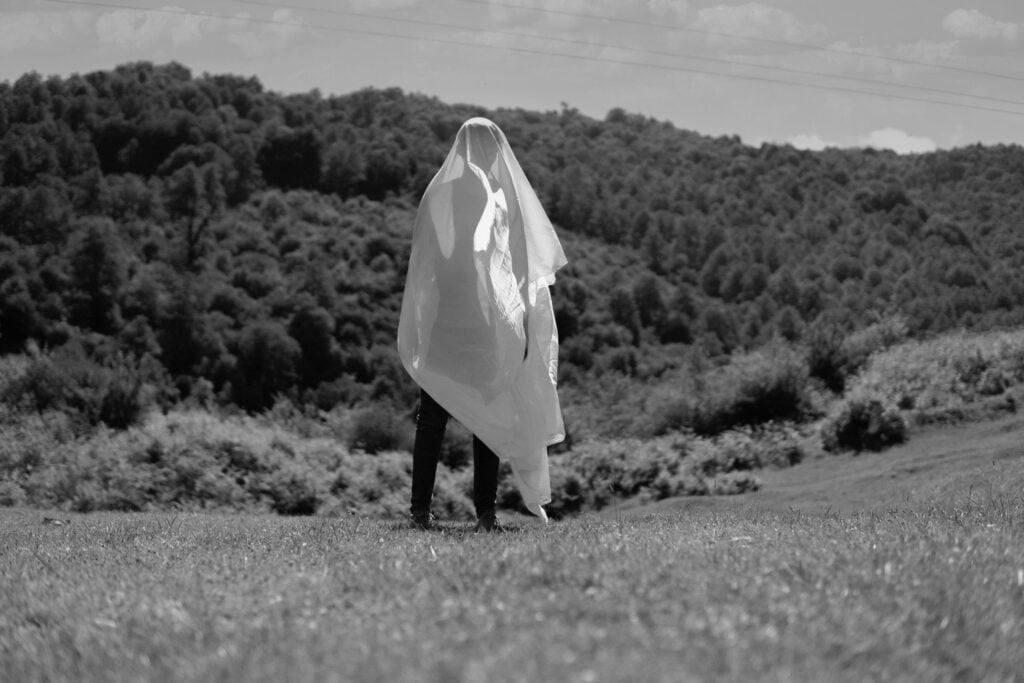
A solitary figure draped in white fabric stands in a serene meadow.

A movement built on cassettes, then MP3s

Science of Identity Foundation, the nonprofit Butler reportedly founded in 1977, distributes his teachings through recorded lectures, books published under the Siddhaswarupananda name, and a network of affiliated yoga and meditation studios. The movement has claimed adherents across Hawaii, the Philippines, Australia, and New Zealand.

Followers describe a structure in which Butler’s voice is constant and his face is absent. New initiates may spend years inside the organization without ever seeing a recent photograph of him. The cassettes carry the same 1980s cover portrait. The MP3 files that replaced them carry the same portrait scanned to digital.

The pattern is a familiar one in accounts of charismatic movements: the deliberate cultivation of distance. The leader becomes a voice, a doctrine, a felt presence. The body recedes.

The Gabbard connection

Most of what the wider public knows about Butler arrived through political coverage of Tulsi Gabbard. Gabbard was reportedly raised inside the Science of Identity community in Hawaii. Her father, Mike Gabbard, was reportedly a prominent Butler follower before his own political career. When Tulsi Gabbard ran for Congress in 2012, then for president in 2020, then was nominated as Director of National Intelligence in 2024, reporters tried to photograph her childhood guru and were unable to do so.

Major publications including The New Yorker, The Intercept, The Daily Beast, and New York Magazine have published profiles attempting to describe Butler. None of them included a current photograph. Every illustration in those pieces used the same handful of decades-old images, sometimes cropped, sometimes color-corrected, always old.

A stack of classic cassette tapes, showcasing retro music media. Perfect for nostalgia-themed projects.

Why old photographs make a person larger

The psychology of absence has been studied for years in the context of celebrity, romance, and authority. The scarcity principle in social perception holds that people assign greater value and intensity to figures who are harder to reach. The harder it is to see someone, the larger they tend to become in the imagination of those who wait. A guru you cannot photograph is, by that logic, more compelling than one who shows up on Instagram.

A related strand of work on attraction and what psychologists describe as love’s scarcity principle suggests that limited availability tends to signal importance, and that the absence of fresh information can produce a more intense bond than constant presence does. The pattern, first mapped in romantic relationships, translates to spiritual organizations with little distortion.

What former members describe

Accounts collected over the past decade from people who left the movement describe a community organized around a leader they rarely saw. Senior followers, sometimes called the inner circle, would occasionally travel to meet him. Rank-and-file members would not.

Some former members say they spent ten or fifteen years in the organization without ever being in the same room as Butler. They listened to him every day on tape. They quoted him. They prayed to a photograph of him taken before they were born.

One former follower said she had no idea what her guru’s voice sounded like at his current age. Only what it sounded like in 1982.

The visual record, frozen

If you search for Chris Butler today, you will find perhaps a dozen distinct images. A young surfer at Sunset Beach. A robed monk lecturing in Honolulu in 1972. A close-up portrait used on cassette covers, undated but stylistically consistent with the early 1980s. A long-lens photograph that may be from the 1990s and may not be him at all.

There is no verified photograph of him aged 60. None aged 70. None aged 78, which is his current age. The man who has shaped the daily life of thousands of households for half a century is, visually, a person who stopped existing during the Reagan administration.

Historical figures whose visual record is incomplete tend to be remembered through whichever image dominates the archive. Lincoln is the bearded president, not the clean-shaven lawyer. Einstein is the white-haired Princeton sage, not the patent clerk. Butler is the young Hawaiian monk on the cassette cover, because that is the only Butler the archive contains.

The Honolulu compound

Butler is widely reported to live in Kailua, on the windward side of Oahu, in a residential property owned through trusts associated with the Science of Identity Foundation. Reporters have described high walls, mature vegetation, and no visible activity. Neighbors have reportedly said they have lived next door for decades and have never seen him.

The property is roughly seven miles from Waikiki Beach, where he learned to surf in the 1950s.

A face the size of a generation

Forty years of visual silence is an unusual span. It covers the entire commercial history of the internet. It covers the introduction of the camcorder, the digital camera, the camera phone, the selfie, and the doorbell camera. A person who has not been photographed in forty years has, in effect, opted out of the visual era of human history.

The cassettes still play. The yoga studios still open in the mornings. The portrait on the cover, taken when Ronald Reagan was in his first term, is still the face that thousands of followers picture when they close their eyes to chant. The man himself, somewhere behind the wall in Kailua, is now closer in age to his own teacher Prabhupada at death than to the young surfer in the photograph.

The image does not age. The movement, organized around it, does not need it to.

The post Chris Butler stepped out of public view a generation ago and reportedly hasn’t given a real interview in decades — the clearest photos of the reclusive Hawaii guru are now roughly 40 years old appeared first on Space Daily.

  •  

Gunpowder, the substance that would eventually be used to build guns, cannons, bombs, and almost every explosive weapon humans have ever made, was invented in China sometime around the 9th century — not as a weapon at all, but accidentally, by Taoist alchemists who were searching for a chemical recipe that would give human beings an elixir of immortality

The Chinese word for gunpowder is 火藥 (huǒyào), which translates as “fire medicine.” The name preserves the original purpose. Gunpowder was not invented as a weapon. It was discovered as a chemical accident in the course of medical and alchemical research, by practitioners of a religious-philosophical tradition that had been systematically experimenting with mineral combinations for several centuries in pursuit of two parallel goals: the transmutation of base metals into gold, and the formulation of a chemical substance that, when ingested by a human being, would grant immortality. The two goals were related. The general framework of Chinese alchemy, like the broadly contemporary tradition of European alchemy, held that the physical properties of matter could be transformed through the application of correct chemical procedures, and that the same principles governing the transformation of metals might also govern the transformation of the human body from its mortal to an immortal form. The alchemists pursued this programme by combining essentially every available natural substance with essentially every other available natural substance, heating the mixtures, observing the results, and recording which combinations produced which effects.

According to Britannica’s overview of gunpowder’s chemistry and historical origins, the specific combination that eventually produced gunpowder involves three ingredients. Saltpeter, also known as potassium nitrate, was called “Chinese snow” in Tang Dynasty alchemical texts and was considered to have spiritually significant properties because of its unusual chemical behaviour — it dissolves easily in water, recrystallises into geometrically perfect forms, and produces a vigorous oxidising reaction when heated. Sulfur, the yellow mineral the European tradition would later call “brimstone,” was associated in Chinese alchemy with the principle of vital fire and was already in widespread use in skin-disease and parasitic-infection treatments. Charcoal, the carbon-rich residue of partially-burned wood, was a routine material in alchemical kilns. None of the three substances, taken individually, behaves in an unexpected way. The combination, however — particularly when the saltpeter constitutes approximately 75 percent of the mixture, the sulfur approximately 10 percent, and the charcoal approximately 15 percent — produces a chemical reaction in which the saltpeter rapidly releases oxygen, the charcoal and sulfur rapidly combust in that oxygen, and a substantial quantity of hot gas is produced in a very short period of time. The result, in confined spaces, is an explosion.

The earliest written warning

The earliest surviving Chinese document that describes the explosive properties of the three-ingredient mixture is a Taoist alchemical text called the Zhenyuan Miaodao Yaolüe — “Classified Essentials of the Mysterious Way of the True Origin of Things” — which dates to approximately 850 CE, in the middle of the Tang Dynasty. The text is not a recipe for gunpowder. It is, in essential respects, the opposite of a recipe for gunpowder. As detailed in a published lecture by the Cambridge historian of science Joseph Needham on the development of gunpowder in medieval China, the text is a compilation of elixir recipes that the author considered too dangerous to recommend to practising alchemists. The relevant warning, translated from the classical Chinese by Needham, reads: “Some have heated together sulfur, realgar and saltpeter with honey; smoke and flames result, so that their hands and faces have been burnt, and even the whole house where they were working burned down.” The text is, in other words, a 9th-century health-and-safety document. The fact that an explicit warning against this particular ingredient combination existed in writing by 850 CE strongly suggests that the discovery itself had been made some time earlier, that multiple alchemists had been injured experimenting with the mixture, and that the broader alchemical community had begun circulating the information as a cautionary tale long before any practical application of the explosive properties had been considered.

Needham — whose multi-volume Science and Civilisation in China remains the definitive English-language academic treatment of the history of Chinese scientific and technological development — described gunpowder explicitly as the product of “the systematic if obscure investigations of Taoist alchemists” rather than of any military or engineering research programme. The alchemists who made the original discovery had no apparent interest in weaponising it. They had been looking for the substance that would prevent death. They had found a substance that produced fire, smoke, and injury. From their perspective, this was a failed experiment — a chemical combination to be added to the list of things one should not, under any circumstances, attempt to ingest. The mixture remained, for approximately the next half-century, a curiosity. It was used in entertainment contexts, in some preparations as a skin treatment, and as a fumigant. It was not yet, in any sense that a 9th-century reader would have recognised, a weapon.

How it became a weapon

The transition from accidental alchemical discovery to systematic military application took approximately a century. As described in a Clemson University academic resource on gunpowder in medieval China that draws on Needham’s authoritative treatment of the subject, the first documented military use occurred in the late 9th to early 10th century, with gunpowder-based “flying fires” or fire arrows appearing in late-Tang military records. The systematic weaponisation of gunpowder began in earnest under the Song Dynasty (960-1279 CE), which faced sustained military pressure from the Khitan Liao, the Tangut Western Xia, and ultimately the Jurchen Jin and the Mongol Empire — each of which made conventional defensive warfare increasingly difficult and provided substantial incentive to develop unconventional alternatives. Song military engineers progressively refined the gunpowder formula, developing fire arrows, fire lances (a kind of proto-flamethrower mounted on a pole), early bombs (the “thunderclap” and “heaven-shaking” varieties), incendiary devices, smoke-screen weapons, and eventually, in the 13th century, the first true firearms.

The earliest published gunpowder formulas — three of them, all developed for military use — appear in a Northern Song military encyclopedia called the Wujing Zongyao (武經總要, “Complete Essentials for the Military Classics”) compiled between 1040 and 1044 CE. Per an EBSCO research summary of the invention of gunpowder and the development of early firearms, the three formulas specified in the text contained substantially less saltpeter than the optimal proportion for explosive propulsion — closer to 50 to 55 percent rather than the eventual 75 percent — which means they functioned more as incendiary devices than as the true propellants that later gunpowder formulations would become. The optimisation took several more centuries. By the 13th century, gunpowder weapons had spread west across Eurasia via the Mongol conquests, with written formulas appearing in the Middle East between 1240 and 1280 in a treatise by the Syrian chemist Hasan al-Rammah, and in Europe by 1267 in the Opus Majus of the English friar Roger Bacon. By the 14th century, the first European cannons were being manufactured. By the 16th century, the firearm had displaced the bow and the crossbow as the dominant infantry weapon of European warfare. By the 19th century, gunpowder-based explosives were being used to blast tunnels through mountains, demolish buildings, and reshape the physical landscape of the planet on a scale that would have been inconceivable to the Tang Dynasty alchemists who had originally discovered the substance.

The historical irony, which the literature on gunpowder has remarked on extensively over the past several centuries, is that the substance that has been more directly responsible for the deaths of human beings in warfare than any other single chemical compound was discovered by people whose entire research programme was organised around the goal of preventing human death. The alchemists pursuing the elixir of immortality had not, in any sense, succeeded — no Taoist practitioner achieved physical immortality through any chemical preparation, and several Tang emperors are now believed to have died from mercury poisoning caused by drinking immortality elixirs prepared for them by court alchemists. The Taoist programme, as a programme for the prevention of death, was a complete failure. The accidental byproduct of that failed programme has since killed more human beings than essentially any other artefact ever produced by any civilisation in human history. The fire medicine, in the long historical record, has been used to do approximately the opposite of what its original inventors were trying to achieve.

The post Gunpowder, the substance that would eventually be used to build guns, cannons, bombs, and almost every explosive weapon humans have ever made, was invented in China sometime around the 9th century — not as a weapon at all, but accidentally, by Taoist alchemists who were searching for a chemical recipe that would give human beings an elixir of immortality appeared first on Space Daily.

  •  

Researchers had 124 adults cut their email checking to three times a day — what dropped wasn’t their workload, it was their daily stress

How many times do you check your email on a normal workday? Be honest. Not the number you’d like to say, the real one, counting every quick glance at the phone and every tab you flick back to between actual tasks.

Some research suggests this little habit might have an effect on wellbeing and stress. 

A quick note before we go further: I’m a writer, not a psychologist or a clinician, and what follows is me reading and thinking about one study, not handing out advice. The research here is drawn from a particular group of people, so treat it as a useful clue about how attention and stress interact, not a rule about your life.

In 2014, Kostadin Kushlev, then a PhD candidate, and Elizabeth Dunn at the University of British Columbia ran a two-week field experiment to test something simple. Does checking email less often make you feel better? They published it the following year in Computers in Human Behavior as “Checking email less frequently reduces stress.”

They recruited 124 adults, about two-thirds of them students, the rest a mix of financial analysts, medical professionals and others. Over two weeks, each person spent one week checking email as often as they liked, and another week limited to three times a day. Which week came first was decided at random. So everyone was their own comparison, living both ways.

You might expect the finding to be about getting more done. Fewer interruptions, more output, that sort of thing. That isn’t what they measured, and it isn’t what jumped out.

What they found was that people felt calmer during the limited week. Participants reported significantly lower daily stress when they were checking less, and lower stress in turn predicted higher well-being across a range of measures. Kushlev put it as plainly as it can be put. “Our findings showed that people felt less stressed when they checked their email less often.”

It’s one two-week study of 124 mostly young people, so it’s a clue rather than a verdict, but the mechanism it points to has shown up in other workplace research too.

The stress relief didn’t come from clearing the inbox faster or replying the moment something landed. It came from checking less often, full stop. The authors point at attention fragmentation, the cost of constantly breaking off what you’re doing to glance at something else, not the speed of your replies.

I know that cost intimately, because I lose to it most days. A Slack message comes in while I’m writing. I tell myself I’ll just glance. I glance, I answer, I come back to the document, and then I sit there for a while staring at the half-finished sentence, trying to remember where I was going with it. The message took ten seconds. Getting back into the writing takes a lot longer.

I’ve built a small fortress against this, with mixed success. The phone goes in another room. I close every tab before I start. No social media open while I work. None of it makes me disciplined. The systems leak, I break my own rules, and some mornings the fortress is more of a fence. But the principle holds: the cost is the interruption itself, not whether the email was urgent.

There’s a wrinkle that makes the study more honest, not less. The people in the limited week mostly couldn’t actually hit three times a day. They checked a mean of about 4.7 times, well above the target, against a baseline of about 15 checks on a normal workday. Kushlev was upfront about it: “Most participants in our study found it quite difficult to check their email only a few times a day.”

So the lower stress showed up in people who tried and largely fell short. That’s encouraging, because most of us are going to fall short too. You don’t have to be a monk about it. Cutting from fifteen-odd checks toward five seems to do something, even if three stays out of reach. As Kushlev framed it, drawing on his own study, “people find it difficult to resist the temptation of checking email, and yet resisting this temptation reduces their stress.”

Kushlev says he changed his own habit after the study. He now checks email in chunks several times a day, rather than constantly responding to messages as they arrive. That’s the one lever from all of this I’ve actually pulled, and the one I plan on keeping — not three times a day, just in chunks, with the inbox shut in between, getting back to whatever I was supposed to be doing before the next glance.

If the low hum of being always-on has tipped into something heavier than email annoyance, a chat with a qualified therapist is worth far more than anything I can offer here.

The post Researchers had 124 adults cut their email checking to three times a day — what dropped wasn’t their workload, it was their daily stress appeared first on Space Daily.

  •  

In September 1969, a 100-kilogram space rock exploded in the sky above Murchison, Australia — and 50 years later, scientists analyzing dust grains buried inside the meteorite found particles between 5 and 7 billion years old, formed in the dying outer layers of stars that lived and died long before our Sun was born, in what remains the oldest solid material ever identified on the surface of the Earth

The Murchison meteorite is, by every available measure, one of the more scientifically valuable single rocks ever to fall on the planet. The fireball that delivered it streaked across the sky above the Goulburn Valley in southeastern Australia on a Sunday morning in September 1969, broke apart at high altitude, and scattered fragments across a roughly 35-square-kilometre area of farmland. One piece punched through the roof of a hay shed. The local dairy farmers who recovered most of the fragments over the following weeks sold the bulk of them to museums and universities, with the largest single collection now held by the Field Museum of Natural History in Chicago. Approximately 80 kilograms of the original 100-kilogram fall is currently held in scientific collections around the world. Over the subsequent five decades, Murchison has been examined more intensively than almost any other meteorite — yielding more than 70 distinct amino acids (including some that do not occur in any known terrestrial biology), sugars including ribose (the backbone of RNA), and several of the nucleobases that make up the building blocks of DNA. The rock has been at the centre of multiple revisions to scientific understanding of how organic chemistry distributes itself through the early solar system.

According to NBC News’s coverage of the 2020 Heck et al. paper on presolar grains in Murchison, the team published its dating results in the Proceedings of the National Academy of Sciences in January 2020. The analysis used a technique called cosmic-ray exposure dating, which Heck described with an unusually accessible analogy: cosmic rays — high-energy particles that constantly stream through the galaxy — interact with solid matter and produce new elements at a roughly constant rate. The longer a particle of matter has been drifting through space exposed to cosmic rays, the more of these new elements accumulate inside it. “I compare this with putting out a bucket in a rainstorm,” Heck told reporters at the time. “Assuming the rainfall is constant, the amount of water that accumulates in the bucket tells you how long it was exposed.” Applying this method to 40 large silicon-carbide grains extracted from the Murchison fragments, the Heck team was able to estimate how long each individual grain had been drifting through interstellar space before being incorporated into the asteroid that eventually fell to Earth.

What presolar grains actually are

The grains the Heck team dated are called presolar grains — solid particles that formed in the atmospheres of dying stars before the solar system existed, drifted through the interstellar medium for hundreds of millions or billions of years, and were then incorporated into the molecular cloud from which the Sun and planets eventually condensed. As reported in Sci.News’s coverage of the same paper, the typical formation environment for the silicon-carbide grains examined by the Heck team was the slowly-expanding atmosphere of an asymptotic giant branch (AGB) star — a red giant in the late stages of its evolution, shedding its outer layers into space at a rate of roughly one solar mass every hundred thousand years. The carbon, silicon, and other elements in the stellar atmosphere condense as the gas cools and expands, forming microscopic dust grains that are then carried outward by the stellar wind into the surrounding interstellar medium.

Most of these grains, once released into space, are eventually destroyed by some combination of supernova shock waves, radiation, and chemical reprocessing within the molecular clouds where new stars form. A small fraction survive intact for billions of years, drifting through the galaxy as part of the general inventory of interstellar dust. When a new solar system begins to form by gravitational collapse of a dense region of interstellar gas, this dust is incorporated into the early protoplanetary disc — and the heat and chemistry of solar system formation typically destroys or substantially alters most of it. The grains that survive intact through the entire formation process do so because they are extraordinarily durable (silicon carbide is one of the hardest materials in nature) and because they are quickly incorporated into the deep interiors of primitive asteroids that never undergo significant thermal processing. Murchison’s parent body was one such asteroid. The grains inside the Murchison fragments are, in a literal sense, time capsules from before the solar system existed.

The age distribution

The headline figure from the Heck team’s analysis — that the oldest grains are approximately 7 billion years old, predating the solar system by approximately 2.5 billion years — captures the extreme of the distribution rather than the average. Per ScienceDaily’s coverage of the Field Museum announcement, the full age distribution of the 40 grains was substantially more informative than the single extreme number suggests. Approximately 60 percent of the grains formed between 4.6 and 4.9 billion years ago — in the few hundred million years immediately preceding the formation of the solar system. Approximately 10 percent formed more than 5.6 billion years ago. A small number formed at the extreme end, around 7 billion years ago. Every grain examined was, by the cosmic-ray exposure dating, older than the 4.6-billion-year-old Sun. This is what made them presolar.

The distribution itself carries scientific weight beyond the individual grain ages. The clustering of a substantial fraction of grains in a narrow age band suggests that an unusual number of stars in the Milky Way galaxy formed, lived their full life cycles, and died during a specific epoch several billion years before the Sun ignited — a “burst” of star formation that produced an unusually large population of dying stars whose outflows seeded the surrounding interstellar medium with the dust that would later contribute to the formation of the solar system. The Heck team’s interpretation, drawing on the age distribution, is that this burst occurred approximately 7 billion years ago. The implication is that the Sun and the planets formed, several billion years later, from a galactic environment that had been substantially enriched with material from this earlier generation of stars.

Why no comparable material exists on Earth

As reported by Malay Mail’s coverage of the age distribution, the broader reason presolar grains can only be found in meteorites — never in any rock of terrestrial origin — is that every piece of solid material that contributed to Earth’s formation has subsequently been heated, melted, recrystallised, or otherwise reprocessed by the geological activity of the planet itself. Plate tectonics has churned the entire crust through the mantle and back at least once. Volcanism has melted and re-erupted vast quantities of material. Even the oldest rocks on Earth, found in places like the Acasta Gneiss Complex in northern Canada, are at most 4.0 to 4.2 billion years old — substantially younger than the planet itself, and far younger than the presolar grains preserved inside primitive meteorites.

The Murchison meteorite, in this respect, occupies a peculiar epistemological position. It is the closest available physical sample of the early solar system, but it is also a sample of the pre-solar-system galaxy that produced the early solar system. The grains inside it are older than anything that can be found by digging downward through the rocks of Earth, by any depth or any drilling technology. They are, in essence, a sample of the chemistry of the Milky Way at a moment several billion years before any of the familiar features of the current solar system existed. The fragments collected by Australian dairy farmers in 1969 and sent to museums in Chicago and elsewhere have turned out to contain, embedded in their carbonaceous matrix, a small but real sample of stardust from stars that finished burning before the Sun began.

The post In September 1969, a 100-kilogram space rock exploded in the sky above Murchison, Australia — and 50 years later, scientists analyzing dust grains buried inside the meteorite found particles between 5 and 7 billion years old, formed in the dying outer layers of stars that lived and died long before our Sun was born, in what remains the oldest solid material ever identified on the surface of the Earth appeared first on Space Daily.

  •  

By the end of this century, the United States is projected to have more than one million centenarians — people aged 100 or older — for the first time in human history, in a demographic shift driven by sharply falling mortality among nonagenarians, and some demographers now believe that a majority of children born today in low-mortality countries can reasonably expect to reach their hundredth birthday

In 1950, the United States Census Bureau estimated that approximately 2,300 Americans were aged 100 or older. The total population of the country at the time was approximately 152 million, which made centenarians one of the rarest possible demographic categories — approximately one in every 66,000 Americans had reached the age. By 1990, the centenarian count had risen to approximately 37,000. By 2020, it had reached approximately 92,000. By 2024, it had passed 101,000. The trajectory has been steep and accelerating, and the demographic shift now visible in the centenarian numbers is one of the larger long-term changes in the structure of the American population — a category that was statistically negligible at the end of World War II is now projected to become, within the lifetimes of most people reading this, a substantial demographic constituency in its own right.

According to the Pew Research Center’s January 2024 analysis of Census Bureau projections, the US centenarian population is projected to more than quadruple from approximately 101,000 in 2024 to approximately 422,000 by 2054 — meaning that within the next 30 years, the proportion of Americans aged 100 or older will rise from approximately 0.03 percent of the population to approximately 0.1 percent. This is the official Census base-case projection. Higher-end estimates developed by demographic researchers — including the MacArthur Foundation Research Network on an Aging Society — have projected substantially higher numbers under more optimistic mortality-improvement scenarios, with some estimates exceeding 1.8 million US centenarians by mid-century and substantially larger numbers by 2100. The range between the Census base case and the higher-end projections is large, and the actual outcome will depend on whether mortality improvements at older ages continue at recent rates, accelerate, or plateau.

What is driving the projected growth

The proximate driver of centenarian growth is not improving mortality among the young or middle-aged — those mortality rates are already very low and have only modest room to fall. The driver is sharply declining mortality among nonagenarians: people aged 90 to 99 who, in previous generations, would typically have died before reaching 100. The mortality rate among 90-year-olds has been falling steadily across developed countries for decades, with each successive cohort of nonagenarians surviving slightly longer than the previous one. The result is that the share of any given birth cohort that eventually reaches 100 has been rising, and the absolute number of centenarians is rising even faster because the population at risk (the 90-year-olds in the country) has also been growing rapidly.

Per a CEOWORLD analysis of the global centenarian surge, the same pattern is visible internationally. The United Nations estimated approximately 722,000 centenarians worldwide in 2024 and projects that the number will rise to approximately 4 million by 2054 — a nearly six-fold global increase in 30 years. By mid-century, the largest national centenarian populations are projected to be China (approximately 767,000), the United States (approximately 422,000), India, Japan, and Thailand, with several Southeast Asian countries and parts of southern Europe showing particularly rapid centenarian growth on a per-capita basis. Japan, currently the country with the world’s highest median age, is projected to have approximately 40 centenarians per 10,000 people by 2054 — meaning that roughly one in every 250 Japanese residents will be aged 100 or older. Thailand is projected to have an even higher ratio, at approximately 49 per 10,000.

The contested longer-term projections

The substantive disagreement among demographers is not about whether centenarian numbers will rise — that is now essentially settled — but about how far they will rise, and how soon a majority of births in low-mortality countries will produce people who eventually reach 100. The optimistic position, associated with the demographer James Vaupel and colleagues at the Max Planck Institute for Demographic Research, holds that life expectancy in the most advanced countries has been increasing by approximately three months per year for the past 150 years and shows no clear sign of slowing — and that this trajectory implies that the majority of children born in low-mortality countries today will live to see their hundredth birthday. The skeptical position, associated most prominently with the American demographer S. Jay Olshansky and his collaborators, holds that life expectancy gains are now slowing substantially in the United States and other developed countries, that the easy mortality reductions from infectious disease control, smoking declines, and cardiovascular medicine have largely been achieved, and that further gains will be substantially harder to obtain.

The empirical evidence for the slowdown position has become more visible in recent years. US life expectancy peaked at approximately 78.9 years in 2014 and then declined — partly because of the opioid crisis, partly because of rising obesity-related mortality, partly because of COVID-19 mortality during the pandemic, and partly because of slowing gains in cardiovascular medicine. The current US life expectancy of approximately 76 years is substantially below the trajectory that the Vaupel projections would have predicted. As covered by a foundational MacArthur Foundation Research Network paper on demographic forecasts for the United States in the 21st century, the higher-end centenarian projections depend on assuming that the recent slowdown is temporary and that the longer-run Vaupel-style trajectory will resume. Whether it does is one of the central empirical questions in contemporary demography, and the answer will substantially affect both the centenarian counts in 2054 and the much larger projections for 2100.

The maximum lifespan question

As reported by a 2021 Bayesian analysis published in Demographic Research by Michael Pearce and Adrian Raftery at the University of Washington, the related question of what the maximum human lifespan will reach by 2100 is approachable with statistical methods even where the underlying biology is uncertain. The Pearce-Raftery analysis modelled the existing distribution of supercentenarians (people aged 110 or older) and the projected growth of that population through the rest of the century, and estimated that there is greater than 99 percent probability that the current record human lifespan — Jeanne Calment of France, who died in 1997 at 122 years and 164 days — will be broken before 2100. They estimate an 89 percent probability that someone will reach age 126, a 44 percent probability that someone will reach 128, and a 13 percent probability that someone will reach 130. These projections are not predictions about the typical lifespan but about the extreme tail of the survival distribution, which depends on the same nonagenarian mortality declines that drive the centenarian numbers.

The deeper question that the centenarian projections raise is the relationship between living longer and living well. The available evidence on healthspan — the proportion of life spent in good health, rather than in disability or substantial decline — suggests that healthspan has been increasing more slowly than lifespan. The result is that the gap between the two has been widening: people are living longer, but with more years of substantial disability, more years of cognitive decline, and more years of dependence on caregivers and the healthcare system. The economic implications are substantial. The current pension systems, healthcare systems, and family structures of most developed countries were built around assumptions about average lifespan and the typical duration of post-retirement life that no longer hold. The institutional response, across most of the developed world, has been slower than the underlying demographic shift. Whether the eventual centenarians — including, possibly, a substantial fraction of the children born this year — will arrive at their hundredth birthdays in good health, in supported decline, or somewhere in between will depend on whether the gains of the coming decades are made primarily in extending lifespan or primarily in extending healthspan. The two trajectories produce very different futures.

The post By the end of this century, the United States is projected to have more than one million centenarians — people aged 100 or older — for the first time in human history, in a demographic shift driven by sharply falling mortality among nonagenarians, and some demographers now believe that a majority of children born today in low-mortality countries can reasonably expect to reach their hundredth birthday appeared first on Space Daily.

  •  

Thought of the day from Stoic philosopher Epictetus: “Some things are in our control and others not. Things in our control are opinion, pursuit, desire, aversion, and, in a word, whatever are our own actions. Things not in our control are body, property, reputation, command, and, in one word, whatever are not our own actions”

Imagine your flight is delayed three hours. Or someone leaves you a bad review that you think is unfair. Or a person you live with wakes up in a foul mood and you can feel it filling the kitchen.

The first reflex, at least mine, is to push back against the thing. To argue with the airline, draft the reply, try to fix the mood. To treat the situation as a problem I can solve if I just apply enough force.

I started reading Stoicism in earnest during a period of failure and a general search for meaning. Seneca’s line about how we waste time stayed with me as a durable impression from that whole reading rabbit-hole.

But the idea I keep coming back to, the one that has been most useful, is the one Epictetus opens his Enchiridion with:

“Some things are in our control and others not. Things in our control are opinion, pursuit, desire, aversion, and, in a word, whatever are our own actions. Things not in our control are body, property, reputation, command, and, in one word, whatever are not our own actions”. 

The handbook was compiled by his pupil Arrian from Epictetus’s teaching, but the thought is his, and modern readers tend to call it the dichotomy of control.

A note before I go further. I’m not a psychologist or a philosopher by training, just a reader who came to the Stoics during a rough stretch and kept reading. What follows is reflection on old ideas and a little modern research, not advice, and the psychology I mention is observational, drawn from particular groups of people rather than rules about you.

The easy misreading is to hear “big things versus small things,” as if Epictetus is telling you to sweat the little stuff and let the big stuff go. I don’t think that is the cut he’s making. The cut is between what is your own doing and what is not. Your judgments, your choices, your effort, your intentions sit on one side. Your body, your property, your reputation, your job title, the outcome of almost anything — all of that sits on the other.

The slightly uncomfortable part is how short the first list turns out to be once you’re strict about it. Almost everything I would naturally call “mine,” the result of my work, what people think of me, whether a plan succeeds, is not actually in my power. As the professor of philosophy, Massimo Pigliucci puts it, the idea “basically reminds us that our agency, our ability to change things, is far more limited than we normally think.” 

Years ago I tried to build a coffee business. It failed. And the part I didn’t understand until afterward was that the outcome was never really mine to control. Whether the business survived depended on the market, on timing, on a hundred things I couldn’t move no matter how hard I pushed. What was actually mine was the effort, the decisions, the work I put in each day. Those I could give fully.

The first time around I got this exactly backwards. I poured my anxiety into the outcome, the part I couldn’t touch, and the fear of failing followed me everywhere. When the thing I’d been dreading finally happened, the strange discovery was that the reality was lighter than the fear had been. Fearing it was worse than living it. I’m not romanticizing this, and I’m certainly not recommending failure as a teacher. But the dichotomy was sitting right there in the experience. The effort was mine. The result never was. Carrying the result as though it were mine just doubled the weight.

None of this is permission to stop caring or go limp. That’s the version of Stoicism that gets it wrong, the one that treats “let it go” as an excuse to do nothing. Epictetus is not saying don’t try. He’s saying try completely on the part that is yours, then release your grip on the part that isn’t. You act fully, then you stop demanding a particular result from the universe as the price of your peace.

So the freedom here is not the obvious kind. It isn’t getting more control over outcomes, more grip on the delayed flight or the bad review or the mood in the next room. It’s noticing, in the moment, which part of the thing is actually your own doing, giving that part everything, and setting down the rest.

These days, when a result I wanted slips away from me, I try to ask one plain question before I start fighting it: was this ever mine to decide? Often the answer is no. And there’s a real lightness in putting down a thing you were never holding up in the first place.

If any of this is landing closer to home than it is interesting, a good therapist or counsellor is worth far more than any old book or article, mine included.

The post Thought of the day from Stoic philosopher Epictetus: “Some things are in our control and others not. Things in our control are opinion, pursuit, desire, aversion, and, in a word, whatever are our own actions. Things not in our control are body, property, reputation, command, and, in one word, whatever are not our own actions” appeared first on Space Daily.

  •  

Quote by Neil deGrasse Tyson: “For me, I am driven by two main philosophies: know more today about the world than I knew yesterday and lessen the suffering of others. You’d be surprised how far that gets you.”

The self-help shelf in any bookshop is a monument to overcomplication. Forty-seven habits, twelve rules, seven levels, a morning routine that begins at half past four and involves cold water and a gratitude journal. I have read a depressing number of these, mostly in airports, and retained almost none of it past the departure gate.

Then Neil deGrasse Tyson, the astrophysicist, was asked on a Reddit thread in 2012 what drives him, and he gave an answer short enough to fit on the back of a receipt. Two philosophies, he said. Know more today about the world than you knew yesterday, and lessen the suffering of others. You would be surprised how far that gets you.

My first reaction was the one you are probably having. Lovely. Goes nicely on a mug. My second reaction, a few years later, was that the man had calmly described the only two things that have ever worked for me, and that the second one once stopped me making the stupidest decision of my career.

Know more today than you knew yesterday

The first one is the scientific method pointed at your own life, and it is far more modest than it sounds.

It does not ask you to be a genius, or to ever finish. It asks you to be slightly less wrong tonight than you were this morning. That is more or less the whole engine of science. Nobody in a serious lab is trying to be right in some final, permanent way. They are trying to be marginally less mistaken than the last person, write it down, and let someone else chip a bit further along.

The humility runs deeper than people outside science tend to assume, too. We have been studying gravity for three centuries and still only know Newton’s constant to three significant figures. Around ninety-five percent of the universe is made of things we have politely named dark matter and dark energy, mostly so we do not have to say out loud that we have very little idea what they are. The best-informed species on the only planet known to carry one spends most of its day confidently not knowing things.

I got this wrong for years in a particular way. I thought “know more” meant collect facts and deploy them to win. I was the man at the table with the correction loaded and ready. What I was doing was the precise opposite of the rule, because a person busy being right learns nothing. The truer version is duller and harder. Assume, every single day, that there is a fact you do not yet have. Above all about a person.

The cook I nearly sacked

That stops being abstract very quickly in a kitchen.

Years ago I had a line cook, a quiet lad called Tomas, who started arriving late. Ten minutes, then twenty, then a morning he missed altogether. In the economy of a busy kitchen that is close to a capital offence. The prep does not do itself, and one slow start poisons the entire service behind it. I had the conversation drafted in my head, the regretful, businesslike one that ends with a final pay packet. By the cold numbers, he had to go.

What stopped me was a flat, almost accidental question. I asked him, with no great warmth, what was actually going on. And it came out that his mother had been taken into a hospital on the far side of the city, that he was sitting with her until the small hours, and then walking ninety minutes to my door because the night buses did not connect and the fare, on a cook’s wages, was a genuine decision every morning.

None of that was visible from where I stood, which was the whole point. I had a full and confident model of Tomas, the unreliable cook, and it was missing the single fact that explained all of it. I knew less than I believed I did, which is the standard human condition and the exact thing the first rule is trying to beat out of you.

So I did something small. I shifted his start to the evening, which suited the kitchen anyway, and stopped docking him for the lost mornings. It cost me close to nothing. He stayed four years, became the steadiest pair of hands in the building, and covered for me more times than I can count when my own life later fell apart. You would be surprised, as the man said, how far that got me.

Lessen the suffering of others

People hear the second philosophy as the soft one. The charity bit, bolted on after the clever bit, to make the clever bit look kind. I think that is exactly the wrong way round.

They are the same engine. Knowing more about Tomas was worthless as trivia. Its only value was that it let me take a little weight off him at almost no cost to me. And easing what he carried was not me playing the saint. It was the most clear-headed thing I did that year, because it kept a good cook and bought a loyalty that no bonus on earth would have. Knowledge without the second philosophy is just cleverness, which is cold and gets you avoided at parties. Kindness without the first is good intentions fired blindfold, which mostly miss the target. You need the two of them aimed together.

That is what Tyson tucks into that last offhand line. He does not promise you enlightenment, or wealth, or a flat stomach by June. He promises only that two ordinary habits will carry you “surprisingly far,” which may be the single most honest sentence in the entire self-improvement trade. Nobody can tell you how far. You would be surprised. That is the whole claim, and it happens to be true.

I walked away from the restaurants a few years after Tomas, and I have since forgotten most of what I once knew about margins and stock rotation and the correct way to close down a kitchen at midnight. What stayed was the picture of a tired young man crossing a sleeping city on foot to stand at my stove, and the small, unheroic discovery that the cheapest thing I ever did, ask one question and move one shift, turned out to be the cleverest entry in the books. Two rules, typed into a website by a stargazer at his keyboard. They really will carry a person an absurd distance, though their author had the good manners not to say how far. He left you to walk it and find out.

The post Quote by Neil deGrasse Tyson: “For me, I am driven by two main philosophies: know more today about the world than I knew yesterday and lessen the suffering of others. You’d be surprised how far that gets you.” appeared first on Space Daily.

  •  

In 2026, wellbeing researchers suggested that simply asking people one question about how good their life is overall may be the clearest and most comparable way to measure wellbeing around the world

Can one question really tell you how a whole life is going? It sounds too simple. A life has work in it, and health, and the people you love, and the quiet sense of whether any of it means anything. Reducing all of that to a single number on a scale feels like measuring an ocean with a teaspoon.

And yet that is more or less what a group of wellbeing researchers argued in earlier this year. In a short reply published in Nature Human Behaviour, the editors of the World Happiness Report made the case that individual wellbeing is best captured “by single self-reports of one’s overall quality of life.” One question, asked directly. That’s the whole proposal.

A quick note before going further. I am not a psychologist, an economist, or a wellbeing researcher of any kind, so take what follows as one curious reader’s reading of a scholarly debate, not advice. The work here is observational social science, and a population-level pattern is never a verdict on how your own life is going.

The case for measuring everything

The argument the 2026 reply is pushing back against has obvious appeal. In 2025, Harvard’s Tyler J. VanderWeele and Baylor’s Byron R. Johnson published early results from the Global Flourishing Study, a survey of more than 200,000 people across 22 countries. Rather than asking one question, they built a composite index across five domains: happiness and life satisfaction, physical and mental health, meaning and purpose, character and virtue, and close social relationships.

You can see why. A person could be financially comfortable and lonely, or healthy and adrift. Stitch the domains together and you get a fuller picture. VanderWeele draws a distinction here between two ideas, and he is careful to hedge it. Wellbeing, he suggests, “might be viewed as all aspects of a person’s life are good as they pertain to that individual, whereas flourishing is all aspects of a person’s life are good, including the context and communities and environments in which that person lives.”

The composite view runs into a problem, though, and I have felt it personally. Ticking the boxes does not reliably move the overall sense of how life is going. 

What the single-item camp actually argues

So the counter-argument is not “wellbeing is simple.” It is closer to this: most of what gets bundled into a flourishing index is not wellbeing, it is the stuff that produces wellbeing. The 2026 authors put it carefully, with the hedge intact. In their view, “most of the individual factors that get combined in such an index are causes of wellbeing and not wellbeing itself.”

Health, money, relationships: on this reading, those are inputs. Ask about them and you are measuring the recipe, not the meal. Ask a person to rate their overall life, and the editors argue, “the resulting product is wellbeing, in other words, the quality of life as we experience it.” The person has already done the weighting in their head. They know how much the lonely-but-comfortable trade actually costs them, in a way no fixed formula across 200,000 strangers can.

This is not a fringe idea dreamed up to win an argument. It is how the global rankings already work. The World Happiness Report’s country ordering rests on a single life evaluation question, the Cantril ladder, which asks people to place their life on a 0 to 10 ladder. Gallup asks it of people in more than 140 countries.

Here is that question: 

“Please imagine a ladder with steps numbered from 0 at the bottom to 10 at the top. The top of the ladder represents the best possible life for you and the bottom of the ladder represents the worst possible life for you. On which step of the ladder would you say you personally feel you stand at this time?”

Closing thoughts

The single question dares to remove almost everything and trust the person to have done the math. There is something honest in that, and something that could go wrong.

But a tidy number can flatter or deceive. A bad week can drag it down; a sunny afternoon can lift it past what you’d say on reflection.

One ordinary evening I tried it on myself. Zero to ten, how good is your life, overall. I landed on a number quickly, which surprised me, and then immediately distrusted it, which surprised me less. The honest answer wasn’t the number. It was the half-minute of weighing that produced it, the things I added in and the things I quietly let go. The number was just where the weighing stopped. Maybe that is the whole point, and maybe it is the catch: the single question doesn’t simplify the life, it just forces you to do the arithmetic.

If any of this is landing closer to home than it is interesting, talking to a good therapist is worth far more than reading this article.

The post In 2026, wellbeing researchers suggested that simply asking people one question about how good their life is overall may be the clearest and most comparable way to measure wellbeing around the world appeared first on Space Daily.

  •  

Thought of the day from Taoist philosopher Lao Tzu: “To understand others is to have knowledge; to understand oneself is to be illumined.”

The line turns on a single word, and the word is doing more work than it first appears. To understand others is knowledge, something gathered and held. To understand oneself is something else, a state the original Chinese marks with the character ming (明). As Sandra Hill writes for Monkey Press, the character “can be translated as brightness, clarity, illumination, enlightenment.” It is built, fittingly, from the characters for sun (日) and moon (月). Knowledge of others is an accumulation. Self-knowledge, in this reading, is a light.

That distinction is the whole of the verse. Why has it survived twenty-five centuries, and does the gap it names between knowing others and knowing oneself hold up when modern researchers go looking for it?

The verse comes from Chapter 33 of the Tao Te Ching, the principal Taoist text traditionally attributed to Lao Tzu, the “Old Master” usually placed in the sixth century BC. Modern scholarship tends to treat the figure as semi-legendary and the authorship as uncertain, but the text itself, eighty-one chapters, has outlasted every argument about who wrote it.

Part of why the line travels so well is that it survives translation with its core intact. The Chinese reads 知人者智,自知者明. In the Gia-fu Feng and Jane English rendering, it becomes “Knowing others is wisdom; Knowing the self is enlightenment.”

Dwight Goddard, working in 1919, put it as “He who knows others is intelligent; he who understands himself is enlightened.” Stephen Mitchell’s 1995 version, a loose interpretive rendering rather than a literal translation, reads “Knowing others is intelligence; knowing yourself is true wisdom.” The vocabulary shifts across translations, but the underlying structure does not. Every version keeps the same two-part contrast: one kind of knowing pointed outward, a different kind pointed in.

Before going further, a note on register. We are writers reading across philosophy and psychology, not clinicians or credentialed researchers, and the studies below describe patterns across groups of people rather than verdicts about any individual reader.

The psychologist Tasha Eurich has spent years probing the kind of gap Lao Tzu names. In her account on the Blanchard LeaderChat podcast, “Our data reveals that 95 percent of people believe they are self-aware, but the real number is 12 to 15 percent.” Those figures come from her own studies rather than a settled cross-field consensus, so they are best read as one researcher’s finding, not a fixed law. The direction is the interesting part: most people are confident they see themselves clearly, and far fewer actually do.

There is an obvious objection to Lao Tzu’s hierarchy. Surely we have privileged access to our own minds. We can hear our own thoughts; we cannot hear anyone else’s. Shouldn’t self-knowledge be the easy half?

Well, some research suggests the privilege backfires. Psychologist Emily Pronin and Matthew Kugler studied what they call the introspection illusion. When assessing their own bias, participants weighed their introspective sense over the evidence of what they actually did, a generosity they did not extend to others. 

That is perhaps the obstacle the verse quietly implies. Knowing others, you have only their actions to go on, and actions are honest in a way intentions often are not. Knowing yourself, you have access to the running commentary, the reasons, the good intentions, and that flood of inside information is exactly what makes the view unreliable.

If any of this lands close to home, a qualified counsellor or therapist is a good person to talk it through with.

The post Thought of the day from Taoist philosopher Lao Tzu: “To understand others is to have knowledge; to understand oneself is to be illumined.” appeared first on Space Daily.

  •  

Over ten workdays, researchers sent employees on 15-minute lunchtime walks through a park, and afternoons changed — sharper concentration, less fatigue, with much of the lift carried by how genuinely people enjoyed the walk.

Most lunch breaks are not really breaks. A sandwich at the desk, the screen never quite off, an eye on the next message. The afternoon arrives already flat, and you spend it pushing a boulder that did not feel this heavy at ten in the morning. I suspect a lot of us know that particular afternoon flatness without ever connecting it to how we spent the forty minutes before it.

A small Finnish study made me think about that connection more carefully.

I am not a psychologist or any kind of clinician, so take this as one curious reader’s reading of one piece of research, not advice about what your body or your workday should do. What follows is a single intervention study with a modest number of people, and the findings are from a particular group, not settled laws about everyone.

What the study actually did

Organizational psychologist Marjaana Sianoja and colleagues asked Finnish knowledge workers to do something simple during their lunch breaks. One group took a slow 15-minute park walk; a comparison group did 15 minutes of relaxation exercises. They kept it up for 10 consecutive working days, and reported on their afternoon concentration, strain, and fatigue along the way. The park walk group had 51 people, the relaxation group 46.

The headline finding is the kind you might expect. The authors reported that “park walks at lunchtime were related to better concentration and less fatigue in the afternoon through enjoyment.” Fifteen minutes among trees, and the afternoon went a little better.

The part that surprised me

The interesting word in that finding is the last one. Through enjoyment.

That reorders things in my head. We tend to treat the activity as the active ingredient, as if a walk is a pill you swallow whether or not you taste it. The study suggests the enjoyment is doing a lot of the quiet work, and the walk is mostly a reliable way to produce some.

A separate line of research points the same direction. In an experience-sampling study, John Trougakos and colleagues found that the restorative value of a lunch break depends heavily on how freely it was chosen.

Why the distinction matters to me

This is where it stops being abstract. My weekday afternoons run from two different cafés, with a walk between blocks. When a sub-task is done, I pack up and move to the second café, and the walk in between is the seam. I did not start doing this for any measured productivity reason. I do it because moving lets the last task drain out of my head before the next one starts, and switching the room seems to switch something in me too.

What I notice is that I look forward to that walk. It is not a chore I have inserted to be virtuous. If someone scheduled it for me, made it mandatory, told me to log it, I think it would quietly stop working. The mechanism in the study and the reason my own version holds up seem to be the same one: the walk is the vehicle, the wanting-to-do-it is the engine.

The honest limits, and what I take from it

It is worth keeping the size of all this in proportion. Research from the same program found that lunch break activities did increase restoration and reduce fatigue, but the authors were candid that the effects seem weak, short-lived, and dependent on the season. Fifteen minutes in a park is probably not going to fix a job that grinds you down, and it was never going to.

What I take from it is smaller and more usable than a fix. Protect the break, and make it one you genuinely want. For me the strongest version of this has nothing to do with work at all: when I am home in Ireland, I walk alone with no music or podcast, and it is the closest thing I have to a practice. I tried meditation and it never stuck. The quiet walk, and solo golf, are my equivalent, and I think the reason they last is the same reason the study points at. I am not enduring them. I like them.

A break taken and a break enjoyed are not the same break. You can do all fifteen minutes, hit every step, and come back no lighter than you left. The walk gets the credit, but perhaps the enjoyment is what is actually carrying the load.

If  flat afternoons are part of something heavier than a dull lunch break, the kind of fatigue that does not lift, a good counsellor or therapist is worth more than any walk or any artic

The post Over ten workdays, researchers sent employees on 15-minute lunchtime walks through a park, and afternoons changed — sharper concentration, less fatigue, with much of the lift carried by how genuinely people enjoyed the walk. appeared first on Space Daily.

  •  
❌