❌

Reading view

66-Million-Year-Old Mystery Solved? Fossilized Bird Feather Reveals How ‘Modern’ Birds Likely Survived the Dinosaur-Killing Asteroid

Scientists investigating a 66-million-year-old mystery have revealed that a bird feather embedded in fossilized dinosaur excrement suggests that the ancestors of modern birds who survived the dinosaur-killing asteroid that also wiped out all other ancient bird species benefited from the waterproofing properties of their feathers.

The newly analyzed bird feather fossil that provided the missing clues comes from an extinct bird group called Hesperornithiforms and not from the ancestor of modern birds, Neornithes.

However, the team said subtle differences between the species suggest previous theories crediting adaptation to water diving as the key to Neornithes’ survival were likely on the right track.

Survival of Modern Bird Ancestors Posed a 66-Million-Year-Old Mystery

When a huge piece of space rock slammed into Earth, killing off virtually all dinosaur species save the ancestors of modern birds, the event also left behind a 66-million-year-old mystery. How did these ancient avians survive this apocalyptic event, resulting in every bird species we see today?

Jingmai O’Connor, the associate curator of fossil reptiles at the Field Museum in Chicago, said her career has been spent analyzing fossils to try to answer this single, critical question. However, unlike the new poop-encased bird feathers, most were not so ‘naturally’ protected from the ravages of time.

“It’s such a beautiful, well-preserved feather, from such an unexpected source, and it’s exciting that it could help us answer this huge question in paleontology,” explained the lead author of a study detailing the new analysis. “As far as I know, no one has ever thought to look for feathers or to study feathers in coprolites, so this project was really exciting.”

Dinosaur Dropping Provided Effective Preservation Medium

Researchers discovered the ancient bird feather in 2016 in Montana. Although she initially suspected it could be a coprolite rock (fossilized feces), O’Connor said she couldn’t confirm the theory for a decade.

66-million-year-old mystery bird feather
David DeMar, Jr., holding the exposed fossil feather in the coprolite fragment on the day of its discovery in 2016. Image Credit: David DeMar, Jr.

The situation changed when O’Connor and Nate Carroll, a co-author of the paper and paleontologist at the Carter County Museum in Ekalaka, Montana, gained access to the micro-CT scanner at USC’s medical campus in Los Angeles, California. According to O’Connor, that’s when “the full feathery fabric of this fossil feces” started to finally reveal itself.

“Every hour processing the data revealed another feather, another scale, another bone—in stunning 3D,” Carrol also recalled.

bird feather solves 66-million-year-old mystery
The fossil feather preserved in dinosaur poop. Image Credit: O’Connor et al.

Along with multiple feathers and tiny fish scales, the ancient dinosaur poop, which may have come from a Tyrannosaurus Rex, also contained legs from a hesperonithiform bird.

O’Connor said hesperonithiforms were ancient aquatic birds with similarities to modern loons. Critically, these cousins of the modern bird ancestor group had evolved specialized feet to hunt for fish by diving deep into the water.

“The feathers showed adaptations for being underwater that we see in living aquatic birds,” O’Connor explained.

Notably, the team said this evolution likely cost ancient hesperonithiforms like the one that was consumed by a dinosaur the ability to fly.

Connection to Modern Birds Offers a Solution 

Although the bird group represented by the fossilized feather did not survive the dinosaur-killing asteroid, its connection to the ancestor of modern birds appears to support a previously proposed theory that adaptation to water may have helped Neornithes survive. O’Connor said she thinks that small differences in the feathers of the two ancient bird species hold the answer to a 66-million-year-old mystery.

“We think the types of feathers that these birds had, and/or the way they molted those feathers, may have been one of the underlying causes of the selectivity of the end-Cretaceous mass extinction,” the researcher explained, adding that this is “essentially why some birds died out and why others survived.”

Specifically, O’Connor pointed to the “smaller, fuzzy, primitive body feathers” found on the extinct bird “that we associate with dinosaurs and enantiornithines” alongside more modern-looking waterproof adaptations.

The team said that these evolutionary relics suggest that hesperornithiforms like the one that left behind its feathers were an evolutionary bridge between older bird groups and the Neornithes that survived the cosmic collision. Even more critically, the team said these earlier feather structures may not have retained heat as effectively as Neornithes feathers, allowing one species to survive the asteroid and another to die in the extreme cold that followed.

“The hesperornithiforms retain primitive feather types that may not have been as efficient for insulation as modern plumaceous feathers, and that could explain why they went extinct along with the enantiornithines,” O’Connor explained.

The study “Bird feathers from a Late Cretaceous coprolite” was published in Current Biology. 

Christopher Plain has spent the last six years as Associate News Editor and Head Science Reporter at The Debrief. Follow and connect with him on X, learn about his novels at plainfiction.com, or email him at christopher@thedebrief.org.

  •  

NASA Science Soars During August Total Solar Eclipse

6 min read

NASA Science Soars During August Total Solar Eclipse

Each time the Moon covers the Sun during a total solar eclipse — darkening daytime skies and briefly revealing the Sun’s ethereal outer atmosphere, the corona — it presents new opportunities to better understand our star and its influence on Earth.

On Wednesday, Aug. 12, as the next total solar eclipse sweeps over Greenland, Iceland, and Spain, NASA-funded science teams will be chasing the Moon’s shadow with a high-altitude jet and scientific balloons to investigate the Sun’s dynamics and how the temporary darkening of our skies affects our atmosphere.

“From our unique perspective on Earth during a total solar eclipse, scientists can study the Sun’s corona in a way we can’t from anywhere else in the solar system,” said Kelly Korreck, eclipse program manager at NASA Headquarters in Washington. “The Sun impacts our daily life, satellites, and astronauts in space, and we can take advantage of this moment to advance our understanding of that influence.”

High-flying jet to record solar dynamics

Soaring in the nose cone of NASA’s WB-57 high-altitude research aircraft is a suite of four cameras to take high-resolution images of the corona in several different wavelengths of visible and infrared light. Part of an instrument developed by the NASA Scientifically Calibrated In-Flight Imagery (SCIFLI) team at NASA’s Langley Research Center in Hampton, Virginia, the cameras will capture at least 20 images per second, recording structures, outflows, and rapid changes in the corona during the total solar eclipse.

With these images, scientists hope to learn more about the formation of prominences (solar material that gets suspended above the Sun’s surface), better understand the corona and how it gets heated to nearly a million degrees, and investigate how material in the corona and the solar wind are related, which flows out from the Sun across the solar system.

These images of the corona and solar prominences were taken in different wavelengths of visible and infrared light by imagers aboard a NASA’s WB-57 jet during the April 8, 2024, total solar eclipse. The same cameras will fly on a NASA WB-57 jet again during the Aug. 12 eclipse.
NASA / SwRI / William Ashfield

By chasing the Moon’s shadow, the jet will extend how long the cameras can observe the corona. On the ground, the longest anyone will be able to see the corona is two minutes and 18 seconds. But flying along the eclipse path at 460 miles per hour, the jet’s view of the corona will last nearly three minutes.

NASA’s WB-57 will fly at 50,000 feet, above any clouds that might obscure the view of the corona from the ground. The altitude also allows the cameras to observe some infrared wavelengths that get absorbed by the lower atmosphere before reaching the ground, and the corona only has been observed in those wavelengths a few times before.

A small white airplane sis on a beige tarmac. It has a skinny nosecone and a fin that sticks straight up, with the NASA insignia.
One of NASA’s WB-57 high-altitude jets will carry a suite of cameras up to 50,000 feet to capture images of the solar corona during the Aug. 12 total solar eclipse.
NASA

The instrument, called SCIFLI Multispectral Airborne Imager, or SAMI, also flew on a WB-57 during the total solar eclipse on April 8, 2024, providing valuable imagery and information about the corona. However, the study’s principal investigator, Amir Caspi of the Southwest Research Institute in Boulder, Colorado, says each total solar eclipse provides new opportunities to learn more about the corona.

“The Sun is always changing,” Caspi said. “Every eclipse is different. So we could see things we didn’t see before. And we learn from each eclipse how to better observe the next one.”

Caspi’s team also is making some enhancements for the 2026 campaign based on lessons learned in 2024. For example, the team will adjust exposure times to better capture bright features that were overexposed in 2024 imagery. They will also leverage software developed since 2024 to process and analyze the data sooner than before.

The experiment is funded by NASA’s Heliophysics Low Cost Access to Space Program.

As a total solar eclipse crosses Russia, Greenland, Iceland, Spain, and Portugal on Aug. 12, 2026, some of the best views will come from 50,000 feet up, aboard NASA’s WB-57 jet. Credit: NASA’s Goddard Space Flight Center

Balloons to watch atmospheric changes

When a total solar eclipse suddenly turns daytime skies dark, our atmosphere changes in ways we don’t yet fully understand.

The NASA-supported Nationwide Eclipse Ballooning Project, led by Angela Des Jardins at Montana State University, is sending students from several U.S. universities to Iceland and Spain to launch scientific balloons before, during, and after the eclipse to better understand those changes.

A photograph shows several people in silhouette standing in a large field in front of the setting Sun, gathered around a large, round, white balloon floating just above their heads against a blue sky.
A student team from the University of Kentucky prepares to launch a ballon from Bloomington, Indiana, to take atmospheric measurements on April 8, 2024, during the 2024 Nationwide Eclipse Ballooning Project campaign.
Sean Bailey (University of Kentucky)

In Iceland, two teams will launch a total of 80 balloons starting 18 hours before the eclipse until eight hours afterward to study how the eclipse affects Earth’s “boundary layer,” the part of the atmosphere that touches the ground. The thickness of the boundary layer changes depending on factors such as surface temperature and moisture in the air.

Previous balloon flights during solar eclipses in October 2023 and April 2024 showed that the boundary layer collapsed, or decreased in thickness, in locations with clear skies but not where there were cloudy skies. Scientists wonder whether that will be different in Iceland in 2026. Changes in the boundary layer are driven by the day-night cycle. However, in Iceland in August, the days are long and nights are short, so the nighttime influences might not be as strong as in 2023 or 2024.

“Will this eclipse be able to collapse the boundary layer?” said Matthew Bernards, a chemical engineering professor at the University of Idaho, who leads one of the Iceland teams.

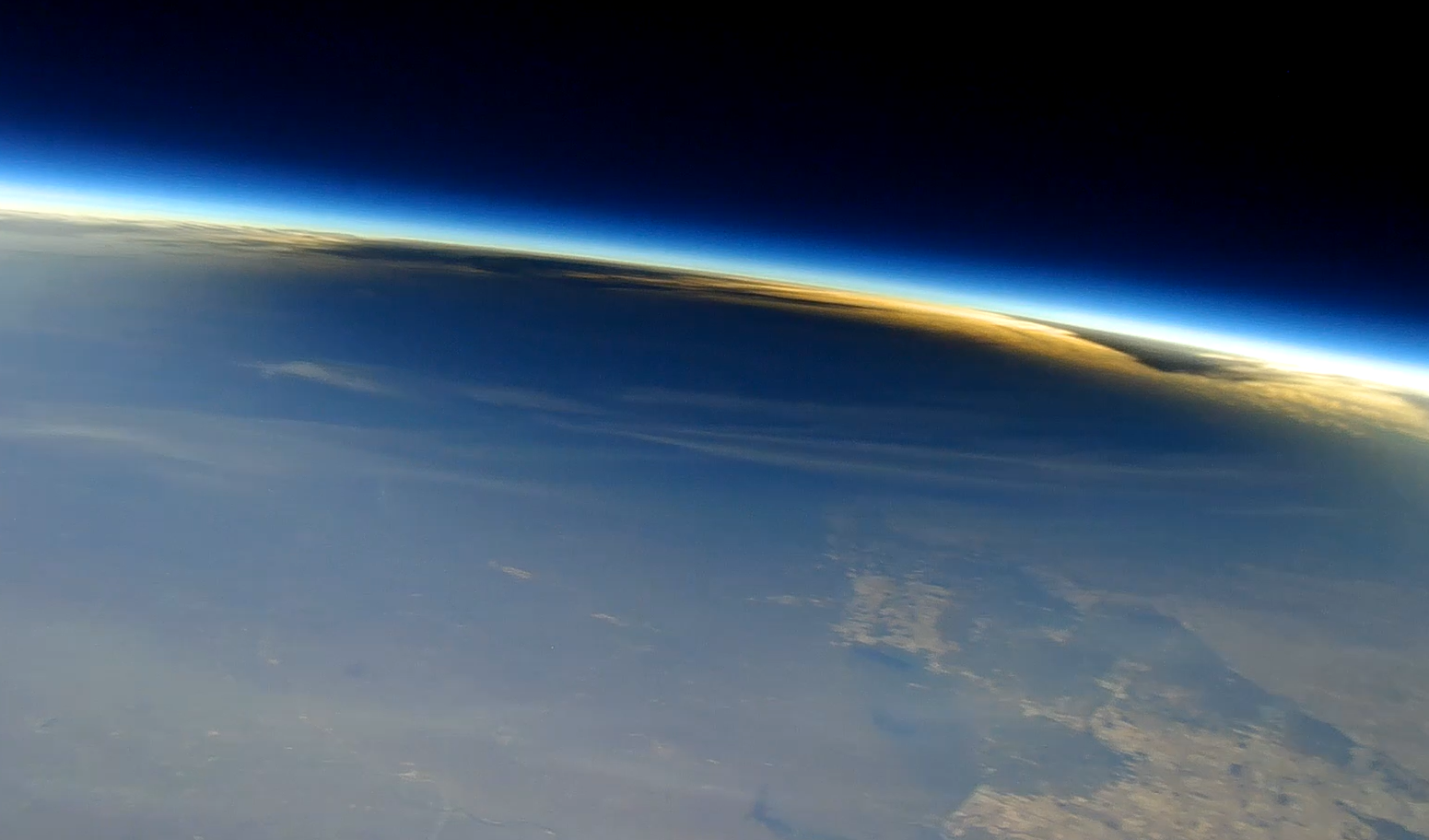
A small part of Earth appears in the lower portion of the view, with the blackness of space in the background at the top. The atmosphere appears as a thin, blue band separating Earth from space. Projected on to Earth is a dark, oval-shaped shadow cast by the Moon during a total solar eclipse.
This image shows the Moon’s shadow on Earth during the total solar eclipse on April 8, 2024, as seen from about 90,000 feet from a camera carried by a scientific balloon. Cameras carried by balloons launched from Spain will capture similar images during the Aug. 12 total solar eclipse.
Nationwide Eclipse Ballooning Project/Virginia Tech

In Spain, three balloon teams will launch a total of six balloons with 360-degree cameras to image the eclipse shadow from above. These balloons also will include instruments designed to measure levels of ozone in the atmosphere, which requires sunlight to form. Similar balloon experiments showed that ozone decreased during totality in April 2024. Scientists wonder whether there will be differences with this eclipse, particularly since it happens at a later time of day and during a different season.

The NASA-funded Nationwide Eclipse Ballooning Project will allow teams of students from across the U.S. to get a unique view of the August total solar eclipse with scientific balloons. Credit: NASA’s Goddard Space Flight Center

Follow along

While the total solar eclipse won’t be visible in the U.S., some parts of the country will be able to see a partial solar eclipse. Learn more about where to see the eclipse and how to view it safely.

by Vanessa Thomas
NASA’s Goddard Space Flight Center, Greenbelt, Md.

Lee esta historia en español aquí.

Keep Exploring

Discover More Topics From NASA

  •  
❌