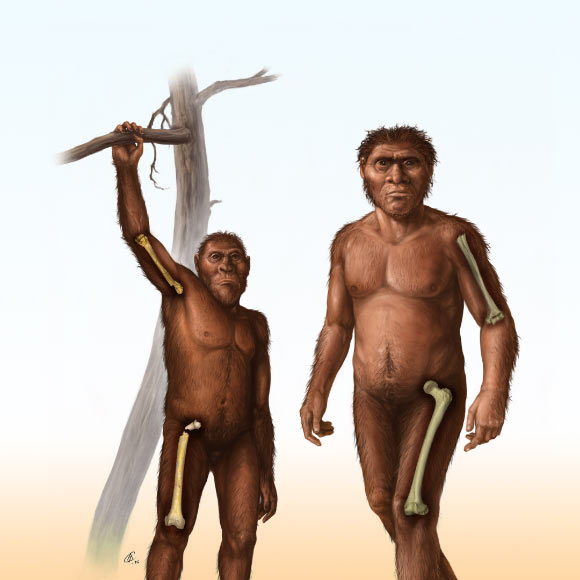
New research led by University of the Witwatersrand and University of Southern California paleoanthropologists sheds more light on one of the most debated transitions in human evolution: when our ancestors stopped regularly climbing trees and committed fully to walking on two legs.
The first Denisovan radius ever discovered is offering scientists a rare new glimpse into one of humanity’s most mysterious ancient relatives, whose scarce fossil remains have left much of their story unknown.
In a recent paper published in Nature, the team described these unique remains, discovered in the Bianfu Cave in Southwest China, an important Paleolithic site.
While Denisovans have been discovered throughout Asia, this part of China has been a major gap in the record. Therefore, this site provides important information about what a complete Denisovan body would have been like, as well as intricate details about regional skull variations among these archaic hominins.
A New Technique
The researchers behind the new study developed a novel technique to make the most of the more than 60,000 bone fragments recovered from Bianfu Cave. While Zooarchaeology by Mass Spectrometry (ZooMS) has become an important tool in working with hominin fossils, using it on a find of this scale would be inefficient and expensive.
Therefore, the team developed a morphological pre-screening and ZooMS identification technique, which greatly increased their efficiency in recovering hominin fragments from the site and could be applied to other Paleolithic sites in the future.
A total of 22 likely hominin bone fragments were identified in the pre-screening process, from which two parietal bone fragments and one proximal radial fragment were confirmed by ZooMS as belonging to hominins.
Above: Various views of the Bianfu Cave radius from layer 7 (BFD771, upper row) and its virtual reconstruction (bottom row); from left to right: anterior, posterior, medial, lateral and proximal views (Image Credit: Rao, H., et al, “Ancient proteins identify various Denisovan remains from Southwest China.” Nature, 1-7. https://doi.org/10.1038/s41586-026-10976-9)
Denisovan Remains Uncovered
Two of these hominin remains were excavated from the same layer, dated between 148,000 and 143,000 years old, which also held four hominin teeth. The research team further examined two of those teeth, and a detailed analysis indicated they belonged to males. The third specimen was even older, from a layer dated between 167,000 and 150,00 years old.
By screening the fragments for amino acids, the team identified a variant of COL1A2 R996K unique to Denisovans as present, confirming the species identity of the remains. Other intriguing amino acids in the fragments included one shared by Denisovans, Neanderthals, and modern humans, as well as one that marks them as distinct from Homo erectus, which also occupied East Asia.
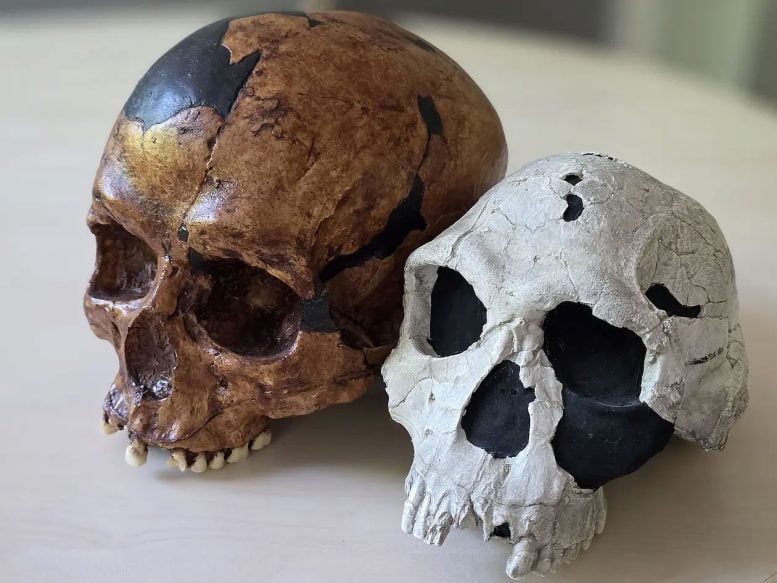
As the team closely examined the morphology of skulls excavated from Bianfu Cave, they identified a cranial thickness pattern remarkably similar to H. heidelbergensis and East Asian late Middle Pleistocene archaic Homo.
A New Understanding of Denisovans
After analyzing the morphology of the first Denisovan radius ever discovered, the researchers suggest it was likely oriented similarly to a Neanderthal’s, but with a shape and cross-sectional geometry closer to that found in modern humans.
The importance of the find lies not only in being the first example of its kind, but also in indicating biochemical demands and adaptations distinct from both Neanderthals and modern humans.
Besides Denisova Cave in Siberia, from which Denisovans draw their name, the team believes Bianfu Cave may hold the largest fossil record for the species. This could provide researchers with crucial new data, over a decade into the quest to understand the Denisovan species of Asia.
Based on the age of the layers in which the remains were found, the team says the Yunnan-Guizhou Plateau region, where the cave resides, may have been an ideal homing habitat at the time. The Earth would have been in a glacial period, during which the area’s relatively warm climate would have aided hominin survival.
Ryan Whalen covers science and technology for The Debrief. He holds an MA in History and a Master of Library and Information Science with a certificate in Data Science. He can be contacted at ryan@thedebrief.org, and follow him on Twitter @mdntwvlf.
A new analysis of three skull fragments unearthed at the Gran Dolina cave site in Spain indicates that Homo antecessor had bone thickness closer to that of Neanderthals and modern people than to more archaic hominins.
Neanderthals vanished roughly 42,000 years ago, but a piece of their biology appears to be quietly at work in some people today, according to a new study led by scientists from the Max Planck Institute for Evolutionary Anthropology.
A team of researchers from the University of Sydney and the University of Glasgow argues that dietary sugars, not animal foods, may have played the decisive role in the expansion of the human brain over the past 4 million years, as hominin brain size grew nearly fivefold, from about 300 grams in early relatives like […]
A 1.4-million-year-old trail of footprints reveals that a powerful human relative grew nearly as large as us and may have traveled in all-male groups. Eight individuals walked across the wet ground beside an ancient Kenyan lake. Within a short time, sediment buried their footprints and preserved a scene that would remain hidden for roughly 1.4 [...]
New research led by the University of California, Berkeley reveals that beyond Neanderthals and Denisovans, humans interbred with two mysterious ‘ghost’ lineages: one in Africa more than 50,000 years ago, another in Eurasia over 1.7 million years ago.
A fossilized skull fragment of Homo sp. unearthed in central Spain offers paleoanthropologists a fresh window into the story of ancient humans who lived in Europe hundreds of thousands of years ago.
A set of 1.43-million-year-old fossil footprints preserved along the margin of an ancient lake in northern Kenya is offering paleoanthropologists new evidence about the size, gait and social lives of the beings who made them and reopening questions about which species they belonged to.
A new analysis of a set of 1.4-million-year-old fossilized footprints found along the shore of an ancient Kenyan lake revealed that the hominins responsible for leaving them were much larger than previously believed, with some specimens approaching the height and body size of modern humans.
The new analysis also determined that discovering a group of footprints belonging to eight different adult males from distant human ‘cousin’ species Paranthropus boisei walking together suggests a complex societal dynamic where males likely competed for females but also worked together for the group’s benefit.
1.4-Million-Year-Old Fossilized Footprints Reveal Unexpectedly Large Body Size
According to a statement announcing the new fossilized footprint analysis, the team behind the research had previously “pioneered” methods allowing science to accurately identify the footprints as belonging to Paranthropus boisei in 2024.
However, lead author Kevin Hatala, of Chatham University and an associated researcher of the Department of Human Origins at the Max Planck Institute for Evolutionary Anthropology in Leipzig, said the new approach, which analyzes foot anatomy and movement patterns based on the fossilized footprints, revealed much larger individuals than expected.
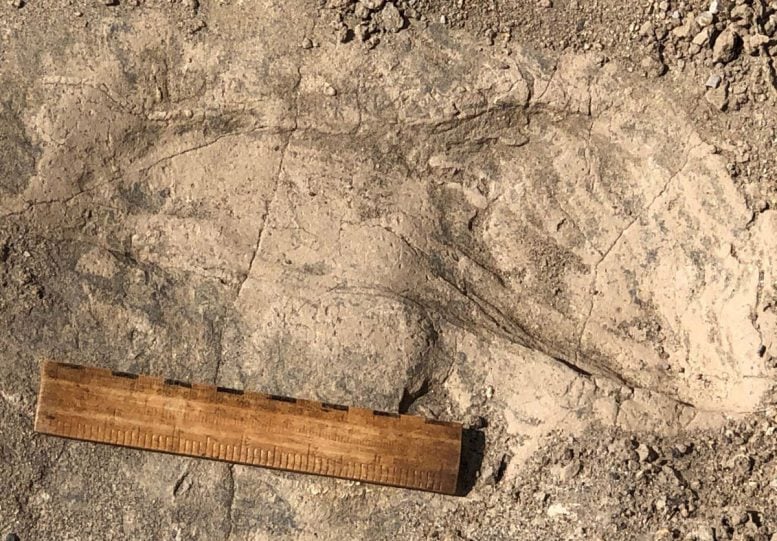
One of the large, 1.4-million-year-old footprints that the team excavated. A 6-inch (~15 cm) ruler is shown for scale. Image Credit: Kay Behrensmeyer.
“The sizes of the footprints indicate human-like body sizes – up to 1.8 meters tall and around 75 kilograms”, Hatala said, noting that scientists studying the rare fossils available for Paranthropus boisei had previously assumed the species was much smaller than the modern human ancestor and contemporary hominin, Homo erectus.
For example, the researchers explain, the “overwhelming majority” of previously identified Paranthropus boisei fossils were skulls with massive jaws and teeth. However, they add, little is known about this ancient hominin’s anatomy from the neck down.
“A Window into Hominin Behavior and Group Dynamics”
Although indirect evidence compared to actual bones, the team notes that fossilized footprints form “very quickly.” This rapid formation helps preserve critical movement and anatomy data that the team notes “can be a useful window into hominin behavior and group dynamics.”
“The fact that eight, mostly adult male, Paranthropus boisei individuals seemingly traveled together as a group, without females or children, hints at a complex social structure in this species”, explained study co-author Neil Roach of Harvard University.
Approximately 1.43-million-year-old hominin footprint from Koobi Fora, Kenya. Image Credit: Kevin G. Hatala.
For example, Roach said the ancient footprint makers may have lived in large groups, “where males competed for mates.” However, he notes, the same footprints suggest these competing males “also tolerated each other at times for safety in a dangerous environment.”
“This discovery adds an important behavioral dimension to the fossil record of Paranthropus boisei, a species that lived alongside early members of the genus Homo, yet took a different evolutionary path,” they explain.
Proximity and Environmental Conditions Could Offer More Behavioral Clues
Although the study focused on the 1.4-million-year-old footprints found on the shore of an ancient Kenyan lake, the work joins a growing catalog of ancient hominin footprints left on equally ancient lake shores. To date, the team has documented hundreds of hominin footprints across more than a half-dozen sites in the local region.
When discussing the significance of their findings, the team noted that these 1.4-million-year-old footprints join this larger group in supporting ancient lakes as an “important habitat with critical resources” that our now-extinct relatives relied on for survival. Study co-author Kay Behrensmeyer of the Smithsonian Institution also highlighted the unexpected nature of the discovery of ancient footprint fossils so close to others from a similarly ancient time.
“To me, it is amazing that we have the same kind of lake margin deposits in two areas of East Turkana that are 40 kilometers apart, at about the same age”, the researcher explained.
Kevin Hatala and colleagues discuss the ancient footprints excavated in northern Kenya in 2023. Image Credit: Kay Behrensmeyer.
Study co-author Anna K. Behrensmeyer from the Department of Paleobiology and Human Origins Program, National Museum of Natural History, Smithsonian Institution, said understanding the environment and local conditions when the footprints were left could fill in even more missing pieces about this enigmatic ancient hominin.
“If we can understand what geological conditions allowed these tracks to be preserved, we should know more about why hominins continued to return to the lake shore environment over more than 100,000 years,” Behrensmeyer said.
Building a Photo Album of Our Past
When detailing the significance of the new analysis, study co-author Purity Kiura of the National Museums of Kenya said finding these fossilized prints along the margins of Lake Turkana “reinforces the region’s global importance in understanding human evolution, preserving remarkable evidence of how our ancient relatives lived 1.4 million years ago.”
“It further strengthens Kenya’s position as one of the world’s leading paleoanthropological landscapes and highlights our responsibility to protect this irreplaceable heritage,” Kiura added.
Most Paranthropus boisei fossils are skulls. By Matt Celeskey from Albuquerque – Australopithecus boisei, CC BY-SA 2.0, https://commons.wikimedia.org/w/index.php?curid=32845963
From a methodology standpoint, the team noted the benefit of combining new analytical approaches with “exceptional” fossil footprints. They also point out that ancient tracks like the 1.4 million-year-old footprints found in Kenya “can reveal the anatomy and movement of extinct human relatives, while also providing rare insights into their social lives and environments.”
To follow up on their findings, the research team said they plan to return to Kenya later this year and conduct more analysis of the footprints. According to Hatala, this work will help archaeologists and anthropologists fill in missing pieces of hominin history, especially those extinct branches of the evolutionary tree.
“Each site represents a snapshot of our past, and we are quickly building a photo album with several different windows to hominin anatomy, locomotion, behavior, and environments during the Early Pleistocene,” the researcher explained.
Christopher Plain is a Science Fiction and Fantasy novelist and has spent the last six years as Associate News Editor and Head Science Writer at The Debrief. Follow and connect with him on X, learn about his books at plainfiction.com, or email him at christopher@thedebrief.org
Ararat-1, a modest limestone cave that lies at an elevation of 1,034 m on the eastern flanks of the Ararat Depression in central Armenia, has yielded a striking puzzle about how Middle Paleolithic humans moved across their landscape.
In a new study of chimpanzees (Pan troglodytes) and bonobos (Pan paniscus), scientists found that embraces, touches and other reassuring gestures before competition for food were linked to more peaceful sharing, suggesting the roots of human social touch stretch back at least six million years.
Scientists say some of the traits that define modern humans may have evolved only after long-standing biological and cultural barriers were broken. Human evolution is often presented as a clear progression: brains grew larger, faces became smaller, tools improved, and our ancestors gradually became more like us. A new study suggests that this familiar story [...]
Üçağızlı II Cave on Türkiye’s Mediterranean coast has yielded a rare and detailed record of two Homo species living the same way of life, one after the other, over more than 20,000 years, offering new evidence that the transition from Neanderthals to modern humans in the region was far more culturally seamless than previously understood.
Scientists have uncovered compelling new evidence that early human ancestors, likely Homo erectus, were deliberately bringing fire into Wonderwerk Cave in South Africa as far back as 1.79 million years ago.
Rare charcoal fragments from an ancient lakeshore campsite are offering new clues about fire use, resource management, and the environmental knowledge of some of humanity’s earliest fire users. Long before cities, farms, or written language existed, some of humanity’s ancestors had already discovered a resource that would transform the course of human evolution: fire. But [...]
Geochemical analysis of 780,000-year-old stone tools from Israel suggests Acheulean (or Acheulian) hominins repeatedly sought specific basalt sources, revealing sophisticated planning and deep knowledge of their landscape.
New research from the University of Oxford and the University of Reading suggests bipedalism and expanding brain size helped drive the overwhelming dominance of right-handedness in humans.

 Login