In a lab at the Okinawa Institute of Science and Technology (OIST) in Japan, a slab of diamond smaller than a pencil eraser hangs from a carbon fiber rod about 5 centimeters (2 inches) long. The rod is attached to a graphite plate that floats in mid-air above four magnets. Nobody touches it. When a […]
A new quantum test of the weak equivalence principle performed on the China Space Station using cold atom interferometry is the most precise to date, yielding an uncertainty of 2.8 x 10⁻⁸ and a test result of around –2.7 x 10⁻⁷. Meanwhile, a separate team in Israel, Germany and the UK has measured an object’s quantum phase in freefall in the laboratory and confirmed that Einstein’s equivalence principle holds here too.
The weak equivalence principle (WEP), or the “universality of freefall”, is an important pillar of Albert Einstein’s general theory of relativity, in which mass and gravity are intimately linked to the curvature of space–time. The WEP states that, in the absence of other forces, all objects fall with the same acceleration under the influence of gravity regardless of their mass or composition. In other words, gravitational mass (the m in F = GMm/r2, where F is the gravitational attraction between two masses placed a distance r apart and G is the gravitational constant) and inertial mass (the m in F = ma, where a is the acceleration produced by the force F) are the same.
Precisely measuring this principle is crucial since any detected violation could point to new physics. It is also important for continuing to corroborate the theory of general relativity, which may be incomplete because it appears to be fundamentally incompatible with another well-tested theory: quantum mechanics. Today, tests of the WEP using macroscopic bodies have reached extraordinary precision – at the 10−13 level on Earth and 10−15 in space. These latest studies investigate the principle in the quantum realm.
Cold atomic interferometry
Conventional interferometry works by splitting a coherent beam of light and then recombining the different components at a detector. If the two components are in phase when they recombine, the interference is constructive and the two components reinforce each other. However, if the two components are out of phase, they cancel each other out, leading to a characteristic pattern of bright and dark fringes. Atomic interferometry is similar but relies on beams of atoms rather than beams of light.
Cold atom interferometry (CAI), which is atomic interferometry at ultracold temperatures of just above absolute zero, has found applications in inertial sensing and fundamental physics research. It also turns out to be a powerful technique for testing the WEP.
There is a problem with using CAI on Earth, however, because our planet’s gravity limits the interference time of the atom beams to just a few seconds. Experiments in microgravity allow this time to be extended to minutes, but because the resolution of a WEP test scales inversely with the square of the interference time, even longer interference times are needed to achieve the required precision (10−17 or more). This necessitates a permanent microgravity environment, something that is only possible in space.
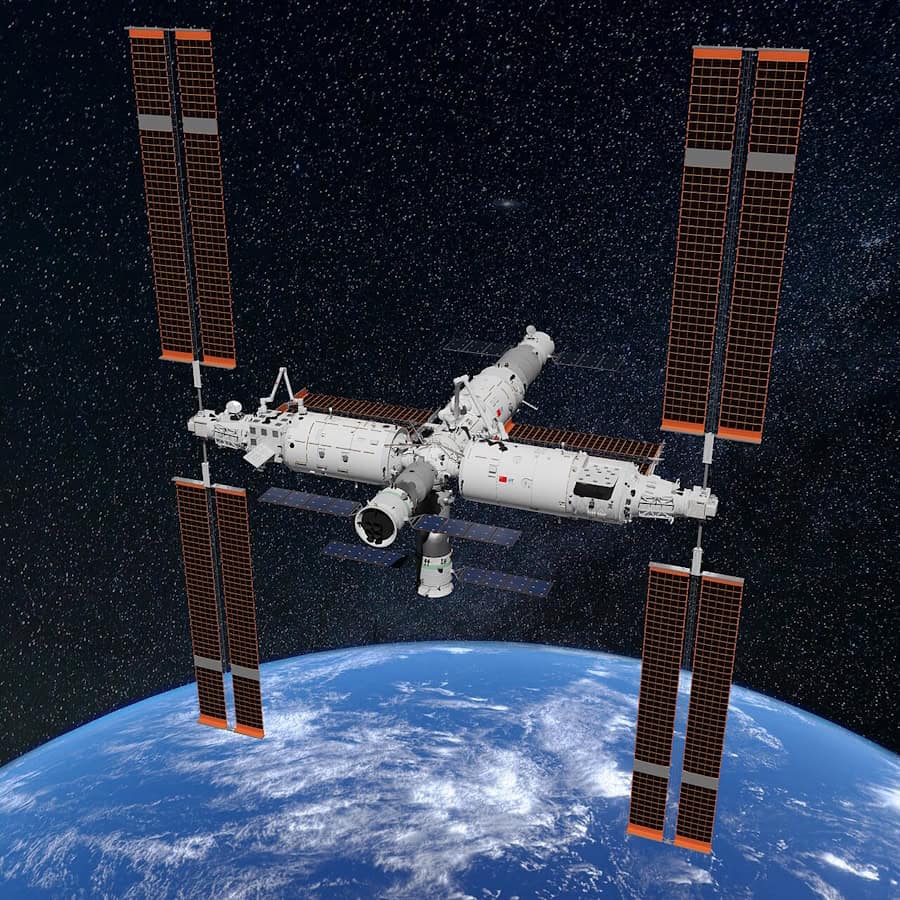
Permanent microgravity environment Rendering of the China Space Station. (Courtesy: CC BY-SA 4.0/Shujianyang)
By exciting and detecting the fluorescence of the isotopes sequentially at slightly different times, the researchers obtained two sets of symmetric interference images, one from the 85Rb atoms and one from the 87Rb atoms. Measuring the differential phase of these images – after suppressing the residual acceleration of the space station and effects from vibrations – allowed them to calculate the difference in the acceleration between the two isotopes in the vertical, freefalling direction.
After running their experiment for 280 days, during which time the researchers acquired more than 9700 pairs of interference fringes, they obtained a test result of around –2.7 x 10⁻⁷, after correcting for errors.
“We believe that our technique will have a significant impact,” says Zhan. “First, it demonstrates that an integrated interferometer meeting the requirements of in-orbit operation is possible, giving the community confidence to continue with even more technically demanding space-based interferometry experiments that aim for ever increasing precision. The technology developed in this project will also itself help advance atom-interferometry-based instruments, such asinertial navigation systems.”
Measuring an object’s quantum phase in freefall
Meanwhile, physicists at the Ben-Gurion University of the Negev, the University of Ulm and the University of Oxford have also used CAI, this time to measure an object’s quantum phase in freefall. They confirm that the effect is the same as predicted by Einstein’s equivalence principle (EP), which states that for an observer in freefall, gravity should locally disappear.
In their work, also detailed in Science Advances, the researchers used a completely novel version of the CAI technique that they call the Quantum Galileo Interferometer (QGI) – in honour of Galileo Galilei’s discoveries regarding the laws of freefall. The experiment, which was carried out at Ben-Gurion University, again makes use of clouds of 87Rb atoms cooled to just above absolute zero.
The researchers began by applying microwave pulses to put the ultracold atoms – which were placed 113 µm below the surface of an atom chip containing current-carrying wires that produce magnetic field gradients – into a quantum superposition. This meant that each atom effectively travels along two different paths at once. One part of the atomic wave responded to the magnetic fields such that an applied upward force exactly counteracted the downward pull of gravity and the wave was held stationary in the apparatus – that is, static relative to Earth. This part of the wave is referred to as the reference atomic wave (or wavepacket). The second part of the wave was sent upwards in a ballistic trajectory.
A magnetic cannon and parachute
Realising this ballistic trajectory, affected only by gravity, required a “magnetic cannon” and a “magnetic parachute”, explains Ron Folman, who is one of the leaders of this study. “After the short-duration magnetic cannon, we switched this part of the wave into a state that is almost unaffected by the magnetic field so that it could fall freely under gravity. And at the end of the fall, we used another precisely controlled magnetic pulse to stop the relative motion between the two waves and reunite the two parts so that they interfered with each other.”
That interference allowed the researchers to measure the tiny difference in quantum phase accumulated while one was falling and the other was held still — two frames that may be referred to as the Einsteinian and the Newtonian frames, respectively. This means that when both parts of the wave have the same velocity, the transformation between the wavefunction in a Newtonian (laboratory) frame of reference and the wavefunction of the same object in an Einsteinian frame that freefalls with the same acceleration, involves a transformation phase known as a gauge phase.
According to their experiments, the gauge phase measured by the researchers is the same as the one predicted when Einstein’s EP is applied to such a quantum wave, so confirming the principle for these quantum objects and at these low masses and energies.
“Some members of our team,” notes Folman, “including Nobel laureate Sir Roger Penrose, expect this co-existence between general relativity and quantum mechanics to break for objects with higher masses. Indeed, the Ben-Gurion University group is now repeating the same experiment with nanodiamond particles to test this hypothesis,” he tells Physics World.
The observation, says study co-leader Vlatko Vedral at Oxford University’s department of physics, constitutes a fundamental test of the interface between quantum theory and gravity. “The connection between these two pillars of modern physics remains one of the most important open questions in physics, and it is thus of paramount importance to understand the phenomenon of freefall and the EP in the quantum domain.”
An international research team has announced the first-ever successful observation of gravity’s effect on a falling quantum object, demonstrating a connection between gravity and the quantum world first predicted by Albert Einstein.
The research team said the result does not unify quantum mechanics and gravity, nor does it prove that gravity is a quantum phenomenon.
However, the researchers said their study offers experimental support that Einstein’s equivalence principle, a fundamental concept at the heart of the famed scientist’s theory of gravity, remains consistent with matter in the quantum world.
Unifying Einstein’s Theory of Gravity with Quantum Mechanics
When physicists want to describe nature, they rely on two distinct sets of rules. Einstein’s theory of gravity explains the mechanics of large-scale phenomena like stars and galaxies. Conversely, quantum mechanics helps scientists characterize the behavior of extremely small objects. Still, finding a scientific bridge uniting the two sets of rules has proven elusive.
“These two pillars of modern physics have so far eluded all attempts at a unified theoretical framework,” explained Professor Ron Folman from Ben-Gurion University of the Negev and the lead author of the new study.
Einstein did, however, identify one mechanism where the two worlds meet. Called the equivalence principle, the concept says that gravity should effectively disappear for an observer in free fall. For example, NASA simulates zero-gravity environments by flying astronauts in a plane, making successive rising and falling parabolic arcs. During the short periods of falling, the astronauts briefly experience ‘weightlessness” due to the equivalence principle.
Above: The 2D MOT apparatus which feeds the science chamber with cold atoms. At the centre is a glass cell held under vacuum between coils producing magnetic fields. The atoms go into the science chamber through the tiny hole that may be seen in the centre of the yellow (reflecting) surface (Image Credit: Or Dobkowski).
Curious if the same phenomena would apply to the quantum world, the research team, which included Nobel Prize-winning physicist Professor Sir Roger Penrose, designed experiments. According to a statement announcing the research, the team hoped their setup would allow them to measure a “distinctive change in the quantum properties of atoms as they fell under gravity.”
Experiments Show Gravitational Pull Affecting Quantum Objects
To search for gravity’s effect in the quantum world, the researchers created clouds of rubidium atoms cooled to just above absolute zero. The researchers used a specially designed atom chip that allowed the team to manipulate the ultracold rubidium atoms.
Next, PhD student Or Dobkowski and colleagues used microwave pulses to place the atoms in quantum superposition. This unique quantum state lets each atom travel down two paths at once.
Using tiny electrical wires embedded on the specialized chip, the researchers generated tunable magnetic fields. The researchers said the field’s precision tunability allowed them to apply an upward force to one half of the atomic wave. For this experiment, the team created a magnetic field at the precise strength needed to counter gravity, effectively holding that half of the wave stationary relative to Earth.
After suspending the first half of the wave, the team used a magnetic pulse to lift the second part. Then, the team switched to a state almost unaffected by the magnetic field, allowing it to fall under gravity.
Once the second half completed its fall, the team used magnetic fields to reunite the two halves. When reunited, the two halves of the atomic wave interfered with each other. The researchers said that interaction allowed them to “measure the tiny difference in quantum phase accumulated while one was falling and the other was held still.”
“The phase measured in the new experiment is the same as the one predicted when Einstein’s principle is applied to such a quantum wave,” they explained.
“One of the Most Fundamental Questions in Physics”
When discussing the results, the research team said their result should not be construed as proof that gravity is quantum. The results also do not unite gravity and quantum mechanics. However, Folman noted, “this complex experiment gives more hints as to how such a unification may be achieved.”
Study co-author Professor Vlatko Vedral from the University of Oxford’s Department of Physics agreed, while also noting that their experimental results successfully demonstrated Einstein’s equivalence principle’s consistency with quantum mechanics, which alone provides an experimental connection between quantum physics and Einstein’s theory of gravity.
“This experiment pushes quantum mechanics into one of its most intriguing frontiers, gravity, and shows that, once again, its predictions hold,” Professor Vedral explained.
The professor also noted the experiment’s combination of hard experimental data with “a far-reaching theoretical interpretation, about one of the most fundamental questions in physics: How can gravity (described by Einstein’s theory of relativity) and quantum theory be unified into one understanding of the universe?”
Christopher Plain has spent the last six years as Associate News Editor and Head Science Reporter at The Debrief. Follow and connect with him on X, learn about his novels at plainfiction.com, or email him at christopher@thedebrief.org.
Black hole collisions, merging neutron stars, exploding supernovae – these massive cosmic events are all observed by interferometer-based gravitational-wave observatories such as LIGO. Detection of the ripples in space-time caused by these phenomena is dependent on the careful control of the mirrors used in these observatories.
Led by Jonathan Richardson at University of California, Riverside, a research team has demonstrated a new wavefront actuator that can correct deformations in the surface of the mirrors by applying carefully mapped heating patterns. In a new development, reported in Classical and Quantum Gravity, Richardson’s team has used thermal imaging cameras to pinpoint where the corrections are needed. This approach should massively reduce the main limitation on the sensitivity of gravitational-wave observations.
Limiting LIGO
Since their first detection in 2015, the world of gravitational-wave observation has thrived. Now, with two major updates planned for pioneer interferometer observatory LIGO (LIGO A+ and LIGO A#) and plans for a more powerful generation of new sites, the field has reached a major turning point. Richardson describes this transition as moving from “an initial discovery era – a time when the closest, loudest events were just barely resolvable above the detectors’ noise floors – to an era of precision science”.
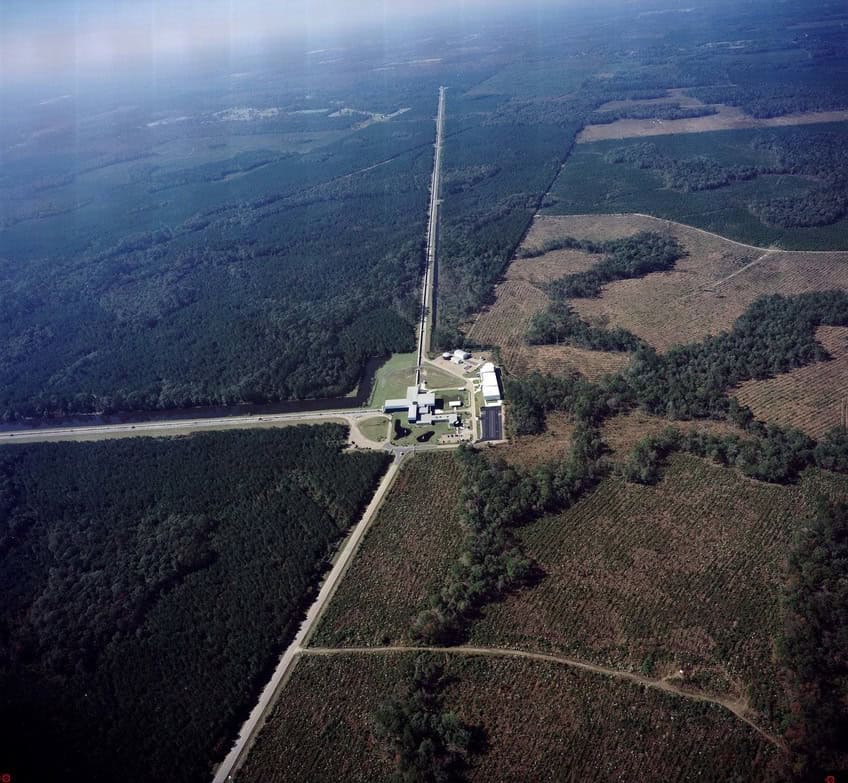
View from above An overhead view demonstrates the immense scale of LIGO’s Livingston site. (Courtesy: Caltech/MIT/LIGO Lab)
Richardson notes that, even now, observations such as that of a binary black hole merger with a record signal-to-noise ratio of 80 are allowing researchers to test our most fundamental theories of the nature of gravity and black holes. Heightened sensitivity will allow the observation of waves that have travelled far greater distances, over longer time periods, and are weaker as a result. These new developments will allow astrophysicists to peer further out into our universe and further back in cosmic time than ever before.
This major increase in sensitivity requires new levels of power, with LIGO A# reaching an unprecedented 1.5 MW of circulating laser arm power. The mirrors used in these detectors absorb some of the power of the incident lasers as thermal energy, resulting in heat-induced distortions that have a detrimental effect on the sensitivity of the detector. It is these deformations that place a limiting factor on the capabilities of gravitational-wave observatories.
A surprisingly simple solution
Richardson’s team has already taken huge steps towards reducing this effect with the development of new adaptive optics. In principle, these devices can apply a variable blanket of heat across the surface of the mirror that cancels out the thermal deformation from the laser heating at the nanoscale. Unfortunately, the application of this method is limited by researchers’ ability to precisely map these aberrations. This lack of sensing capability posed a roadblock on the path to high-powered gravitational-wave observation.
Richardson’s group discovered a solution to this problem when testing this new technology on a full-scale 40 kg LIGO mirror. They realised that they could accurately reconstruct the optical distortions across the entire 34 cm-diameter mirror by combining direct measurements of the surface temperature with a well programmed model of heat flow in the material.
In a surprising turn of events, the thermal imaging cameras needed to survey the full aperture of the mirror are widely commercially available and can be calibrated using LIGO’s Hartmann wavefront sensors that are already in place. Without the need for a lengthy process of technology development, as is usually required to solve LIGO instrumentation problems, Richardson is “all the more hopeful that we will reach megawatt-scale interferometry in the coming years”.
The future of gravitational-wave detection
The planned improvements to LIGO will drastically increase the observational power of this leading facility, but designs for a new generation of observatories could present even greater opportunities.
Cosmic Explorer is the US-led contribution to a new class of interferometers. Its arms will reach an enormous 40 km each, with ten times the sensitivity of LIGO. Richardson’s team will be responsible for implementing their cutting-edge research in laser wavefront sensing and correction as part of Cosmic Explorer’s base design. As a testing ground for these developments, LIGO will pave the way for an exciting new era of gravitational-wave detection.
With these levels of sensitivity, Cosmic Explorer aims to observe gravitational waves from hundreds of thousands to millions of black hole and neutron star mergers per year. Gravitational-wave detection will then reach close to the edge of our observable universe, looking back approximately 14 billion years across cosmic time.
Using existing, widely available technology, Richardson’s research group is pushing the limits of gravitational-wave detection and spurring on the development of a new, more powerful class of observatory.
Usually, when physicists want to model the merger of two black holes, they use supercomputers. Now, however, physicists in the US have found a possible shortcut. In a study published in Physical Review Letters, they show that, of the final states permitted by energy and angular momentum, the remnant of a non-spinning black hole merger ends up in a state quite close to one that maximizes the system’s entropy – a surprising and puzzling result that reinforces the deep connection between thermodynamics and black holes.
“Our group has long believed that black hole thermodynamics could provide a new perspective on binary black hole mergers,” says team member Monica Rincon-Ramirez, a postdoctoral researcher at Pennsylvania State University. “While black hole thermodynamics is well established for equilibrium systems, much less is understood in the highly dynamical regime of mergers.”
Merging black holes
Black hole mergers occur when two black holes that orbit each other spiral inward with increasing speed, losing both energy and angular momentum by emitting gravitational waves until they eventually converge in a violent clash. After the moment of merger, the remnant oscillates vigorously, “ringing down” into a quiescent, rotating object known as a Kerr black hole that can be described in terms of just two quantities: mass and spin.
Meanwhile, the gravitational waves – ripples in the fabric of spacetime – from this energetic collision propagate through space virtually uninterrupted. These gravitational waves encode information about their source, and when we detect them on Earth (millions of light-years away from their origin), we can use them to predict the remnant’s size and spin. However, doing this requires solving complex equations from Einstein’s general theory of relativity using computationally expensive numerical simulations.
Connecting black holes and thermodynamics
Thermodynamics is the branch of physics concerned with the relationships between energy, heat, work and temperature. For ordinary matter, thermodynamics can describe how energy flows from one system to another in simple terms, even for complex systems with numerous particles and degrees of freedom. For example, rather than meticulously tracking each individual particle, concepts such as entropy – a measure of a system’s disorder – can be used to describe the final state of the entire system.
Physicists have long known that black holes obey laws that closely parallel the laws of thermodynamics, with the event horizon and surface gravity of black holes being analogous to entropy and temperature, respectively. Building on this established connection, Rincon-Ramirez and colleagues at the University of Mississippi, the University of California, Berkeley, and Northwestern University as well as Penn State investigated whether black hole thermodynamics could go beyond describing the properties of isolated, stationary black holes and provide, in addition, a principle for determining the final state of a merger.
The maximum-entropy conjecture
After accounting for the energy and angular momentum carried away by gravitational waves, the researchers tracked the evolving mass and angular momentum of a binary, mapped these values to those of hypothetical Kerr black holes, and calculated the corresponding entropy. They found that the Kerr entropy reaches a maximum at a mass and spin strikingly close to the final mass and spin predicted by numerical relativity simulations. Indeed, the two methods agreed with each other to within a few percent. “The Kerr entropy turned out to be remarkably meaningful for the binary system as a whole,” Rincon-Ramirez says.
Interpreting and presenting these results proved to be a challenge, however. “What we found was completely unexpected,” says Rincon-Ramirez. After deliberating among themselves as to why the final black hole’s parameters should lie so close to those of the maximum-entropy black hole, they ultimately chose to extend the conversation to the scientific community. By presenting their puzzling results and a broad conjecture, which they term the “maximum entropy conjecture for black hole mergers”, they hope to sharpen their findings through rigorous testing and eventually place them on a firm mathematical foundation within general relativity.
In the meantime, the researchers plan to extend their conjecture to more general binary black hole systems. By studying systems such as highly spinning and eccentric binaries, they hope to gain further understanding of the role of thermodynamic quantities in general relativity. “Ultimately, we hope this work will contribute to a more complete thermodynamic framework for highly dynamical spacetimes,” Rincon-Ramirez says.
An exceptionally loud gravitational wave signal has offered an unprecedented glimpse into the region of space near a black hole’s event horizon – the “surface of no return” beyond which nothing, not even light, can escape the pull of gravity. Denoted GW250114, the signal originated from the merger of two black holes, and its unusual strength and clarity meant that astrophysicists could extract information from it that was previously only accessible via theoretical modelling.
Physicists describe a black hole’s event horizon in terms of two parameters: the black hole’s rotation frequency ΩH and its surface gravity κ. When an object falls into a black hole, it appears to orbit at ΩH because of a phenomenon known as frame dragging in which the black hole literally drags nearby spacetime along with it as it rotates. This means that objects near a black hole’s edge are constantly in motion relative to observers on Earth.
Regions of space near an event horizon can be described very well theoretically, but observational data has been hard to come by – at least until recently. “Gravitational waves are changing that,” says Sizheng Ma, a postdoctoral researcher at Canada’s Perimeter Institute who led the new study alongside astrophysicist Ling Sun and PhD student Neil Lu from the ARC Centre of Excellence for Gravitational Wave Discovery (OzGrav) and the Australian National University.
Gravitational waves are ripples in spacetime produced whenever dense astronomical objects such as black holes and neutron stars collide. With facilities such as the Laser Interferometer Gravitational-Wave Observatory (LIGO), Virgo and KAGRA (Kamioka Gravitational Wave Detector) now routinely recording these ripples, Ma says, “something that once sounded almost like science fiction – learning about black-hole horizons through observations – is now becoming a real scientific programme”.
From prediction to observation
In earlier theoretical work, Ma and colleagues in Japan, China and the US predicted that if Einstein’s general theory of relativity is correct, the gravitational waves produced when two black holes merge should carry information about the near-horizon region during the final stage of the merger. This information takes the form of a gravitational-wave component known as a direct wave that oscillates around a value that is twice that of ΩH. “The big question was whether such a signal could actually be seen in real gravitational-wave data,” Ma says.
Observing an event horizon: Team members Ling Sun and Neil Lu from the ARC Centre of Excellence for Gravitational Wave Discovery (OzGrav) and the Australian National University. (Courtesy: OzGrav/Swinburne University)
The main challenge, he explains, is that gravitational-wave data are hard to interpret. “Interesting features can appear for many reasons, so we had to be very cautious,” he says. “We needed to separate this possible direct-wave signature from the much stronger and better-known ‘ringdown’ signal of the final black hole, and then check whether the remaining pattern behaved as the theory predicted.”
When the LIGO-Virgo-KAGRA network detected GW250114 last year, the astrophysicists realized they were in luck. With a network signal-to-noise ratio of approximately 80, this event was around three times louder than LIGO’s first gravitational-wave signal in 2016, and it gave the team a rare opportunity to test their prediction against data. “Our new analyses have allowed us to decrypt the signal and measure ΩH and κ for the first time,” Ma says.
“A new way of studying black holes”
Even with an unusually clear signal, Ma acknowledges that the work required “careful modelling and many double-checks to make sure we were not overinterpreting a feature in the noise”. But if the team’s interpretation holds up, Ma tells Physics World that their method could become a new way of studying black holes. Gravitational-wave observations have already enabled scientists to study how black holes orbit, merge and settle down, Ma notes. The present work extends this by offering access to the near-event-horizon region during the merger’s final stage.
“That gives us a new observational handle on some of the most extreme predictions of Einstein’s theory, allowing us to perform sharper tests of this theory and better understand how black holes form and relax after a merger,” he says. “It also allows us to explore whether the near-horizon region behaves exactly as Einstein predicted.”
The researchers’ next step will be to improve their direct-wave model so that it describes realistic black hole mergers in greater detail. “On the observational side, we want to apply the analysis to more gravitational-wave events,” Ma says. “The result detailed in this study comes from one exceptionally loud and clean event, so the most convincing confirmation would be to see the same kind of near-horizon signature in other black-hole mergers.”
The good news is that as gravitational-wave detectors continue to improve, the researchers hope to collect more such high-quality events. “These will allow us to test whether this pattern appears consistently in the way general relativity predicts and eventually turn this first result into a more systematic way of studying the regions near black hole horizons,” Ma says.
New research examines how gravity can be reconciled with thermodynamics through the Gravity from Entropy theory. Galaxies, stars, planets, and life emerged as the Universe expanded and became more complex. Yet the second law of thermodynamics says that the total entropy of an isolated system should rise over time, creating a fundamental question: how can [...]
The second law of thermodynamics states that entropy, or disorder, in an isolated system always increases over time. Einstein famously said that “the second law of thermodynamics occupies a unique position among the laws of Nature,” reflecting how fundamental he believed the principle to be.
In its early days, the universe was smooth and uniform, with low entropy. As it expanded, gravity pulled gas into stars, stars into galaxies, and eventually made life possible. Each step seems to create order in one place, even though the universe as a whole became more disordered. Cosmologists have usually explained this by pointing to the universe’s growing volume.
Gravity as a Ledger, Not a Force
Mathematician Ginestra Bianconi at Queen Mary University of London addressed this problem with a framework called Gravity from Entropy. Rather than treating gravity as a fundamental force, the Gravity from Entropy framework proposes that it emerges from an information-based difference between two descriptions of spacetime geometry. One metric describes the actual shape of spacetime, while the other describes the geometry that matter and curvature would create. When these two match, gravity disappears. When they differ, gravity arises from the difference.
In the low-energy, weak-curvature limit, the framework reduces to general relativity. In the new study, Bianconi adds a thermodynamic perspective. She applies Gravity from Entropy to the standard model of an expanding universe and shows that the local geometric degrees of freedom follow the first law of thermodynamics, with their own temperature and pressure emerging from the equations.
Falling Density, Rising Total
One of the study’s central findings is the distinction between total entropy and entropy per unit volume. As the universe grows, the total entropy increases, just as the second law demands. However, the study found that entropy per unit volume decreases over time even as the universe’s total entropy continues to increase. Within the Gravity from Entropy framework, Bianconi proposes that this declining local entropy density may help explain how galaxies and other cosmic structures emerge.
The study also shows that these geometric temperatures change depending on what dominates the universe. In a universe dominated by matter or radiation, the temperature decreases over time. In a universe dominated by dark energy, like our own, they remain nearly constant. The framework even assigns a temperature and pressure to empty spacetime.
A Theory Still Waiting to Be Tested
“This work reveals how the Gravity from Entropy theory can tackle the challenging question of reconciling the second law of thermodynamics with the emergence of complexity in our universe,” stated Bianconi. “These results may open new avenues for investigating the long-standing problem of reconciling the foundations of cosmological irreversibility, the emergence of complex structures, and ultimately life with fundamental gravitational dynamics.”
So far, Gravity from Entropy has not been confirmed by observations. The theory makes predictions that future observations of large-scale cosmic structures and other gravitational phenomena could test. While it remains unproven, Bianconi believes it could offer a new way to link gravity, thermodynamics, quantum mechanics, and the rise of complexity in the universe.
Austin Burgess is a writer and researcher with a background in sales, marketing, and data analytics. He holds an MBA, a Bachelor of Science in Business Administration, and a data analytics certification. His work focuses on breaking scientific developments, with an emphasis on emerging biology, cognitive neuroscience, and archaeological discoveries.
Future spacecraft may travel farther by drawing momentum from planets, sunlight, and the solar wind instead of onboard fuel. Every conventional rocket faces the same problem: it must carry the material that propels it. Since Konstantin Tsiolkovsky described the rocket equation in 1903, spacecraft have burned fuel and expelled it backward to move forward under [...]
In Einstein's theory of general relativity, gravity is always attractive. But according to a new paper, quantum mechanics offers a loophole that can create antigravity. And not only this, if it was measurable that would prove that gravity has quantum properties. How does this work and how can repulsive gravity be compatible with the laws of physics that we know and like? Let's take a look.
When Lucid introduced the Air electric sedan in late 2021, the first Air Dream Edition I tested packed over 1,100 hp (820 kW) and carried a $180,000-plus window sticker. It's easily the most powerful street car I've tested; the only vehicle I've driven with more power was a purebred race car with a third the mass, and it was on a proper track. Its combustion engine was also about 1,000 times louder than the Air, helping to remind us that "combustion" really does mean explosion after explosion.
For Lucid's second act, the company debuted the Gravity electric SUV last year, and I've just tested the 2026 Gravity Touring, which starts at about $82,000 in the US, including the required destination charge.
My test model carried a bevy of options, including a 22-speaker audio system, the Comfort and Convenience package, third-row seating, a Dynamic Handling package (combining rear-wheel steering and three-chamber air suspension), a luxury seating package (bundling Nappa leather and massaging and ventilated front seats), and special metallic paint.
New experiments are bringing into focus the mechanism behind Hawking radiation, the strange phenomenon that demonstrates black holes are not strictly a one-way street.
While theoretical physicist Stephen Hawking’s prediction of this faint radiation from black holes has yet to be detected from space, researchers have replicated it in laboratory models and have developed complex theories to explain the phenomenon.
In their recent paper in Nature, an international team of researchers from Germany’s Paderborn University, Mexico’s Cinestav, and Israel’s Weizmann Institute of Science has developed laboratory models that may point to a much simpler mechanism underlying these theoretical black hole emissions.
Hawking Radiation
Stephen Hawking first described Hawking radiation in a 1974 theoretical model, characterizing this as a type of blackbody radiation, meaning it is in thermodynamic equilibrium with its environment and changes with the body’s temperature. His prior work had assumed that the pull of a black hole was so powerful that electromagnetic radiation could not escape it. But eventually he reconsidered the work of two Soviet scientists, Yakov Zeldovich and Alexei Starobinsky, who proposed in 1971 that black holes could create and emit particles.
A major consequence of this theoretical radiation is that if it were real, it would mean that black holes slowly evaporate as they lose electromagnetic radiation. Given enough time, if a black hole failed to feed, it would continue to shrink until it vanished entirely.
Intriguingly, the rate at which this happens would be inversely proportional to the black hole’s mass, with smaller black holes emitting radiation at a faster rate. Therefore, micro black holes could disappear remarkably quickly compared to their larger siblings.
Modeling Black Hole Emissions
The international team’s work models the generation of Hawking radiation in a nonlinear optical environment, allowing them to identify a simple mechanism responsible for the emission and its impact on the system.
Earlier work described a significantly more complicated scenario, involving multiple quantum-mechanical processes interacting in a cascade to generate the Hawking radiation. The new solution utilized a fiber-optic model of a black hole’s event horizon, combined with precision experiments and rigorous modeling to reveal a much simpler mechanism by which radiation generates and feeds back.
“This simplifies the theoretical understanding and opens up new ways of calculating effects in such systems,” explained lead author Dr. Lorenzo M. Procopio, formerly of Weizmann but now of Paderborn University. “It might even shed light on how Hawking radiation arises in the context of gravity.”
Experimental Verification
The international researchers’ work goes beyond identifying the simplified mechanism; it also provides evidence that Hawking radiation interacts with the black hole system, rather than passively emitting from it into space.
Understanding this emission system is crucial to one of the great unanswered questions about black holes: do they lose mass over time or remain in permanent equilibrium? The enormous cosmic scale of a black hole and massive distances involved make such a precise study out of reach for current observational technology.
However, this laboratory work provides a unique opportunity to study the effect of Hawking radiation on a measurable scale. Additionally, Hawking radiation experiments offer essential clues to the nature of elusive quantum gravity, in which physicists are still trying to determine how macroscopic gravity impacts the microscopic quantum world.
Ryan Whalen covers science and technology for The Debrief. He holds an MA in History and a Master of Library and Information Science with a certificate in Data Science. He can be contacted at ryan@thedebrief.org, and follow him on Twitter @mdntwvlf.
In a groundbreaking advancement poised to redefine core principles in theoretical physics, researchers from Kyushu University and esteemed international collaborators have unveiled insights into the nature of continuous parameters within quantum gravity. This study challenges the long-standing assumption that such parameters are freely adjustable external inputs by demonstrating—under particular theoretical conditions—that they inherently originate from operators embedded within the physical theory itself. This resolution not only revitalizes Albert Einstein’s century-old assertion regarding the intrinsic completeness of physical laws but also propels forward our comprehensive understanding of the quantum structure of spacetime.
Central to this revelation is the concept of exactly marginal operators within the framework of conformal field theory (CFT), a pivotal branch of modern physics that explores systems invariant under scale transformations. CFT serves as a formidable bridge between quantum theory and gravitational physics, especially through the lens of the anti-de Sitter/conformal field theory (AdS/CFT) correspondence. This correspondence posits a deep equivalence between gravitational theories in a curved AdS spacetime and lower-dimensional CFTs residing at its boundary, rendering CFT an indispensable tool to probe quantum gravity’s elusive traits.
At the heart of the research lies the structure known as the conformal manifold—an abstract space parameterizing a continuous family of CFTs interconnected via exactly marginal deformations. These deformations represent operators that tweak a theory’s parameters without sacrificing its conformal symmetry. The pressing theoretical puzzle was whether the existence of such a manifold necessarily implies that continuous variations in the theory’s parameters emerge from operators already encoded within the theory, rather than arbitrary, external parameters appended to the formalism.
To rigorously examine this, the interdisciplinary team led by Associate Professor Yuya Kusuki embraced an innovative approach involving conformal interfaces, mathematical constructs that serve as boundary layers interpolating between two related CFTs situated on a conformal manifold. The researchers posited that as two nearby CFTs approach equivalence, the conformal interface connecting them should become trivial. Under the plausible assumption that certain correlation functions transition smoothly as this interface dissolves, they utilized the interface’s displacement operator—which quantifies the response of the interface to infinitesimal positional shifts—to reconstruct an exactly marginal operator governing motions on the manifold.
This reconstruction represents a monumental stride because it conclusively ties continuous parameters characterizing a family of theories not to arbitrary external dials but to concrete operators intrinsic to the theory’s internal dynamics. By examining the perturbative behavior of the conformal interface, the team effectively identified the fundamental origin of parameters that might otherwise have seemed freely tunable.
What does this imply for the broader quest of quantum gravity? Through the prism of AdS/CFT duality, the intimate relationship between conformal manifolds in CFT and the moduli space of vacua in quantum gravity theories becomes transparent. This newly established principle supports the profound conjecture that quantum gravity forbids arbitrary external parameters, with all continuous couplings traceable to internal degrees of freedom—a concept resonant with a widespread expectation but hitherto unproven with such clarity.
Importantly, the present findings apply specifically to two-dimensional CFTs, a fertile domain where theoretical control is well established. Nevertheless, the researchers have expressed optimism that their methods and conceptual revelations will motivate extensions to higher-dimensional CFTs and more general quantum gravity landscapes. Extending these results could illuminate the landscape of string theories and the parameters governing candidate quantum gravity models.
Moreover, these results have significant implications for the so-called “Swampland program,” a burgeoning field striving to delineate which consistent-looking effective field theories can be embedded into quantum gravity. By constraining continuous deformations to those generated by internal operators, this study offers fresh constraints on the space of viable theories and sharpens the boundaries between the “landscape” of consistent theories and the “swampland” of inconsistent ones.
The research underscores an increasingly vital notion: the parameters defining fundamental physics are not arbitrary selections but emergent phenomena anchored within the theory’s operator framework. This insight advances a vision in which the fabric of physical law is self-contained, avoiding unexplained fundamental constants, and aligning with Einstein’s aspiration for a theory without ad hoc inputs.
Led by Kusuki alongside collaborators Shota Komatsu of CERN, Marco Meineri from the University of Turin, and Hirosi Ooguri of the California Institute of Technology, the project utilized sophisticated computational simulations combined with analytic operator algebra techniques to bring these abstract mathematical objects into clearer physical focus.
Published in the prestigious journal Physical Review Letters on June 16, 2026, the paper titled “Continuous Family of Conformal Field Theories and Exactly Marginal Operators” delineates these technical breakthroughs and their broader theoretical implications, offering a compelling blueprint for future explorations in the intersection of quantum theory and gravity.
As the physics community absorbs the ramifications of this breakthrough, it heralds a renewed momentum for using conformal field theory and holographic dualities as guiding principles to unravel the enigmatic quantum nature of gravitation, spacetime, and the universe’s foundational constants.
—
Subject of Research: Not applicable
Article Title: Continuous Family of Conformal Field Theories and Exactly Marginal Operators
Scientists from Goethe University, Frankfurt, studying alternatives to black holes have suggested a mathematically viable formation mechanism for one proposed alternative called a ‘Gravastar.’
Although the team behind the newly proposed gravastar formation mechanism conceded that black holes still represent the simplest and most natural solution to gravitational collapse, they also suggest that the physics behind the alternative, which doesn’t require a single point where spacetime curves infinitely, called a “singularity,” can make them “easier to accept” than black holes.
If correct, and some or all black holes are, in fact, gravastars that mimic their expected properties, the work would establish a valid formation mechanism that could rewrite decades of accepted science and open a new field of research dedicated to understanding this previously misunderstood phenomenon.
Meet Gravastar: The Black Hole Mimicker without a Singularity
According to standard cosmology theories, black holes form when extremely massive stars stop generating energy, allowing the force of gravity to take over and collapse the remaining matter into a single point, or singularity. Unfortunately, the research team behind the new study notes that “the laws of physics break down” within the singularity, making the formation of the resulting black hole a difficult phenomenon to predict.
“How can spacetime be curved infinitely at that point, the singularity?” asks the team’s statement announcing the new approach. They also note that no information escapes a black hole, including light, making studying its inner workings effectively impossible, and opening up the possibility that “black holes are in fact entirely different objects.”
Some options have been proposed, including ‘horizonless’ black hole mimickers. The team notes that these proposed options are “mathematically consistent alternatives” that also address the physics challenges posed by traditional black holes.
Still, how these alternative objects form has remained largely unclear. The research team said this lack of a formation mechanism constitutes “a significant open problem” since understanding how they form is the “first step” to determining if they truly exist.
New Model Creates a ‘Big Bang’ Inside a ‘Mini-Universe’
In the new formation model, theoretical physicists Daniel Jampolski and Theoretical Astrophysics Professor Luciano Rezzolla from Goethe University showed that the collapse of a dying star may not go far enough that it reaches the point of no return, where “the collapse to a black hole is inevitable.”
Instead, the collapse slows down near a point scientists call the Schwarzschild radius, then stops. The result is what the team termed a “miniature universe” within the collapsing matter, which they compared to the dynamics of the Big Bang, which most theorists agree formed the entire universe.
Since the universe’s expansion was driven by dark energy, the new model proposes that the dark energy within the mini-universe establishes an “equilibrium” with the counteracting force of gravity, therefore halting the collapse of the star “before a black hole can form.”
“The Big Bang of the emerging universe can unfold once the star has already collapsed almost to the point of becoming a black hole,” explained Jampolski, who discovered the black hole alternative gravastar solution in his master’s thesis while under the supervision of Professor Rezzolla.
Maintaining an Unbiased Approach Toward “What We Do Not Know”
When discussing the impact of their proposed black hole alternative formation model, Jampolski said that from a mathematical and physics standpoint, it is “easier to imagine that the Big Bang occurs only at a very late stage, when matter has already been compressed to an extreme degree, thereby giving rise to new effects.” The team also notes that the unresolved behavior of matter in this environment “leaves room for new physics.”
Although the team’s model offers a mathematically sound formation for an alternative to black holes, Rezzolla notes that the search for gravastars or other alternatives “should not suggest a skepticism towards black holes,” which, he adds, “still represent the most natural and simplest solution to the fate of gravitational collapse.”
Instead, the Goethe professor explained, his general role as a scientist and his specific discipline as a theoretical physicist make it essential that he and his colleagues “maintain an unbiased approach towards what we do not know and hence explore both the accepted wisdom and the more exotic interpretations.”
“History teaches us that it is not unusual for the latter to become the former,” the professor added.
Christopher Plain is a Science Fiction and Fantasy novelist and Head Science Writer at The Debrief. Follow and connect with him on X, learn about his books at plainfiction.com, or email him directly at christopher@thedebrief.org.
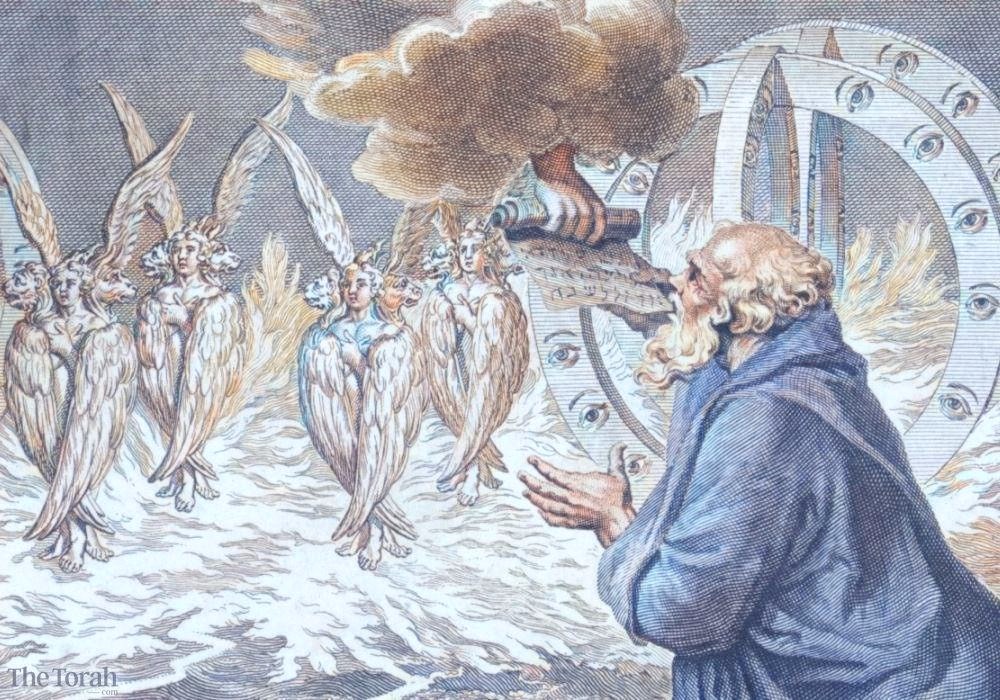
Ezekiel's vision is discussed, questioning whether it depicts a divine encounter or ancient astronauts. I critique Erich von Däniken's theories on UFOs, emphasize that advanced propulsion technologies have military origins, and confirm that true anti-gravity remains unattainable within known physics, dismissing claims of reverse-engineered alien technology.
Physicists have been trying to reconcile the differences between Einstein’s theory of spacetime and our observations of quantum mechanics for almost a century. One way that they’ve attempted to do this involves theories that treat space as one-dimensional at very short distances. In a recent paper, physicists claim that they’ve solved a major problem that’s plagued these theories for decades.

 Login