❌

Reading view

First-of-a-Kind Experiments Demonstrate Effects of Einstein’s Gravity in the Quantum World

An international research team has announced the first-ever successful observation of gravity’s effect on a falling quantum object, demonstrating a connection between gravity and the quantum world first predicted by Albert Einstein.

The research team said the result does not unify quantum mechanics and gravity, nor does it prove that gravity is a quantum phenomenon.

However, the researchers said their study offers experimental support that Einstein’s equivalence principle, a fundamental concept at the heart of the famed scientist’s theory of gravity, remains consistent with matter in the quantum world.

Unifying Einstein’s Theory of Gravity with Quantum Mechanics

When physicists want to describe nature, they rely on two distinct sets of rules. Einstein’s theory of gravity explains the mechanics of large-scale phenomena like stars and galaxies. Conversely, quantum mechanics helps scientists characterize the behavior of extremely small objects. Still, finding a scientific bridge uniting the two sets of rules has proven elusive.

“These two pillars of modern physics have so far eluded all attempts at a unified theoretical framework,” explained Professor Ron Folman from Ben-Gurion University of the Negev and the lead author of the new study.

Einstein did, however, identify one mechanism where the two worlds meet. Called the equivalence principle, the concept says that gravity should effectively disappear for an observer in free fall. For example, NASA simulates zero-gravity environments by flying astronauts in a plane, making successive rising and falling parabolic arcs. During the short periods of falling, the astronauts briefly experience ‘weightlessness” due to the equivalence principle.

quantum gravity
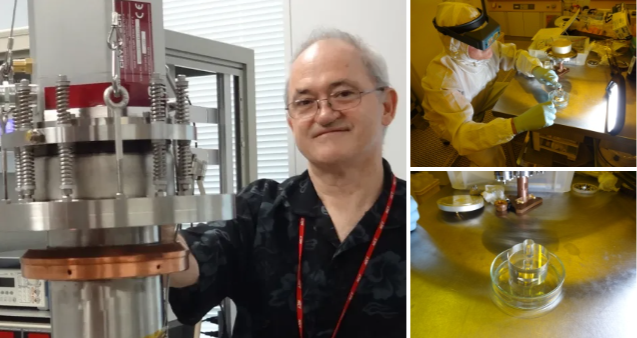
Above: The 2D MOT apparatus which feeds the science chamber with cold atoms. At the centre is a glass cell held under vacuum between coils producing magnetic fields. The atoms go into the science chamber through the tiny hole that may be seen in the centre of the yellow (reflecting) surface (Image Credit: Or Dobkowski).

Curious if the same phenomena would apply to the quantum world, the research team, which included Nobel Prize-winning physicist Professor Sir Roger Penrose, designed experiments. According to a statement announcing the research, the team hoped their setup would allow them to measure a “distinctive change in the quantum properties of atoms as they fell under gravity.”

Experiments Show Gravitational Pull Affecting Quantum Objects

To search for gravity’s effect in the quantum world, the researchers created clouds of rubidium atoms cooled to just above absolute zero. The researchers used a specially designed atom chip that allowed the team to manipulate the ultracold rubidium atoms.

Next, PhD student Or Dobkowski and colleagues used microwave pulses to place the atoms in quantum superposition. This unique quantum state lets each atom travel down two paths at once.

Using tiny electrical wires embedded on the specialized chip, the researchers generated tunable magnetic fields. The researchers said the field’s precision tunability allowed them to apply an upward force to one half of the atomic wave. For this experiment, the team created a magnetic field at the precise strength needed to counter gravity, effectively holding that half of the wave stationary relative to Earth.

After suspending the first half of the wave, the team used a magnetic pulse to lift the second part. Then, the team switched to a state almost unaffected by the magnetic field, allowing it to fall under gravity.

Once the second half completed its fall, the team used magnetic fields to reunite the two halves. When reunited, the two halves of the atomic wave interfered with each other. The researchers said that interaction allowed them to “measure the tiny difference in quantum phase accumulated while one was falling and the other was held still.”

“The phase measured in the new experiment is the same as the one predicted when Einstein’s principle is applied to such a quantum wave,” they explained.

“One of the Most Fundamental Questions in Physics”

When discussing the results, the research team said their result should not be construed as proof that gravity is quantum. The results also do not unite gravity and quantum mechanics. However, Folman noted, “this complex experiment gives more hints as to how such a unification may be achieved.”

Study co-author Professor Vlatko Vedral from the University of Oxford’s Department of Physics agreed, while also noting that their experimental results successfully demonstrated Einstein’s equivalence principle’s consistency with quantum mechanics, which alone provides an experimental connection between quantum physics and Einstein’s theory of gravity.

“This experiment pushes quantum mechanics into one of its most intriguing frontiers, gravity, and shows that, once again, its predictions hold,” Professor Vedral explained.

The professor also noted the experiment’s combination of hard experimental data with “a far-reaching theoretical interpretation, about one of the most fundamental questions in physics: How can gravity (described by Einstein’s theory of relativity) and quantum theory be unified into one understanding of the universe?”

The study “Observation of the quantum phase of free fall and the consistency with the equivalence principle” was published in Science Advances. 

Christopher Plain has spent the last six years as Associate News Editor and Head Science Reporter at The Debrief. Follow and connect with him on X, learn about his novels at plainfiction.com, or email him at christopher@thedebrief.org.

  •  

Apple veteran Phil Schiller steps down from App Store and product events

Phil Schiller becomes an Apple Fellow after a storied career that began in 1987.
In 2020, Phil Schiller became an Apple Fellow after a long career at Apple that began in 1987.

Apple’s Phil Schiller, one of the company’s most visible executives spanning the Steve Jobs and Tim Cook eras, has stepped down from running the App Store and Apple’s product events, according to Bloomberg News’ Mark Gurman.

The 66-year-old, who left the senior vice president of marketing role in 2020 and became an Apple Fellow, made the change in recent days, people familiar with the matter told Gurman. Schiller will remain at Apple as a Fellow and work on unspecified initiatives. Company employees view the move as a significant step toward an eventual retirement.

Schiller first joined Apple in 1987, left in 1993, and returned in 1997 when Jobs came back. He was a central figure in launches of the iPod, iPhone, iPad, and Apple Watch, and later oversaw App Store policy through years of regulatory pressure, including Europe’s Digital Markets Act. In 2020, Apple said he would keep leading the App Store and events after handing marketing to Greg Joswiak. As recently as 2024, he was still reported to be working nearly 80 hours a week.

Responsibility for the App Store is moving to the services organization led by Eddy Cue, who previously oversaw the store until 2015. Day-to-day operations, including app distribution, third-party marketplaces, and Apple Arcade, will be handled by Carson Oliver. Ann Thai, who has worked on distribution tools and alternative marketplaces, will report to Oliver. Leadership of product events is going to Nola Weinstein, Schiller’s deputy since 2023, who will report to communications vice president Kristin Huguet Quayle.

The shift comes on Tim Cook’s last day as CEO and as John Ternus prepares to take over, with Cook becoming executive chairman. The App Store remains a major services business, widely estimated to generate more than $30 billion a year. Weinstein’s team is preparing for Apple’s September 9th event, expected to include a foldable iPhone and updated Apple Watch models.

MacDailyNews Take: The only constant is change,


‎
Please help support MacDailyNews — and enjoy subscriber-only articles, comments, chat, and more — by subscribing to our Substack: macdailynews.substack.com. Thank you!

Support MacDailyNews at no extra cost to you by using this link to shop at Amazon.

The post Apple veteran Phil Schiller steps down from App Store and product events appeared first on MacDailyNews.

  •  

El Sol curvará la luz de las estrellas durante el eclipse como predijo Einstein

Algunas estrellas parecerán estar donde no deberían durante el eclipse total del 12 de agosto. La diferencia será minúscula, pero detrás de ese desplazamiento se esconde una de las ideas más revolucionarias de la física.
  •  

La sonda Danuri ha fotografato la macchia scura lasciata dallo schianto di…

La sonda Danuri ha fotografato la macchia scura lasciata dallo schianto di uno stadio superiore di un razzo Falcon 9 di SpaceX sulla superficie lunare. Il componente, lungo 14 metri, è stato spinto fuori rotta dall'interazione tra gravità e vento solare, finendo per impattare vicino al cratere Einstein a oltre 8.000 km/h. L'evento, confermato anche dai rilevamenti dello spettro gassoso dal Very Large Telescope in Cile, ha scavato un nuovo cratere di 18 metri di diametro, riaccendendo l'attenzione dei ricercatori sulla gestione dei detriti spaziali nelle orbite cislunari.
  •  

La Tierra hace algo insólito mientras gira: retuerce el espacio-tiempo, como predijo Einstein hace más de un siglo

La Tierra no solo completa una vuelta sobre sí misma cada día. Mientras rota, altera levemente el espacio-tiempo, un comportamiento anticipado por Albert Einstein que un satélite acaba de constatar con un rigor inédito.
  •  

This Philosopher Thinks Physics May Be Asking the Wrong Question About Space-Time


Einstein’s equations have withstood every experimental test for more than a century. However, according to one philosopher, they have not withstood careful scrutiny of the language used to describe them.

Daryl Janzen, an astronomer and instructor at the University of Saskatchewan, recently published a philosophical challenge in The Conversation. Janzen’s critique does not question the mathematics but instead focuses on how physicists and philosophers describe the nature of space-time itself. He argues that over the past century, the language used to describe space-time has gradually merged two separate concepts into one.

Existence vs. Occurrence

The main focus of this argument is the idea of the “block universe.” In this view, also known as eternalism, space-time is a fixed, four-dimensional structure. All past, present, and future events are equally real within this block, according to this interpretation. Time does not flow, and there is no single present moment. The block contains everything that has ever occurred.

Janzen does not object to the geometry itself. His concern lies with the way the word “exists” is used in this context.

Janzen distinguishes between existence and occurrence. Objects exist because they endure through time. Events occur at a specific place and moment, and then they are over. For example, an elephant standing in a room exists. A cross-sectional snapshot of that elephant, representing a single instant removed from its timeline and frozen in place, does not exist in the same way; it only occurs.

In the block universe model, space-time holds every moment of the elephant’s existence as a four-dimensional world line. This world line shows the animal’s full path through space and time. A single cross-section, or one slice of that path, is not the elephant itself; it is only a record of what the elephant was doing at a certain moment. Janzen says the block is better understood as a representational framework rather than a physical object in the usual sense.

A Problem of When

This confusion leads to a fundamental problem. The entire block universe is said to exist, but it is unclear when it exists. A timeless structure that never unfolds cannot endure as the elephant endures from moment to moment. Meanwhile, if the whole block occurs at once, like a single flash, there is no internal experience of time that could be considered an illusion. 

To keep the sense of time passing in a block universe, the four-dimensional structure would need to endure in some sense. This would mean adding a fifth dimension, a second time axis outside the block, for the block itself to exist within; however, this extra axis is not part of Einstein’s original theory.

Janzen uses a simpler analogy. He compares the situation to describing a song that exists all at once, complete but unperformed. A song only becomes a song when it unfolds over time.

Austrian-British philosopher Ludwig Wittgenstein warned that philosophical problems arise when “language goes on holiday.” Janzen argues that physics has been in this situation for decades, reusing words such as “timeless,” “exist,” and “become” in technical senses without considering their everyday connotations.

Implications for Physics and Philosophy

One of the biggest unsolved problems in physics is how to bring together general relativity, which explains gravity and the large-scale universe, with quantum mechanics, which describes matter at the smallest scales. These two frameworks do not fit together, and every real attempt to unify them demands a clear definition of what space-time actually is.

If the language physicists use to describe space-time has been internally inconsistent for more than a century, Janzen suggests the resulting confusion may extend beyond philosophy. Clarifying what physicists mean when they talk about space-time could influence how researchers think about attempts to reconcile general relativity and quantum mechanics.

Janzen does not propose a replacement for the current framework but instead suggests that the fundamental question is not how space-time curves, but how to properly define them in the first place.

Austin Burgess is a writer and researcher with a background in sales, marketing, and data analytics. He holds an MBA, a Bachelor of Science in Business Administration, and a data analytics certification. His work focuses on breaking scientific developments, with an emphasis on emerging biology, cognitive neuroscience, and archaeological discoveries.

  •  

True Science and Science Falsely So-Called

I discuss the distinction between operational science, which relies on repeatable experiments, and historical science, particularly cosmology. While acknowledging the contributions of renowned scientists, I argue that cosmology lacks the capacity for experimental verification and is thus not true science, but science falsely so-called.

  •  

Einstein Field Equations Explained: Structure, Solutions, Facts

The Einstein Field Equations (EFE) are ten coupled, nonlinear differential equations that describe how matter and energy determine the curvature of spacetime. First published by Albert Einstein in 1915, they form the mathematical core of general relativity, linking spacetime geometry to its energy and matter content through the equation [itex]G_{\mu\nu} = \frac{8\pi G}{c^4} T_{\mu\nu}[/itex]. Key...
  •  
❌