Russia's attempt to replicate SpaceX's Starlink satellite network seems to be moving as slowly as the front lines in eastern Ukraine.
The Rassvet program, often billed as Russia's answer to Starlink, started launching its first operational satellites earlier this year. Two launches, one in March and a second in July, have delivered 32 Rassvet satellites to low-Earth orbit, some 10 percent of the roughly 300 Rassvet spacecraft Russia aims to put into orbit by the end of next year to provide connectivity for military and civilian users. The company in charge of Rassvet, Bureau 1440, wants to deploy 924 satellites by 2035.
But none of the 32 satellites launched so far have reached the 500-mile (800-kilometer) orbit they were designed to operate in. The rockets that launched the first two batches of Rassvets released the satellites much closer to Earth, and the satellites were expected to use their own plasma engines to raise their orbits over the next few months.
A resource for checking Mac external-display support, Comcast’s move away from NBCUniversal, Peacock’s streaming and sports strategy, and whether broadband offers a stronger business model than media all started off this MacVoices Live! conversation. Chuck Joiner, David Ginsburg, Brian Flanigan-Arthurs, Ben Roethig, Eric Bolden, Marty Jencius, Jeff Gamet, Norbert Frassa, Jim Rea, and Web Bixby examine Apple Invites and question why so many Apple features launch with fanfare but receive little sustained development.
Adding more fuel to the fire over which city is actually Australia’s best place to live, those residing in the all-seasons-in-a-day city of Melbourne have a new statistic on their side — and it all relates to fixed-line broadband speed.
Ookla, the company behind the hugely popular Speedtest tool that helps anyone diagnose their home internet speeds, has published its latest Global Index rankings, revealing median fixed-broadband download speeds by country and city.
As a country, Australia is slowly but surely moving up the table. There was a time we ranked as low as 86th, but we now sit at 50th, with a median fixed-broadband download speed of 162.34Mbps.
That improvement follows NBN Co’s September 2025 speed-tier shake-up, which introduced a 2Gbps wholesale option for eligible FTTP and HFC premises, alongside faster speeds on several existing higher-end tiers. Of course, not every Australian can access 2Gbps just yet — and, as we’ll see, the plan you choose is only one part of the equation.
For context, Singapore takes the crown with a median download speed of 447.75Mbps. One can only dream of a day when that becomes a reality Down Under.
Why the huge gap?
There are several reasons why Australia trails the pack so dramatically — although with 141 other countries clocking slower speeds, things could certainly be worse — and, in my mind, one of the most obvious is that many Australians are still connected to comparatively slow NBN plans.
The most recent report, covering the March quarter of 2026 and published in July, revealed there were just over 2.665 million active 50Mbps NBN connections, out of a total of 8.839 million residential broadband services. That works out to around 30.2%.
A 50Mbps plan naturally puts a ceiling on the speed a customer can record in a Speedtest. If enough users on lower-speed tiers are represented in Ookla’s sample, that will bring the national median down.
One relatively straightforward way for Australia’s international standing to improve, then, is for more eligible households to take advantage of NBN Co’s free fibre upgrade. The program is open to millions of eligible FTTN and FTTC premises, allowing them to upgrade to FTTP if they take out an eligible high-speed service — such as one of the best NBN 500 plans.
A fixed-line civil war
Move the slider over to ‘City’ and the results become much more varied, with cities from North and South America, Asia and Europe all jostling for position. Valparaíso in Chile takes the crown with a huge 425.84Mbps, followed by Abu Dhabi with 399.92Mbps, for example.
Australian cities evidently have some work to do. Scroll down to position 64 and you hit Melbourne with a median download speed of 177.69Mbps — faster than Australia’s national median, it must be said — while Sydney trails behind in position 76 with a meagre 149.91Mbps.
A difference of 27.78Mbps might not sound like much, but Melbourne’s median result is around 18.5% faster than Sydney’s. When intercity tensions are already high, that’s a huge bragging right for the southerners.
Wait, we can (try to) explain
Nobody ever wants to be seen as the weaker of two, and while the reported figures are great news for people in Victoria, there is potentially a plethora of factors at play that pave the way for a Melbourne victory.
We’re not here to make excuses, of course, but there are plenty of unknowns.
Firstly, there could simply be a larger proportion of Melburnians connected via superior fibre-to-the-premises infrastructure. FTTP allows households to access the fastest NBN plans, including the newer multi-gigabit options where available.
While it’s not totally conclusive, there is some evidence to support this idea. That evidence is publicly available technology-mix figures, although they’re reported at a state level, rather than for Greater Melbourne and Greater Sydney specifically. Data compiled from NBN rollout information indicates Victoria has a higher share of premises using FTTP than NSW — roughly 66% versus 60% — while it also indicates there are more active connections on the inferior fibre to the node (FTTN) connection type in NSW too.
This doesn’t completely settle the argument. The figures not only include regional areas, but they also show the technology available to a property, as opposed to an active plan supplying an address.
All fixed-line connections are welcome
Furthermore, on the subject of NBN, Ookla’s Speedtest results don’t only capture NBN connections, but fixed-broadband tests from other fixed networks too, including private fibre operators. Both Melbourne and Sydney are home to several such networks, including Vocus, GigaComm and OptiComm, while Melbourne also has DGtek — a private FTTP network concentrated in the city’s CBD and inner south-east.
Exact figures for active connections on those networks are tricky to come by. But if Melbourne has a higher concentration of people connected to these kinds of high-speed private fibre services, they could be recording considerably quicker test results and helping push its city median upwards.
Not telling the complete story?
Another excuse potential explainer is the way Ookla collects its data. Whereas the ACCC’s Measuring Broadband Report — which published its final instalment in June 2026 — monitors a selected group of Australian homes across nine popular ISPs, Ookla receives data when people choose to run a Speedtest.
This doesn’t mean someone repeatedly checking their connection can single-handedly skew the data, as Ookla averages each unique user’s results into a single sample for the relevant time period and location. Still, the results are dependent on who chooses to test. Melbourne’s sample could contain a different mix of internet plans, connection technologies, devices and Wi-Fi setups than Sydney’s.
(Image credit: TP-Link)
When did you last check your Wi-Fi router?
Home equipment can make a considerable difference too. A household with a Wi-Fi 5 router tucked away in a cupboard, a busy 2.4GHz network and a phone testing from the other end of the house could record a much slower result than the same connection tested over Ethernet.
On the flip side, a newer Wi-Fi 6E or Wi-Fi 7 router, a properly positioned mesh system and a compatible device can give a household a far better chance of getting close to the speeds it actually pays for. That doesn’t make the underlying internet plan any faster, of course — it simply means the home network is less likely to be the bottleneck.
If your own Speedtest result seems suspiciously low, it may be worth checking out our guide to the best mesh Wi-Fi systems to find out if your home could benefit from an upgrade.
And, trying to claw a point back for Sydney, it can be argued that people often run a speed test when their internet connection starts lagging. While Melbourne’s median tested speed is higher, that doesn’t necessarily mean every connection in the city is consistently faster or more reliable.
One week ago, three widely respected European news outlets published the results of an investigation into what they described as a "joint plan" by China and Russia to "defeat Elon Musk's Starlink."
The story was the product of a long-running inquiry by The Insider, Der Spiegel, and Le Monde. Reporters at those publications said they reviewed a cache of documents detailing growing military cooperation between China and Russia. The documents covered discussions between the nuclear powers on integrated air and missile defense systems, autonomous "swarm" loitering munitions, next-generation armored vehicles, and military aviation, the report said.
According to the papers, the investigation found evidence of a partnership between China and Russia in the field of space weapons far deeper than either country has acknowledged. One particular focus for China and Russia has been developing strategies to counter SpaceX's Starlink satellite broadband network.
Jio Platforms, which owns India’s largest telco, is looking to lease broadband capacity from satellite constellations to jumpstart its own sovereign LEO network in the country.
If you've been considering changing your NBN plan to one that's more affordable or perhaps even faster than what you currently have, now's the time to shop around.
British small satellite specialist Open Cosmos is seeking more time to deploy its proposed sovereign broadband constellation for Europe after running into launch issues.
The Federal Communications Commission has waived a requirement for Amazon to launch half of its satellite broadband constellation by the end of July, a key regulatory reprieve that buys the tech giant time to get more of its spacecraft into orbit.
Amazon won regulatory approval for the Amazon Leo network in July 2020. The FCC's authorization came with two deadlines. First, Amazon had to launch half of its 3,232 satellites by July 30, 2026, in order to maintain authorization to launch the rest of the network. The regulator gave Amazon a deadline of July 30, 2029, to have all of its first-generation satellites in orbit.
It has been apparent for some time that Amazon would not meet the FCC's requirement to launch half of its satellites—1,616 spacecraft—by the end of next month. Amazon filed an application in January requesting the FCC extend the deadline to July 2028 or waive it altogether. The commission decided on the latter option, removing any time limit for the 50 percent deployment milestone, but keeping the July 2029 deadline in place for the entire constellation.
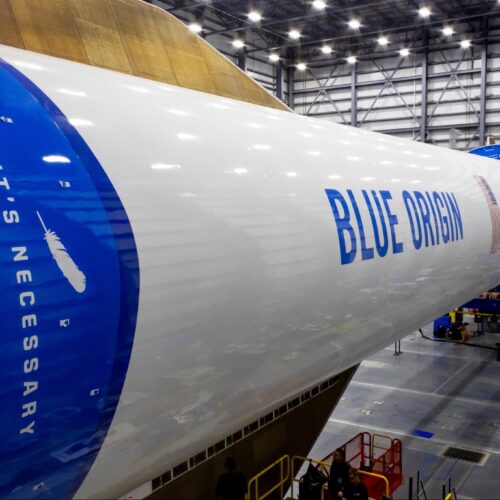
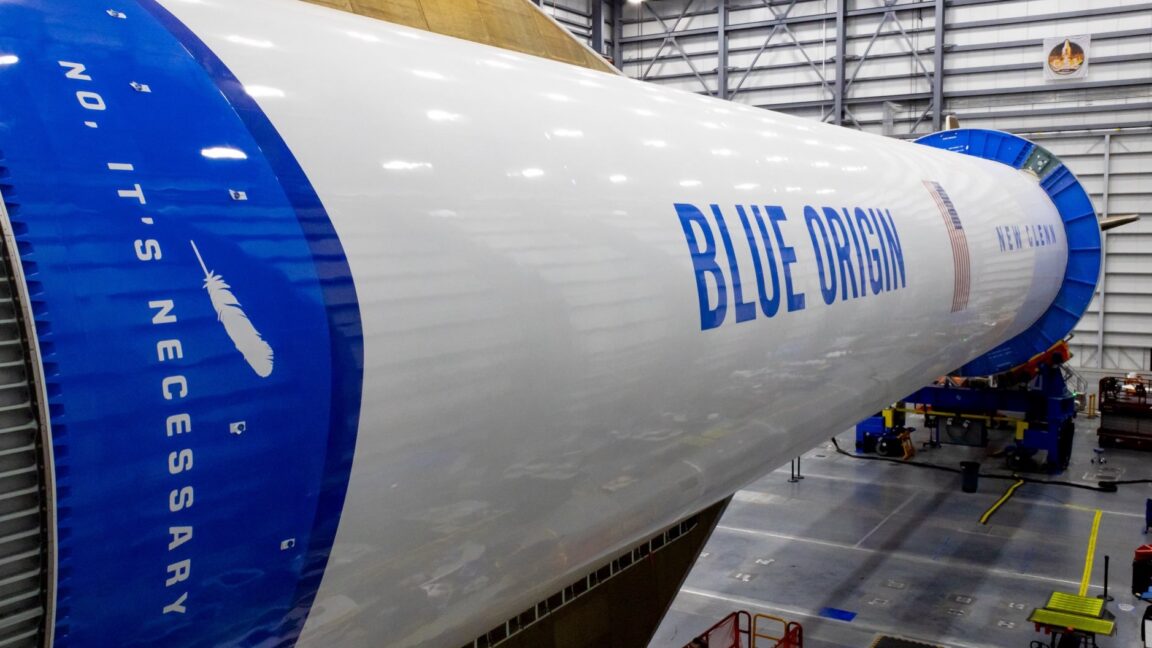
It was less than two months ago that the third flight of Blue Origin's heavy-lift New Glenn rocket left a customer's payload in an unusable orbit. Investigators have now identified the cause of the failure, and Blue Origin is preparing to launch the next New Glenn mission as soon as next week.
The Federal Aviation Administration and Blue Origin announced the closure of the failure investigation May 22. Yesterday, officials confirmed Blue Origin's next launch will loft a payload of 48 commercial satellites for Amazon's broadband network in low-Earth orbit. This will be the most satellites Amazon has launched on a single rocket, surpassing previous flights on United Launch Alliance's Atlas V, SpaceX's Falcon 9, and Europe's Ariane 6.
Blue Origin and Amazon, each founded by Jeff Bezos, have not officially revealed a target launch date, but public notices of airspace and maritime closures suggest the mission is set to lift off from Cape Canaveral Space Force Station, Florida, as soon as next Thursday, June 4. Blue Origin is expected to roll the New Glenn rocket to its launch pad in the coming days for a test-firing of its seven main engines, fueled by liquified natural gas and liquid oxygen.

 Login