❌

Reading view

Benchmarks preliminares do chip A20 Pro atestam avanços de CPU e GPU

Resultados preliminares de benchmark do chip A20 Pro, que alimenta o iPhone 18 Pro, o iPhone 18 Pro Max e o iPhone Duo, surgiram na manhã de hoje no banco de dados do Geekbench 7, oferecendo uma primeira visão do desempenho de CPU 1Central processing unit, ou unidade central de processamento. e GPU 2Graphics processing unit, ou unidade de processamento gráfico. dos novos modelos antes mesmo de chegarem ao mercado.

Com base nesses resultados iniciais, o chip A20 Pro parece oferecer um desempenho cerca de 21% a 23% mais rápido em single-core (média de 4.722 pontos), além de 27% a 28% mais rápido em multi-core (média de 12.626 pontos) em comparação com o chip A19 Pro dos iPhones 17 Pro/17 Pro Max.

Benchmarks do iPhone 18 Pro
Benchmarks do iPhone 18 Pro Max

Talvez não surpreenda que os resultados do iPhone 18 Pro Max sejam praticamente iguais aos do iPhone 18 Pro. Uma diferença aparece nas pontuações do teste Metal: o modelo menor marcou 64.069 pontos, enquanto o maior atingiu 64.915 pontos.

Ainda assim, os resultados gráficos alinham-se, em linhas gerais, à afirmação da Apple — presente no comunicado de imprensa e na página do iPhone 18 Pro — de que o A20 Pro oferece uma performance gráfica até 40% mais rápida que o chip A19 Pro.

Também foram vistos resultados de benchmark do iPhone 18 Pro Max no AnTuTu, que registrou uma pontuação geral de 3.551.073. A pontuação da CPU, especificamente, foi de 920.410, enquanto a GPU alcançou 1.397.374 pontos. Os testes de memória e UX registraram 470.245 e 763.044 pontos, respectivamente. Para fins de comparação, o iPhone 17 Pro Max obteve uma média de 2.275.118 pontos, colocando o novo modelo substancialmente à frente no benchmark.

Benchmarks do iPhone 18 Pro Max no AnTuTu

Vale ressaltar que esses testes de desempenho pontuais — que ainda não foram confirmados — não indicam como os dispositivos se comportarão durante sessões prolongadas de jogos ou outras cargas de trabalho exigentes; afinal, os resultados de testes no mundo real poderão apresentar algumas diferenças.

via MacRumors, Gizmochina

Notas de rodapé

  • 1
    Central processing unit, ou unidade central de processamento.
  • 2
    Graphics processing unit, ou unidade de processamento gráfico.

  •  

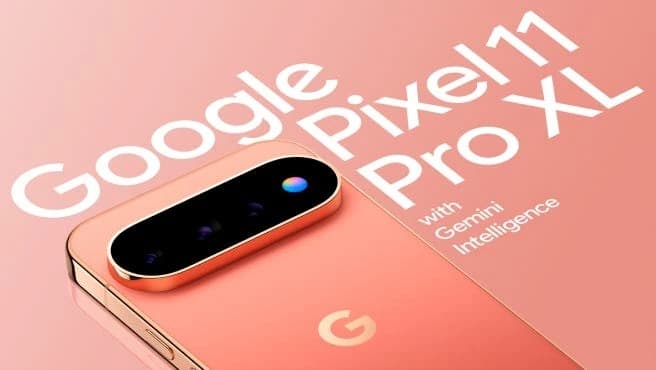
Google Pixel 11 Pro XL Geekbench Scores Leak: Tensor G6 Shows Limited Performance Gains

Google’s upcoming Pixel 11 Pro XL has reportedly appeared on Geekbench 7, revealing early performance details of the company’s next-generation Tensor G6 chipset. While the new processor is expected to bring improvements in efficiency and AI capabilities, the leaked benchmark results suggest that raw performance gains may be relatively modest compared with the previous-generation Tensor G5.

According to Igeekphone, the Pixel 11 Pro XL and other Pixel 11 series models are expected to be unveiled at Google’s annual Made by Google event on August 12. Ahead of the official announcement, benchmark information has provided the first look at the performance of Google’s upcoming flagship processor.

Tensor G6 Benchmark Results Revealed

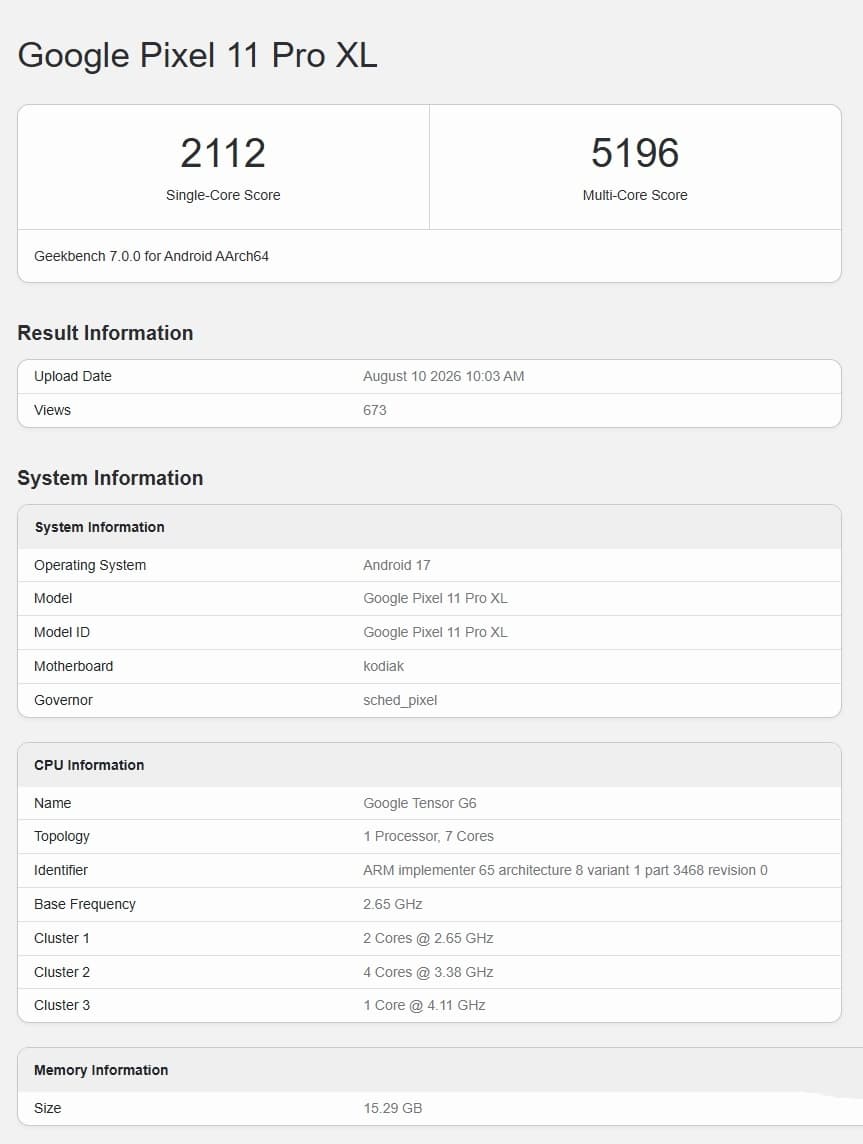
The Geekbench 7 listing reportedly shows that the Google Pixel 11 Pro XL achieved:

  • Single-core score: 2,112 points
  • Multi-core score: 5,196 points

These results represent the first known real-world benchmark scores for the Tensor G6 chipset, which has previously appeared only through leaks and industry reports.

The benchmark listing also confirms that the tested device is equipped with:

  • 16GB RAM
  • Android 17 operating system

While benchmark results do not reveal every aspect of real-world performance, they provide an early indication of the processing capabilities of Google’s next flagship smartphone platform.

Tensor G6 Reportedly Uses Seven-Core Architecture

According to the Geekbench database information, the Tensor G6 appears to use a seven-core CPU architecture consisting of three core clusters.

The reported configuration includes:

  • Two cores clocked at 2.65GHz
  • Four cores clocked at 3.38GHz
  • One high-performance core clocked at 4.11GHz

The listing does not confirm whether the Tensor G6 is manufactured using a 2nm process technology, despite previous reports suggesting that Google could become one of the first smartphone manufacturers to adopt a 2nm Tensor chip.

Limited Improvement Compared with Tensor G5

Although the Tensor G6 represents a new generation of Google’s custom smartphone chipset, the leaked benchmark results suggest that the performance improvement may not be dramatic.

For comparison, the previous-generation Pixel 10 Pro’s Tensor G5 reportedly achieved:

  • Single-core score: 1,977 points
  • Multi-core score: 5,805 points

Compared with those numbers, the Tensor G6 appears to offer a small increase in single-core performance but a lower multi-core score in this early Geekbench test.

If the leaked results are accurate, the Pixel 11 Pro XL may not deliver a major upgrade in traditional computing performance. Instead, Google may continue focusing on areas where Tensor chips have historically stood out, such as artificial intelligence processing, photography enhancements, and software optimization.

Pixel 11 Standard Model Also Appeared in Benchmarks

The Pixel 11 series has previously appeared in Geekbench databases as well.

Earlier testing of the standard Pixel 11 model reportedly showed:

  • Single-core score: 875 points
  • Multi-core score: 2,657 points

That listing also indicated a seven-core Tensor G6 architecture, although the performance results were significantly lower than the Pixel 11 Pro XL benchmark.

Differences between models could be related to software optimization, testing conditions, clock speeds, or hardware configurations.

Google May Focus More on AI Features

Google’s Tensor processors have traditionally prioritized artificial intelligence and machine learning capabilities rather than competing directly with flagship chips from Qualcomm and Apple in raw benchmark performance.

The Tensor G6 is expected to bring improvements in areas such as:

  • AI-powered features
  • Computational photography
  • Voice processing
  • On-device machine learning
  • System efficiency

For Pixel users, these software-driven improvements may be more noticeable in daily use than benchmark score increases.

Pixel 11 Series Expected to Launch Alongside Pixel Watch 5

Google is expected to officially introduce the Pixel 11 series along with the Pixel Watch 5 during the upcoming Made by Google event on August 12.

The Pixel 11 lineup is expected to include multiple models, including:

  • Google Pixel 11
  • Google Pixel 11 Pro
  • Google Pixel 11 Pro XL

The Pixel 11 Pro XL is expected to serve as the top-tier model, featuring the largest display, highest memory configuration, and the most advanced camera system in the lineup.

Final Thoughts

The leaked Geekbench results for the Google Pixel 11 Pro XL suggest that the upcoming Tensor G6 chipset may deliver only moderate improvements in traditional processing power. While the move to a newer architecture and potential 2nm manufacturing process could improve efficiency, the benchmark numbers indicate that Google is not necessarily chasing the highest raw performance scores in the smartphone market.

Instead, the Pixel 11 series is likely to continue Google’s strategy of combining custom hardware with advanced AI software experiences. For potential buyers, the most important upgrades may come from new AI features, camera improvements, and software innovations rather than a major leap in benchmark performance.

The post Google Pixel 11 Pro XL Geekbench Scores Leak: Tensor G6 Shows Limited Performance Gains appeared first on IGeeKphone China Phone, Tablet PC, VR, RC Drone News, Reviews.

  •  

New Standard Sets the Bar for AI Performance in Routine Patient Care

In a groundbreaking advancement for artificial intelligence in healthcare, researchers at Mass General Brigham have unveiled BRIDGE, a comprehensive multilingual benchmark designed to critically assess how effectively large language models (LLMs) comprehend and interpret clinical patient-care text. Unlike existing AI evaluation metrics that rely primarily on structured and standardized medical exam questions, BRIDGE is engineered to engage with the multifaceted and complex language found in real-world clinical communications, including electronic health records (EHRs), case reports, and patient-doctor consultations, across nine different languages. This innovation represents a transformative step toward making AI tools more reliable and contextually aware in actual healthcare settings.

The existing paradigm in medical AI evaluation has predominantly centered on licensing exam questions composed in a controlled, formalized medical lexicon. These assessments, while rigorous, often fall short of reflecting the nuanced, variable, and sometimes ambiguous language used in actual clinical environments. The BRIDGE benchmark circumvents this limitation by employing authentic clinical texts, which capture the complexities and heterogeneity inherent to patient care dialogues, medical documentation, and clinical decision-making processes. This shift brings essential granularity and relevance to model performance metrics, providing clinicians and developers with more actionable insights.

The creators of BRIDGE demonstrated the stark contrast in performance between conventional exam-based evaluations and real-world clinical comprehension. For instance, the highest-performing LLM evaluated scored impressively on standard medical exams, achieving up to 92%. However, when subjected to BRIDGE’s rigorous clinical text test, the same model’s proficiency plummeted to only 44.8%. This significant disparity exposes considerable gaps in the AI’s ability to grasp the subtle clinical context, implicit meanings, and domain-specific language patterns prevalent in healthcare communications.

To validate the robustness and breadth of BRIDGE, the research team conducted a systematic performance evaluation of 95 distinct LLMs sourced from 59 different clinical AI initiatives. These models were subjected to a comprehensive battery of real-world clinical tasks encompassing the entire patient care continuum, ranging across 14 medical specialties. The tasks included patient triage, extraction of critical information from records, diagnostic reasoning, prognostic forecasting, and administrative functions such as billing code assignment. This extensive benchmarking provides a panoramic view of LLM capabilities and limitations in diverse clinical scenarios.

One of the more innovative features of BRIDGE is its public and continuously updated leaderboard hosted on the Hugging Face platform. This dynamic leaderboard catalogs the performance metrics of over 100 LLMs, enabling stakeholders including clinicians, health administrators, and AI developers to track comparative model efficacy in near real-time. The leaderboard thus fosters transparency and spurs iterative improvements by highlighting strengths and vulnerabilities within specific clinical tasks or language domains.

Another salient discovery made possible by BRIDGE is the identification of variability in AI performance across different medical specialties. Given that the benchmark corpus includes nine languages, the tool also illuminates disparities in model effectiveness when dealing with non-English clinical texts. This multilingual adaptability is particularly crucial as healthcare becomes more globally interconnected, underscoring the urgent need to develop culturally and linguistically sensitive AI applications that avoid exacerbating health inequities.

The scientific rigor of BRIDGE is underscored by its deep collaboration among experts spanning pharmacoepidemiology, pharmacoeconomics, clinical medicine, and computational modeling. The team includes senior authors such as Jie Yang, PhD, and Joshua Lin, MD, along with co-first authors Jiageng Wu and Bowen Gu, whose collective expertise was critical in ensuring the benchmark’s relevance and accuracy. Such interdisciplinary engagement is vital for bridging the gap between AI innovation and clinical applicability.

BRIDGE’s architecture and methodology leverage advanced computational simulation and modeling techniques, facilitating nuanced task designs that mimic real clinical workflows. This approach allows the benchmark to capture the dynamic and context-rich nature of clinical text interactions, incorporating elements like colloquial doctor-patient exchanges, complex diagnostic narratives, and procedural documentation. Consequently, BRIDGE functions as a high-fidelity proxy for real healthcare communication scenarios, offering a much-needed calibration tool for medical LLMs.

Funding generously provided by the Patient-Centered Outcomes Research Institute, the National Institutes of Health, and institutional scholarships reflects the strategic priority placed on refining AI’s role in healthcare delivery. Moreover, the rigorous conflict of interest disclosures and adherence to institutional compliance underscore the study’s commitment to transparency and ethical research standards. These factors enhance the credibility of BRIDGE as a benchmark tool destined to influence clinical AI development profoundly.

Importantly, BRIDGE is more than a passive evaluation tool—it is a catalyst for elevated AI design tailored to the clinical domain. By exposing the blind spots and differential performance across specialties and languages, it empowers AI developers to iterate more purposefully, embedding clinical nuance and real-world complexity into model training. This iterative feedback loop has the potential to accelerate the maturation of AI models from theoretical capabilities to practical clinical decision-support systems.

The release of BRIDGE is poised to address one of the persistent challenges in clinical AI—trust. Reliable understanding of patient-care language is paramount to fostering clinician confidence in AI-assisted diagnoses, prognoses, and patient management recommendations. The benchmark’s capacity to expose and rectify shortcomings before clinical deployment mitigates risks of errors caused by misinterpretation of nuanced clinical text, thereby safeguarding patient safety and improving care outcomes.

In closing, BRIDGE exemplifies a paradigm shift that acknowledges the inherent complexities of clinical language and seeks to elevate the fidelity of AI’s interpretative functions accordingly. As healthcare continues its digital transformation, integrating intelligent systems into everyday practice demands benchmarks as sophisticated and reflective as the environments they serve. BRIDGE sets a new gold standard in this endeavor, bridging the divide between cutting-edge AI performance and meaningful clinical utility.

Subject of Research: People

Article Title: BRIDGE: benchmarking large language models for understanding real-world clinical practice texts

News Publication Date: 17-Jun-2026

Web References:

References: Wu, J. et al. “BRIDGE: Benchmarking Large Language Models for Understanding Real-world Clinical Practice Text” Nature Biomedical Engineering DOI: 10.1038/s41551-026-01719-2

Keywords: Artificial intelligence, machine learning, clinical medicine, large language models, electronic health records, multilingual AI, clinical text comprehension, medical AI benchmarking, healthcare AI, patient care AI

  •  
❌