❌

Reading view

Ailanthone suppresses HSV-1 and eases keratitis in mice

A plant-derived compound called ailanthone reduced HSV-1 replication in several cell models and eased corneal disease in a mouse model of herpes simplex keratitis, according to the study. The researchers found that ailanthone acted mainly after the virus entered cells and linked much of this effect to reduced expression of integrin beta 2, or ITGB2, a host protein that supports viral replication. The results identify ailanthone as a potential drug candidate, but the experiments do not establish that it is safe or effective in people.

The team began by screening natural compounds and testing ailanthone in African green monkey kidney Vero cells infected with HSV-1. Concentrations of 100 to 3,000 nanomolar reduced transcription of the viral immediate-early genes ICP0 and ICP4 and the late gene gD in a dose-dependent manner. The compound also reduced plaque formation and the concentration of progeny virus released into culture. Ailanthone had a half-maximal cytotoxic concentration above 10,000 nanomolar in these cells, while its half-maximal effective concentration against viral replication was 197.4 nanomolar, giving a selectivity index greater than 50. It also suppressed HSV-1-induced increases in the inflammatory cytokine genes IL-1B and TNF-α.

Antiviral activity was subsequently observed in human corneal epithelial cells, a model more directly relevant to the tissue affected by keratitis. Ailanthone concentrations of 100 to 500 nanomolar markedly reduced the cytopathic effects of HSV-1F, lowered expression of ICP0, ICP4 and gD, and reduced the viral induction of IL-1B and TNF-α. Its effective concentration in these cells was 50.16 nanomolar, with a cytotoxicity concentration above 10,000 nanomolar and a selectivity index greater than 100. The researchers also tested the compound in human retinal pigment epithelial ARPE-19 cells, where it reduced viral gene expression, plaque formation and progeny-virus titers while showing low cytotoxicity.

Activity was not restricted to the laboratory HSV-1F strain. In ARPE-19 cells, ailanthone concentration-dependently inhibited the late gD gene in the clinical acyclovir-resistant strain HSV-1/153, whereas 1,000 nanomolar acyclovir had little effect. The compound’s effective concentration was 35.05 nanomolar against HSV-1F and 227.4 nanomolar against HSV-1/153, with selectivity indices above 100 for both strains. A time-of-addition experiment indicated that ailanthone did not prevent attachment of HSV-1 to cells. It reduced entry under one experimental schedule and had its strongest effect on post-entry replication, where it lowered gD expression.

To investigate how the compound might work, the researchers combined computational target prediction with protein-interaction network analysis. They identified 36 targets shared by ailanthone and herpes simplex keratitis, then selected ITGB2 as a highly connected hub in the resulting network and as a top candidate in molecular docking. The predicted docking score for ailanthone and ITGB2 was −8.6 kcal per mole. Computational predictions alone cannot establish direct binding, so the team also performed a drug affinity responsive target stability assay in THP-1 cell lysates. Ailanthone protected ITGB2 from digestion by the protease pronase E in a dose-dependent manner, while acyclovir did not, providing biochemical evidence consistent with a direct interaction.

Functional experiments then tested whether ITGB2 was necessary for the antiviral effect. Three independent small interfering RNAs reduced ITGB2 messenger RNA and protein in THP-1 cells. Following HSV-1 infection, this knockdown lowered gD messenger RNA and protein and reduced the number of plaques produced when culture supernatants were transferred to fresh Vero cells. The converse pattern appeared when ITGB2 was overexpressed: elevated ITGB2 increased gD expression in infected cells, and it partially counteracted the reduction in gD protein caused by ailanthone in 293T and ARPE-19 cells. Together, these loss- and gain-of-function results support the conclusion that ailanthone’s antiviral activity is mediated at least partly by lowering ITGB2.

The researchers next tested ailanthone in an acute mouse model of HSV-1 keratitis. Six-week-old male BALB/c mice received a corneal scratch followed by application of HSV-1F, then received intraperitoneal ailanthone at 1 or 5 milligrams per kilogram or acyclovir at 5 milligrams per kilogram on days 1, 3 and 5 after infection. The methods section states that six animals were assigned to each group, although the discussion says five mice per group were used in the animal experiment. The 5-milligram-per-kilogram ailanthone treatment significantly reduced clinical disease scores, improved the appearance of the cornea under normal and cobalt-blue illumination, and lowered fluorescein staining scores on days 3 and 5. Hematoxylin and eosin staining at day 6 also indicated reduced corneal inflammation, and viral titers in ocular swabs were significantly lower than in infected mice given vehicle.

Analysis of mouse corneal tissue was consistent with the proposed mechanism. ITGB2 was upregulated in the corneas of infected animals, and ailanthone reduced its fluorescence intensity in a dose-dependent manner. Acyclovir did not significantly alter corneal ITGB2 levels. The investigators interpreted this as evidence that ailanthone differs from a direct viral DNA-replication inhibitor: the data are consistent with modulation of a host dependency factor rather than action solely through a viral enzyme. However, the study did not determine precisely how binding to ITGB2 leads to lower protein abundance. The authors note that transcriptional regulation, changes in messenger-RNA stability, or enhanced protein degradation could all be involved, and dedicated experiments would be required to distinguish among them.

Several limitations constrain how far the findings can be generalized. The cell experiments used established lines, including corneal epithelial and retinal pigment epithelial cells, rather than primary human corneal cells or an intact human immune system. The animal experiment examined acute primary infection in young male mice, whereas recurrent reactivation and the inflammation associated with repeated episodes are important features of human herpes simplex keratitis. Ailanthone was administered by intraperitoneal injection, but no topical ophthalmic formulation, corneal penetration, intraocular distribution, or optimized dosing regimen was evaluated. Long-term ocular toxicity and safety under repeated exposure also remain unknown. The natural compound may additionally affect multiple targets, and compensation among integrins could limit or alter its effects. The evidence therefore supports further preclinical investigation of ailanthone and ITGB2 as a host-directed antiviral strategy, not a clinical recommendation or a claim of human therapeutic benefit.

Subject of Research: Preclinical evaluation of ailanthone as a host-directed inhibitor of HSV-1 replication and herpes simplex keratitis.

Article Title: Natural compound ailanthone alleviates herpes simplex keratitis in mice by inhibiting HSV-1 replication

Article References: Chen, L., Yang, E., Zhang, X., Zhang, L., Wu, L., Chen, S., Jin, W., Qin, Q., Chen, R., Wu, J., & Chen, D. (2026). Natural compound ailanthone alleviates herpes simplex keratitis in mice by inhibiting HSV-1 replication. Frontiers in Pharmacology, 17, Article 1937590. https://doi.org/10.3389/fphar.2026.1937590

Image Credits: AI Generated

DOI: 10.3389/fphar.2026.1937590

Keywords: HSV-1, herpes simplex keratitis, ailanthone, ITGB2, host-directed antivirals, viral replication, corneal infection, mouse model, integrin beta 2, drug resistance, Natural, compound


  •  

Microsoft deixa projeto de datacenter com Nscale no Reino Unido. Planos para Sines estão em risco?

A Microsoft saiu de um acordo com a Nscale para um projeto de datacenter de IA no Reino Unido devido a constrangimentos no acesso à rede elétrica. Apesar da decisão no projeto britânico, os planos para Portugal mantêm-se, avança uma fonte familiarizada com o processo ao TEK Notícias.

The post Microsoft deixa projeto de datacenter com Nscale no Reino Unido. Planos para Sines estão em risco? appeared first on Tek Notícias.

  •  

I use Bitdefender Total Security to protect all of my devices, and it’s down to $28 at Newegg

I've used Bitdefender Total Security to protect my own devices for years, and I highly recommend it. I've found a great deal on the security software at Newegg that brings a year's coverage for up to 10 devices down to under $30.

Bitdefender Total Security 2026 is reduced to $28 (was $100) at Newegg with promo code EPF56892. It doesn't get much cheaper than this, so well-worth checking out.

• Best for: Households with multiple devices, anyone wanting protection across different operating systems, and people looking for antivirus software with additional privacy and ransomware defenses.

• Why I like it: I use Bitdefender Total Security to protect all of my devices at home, and it's much more than a traditional antivirus tool. As well as keeping you safe from viruses, spyware, Trojans, ransomware, and other malicious software, it also uses behavioral detection to identify suspicious activity and defend against unknown threats.

Today's best antivirus software deal

Total Security 2026: was $99.99 now $27.99
Bitdefender Total Security provides one year of protection for 10 Windows, macOS, Android, and iOS devices, with malware detection, ransomware defense, privacy tools, parental controls, and limited daily VPN access included.View Deal

Why we recommend it

The software can block online tracking, monitor attempts to access your webcam or microphone, and identify potentially dangerous websites. The subscription covers up to 10 devices running Windows, macOS, Android, and iOS.

The package also includes access to Bitdefender VPN, although it's limited to 200MB per day per device, which is only really enough for occasional use. Parental control features will be of interest to anyone with children, although availability and functionality depend on the OS.

In covering the software, we said: "Bitdefender tops our list and ticks every box. It performed well across our testing, boasts all the tools you need to protect your devices from malware (and more), and is nice and easy to use – regardless of platform. While some expert users might wish for a little more granular customization, we think that Bitdefender strikes the right balance in terms of configuration and ease of use."

Price context & historical value

Newegg sells the one-year, 10-device subscription for $99.99, but is currently offering it at $52.99. Enter EPF56892 at checkout to save a further $25, bringing the final price to $27.99.

That represents a $72 saving against the original price, approximately 72% off. If you activate the program on all 10 devices, the first-year cost works out to approximately $2.80 per device.

It's important to remember that this is a one-year license, rather than a permanent software purchase. You're not locked in though. What I usually do is search for a new deal around the renewal time.

For more options, take a look at our roundup of the best antivirus software.

Should you buy it?

✅ Buy the Bitdefender Total Security if...

You want one antivirus subscription covering Windows, Mac, Android, and iOS devices. It's also great for ransomware protection, malicious website detection, and privacy tools. At $27.99, this is a fantastic deal.

❌ Skip Bitdefender Total Security if...

You only need to protect one computer and are satisfied with your device's built-in antivirus software. Windows includes Microsoft Defender, and macOS and mobile operating systems have their own security protections.

  •  

John Ternus Discusses His Close Collaboration With Apple Designers

Apple CEO John Ternus recently shed light on his working relationship with the company’s internal design teams. In a new interview, Ternus explained how closely he interacts with both the industrial and software designers, emphasizing that design remains a foundational element of the technology giant’s product development process. Engineering and design work together from the […]

The post John Ternus Discusses His Close Collaboration With Apple Designers appeared first on The Mac Observer.

  •  

AMD and Intel will work together to create a single PyTorch code path for AI inference on CPUs

Intel and AMD are integrating their CPU optimizations for PyTorch into a unified library, offering tuning for both AMD and Intel chips through the oneDNN library. AMD has maintained a downstream version of oneDNN called ZenDNN, which is now moving into the open-source oneDNN, published by the UXL Foundation and driven by Intel. AMD also announced it's joining the UXL Foundation as a "steering member," which "influences the future of the UXL Foundation" in exchange for a contribution of $20,000 per year.

AMD says the move to unify these efforts under oneDNN was recommended by the x86 Ecosystem Advisory Group (EAG), which is a joint initiative that primarily exists between Intel and AMD and was established in 2024. The two companies have collaborated through the EAG previously, such as with the ACE extensions for x86 that we learned about earlier this year.

The oneDNN backend is used for CPU inference, and it's built to accelerate that workload for the latest Intel (and now AMD) chips in frameworks like PyTorch. When oneDNN was added to PyTorch as a backend in late 2023, it showed a 1.24x improvement with the Float32 data type, and 2.21x for the BFloat16 data type.

From the oneDNN GitHub, the library "detects hardware features at runtime" to generate optimized kernels for the platform, as well as provides low-precision data types. It also features optimized instructions for common AI and machine learning operations, such as matrix multiplication and convolution.

For developers, the move simplifies working with PyTorch across different systems, ensuring a single backend provides the proper optimizations for whatever hardware you're running. Although the news here is focused on the x86 guard, oneDNN is a cross-platform library that works on Arm and RISC-V architectures as well.

Intel originally developed oneDNN, built on top of previously deep learning libraries, before it was folded into the UXL Foundation. Intel was among the founding members of the UXL Foundation, alongside Arm, Qualcomm, Google Cloud, and others.

  •  

Apple CEO John Ternus Explains What Makes Good Product Design

Apple CEO John Ternus says improving the user's experience guides Apple's design decisions, whether that means adding practical features or an animation that simply makes a device more enjoyable to use.


TIME published an interview with Ternus last week, and released the video version on Tuesday with additional discussion about design.

In the video, Ternus was asked how Apple distinguishes a design choice that contributes to a product from one that merely attracts attention. He said teams work together to determine what will make a product better for its users, ruling out ideas that are frivolous or distracting.

That approach apparently still leaves room for playful details. Ternus pointed to the animation that appears when opening the iPhone Duo's inner display, explaining that it serves no functional purpose but can make the experience more satisfying. "Sometimes you just want a little whimsy," he said.

Ternus also discussed Kids Cue, which displays Peanuts characters such as Snoopy on the ‌iPhone Duo‌'s outer screen to draw a child's attention toward the camera during a photo. He said developing a different kind of iPhone gave Apple's teams an opportunity to explore ideas made possible by the new hardware. Asked how involved he remains with design, Ternus said:

I'm a mechanical engineer by background, and the team that the product designers work most closely with are the industrial designers. So, I've been working hand in hand with industrial designers at Apple since I started. And it's an amazing relationship.

I think what's so special about this place is design is at the center of it. Design means everything to us. And what's incredible is our designers, both on the software side and the hardware side, they really understand the engineering. And the engineers have a very deep appreciation for design. And so it's a really powerful collaboration.


The same focus on the experience purportedly informs Apple's approach to AI. Ternus said the technology creates opportunities to improve existing products and develop new ones, but users should be able to appreciate a feature without needing to understand that AI makes it possible. He identified personalized experiences, supported by access to information on the user's phone, as a particular focus for Apple.

The comments follow a report earlier this month that Ternus has made product design a major priority since becoming CEO in September, visiting Apple's design studio several times a week. The interview ended with a question about what Ternus wants to preserve as CEO:


The opportunities in the products, that stuff will change. It'll evolve as it does as new technologies come, but the way we work, I don't want that to change.


The full interview also covers Apple's updated parental controls, Ternus's transition to CEO, and his interest in motor racing.
This article, "Apple CEO John Ternus Explains What Makes Good Product Design" first appeared on MacRumors.com

Discuss this article in our forums

  •  

Americans, this is your chance to slap down the tech broligarchs

The midterms will be a referendum on the GOP’s alignment with tech overlords over the public they’re meant to serve

Welcome back to How We Win, a Guardian opinion series with leading thinkers, offering bold ideas for America’s political future. Last week, Robert Reich highlighted the link between corruption and affordability. Today’s edition was written by Guardian US columnist Rebecca Solnit. Sign up for future editions here.

“The world should accept some bad things happening,” Sam Altman, the head of OpenAI, said recently, “for the benefits of this technology and people having the agency.” Like so many things tech oligarchs say, it’s incoherent, since Altman would like to deny the world and the people in it the agency to decide whether or not we should accept his bad things. Surveys show that most Americans would like to pause AI; opposition to AI datacenters is a factor in many races in the midterm elections. People are outraged and anxious about what tech hath wrought, mad enough to fight back in what is coming to seem like a human v machine battle.

Continue reading...

© Photograph: Evelyn Hockstein/Reuters

© Photograph: Evelyn Hockstein/Reuters

© Photograph: Evelyn Hockstein/Reuters

  •  
  •  

AMD's FSR 4.1 now works on Radeon RX 6000 cards, Xbox Series X and S, and Ryzen AI Max, AI 9, and Z2 SoCs

Earlier this year, AMD brought the previously RX 9000-exclusive FSR 4 upscaling tech to Radeon RX 7000-series graphics cards and promised an early 2027 release for RX 6000-series products. Christmas has come early for RDNA 2 and many other Radeon gamers, as Radeon honcho Jack Hyunh has announced an FSR 4.1 release for Radeon RX 6000 series cards, Xbox Series X and Series S consoles, Ryzen Z-series handhelds, and machines with Ryzen AI Max and AI 9 chips today.

To accomplish this feat, AMD says it tweaked FSR 4.1's neural network model to support the INT8 shader hardware (as opposed to the higher-precision FP8 matrix acceleration hardware on Radeon 9000 cards). Additionally, the version specific to handhelds is slimmed down even further, to less than half the size of the full one.

AMD says that compared to FSR 3, games on the aforementioned GPUs and APUs will now deliver better image quality, all else equal. With Cyberpunk 2077 running in FSR Balanced mode at 4K, our quick testing with a Radeon RX 6900 XT shows that running FSR 4 costs just about 13% performance, a small price to pay for sharper and more stable visuals, especially in motion.

And the higher upscaling quality of FSR 4.1 might let gamers use Performance mode where they might previously have used Balanced, or so on, which might offset that performance cost.

There are more goodies in store, too. The Radeon team says that FSR Frame Generation now ought to have better frame pacing, resolving a longstanding complaint with the tech and potentially making for smoother gameplay with framegen enabled. Support for the Vulkan API with FSR 4.1 is set to arrive at some point, as well, a boon for some games and console emulators. Finally, AMD says FSR Ray Regeneration will also be coming to more games, too. The company showed the tech running in Warhammer 40,000: Darktide, and that integration is available now.

To get all this goodness into your GPU, you can download the just-released Radeon 26.10.1 drivers from the AMD Adrenalin application or directly from AMD's website. The updated software also adds support for Call of Duty: Modern Warfare 4, Star Wars: Galactic Racer, and Final Fantasy Resonance. You can check out the full release notes here.

For owners of Xbox and Ryzen Z2-series handhelds, AMD says that an update from their manufacturers will be forthcoming, as those devices depend on OEM-specific drivers.

We're pleased to see that Radeon gamers are getting upgrades for their existing graphics chips along the lines of what Nvidia has been delivering throughout 2025, because the way things are going, it looks like it'll be around 2077 before there will be a new gaming graphics card launch. If you're an RDNA 2 gamer, go give FSR 4 a shot and see what you think.

  •  

T-Mobile US, Ericsson tout AI beamforming gains

T-Mobile US is testing AI to allocate radio resources on its 5G-Advanced network, with Ericsson trial results showing the biggest gains during peak traffic.

The operator is trialling AI-Managed Beamforming on live commercial traffic at scale. Chief network officer Ankur Kapoor (pictured) outlined the results in a blog post. The work focuses on sounding reference signals (SRS), short transmissions from phones that help the network measure the path between a device and a cell site and direct beams more accurately.

Due to those resources being limited, they have traditionally been allocated under fixed rules. T-Mobile instead uses a supervised-learning model trained on its network data and running on Ericsson’s RAN compute and silicon to predict where demand is rising and redirect resources accordingly.

Kapoor explained training the model on T-Mobile’s data gives it an advantage on the operator’s network over networks which do not contribute their own tuning data.

The results came from newly activated sites in New York City, but the blog did not say how many were included or give a baseline for the trial.

T-Mobile reported the biggest gains during peak hours, including about a 50% increase in advanced beamforming using full-band SRS, a 16% improvement in downlink user throughput, 12% better spectral efficiency and a 10% increase in downlink data volume.

In May, the companies reported close to 10% better spectral efficiency from a separate AI-native scheduler with link adaptation on live traffic.

Kapoor said the technology suits T-Mobile’s network because beamforming works particularly well in TDD spectrum, where uplink and downlink share the same band, and the operator has a leading position in midband TDD.

He linked the trial to rising network demand, citing Ericsson’s June 2026 Mobility Report, which reported global mobile data traffic growth of 22% year-on-year. Video accounted for about 75% of traffic and 5G subscriptions topped 3.1 billion.

Jaco du Plooy, SVP and head of the T-Mobile customer unit at Ericsson Americas, stated the trial marked another step toward networks which respond more intelligently to demand, enabled by Ericsson’s silicon.

Kapoor said 6G networks will need to sense, learn and respond to support applications such as distributed AI, robotics, vision AI and other forms of physical AI, describing T-Mobile’s nationwide 5G-Advanced network as its proving ground.

The post T-Mobile US, Ericsson tout AI beamforming gains appeared first on Mobile World Live.

  •  

Mysterious AMD Zen 6 APU with 24GB of LPDDR5 memory appears in benchmarks

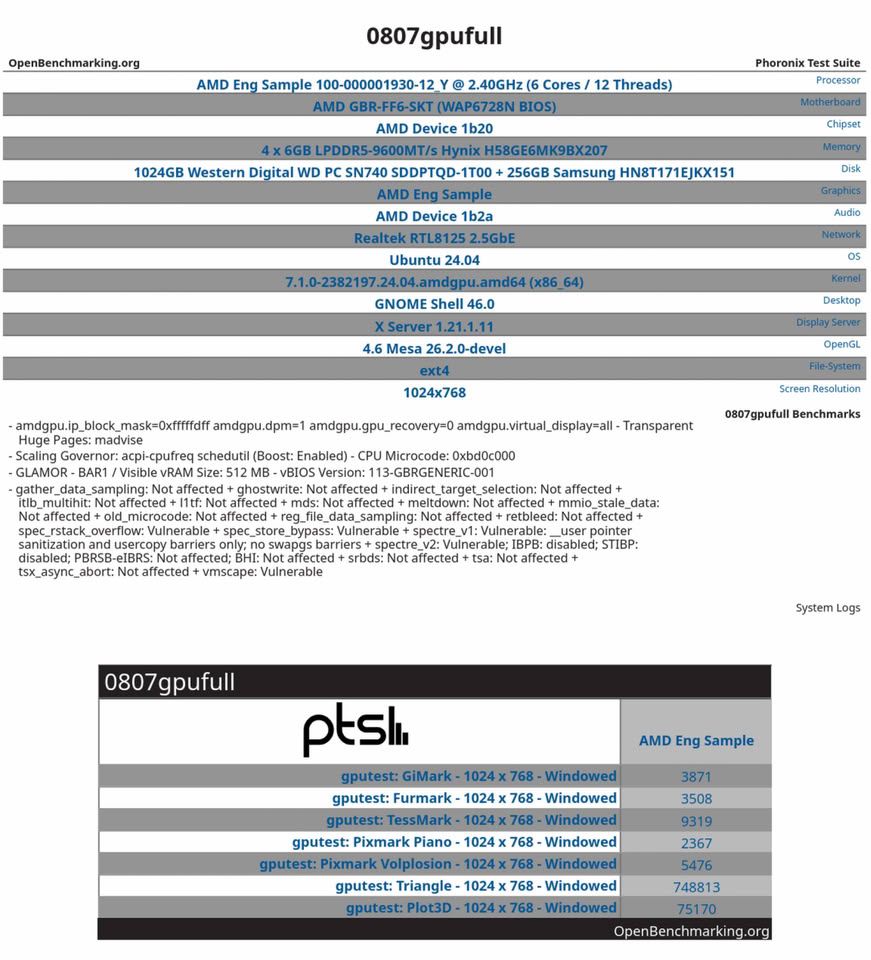
An AMD engineering sample has made an appearance in a listing on OpenBenchmarking. According to a report by TechPowerUp, the chip could potentially be a part of AMD’s upcoming Gainsborough family and a possible candidate for the next-generation Steam Deck handheld console. As per the OpenBenchmarking listing, the chip comes with a six-core, 12-thread processor paired with 24GB of high-speed LPDDR5 memory.

The engineering sample with part number 100-000001930-12_Y was tested on an AMD GBR-FF6-SKT validation board, with the CPU running at clock speeds of 2.4 GHz. The system also features four 6GB SK Hynix memory packages, resulting in 24GB of LPDDR5 memory running at 9,600 MT/s. That’s a big jump when compared to the current Steam Deck, which comes with 16GB of LPDDR5 memory running at 6,400 MT/s, alongside a four-core, eight-thread AMD Zen 2 processor.

A listing from OpenBenchmarking of an AMD engineering sample

(Image credit: OpenBenchmarking)

The benchmark listing also provides some clues about the processor’s underlying architecture. As per Notebookcheck, the sample’s CPU microcode revision corresponds to AMD’s Family 1Ah, model DCh. Linux kernel changes indicate that this model falls within the range reserved for newer Zen 6 processors, suggesting that Gainsborough could use AMD’s next-generation CPU architecture. However, there is no clarity or any confirmation whether it will use standard Zen 6 cores or the denser Zen 6C variant.

The integrated GPU is listed with a clock speed of 2,400 MHz, although its architecture and compute unit count remain unknown. The sample was tested using the GpuTest benchmark suite on Ubuntu 24.04 at 1024 x 768 resolution, resulting in scores of 3,871 in GiMark, 3,508 in FurMark, and 9,319 in TessMark. While the FurMark score is comparable to the original Stam Deck, we can’t really come to any conclusions at this point, as the tests were conducted on an engineering platform using development software rather than a finished handheld. For now, the results do not establish how the chip would perform in games, as power limits, cooling, driver maturity, and the final GPU configuration all contribute to the performance in a compact gaming device.

If these specifications carry over to a future Steam Deck, the additional CPU cores along with the larger and faster memory would provide a meaningful hardware upgrade. That being said, neither AMD nor Valve have confirmed a connection between the Gainsborough family and a future Steam Deck. Thus, it is best to take this with a grain of salt and wait until there is more concrete information in the future.

  •  

China’s tech giants drop $35 billion on export-compliant Nvidia RTX Pro 5500 workstation GPU orders to power AI ambitions, according to reports

Chinese technology giants ByteDance, Alibaba and Tencent have reportedly spent over $35 billion on orders for more than 3 million Nvidia RTX Pro 5500 workstation GPUs. The huge order for the RTX Pro 5500, fully compliant with U.S. restrictions on exports of AI-capable GPUs to China, is reportedly far beyond Nvidia's planned production for this card. As a result, Nvidia has, according to sources who spoke to Reuters, told its customers that it isn't in a position to fill the orders as it far outstrips its planned production for this GPU.

The RTX Pro 5500 is a workstation GPU with the same number of CUDA cores as its flagship RTX 5090 GPU, but with 84GB of GDDR7 memory attached, making it a good option for AI applications. The RTX Pro 5500 is a popular choice at the moment for Chinese buyers as exporting it isn't currently restricted by the U.S. government. It's less powerful than the H200 and B300, Nvidia's AI-focused GPUs for the enterprise market, but those GPUs remain either banned or heavily restricted. As China competes with the U.S. in the race to produce newer, better AI models, GPUs like the RTX Pro 5500 continue to be indispensable.

The report reveals some interesting data about the Chinese tech firms orders. Two of its sources revealed that the cards are priced at around $11,400 each, reaching a total order value of $35 billion. Meanwhile, another source suggested that Nvidia has informed its partners that it may only be able to deliver enough cards to meet between 5% and 10% of the demand. Meanwhile, Nvidia is reportedly in a position to only produce 3 million RTX Pro 5500 cards globally in 2027.

Neither Nvidia nor the three Chinese companies have confirmed any of this on the record. However, an Nvidia spokesman told Reuters that demand from the Chinese market for these chips has faced "unprecedented growth since 2022" since export restrictions were introduced. "U.S. firms continue to be restricted by a combination of outdated U.S. export controls, which cover gaming products released nearly half a decade ago, and China's own limits on U.S. imports."

While trade hostility between the U.S. and China shows no sign of abating, demand for Nvidia's GPUs hasn't slowed down, despite U.S. attempts to restrict Nvidia's ability to export to China. Meanwhile, export-restricted Nvidia AI chips continue to reach China despite the restrictions, bypassing the Trump administration's efforts in the process.

  •  

Mods can almost double DLSS 5 performance through Foveation, reducing resolution at the edges of frames

Popular graphics post-processing injector software ReShade, commonly used to mod DLSS 5 into unsupported games, now has a foveated imaging add-on, including another standalone project that doesn't need precursor software, allowing DLSS 5 to affect only what's in view, reducing GPU load and increasing FPS.

Foveated imaging is nothing new; it's a technique that's been used in VR to increase performance. It works by only rendering what's in view, often increasing the resolution in the center and reducing it at the edges. Our eyes work in a similar way, with the clearest image in a small area in the center of your vision, blurring on the edges. With foveated rendering, you barely notice the lower-resolution edges as the peripheral vision is less concerned with fine details.

I made a foveated rendering mod for DLSS5 than can double performance by reducing the resolution inputs near the edges
 from r/DLSS

Instead of varying the resolution of the image, however, it varies the level of detail in DLSS 5 Neural Rendering. DLSS NR loads a whole AI model into your GPU and renders images in real time, making it a resource-intensive task; but the task is minimized greatly when most of the detail is only asked for in the middle of the image. That's what projects like maximedgoulet’s Foveated DLSS5 and ClarkCheekyKent’s CheekyFoveatedDLSS aim to do; with Foveated DLSS being a ReShade add-on and CheekyFoveatedDLSS capable of being a standalone integration.

Both implementations allow you to adjust the size of the center area with the highest rendering quality, with independent width and height adjustments to suit your personal situation, as some people have a larger focus area than others or have a different monitor distance. You can also adjust the render fall-off rate, so the image quality lessens more quickly or slowly past the focus area.

As Maximedgoulet's implementation is an add-on for an injector, the pipeline is quite long compared to the standalone integration of CheekyFoveatedDLSS, which Reddit comments claim is more convenient and more polished. Though both show a big improvement in performance, Maximed's Reddit post on Foveated DLSS5 claims an improvement from 48 to 80FPS in The Witcher 3 with 2x Multipass at ultrawide 7680x2160p on an RTX 4090. Considering Maximedgoulet’s 4090 could not handle DLSS-NR on an ultrawide, this implementation might genuinely be feasible to make Neural Rendering more playable.

  •  

Modal taps Nvidia Vera CPUs after firm's internal tests show 2x throughput over Intel and AMD chips

Nvidia has earned billions selling AI accelerators, but with the emergence of agentic AI, CPUs are going to play a considerably more significant role than before, which creates new opportunities for the company. Reuters reports that Nvidia has secured a major design win with its Vera CPUs with AI cloud provider Modal. According to Modal, preliminary evaluations showed that Vera could deliver twice the throughput of its existing AMD and Intel processors, although the company does not intend to cease using CPUs from its current suppliers.

Modal provides cloud infrastructure that enables AI developers to deploy AI agents that can perform complex operations autonomously over extended periods. Such workloads require substantial CPU resources for software execution, data processing, and other tasks that cannot be efficiently handled by GPUs. Modal currently relies exclusively on AMD and Intel processors for these operations, but its tests indicate that Nvidia's new Vera CPUs could significantly improve performance in its specific workloads. Of course, since Vera is based on an Arm instruction set architecture, Modal's decision to adopt Vera will require substantial modifications to its software. Nevertheless, Modal believes that the potential performance improvements justify the additional engineering effort.

The reported 2x throughput advantage is particularly interesting because agentic AI workloads can involve numerous independent tasks that compete for CPU cores, cache capacity, and memory bandwidth. However, Modal has not disclosed detailed benchmark configurations it used, specific AMD and Intel processor models, or performance-per-watt figures. Consequently, it remains unclear whether Vera's advantage is enabled by advantages of its Arm v9.2-based Olympus CPU cores that can decode and execute up to 10 instructions per cycle, its memory subsystem with 1.2 TB/s of bandwidth, or other architectural characteristics. Also note that tests compared Vera against currently available AMD and Intel processors rather than their upcoming generations that will compete against Vera in the coming years.

Since Modal cannot port all of its software to Arm ISA overnight, the company will continue using x86 CPUs from AMD and Intel, according to Modal chief executive Erik Bernhardsson. Rather than sticking to one ISA for everything, Modal intends to operate a heterogeneous server fleet and select the most suitable processors for each workload. Naturally, the company intends to evaluate upcoming AMD and Intel processors once they become available to make its choices in the future.

For Nvidia, the agreement represents a major step toward making Vera a standalone server processor that commands a major share of the server market. The company expects Vera sales to generate at least $20 billion during its current fiscal year and estimates the potential total available market for these CPUs is approximately $200 billion. The company is on track to sell at least four million Vera CPUs in fiscal 2026.

The announcement comes shortly after Modal secured $750 million in financing led by Accel, which valued the company at $15.75 billion. Modal expects its annual revenue to reach $1 billion within the next year. The company's service consumption has increased 3X in the last 12 months, while revenue has surged more than 15 times compared with the previous year, Reuters reports.

  •  
❌