
❌

Reading view

Gemini North Telescope Captures Stunning Portrait of Merging Spiral Galaxies
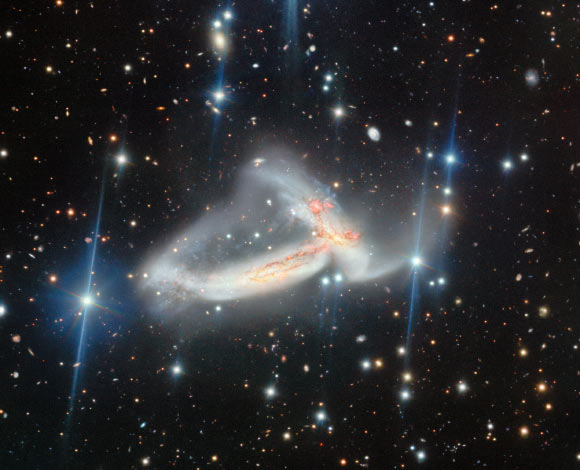
This image of NGC 7253 was captured by the Gemini North telescope on Maunakea, one half of the International Gemini Observatory. Image credit: International Gemini Observatory / NOIRLab / NSF / AURA / J. Miller & M. Rodriguez, International Gemini Observatory & NSF’s NOIRLab / T.A. Rector, University of Alaska Anchorage & NSF’s NOIRLab / D. de Martin & M. Zamani, NSF’s NOIRLab.

A new image from the Gemini North telescope on Maunakea in Hawai’i offers the sharpest look yet at a striking pair of interacting spiral galaxies, cataloged as NGC 7253.

The post Gemini North Telescope Captures Stunning Portrait of Merging Spiral Galaxies appeared first on Sci.News: Breaking Science News.

  •  

Hubble Spots Spiral Galaxy Warped by Cosmic Forces

This Hubble image shows NGC 4654, an intermediate spiral galaxy some 55 million light-years away in the constellation of Virgo. Image credit: NASA / ESA / Hubble / D. Thilker / J. Lee / PHANGS-HST Team.

A stunning new image captured by the NASA/ESA Hubble Space Telescope shows the lopsided intermediate spiral galaxy NGC 4654, whose unusual shape was sculpted by both a close encounter with another galaxy and a headlong plunge through the hot gas of the Virgo Cluster.

The post Hubble Spots Spiral Galaxy Warped by Cosmic Forces appeared first on Sci.News: Breaking Science News.
  •  

Our Milky Way Galaxy Likely Underwent Disk Flip after Ancient Galactic Collision: Study

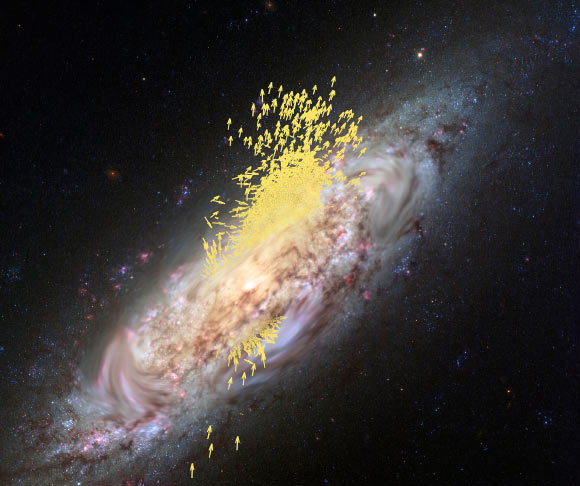
Using supercomputer simulations of galaxies like the Milky Way, Batrakov et al. found that galaxies with slowly rotating stellar haloes are more likely to have experienced a major β€˜disk flip,’ where our Galaxy’s disk changed its orientation by more than 90 degrees. Image credit: Batrakov et al.

A head-on collision with another galaxy billions of years ago may have dramatically reoriented the Milky Way’s disk, according to new supercomputer simulations that reveal how violent mergers can leave spiral galaxies looking surprisingly normal today.

The post Our Milky Way Galaxy Likely Underwent Disk Flip after Ancient Galactic Collision: Study appeared first on Sci.News: Breaking Science News.

  •  

Hubble Captures Active Spiral Galaxy: Messier 88

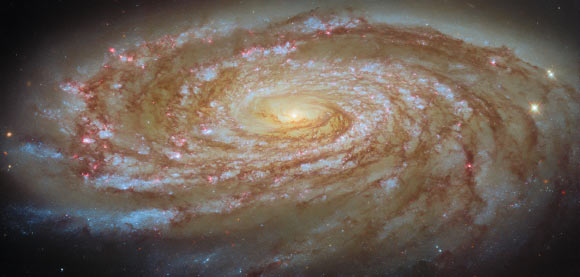
This image, taken with the Wide Field Camera 3 (WFC3) instrument aboard the NASA/ESA Hubble Space Telescope, shows the spiral galaxy Messier 88. Image credit: NASA / ESA / Hubble / D. Thilker / MAUVE-HST Team.

A newly-released Hubble image shows Messier 88, a black hole-powered spiral galaxy that is gradually plunging toward the crowded heart of the Virgo Cluster.

The post Hubble Captures Active Spiral Galaxy: Messier 88 appeared first on Sci.News: Breaking Science News.

  •  
❌