❌

Reading view

Study: Famous ‘Space Weather’ Train Delay Actually Happened Seven Years Later

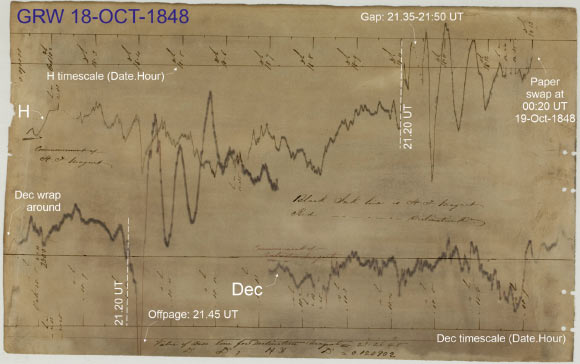
The magnetogram recorded at Greenwich Magnetic Observatory (London) from 11:20 UT on 18 October 1848 to 00:20 UT on 19 October 1848. Powerful geomagnetic disturbances are apparent on the evening of 18 October 1848 from 21:20 UT. Image credit: Wild et al., doi: 10.1029/2026SW005239.

Although the famous Carrington Event of 1859 is often described as the first major space weather event to affect technology, earlier incidents did occur. Historical records show that telegraph systems were disrupted by geomagnetic storms as early as the late 1840s.

The post Study: Famous ‘Space Weather’ Train Delay Actually Happened Seven Years Later appeared first on Sci.News: Breaking Science News.

  •  

Britain’s Power Grid Has a Blind Spot for Extreme Solar Storms, New Research Reveals

In May 2024, the strongest geomagnetic storm in two decades pushed the Northern Lights far enough south to become visible across much of the UK and beyond. Now, a study that appeared in Royal Society Open Science reveals that the incident also exposed important gaps in how the UK monitors and prepares its power grid, satellites, and aviation for future extreme space weather.

The storm reached a G5 rating, which is the highest level on the geomagnetic storm scale used by NOAA, as a result of five coronal mass ejections reaching Earth within a period of two days. Researchers with the Space Environment Impacts Expert Group (SEIEG) stated that although the storm caused only relatively minor disruption, it revealed shortcomings in the UK’s capacity to monitor and prepare for more severe space weather events.

The SEIEG then made 14 recommendations to the UK government addressing matters such as grid monitoring, satellite operations, and space weather forecasting. Richard Horne, chair of SEIEG and head of space weather at the British Antarctic Survey, recently gave a presentation on the findings at the Royal Astronomical Society’s National Astronomy Meeting in Birmingham.

A Storm That Tested the Limits

Researchers estimate that the May 2024 storm was a one-in-13-year event. By contrast, a Carrington-class storm, like the 1859 event that defines the standard for extreme space weather, has about a 1% chance of occurring in any given year. This means that a much more disruptive storm is still possible. The SEIEG report uses the 2024 storm as a practical example to assess how prepared the UK is for a more severe event.

“The Northern Lights were the most visible sign of the May 2024 storm, but they were only one part of a much broader space weather event that tested the UK’s critical infrastructure. The storm highlighted where we need better monitoring, better forecasting and more research so we’re prepared for a more severe event in the future,” Horne said.

The Blind Spot in Britain’s Power Grid

Geomagnetic storms create electric fields at Earth’s surface that can drive geomagnetically induced currents (GICs) through long conductive systems, including power transmission networks. High levels of GICs can overheat transformers, disrupt their normal function, and in severe cases cause damage that may lead to failures across parts of the power grid.

Currently, there are no GIC monitors in operation in England or Wales. The SEIEG report recommends establishing a network of monitors to assess how much current various transformer designs can tolerate before sustaining damage.

New Zealand as the Model

The report cites New Zealand as an example of effective monitoring. Since it is at a similar geomagnetic latitude, the country faces similar space weather risks, and its grid operators monitor around 93 transformers across 28 substations. Unlike in England and Wales, where monitoring is absent, these operators have verified their models using actual measurements and implemented operational mitigation procedures during the May 2024 storm.

Crowded Skies, Rising Risk

The storm also affected satellites in orbit. Almost 5,000 satellites adjusted their orbits during the storm. Satellites licensed in the UK saw their number of collision warnings rise by 35%. Since there are now so many objects in low-Earth orbit, a serious storm could raise the risk of collisions, possibly resulting in debris and causing additional incidents.

Preparing for Future Storms

SEIEG also recommends improving forecasts of coronal mass ejections and solar energetic particle events to provide two to three hours of warning before severe geomagnetic storms reach Earth. Improved forecasts could allow grid operators, satellite controllers, and airlines to take protective measures before severe geomagnetic storms arrive. 

“One of the biggest lessons from the May 2024 storm is that we still have important gaps in our monitoring and understanding of how severe space weather could affect UK infrastructure,” said Horne. “We were fortunate that this was not a one-in-100-year event. We now have an opportunity to strengthen our monitoring, improve our forecasts and make sure the UK is better prepared before a much larger storm occurs.”

The 14 recommendations are now under review by the UK government. Whether these steps will be taken before a Carrington-scale storm occurs remains uncertain. With this extreme class of storms remaining a realistic possibility, the researchers argue that improving monitoring and forecasting now could reduce the impact of a future extreme event.

Austin Burgess is a writer and researcher with a background in sales, marketing, and data analytics. He holds an MBA, a Bachelor of Science in Business Administration, and a data analytics certification. His work focuses on breaking scientific developments, with an emphasis on emerging biology, cognitive neuroscience, and archaeological discoveries.

  •  

Space Weather May Warp Martian Weather during Dust Storms, Planetary Scientists Suggest

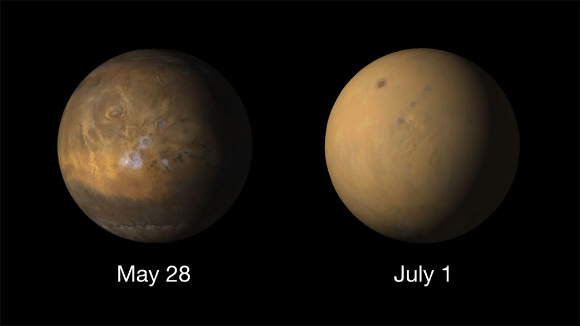
These images from Mars Color Imager (MARCI) aboard NASA’s Mars Reconnaissance Orbiter (MRO) show Mars before (left) and during (right) the June 2018 dust storm. Image credit: NASA / JPL-Caltech / University of Arizona.

Planetary researchers have found the first evidence that bursts of energetic particles from the Sun could warm the lower atmosphere of Mars during massive dust storms, hinting at an unexpected link between space weather and Martian climate.

The post Space Weather May Warp Martian Weather during Dust Storms, Planetary Scientists Suggest appeared first on Sci.News: Breaking Science News.

  •  

“This Upper Limit is an Illusion”: NASA Study Warns There May Be “No Limit” to How Solar Storms Impact Earth 

Our modern society depends heavily on communications and power networks that are highly susceptible to interference from solar storms, making these volatile space weather events a paramount concern for scientists.

Now, it turns out there may be more to fear than previously realized. Scientists are discovering that there may be no ceiling to the devastating effects solar storms may have on Earth, overturning what little sense of security may exist as a mere mathematical anomaly.

In a recent paper published in Nature, a NASA-led team discovered that the potential impact of solar storms on our technological infrastructure could be substantially more severe than currently recognized.

Solar Storms Reconsidered

According to new research, any past limitations perceived regarding the impact of solar storms on our planet are purely an illusion, which arises from imprecise data collection.

Previous observations of electric currents in the Earth’s upper atmosphere during solar storm events suggested a ceiling to how far they could increase. Yet the new paper claims that uncertainties in solar wind data are falsely giving rise to this idea.

The researchers say that the distance of the spacecraft taking solar wind measurements is the issue. Those spacecraft are millions of miles closer to the Sun than the Earth is, meaning that by the time those winds reach Earth, they have weakened considerably. Additionally, instrument error and the effects of the local plasma and field conditions all come into play.

All this, the researchers say, creates a mismatch between the measured strength of the wind and its effects on our planet’s electrical currents.

Correcting For Distance

The new findings contain one significant difference from existing research: they relied on observation platforms much closer to Earth to collect data, which included spacecraft such as NASA’s MMS and THEMIS.

Launched in 2007, THEMIS consists of five satellites that target the Earth, rather than the Sun, to study our planet’s magnetosphere and auroras. MMS consists of four spacecraft that also study the Earth’s magnetosphere.

Existing charts show the impact of solar winds on Earth leveling off at a certain threshold, which scientists had believed was the maximum saturation possible. However, in new solar wind strength data collected much closer to Earth, more accurately reflecting power at the time of impact, this saturation point disappeared. Instead, this data revealed that there is no ceiling on how heavily solar storms can charge the Earth’s electrical currents.

Solar Storm Impacts

Another crucial element in the NASA-led research is the statistical concept of regression to the mean, which holds that extreme measurements often change as more data come in. In this case, as more data on solar storm impacts on Earth recorded from various distances were collected, the plating effect disappeared. The authors note that similar effects occur in other areas of research, such as climate studies and chronic medical pain.

These new findings present a major challenge to our understanding of space weather. Scientists will now need to conduct many further observations to determine if any such ceiling exists. The threat to our infrastructure may be severe, as satellite communication underpins our modern society, not to mention the power grid, which keeps our world running.

For now, NASA continues to monitor solar storms to prepare for their potentially dangerous effects on our infrastructure, and in light of the new research, the potential for future challenges ahead may be greater than previously realized.

The paper, “Regression to the Mean Can Explain Saturation of Geomagnetic Storms,” appeared in Nature on July 15, 2026.

Ryan Whalen covers science and technology for The Debrief. He holds an MA in History and a Master of Library and Information Science with a certificate in Data Science. He can be contacted at ryan@thedebrief.org, and follow him on Twitter @mdntwvlf.

  •  
❌