❌

Reading view

Hurricane Polo Explodes in Pacific, UK Aphid Swarm Wipes Out 30 Million Lettuces, Glasgow Braces for Rubbish Pileup — Today’s Environmental Briefing for Thu, Sep 24 2026

Satellite view of Hurricane Polo swirling over the Pacific Ocean with visible eye structure

Across the stories today, a common thread emerges: the planet is speaking in signals — some subtle, some deafening — and the question is whether our institutions can listen fast enough to act.

Start with the signals themselves. El Niño has surged to record strength weeks ahead of schedule, and its fingerprints are already visible — from Hurricane Polo’s explosive intensification in the Pacific to the climate volatility rippling through global weather systems. In the UK, an aphid outbreak wiped out 30 million lettuce heads almost overnight, a small but telling example of how shifting conditions can upend food systems in ways no one budgets for. In Malawi, an unexplained weed overgrowth has choked Chia Lagoon, stranding farmers and fishers in flooded fields nearly seven months after the rains should have drained. These aren’t isolated oddities. They’re the planet’s early warning system, written in crop yields and clogged waterways.

Then there’s the human response — uneven, but not absent. Germany’s landmark pledge to phase out fossil fuels by 2045 marks a rare moment of policy catching up to urgency, moving beyond vague “carbon neutrality” language toward something more concrete. The UK’s decision to declassify a once-suppressed intelligence report — warning that climate breakdown is a direct threat to global security — suggests governments are quietly acknowledging what scientists have said for years, even if political will lags behind. And at UN climate talks in New York, amid what The Guardian describes as a genuinely grim mood, solar power’s continued growth offered rare, tangible hope. As Al Gore noted twenty years after An Inconvenient Truth, he’s surprised by the ferocity of fossil fuel pushback — but still believes, cautiously, that the fight can be won.

Behind the numbers are real communities adapting in real time. In the Andes, villagers near Villa de Arma are turning to ancient wetland systems as glaciers they once walked across vanish into bare rock. In Guam, resident Leevin Camacho learned his family’s water contained a pesticide banned since 1987 — a stark reminder that militarization and environmental cost are often intertwined, especially in the Pacific. And in Sarawak, Indigenous communities are still reckoning with displacement from the Bakun megadam three decades later, a cautionary tale as the world races toward a “clean” energy future that doesn’t always ask who pays for it.

It’s a reminder that progress and pressure often arrive together. Endangered birds on South Australia’s Eyre Peninsula won last-minute protection from a rocket launch site — a genuine conservation victory — even as a Norfolk Broads housing levy was quietly slashed, raising fears that environmental safeguards elsewhere are eroding. Meanwhile, olive ridley sea turtles nesting for the first time ever on California beaches offer something rarer: wonder. A signal, too, but one that invites curiosity rather than alarm — proof that the natural world is still capable of surprising us.

As the week unfolds, all eyes will be on whether momentum from Climate Week — bolstered even by a monster from Sesame Street reminding children it’s okay to feel both fear and courage — translates into follow-through. The data, the disasters, and the small human stories all point the same direction: the era of asking “if” is over. What remains is the harder work of “how fast,” and “for whom.”

The post Hurricane Polo Explodes in Pacific, UK Aphid Swarm Wipes Out 30 Million Lettuces, Glasgow Braces for Rubbish Pileup — Today’s Environmental Briefing for Thu, Sep 24 2026 first appeared on EnviroLink Network.

  •  

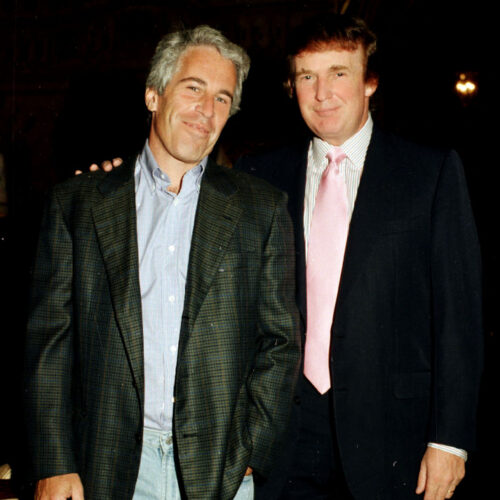
Epstein had huge cache of child sex pics; victims sue to find out who's in them

On Tuesday, two survivors of child sex abuse accused the Justice Department of failing to notify dozens of victims found in Jeffrey Epstein’s massive collection of child sex images.

In a proposed class action, survivors explained that Epstein apparently started collecting child sex images in the 1990s, many of which the DOJ recovered after his arrest. In 2025, the FBI started reviewing “tens of thousands of videos” containing illegal child sexual abuse material (CSAM) and issued a memo confirming that “a large volume of images” seized depicted likely minors.

Some of these victims may have had contact with Epstein, as the disgraced financier kept a "modelbook" of nude photos of young girls roped into his ring. However, the FBI also identified hundreds of CSAM images in cache, which include approximately 15–20 images of known CSAM dating back to the 1990s. And so far, the DOJ has largely ignored those victims, who likely never met Epstein and have no way of knowing if he possessed, transported, or traded their images, survivors alleged.

Read full article

Comments

  •  

California may gut state net neutrality law to comply with Trump admin demand

California is on the verge of accepting $1.86 billion in federal broadband grant funds, despite the Trump administration telling states they cannot enforce net neutrality rules on any Internet service provider that gets a piece of the grant money.

When the Trump administration overhauled the $42 billion Broadband Equity, Access, and Deployment (BEAD) program last year, it ruled that states must agree not to enforce any rate regulation or net neutrality rule on ISPs that receive funding. This is particularly problematic for California, which previously won a yearslong court battle to defend its state net neutrality law.

Similar to federal net neutrality rules repealed during the first Trump administration, California's law prohibits ISPs from blocking or throttling lawful traffic and says ISPs may not require fees from websites or online services to deliver or prioritize their traffic to Internet users. While the first Trump administration lost its attempt to preempt state net neutrality laws, the second Trump administration is trying to achieve a similar result by making federal broadband money conditional on whether states agree not to enforce net neutrality.

Read full article

Comments

© Getty Images | Yuichiro Chino

  •  

It’s OK to tell ICE their actions will haunt them, judge rules in speech fight

It’s not illegal to send an email telling Immigration and Customs Enforcement (ICE) officials that their actions will haunt them, a federal judge ruled Tuesday, granting a preliminary injunction that blocks ICE from threatening to prosecute a critic for protected speech.

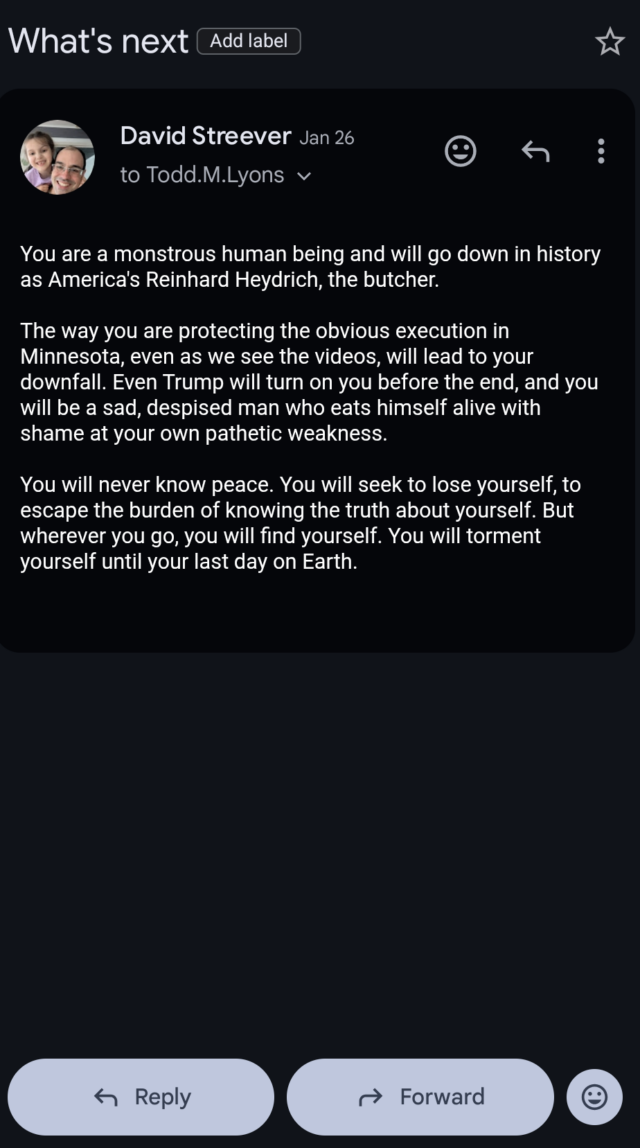
Back in January, David Streever sent a scathing three-paragraph email to then-acting director of ICE, Todd Lyons. Outraged by the killings of two Minnesota protestors against ICE, Renee Good and Alex Pretti, Streever told Lyons that he was a “monstrous human being” who will eat himself “alive with shame” for defending officers who shot people who posed no threat and had no weapons. Comparing Lyons to an infamous high-ranking Nazi cop, Streever predicted that “even Trump” would one day turn on Lyons for defending the “obvious” slayings of Americans.

David Streever's email to ICE. Credit: via FIRE

“You are a monstrous human being and will go down in history as America’s Reinhard Heydrich, the butcher,” Streever wrote. “You will never know peace. You will seek to lose yourself, to escape the burden of knowing the truth about yourself. But wherever you go, you will find yourself. You will torment yourself until your last day on Earth.”

Read full article

Comments

© via FIRE

  •  

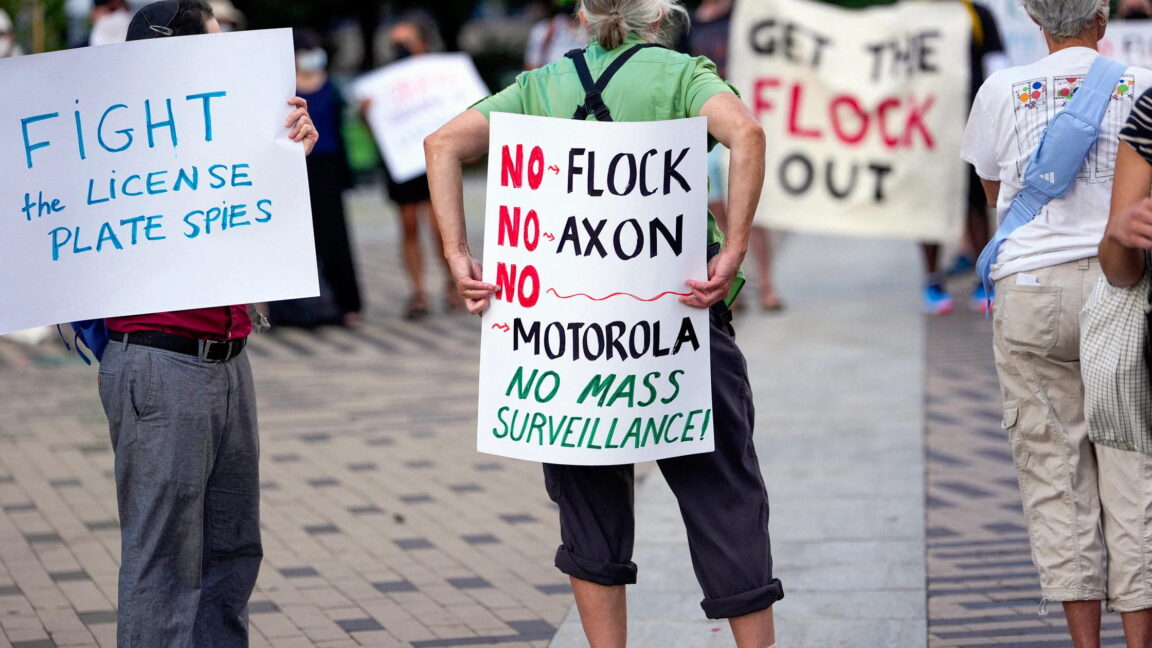
Lawmakers target Flock cameras with a threat to highway funding

A bipartisan pair of US lawmakers tell WIRED they plan to introduce legislation today that would strip federal funding from states that fail to restrict the use of Flock cameras and other automated license plate readers. The devices, which help police track the location of vehicles tied to crimes, have become the subject of nationwide backlash in recent months over more nefarious uses by officers.

The No FLOCK Act—for Federal License-Plate Observation and Camera Keeping—directs the US secretary of transportation to withhold 10 percent of annual financial support due to states for highways, roads, and bridges if it fails to ban Flock and similar devices for all but five use cases. Congressmen Raja Krishnamoorthi, a Democrat representing Chicago suburbs, and Michael Cloud, a Republican whose Texas district includes Corpus Christi, are cosponsoring the bill.

The legislation says that Flock cameras could be used only for “enforcing toll systems, identifying stolen vehicles, missing or endangered persons, vehicles registered to persons with a warrant for a felony offense, or investigating a vehicle involved in a felony offense.” Notably absent are uses like conducting traffic studies, investigating minor drug crimes, and enforcing parking and speeding rules.

Read full article

Comments

© Barry Chin/Getty

  •  

US Confirms Orbital Weapon, Essex Wildlife Habitat Threatened by Data Centre — Today’s Environmental Briefing for Wed, Sep 16 2026

Illustration of a military satellite weapon orbiting Earth above rare UK wildlife habitat threatened by development

Across the stories today, a common thread emerges: the boundaries we once drew around “the environment” — between land and sea, sky and orbit, economy and ecology — keep dissolving, revealing how deeply intertwined these systems have become.

Start with the sky, in more ways than one. The US government’s confirmation that it has deployed a weapon in Earth’s orbit marks a genuine turning point, not just for defense policy but for how we think about the commons above our heads. Space has long been treated as neutral ground; now it’s becoming contested territory, raising quiet but urgent questions about debris, escalation, and what “environment” even means when it extends past the atmosphere. Meanwhile, back on solid ground, the UK’s climate advisers delivered a pointed message to Heathrow: a third runway cannot proceed unless airlines help pay for the emissions it would unleash, potentially through carbon removal costs. It’s a small but telling signal that growth and climate accounting are becoming inseparable in policy conversations — expansion is no longer a given, even for infrastructure long considered inevitable.

That tension between growth and limits runs through much of today’s coverage. A Guardian analysis found that the world’s twenty largest private equity firms back energy portfolios emitting more greenhouse gases than all but three countries on Earth — a stark reminder that climate accountability often hides behind layers of finance most people never see. In Venezuela, a US-backed push for “legitimate” mining and a new oil megadeal are drawing warnings from environmental and human rights groups who see familiar risks dressed in new language. And in Guinea-Bissau, industrial fishmeal factories are quietly hollowing out a food fish that coastal communities have relied on for generations. Behind the numbers are real communities adapting in real time — from Vietnamese fishers losing thousands of dollars per vessel to tangled plastic waste, to Dhaka residents like Yeasmin Begum, who has spent her life breathing the smoke of a landfill she never chose to live beside.

Yet alongside these pressures, the day’s coverage also points to growing momentum around resilience and repair. Ukrainians are turning to rooftop solar to keep homes running amid bombardment — a portrait of adaptation born from necessity. A Congolese NGO now co-manages a national reserve for the first time, a homegrown model of stewardship. Moon bears rescued from bile farms are stretching their limbs in Suffolk enclosures, and three wild dog brothers wandered 2,500 miles across Zambia in search of a mate, offering an unlikely note of hope for their species. Even Griffith Park’s mountain lion — photographed beneath the Hollywood sign — helped inspire the world’s largest wildlife crossing, proof that a single image can shift infrastructure decisions.

It’s a reminder that progress and pressure often arrive together. Some communities are innovating their way through crisis; others, like the land defenders now forming self-defense units amid rising violence, are simply trying to survive it. As Brazil’s upcoming election looms over the Amazon’s future, and Chief Raoni Metuktire — one of its most storied protectors — enters palliative care, the coming months may reveal whether today’s momentum toward stewardship can outpace the forces pulling the other way.

The post US Confirms Orbital Weapon, Essex Wildlife Habitat Threatened by Data Centre — Today’s Environmental Briefing for Wed, Sep 16 2026 first appeared on EnviroLink Network.

  •  

A brief history of AI executives calling for regulation

H.A.L.-style glowing red digital eye over a textured digital backdrop.

Over the past few days, a lot of people who stand to make a lot of money from AI all publicly agreed that it's time to make everyone slow down before we lose control - including OpenAI CEO Sam Altman, Anthropic CEO Dario Amodei, Google DeepMind cofounder Demis Hassabis, Microsoft CEO Satya Nadella, and X CEO Elon Musk.

When people who profit from something declare that it's dangerous and needs to be regulated, there's always reason to be skeptical. But whatever their reason, this is far from the first time AI thought leaders have sounded the alarm.

Charles Darwin's theory of evolution prompted author Samuel Butler to warn about intelligen …

Read the full story at The Verge.

  •  

Chinese state media counters Anthropic's call to put brakes on AI development — paper says move is ‘a response to Chinese competition’

China's state-run newspaper has downplayed the call of Anthropic founder Dario Amodei to “pace the frontier.” China Daily, the official English mouthpiece of the Communist Party of China, questioned the move, which was supported by OpenAI CEO Sam Altman and SpaceXAI’s Elon Musk, asking if they were doing it out of concern for humanity or if they’re afraid of competition from China.

“The report, and the corporate ‘alliance’ that followed it, amounted in essence to a coordinated play — a response to Chinese competition and to the regulatory pressure coming from Washington. Its aims were threefold: to blunt China's AI advance, to win a favorable policy environment at home and to keep investors' enthusiasm for US AI alight,” the publication wrote. It further criticized the move thusly: “The proposed coordination among the three companies sounds rather like a club whose membership rules have been drafted before the guest list is announced. A global AI-safety framework that excludes China is not quite global.”

The paper also called out the U.S. efforts in blocking Chinese AI advancement, both through hardware, by blocking Beijing’s access to the latest Nvidia chips, and software, with Amodei’s multiple accusations of illegal distillation of Claude by Chinese AI labs. China Daily said that these efforts have apparently failed, and cited the success of the DeepSeek and Kimi K3 models, which turned out to perform well enough but at a much lower cost.

The availability of those models has resulted in many AI users shifting demand to cheaper tokens, like Kimi K3 (low) and DeepSeek V4 Pro, over the expensive frontier models like Fable 5.1, GPT 5.6 Sol, Grok 4.6, and Kimi K3 (max).

China Daily also took issue with Amodei’s focus on excluding China from his proposal. It suggests that the move is meant to widen the technological gap between the two rivals when it comes to AI technology and give American AI labs breathing room to “pace the frontier,” and that it reveals how Washington sees Chinese AI as an existential threat.

Nevertheless, Chinese policy acknowledges some of the risks that Amodei raised. The Standardization Administration of China, in cooperation with the Cyberspace Administration of China, says that the development of AI technology must be monitored as it may go beyond human control.

“Treating the AI race as a zero-sum game makes the cooperation needed to manage those risks more difficult. China and the US should cooperate where neither can manage the consequences alone,” says the state media outfit. “The planned AI-safety dialogue between the two sides and future high-level exchanges offer opportunities for practical engagement. The promise of AI lies in serving humanity's common good, not in being weaponized for geopolitical gain or instrumentalized for personal profit.”

  •  

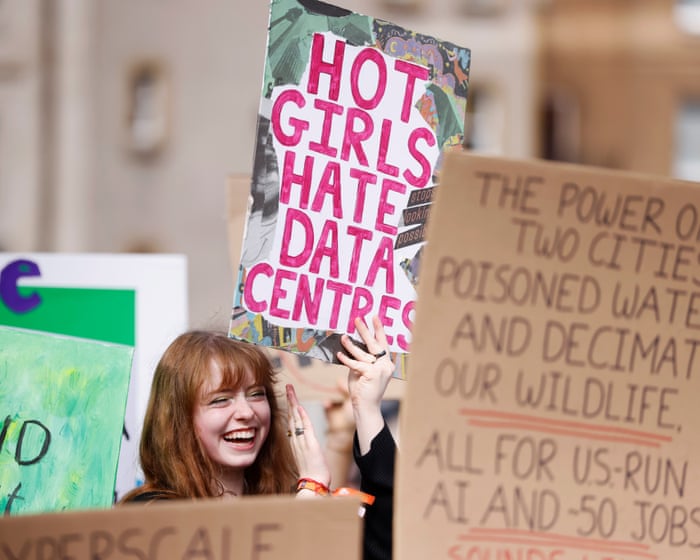
Planning permission for new Scottish AI datacentres suspended for up to a year

MSPs vote for strict environmental impact assessments and will delay decisions until national strategy is developed

Holyrood has voted to pause planning applications for all new AI datacentres for up to a year until the Scottish government has developed a national strategy.

On Wednesday, MSPs backed a Scottish Labour motion to halt new schemes for up to 12 months while rules on hyperscale datacentres are developed in what could be a blow to the British government’s AI strategy.

Continue reading...

© Photograph: Murdo MacLeod/The Guardian

© Photograph: Murdo MacLeod/The Guardian

© Photograph: Murdo MacLeod/The Guardian

  •  

AI and data centers are incredibly unpopular in every poll

Graphic image of a data center.

Poll data released Tuesday by The New York Times and Siena University confirms what we've already been seeing, and what politicians are responding to - AI and data centers are incredibly unpopular. Asked if they support or oppose the construction of data centers to power AI tech, 61 percent of the 1,503 likely voters surveyed in early September (ahead of the recent AI safety slowdown discussion) said they were opposed, with only 14 percent saying they strongly support. The split was about even among 2024 Donald Trump voters, at 49 percent support to 45 percent oppose, while people who had voted for Kamala Harris or who didn't vote leaned opp …

Read the full story at The Verge.

  •  

“Filmmaker” suing PassThePopcorn may be banned user out for revenge

Some of the most widely used private torrent trackers for pirating movies suspect that a banned user may have posed as a filmmaker protecting copyrights in a failed attempt to seek revenge.

TorrentFreak has been tracking this story closely, reporting last September that an alleged independent filmmaker named Matthew Schneider sued six private trackers for infringing copyrights on some films that he supposedly made. Trackers targeted include PassThePopcorn, BroadcasTheNet, and HDBits. For months, the filmmaker sought to get Cloudflare to unmask operators of the trackers through a copyright fight, which went on until trackers alerted the court last month that Schneider appeared to be an impostor.

In a sworn declaration, the actual filmmaker behind the movies cited in the complaint wrote that he had no association to the plaintiff in the case. “I am not involved in, nor have I ever appeared in, this case,” Schneider wrote.

Read full article

Comments

© Valentyna Yeltsova | iStock / Getty Images Plus

  •  

What if social media isn’t hurting kids?

Child using social media on a cell phone on a graphic green background.

Two years ago, social psychologist Jonathan Haidt released his New York Times bestseller The Anxious Generation. The book posits that the rise of social media and smartphone use is largely to blame for the prominent decline in teen mental health since 2010. It quickly became a central rallying cry of the social media backlash. Haidt has been credited with helping inspire Australia's nationwide teen social media ban. He has joined forces with bereaved parents who are fighting tech companies in court. His name comes up unprompted in conversations with people in power who say his book opened their eyes to an online crisis.

Haidt's theory has …

Read the full story at The Verge.

  •  

Boston dumps Flock, says it shared data nationwide in violation of contract

The Boston city government abandoned Flock Safety's license-plate reader cameras after the company shared data nationwide in violation of a contract provision, according to city officials.

"We have actually abandoned Flock," Boston Mayor Michelle Wu said in her monthly "Ask the Mayor" segment on GBH News last week. Wu made the comment a few days before the release of Boston's annual surveillance technology report, which said a Flock "vendor error" resulted in nationwide data sharing.

The report, which covers 2025, describes how the Boston Police Department deployed about 45 Automated License Plate Reader (ALPR) cameras in a trial with Flock from April to September last year. The unauthorized data sharing occurred during the first few days of the pilot, the report said:

Read full article

Comments

© Getty Images | Smith Collection/Gado

  •  

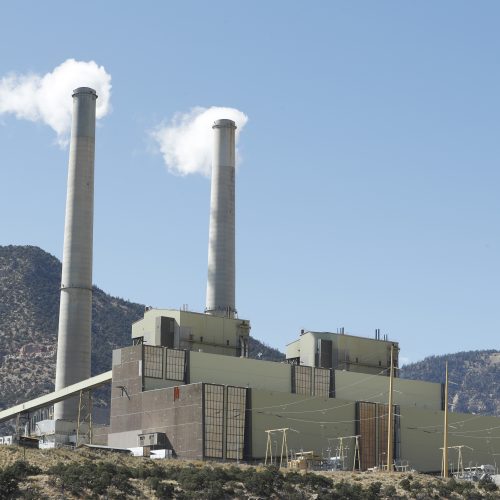
Trump EPA moves to wipe out climate rules for power plants

On the heels of the hottest summer on record and a United Nations report warning that global temperatures are likely to push climate risks to “increasingly dangerous heights,” the Trump administration overturned most of a Biden-era rule limiting climate pollution from power plants, the second-largest source of greenhouse gas emissions.

The Environmental Protection Agency announced a final plan Monday that guts the 2024 Carbon Pollution Standards, which the agency said exceeds its authority under the Clean Air Act by requiring control technologies “that are not adequately demonstrated.” The agency also proposed revoking “all remaining GHG emissions requirements for power plants,” arguing their emissions “have no material impact on climate change.”

The plan to revoke the Carbon Pollution Standards was initially revealed last spring.

Read full article

Comments

© George Frey/Getty Images

  •  

OpenAI stuck fighting Musk antitrust suit after Apple finds a way out

Elon Musk is seemingly done attacking Apple over its decision to integrate ChatGPT into iPhone features.

Back in 2024, when the partnership was first announced, Musk slammed the integration as an agreement from Apple to let OpenAI install “creepy spyware” on users’ devices. The next year, he sued, claiming the partnership gave the firms a “monopoly” on Apple users’ AI prompts, which allegedly harmed competition in both smartphone and chatbot markets.

For Musk, the fight with Apple seemingly escalated after he believed that his chatbot, Grok, was perhaps being illegally blocked from topping Apple’s App Store rankings. Last August, he claimed that “Apple is behaving in a manner that makes it impossible for any AI company besides OpenAI to reach #1 in the App Store, which is an unequivocal antitrust violation.”

Read full article

Comments

© Getty Images News | Getty Images AsiaPac

  •  

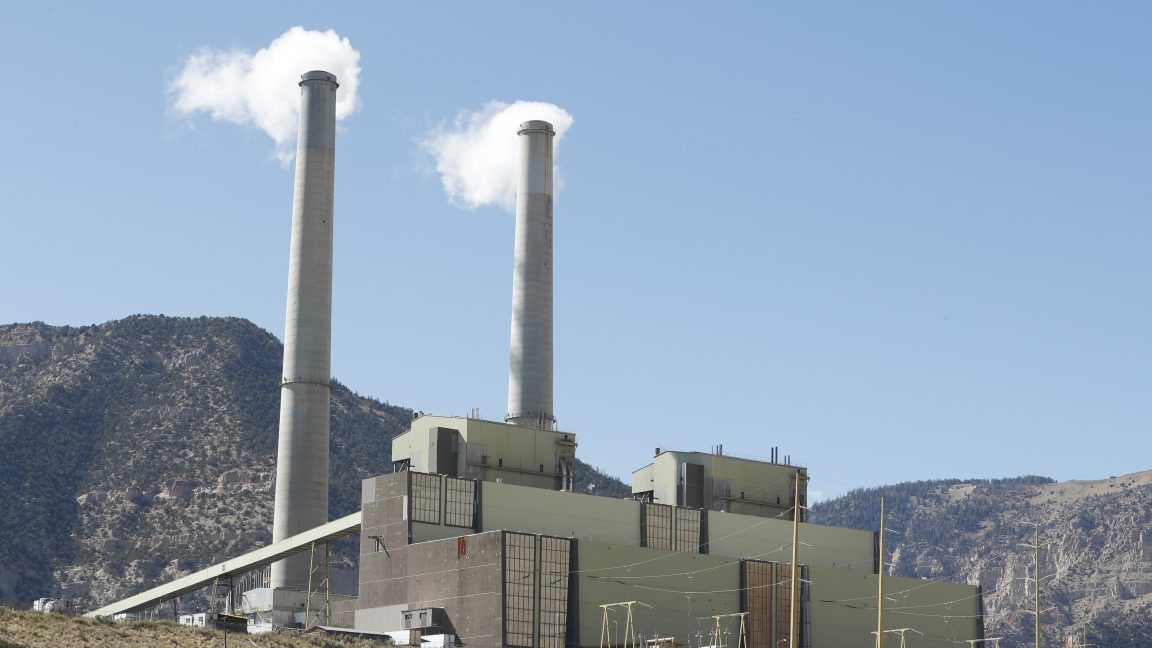
Trump's forced coal plant extensions thrown out by judge

The use of coal to generate electricity on the US grid has been plunging for nearly two decades, and the first Trump administration was unable to affect the trend. So his second administration has attempted more aggressive interventions to prop up coal use. One of its most direct means of doing so is to order coal plants that were scheduled to close to remain open, even if there is no need for them.

The administration's justification for these orders is a statute that allows the Department of Energy (DOE) to declare an emergency in the case of wartime or a sudden shortfall in generation. A number of parties, including states where coal plants have been slated to close, have challenged this declaration. And on Friday, in the first of these cases to make its way through the courts, the declaration was judged to be contrary to the statute. While this only affects a single coal plant in Michigan, the reasoning of the decision will apply to every coal plant closure that has been blocked by the DOE.

No emergency

The decision was issued by a unanimous three-judge panel from the DC Circuit's Court of Appeals. It focuses on the J.H. Campbell Generating Plant, which was scheduled to close last year but has been kept open by a total of five emergency declarations by the DOE, each limited to 90 days by the Federal Power Act. At issue was section 202(c) of that Act, which allows the DOE to declare emergencies when the US is at war or when “an emergency exists by reason of a sudden increase in the demand for electric energy, or a shortage of electric energy.”

Read full article

Comments

© UCG

  •  
❌