❌

Reading view

Mercury Has Shrunk Even More than Planetary Scientists Thought

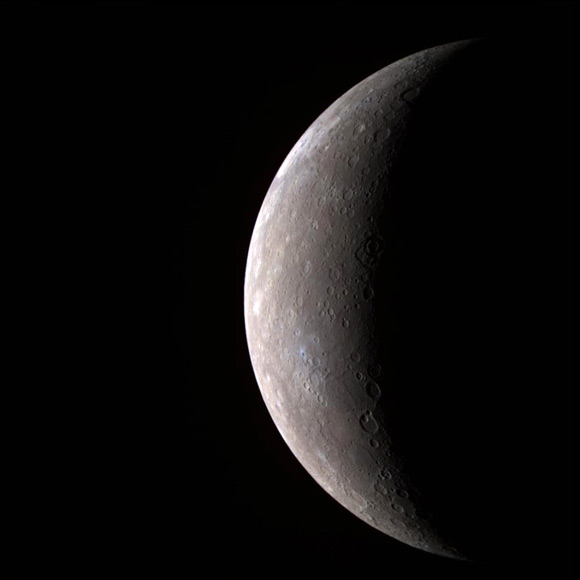
This color image of Mercury was generated from three MESSENGER images taken through filters sensitive to light in different wavelengths. Image credit: NASA / Johns Hopkins University Applied Physics Laboratory / Carnegie Institution of Washington.

The Solar System’s smallest planet has contracted by nearly 19 km (12 miles) across, as crater debris masked telltale wrinkles on its surface, according to new research led by the German Aerospace Center’s Institute of Space Research.

The post Mercury Has Shrunk Even More than Planetary Scientists Thought appeared first on Sci.News: Breaking Science News.

  •  

Researchers Unveil Complete Fruit Fly Connectome

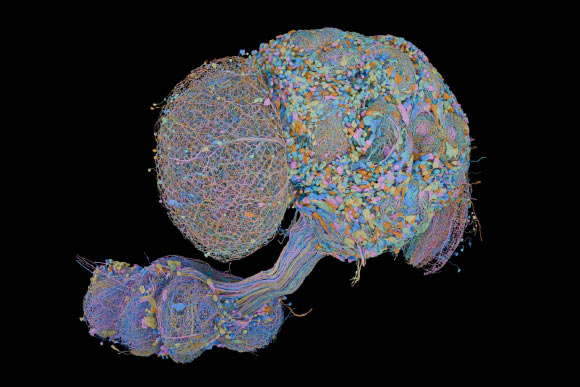
The wiring diagram of the central nervous system of an adult male fruit fly will help researchers better understand how the brain enables complex action, from sensory perception to behavior. Image credit: FlyEM Project Team, HHMI’s Janelia Research Campus / Cambridge Connectomics Group / Google Research / Philip Hubbard, HHMI Janelia Research Campus.

After nearly two decades of work, scientists have completed a wiring diagram of the central nervous system of an adult male fruit fly (Drosophila melanogaster).

The post Researchers Unveil Complete Fruit Fly Connectome appeared first on Sci.News: Breaking Science News.

  •  

Juno’s Microwave Vision Peers beneath Surface of Jupiter’s Volcanic Moon Io

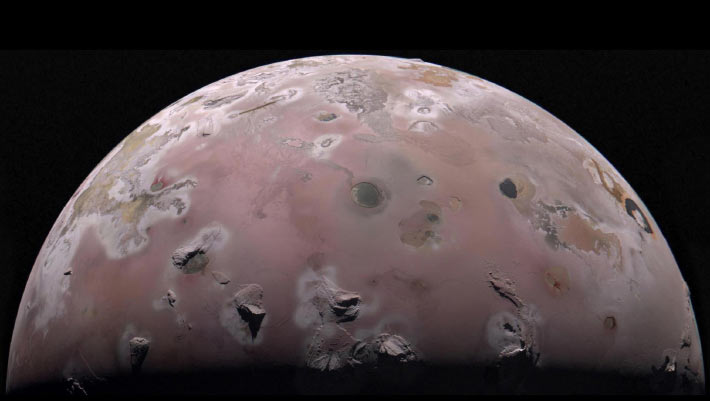
The north polar region of Io was captured by NASA’s Juno spacecraft on December 30, 2023. Image credit: NASA / JPL-Caltech / SwRI / MSSS / Gerald Eichstädt.

New data from NASA’s Juno spacecraft show temperatures spike more than 20 degrees Celsius just a few meters under Io’s surface, providing the first look at what’s happening below the crust of the Solar System’s most volcanic world.

The post Juno’s Microwave Vision Peers beneath Surface of Jupiter’s Volcanic Moon Io appeared first on Sci.News: Breaking Science News.

  •  

Astronomers Uncover Hidden Structures Surrounding Orion Nebula

Extended Orion nebula shell sampled by HI emission from the combined VLA and FAST observations (shown in red), Hα emission from the European Southern Observatory Digitized Sky Survey (shown in green), and 3.4-μm emission registered by the Wide-field Infrared Survey Explorer (WISE) satellite (shown in blue). Image credit: Juan D. Soler, University of Vienna / NRAO / VLA / NASA / WISE.

Using the Karl G. Jansky Very Large Array (VLA) s and the Five-hundred-meter Aperture Spherical Radio Telescope (FAST), astronomers have created the sharpest-ever radio maps of neutral hydrogen around the Orion Nebula.

The post Astronomers Uncover Hidden Structures Surrounding Orion Nebula appeared first on Sci.News: Breaking Science News.

  •  
❌