Neanderthals left plenty of traces in the western Pyrenees, the mountain range that separates Spain from France. Stone tools, butchered animal bones, the leftovers of their camps. What nobody had ever found in Navarre, the region of northern Spain whose capital is Pamplona, was a single bone of the people themselves. On Monday that changed, […]
The shoulder blade is such a wide and flat bone that in some areas it becomes almost translucent when held up to the light. That is why it is rare to find it whole, even in modern burials, and why it so surprised archaeologists from the University of Cambridge that from Shanidar Cave, in Iraqi […]
Deep inside Ojo Guareña, one of the largest cave systems in Europe, in the northern Spanish province of Burgos, archaeologists have spent eleven consecutive summers digging through a single Neanderthal layer. This year’s season, which wrapped up in late August 2026, pushed the excavated area of that layer — known as level 4D — to […]
A new analysis of three skull fragments unearthed at the Gran Dolina cave site in Spain indicates that Homo antecessor had bone thickness closer to that of Neanderthals and modern people than to more archaic hominins.
A team of researchers from the University of Burgos and the Atapuerca Foundation has published the first detailed analysis of the bone retouchers found in the Valdegoba cave, in the municipality of Huérmeces (Burgos). This site, occupied by Neanderthals during the Middle Paleolithic, has yielded 38 bone fragments that were used as tools to retouch […]
Neanderthals vanished roughly 42,000 years ago, but a piece of their biology appears to be quietly at work in some people today, according to a new study led by scientists from the Max Planck Institute for Evolutionary Anthropology.
New research led by the University of California, Berkeley reveals that beyond Neanderthals and Denisovans, humans interbred with two mysterious ‘ghost’ lineages: one in Africa more than 50,000 years ago, another in Eurasia over 1.7 million years ago.
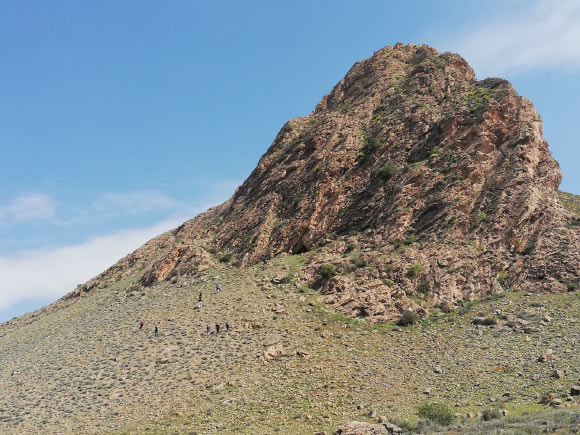
Ararat-1, a modest limestone cave that lies at an elevation of 1,034 m on the eastern flanks of the Ararat Depression in central Armenia, has yielded a striking puzzle about how Middle Paleolithic humans moved across their landscape.
Üçağızlı II Cave on Türkiye’s Mediterranean coast has yielded a rare and detailed record of two Homo species living the same way of life, one after the other, over more than 20,000 years, offering new evidence that the transition from Neanderthals to modern humans in the region was far more culturally seamless than previously understood.

 Login