
❌

Reading view

Gemini North Telescope Captures Stunning Portrait of Merging Spiral Galaxies
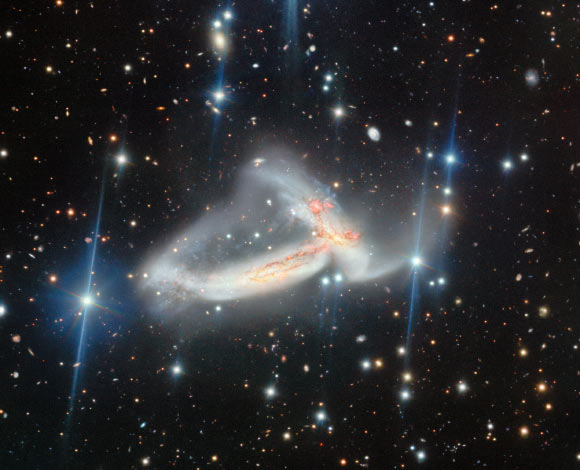
This image of NGC 7253 was captured by the Gemini North telescope on Maunakea, one half of the International Gemini Observatory. Image credit: International Gemini Observatory / NOIRLab / NSF / AURA / J. Miller & M. Rodriguez, International Gemini Observatory & NSF’s NOIRLab / T.A. Rector, University of Alaska Anchorage & NSF’s NOIRLab / D. de Martin & M. Zamani, NSF’s NOIRLab.

A new image from the Gemini North telescope on Maunakea in Hawai’i offers the sharpest look yet at a striking pair of interacting spiral galaxies, cataloged as NGC 7253.

The post Gemini North Telescope Captures Stunning Portrait of Merging Spiral Galaxies appeared first on Sci.News: Breaking Science News.
  •  

Astronomers Trace Elusive High-Energy Neutrino to Star-Forming Galaxy in Early Universe

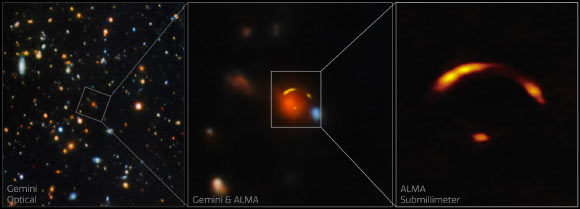
The origin of high-energy astrophysical neutrinos remains unresolved, and secure electromagnetic counterparts to individual events are rare despite rapid follow-up. Dusty star-forming galaxies at cosmic noon (redshift of z β‰ˆ 1-4) are natural cosmic-ray calorimeters, yet observational links between these galaxies and neutrinos have remained unknown. Urata et al. report a compact-core, dusty star-forming galaxy within an IceCube localization, JCMT0402-0424, a quadruply lensed galaxy at z = 2.988 located inside the 90% containment region of the IceCube event IC 210922A. Image credit: International Gemini Observatory / NOIRLab / NSF / AURA / ALMA / ESO / NAOJ / NRAO / T.A. Rector, University of Alaska Anchorage & NSF’s NOIRLab / D. de Martin & M. Zamani, NSF’s NOIRLab / Yuji Urata. MITOS Science Co., LTD.

JCMT0402-0424, a dusty starburst galaxy around 11 billion light-years away, is the strongest candidate yet for the source of the high-energy neutrino event IC 210922A, according to a team of astronomer led by Yuji Urata of MITOS Science Co.

The post Astronomers Trace Elusive High-Energy Neutrino to Star-Forming Galaxy in Early Universe appeared first on Sci.News: Breaking Science News.
  •  

Astronomers Detect Clearest Signs Yet of Magnetic Fields on Extrasolar Planets

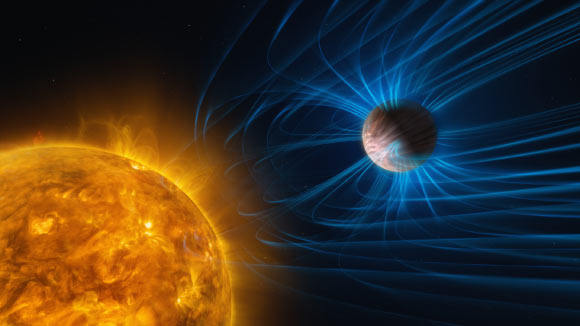
This illustration shows magnetic activity in an ultra-hot Jupiter. Image credit: ESO / M. Kornmesser / L. CalΓ§ada.

By tracking fierce winds racing through the atmospheres of seven ultra-hot Jupiters, astronomers have uncovered the strongest evidence yet that magnetic fields shape weather on worlds beyond our Solar System.

The post Astronomers Detect Clearest Signs Yet of Magnetic Fields on Extrasolar Planets appeared first on Sci.News: Breaking Science News.

  •  

Gemini North Telescope Peers into Crystal Ball Nebula

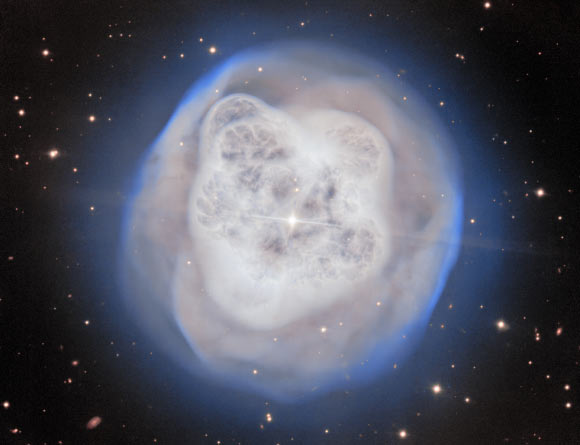
This image of the Crystal Ball Nebula was captured by the 8.1-m Gemini North telescope at the International Gemini Observatory. Image credit: J. Miller & M. Rodriguez, International Gemini Observatory & NSF’s NOIRLab / T.A. Rector, University of Alaska Anchorage & NSF’s NOIRLab / D. de Martin & M. Zamani, NSF’s NOIRLab.

A stunning new image from the 8.1-m Gemini North telescope, located on the summit of Maunakea in Hawai’i, reveals the Crystal Ball Nebula in unprecedented detail: a lumpy, glowing sphere of gas sculpted by a pair of stars.

The post Gemini North Telescope Peers into Crystal Ball Nebula appeared first on Sci.News: Breaking Science News.

  •  
❌