 Login

Researchers Made White Bread With Spinach and It Was Surprisingly Easy to Eat
 A small trial hints that redesigning staple foods could make better nutrition easier.
 A small trial hints that redesigning staple foods could make better nutrition easier.
Billions of people still suffer from hunger and food insecurity worldwide. Meanwhile, microbial contamination causes a third of global food waste annually, resulting in major economic losses and illnesses. Although antibiotics and pesticides help control contamination, their excessive use can promote bacterial resistance or leave toxic residues.
One alternative uses materials that generate highly reactive forms of oxygen when exposed to light, called photocatalysts, to prolong food freshness. These molecules kill bacteria by damaging their cell components in a process called photodynamic inactivation or PDI. However, current PDI systems rely on energy-intensive lasers and long exposure times because the bacteria’s protective cell membranes block reactive oxygen molecules. As a result, the systems don’t kill bacteria effectively and risk overheating food, affecting its freshness and nutritional value.
Scientists at Zhejiang University in China thought that it would be possible to achieve a PDI system using accessible, free sunlight with the right photocatalyst. Moreover, they also wanted to integrate this photocatalyst into food packaging to combat microbes during storage.
To make the photocatalyst, the researchers mixed water with a glue-like plant fiber that provides structural support, called pectin, and a chemical from plant seeds that supplies phosphorus, called phytic acid. Then they heated the mixture in a sealed reactor at 220ºC (428ºF) for 5 hours to form tiny structures composed of a carbon core surrounded by a phosphorus-rich shell called phosphorus-modified carbonized polymer dots or PCDs.
To incorporate the PCDs into film packaging, the researchers dissolved equal amounts of a plant fiber from konjac, called glucomannan, and another plant-derived molecule, called carboxymethylcellulose, in warm water to form a network of entangled molecular chains. Then, they added 1.5 milligrams of PCD per milliliter to this mixture, which linked the chains together like molecular fasteners. Finally, they added a moisture-binding chemical called glycerin to prevent brittleness. The researchers cast this mixture onto separate Petri dishes and dried them, forming thin, plastic-like PCD films.
To test the films, the researchers placed Escherichia coli bacteria between 2 sterilized film sheets and exposed the samples to either darkness or simulated sunlight for 20 minutes. They then transferred the microbes onto agar plates and incubated them for 15 hours, allowing surviving bacteria to form visible colonies. They compared the number of bacterial colonies with those of untreated samples to calculate the percentage of bacteria the films eliminated in each environment.
Tests under darkness showed that the films eliminated about 60% of the bacteria. The researchers attributed this result to the positive electrical charge of PCDs, which attracts the bacteria’s negatively charged cell surfaces. The electrical attraction stresses their cell membranes, interfering with essential life processes. This result suggested that the films use a separate charge-based antibacterial mechanism apart from PDI, which requires light to work.
Under simulated sunlight, the films eliminated nearly 100% of the bacteria. The researchers identified 2 principal mechanisms causing this. First, the PCDs acted as tiny heaters that generated localized heat, which stretched holes in the bacterial membranes, allowing contents to leak out of their cells through a process called photoporation. Second, the PCDs generated reactive oxygen molecules that could then penetrate the bacteria. Once inside the cells, these molecules irreversibly damage the bacteria’s internal components and genetic material through PDI.
The researchers also investigated whether PCD films could serve as food packaging by using them to wrap fresh strawberries. Compared with conventional nonbiodegradable polyethylene packaging where visible rotting occurred, the PCD films kept the strawberries fresh for more than 4 days by suppressing bacterial growth and regulating moisture levels. When the team tested whether the films were toxic, they found that the films are safe for humans and compatible for food applications. They also buried the films in soil for 24 days and found that they degraded by 78%, demonstrating biodegradability suitable for packaging fresh foods.
The team concluded that PCD films could be a biodegradable food packaging that combines plant-based materials with multiple antibacterial strategies. The films retained antibacterial activity in darkness and became more effective under sunlight through the combined effects of photoporation and PDI. These findings demonstrated that by combining multiple mechanisms into a single material, researchers can create multifunctional food packaging that remains effective across different storage conditions.
The post Harnessing sunlight to fight bacteria appeared first on Sciworthy.
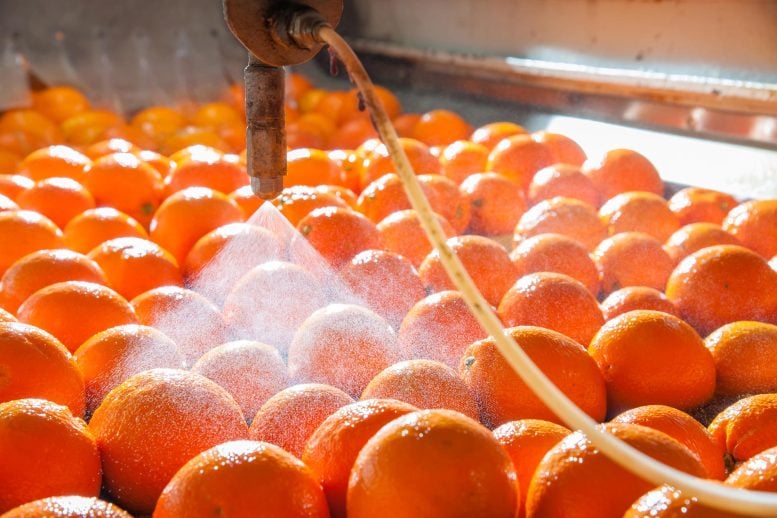 A biodegradable wash may help remove surface pesticide residues and keep fruit fresh longer, though more testing is needed before real-world use. Many shoppers follow the same pattern after buying produce: they bring fruits and vegetables home, wash them, dry them, and hope they stay good long enough to eat. Fresh produce, however, can deteriorate [...]
Since the 1850s, plowing and clear-cutting in modern agriculture have increased how fast soil erodes in the Upper Mississippi River Valley. Across the globe, farming strips soil up to 100 times faster than natural processes. It also removes farmable land and clogs waterways, threatening long-term environmental sustainability. However, scientists in the past have struggled to separate the effects of land-use changes from the transition out of the last ice age over the past 20,000 years.
To determine whether current farming practices are sustainable, researchers from Minnesota recently measured the speed at which soil eroded during the ice age transition and compared it with modern agricultural erosion. They focused on the Trout Creek tributary of the Mississippi River. This tributary has 2 step-like formations, or terraces, on its bank that represent past floodplains before the river eroded to its current level.
The oldest, upper terrace is about 14 meters (50 feet) above the lower terrace, which is about 8 meters (26 feet) above the modern floodplain. Scientists studying nearby areas have suggested that the terraces contain sediment from the last ice age, 20,000 years ago, referred to as the Last Glacial Maximum, to today.
In the upper terrace, the researchers pushed an empty cylinder into the ground, like a straw into a layer cake, to collect a cylindrical sample of sediments about 4 centimeters (1.5 inches) wide and 6 meters (20 feet) deep, called a sediment core. They collected slices of this core from 2 meters (6 feet) and 6 meters (20 feet) to find the terrace’s age.
Some grains in the sediment trap electrons while buried and release them when exposed to light. So the team shone light on the sediment slices to stimulate these electrons and measure the intensity of light emitted, known as their optically stimulated luminescence. Brighter light emissions indicate the sediment is older and was buried for a longer period of time. Using this method, they confirmed that the deep sediment slice was 22,000 years old, and the shallow sediment slice was 20,000 years old, dating the terrace back to the Last Glacial Maximum.
Next, the team drilled into the upper terrace with an auger to collect 25-centimeter (10-inch) wide plastic tubes of sediment. They pulled 4 samples from 0 to 2 meters (0 to 6 feet), and 1 sample from 6 meters (20 feet) deep. They explained that minerals in the sediment called quartz produce the radioactive form of the element beryllium, known as 10Be, when exposed to the Sun, so low 10Be means the sediment was buried quickly and had little sun exposure. The team measured the concentration of 10Be in each sediment sample and used an online calculator to estimate how quickly it eroded. The researchers calculated that during the Last Glacial Maximum, 0.073 millimeters (0.003 inches) of surface sediment were removed per year.
The researchers collected similar samples from the lower terrace and used optically stimulated luminescence to determine that it was between 22,000 and 14,000 years old. This terrace was the floodplain during the transition out of the Last Glacial Maximum, or deglacial period, where temperatures warmed and permafrost retreated. They measured the concentration of 10Be in samples from this terrace and determined that 0.049 millimeters (0.002 inches) of surface sediment were removed per year.
Finally, the researchers measured 10Be in a sediment sample from the modern floodplain, deposited between 14,00 years ago and today. They found that the sediment had eroded 0.053 millimeters (0.002 inches) per year during that interval, at a rate slower than it had during the glacial period, but similar to the deglacial period.
The researchers compared their findings to the average soil loss caused by modern agriculture, as reported by 4 previous scientists studying the area. They saw that modern farming removes an average of 0.60 millimeters (0.02 inches) of soil per year, which is 8 to 12 times greater than all the natural erosion rates they calculated.
They concluded that the recent spike in soil loss from agriculture greatly exceeds that caused by the largest natural climate transition in recent Earth history. Human-driven erosion shows an upward “hockey stick” trend like the one seen in global temperatures, suggesting that similar trends could exist throughout Earth systems. The team concluded that modern agricultural practices aren’t currently sustainable. While measures like native plant reintroduction can help curb this trend, more research is required to determine how best to limit long-term erosion.
The post Is modern farming sustainable? appeared first on Sciworthy.
Temperatures in the Arctic are increasing at a rate 4 times faster than the average global temperature. Scientists have documented the global effects of climate change, but there are still regions where these effects are less well known. This is the case for freshwater ecosystems in the Arctic.
When the ground has been permanently frozen for 2 years, scientists call it permafrost. Permafrost contains soil, sand, rocks, and organic matter held together by ice. As temperatures rise, permafrost thaws, which can change groundwater flow paths. It can also alter a stream’s temperature, flow patterns, and nutrient loads by introducing new material from the permafrost.
To determine how thawing permafrost affects Arctic ecosystems, scientists from the U.S. Geological Survey recently studied 10 headwater streams within the Brooks Range in the Noatak National Preserve of Alaska. The scientists studied streams with different amounts of permafrost and ice to test whether connections exist between permafrost, food webs, and populations of fish called the Dolly Varden and Arctic Graylings. They focused on these 2 species of fish because their migrations often indicate ecological shifts in the area.
The scientists collected fish from the streams by temporarily stunning them, using a method called electrofishing, or by catching them in minnow traps. They manually identified each species they collected, then froze the fish and shipped them to a lab. Once in the lab, the scientists measured the length of each fish and used documented growth patterns to estimate its biomass. To calculate fish abundances, they divided their total biomass by the time spent electrofishing or trapping. Finally, they measured the energy density of each fish by burning it in a device called a bomb calorimeter.
At each stream, the scientists took manual temperature measurements and deployed loggers that recorded the temperature every 15 minutes. They also deployed equipment at the bottom of each stream to record water pressure in 15-minute intervals and converted the data to depth, since pressure increases with depth. Then, they used wading rods to measure how much water was flowing through each stream at a given spot.
They combined the depth and wading rod data to determine the flow rate of water in the streams over time. They used these data to identify unstable streams where water rose and fell rapidly. They also collected water samples from each stream and measured their nutrient concentrations, including dissolved organic carbon, nitrogen, and phosphorus, to determine water quality.
Finally, they measured 2 types of smaller organisms that allow energy to flow through the food web to the fish, called microbial biofilms and macroinvertebrates. They used a hand-held device to estimate the types and amounts of biofilms, and nets to collect macroinvertebrates.
Once they had compiled these data, the team conducted a statistical analysis to compare the studied parameters and fish populations to the extent of permafrost in each area. They found that streams with more permafrost in the area had warmer temperatures, because the permafrost prevented water from infiltrating the soil to cool off. The streams with warmer temperatures, in turn, had lower abundances and biomass of Dolly Varden fish and Arctic Grayling with lower energy densities. They suggested that these results meant that the high temperatures had pushed the fish above their optimum temperature range.
They also learned that the limited infiltration in permafrost areas caused rainfall to flow straight into the stream. This process created instability as the stream levels rose and fell rapidly. Fish in these unstable streams had lower energy densities, likely due to the harsher environment.
Areas with greater permafrost also had higher concentrations of dissolved organic carbon and phosphorus, which stimulated the formation of biofilms at the bottom of the food chain. They noted that areas with more biofilms also had more macroinvertebrates and more Dolly Varden biomass. Since the Dolly Varden eats macroinvertebrates, this finding suggested that the lowest levels of the food web shape the health of species higher up. This is called the bottom-up effect, and means that areas with more biofilms and macroinvertebrates will likely have healthier and larger fish populations.
The scientists explained that knowing how these factors influence Arctic fish populations can help researchers understand how thawing permafrost might affect Arctic ecosystems in the future. They anticipated that their data could help future researchers predict how these and other ecosystems will be impacted by changing landscape dynamics caused by global warming.
The post Thawing permafrost is affecting fish health appeared first on Sciworthy.
British cheesemakers have struggled to find a use for the 95,000 tonnes of salty whey they produce every year. But researchers may have come up with a solution
Name: Whey.
Age: As old as milk.
Continue reading...
© Photograph: JulieAlexK/Getty Images

© Photograph: JulieAlexK/Getty Images

© Photograph: JulieAlexK/Getty Images
In the Bolivian Altiplano, fewer Aymara farmers are relying on local weather knowledge to schedule farming tasks, like choosing the best dates to plant crops and predicting a frost or drought. At the same time, there is growing doubt about whether these traditional indicators remain relevant today in the context of rapid social, economic, and climatic changes.
Farmers are struggling because the National Weather Service of Bolivia (SEHNAMI) fails to provide useful weather forecasts due to the geographical complexity of the Andes and a scarcity of weather stations. In addition, many farmers can’t access this information because SEHNAMI lacks local outreach programs to deliver reports directly to them. In a region with a weak technical forecasting system, local knowledge is a vital resource, but its use is declining.
Scientists in the past focused on preserving local weather knowledge or discussing how it might help communities adapt to climate change. However, very few researchers have scientifically validated local weather indicators, since doing so requires many years of historical meteorological data to establish statistical “skill” in local forecasting.
Faced with this gap, researchers in the US and Bolivia recently set out to validate indigenous indicators in 2 Bolivian municipalities: Umala in the Central Altiplano and Ancoraimes in the Northern Altiplano. To do this, they paired each traditional weather sign with a measurable variable, like temperature, that could approximate it. This approach allowed them to directly compare traditional observations with scientific data.
The researchers wanted to determine whether traditional weather knowledge is still accurate and relevant under current conditions, since validating these methods would strengthen local knowledge and benefit the schools and policies that promote it. To test this, the researchers worked with 6 Aymara communities. First, they conducted workshops with local leaders and experts to compile a set of weather-forecast indicators. Then, they surveyed 95 farmers to rank the reliability of these indicators.
Through discussions with these communities, the team identified 13 weather indicators in the Central region and 20 in the Northern region. These indicators included specific plants, animals, and physical factors like constellations or winds that the farmers used to decide when and where to plant crops, and to predict weather conditions for the next season. The researchers focused on 2 key indicators that the farmers ranked as most reliable: the presence or absence of moisture under rocks on the Fiesta de San Juan on June 24th, and the flowering patterns of specific plants, called Thola and Sank’ayu. The farmers used the San Juan indicator to predict whether the upcoming year would be rainy or dry, and the plants to determine the most favorable dates for planting to avoid agricultural risks like frosts.
Finally, the researchers compared forecasts based on these 2 signs with over 30 years of meteorological data from nearby weather stations. In both cases, they used the minimum daily temperature as the measurable way to represent these local signs scientifically. Their results showed that the minimum daily temperature on the Fiesta de San Juan could explain more than half (55.5%) of the changes in rainfall during the growing season. They also confirmed that severe frosts that “burned” Thola and Sank’ayuthe flowers were followed by periods without rain, validating the farmers’ strategy of delayed planting.
The researchers concluded that local weather indicators used by Aymara farmers are most reliable for seasonal planning, especially in predicting the start of the rainy season. They stated that this result helps legitimize traditional knowledge and empower the community. For example, these communities now hold regular meetings to discuss forecasts and share this information with their neighbors via WhatsApp groups.
However, the team acknowledged that local knowledge was limited to short-term forecasting, as it only provided warnings a few hours in advance. Farmers need alerts several days in advance to effectively reduce their vulnerability to events such as frosts or hail. For this reason, the researchers suggested that the next step will be to co-produce forecasts by combining meteorological science with traditional knowledge.
The post Testing local weather knowledge in the Bolivian Altiplano appeared first on Sciworthy.
 Water and spice influenced eating in opposite and unexpected ways during controlled meal experiments. A glass of water beside a meal is often treated as an easy way to eat less. The usual explanation is that the water stretches the stomach and creates a sense of fullness before too much food is consumed. A Cornell [...]
Nitrogen is an essential building block of proteins, amino acids, and DNA. Without nitrogen, cells can’t function or reproduce. Nitrogen is abundant in the atmosphere as dinitrogen gas, but plants and animals can’t access atmospheric nitrogen. Instead, we rely on biologically available forms like ammonia and nitrate.
Specialized microbes can transform atmospheric nitrogen into ammonia via a process called biological nitrogen fixation. Nitrogen-fixing soil bacteria have a unique protein complex, the nitrogenase complex, that facilitates this nitrogen transformation. The nitrogenase complex is activated by a group of genes known as nif genes.
Legume plants like peanuts, peas, and beans have nitrogen-fixing bacteria in the soil zone around their roots, called the rhizosphere. The symbiotic relationship between nitrogen-fixing soil bacteria and legume plants supplies most of the biologically available nitrogen to life on Earth.

Bacteria attached to plant roots “feed” nitrogen to plants through the soil, and in turn receive organic acids for energy from plants performing photosynthesis. Source: Wikimedia Commons
However, one piece of the puzzle remains unexplored: the role of soil viruses in these nitrogen transformations, referred to as the nitrogen cycle. Viruses are microscopic particles made up of genetic material and proteins, but they can’t reproduce without a host cell. Scientists consider viruses to be biological entities that are halfway between living and non-living.
To reproduce, viruses contact a host cell and inject their genetic material into it. The virus’s genetic material takes over the host cell’s genome and forces the cell to produce proteins that assemble into new viruses. As new viruses are created, they can incorporate genes from the host cell into their own genetic material. Genes that are transferred from a host cell to a virus are known as auxiliary metabolic genes (AMGs). Viruses can carry AMGs and pass them to other hosts or use them to increase their own ecological fitness.
Scientists from China, Spain, and the Czech Republic set out to investigate whether viruses from legume roots could increase local soil nitrogen fixation by expressing nif AMGs or by transferring nif genes to other bacteria. First, they determined the global distribution of viral nitrogen-fixing genes by analyzing about 8.6 million viral genomes from the Integrated Microbial Genomes/Virus database. They looked for the DNA sequences of known nitrogen-fixing genes and the locations where the viruses were sampled. They found that only 0.003% of the viruses in the database had at least 1 nitrogen-fixing gene, but they clustered in the same locations as nitrogen-fixing bacteria.
The team also found 3 types of viruses that most commonly carried nitrogen-fixing genes: Kyanoviridae, Nudiviridae, and Bronfenbrennervirinae. Kyanoviridae viruses carried a nif gene called nifU. The researchers used a computer program called DRAM-v to confirm that nifU was a fully functional gene and a real tool that viruses could use.
Next, the team collected soil samples from a cowpea field in Nanjing, China, to test whether the cowpea roots influenced the abundance of viruses using nitrogen-fixing genes. They collected soil from the cowpea rhizospheres and soil away from the plants. They analyzed both viral and bacterial RNA in the soil samples to identify active genes, using a sequencing process called metatranscriptomics. They found that the viral nifU gene was actively expressed in the cowpea rhizosphere samples more than in the non-crop soil. Although about 96% of nifU genes were being expressed by bacteria, viruses contributed about 4%.
The researchers then assessed whether rhizospheric viruses changed the amount of nitrogen being fixed in these soils. They set up small, enclosed containers of sterile soil and added either bacteria or a mixture of bacteria and viruses extracted from the cowpea rhizospheres. They found that soil with viruses had higher total nitrogen (36 milligrams per kilogram, or mg/kg) than soil without viruses (17 mg/kg).
Finally, they adjusted the air in each container to have a different form of dinitrogen gas. Atoms of the same element that have different atomic masses are known as isotopes. Nitrogen has 2 stable isotopes: lighter nitrogen-14 and heavier nitrogen-15. Bacteria or viruses that fix nitrogen at natural isotope abundances will take up nitrogen-14. But scientists can track who in the population fixes nitrogen by adding nitrogen-15 to the air, a process called nitrogen-15 stable isotope probing. Nitrogen-fixers will incorporate the heavy nitrogen-15 into their biomass over time and increase their weight, allowing researchers to separate and identify them.
The team grew the bacteria and viruses with nitrogen-15 for 35 days, then used stable isotope probing to separate the nitrogen fixers. They detected viral nifU AMGs among the heavier biomass, confirming that rhizospheric viruses were fixing nitrogen.
The team concluded that rhizospheric viruses and the viral nifU AMG can increase nitrogen fixation in cowpea soils. The team suggested that although viruses with nitrogen-fixing genes are rare, they can influence the soil nitrogen cycle. They recommended that future researchers further test the contribution of viral nifU genes to plant nitrogen fixation with controlled infection experiments.
The post Viruses help plants obtain nitrogen appeared first on Sciworthy.
 New research indicates that when it comes to heart health, the types of fruits and vegetables consumed may be just as important as the amount. Most healthy eating advice focuses on quantity: eat more fruits and vegetables, aim for five servings a day, and your heart will benefit. But new research suggests that when it [...]
 Tea choice significantly changes kombucha’s chemistry, flavor, and antioxidant potential, with green and oolong teas showing the strongest biological activity. Kombucha has surged in popularity worldwide in recent years, but researchers are looking beyond its flavor to better understand its chemistry and possible health-related properties. A team from the Wrocław University of Environmental and Life [...]
Brown rot is a common fungal disease in the Southeastern United States that affects stone fruits like peaches, cherries, and plums. Monilinia fructicola is a tan, fuzzy fungus that grows on tree flowers, twigs, and fruit, and is the most common cause of brown rot. Once brown rot infects a tree, the damage is irreversible, causing significant crop losses in commercial orchards. Farmers try to control the spread of M. fructicola by applying chemical sprays, called fungicides, to fruit trees in the spring.
In M. fructicola, a biosynthesis gene named MfCYP51 encodes a major protein critical to the fungi’s survival. Certain fungicides, called demethylation inhibitor (DMI) fungicides, stop M. fructicola from growing by targeting this protein. Over the last 20 years, DMI fungicides have become less effective against brown rot as M. fructicola becomes more resistant.
Living microorganisms and their metabolites can control fungal diseases as an alternative to chemical fungicides, known as biofungicides. Many bacteria produce compounds like hydrogen cyanide and pyrrolnitrin that damage fungal cells. However, scientists have not found a biofungicide suitable for commercial production. A group of researchers at Clemson University in the USA and Huazhong Agricultural University in China set out to test whether the soil bacteria Pseudomonas chlororaphis and Bacillus subtilis could be effective biofungicides against brown rot.
The researchers performed an incubation experiment to analyze how the fungal cells make their critical protein from the MfCYP51 gene, a process called gene expression, under different fungicide treatments. They used 3 M. fructicola strains sensitive to traditional DMI fungicides and 3 resistant strains. They tested these with 5 different fungicide treatments: a DMI fungicide, a mixture of P. chlororaphis metabolites, a mixture of living B. subtilis cells, a DMI fungicide + P. chlororaphis metabolites, and a DMI fungicide + B. subtilis cells. They also set up a control treatment with sterile water instead of fungicide.
After 6 hours, the researchers extracted the molecule that measures gene expression, called RNA, from the fungi. They found that both the P. chlororaphis treatment and the DMI fungicide + P. chlororaphis treatment substantially reduced MfCYP51 expression in both the sensitive and resistant isolates compared to the controls. In contrast, the DMI fungicide, B. subtilis, and DMI fungicide + B. subtilis treatments increased MfCYP51 expression in the resistant isolates. The researchers concluded that P. chlororaphis has a unique ability to reduce gene expression, unlike other biofungicides.
To further investigate how the biofungicide treatments work, the team tested whether P. chlororaphis and B. subtilis produced the anti-fungal metabolite pyrrolnitrin. They added 1 milliliter of each treatment to a machine that separates and identifies liquid compounds using high pressure, called a high-performance liquid chromatograph. They found that the P. chlororaphis treatment contained pyrrolnitrin, so they hypothesized that it was responsible for reducing gene expression.
Additionally, the researchers tested their 5 treatments on brown rot in fruit. For each treatment, they took 10 Gala apples, washed and sterilized their surfaces, and sprayed them with the fungicides. After 24 hours, they poked holes in the apples with toothpicks and added 20 microliters of liquid containing M. fructicola cells to the poked holes. They placed the apples in a humid chamber for 5 days and measured the number and size of brown rot spots that developed on their surfaces.
Despite decreasing MfCYP51 expression, the researchers found that P. chlororaphis treatment alone didn’t reduce brown rot disease compared to the control, but the DMI fungicide and B. subtilis treatments did. The mixed treatments of DMI fungicide + P. chlororaphis and DMI fungicide + B. subtilis both reduced brown rot disease compared to the control, but only the DMI fungicide + P. chlororaphis treatment prevented it.
The researchers concluded that although biofungicides may not be fully effective on their own, commercializing them could allow farmers to use less DMI fungicide. They explained that scaling back the use of DMI fungicides would slow M. fructicola resistance. Finally, they proposed that future researchers test biofungicide mixtures containing pyrrolnitrin in the field to observe real-world effects on stone fruit trees.
The post Using bacteria to fight fungal brown rot appeared first on Sciworthy.
