❌

Reading view

Manta rays inspire a smarter algorithm for cleaner, cheaper power grids

Every time a power grid operator decides how much electricity each generator should produce, a quiet balancing act takes place. Burning less fuel saves money, but it often means allowing more pollution, and cutting emissions usually drives costs up. Engineers have long searched for a way to satisfy both goals at once, a challenge known as combined economic emission dispatch, or CEED. Now, a team of researchers has turned to one of the ocean’s most graceful feeders, the manta ray, for inspiration, and the result is an optimization algorithm that outperforms a crowded field of competitors on both cost and cleanliness.

The study, published in the journal Results in Engineering by Yu-Feng Sun, Jie-Sheng Wang and colleagues, describes an enhanced version of the Manta Ray Foraging Optimization algorithm, or MRFO. The original algorithm, first introduced a few years ago, mimics the cooperative hunting strategies that manta rays use to harvest plankton. Because plankton drifts unpredictably with seasons and weather, manta rays have evolved three distinct foraging behaviors: chain foraging, in which animals line up in arcs so that each one catches food missed by the one ahead; spiral foraging, where the group coils around a dense patch of food; and somersaulting, in which individuals flip back and forth around a promising spot. Translated into mathematics, these behaviors become rules that move a population of candidate solutions around a search space, gradually converging on the best answer.

What makes the CEED problem so stubborn is its mathematical character. The relationship between a generator’s output and its fuel consumption follows a cubic curve, and the emissions of carbon dioxide, nitrogen oxides and sulfur dioxide each follow their own cubic functions. The combined objective is nonlinear, nonconvex and discontinuous, riddled with local minima that can trap classical techniques such as lambda iteration or gradient-based methods. To make matters harder, the problem is genuinely multi-objective, so the researchers converted it into a single objective by applying price penalty factors that fold the cost of each pollutant into one total figure in dollars per hour.

Constraint handling is where many algorithms stumble. Traditional approaches add a fixed penalty whenever a solution violates the power balance requirement, the equation demanding that total generation minus transmission losses equals demand. But a fixed penalty is a blunt instrument. Set it too low and the algorithm happily returns infeasible schedules; set it too high and the search becomes so restricted that it cannot explore properly. Finding the right value through trial and simulation is time-consuming and inefficient. The team’s answer was to make the penalty itself dynamic, drawing on five different mathematical functions: sinusoidal, hyperbolic tangent, arctangent, linear and hyperbolic secant. Each function is raised to an order that changes during the run, so the penalty strength adapts to both the size of the violation and the stage of the optimization. Early on, mild penalties preserve exploration; later, penalties tighten to push solutions toward feasibility.

The second major innovation targets the heart of the MRFO algorithm. In the original design, a parameter called C governs the switch between exploration, casting the net wide across the search space, and exploitation, homing in on the best solution found so far. This parameter rises monotonically from zero to one, a predictable march that can leave the algorithm poorly balanced at certain stages. The researchers replaced it with a chaotic switching factor, drawn from nine well-known chaotic maps including Chebyshev, logistic, tent, sine, Gauss and singer maps, combined with an exponential adjustment function. The result is a parameter that still trends upward but oscillates along the way, periodically reopening the search space and preventing the population from settling prematurely into a local optimum.

To find out which chaotic map worked best, the team ran all nine enhanced variants, named C1MRFO through C9MRFO, through the CEC-2022 benchmark suite of twelve test functions, using a population of thirty and five hundred iterations averaged over thirty independent runs. The Chebyshev-based variant, C1MRFO, emerged as the overall winner, ranking first among the nine and beating the original MRFO, which finished last. Wilcoxon rank-sum tests confirmed that most of the improvements were statistically significant, with p-values below the conventional 0.05 threshold. When C1MRFO was pitted against a roster of state-of-the-art metaheuristics, including the dhole optimization algorithm, evolutionary mating algorithm, dung beetle optimizer, snow geese algorithm, particle swarm optimization, grey wolf optimizer, sparrow search algorithm and marine predators algorithm, it achieved the best final rank, taking first place on many of the test functions while keeping computational times competitive.

The real test, however, came when the algorithm was applied to actual dispatch problems. The researchers simulated a six-unit power system under four load demands of 150, 175, 200 and 225 megawatts. Across all four scenarios, C1MRFO produced the lowest comprehensive total cost, which combines fuel cost with the weighted penalties for carbon dioxide, nitrogen oxide and sulfur dioxide emissions. At 150 megawatts, for example, it reached a total cost of about 10,137 dollars per hour, edging out the grey wolf optimizer and clearly beating algorithms such as the arithmetic optimization algorithm, Harris hawks optimization, whale optimization algorithm, sine cosine algorithm, particle swarm optimization and the lambda iteration method. The pattern held at every load level, with the margin over the weakest classical method growing to thousands of dollars per hour at 225 megawatts.

The dynamic penalty functions delivered a further, striking gain. When the sinusoidal penalty function was applied with the parameter order set to dy5, the total cost at 150 megawatts dropped from roughly 10,137 to 9,065.71 dollars per hour, and similar reductions appeared at the higher loads, reaching 14,621.45 dollars per hour at 225 megawatts. Comparing the five penalty shapes, the sinusoidal function consistently produced the lowest minimum costs, beating the hyperbolic tangent, arctangent, linear and hyperbolic secant alternatives by margins ranging from hundreds to nearly two thousand dollars per hour depending on the load. Notably, when the penalty order was fixed rather than dynamic, performance was worst across the board, confirming that the adaptivity of the penalty, not merely its presence, is what matters.

To verify that each improvement contributes on its own, the team conducted an ablation study on a much larger twenty-unit system with a total demand of 2,500 megawatts. The results formed a clear hierarchy: the original MRFO achieved 61,835.16 dollars per hour, the chaos-enhanced C1MRFO reached 61,826.11, and the fully improved version combining chaos with the optimal sinusoidal dynamic penalty, sin(dy5)MRFO, achieved the best figure of 61,807.36 dollars per hour. All three outperformed the phasor particle swarm optimization benchmark, which came in at 61,895.57 dollars per hour. The stepwise improvement demonstrates that the two enhancements are not redundant but superimpose their benefits, and that the framework scales to systems far larger than the six-unit case.

The authors are careful to note where the work goes next. The current approach converts the multi-objective problem into a single objective through price penalty factors, but future versions could adopt Pareto-based multi-objective optimization to generate full sets of non-dominated trade-off solutions. The test cases also assume deterministic demand, so extending the algorithm to stochastic dispatch with wind and solar integration is another goal, as is combining the dynamic penalty with feasibility-first constraint-handling strategies. For now, the study offers a compelling demonstration that borrowing the foraging logic of a filter-feeding fish, perturbing it with chaos, and teaching it to calibrate its own punishments can squeeze meaningful savings and emission reductions out of one of power engineering’s hardest scheduling problems.

Subject of Research: An improved manta ray foraging optimization algorithm with chaotic switching factors and dynamic penalty functions for solving the combined economic emission dispatch problem in power systems.

Article Title: Manta ray foraging optimization algorithm with dynamic penalty function and chaos switching factor to solve combined economic emission dispatch problem

Article References: Sun, Y.-F., Wang, J.-S., Zhang, X.-Y., Li, Y.-X., Guan, X.-Y., & Liu, X. (2026). Manta ray foraging optimization algorithm with dynamic penalty function and chaos switching factor to solve combined economic emission dispatch problem. Results in Engineering, 32, Article 113383. https://doi.org/10.1016/j.rineng.2026.113383

Image Credits: AI Generated

DOI: Not provided

Keywords: manta ray foraging optimization, combined economic emission dispatch, metaheuristic algorithms, chaotic maps, dynamic penalty function, power system optimization, emission reduction, fuel cost minimization, CEC-2022 benchmarks, swarm intelligence, constraint handling, Results in Engineering

  •  

Benchmarks preliminares dos chips M6 e M5 Ultra revelam avanços de até 35% em CPU

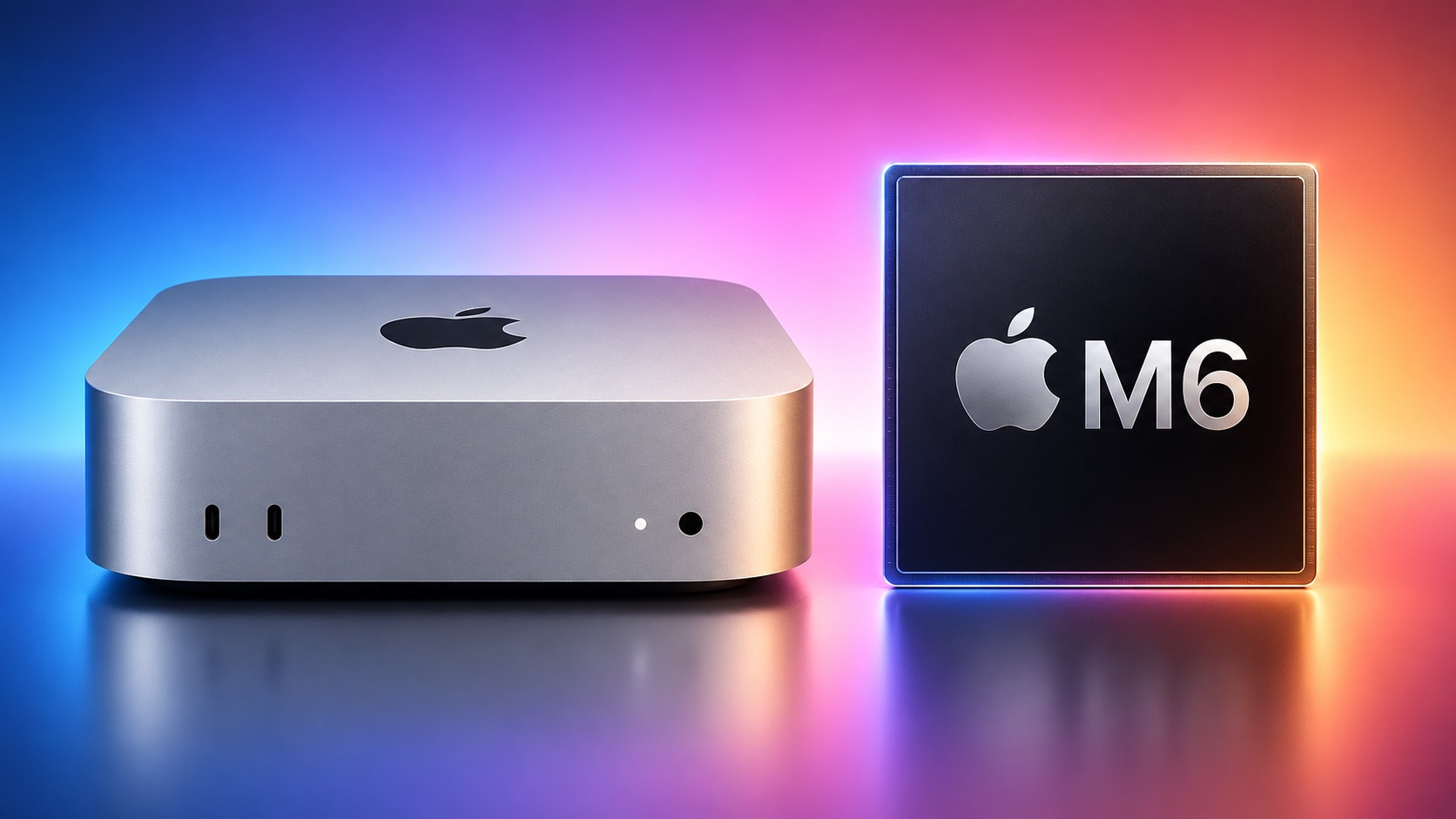
Previstos para serem lançados na semana que vem (pelo menos nos Estados Unidos e em Portugal), os novos Mac mini e Mac Studio são alimentados com os chips M6 e M5 Ultra, respectivamente — lembrando que o mini pode ser configurado também com o M5 Pro, enquanto que o Studio de entrada vem com o chip M5 Max.

Pois os primeiros resultados de benchmarks dos dois novos processadores apresentados recentemente pela Apple surgiram hoje no banco de dados do Geekbench 7, oferecendo uma visão dos ganhos de desempenho de cada um deles.

Em ambos os casos, os resultados vistos até agora tratam apenas dos testes de CPU 1Central processing unit, ou unidade central de processamento. — os de GPU 2Graphics processing unit, ou unidade de processamento gráfico. ainda não foram divulgados.

Confira abaixo a pontuação do chip M6 e as pontuações médias do chip M5 para efeito de comparação:

Benchmark de CPUM6M5
Single-core4.071 pontos3.641 pontos
Multi-core22.783 pontos17.948 pontos

Se o resultado acima for preciso, o chip M6 apresenta um desempenho single-core cerca de 12% mais rápido e uma performance multi-core cerca de 27% mais rápida em comparação com o chip M5. Vale notar que o chip M6 está no novo Mac mini, enquanto as pontuações do chip M5 baseiam-se no MacBook Pro de 14 polegadas — mas o desempenho deve ser semelhante.

Na tabela abaixo está a pontuação do chip M5 Ultra de ponta, com CPU de 36 núcleos, bem como as pontuações médias do chip M3 Ultra de ponta, com CPU de 32 núcleos (já que a Apple nunca lançou um chip “M4 Ultra”).

Benchmark de CPUM5 UltraM3 Ultra
Single-core3.774 pontos2.920 pontos
Multi-core52.516 pontos39.059 pontos

Se os resultados acima procederem, o chip M5 Ultra oferece um desempenho de CPU single-core cerca de 30% mais rápido e um desempenho multi-core cerca de 35% mais rápido em comparação com o M3 Ultra.

Nada mau, hein!

Mac Studio

Chip: M4 Max ou M3 Ultra
Memória: 36GB, 48GB, 64GB, 96GB, 128GB, 256GB ou 512GB
Armazenamento: 512GB, 1TB, 2TB, 4TB, 8TB ou 16TB
R$ 25.999,00

Mac mini

Chip: M4 ou M4 Pro
Memória: 16GB, 24GB, 32GB, 48GB ou 64GB
Armazenamento: 256GB, 512GB, 1TB, 2TB, 4TB ou 8TB
Conectividade: Ethernet ou Gigabit Ethernet 10
R$ 12.299,00
R$ 16.999,00

NOTA DE TRANSPARÊNCIA: O MacMagazine recebe uma pequena comissão sobre vendas concluídas por meio de links deste post, mas você, como consumidor, não paga nada mais pelos produtos/serviços usando os nossos links de afiliado.

via MacRumors [1, 2]

Notas de rodapé

  • 1
    Central processing unit, ou unidade central de processamento.
  • 2
    Graphics processing unit, ou unidade de processamento gráfico.

  •  

M5 Ultra Chip's Impressive Performance Boost Revealed in First Benchmark Result

The first unverified benchmark result for Apple's new M5 Ultra chip surfaced in the Geekbench 7 database today, offering a look at the chip's impressive performance gains. The new Mac Studio will be Apple's first device to be equipped with the M5 Ultra.


Here is how the highest-end M5 Ultra chip with a 36-core CPU scored:

  • Single-core CPU score: 3,774

  • Multi-core CPU score: 52,516
Apple never released an M4 Ultra chip. Here are the average scores for the highest-end M3 Ultra chip with a 32-core CPU on Geekbench 7:

  • Single-core CPU score: 2,920

  • Multi-core CPU score: 39,059


Unsurprisingly, the M5 Ultra is Apple's fastest chip ever. If this Geekbench result is accurate, it has up to around 30% faster single-core CPU performance and up to around 35% faster multi-core performance compared to the M3 Ultra. But, it comes at a steep cost. In the U.S., the Mac Studio with a 36-core M5 Ultra starts at $6,799.

Apple said the M5 Ultra has up to 1.25× faster single-threaded CPU performance and up to 1.3× faster multi-threaded CPU performance compared to the M3 Ultra, so the benchmark result roughly aligns with or even beats those advertised claims. However, keep in mind that there wil be some variance in scores as additional results surface.

Here is where the M5 Ultra slots in for maximum multi-core CPU performance:
  • M5 Ultra: 52,516

  • M3 Ultra: 39,059

  • M5 Max: 35,119

  • M5 Pro: 33,593

  • M4 Max: 29,047

  • M2 Ultra: 28,789

  • M4 Pro: 24,894

  • M3 Max: 24,649

  • M1 Ultra: 23,328

  • M6: 22,783

  • M5: 17,948

  • M2 Max: 17,387

  • M3 Pro: 16,880

  • M2 Pro: 16,725

  • M4: 15,477

  • M1 Max: 14,299

  • M1 Pro: 13,914

  • M3: 11,650

  • M2: 9,809

  • M1: 8,582
Based on these scores, the M5 Ultra is up to 2.25× faster than Apple's original M1 Ultra chip and up to 6× faster compared to the regular M1 chip.

As always, real-world performance varies.

The new Mac Studio with M5 Max and M5 Ultra chips and the new Mac mini with M6 and M5 Pro chips launch on Tuesday, September 22.

We are still waiting for GPU results for the M5 Ultra to appear in the Geekbench 7 database.
Related Roundup: Mac Studio
Buyer's Guide: Mac Studio (Buy Now)
Related Forum: Mac Studio

This article, "M5 Ultra Chip's Impressive Performance Boost Revealed in First Benchmark Result" first appeared on MacRumors.com

Discuss this article in our forums

  •  

M6 Chip Benchmark Surfaces Ahead of New Mac Mini Launch Next Week

The first unverified benchmark result for Apple's new M6 chip surfaced in the Geekbench 7 database today, offering a look at the chip's performance gains. The new Mac mini will be Apple's first device to be equipped with the M6 chip, which is 2nm.


Here is how the M6 chip scored:

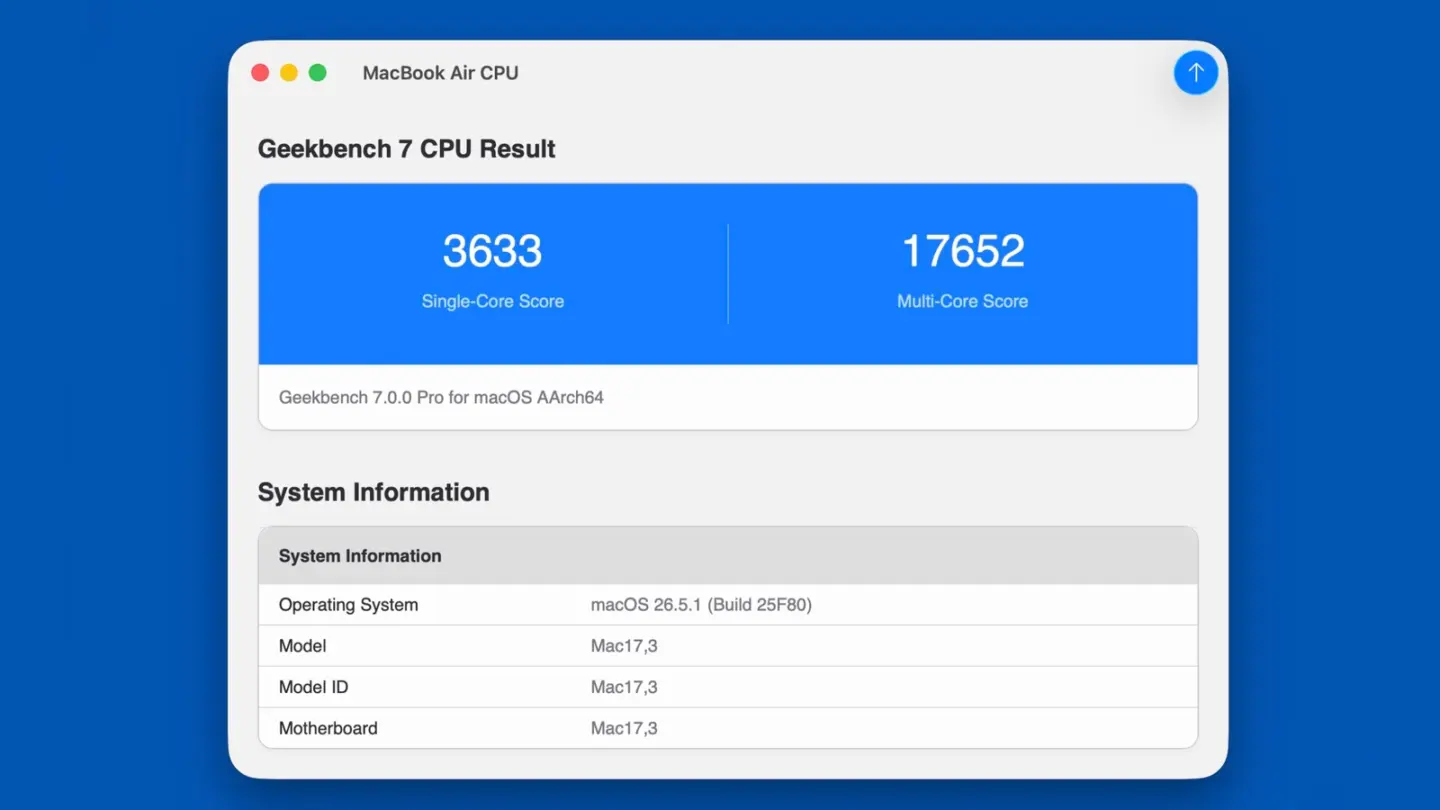
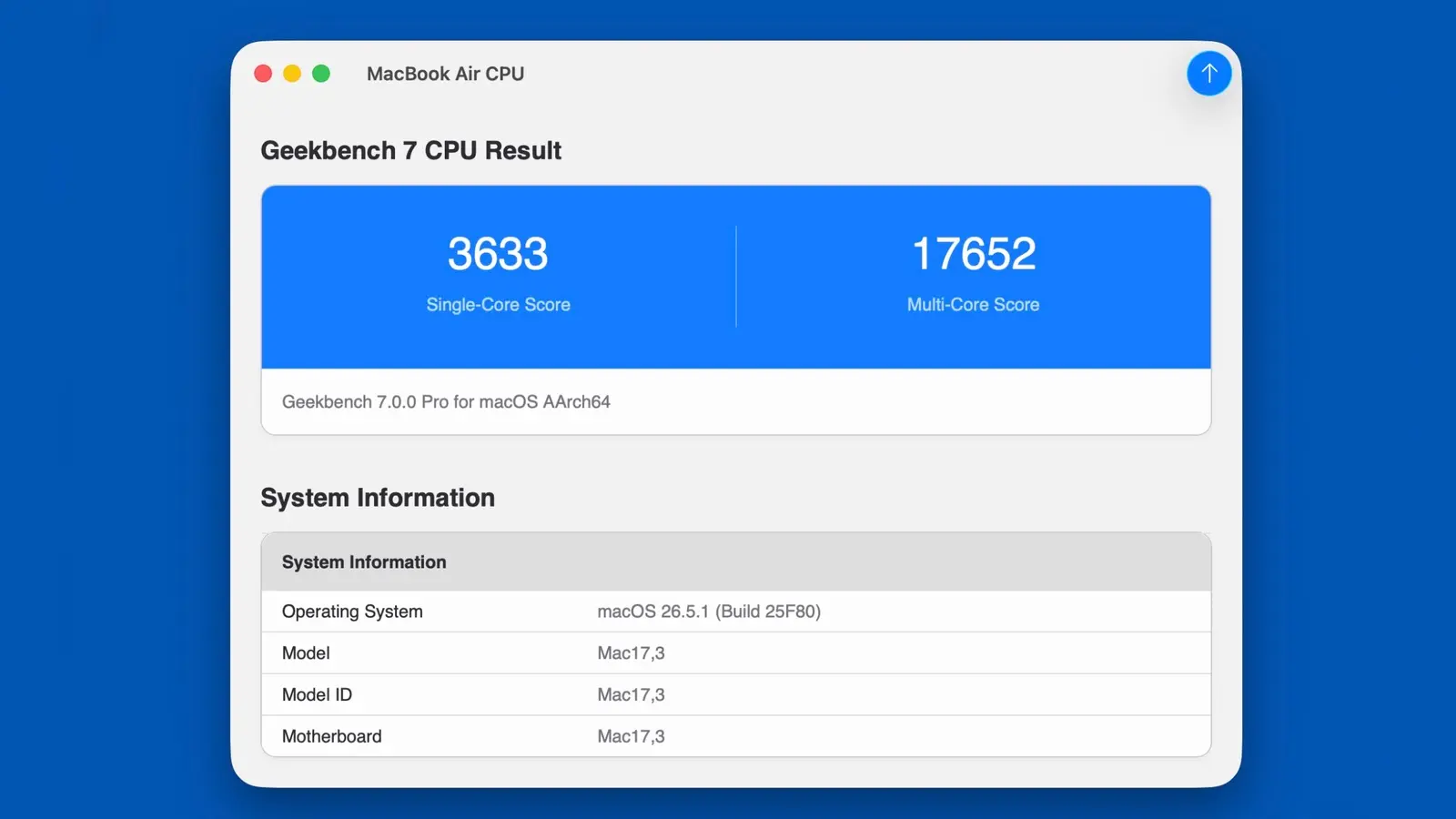
  • Single-core CPU score: 4,071

  • Multi-core CPU score: 22,783


Here are the average M5 chip scores for comparison:

  • Single-core CPU score: 3,641

  • Multi-core CPU score: 17,948
If this single Geekbench 7 result is accurate, the M6 chip has up to around 12% faster single-core CPU performance and up to around 27% faster multi-core CPU performance compared to the M5 chip. Note that the M6 chip is in the new Mac mini, while the M5 chip scores are based on the 14-inch MacBook Pro, but performance should be similar.

Apple said the M6 chip has the world's fastest single-threaded CPU performance, and its 4,071 single-core score indeed tops all other Macs and PCs in the Geekbench 7 database, including the M5 Max chip (3,731) and Qualcomm's Snapdragon X2 Elite Extreme (3,396). Up to 27% faster multi-core CPU performance is in line with Apple's claim of up to 1.2× faster multi-threaded performance, so all of Apple's advertised claims hold up.

Here is where the M6 chip slots in for maximum multi-core CPU performance:
  • M5 Ultra: 52,516

  • M3 Ultra: 39,059

  • M5 Max: 35,119

  • M5 Pro: 33,593

  • M4 Max: 29,047

  • M2 Ultra: 28,789

  • M4 Pro: 24,894

  • M3 Max: 24,649

  • M1 Ultra: 23,328

  • M6: 22,783

  • M5: 17,948

  • M2 Max: 17,387

  • M3 Pro: 16,880

  • M2 Pro: 16,725

  • M4: 15,477

  • M1 Max: 14,299

  • M1 Pro: 13,914

  • M3: 11,650

  • M2: 9,809

  • M1: 8,582
Based on these scores, the M6 chip is more than 2.5× faster than Apple's original M1 chip.

As always, real-world performance varies.

The new Mac mini with M6 and M5 Pro chips and the new Mac Studio with M5 Max and M5 Ultra chips launch on Tuesday, September 22.

We are still waiting for GPU results for the M6 chip to appear on Geekbench 7.
Related Roundup: Mac mini
Buyer's Guide: Mac Mini (Buy Now)
Related Forum: Mac mini

This article, "M6 Chip Benchmark Surfaces Ahead of New Mac Mini Launch Next Week" first appeared on MacRumors.com

Discuss this article in our forums

  •  

Benchmarks preliminares do chip A20 Pro atestam avanços de CPU e GPU

Resultados preliminares de benchmark do chip A20 Pro, que alimenta o iPhone 18 Pro, o iPhone 18 Pro Max e o iPhone Duo, surgiram na manhã de hoje no banco de dados do Geekbench 7, oferecendo uma primeira visão do desempenho de CPU 1Central processing unit, ou unidade central de processamento. e GPU 2Graphics processing unit, ou unidade de processamento gráfico. dos novos modelos antes mesmo de chegarem ao mercado.

Com base nesses resultados iniciais, o chip A20 Pro parece oferecer um desempenho cerca de 21% a 23% mais rápido em single-core (média de 4.722 pontos), além de 27% a 28% mais rápido em multi-core (média de 12.626 pontos) em comparação com o chip A19 Pro dos iPhones 17 Pro/17 Pro Max.

Benchmarks do iPhone 18 Pro
Benchmarks do iPhone 18 Pro Max

Talvez não surpreenda que os resultados do iPhone 18 Pro Max sejam praticamente iguais aos do iPhone 18 Pro. Uma diferença aparece nas pontuações do teste Metal: o modelo menor marcou 64.069 pontos, enquanto o maior atingiu 64.915 pontos.

Ainda assim, os resultados gráficos alinham-se, em linhas gerais, à afirmação da Apple — presente no comunicado de imprensa e na página do iPhone 18 Pro — de que o A20 Pro oferece uma performance gráfica até 40% mais rápida que o chip A19 Pro.

Também foram vistos resultados de benchmark do iPhone 18 Pro Max no AnTuTu, que registrou uma pontuação geral de 3.551.073. A pontuação da CPU, especificamente, foi de 920.410, enquanto a GPU alcançou 1.397.374 pontos. Os testes de memória e UX registraram 470.245 e 763.044 pontos, respectivamente. Para fins de comparação, o iPhone 17 Pro Max obteve uma média de 2.275.118 pontos, colocando o novo modelo substancialmente à frente no benchmark.

Benchmarks do iPhone 18 Pro Max no AnTuTu

Vale ressaltar que esses testes de desempenho pontuais — que ainda não foram confirmados — não indicam como os dispositivos se comportarão durante sessões prolongadas de jogos ou outras cargas de trabalho exigentes; afinal, os resultados de testes no mundo real poderão apresentar algumas diferenças.

via MacRumors, Gizmochina

Notas de rodapé

  • 1
    Central processing unit, ou unidade central de processamento.
  • 2
    Graphics processing unit, ou unidade de processamento gráfico.

  •  

Geekbench 7 chega com benchmark de GPU e testes multi-core reformulados

A Primate Labs anunciou hoje o Geekbench 7, a geração mais recente de sua popular ferramenta de benchmark, que traz conjuntos de dados maiores e mais exigentes para o processamento de GPUs 1Graphics processing units, ou unidade de processamento gráfico., testes multi-core reformulados, entre outras novidades.

A Primate Labs afirma que o benchmark de GPU reformulado concentra-se em aprendizado de máquina e criação de conteúdo para refletir a forma como as GPUs são utilizadas atualmente. Ele inclui agora testes que rastreiam rostos e aplicam efeitos de filtro em tempo real a vídeos, realizam upscaling de imagens com aprendizado de máquina e desfocam fundos em transmissões de videoconferência.

Já os benchmarks multi-core foram projetados para refletir melhor o comportamento real dos softwares, visto que as novas cargas de trabalho só utilizam múltiplas threads quando as tarefas simuladas exigem.

Geekbench 7
Divulgação/Primate Labs

A Primate Labs adicionou ainda um teste expandido de edição de fotos, com um conjunto mais abrangente de edições. Ademais, a carga de trabalho de biblioteca de fotos oferece suporte à importação e ao processamento de formatos de imagem como JPEG XL e DNG. Além disso, os novos testes de áudio e vídeo agora incluem suporte a AV1 e Opus, além de simular cargas de trabalho de streaming e consumo de conteúdo.

No mais, ele tem a mesma aparência do Geekbench 6 — e a licença Pro continua custando US$100 (com desconto para US$80 até 6 de agosto). A versão Pro permite realizar benchmarks offline — sem envio de dados para o Geekbench Browser — e abrange todas as plataformas desktop compatíveis (macOS, Windows e Linux).

É possível baixar gratuitamente o Geekbench 7 para macOS e outros sistemas operacionais nessa página. A versão para iOS/iPadOS ainda não foi atualizada na App Store.

Notas de rodapé

  • 1
    Graphics processing units, ou unidade de processamento gráfico.

  •  

Claude Fable 5 e Claude Mythos 5 são a última geração do modelo de IA da Anthropic mais poderoso do mercado

O Claude Fable 5 é a primeira versão pública da classe Mythos da Anthropic e supera todos os modelos anteriores em praticamente todos os benchmarks testados. Mas chegou ao mercado com salvaguardas tão conservadoras que perguntas básicas de biologia ativam o sistema de segurança.

The post Claude Fable 5 e Claude Mythos 5 são a última geração do modelo de IA da Anthropic mais poderoso do mercado appeared first on Tek Notícias.

  •  
❌