❌

Reading view

NASA’s Hubble Shows Star Formation in Andromeda Galaxy Winding Down
6 Min Read

NASA’s Hubble Shows Star Formation in Andromeda Galaxy Winding Down

The left half of the disk of the Andromeda galaxy, with a jagged outer edge at the top and bottom on a black background. At right, the galaxy’s center is a horizontal yellow oval extending across about a third of the image. Two crescent shaped clumpy, dark dust lanes with abundant stars throughout extend out from the center. The galaxy becomes bluer as you move outward. At top middle, the satellite galaxy M32 appears as a small, fuzzy yellow oval. Within the disk of Andromeda, two regions at upper right and lower middle are outlined in small white boxes labeled 1 and 2, respectively. At the left side of the image, those two regions are enlarged in pullouts. Both contain a dense, grainy-appearing field of thousands of stars. Region 1 is noticeably bluer than region 2 and contains blue star-forming clumps.
NASA Hubble’s view of part of the Andromeda galaxy.
Credits:
Image: NASA, ESA, Benjamin Williams (UWashington), Zhuo Chen (UWashington), L. Clifton Johnson (Northwestern); Image Processing: Joseph DePasquale (STScI)

A new study using data from NASA’s Hubble Space Telescope finds that star formation in the nearby Andromeda galaxy has undergone a 500-million-year decline, with an even steeper drop in the last 40 million years. Andromeda, a spiral galaxy comparable in size to our Milky Way, is close enough to be seen with the unaided eye from areas with dark skies. Located about 2.5 million light-years from Earth, practically our cosmic backyard, Andromeda offers an opportunity for astronomers to examine its stellar populations in detail, leading to better understanding of the past of galaxies like our own.

The results published Monday in The Astrophysical Journal.

To reach this conclusion, the researchers combined data from two Hubble surveys: the Panchromatic Hubble Andromeda Treasury and the Panchromatic Hubble Andromeda Southern Treasury. Together, these two surveys mapped two-thirds of the disk of Andromeda in ultra-sharp detail. In total, the team measured about 200 million individual stars across the galaxy, giving them a detailed picture of Andromeda’s past activity.

“We need to measure the individual stars because they are the fossil record of the galaxy’s formation. Hubble is the only telescope that can give you high enough spatial resolution over a large enough area to be able to do that in Andromeda,” said Ben Williams, astronomer at the University of Washington and a co-author on the study.

Massive stars are bluer and short-lived, while less massive stars are redder and longer-lived. As a result, areas that have experienced recent star formation tend to have a larger fraction of blue stars, while areas with less recent star formation typically have a redder population. The team divided the Andromeda images into thousands of squares, spanning 300 light-years on each side of the square, and determined the history of star formation within each parcel to gain a comprehensive view of the galaxy’s past.

NASA’s Hubble Space Telescope has provided a detailed view of millions of stars in the Andromeda galaxy. Regions that have experienced recent star formation (1) appear significantly bluer than regions with less recent star formation (2).
NASA, ESA, Benjamin Williams (UWashington), Zhuo Chen (UWashington), L. Clifton Johnson (Northwestern); Image Processing: Joseph DePasquale (STScI)

Steady decline

Previous research showed the Andromeda galaxy experienced a dramatic burst of star formation about 2 billion years ago, likely due to a past interaction or merger with another galaxy. Since that time, star formation has been steadily declining.

Astronomers measure the rate of star formation in terms of the mass, or amount of gas and dust, converted into stars per year. The researchers calculated that, 500 million years ago, Andromeda formed stars at a rate of about one solar mass per year. However, the formation rate dropped to about half that by 40 million years ago. The current rate has plummeted even farther, to about one-fifth the mass of our Sun per year.

The team also examined whether that decline was consistent across the galaxy or concentrated in certain areas. They found that much of the recent star formation has occurred in a star-forming ring located about 32,000 light-years from the galaxy’s center. As a result, much of the decline they measure is driven by decreasing activity within that ring.

Rather than being the result of reduced material from which new stars can form, the decline is more likely to be a natural winding down from its previous, more active state.

“It’s just like after running a marathon, sometimes you’ve got to take a bit of a breather,” said Tobin Wainer, lead author, University of Washington.

Likely suspect

The team also investigated whether there was any connection between the decrease of activity in Andromeda and its proximity to satellite galaxy M32 (Messier 32). The M32 galaxy is separated from Andromeda by about 16,000 light-years in the plane of the sky; however, its 3D location in space is uncertain. As a result, astronomers are unsure if or when it might have interacted with Andromeda in the past.

“One of the major motivations for this program was to probe potential interactions between M32 and Andromeda’s disk,” said Zhuo Chen, co-author, University of Washington.

Survey data from the Panchromatic Hubble Andromeda Southern Treasury allowed the team to study the history of star formation in Andromeda near M32. They found that this area showed signs of decreased star formation compared with other regions. The timing of this decrease, which this study finds began roughly 60 million years ago, could help constrain when the M32 galaxy interacted with Andromeda’s disk.

“We can’t explicitly say that we are seeing a decrease in star formation because of M32. But it’s right there, and it’s definitely the most likely suspect,” said Wainer.

This movie, created from an analysis of data from NASA’s Hubble Space Telescope, demonstrates how the rate of star formation in the Andromeda galaxy has declined over the past 500 million years. Brighter colors indicate where star formation was highest during a given time.
Visualization: Tobin Wainer (UWashington); Image Processing: Joseph DePasquale (STScI); Video: NASA, ESA, STScI, Gregory Bacon (STScI)

The team plans to continue analyzing the Hubble data and combine it with data from ground-based observatories to gain additional insights into the history of Andromeda.

“There’s a strong scientific value to this archival data. Andromeda is important because it’s a neighbor that is close enough that we can see it in great detail while also getting a global perspective,” said Raja GuhaThakurta, co-author, University of California Santa Cruz.

An even greater global perspective is likely to come from NASA’s Nancy Grace Roman Space Telescope after it launches as early as Sunday, Aug. 30. Roman’s gigantic field of view can cover at least 100 times as much area as Hubble at near-infrared wavelengths in a single observation. A newly approved Roman observing program will image the entirety of Andromeda’s disk and areas of its surrounding halo, allowing astronomers to measure hundreds of millions of stars and enabling groundbreaking new science.

The Hubble Space Telescope has been operating for more than three decades and continues to make ground-breaking discoveries that shape our fundamental understanding of the universe. Hubble is a project of international cooperation between NASA and ESA (European Space Agency). NASA’s Goddard Space Flight Center in Greenbelt, Maryland, manages the telescope and mission operations. Lockheed Martin Space also supports mission operations at Goddard. The Space Telescope Science Institute in Baltimore, which is operated by the Association of Universities for Research in Astronomy, conducts Hubble science operations for NASA.


Related Images & Videos

The left half of the disk of the Andromeda galaxy, with a jagged outer edge at the top and bottom on a black background. At right, the galaxyu2019s center is a horizontal yellow oval extending across about a third of the image. Two crescent shaped clumpy, dark dust lanes with abundant stars throughout extend out from the center. The galaxy becomes bluer as you move outward. At top middle, the satellite galaxy M32 appears as a small, fuzzy yellow oval. Within the disk of Andromeda, two regions at upper right and lower middle are outlined in small white boxes labeled 1 and 2, respectively. At the left side of the image, those two regions are enlarged in pullouts. Both contain a dense, grainy-appearing field of thousands of stars. Region 1 is noticeably bluer than region 2 and contains blue star-forming clumps.

Andromeda Galaxy

NASA’s Hubble Space Telescope has provided a detailed view of millions of stars in the Andromeda galaxy.

On a black background, a pixelated, partial ring of bright pink and purple extends from 8 ou2019clock clockwise to 3 ou2019clock. There is a black gap at the bottom of the ring as well as in the middle. Below the ring, a timeline labeled millions of years ago lists the numbers 500, 200, 100, 50, 25, 0. The numbers 500 and 200 are yellow with a yellow line between them, indicating that the image shows the rate of star formation that was occurring in that timeframe.

Star Formation Rate in Andromeda Over Time

This movie, created from an analysis of data from NASA’s Hubble Space Telescope, demonstrates how the rate of star formation in the Andromeda galaxy has declined over the past 500 million years.


Share

Details

Last Updated
Jul 27, 2026
Editor
Andrea Gianopoulos
Contact
Media

Claire Andreoli
NASA’s Goddard Space Flight Center
Greenbelt, Maryland
claire.andreoli@nasa.gov

Christine Pulliam
Space Telescope Science Institute
Baltimore, Maryland

  •  

Hubble Spies One-Sided Spiral

3 min read

Hubble Spies One-Sided Spiral

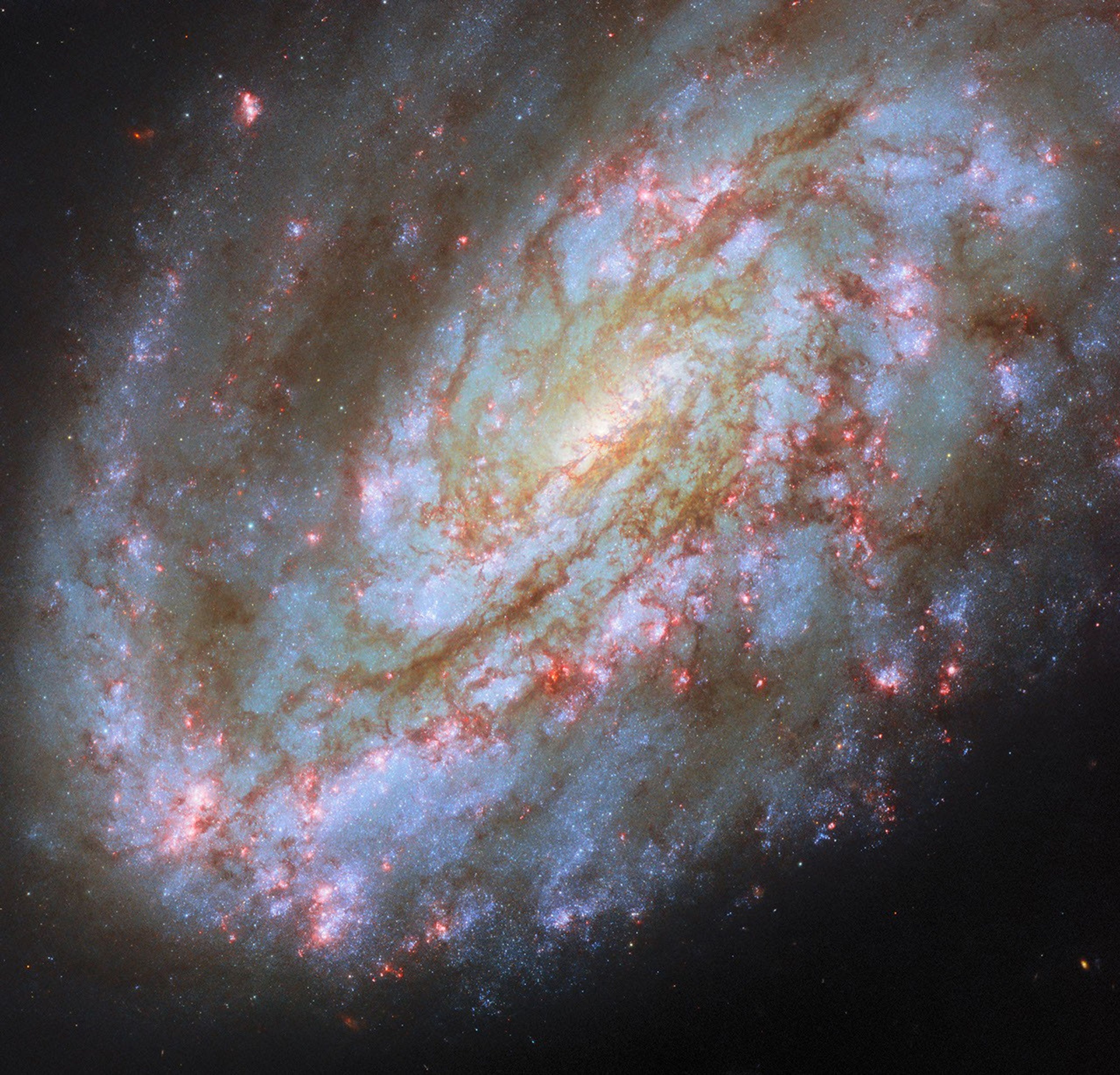
A spiral galaxy. It has a prominent spiral arm on one side (lower left) and a wide, glowing core. Dark brown filaments of dust swirl through its disk, while blue clusters of stars are visible mostly going out to its arm. On the opposite side of the arm (upper right), gas trails off from the disk, beyond the field of view in this image. A matching spiral arm is not visible on this side. The galaxy lies on a dark background.
This NASA/ESA Hubble Space Telescope image features the spiral galaxy NGC 4654, located 72 million light-years away in the constellation Virgo (the Maiden).
NASA, ESA/Hubble, D. Thilker, J. Lee, and the PHANGS-HST Team

The subject of this NASA/ESA Hubble Space Telescope image is a spiral galaxy struggling against titanic forces that appear on galactic scales in space. This is NGC 4654, an intermediate spiral galaxy in the constellation Virgo (the Maiden). It is classified as an “intermediate” because its overall shape lies between spiral galaxies that have a bar across their centers and those that don’t. NGC 4654 has a weak bar structure at its center and is located 72 million light-years from Earth in the Virgo Cluster, a particularly massive and populous galaxy cluster.

NGC 4654 is particularly asymmetric, with a rounded and clearly-defined edge on one side and a long tail of gas stretching out from the opposite side — outside the field of view captured in this image. This gaseous tail is the result of ram pressure stripping, a force that galaxies can experience as they plow through space. NGC 4654 moves with such high velocity that it sweeps up and rams through the hot, rarefied gas filling the space between the Virgo Cluster’s galaxies. This intracluster medium in turn exerts a “ram pressure” on the galaxy, compressing the galaxy’s leading edge and dragging its gas behind the galaxy, creating the elongated tail.

It’s not just the galaxy’s gas that is unevenly distributed: its stars are too, and this is more unusual for a spiral galaxy. While the spiral arm on its leading edge is rich with stars and gas, the opposite arm noticeably lacks stars, influencing the galaxy’s lopsided spiral shape. Astronomers think that ram pressure alone is unlikely to cause this effect. Rather, NGC 4654 was also subjected to the gravitational force of fellow Virgo Cluster galaxy NGC 4639. While the two galaxies are far apart now, it’s thought that a fly-by interaction between them around 500 million years ago ripped away NGC 4654’s gas along one side, limiting star formation there and creating the asymmetry in its shape.

Many galaxies that undergo ram pressure stripping suffer reduced star formation rates as the cold gas that collapses to form their stars is pulled away and lost. NGC 4654, however, is still forming nearly two Suns’ worth of stars every year, a rate comparable to other galaxies of similar size. The active star formation is visible in the latest Hubble data included in this image. The data picks up on a wavelength of red light emitted by the clouds of energized gas where newborn stars lurk. The bright pink bubbles that appear across NGC 4654 — from its forward spiral arm, to around its weak bar, and out to the edge of its disk — are areas where these newborn stars shine.

The data used in this image came from two observing programs (#15654, #17502) that aim to link the gas in galaxies with star formation. By observing many prominent galaxies in the vicinity of our own, researchers hope to better understand how gas moves in galaxies, where and when it collapses to form stars and star clusters, and what effect those new stars have on the gas around them.

Text Credit: ESA/Hubble

Media Contact:

Claire Andreoli
NASA’s Goddard Space Flight Center, Greenbelt, MD
claire.andreoli@nasa.gov

  •  

Hubble Glimpses Merging Galaxy Clusters

2 min read

Hubble Glimpses Merging Galaxy Clusters

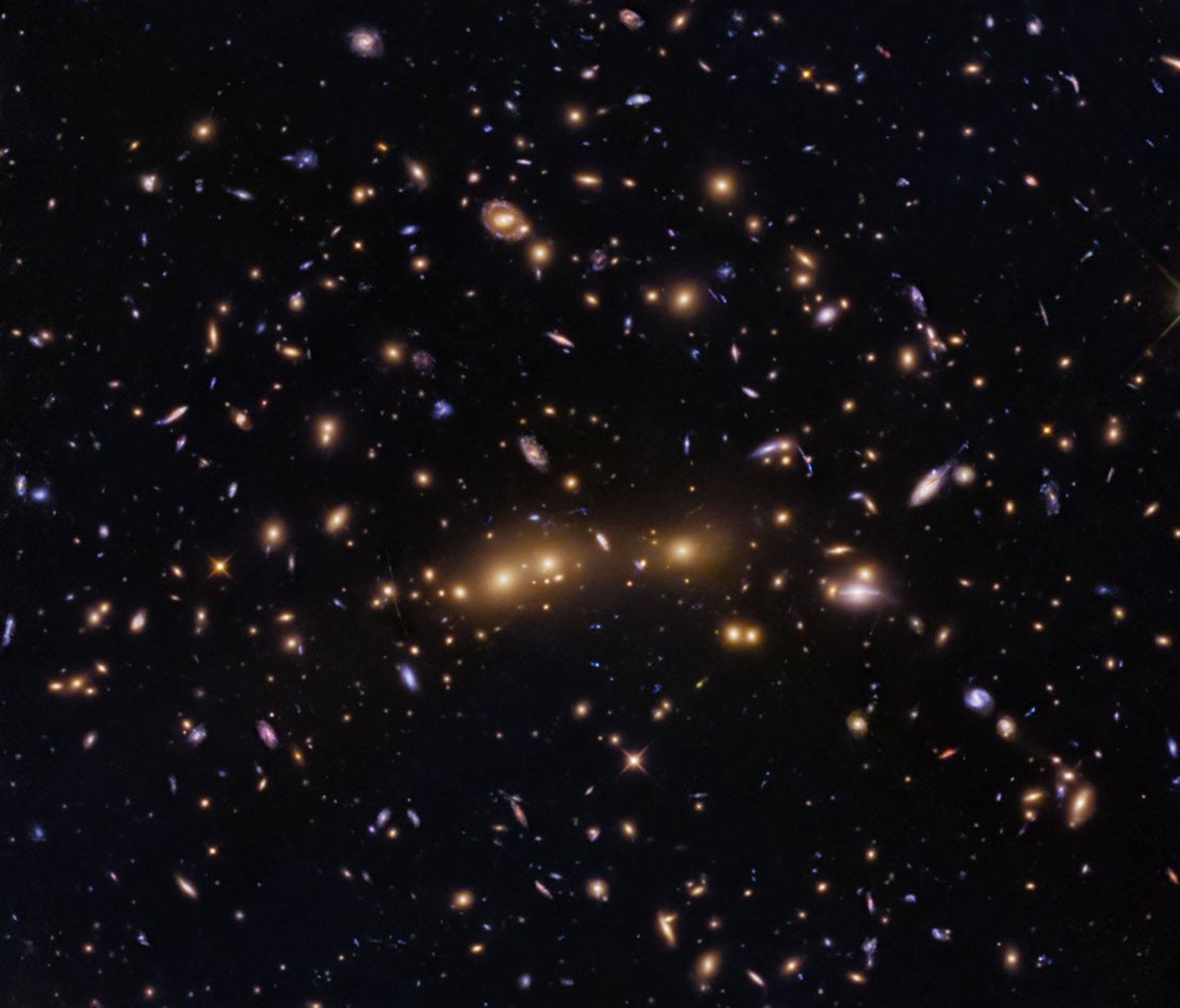
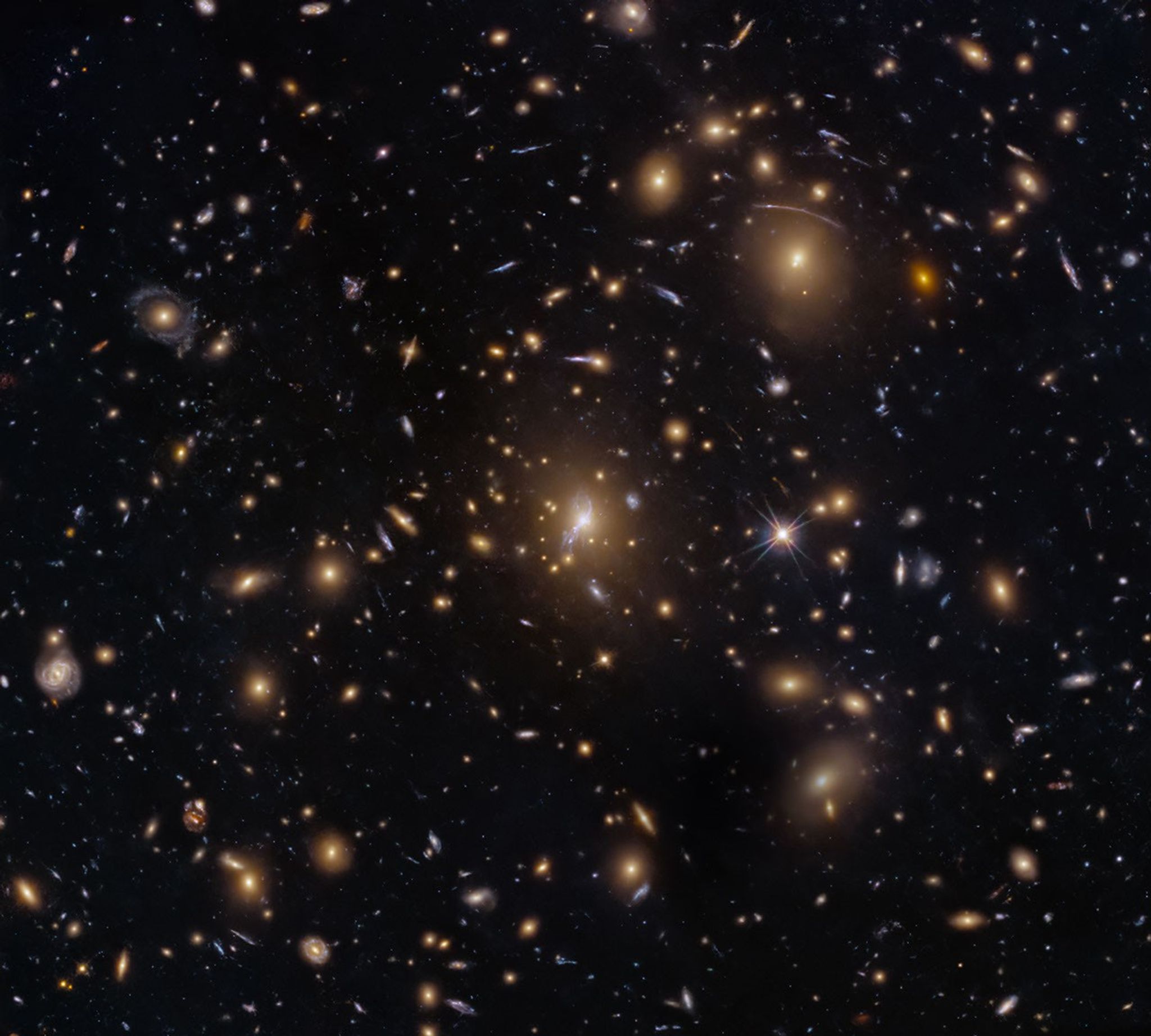
Several massive elliptical galaxies appear to sit in a nearly horizontal line across the center of the image. Numerous spiral, lenticular, and smaller elliptical galaxies dot the space surrounding the giant ellipticals.
This NASA Hubble Space Telescope image features a swarm of galaxies in the galaxy cluster called CL0016+1609 or MACS J0018.5+1626.
NASA, ESA, H. Ebeling (University of Hawaii), D. Coe (STScI, ESA, JWST); Image Processing: G. Kober (NASA/Catholic University of America)

This NASA Hubble Space Telescope image features a galaxy cluster, called CL0016+1609 or MACS J0018.5+1626, that is very bright at X-ray wavelengths and is one of the most extensively studied clusters at X-ray and radio wavelengths. The X-ray observations of this cluster revealed that it is two clusters merging along our line of sight.

Researchers requested time to observe CL0016+1609 with Hubble’s Advanced Camera for Surveys because that data would help them accurately measure the cluster’s dark-matter distribution, which helps them study the merger and the role of CL0016+1609 in the large-scale structure of the universe. Hubble can’t directly see dark matter, but its infrared and visible light observations can detect dark matter’s gravitational lensing effects on the normal matter Hubble observes.

The data in this image also includes observations with Hubble’s Wide Field Camera 3 taken as part of an observing program that obtained the first Hubble infrared images of 46 massive galaxy clusters and looked for distant galaxies gravitationally lensed by these clusters. Called RELICS (Reionization Lensing Cluster Survey), this survey found some 300 high-redshift candidate galaxies lensed by these clusters.

You can see the faint vertical arc of one of these distant galaxies in the image above. Look for it just to the left of the large elliptical galaxies in the center of the image. Another brighter, though shorter arc is visible just above and to the right of the large elliptical galaxies in the center of the image.

Media Contact:

Claire Andreoli
NASA’s Goddard Space Flight Center, Greenbelt, MD
claire.andreoli@nasa.gov

The post Hubble Glimpses Merging Galaxy Clusters appeared first on NASA Science.

  •  

Search for Hidden Cosmic Companions in Sun’s Backyard

Some stars have planets. Others are orbited by brown dwarfs, balls of gas too massive to be planets, but too low-mass to be stars. Astronomers love these brown dwarf-star pairs because being paired with a star helps reveal a brown dwarf’s age. Ages of astronomical objects are often hard to measure, but essential for understanding how they form. 

Now, you can join NASA’s new Backyard Worlds: Binaries project and help astronomers discover these rare and interesting pairs. As a volunteer, you’ll inspect images from NASA’s Wide-field Infrared Survey Explorer (WISE) space telescope. Brown dwarfs may appear as small dots moving across a field of otherwise static stars. 

“We need your help to gain critical insights into these enigmatic cosmic objects,” said project lead Aaron Meisner.

Brown dwarfs are common but mysterious because they are so faint. There’s one for every three or four stars in our corner of the Milky Way galaxy. They are important laboratories for understanding giant planets like Jupiter.

Join the Backyard Worlds: Binaries project today and help astronomers understand where and when brown dwarfs form! You can also try one of our other brown dwarf-related projects: Backyard Worlds: Cool Neighbors! Anyone with a laptop or cell phone can participate. Participation does not require citizenship in any particular country.

Share

Details

Last Updated
Jun 18, 2026
Editor
NASA Science Editorial Team

The post Search for Hidden Cosmic Companions in Sun’s Backyard appeared first on NASA Science.

  •  

Search for Hidden Cosmic Companions in Sun’s Backyard

Some stars have planets. Others are orbited by brown dwarfs, balls of gas too massive to be planets, but too low-mass to be stars. Astronomers love these brown dwarf-star pairs because being paired with a star helps reveal a brown dwarf’s age. Ages of astronomical objects are often hard to measure, but essential for understanding how they form. 

Now, you can join NASA’s new Backyard Worlds: Binaries project and help astronomers discover these rare and interesting pairs. As a volunteer, you’ll inspect images from NASA’s Wide-field Infrared Survey Explorer (WISE) space telescope. Brown dwarfs may appear as small dots moving across a field of otherwise static stars. 

“We need your help to gain critical insights into these enigmatic cosmic objects,” said project lead Aaron Meisner.

Brown dwarfs are common but mysterious because they are so faint. There’s one for every three or four stars in our corner of the Milky Way galaxy. They are important laboratories for understanding giant planets like Jupiter.

Join the Backyard Worlds: Binaries project today and help astronomers understand where and when brown dwarfs form! You can also try one of our other brown dwarf-related projects: Backyard Worlds: Cool Neighbors! Anyone with a laptop or cell phone can participate. Participation does not require citizenship in any particular country.

Share

Details

Last Updated
Jun 18, 2026
Editor
NASA Science Editorial Team
  •  

NASA’s Webb Catches Exoplanet Getting Roasted

 
4 Min Read

NASA’s Webb Catches Exoplanet Getting Roasted

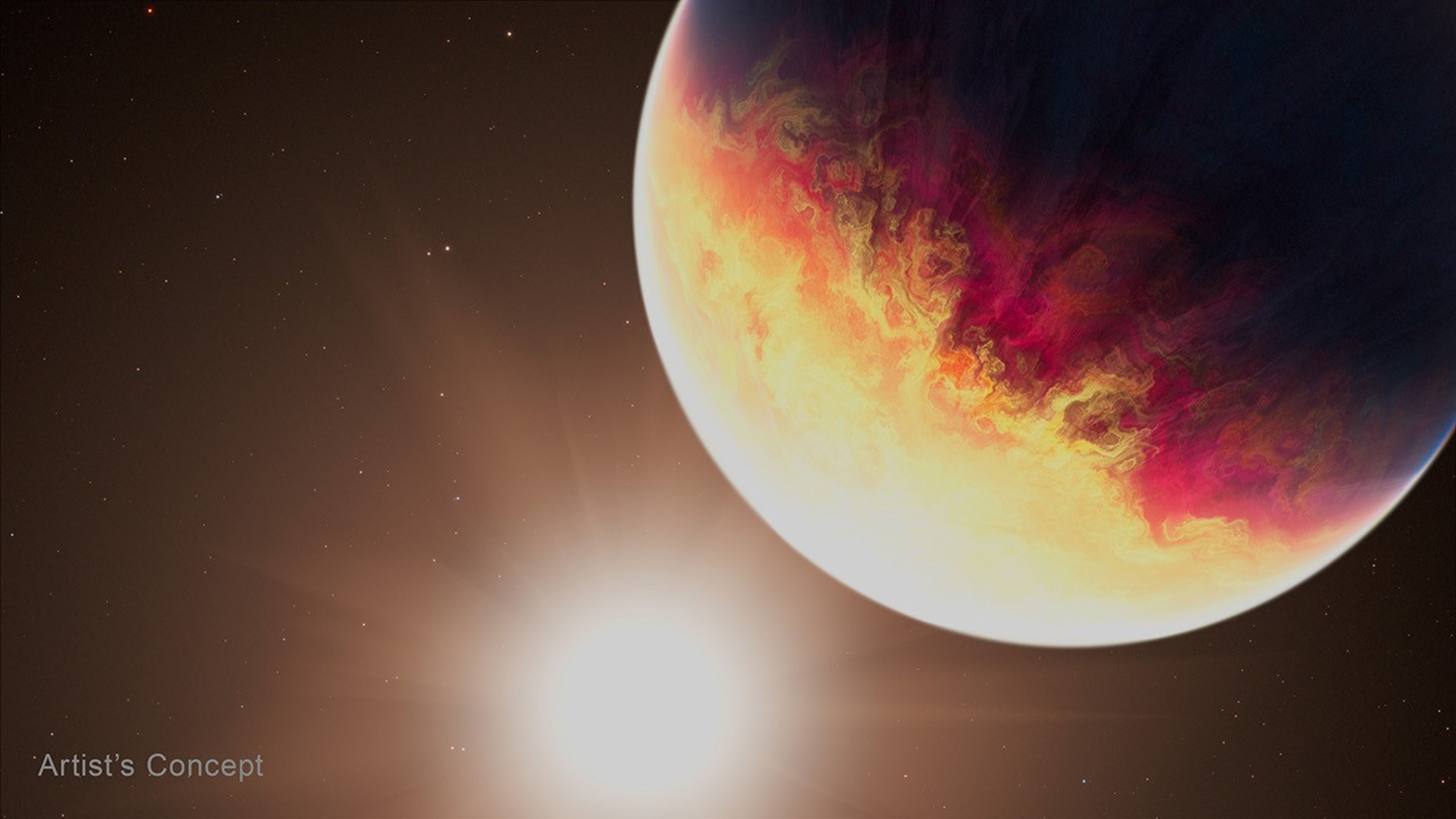
Illustration of a planet and a star, labeled artist’s concept at the bottom left. The planet fills more than a quarter of the image to the upper right, with the bright star to its lower left. The planet is white hot on the star side, fading to yellow that mixes with swirls of bright red across its middle, and eventually fading to black on the side most distant from the star. Distant stars dot the background of space, which is black near the edges of the frame.
This artist’s concept shows exoplanet HD 80606 b being “roasted” as its orbit approaches periastron, the point at which it is closest to its host star, which is similar to our Sun.
Credits:
Artwork: NASA, ESA, CSA, Joseph Olmsted (STScI)

4 min read

NASA’s Webb Catches Exoplanet Getting Roasted

One well-done gas giant, coming right up! That’s the latest from researchers analyzing NASA’s James Webb Space Telescope’s observations of HD 80606 b, an exoplanet four times the mass of Jupiter with an extremely elliptical orbit that sweeps close by its Sun-like star. The research team is presenting their study and preliminary findings Tuesday at the 248th meeting of the American Astronomical Society in Pasadena, California.

“Hot Jupiters are already considered some of the most extreme exoplanets we know of, but even among that population, HD 80606 b is one of the most extreme,” said Tiffany Kataria, the study’s principal investigator at NASA’s Jet Propulsion Laboratory in Southern California. “We typically think of hot Jupiters as hot gas giants sitting right next to their stars, but this planet’s highly eccentric orbit creates a completely different beast.”

As the planet plunges close to its star, Webb shows its temperature skyrockets by 1,100 degrees Fahrenheit. Previous studies have shown that radical temperature swings can cause an exoplanet’s chemistry and clouds to change in real time. According to the research team, the dynamic conditions of HD 80606 b make the planet an ideal target to observe these changes with Webb’s powerful instruments.

Image: Artist’s concept exoplanet HD 80606 b

Illustration of a planet and a star, labeled artistu2019s concept at the bottom left. The planet fills more than a quarter of the image to the upper right, with the bright star to its lower left. The planet is white hot on the star side, fading to yellow that mixes with swirls of bright red across its middle, and eventually fading to black on the side most distant from the star. Distant stars dot the background of space, which is black near the edges of the frame.
This artist’s concept shows exoplanet HD 80606 b being “roasted” as its orbit approaches periastron, the point at which it is closest to its host star, which is similar to our Sun.
Artwork: NASA, ESA, CSA, Joseph Olmsted (STScI)

“Observing a planet like HD 80606 b is actually very efficient because its unusual orbit, with the corresponding swings in temperature and chemical composition, allow us to gather data under varying conditions in just hours and apply those findings to other hot Jupiters or more conventional exoplanets,” said Laura C. Mayorga, co-investigator on the study and an exoplanet astronomer at the Johns Hopkins Applied Physics Laboratory in Laurel, Maryland.

Measurements of temperature and chemical composition were done with spectroscopy, a technique scientists use to break light into its component colors to reveal information about the composition, temperature, motion, and physical properties of objects in space. The team used Webb’s MIRI (Mid-Infrared Instrument) for an extended observation of HD 80606 b before, during, and after its periastron, or closest pass by its star. During periastron, the planet also passed behind the star from Webb’s perspective in what’s known as a secondary eclipse. The observation was years in the planning, as scheduling the time to catch the planet at this point was complex given its extremely elliptical 111-day orbit, and Webb’s own restrictions on where it can look during specific times of the year, based on Earth’s position in orbit around the Sun.

Researchers say they have only begun to peel back the layers of an incredibly rich dataset, but they can clearly see a dramatic shift in the exoplanet’s temperature. “Webb has shown that the planet’s increase in temperature was even more extreme than we anticipated based on Spitzer data,” said Kataria.

In fact, the planet had already been dubbed the “roasted exoplanet” and even got its own poster in NASA’s popular series. NASA’s now-retired Spitzer Space Telescope laid the groundwork of infrared observations of HD 80606 b, showing that more detailed spectroscopic data from Webb would be especially compelling.

“Spitzer did amazing work on this exoplanet, and now Webb is building on that legacy by enabling us to drill down to distinguish specific chemical signatures like methane and carbon dioxide, which is just amazing progress,” said Ryan Challener, co-author and research associate at the Cornell Center for Astrophysics and Planetary Science. “There’s so much to learn from this one dataset here — we really are just getting started deciphering what Webb has to tell us.”

The James Webb Space Telescope is the world’s premier space science observatory. Webb is solving mysteries in our solar system, looking beyond to distant worlds around other stars, and probing the mysterious structures and origins of our universe and our place in it. Webb is an international program led by NASA with its partners, ESA (European Space Agency) and CSA (Canadian Space Agency).

For more information on Webb, visit:

science.nasa.gov/webb

Downloads & Related Information

The following sections contain links to download this article’s images and videos in all available resolutions followed by related information links, media contacts, and if available, research paper and Spanish translation links.

Related Images & Videos

Illustration of a planet and a star, labeled artistu2019s concept at the bottom left. The planet fills more than a quarter of the image to the upper right, with the bright star to its lower left. The planet is white hot on the star side, fading to yellow that mixes with swirls of bright red across its middle, and eventually fading to black on the side most distant from the star. Distant stars dot the background of space, which is black near the edges of the frame.

HD 80606 b (Artist’s Concept)

This artist’s concept shows exoplanet HD 80606 b being “roasted” as its orbit approaches periastron, the point at which it is closest to its host star, which is similar to our Sun.

Related Links

Este Artículo en Español – “Telescopio Webb de la NASA Detecta un Exoplaneto Asandose”

Read:  Webb’s Impact on Exoplanet Research

Watch:  How to Study Exoplanets: Webb and Challenges

Explore:  Eyes on Exoplanets

Print: The Roasted Exoplanet Poster

More Webb: News | Images | Science | Home Page


Share

Details

Last Updated
Jun 17, 2026
Contact
Media

Laura Betz
NASA’s Goddard Space Flight Center
Greenbelt, Maryland
laura.e.betz@nasa.gov

Leah Ramsay
Space Telescope Science Institute
Baltimore, Maryland

Hannah Braun
Space Telescope Science Institute
Baltimore, Maryland

  •  

Backyard Worlds: Binaries

Backyard Worlds: Binaries

Most stars in our Milky Way galaxy exist in groups, including pairs or “binaries,” in which two stars orbit each other. Some binaries are stars paired with brown dwarfs, balls of gas more massive than planets without enough mass to sustain nuclear fusion. Finding brown dwarfs in pairs helps scientists deduce their ages and origin stories! Backyard Worlds: Binaries invites you to search images made by NASA’s Wide-field Infrared Survey Explorer (WISE) space telescope to find these vital brown dwarfs in binary systems. Your discoveries will teach us about brown dwarf formation and identify objects that resemble giant planets like Jupiter.

Go to Project Website about Backyard Worlds: Binaries

project task

Examining Images

division

Astrophysics

where

Online

launched

2026

Illustration showing a large, dark red gas‑giant–like world in orbit with a white dwarf shown as a bright white dot. The bright band of the Milky Way stretching across the star‑filled background.
Artist’s rendition of a brown dwarf orbiting a white dwarf (the bright white circle) with the Milky Way in the background.
 NOIRLab/NSF/AURA/P. Marenfeld

What you’ll do

  • Learn how to recognize binary systems and brown dwarfs in images made by NASA’s WISE space telescope. 
  • Click buttons to indicate whether or not they contain binaries. If you see a binary, click a button to indicate whether or not it includes a brown dwarf. Review as many image sets as you like, 
  • If you want to, you can discuss what you have found with other volunteers and scientists in the Talk forum.

Requirements

  • Time: 5-15 minutes to complete the tutorial
  • Equipment: Web-connected device.
  • Knowledge: None. In project tutorial provides all instruction needed.

Get started!

  1. Visit the project website.  
  2. Complete the in-project tutorial to learn how to spot binary systems in short animations of WISE data.
  3. Start identifying candidate binary systems containing a brown dwarf, using a Field Guide reference as necessary.

Learn More

The Backyard Worlds: Binaries Research page gives an overview of the research being pursued and its value towards expanding what we know about how star and planetary systems form. Links throughout this page take the reader to additional sources of information. The Frequently Asked Questions (FAQs) page has additional information relevant to the work of the project. 

You might also like to try Backyard Worlds: Cool Neighbors and Backyard Worlds: Planet 9!

A vibrant logo set against a starry space background. In the center is a colorful, striped planet featuring shades of blue, green, and pink, surrounded by a glowing orange-red ring. A white silhouette of a telescope on a tripod points up toward the planet. Arcing above the planet is the text "BACKYARD WORLDS:" in white, blue-outlined letters. Arcing below is the word "BINARIES" in large, stylized red bubble letters on a white, cloud-like background.

Looping side‑by‑side animation showing two sky images: the original WISE sky view on the left and processed images on the right. Pixelated points labeled as M‑dwarf stars shift position between frames, illustrating how subtracting sequential images reveals moving objects.
Animated images from the Backyard Worlds: Binaries project showing two distinct “dipoles” – single objects moving through space – that appear to be moving together. These dipoles “flip” together, indicating that they are moving in the same direction.
Backyard Worlds: Binaries WISE data.

Get to know the people of Backyard Worlds: Binaries!

Mei Lin

Intern, undergraduate student
Harvard University

Portrait photo of a man wearing a blue shirt and blazer

Aaron Meisner

Staff Astronomer
NSF’s NOIRLab and Harvard University

Zachary Hartman

NASA Postdoctoral Fellow
NASA Ames Research Center

Austin Rothermich

Graduate Student
City University of New York and American Museum of Natural History

Portrait photo of a woman with long curly hair

Jackie Faherty

Astrophysicist / Scientist at American Museum of Natural History

Adam Schneider

United States Naval Observatory

Portrait photo of a smiling man

J. Davy Kirkpatrick

Astronomer, Infrared Processing and Analysis Center (IPAC) at the California Institute of Technology 

Portrait photo of a bearded young man

Dan Caseldon

Citizen scientist and Research Associate, American Museum of Natural History

Arjun Dey

Astronomer, NSF’s NOIRLab 

John Gizis

Observational Astronomer, University of Delaware

The post Backyard Worlds: Binaries appeared first on NASA Science.

  •  

Hubble Sees Swarm of Galaxies

2 min read

Hubble Sees Swarm of Galaxies

Numerous galaxies dot the scene and appear to cluster around the image center. The view includes large elliptical galaxies along with spiral and lenticular galaxies. Faint arcs of distant galaxies gravitationally lensed by the cluster appear in the upper-right quadrant of the image. A couple of foreground stars are also visible and easily distinguished by their diffraction spikes.
This NASA Hubble Space Telescope image features the galaxy cluster MACS0329-0211.
NASA, ESA, M. Postman (STScI); Image Processing: G. Kober (NASA/Catholic University of America)

Looking somewhat like a swarm of bees returning to their hive, this NASA Hubble Space Telescope image features the galaxy cluster MACS0329-0211. Galaxy clusters like MACS0329-0211 are important signposts in the story of how the structure of the universe evolved, and are the ultimate telescopic lenses, placing gravitationally lensed galaxies from the earliest stages of the universe into our view.

Zoom into this galaxy swarm and you will find large, oval-shaped elliptical galaxies, and thin spiral and lenticular galaxies viewed from the edge. We can also see the full, face-on view of spiral galaxies and their curving spiral arms. The image’s upper-right quadrant holds faint arcs of distant galaxies gravitationally lensed by the cluster’s massive gravity. The largest of these arcs appears above the bright oval shape of a giant elliptical galaxy. Closer inspection of the image’s center reveals several bright-white intersecting curves that appear as a distorted figure eight. This may be another distant galaxy whose light was magnified and distorted by this massive cluster’s gravity.

Hubble looked at MACS0329-0211 as part of an observing program of X-ray bright galaxy clusters. Researchers used Hubble’s two main cameras, the Advanced Camera for Surveys and its Wide Field Camera 3, to gather data visible and infrared light from the cluster. Hubble’s ability to see such a broad spectrum of light makes it a valuable tool in understanding the very nature of these galaxy clusters.

Media Contact:

Claire Andreoli
NASA’s Goddard Space Flight Center, Greenbelt, MD
claire.andreoli@nasa.gov

The post Hubble Sees Swarm of Galaxies appeared first on NASA Science.

  •  

NASA to Preview Katalyst Mission to Boost Swift Spacecraft’s Orbit

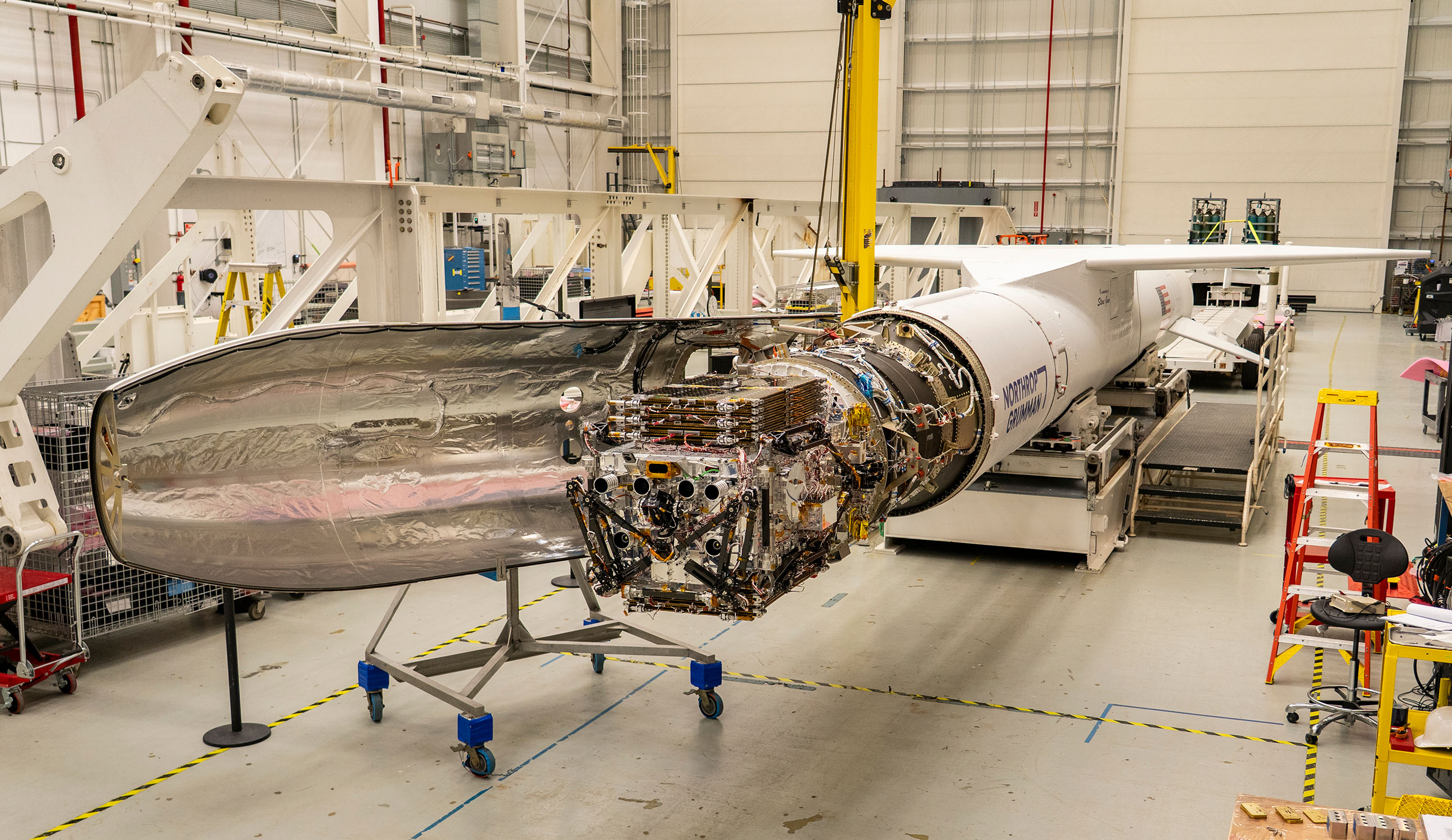
LINK attached to the front of the Pegasus XL
Katalyst Space’s LINK robotic servicing satellite awaits encapsulation inside a Northrop Grumman Pegasus XL on June 8, 2026, at NASA’s Wallops Flight Facility in Virginia. The rocket will carry LINK to space for an attempted orbital boost of NASA’s Neil Gehrels Swift Observatory.
Credit: NASA/Ron Beard

NASA will host an audio-only media teleconference at 11 a.m. EDT, Wednesday, June 17, to preview the Katalyst Space mission to boost the orbit of NASA’s Neil Gehrels Swift Observatory.

Katalyst’s robotic servicing spacecraft, called LINK, will attempt to rendezvous with Swift and raise its altitude, extending its science mission lifespan and advancing a key capability for the future of space exploration. The LINK spacecraft will launch on Northrop Grumman’s Pegasus XL rocket later this month from Kwajalein Atoll in the Marshall Islands.

Media interested in participating by phone must RSVP no later than two hours before the start of the call to Amy Barra at: amy.l.barra@nasa.gov. NASA’s media accreditation policy is available online.

Audio of the media teleconference will stream on the agency’s website at:

https://www.nasa.gov/live

Participants in the media teleconference include:

  • Shawn Domagal-Goldman, division director, Astrophysics, NASA Headquarters in Washington
  • Brad Cenko, principal investigator, Swift, NASA’s Goddard Space Flight Center in Greenbelt, Maryland
  • Kieran Wilson, principal investigator, LINK, Katalyst Space
  • Robert Lamontagne, vice president, strategic partnerships, Katalyst Space
  • Wes Collier, vice president, launch systems, Northrop Grumman

The Swift mission, which launched in 2004, leads NASA’s fleet of telescopes in studying changes in the high-energy universe, like gamma-ray bursts, which are the most powerful explosions in the cosmos. When a rapid, sudden event takes place in the sky, Swift serves as a “dispatcher,” providing critical information that allows other “first responder” missions to follow up to learn more about how the universe works.

After 21 years, Swift’s low Earth orbit has begun to rapidly decay because of increased solar activity. Rather than allowing the observatory to re-enter Earth’s atmosphere, as many missions do at the end of their lifetimes, NASA is using this opportunity to advance U.S. spacecraft servicing technology. In September 2025, NASA awarded a contract to Katalyst to mount a robotic servicing mission for Swift in less than a year. The mission will use LINK to rendezvous with Swift and boost it to a higher altitude, demonstrating a key capability for the future of space exploration. The mission is targeted for launch in June from Kwajalein Atoll, Marshall Islands.

Learn more about the mission to boost Swift’s orbit at:

https://science.nasa.gov/mission/swift/swift-boost-mission/

-end-

Karen Fox / Alise Fisher
Headquarters, Washington
202-385-1287 / 202-358-2546
karen.c.fox@nasa.gov / alise.m.fisher@nasa.gov

Amy Barra
Wallops Flight Facility, Wallops Island, Va.
757-824-1579
amy.l.barra@nasa.gov

The post NASA to Preview Katalyst Mission to Boost Swift Spacecraft’s Orbit appeared first on NASA Science.

  •  

NASA to Preview Katalyst Mission to Boost Swift Spacecraft’s Orbit

LINK attached to the front of the Pegasus XL
Katalyst Space’s LINK robotic servicing satellite awaits encapsulation inside a Northrop Grumman Pegasus XL on June 8, 2026, at NASA’s Wallops Flight Facility in Virginia. The rocket will carry LINK to space for an attempted orbital boost of NASA’s Neil Gehrels Swift Observatory.
Credit: NASA/Ron Beard

NASA will host an audio-only media teleconference at 11 a.m. EDT, Wednesday, June 17, to preview the Katalyst Space mission to boost the orbit of NASA’s Neil Gehrels Swift Observatory.

Katalyst’s robotic servicing spacecraft, called LINK, will attempt to rendezvous with Swift and raise its altitude, extending its science mission lifespan and advancing a key capability for the future of space exploration. The LINK spacecraft will launch on Northrop Grumman’s Pegasus XL rocket later this month from Kwajalein Atoll in the Marshall Islands.

Media interested in participating by phone must RSVP no later than two hours before the start of the call to Amy Barra at: amy.l.barra@nasa.gov. NASA’s media accreditation policy is available online.

Audio of the media teleconference will stream on the agency’s website at:

https://www.nasa.gov/live

Participants in the media teleconference include:

  • Shawn Domagal-Goldman, division director, Astrophysics, NASA Headquarters in Washington
  • Brad Cenko, principal investigator, Swift, NASA’s Goddard Space Flight Center in Greenbelt, Maryland
  • Kieran Wilson, principal investigator, LINK, Katalyst Space
  • Robert Lamontagne, vice president, strategic partnerships, Katalyst Space
  • Wes Collier, vice president, launch systems, Northrop Grumman

The Swift mission, which launched in 2004, leads NASA’s fleet of telescopes in studying changes in the high-energy universe, like gamma-ray bursts, which are the most powerful explosions in the cosmos. When a rapid, sudden event takes place in the sky, Swift serves as a “dispatcher,” providing critical information that allows other “first responder” missions to follow up to learn more about how the universe works.

After 21 years, Swift’s low Earth orbit has begun to rapidly decay because of increased solar activity. Rather than allowing the observatory to re-enter Earth’s atmosphere, as many missions do at the end of their lifetimes, NASA is using this opportunity to advance U.S. spacecraft servicing technology. In September 2025, NASA awarded a contract to Katalyst to mount a robotic servicing mission for Swift in less than a year. The mission will use LINK to rendezvous with Swift and boost it to a higher altitude, demonstrating a key capability for the future of space exploration. The mission is targeted for launch in June from Kwajalein Atoll, Marshall Islands.

Learn more about the mission to boost Swift’s orbit at:

https://science.nasa.gov/mission/swift/swift-boost-mission/

-end-

Karen Fox / Alise Fisher
Headquarters, Washington
202-385-1287 / 202-358-2546
karen.c.fox@nasa.gov / alise.m.fisher@nasa.gov

Amy Barra
Wallops Flight Facility, Wallops Island, Va.
757-824-1579
amy.l.barra@nasa.gov

  •  
❌