❌

Reading view

The search for habitable worlds

The NASA Exoplanet Exploration Program (ExEP) has a curated list of 164 nearest Sun-like stars that are easily visible from Earth. This list represents the first targets for a proposed large space telescope specially designed to find life in the universe, currently known as the Habitable Worlds Observatory (HWO).Β 

After the HWO is completed, likely sometime in the 2040s, scientists will use the specialized telescope to directly image planets in those star systems. The telescope will search around Sun-like stars for planets in a region known as the habitable zone, where temperatures allow liquid water to exist. Scientists hope to find Earth-like planets with liquid water in the habitable zones of other stars.

While the 164 stars on ExEP’s list have qualities that make them good candidates for study, it remains unknown how many actually have terrestrial planets within their habitable zones. A team of scientists at Arizona State University used simulated data for ExEP’s 164 stars and their hypothetical planetary systems to assess which are most likely to have habitable worlds. Their results would help the HWO prioritize which star systems to observe.

The team started with a subset of 134 stars on ExEP’s list with no known exoplanets, giving researchers the freedom to simulate potential worlds around them. They used a software model called the DYNAmical Multi-planet Injection TEster (DYNAMITE) to predict the possibility that an unseen planet exists around each star by generating 100,000 simulated planetary systems around it. The simulations use mathematical formulas based on observations of real exoplanets to determine the sizes and orbital characteristics of hypothetical gas giants and rocky exoplanets. DYNAMITE then determines whether these planetary systems would be stable and include a terrestrial exoplanet in the star’s habitable zone.

The other 30 stars in the ExEP’s list have known exoplanets, but none of them are rocky planets in habitable zones. To predict whether these stars have unseen terrestrial planets in their habitable zones, the team used the same DYNAMITE process as before with the additional requirement that each star must have an exoplanet matching the one already found.
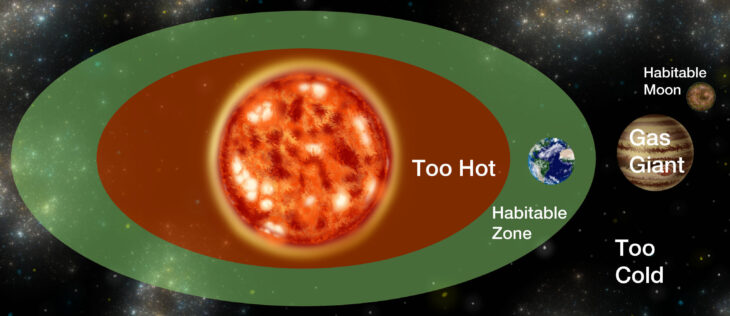
The space around a Sun-like star can be divided into three regions. The region closest to the star is too hot for liquid water to persist on an exoplanet’s surface, while the region farthest from the star is so cold that any water on an exoplanet would be frozen solid. Between these lies the habitable zone, where temperatures would allow liquid water to exist. However, it’s also possible that a combination of light and gravity could create habitable temperatures on large enough moons orbiting gas giants even beyond a star’s main habitable zone. Illustration by <a href="https://www.linkedin.com/in/andrew-bizal-ab14401ab/">Andrew Bizal</a>.

The space around a Sun-like star can be divided into three regions. The region closest to the star is too hot for liquid water to persist on an exoplanet’s surface, while the region farthest from the star is so cold that any water on an exoplanet would be frozen solid. Between these lies the habitable zone, where temperatures would allow liquid water to exist. However, it’s also possible that a combination of light and gravity could create habitable temperatures on large enough moons orbiting gas giants even beyond a star’s main habitable zone. Illustration by Andrew Bizal.

To increase the chances of finding a terrestrial planet in a habitable zone, the team also investigated potentially habitable moons orbiting gas giants in these systems. For each simulation that included a gas giant, the team inserted between 2 and 23 moons, with masses between 10% of Earth’s Moon and 50% of Earth. Then they simulated the surface temperatures of these moons based on how much starlight they receive and how strongly their host planet pulls on them. They deemed the moons potentially habitable if they were large enough to retain an atmosphere and had a temperature ideal for liquid water, even if they were not technically in their stars’ habitable zones.

For each star, the team calculated a metric based on the probabilities that the star had a terrestrial planet in its habitable zone, that the planet would remain in a stable habitable zone for at least 2 billion years, and that the star had a potentially habitable moon. They called this probability statistic a ranking metric and used it to compare star systems.Β 

Based on the ranking metric, the team found that the dimmer and cooler stars on their list generally had better chances of hosting a habitable-zone terrestrial planet than the brighter, hotter stars. They also found that stars without known exoplanets ranked more favorably. Around 70% of the stars with known exoplanets had less than a 1% probability of hosting a terrestrial planet in their respective habitable zones. Additionally, fewer than 0.1% of their simulated moons were habitable.

Overall, the researchers concluded that the HWO should prioritize observing cooler, Sun-like stars with no known exoplanets. They claimed that the exoplanets with known characteristics in their sample set were of sizes and in positions that made it unlikely for other exoplanets to be in their systems’ habitable zones. Even with expanded habitability criteria for moons, it would be very unlikely for HWO to find another Earth orbiting a gas-giant exoplanet. They ranked 47 stars in the highest-priority category (A Tier), 51 stars in the middle category (B Tier), and 66 stars in the lowest category (C Tier) to observe with HWO.Β 

At the end of their study, the team remarked that the proposed HWO represents a potential next step in the search for other Earths, but scientists still need to identify the best targets for this future telescope. The HWO telescope should be able to image rocky exoplanets directly, so thorough research to prepare a list of high-priority targets will help avoid overlooking other Earths.

The post The search for habitable worlds appeared first on Sciworthy.

  •  

Where did the galaxy get its carbon?

Carbon is the 4th most abundant element in the universe. It’s everywhere, from the air you breathe to the carbohydrates in your food to the petroleum in the Earth’s crust. Like most elements, carbon was not created by the Big Bang, but came from 2 different types of stars that fuse lighter elements together.Β 

Massive stars at least 8 times the Sun’s mass fuse 3 helium atoms into a carbon atom in their cores, through a mechanism called the triple-alpha process. They eventually expel this carbon into space, either through a stream of material called a stellar wind or at the end of their lives during a core-collapse supernova.Β 

Meanwhile, low-to-intermediate-sized stars between Β½ and 8 times the Sun’s mass also induce the triple-alpha process. But unlike massive stars, they produce carbon not in their cores, but in a dense shell of helium that surrounds them during an advanced stage known as the asymptotic giant branch or AGB. AGB stars undergo cycles of swelling and contraction, during which they shed some of their material into space.

While scientists understand these processes, the contribution of each star type to the carbon supply in the universe remains uncertain. To address this, a team of scientists modeled how the chemical elements in the Milky Way Galaxy change over time with different contributions from the 2 carbon-creating processes. They then verified their findings by comparing them with the actual carbon concentration in the Milky Way.

To obtain the benchmark for the Milky Way Galaxy’s carbon content, the team turned to the catalog of stars observed by the Apache Point Observatory Galactic Evolution Experiment (APOGEE) survey. They selected 14,066 stars that were large and bright enough to yield reliable data but, unlike AGB and massive stars, were still at a stage of life when their newly produced carbon was still confined to their cores. The researchers used the carbon in the outer layers of these stars, known as subgiants, as a compositional record of the gas from which they formed, thereby estimating the Galaxy’s carbon content during their formation.Β 

The scientists started with a computer program developed by another team that models how the Milky Way’s chemistry changes over time. First, the team calculated the potential amount of carbon produced by different types of stars using estimates from earlier studies. Then, they incorporated these results into a model that accounts for how stars form, fuse elements, and release carbon into the Galaxy, using a simulation program called the Versatile Integrator for Chemical Evolution, or VICE. The researchers ran 14 versions of this model, each assuming a different contribution of carbon from AGB stars relative to massive stars.

In their computer model, the Milky Way Galaxy began as a set of 200 concentric rings, each containing its own population of stars, different speeds at which stars form, and varying amounts of gas available to form new stars. The team then stitched these rings together by having stars migrate between them. They allowed these model Galaxies to settle over 10 billion years, then picked a random sample of 14,066 simulated stars to compare their carbon content with carbon in the same number of observed subgiants from APOGEE.

The team’s model most closely reproduced the actual carbon content of the Milky Way’s subgiant stars when AGB stars contribute between 10% and 40% of the Galaxy’s carbon, with the strongest agreement occurring at 15% to 30%. Even though they found that massive stars are the dominant source of carbon, they also found that smaller AGB stars could produce carbon more efficiently than previously thought, though they take longer to become carbon sources than their larger counterparts.

The team concluded that their estimates of how much carbon comes from AGB and massive stars provide a benchmark for future studies, as the connection between the production of elements inside stars and the processes by which those same stars lose mass remains poorly understood. They suggested that future researchers analyze larger sample sizes, examine other galaxies, and use data from future surveys to better understand the chemical history of the universe.

The post Where did the galaxy get its carbon? appeared first on Sciworthy.

  •  

Finding alien life with light signals

Astronomers and astrobiologists use a wide range of tools in their search for extraterrestrial life. Probes, satellites, and rovers take photographs and collect data on the geology and chemistry of planets and moons in the solar system. Radio telescopes sweep the sky, looking for signals from intelligent civilizations. And telescopes like the JWST can observe the atmospheres of distant exoplanets, potentially finding ones similar to Earth’s.Β 

A limitation of these methods is that they assume life on other worlds is fundamentally similar to life on Earth, requiring the same balance of molecules in the atmosphere, producing the same chemicals for their metabolic processes, or developing technologies analogous to those humans make. While researchers use these assumptions as baseline markers to look for, assuming such similarities might lead them astray. Scientists looking for life using too narrow a set of parameters might miss life unlike Earthlings. Or they might mistake coincidentally similar geological, chemical, or astronomical processes for having been made by living things.

So, to complement techniques that assume alien life resembles life on Earth, scientists also consider approaches that detect signs of life while making as few assumptions as possible about what it could look like, known as agnostic biosignatures. One of these life signs with few assumptions is complexity. Though it can be difficult to quantify precisely, living things tend to create more complex systems than nonliving things. A team of researchers recently tested whether living and nonliving worlds could be distinguished solely by examining the complexity of the light-reflection patterns from their surfaces.

For this, the team treated Earth and Mars, similar planets but one with life and one without, as stand-ins for exoplanets around other stars. They collected data on the light reflected off both planets’ surfaces from a space station monitoring Earth, known as the Deep Space Climate Observatory or DSCOVR, and an orbiter around Mars observing its atmosphere, known as the Hope Probe.Β 

The team identified 3 nearly identical wavelengths of light that these machines observe from their respective planets. From the machine databases, they collected measurements of how much light each planet reflected, called its reflectance, at these 3 wavelengths over 486 local days. By using only individual wavelengths of light rather than full photographs, the team claimed that, if their test worked, researchers could apply it to distant exoplanets that cannot be photographed in detail.

Without looking for any particular chemical or signal, the team compared these measured reflectances using a series of statistical tests to determine the variation and randomness in their reflected light, which they considered representative of the complexity of the planets’ surfaces. The researchers found that of the 27 complexity metrics they tested, Earth scored higher than Mars on 25, Mars scored higher than Earth on 1, and the planets scored the same on 1. So, even though both planets have rocky surfaces with atmospheres, weather, and cyclical changes, the one with life is measurably more intricate and dynamic, and the researchers found this difference detectable even with a small stream of light at great distances.

The researchers claimed their test demonstrated that complexity could be a valid agnostic biosignature, with caveats. One is that Earth is quite distinct from Mars, in that it has oceans and a relatively thick atmosphere. This means that processes like making and dispersing clouds and the sharp contrast between land and water could add complexity to Earth’s measurements without direct ties to living things.Β 

They suggested 2 possible explanations for how these complicating factors relate to life on Earth. Either life allows Earth to have these factors, or Earth is inherently complex regardless of life, and therefore it can’t be used to assess how life leads to measurable complexity. To say which is the case, one would have to replicate this test with a lifeless copy of Earth. However, the team argued that Earth’s biosphere is unlikely to be wholly unrelated to its water cycle.

To bolster the validity of their methods, the team plans to expand their sample of planets to include Venus, Saturn’s moon Titan, and simulated exoplanets with modeled biochemistry and atmospheres. If the model holds up, their methodology could represent a new category of mission to find alien life, with long searches for variations in reflected light uncovering properties of distant worlds that would otherwise go unnoticed.

The post Finding alien life with light signals appeared first on Sciworthy.
  •  

James Webb telescope pinpoints the most distant 'fast radio burst' ever seen

Astronomers have detected the most distant burst of radio signals ever seen: an explosion that's emitting waves of energy from more than 10 billion light-years away.

The event, named FRB 20240304B, is known as a fast radio burst (FRB). Astronomers have detected thousands of FRBs before this. But because these events last only milliseconds, they are extremely difficult to study and their origin stories remain unclear.

In this case, however, astronomers managed to use a radio telescope array and the James Webb Space Telescope (JWST) to chart the event, with JWST narrowing down the precise host galaxy that FRB 20240304B came from. The study, published Thursday (Oct. 8) in the journal Science , sheds more light on a time when the universe was only about 3 billion years old, showing that FRBs arose early in our cosmos' history. The detection more than doubles the previous distance record for FRBs.

The JWST played an instrumental role in the discovery, study co-author Themiya Nanayakkara, a senior lecturer at the Sydney Institute for Astronomy, told Live Science in an email. The email was written in collaboration with study first author Manisha Caleb, a senior lecturer in astrophysics at the same university.

For example, JWST's observations showed that the host galaxy was smaller than expected, was "metal-poor" (had few elements besides hydrogen and helium), and was forming a lot of stars. These characteristics could offer new clues about the environments in which FRBs arise, giving more information about the mysterious events. Researchers suggest that this FRB may have been linked to a magnetar, a highly magnetic star core left after a supernova.

Zooming in with the James Webb telescope

The ancient FRB was initially detected with MeerKAT, an array of 64 radio telescopes in South Africa. Nanayakkara said MeerKAT revealed "both the detection of the fast radio burst and, importantly, a very precise position on the sky."

The researchers knew the FRB was far away because of the large dispersion of the radio signal, but initial searches with powerful ground-based telescopes, "saw essentially nothing; it looked like empty sky," the researchers told Live Science. "The most likely explanation was that the galaxy was simply too faint to be detected in those observations. That is where JWST became transformative."

An illustration of a series of colorful hexagons in front of a pink background

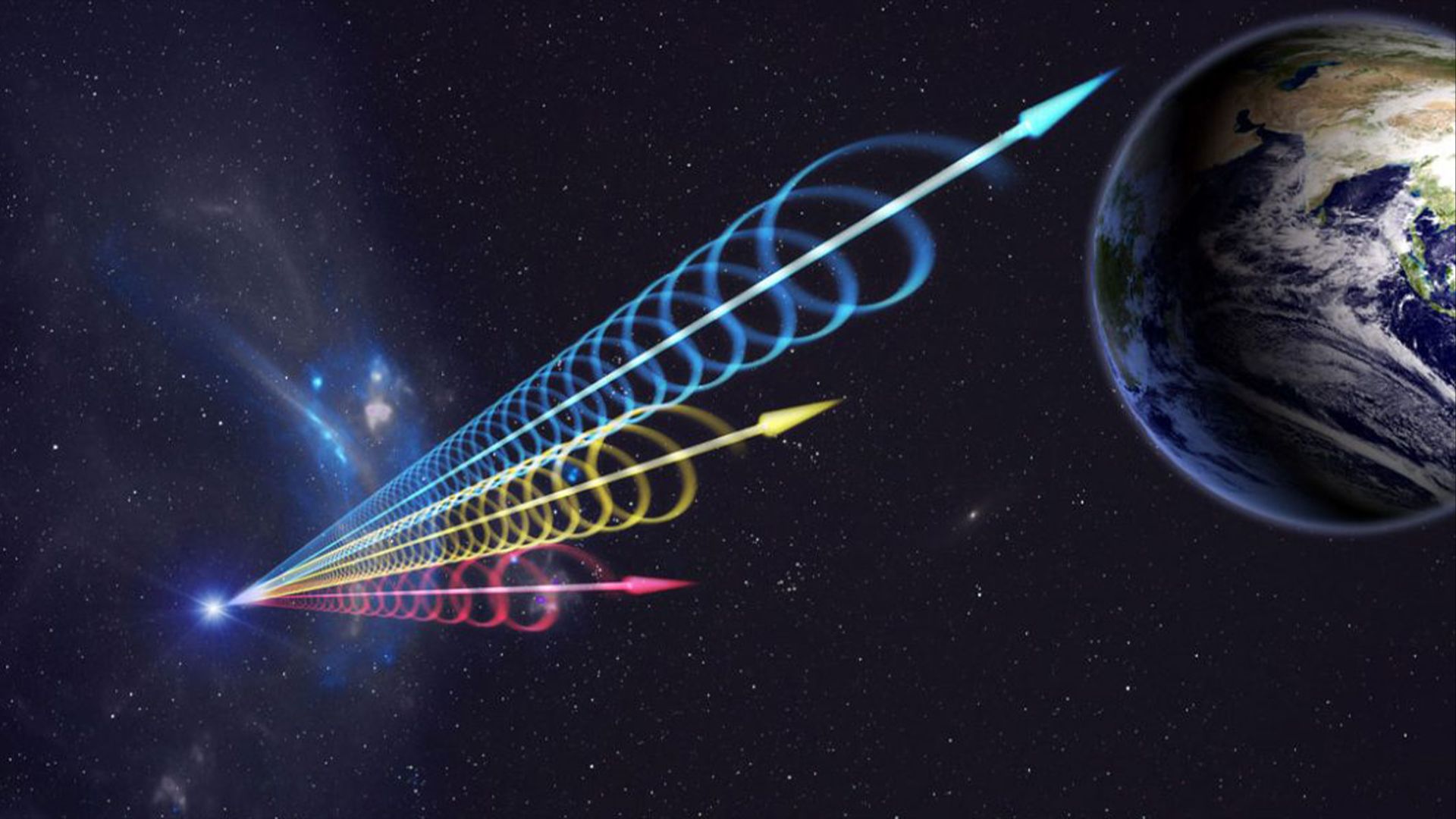
An illustration of a fast radio burst (FRB) being detected by the MeerKAT radio telescope array. (Image credit: Carl Knox - OzGrav, Swinburne University of Technology Background Image Credit: NASA, ESA, CSA, STScI, Themiya Nanayakkara (USYD) Background Image Processing Credit: Joseph DePasquale (STScI))

The science team successfully got time on JWST with a program called Director’s Discretionary Time, which is aimed at time-sensitive observations. The researchers started by using JWST's Near Infrared Camera to trace the radio signal and take a very deep image of the target region.

"Suddenly, there it was: a very faint galaxy almost exactly where we expected the host of the FRB to be," Nanayakkara said. The researchers then used JWST's Near Infrared Spectrograph to obtain a spectrum (wavelengths of light broken into different chemical signatures), which showed hydrogen and oxygen.

"These spectral features act like fingerprints: because we know the wavelengths at which they are produced in the laboratory, we can measure how much they have been shifted by the expansion of the universe," Nanayakkara explained. "That gave us a very precise redshift of about 2.15. We are therefore seeing this galaxy as it was when the universe was only around three billion years old, so roughly one-fifth of its current age."

Because the host galaxy is fairly young, it supports the idea that at least some FRBs are generated by magnetars, which are more likely to appear in spry galaxies where intense star formation is occurring, the team said.

The team plans to continue hunting for FRBs with JWST.

"We do not know what the sources will be yet," Nanayakkara said, as that depends on what pops up in the sky and is spotted by ground-based radio telescopes. "Once our radio telescopes find and localize a suitable new source, we can trigger the JWST observations. So it is quite exciting, because we really have no idea what we will find when we combine the power of these two types of telescopes."

  •  

The Milky Way is one galaxy β€” but it used to be thousands, new simulations reveal

Long before it became the luminous spiral galaxy we call home, the Milky Way was a sprawling, chaotic swarm of thousands of small galaxies, new research shows.

The findings suggest that in the first 2 billion years after the Big Bang, the region of the universe that would become our galaxy was littered with thousands of smaller galaxies of many sizes and shapes. Over time, these galaxies collided and merged into the single galaxy in which we reside today.

"Looking at these results, it's very clear that the physics happening right after the Big Bang has direct impact on what we see today in the local universe," study co-author Harley Katz, an assistant professor of astronomy and astrophysics at the University of Chicago, said in a statement.

To understand more about the early universe, astronomers build sophisticated computer models that encode the laws of nature to see how the cosmos may have evolved. The new work, which is the result of three years of supercomputer simulations, is the most detailed tracing yet of how a galaxy like ours came to be. It also arrives just as astronomers need a stronger yardstick for what they're seeing in the early universe.

Megatron, the cosmic transformer

The James Webb Space Telescope (JWST) can peer farther into the early universe than any previous telescope, and its discoveries have often defied computer models. For instance, JWST found surprisingly bright early galaxies and a mysterious new class of compact galaxies dubbed "Little Red Dots." These anomalies demonstrate that current computer models need an update to handle the complex physics of the early universe, the researchers said.

To bridge that gap, the scientists built a new suite of supercomputer simulations they call Megatron. By tracing ancient gas, starlight and chemistry from 180 million years to 2 billion years after the Big Bang, Megatron predicts the distinct light signatures of its virtual galaxies, according to the statement. Because JWST collects the same type of spectral data across a similar span of cosmic time, scientists can directly cross-reference the simulation against real observations to pinpoint what the old models are missing, the team said.

The simulation also tracks how the universe's first stars formed, died and forged the essential elements that make life as we know it possible. By comparing the simulation with JWST observations of early galaxies and with the chemical traces left in ancient stars, scientists can better understand how those first stars enriched their surroundings, the researchers said.

"Together, these complementary observations allow us to test competing models of the first stars in ways that weren't previously possible," study co-author Martin Rey, a theoretical astrophysicist at the University of Bath in the U.K., said in a separate statement.

The scientists detailed their findings in one of the six papers the Megatron collaboration published Sept. 30 in The Open Journal of Astrophysics.

Assembling the Milky Way

The team's simulation begins 180 million years after the Big Bang, when the universe is devoid of stars and galaxies and holds only pristine gas. As the next 2 billion years pass,, the model captures how the very first stars light up the dark universe and kick off "cosmic dawn," eventually culminating in those stars' violent deaths. As they die, the stars spread newly forged heavy elements such as carbon, oxygen and iron into the surrounding gas, laying the building blocks for future stars and planets.

A glowing circular galaxy in deep space.

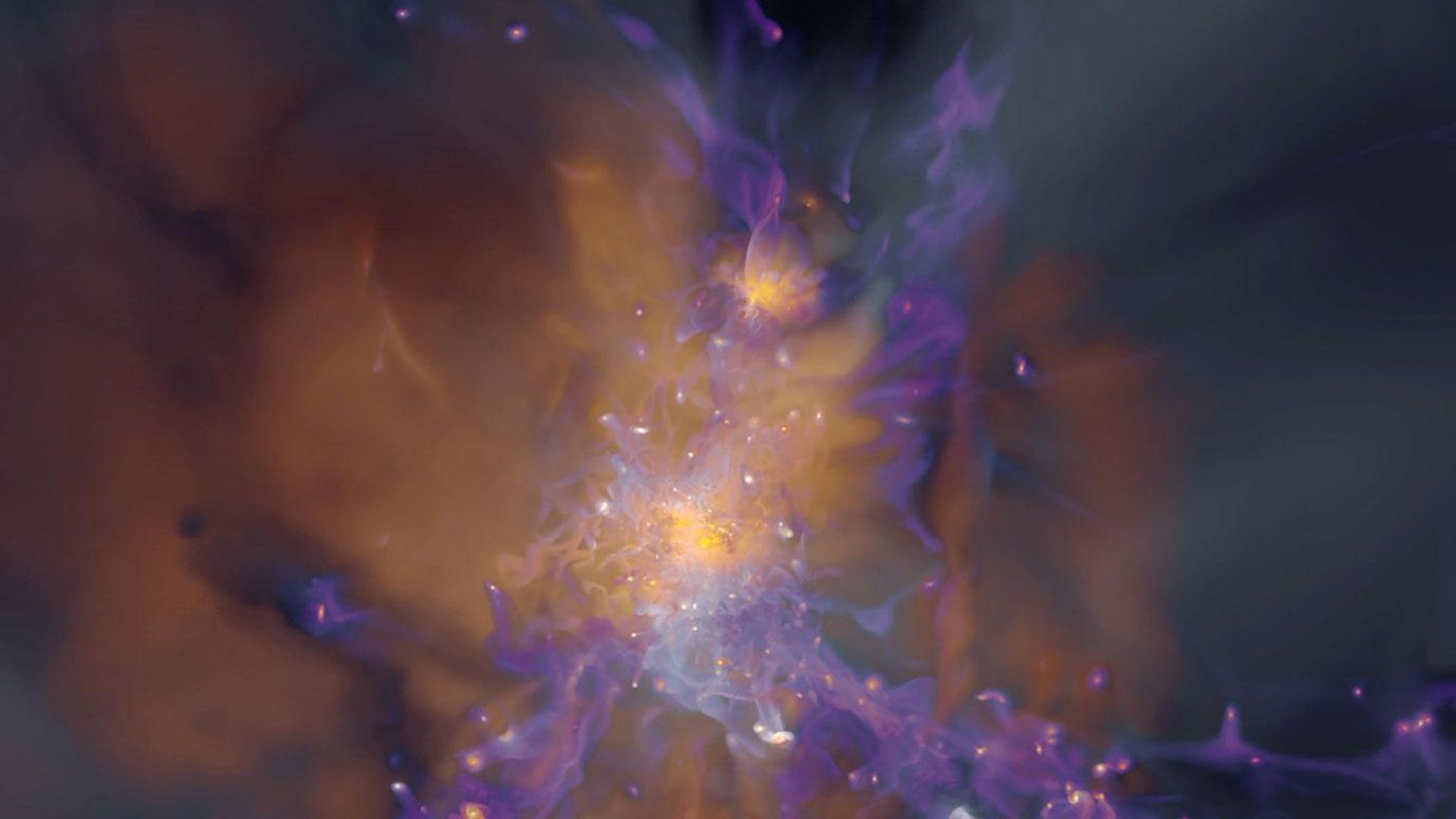
A simulated view of what the Milky Way may have looked like 12 billion years ago. The bands of light are remnants of a galaxy collision, one of the thousands of mergers that the new study says built our galaxy. (Image credit: Harley Katz/MEGATRON Collaboration)

The simulation ends 2 billion years after the Big Bang, but the Milky Way's mergers continued long after this point, and scientists are still discovering traces of the small galaxies that have joined it. The most recent massive merger, with the Sagittarius dwarf galaxy, began more than 6 billion years ago and is still unfolding.

The simulation results help scientists understand how certain physics parameters impact the early universe, and better match up JWST's observations with computer models. But it also highlights areas that need further study.

"But there are also things we're not getting right, which is interesting too β€” what are the parts we're still missing?" Katz said in the statement. "That can lead you into new directions and new questions."

Megatron team members in the U.K. are now developing the next generation of simulations, backed by dedicated time on the country's supercomputers. Those simulations will include more complex physics, such as active black holes, which JWST has revealed to be surprisingly common in the early universe, the researchers said.

How well do you know our home galaxy? Find out with our Milky Way quiz!

  •  

1,000-mile-long cloud that forms and vanishes on Mars every day obeys 'exotic physics' never seen on Earth

A 1,000-mile-long (1,600 kilometers) Martian cloud that emerges and then quickly disappears from the Red Planet's sky nearly every day is even weirder than scientists realized. New simulations suggest that the eerie apparition can only be explained using "exotic physics" that have been theorized but never seen on Earth or anywhere else in the solar system.

The mysterious floating mass, dubbed the Arsia Mons Elongated Cloud (AMEC), frequently emerges above Arsia Mons, a 12-mile-tall (20 km) extinct volcano located in the Tharsis region, just south of the Red Planet's equator. The water vapor cloud was first spotted in 2018 by the European Space Agency's Mars Express orbiter and has since appeared nearly every morning throughout Mars' spring and summer, when increased solar radiation triggers strong surface winds. But it lasts only a few hours each day, before fully evaporating.

The AMEC can stretch up to 1,100 miles (1,800 km) long, around one-twelfth of Mars' circumference. For context, that is roughly twice the length of the U.K. or the distance between New York City and Miami.

Although the Red Planet is no stranger to giant dust clouds and occasional "iridescent streaks" of carbon dioxide, it is almost completely devoid of atmospheric water vapor. That makes it extremely rare for puffy, Earth-like clouds to form there, let alone ones so vast. As a result, scientists have struggled to explain this whacky weather.

But in a new study published Wednesday (Oct. 7) in the journal Nature Geoscience, researchers used Mars Express data to create new simulations in an effort to finally explain the AMEC. Initially, the team struggled to recreate the puzzling phenomenon. But when they abandoned traditional meteorological principles in favor of a more out-of-the-box explanation, they were eventually successful.

A top-down photo of the cloud next to Arsia Mons

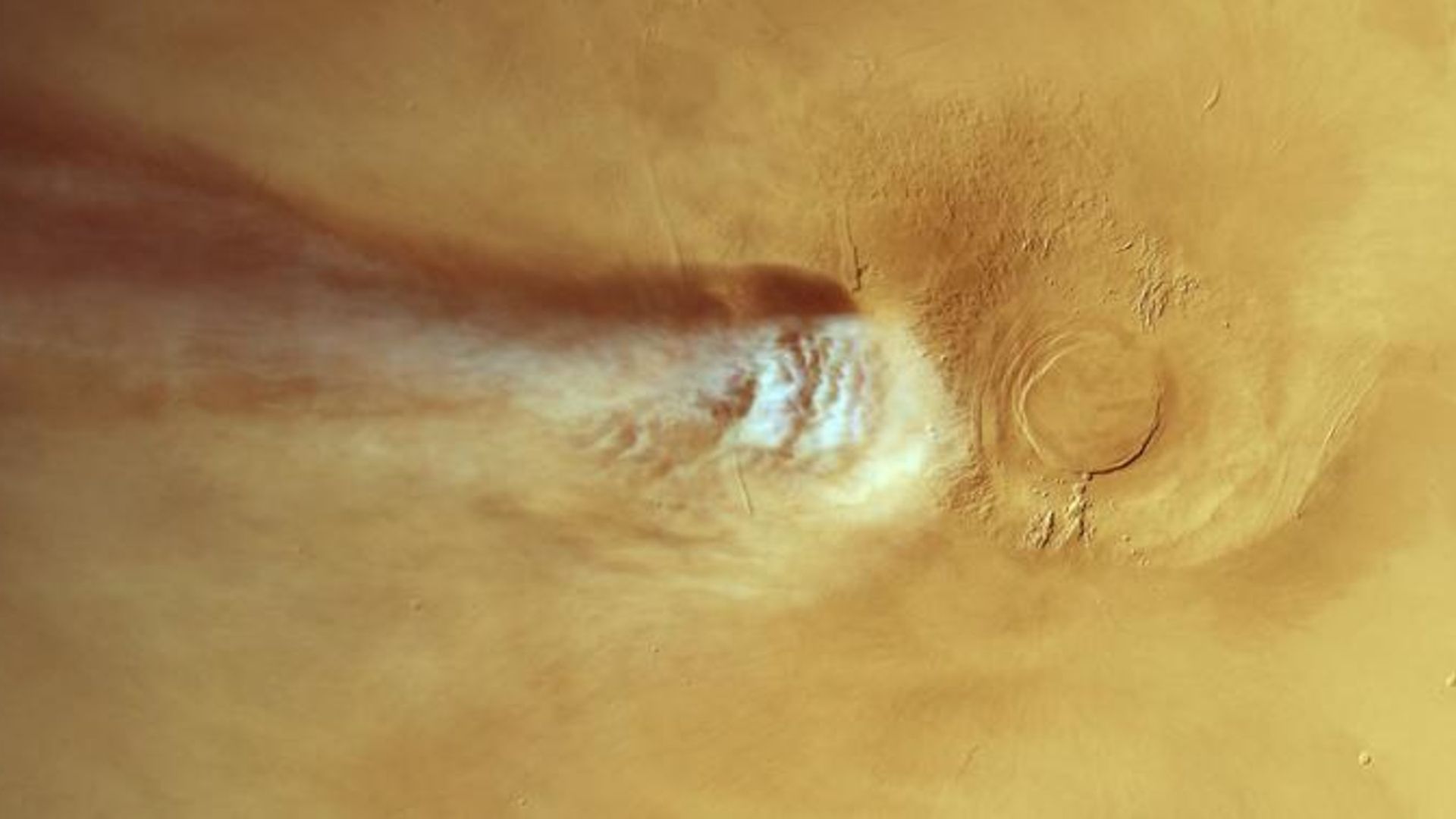
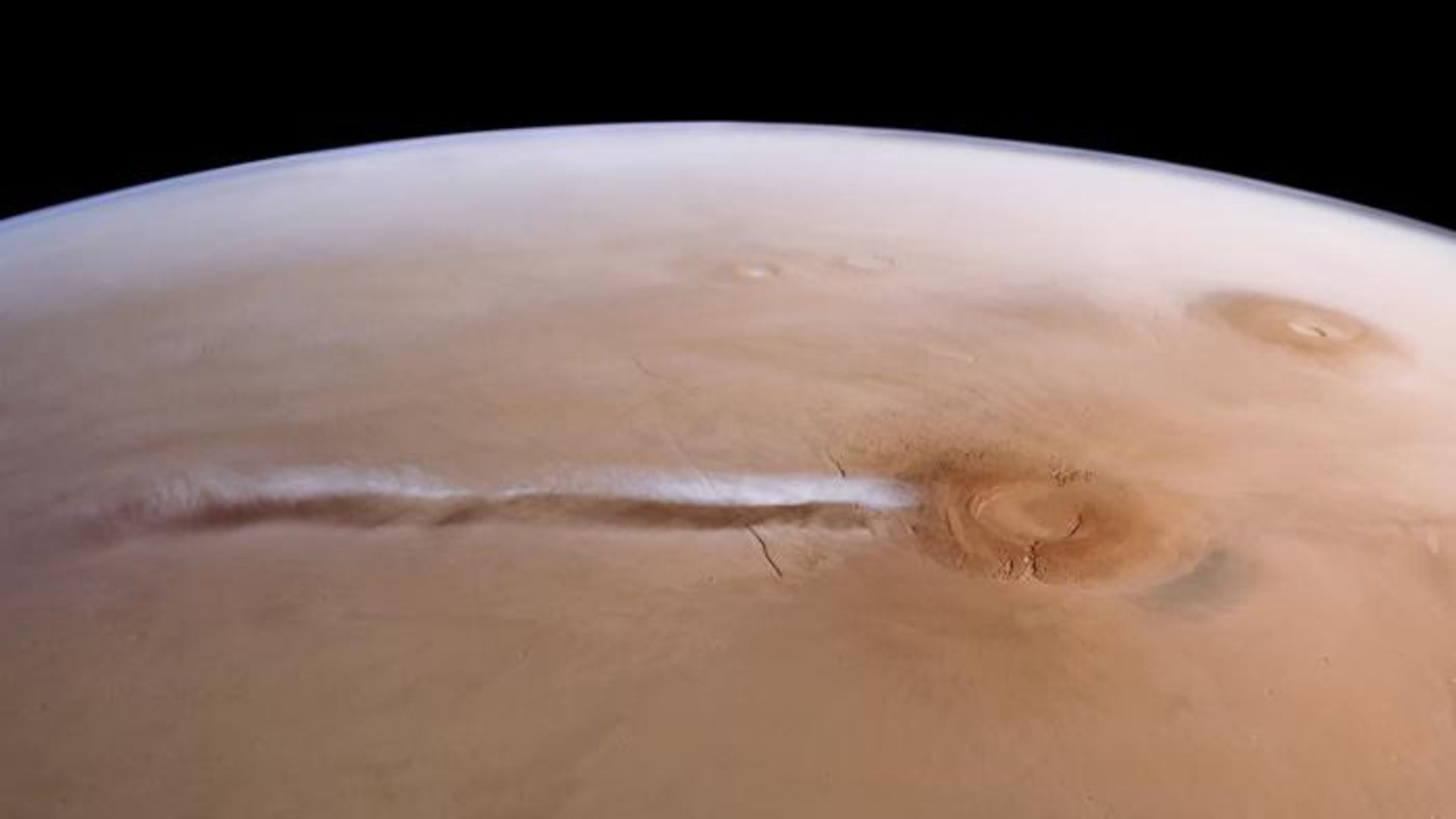
The AMEC forms when summer winds push water vapor up and over the 12-mile-high slopes of Arsia Mons. But it only lasts for a couple of hours at a time. (Image credit: ESA/DLR/FU Berlin)

"To create the AMEC in our modelling, we found that we needed to include some exotic physics … physics that, while included in textbooks, is treated as theoretical and usually thought not to happen in nature," study first author Jorge HernΓ‘ndez-Bernal, a planetary scientist at the University of the Basque Country in Spain who was affiliated with Sorbonne University in Paris at the time of the study, said in a statement. "Once we included this physics in our simulations, the AMEC emerged just as we hoped."

"Wholly unexpected"

The AMEC is an orographic cloud, meaning it forms as strong winds push water vapor up and over a raised structure, such as a mountain. Similar clouds also exist on Earth, including the "Levanter" cloud, which occasionally forms above the Rock of Gibraltar in southern Europe. However, the Martian equivalent cannot be explained by the same processes that occur on our planet.

On Earth, clouds form via a process called heterogeneous nucleation, in which moist air cools and condenses into ice crystals that form around tiny atmospheric particles, such as dust, salt, pollen or soot. But while Mars has plenty of atmospheric dust, that's not what's happening there.

"For the AMEC, it seems that cloud formation takes place without needing any of this 'stuff' [in the air]," said HernΓ‘ndez-Bernal, who has been studying the AMEC for the past six years. "Water vapour turns directly into icy cloud particles without any middle step. It's akin to droplets of condensation appearing in the middle of a room, rather than on a window."

The researchers call this "homogeneous nucleation" and say it has never been seen before in a planetary atmosphere. "It's wholly unexpected," HernΓ‘ndez-Bernal added.

A blurry photo of Arsia Mons towering over the surface of Mars.

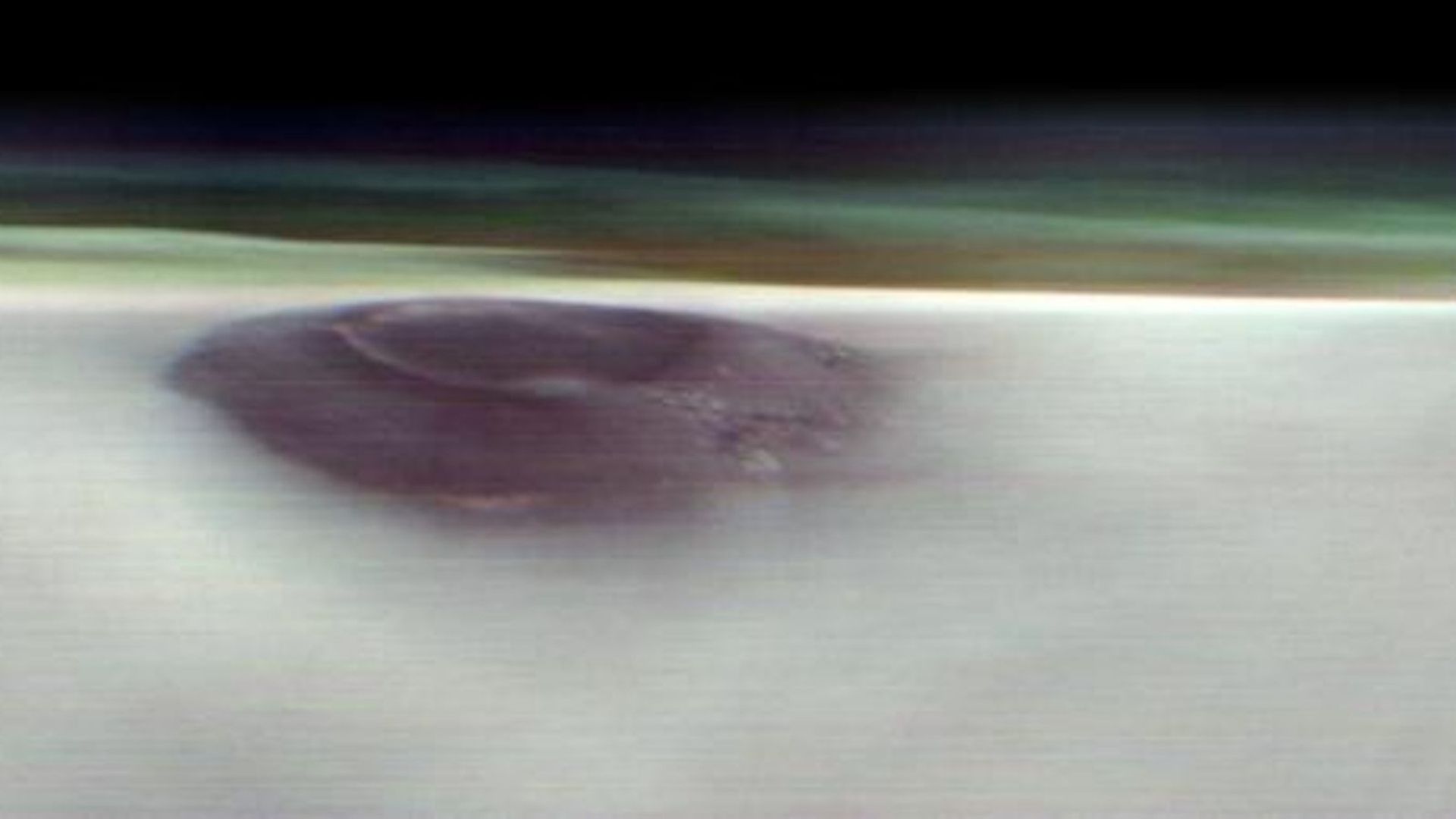
Arsia Mons is the second-tallest volcano on Mars behind Olympus Mons, but is twice as tall as Mount Everest. This image, captured by NASA's Odyssey orbiter, helps give a scale of how huge the Martian mountain really is. (Image credit: NASA/JPL-Caltech/ASU)

Other scientists previously predicted that homogeneous nucleation could occur in Earth's upper atmosphere or in the skies above Venus. However, this has been deemed highly unlikely because it requires humidity levels roughly 100,000 times greater than those on our planet's surface.

Given that modern-day Mars is almost completely devoid of water, it may seem unlikely that its humidity levels could reach such lofty heights. However, the Mars Express data tells a different story.

As wind rises up the slopes of Arsia Mons, which is more than twice as tall as Mount Everest, it creates a powerful wave that shoots air into the upper atmosphere at tremendous speed. The researchers calculated that the temperature of this air can drop by up to 54 degrees Fahrenheit (30 degrees Celsius) in just 10 minutes. This not only makes it easy to freeze but also greatly increases the humidity within the wave, allowing homogeneous nucleation to take place, the simulations show.

So where does all this water come from? Some of it is already in the atmosphere, but some likely originates at the summit of Arsia Mons, which is covered with a thick layer of frost, the researchers suggested.

"A big success"

The new simulations mark a big step forward in our understanding of the AMEC and wider Martian meteorology.

"We don't have nearly as much information about Mars' atmosphere as we do about Earth's, so reproducing the AMEC to this degree is a big success for the model," HernΓ‘ndez-Bernal said.

Two side-by-side photos of Mars as a crescent in space with the cloud stretching across its surface

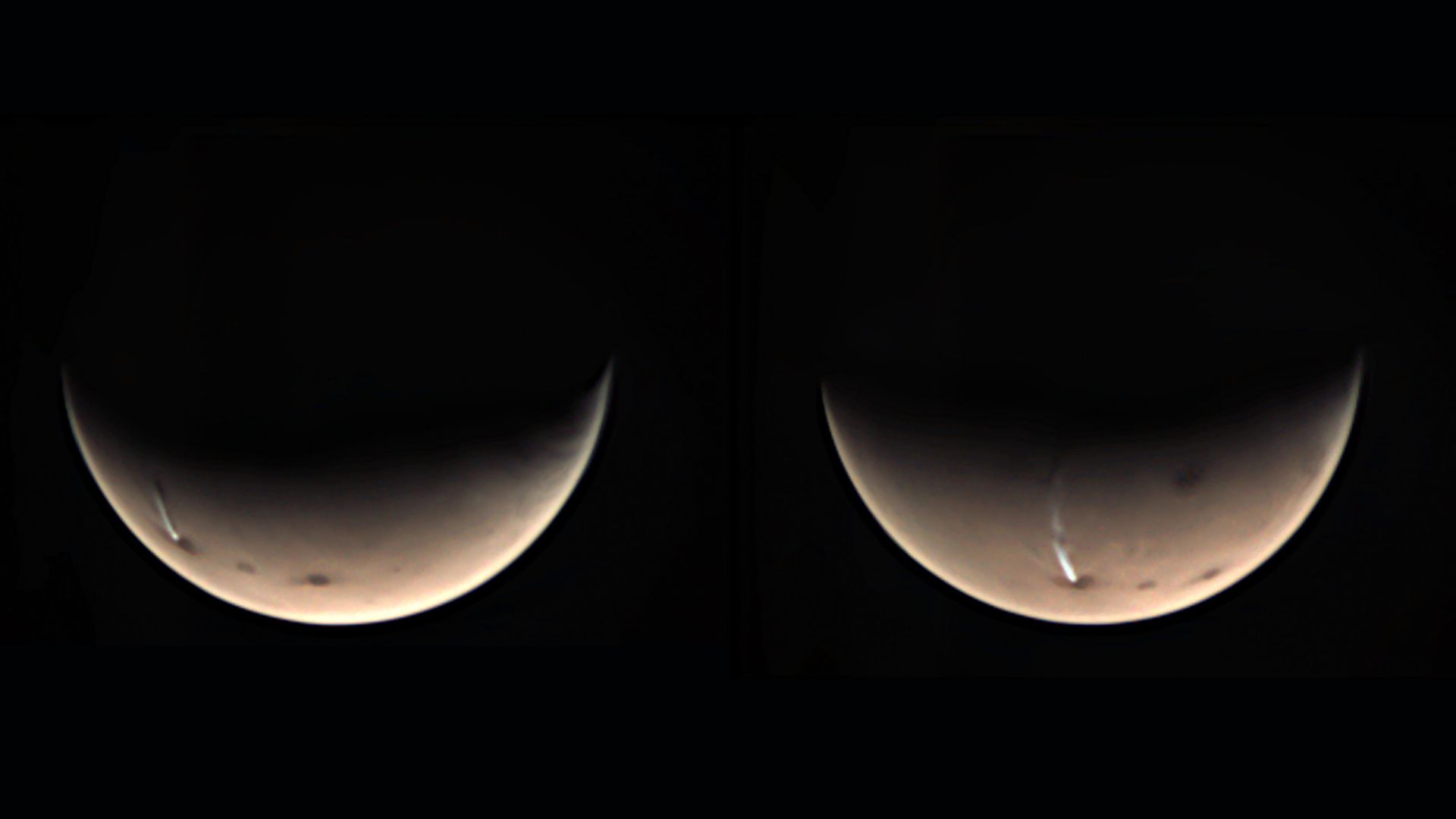
Mars Express has been closely monitoring the AMEC since 2018. These photos show the cloud appearing over consecutive days in July 2020. (Image credit: ESA/GCP/UPV/EHU Bilbao)

The findings would not have been possible without the Mars Express orbiter, which used three instruments β€” the Visual Monitoring Camera, the High Resolution Stereo Camera and the OMEGA instrument β€” to map out how the AMEC takes shape and evolves every day. It is also one of the only Mars spacecraft that can see Arsia Mons in daylight.

"Mars Express discovered the AMEC, has followed up and monitored it for years, and is now helping reveal the secrets of its formation," Colin Wilson, the project scientist for Mars Express, who was not involved in the new study, said in the statement.

The discovery is also a reminder that, despite sharing the same basic principles, weather systems do not behave the same on other worlds as they do on Earth, which could have big implications for solar system exploration and the hunt for extraterrestrial life on distant exoplanets.

"While clouds on Earth and Mars seem to be governed by the same 'rules', understanding this exotic Martian cloud required exotic physics β€” and this may be true elsewhere in the cosmos," Wilson said.

  •  

'Completely unexpected': Astronomers spy never-before-seen 'phoenix planet' rising from the ashes of a dead star

Astronomers have spotted a never-before-seen type of "phoenix planet" rising from the ashes of a dying alien sun. The discovery, which the scientists say was "completely unexpected," raises hopes that more of these reborn alien worlds could be lurking throughout the cosmos β€” and may offer a glimpse of our own solar system's fate.

The unnamed exoplanet was spotted circling the white dwarf HS 0209+0832, which is located roughly 270 light-years from Earth. White dwarfs are stellar remnants, sometimes dubbed "zombie stars," that form from the leftovers of massive red giants that run out of fuel before eventually collapsing into shriveled husks. HS 0209+0832 is a particularly young white dwarf, still burning at around 63,000 degrees Fahrenheit (35,000 degrees Celsius), which suggests it made this transition within the past few million years.

Scientists previously discovered some surprising heavy elements within the visible spectrum of HS 0209+0832, which was first captured by the Hubble Space Telescope in the late 1990s. These elements β€ͺ—‬ which included aluminium, titanium and nickel β€ͺ—‬ are not normally found inside white dwarfs, so their presence suggested that something unusual was going on. But until now, there was not enough data to figure out what.

In the new study, published Oct. 5 in the journal Nature Astronomy, researchers took a closer look at HS 0209+0832. Using some of Hubble's updated instruments and data from other observatories, the team captured a more detailed spectrum of the stellar zombie. This revealed a high concentration of additional heavy elements, including zinc and copper, as well as niobium, which has never been seen in a white dwarf before.

The researchers think these out-of-place elements were created during the death throes of the former red giant and later coalesced into a "second-generation" planet around the newly forged white dwarf. They suspect the atmosphere of this hypothetical planet is being stripped by the white dwarf's stellar winds, causing the rare elements to fall back onto the zombie star.

Four illustrations showing the stages of the star's life from main sequence star, to red dwarf, to white dwarf and then with an exoplanet companion

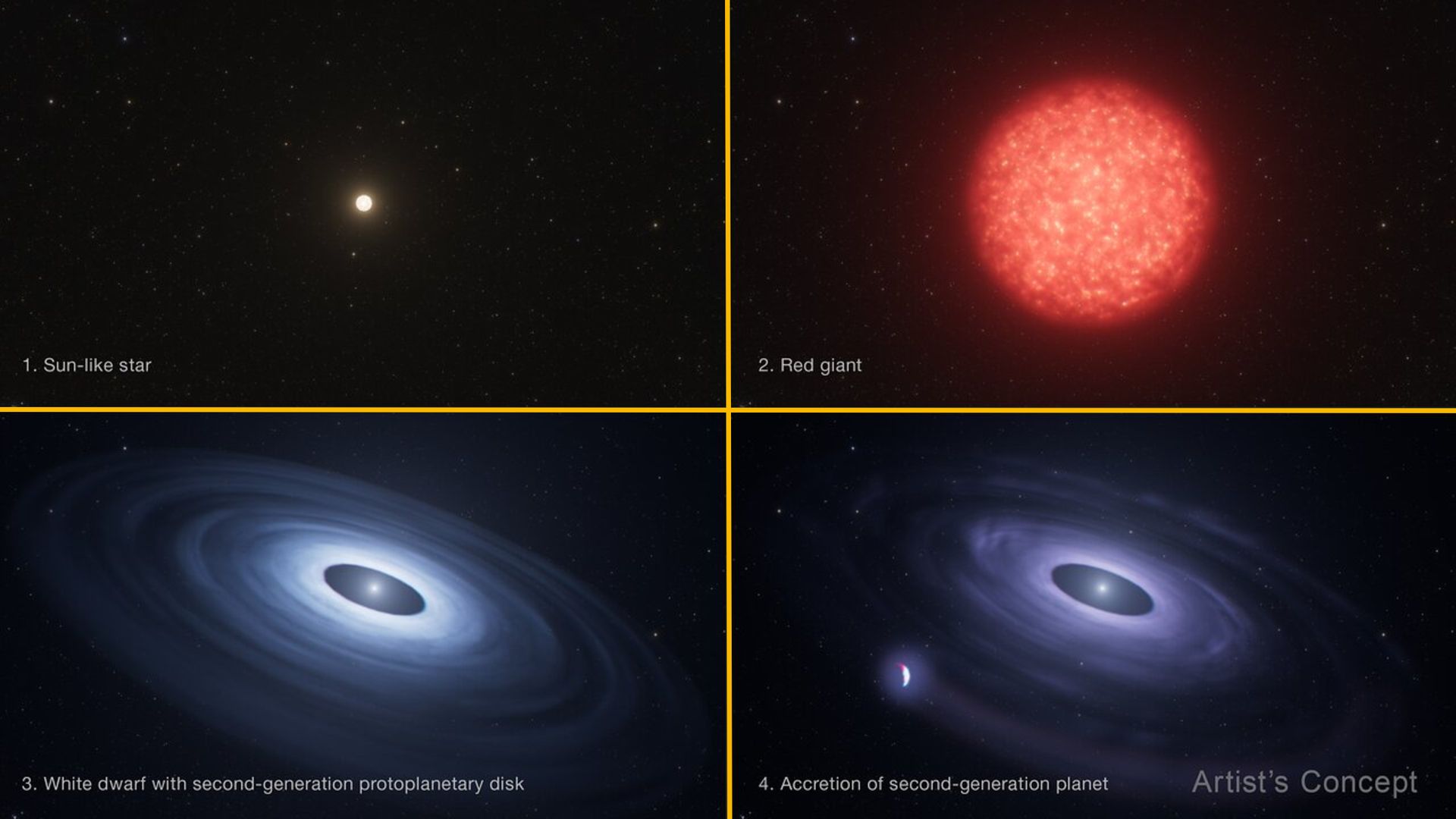
HS 0209+0832 was once a main-sequence star like the sun (top left) that ballooned into a red giant after it ran out of fuel (top right). Eventually, it collapsed into a white dwarf (bottom left), before an exoplanet emerged from the ashes of the red giant (bottom right). (Image credit: NASA, ESA, L. Hustak (STScI))

Follow-up observations then revealed a recurring dip in the brightness of HS 0209+0832, suggesting that an exoplanet was repeatedly passing in front of the undead star. Based on the alien world's orbit, which lasts approximately 4.4 Earth days, and the duration of its transits in front of the star, the team predicted that the planet is roughly the size of Jupiter. (Its close proximity to the white dwarf also supports the hypothesis that its atmosphere is being stripped away.)

"Second-generation planets are worlds that form out of the material a star casts off as it dies," study first author Jamie Williams, a doctoral candidate in astronomy and astrophysics at the University of Warwick in the U.K., said in a statement. "They're incredibly rare, and finding one around a white dwarf was completely unexpected. It's a bit like finding a planet that has risen from the ashes of the very star it once orbited."

"Completely unexpected"

This is not the first time astronomers have spotted an exoplanet around a white dwarf. For example, in 2019, some of the authors of the new study previously spotted an alien world surrounding the white dwarf WDJ0914+1914. However, in that case, they were confident that it was a first-generation world that somehow survived its star's fiery end.

But the heavy elements that seem to be falling onto HS 0209+0832 β€” and the relative lack of other elements common in first-generation planets, such as silicon and iron β€” suggest that's not what's happened for this recently detected world.

"This pattern of elements is a telltale sign of the 's-process,' a nuclear reaction that builds heavy elements inside dying stars during their bloated red giant phase," study co-author Nicholas Stone, an astronomer at the University of Wisconsin-Madison, said in the statement. "It's a chemical signature no ordinary, 'first-generation' planet should carry, which told us that this new planet was something different."

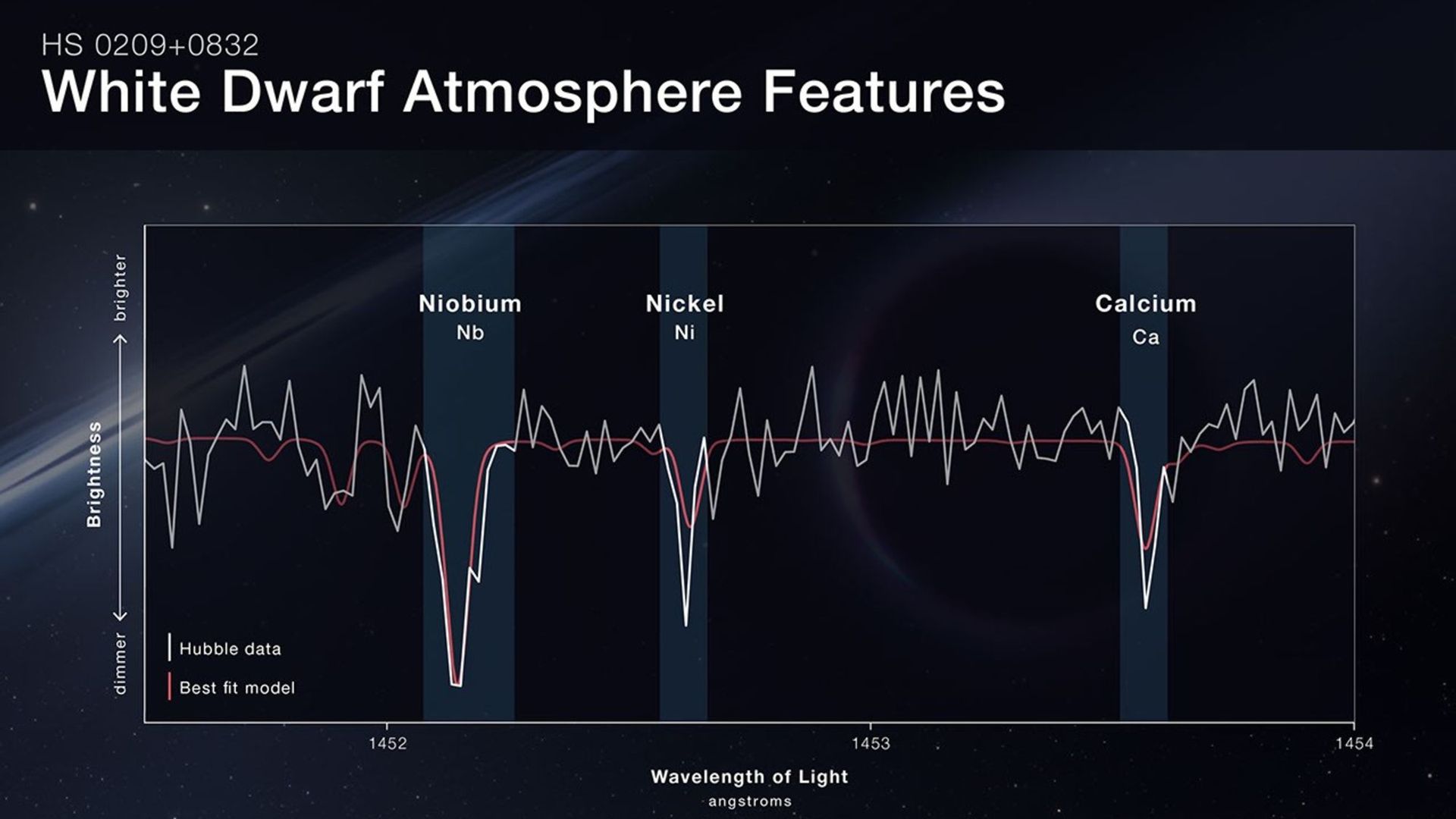
A graph showing the visiblespectrum of the white dwarf star

The elements in HS 0209+0832's visible spectra, strongly suggested that it was accreting material from a second-generation exoplanet. The transit data later confirmed this theory. (Image credit: Illustration: NASA, ESA, Leah Hustak (STScI))

Instead, the newly detected exoplanet likely formed directly from the material that was shed by the dying red giant after it expanded and before it collapsed in on itself.

Similar phoenix planets have been spotted alongside other stellar remnants, such as pulsars, which form when stars explode as supernovas. However, until now, such worlds have never been seen around a white dwarf.

Rising from the ashes

"What's remarkable about the planet around HS 0209+0832 is that this isn't a planet from somewhere else, or a survivor from the system's birth, it looks like it was built from the very material its own star cast off as it died," study co-author Boris GΓ€nsicke, an astrophysicist at the University of Warwick who also helped to discover the exoplanet around WDJ0914+1914 in 2019, said in the statement. "In a sense, this system has given birth to a new world using the foundations of the old one."

HS 0209+0832 may have once harbored other exoplanets when it was a red giant. But if they existed, these alien worlds likely perished in flames as the dying star ballooned β€” similar to what experts think will happen to Earth when the sun runs out of fuel and transitions into a red giant in around 5 billion years.

An artist's interpretation of what the new exoplanet may look like

HS 0209+0832's exoplanet likely has very little to no atmosphere left due to strong gusts of stellar wind stripping it away. (Image credit: Dr Snehalata Sahu/University of Warwick)

Once the sun has finished bulging, it will turn into a white dwarf too. The new discovery hints that our star could also host brand-new worlds after it has transformed, creating a sort of solar system 2.0.

"Finding this one example raises the question of how many more might be out there and might our own solar system host a second-generation planet formed from the ashes of our sun," GΓ€nsicke said.

However, more work is required to figure out exactly how the newfound exoplanet formed and, as a result, how likely this scenario is. The researchers suspect that another object, such as a lost stellar sibling, may have been required to create the new world.

"Forming the protoplanetary disc in this situation is not easy and helps explain why these planets are so rare," Williams said. "To form a disc of material necessary to birth a planet, HS 0209+0832 likely required a companion star that pulled the ejected material back into orbit, rather than letting it escape."

  •  

The Draconids, an unpredictable shower that can bring hundreds of meteors per minute, has begun

The Draconids, one of the year's most unpredictable meteor showers, will peak this week. Although only a few "shooting stars" are expected, the shower has a history of producing spectacular meteor storms with little warning.

The Draconid meteor shower takes place Oct. 6-10 each year, peaking on Oct. 8-9, when around 10 "shooting stars" per hour are expected. Whereas most meteor showers are best seen after midnight or during the dark hours before dawn, the best time to view the Draconids is in the evening, according to Timeanddate.com, making it one of the more convenient meteor showers of the year. Just after dark Thursday (Oct. 8) will be the best time to look.

The Draconids are different from most other showers because their radiant β€” the point from which their meteors appear to originate β€” is in the constellation Draco, the Dragon, which is highest in the sky in the evening. It's also circumpolar in much of the Northern Hemisphere, so it never sets below the horizon. However, there's no need to stare directly at Draco, because meteors can appear anywhere in the sky.

This year, the Draconid meteor shower peaks at the perfect time of the month for dark skies. Because the new moon occurs Saturday (Oct. 10), there will be no significant moonlight when the Draconids reach maximum activity.

However, the Draconids are notoriously unpredictable; while just a handful of meteors per hour are expected, the shower can sometimes produce huge meteor storms. For example, during the Draconids' peak in 1933, Europe saw 500 meteors per minute, according to NASA, and during the 1946 peak, 50 to 100 meteors were seen per minute in the U.S.

The source of the Draconids is Comet 21P/Giacobini-Zinner, which was discovered in 1900 and orbits the sun every 6.6 years. It was last in the inner solar system in 2025 and will return in 2031.

Each October, Earth passes through streams of dust and debris left along the comet's orbit. When those tiny particles strike Earth's atmosphere, they heat up and vaporize, creating streaks of light in the night sky.

Most observers will probably see only a few Draconids this year, but with a meteor shower this unpredictable, it's always worth looking up. The best way to see the Draconids is with the naked eye, but a good pair of stargazing binoculars or a nice backyard telescope will help you enjoy the feast of fall skywatching events on the horizon. Amazon has great deals on skywatching gear this week, so it's a perfect time to get involved.

  •  

Earth is in the firing line of a strange new type of cosmic object, astronomers say

Researchers have observed the strongest candidate yet for a "microblazar" β€” a dazzling object that has long been predicted to exist but never spotted.

Observations of microblazars would give astronomers closer views of black holes emitting powerful jets of energy and help them understand how these extreme objects behave.

Blazars are some of the most energetic objects in the universe. They are a type of quasar β€” a brightly glowing object fueled by a supermassive black hole stripping material from its host galaxy and then ejecting some of it in powerful, opposing jets of particles and radiation. To qualify as a blazar, one of those near-light-speed jets needs to point directly at Earth. Astronomers have previously discovered smaller versions of quasars, dubbed microquasars, and long theorized that there must be smaller versions of blazars as well.

Now, an international team led by astronomers in Spain, the Netherlands and Argentina has described a microblazar in a study accepted for publication in the journal Astronomy and Astrophysics.

"It is the first time that we have a serious candidate," Josep MartΓ­, an astronomer at the University of JaΓ©n in Spain and first author of the study, told Live Science.

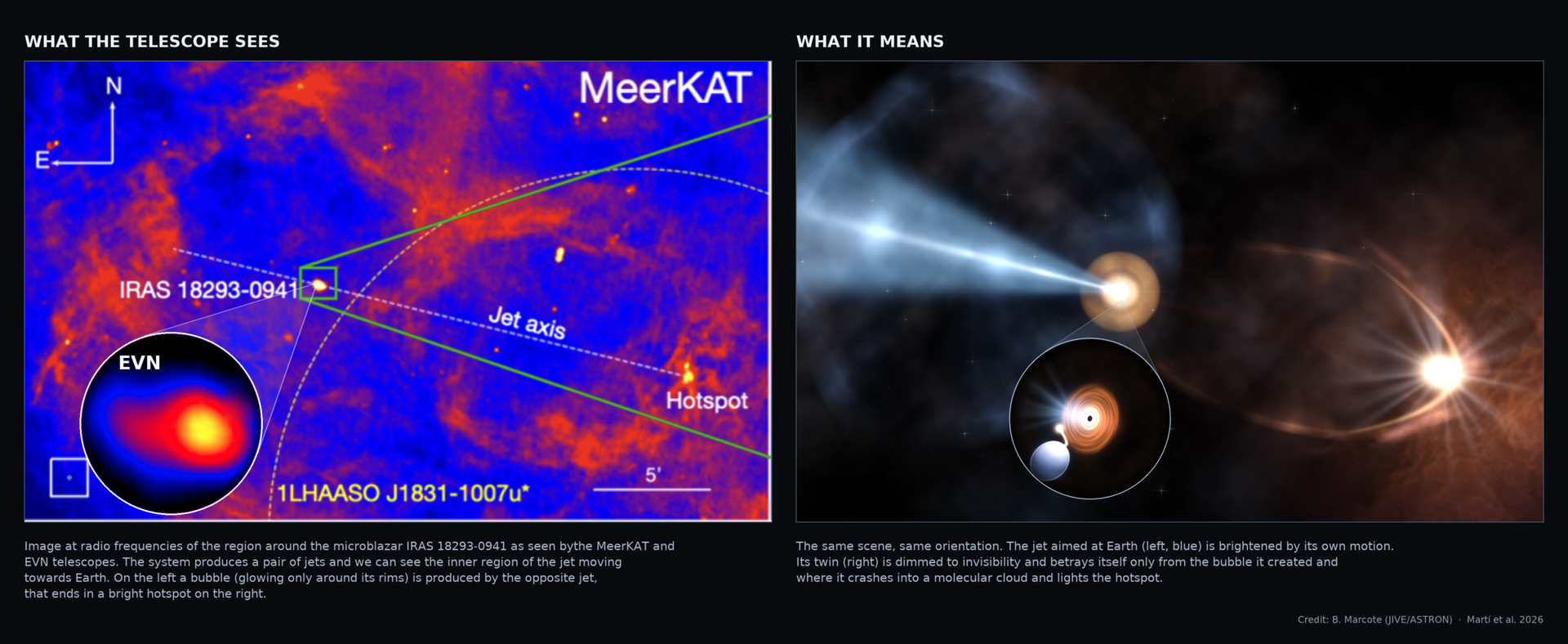
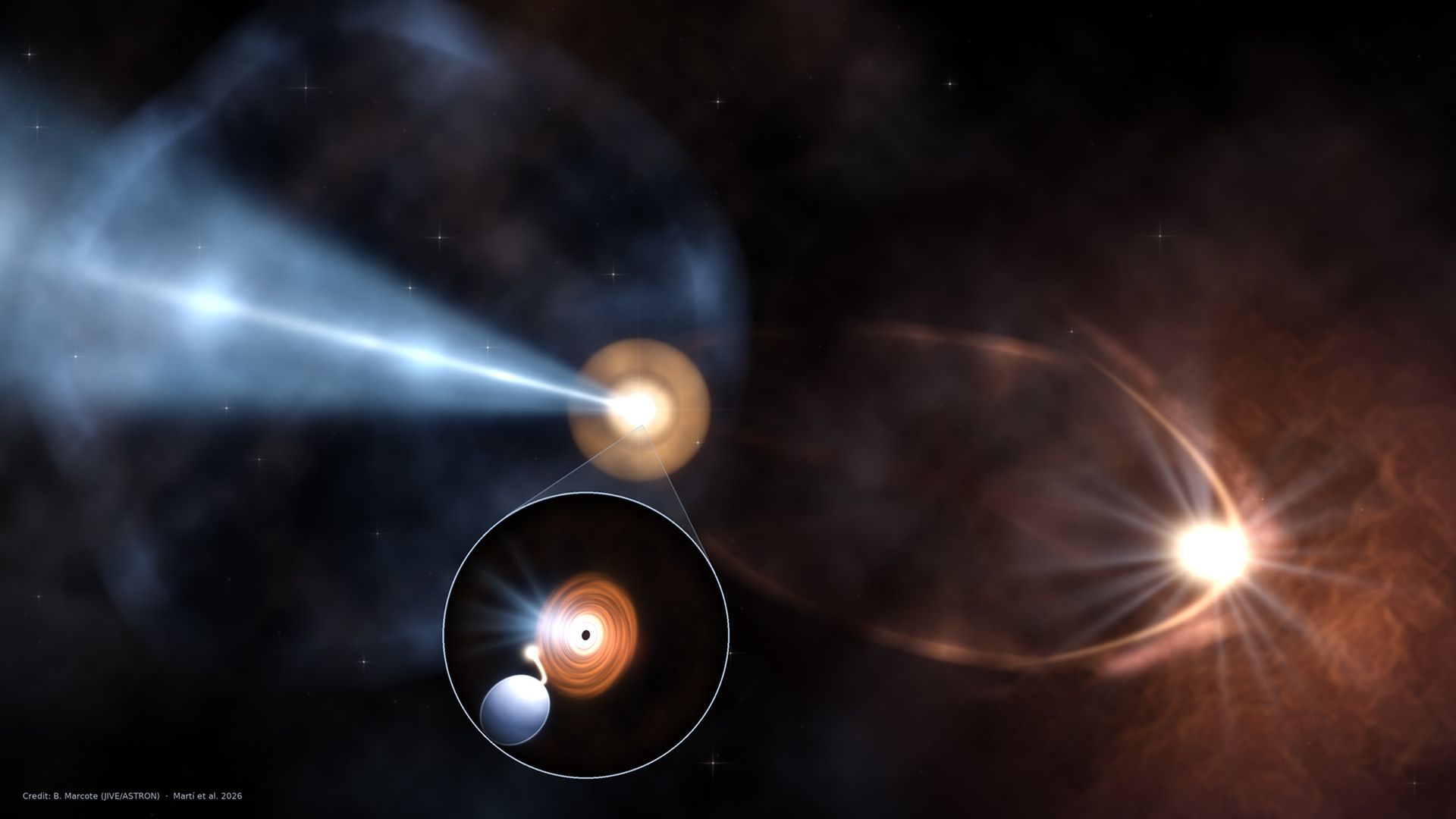
The object, called IRAS 18293-0941, is located in our galaxy, about 12,000 light-years from Earth, and it's hidden behind a veil of dust. It is a binary system that includes a black hole that orbits a hot, gigantic star every 11 days. Matter from the star falls into the black hole, and some of this material is jettisoned into the surrounding environment in two opposing jets. One of those jets flares toward Earth.

An image of a glowing ball of light against a dark background, with a heat map comparison next to it.

Comparison between the astronomical images of IRAS 18293-0941 (left) and the artist's impression (right). (Image credit: B. Marcote (JIVE/ASTRON).)

These objects, as well as microquasars in general, are tricky to observe, MartΓ­ said. "Because of stellar evolution, you need to catch the system at the right time," he added. "The microquasar phase of evolution is very short, and so it is difficult to find one in that phase."

Theorists predicted that microblazars would have special characteristics that should help define them. These features include powerful emissions across the electromagnetic spectrum, rapid changes in brightness (variability), and a hotspot behind them where its opposing jet heats up the interstellar medium in the opposite direction of Earth.

To observe IRAS 18293-0941, the study authors used a variety of instruments β€ͺ—‬ including the Calar Alto Astronomical Observatory in Spain, a network of radio astronomy telescopes called the European VLBI Network, and the MeerKAT radio telescope array in South Africa β€ͺ—‬ as well as archival data from the Very Large Array in New Mexico.

They found that IRAS 18293-0941 has all of the expected microblazar characteristics, except one β€ͺ—‬ variability. Microblazars have rapid variability, which means their brightness changes a lot in a short period, because one of the jets is facing Earth and small changes in brightness are amplified by an effect called Doppler boosting.

MartΓ­ said IRAS 18293βˆ’0941's lack of rapid variability could be explained by the dense cloud of gas surrounding it, which could smooth out quick fluctuations in brightness.

The researchers are currently investigating whether the observed area behind the microblazar is in fact a hotspot, study co-author Pedro Luque-Escamilla, an astronomer at the University of JaΓ©n, told Live Science.

Even with one of the expected features missing, this object is a promising candidate for the first known microblazar. "The claims and the results of the paper are sensible and there are no questionable hidden assumptions," Kinwah Wu, a theoretical astrophysicist at University College London who was not involved in the research, told Live Science in an email. "The source in this paper had shown signatures of interactions between the jets and the ambient material, which naturally leads to [particle] interaction."

Svetlana Jorstad, a senior research scientist at the Institute for Astrophysical Research at Boston University who was not involved in the research, told Live Science in an email that the new study was "very interesting, important and comprehensive."

Itumeleng Monageng, an astronomer at the University of Cape Town who was also not involved in the research, added that the team's observations "presents a previously overlooked mechanism for generating some of the highest energy emissions observed."

Microblazars "may power some of the universe's most energetic processes," Monageng told Live Science in an email.

MartΓ­, J., Luque-Escamilla, P. L., Marcote, B., Abaroa, L., Aguasca-Cabot, A., Combi, J. A., Romero, G. E., Paredes, J. M., GarcΓ­a, F., Fogantini, F., Saavedra, E. A., Del Ser, D., & Van Den Eijnden, J. (2026). A Galactic microblazar as a potential accelerator of ultra-high-energy particles. Astronomy and Astrophysics. https://doi.org/10.1051/0004-6361/202661105

See how much you know about black holes with our black hole quiz!

  •  

Jupiter will disappear behind the moon in a once-in-a-decade alignment tomorrow

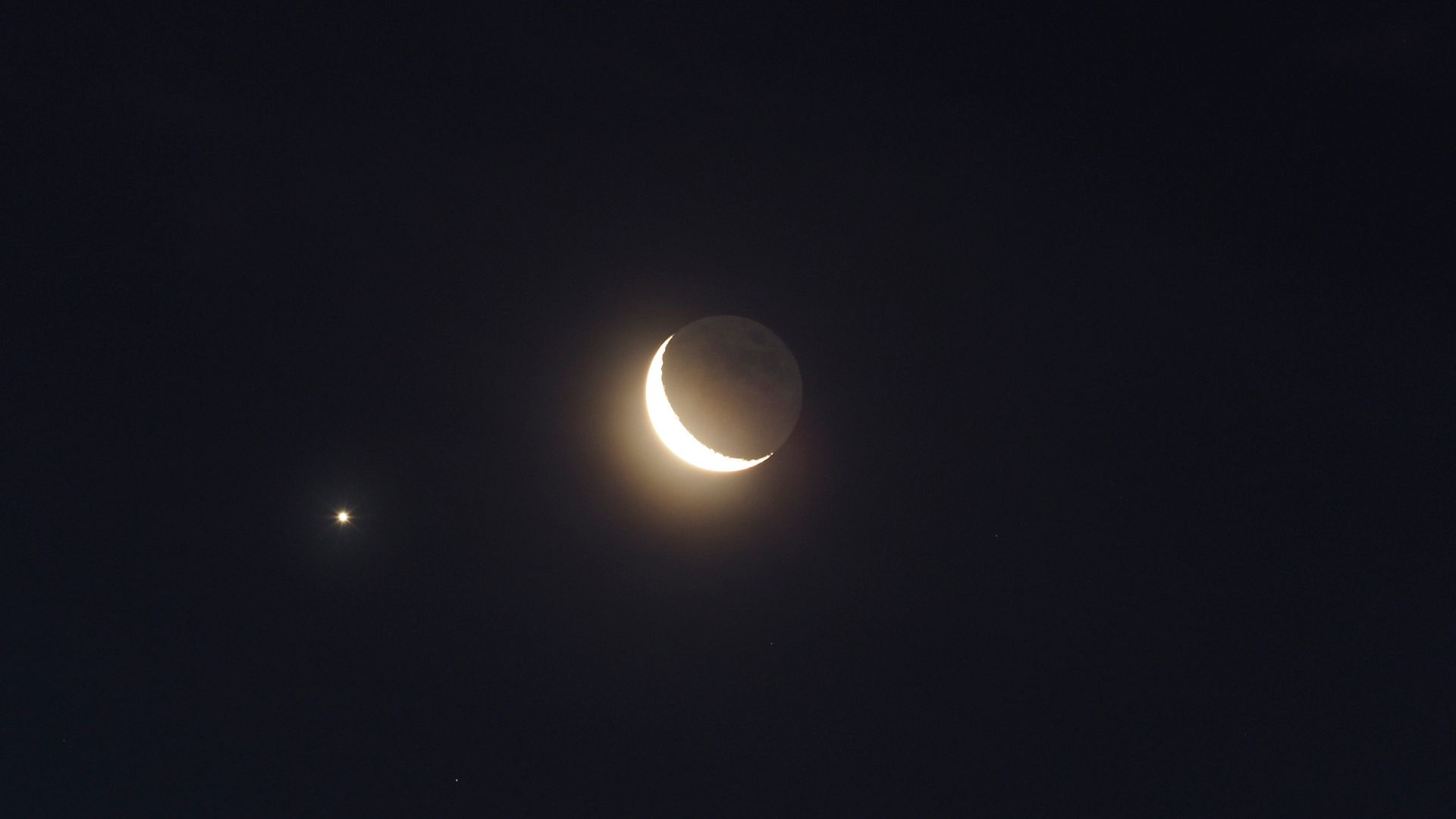
You may have watched the moon block out the sun during a solar eclipse, but have you ever seen it do that to a planet? Early Tuesday (Oct. 6) morning, skywatchers across much of eastern North America will have an opportunity to watch a crescent moon pass directly in front of Jupiter. The rare alignment won't happen again for 11 years.

During the event, known as a lunar occultation, Jupiter will disappear behind the moon for up to about an hour before suddenly reappearing. The occultation will be visible before dawn from much of the eastern and central U.S., Canada and the Caribbean, while parts of Africa will experience the event during daylight, according to In-The-Sky.org.

The moon will be a beautiful waning crescent, just 20% illuminated, and Jupiter will shine brightly alongside it. The pair will rise together in the east early Tuesday morning and gradually appear to move closer as the moon travels eastward against the background stars.

When the occultation begins, Jupiter will remain hidden behind the moon for roughly an hour. No telescope will be needed to watch Jupiter disappear and reappear. However, a pair of binoculars or a small telescope will make the event much more dramatic.

Through a telescope, Jupiter will look like a tiny disc rather than a point of light and will take about a minute to disappear completely behind the moon. An easy way to photograph the event is to use a smart telescope to image the moon. (Here's everything you need to know about lunar photography).

Below are the times when Jupiter will disappear and reappear in 10 major cities Tuesday morning, according to the International Occultation Timing Association.

  • Chicago: 3:22-4:17 a.m. CDT
  • Atlanta: 4:15-5:17 a.m. EDT
  • Detroit: 4:16-5:20 a.m. EDT
  • Miami: 4:20-5:09 a.m. EDT
  • Washington, D.C.: 4:20-5:24 a.m. EDT
  • Philadelphia: 4:22-5:26 a.m. EDT
  • New York: 4:23-5:27 a.m. EDT
  • Toronto: 4:25-5:22 a.m. EDT
  • Boston: 4:26-5:30 a.m. EDT
  • Montreal: 4:30-5:26 a.m. EDT

Outside the occultation path, Jupiter won't disappear at all. Instead, it will appear to be skimmed by the crescent moon β€” still a potentially spectacular sight that could produce some amazing photos. From across much of the world, the crescent moon and Jupiter will appear exceptionally close together.

The next lunar occultation of Jupiter visible from North America will occur on Nov. 27, 2037, according to When The Curves Line Up.

  •  

First photos from Smile spacecraft show Earth like you've never seen it before

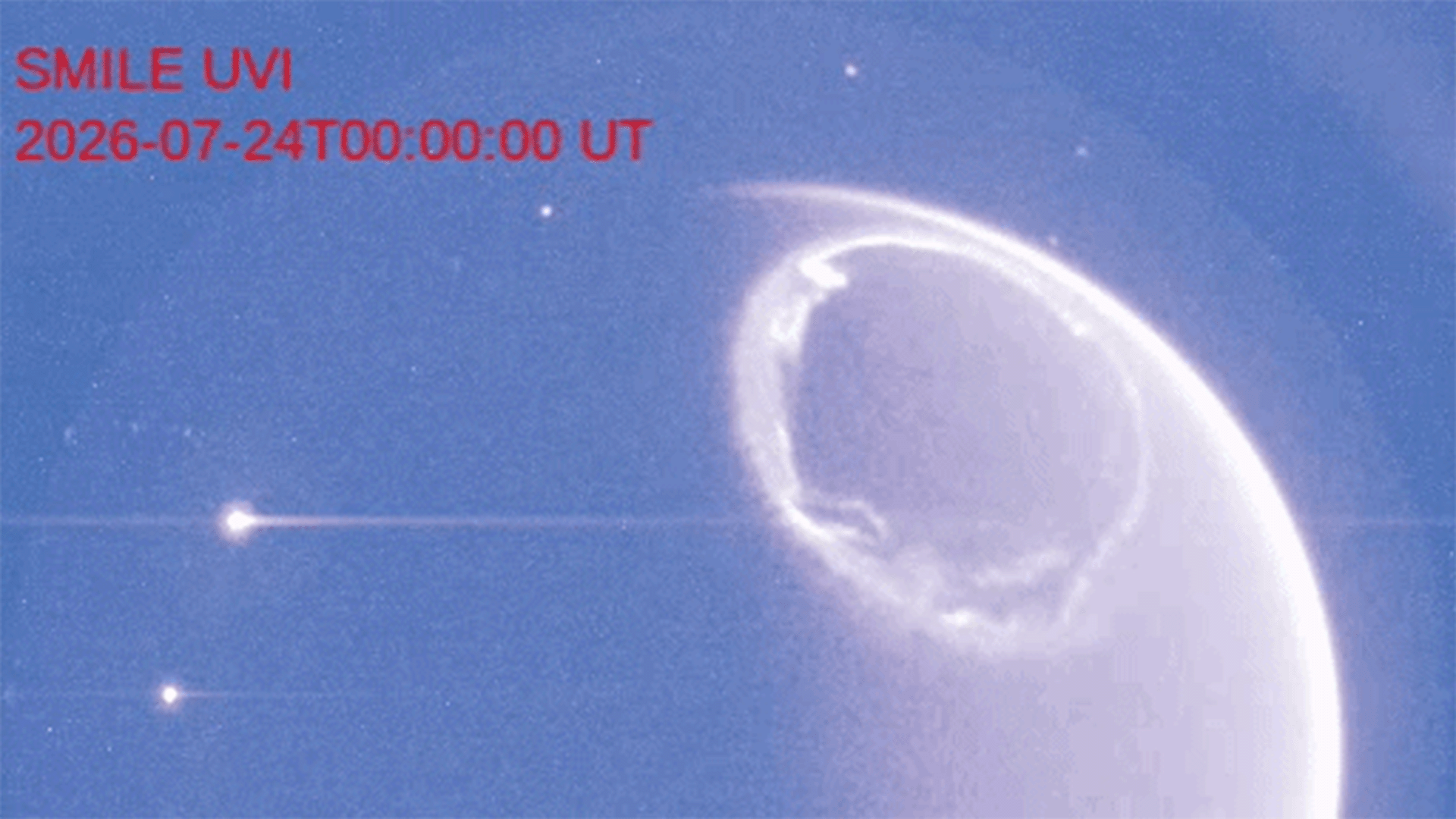
A gif showing a round sphere with glowing white dots around it

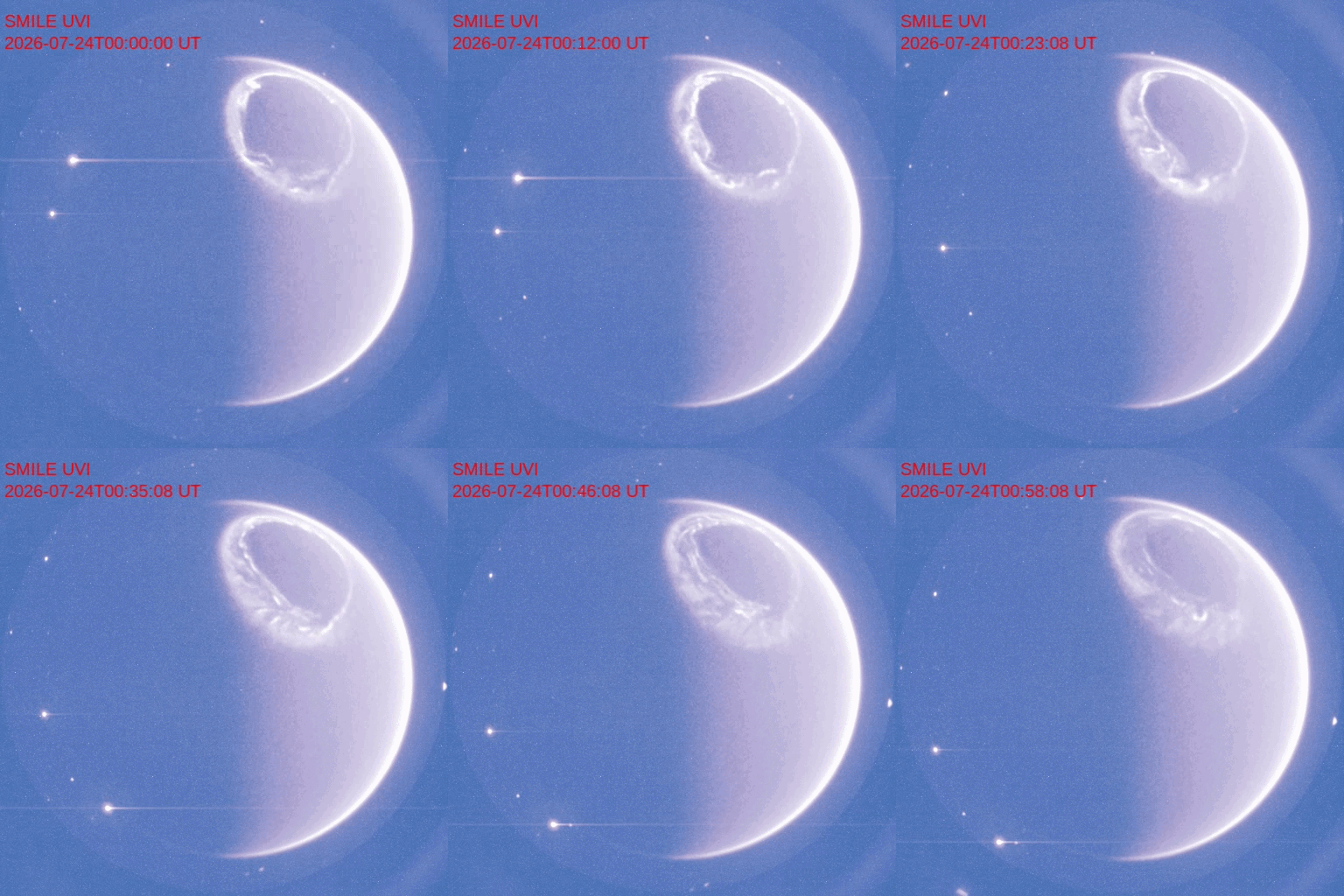
Earth glows like a half moon while a giant aurora writhes over the North Pole in this ultraviolet image from the new Smile spacecraft. (Image credit: ESA & CAS/Smile/UVI CC BY-SA 3.0 IGO)
Quick facts

What it is: An aurora on the sunlit side of Earth

Where it is: Over the North Pole, as seen from about 75,000 miles away

When it was shared: Sept. 30

The debut images from a new Earth-observing satellite have just given us a view of the impossible: giant auroras rippling over the North Pole in broad daylight.

Earth's auroras are one of our planet's signature wonders β€” a sight worth advertising in interstellar travel guides, alongside our perfect total solar eclipses, bright shooting stars and majestic blobfish. They are the beautiful result of electrical storms in the atmosphere, appearing when charged solar particles skate along Earth's magnetic-field lines and collide with light-emitting molecules near the poles. (Auroras do exist on other planets, but they are usually not in bright visible colors like ours.)

To human eyes, auroras come out only at night and rarely stray from the poles. That's what makes these first observations from the joint European-Chinese Smile mission, which officially began science operations this week, so special.

Captured in ultraviolet light, the stunning images show a huge, serpent-like ring of charged particles coiling around the North Pole in July 2026. In the foreground, Earth appears ghostly and featureless, glowing like a half moon. The aurora writhes around our planet's sunlit side, covering about a third of it, while Earth's dark nightside bleeds into the background sky. Far behind, bright stars fall like raindrops as Smile shifts subtly in its orbit.

A spiderweb overlay is on top of a heat-map type image with red and orange colors.

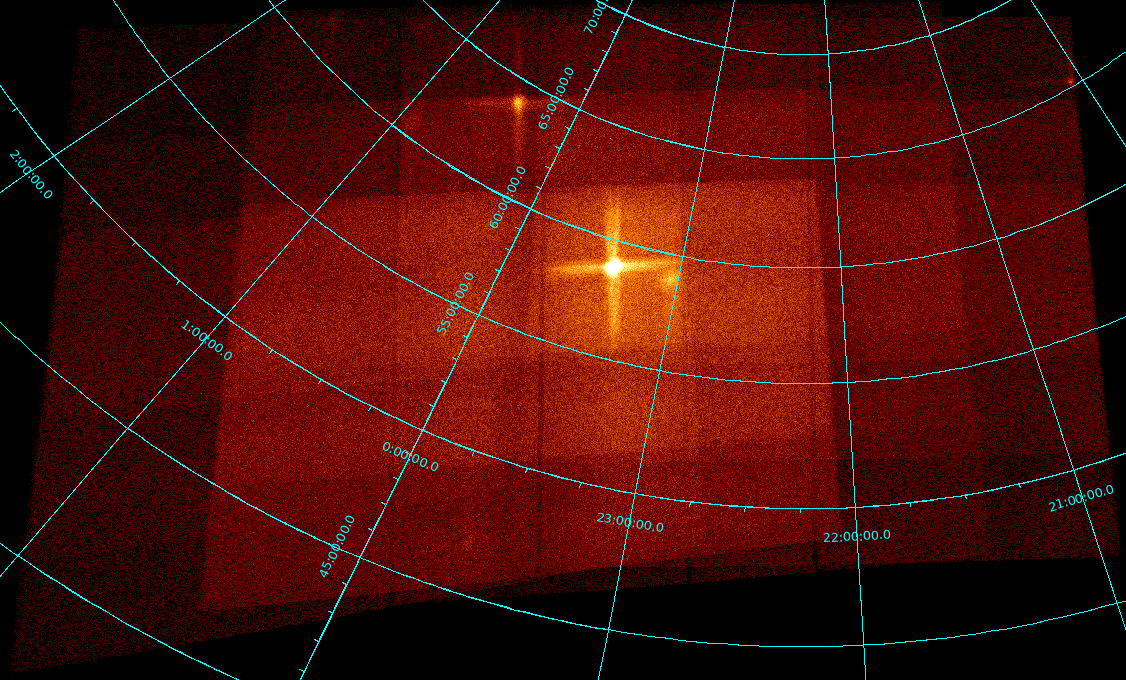
Smile tested its soft X-ray imager on the light of the distant supernova remnant Cassiopeia A (center), located 11,000 light-years from Earth. (Image credit: ESA, CC BY-SA 3.0 IGOΒ )

The view alone is worth smiling about, but the new images also promise exciting science to come. Taken just two weeks after scientists first turned Smile's Ultraviolet Aurora Imager on, the observations show that the satellite's instruments are working as they should and that the joint European Space Agency (ESA) and Chinese Academy of Sciences mission can officially begin.

Launched on May 19, Smile will spend the next three years watching Earth from a highly elliptical orbit that takes it about 75,000 miles (121,000 kilometers) over the North Pole β€” about a third of the way to the moon. From there, Smile can observe the North Pole for a record-breaking 45 hours at a time, offering an unprecedented view of solar activity there.

In addition to the Ultraviolet Aurora Imager, Smile carries three more science instruments to detect X-rays, magnetic fields and light ions over Earth.

This week, scientists also tested the spacecraft's soft X-ray imager by pointing it at the distant supernova remnant Cassiopeia A, located about 11,000 light-years from Earth (image above). Although the camera is working fine, the detector is still picking up a bit too much light when aimed at Earth, so it will require a bit more calibration from scientists on the ground.

  •  

Oct. 4th, 1957: Sputnik launches

On Oct. 4th, 1957, at 10:29 PM Moscow time, the Soviet Union successfully launched Sputnik 1 into space on a repurposed R-7 rocket. The world’s first artificial satellite, Sputnik was about 22 inches (58 centimeters) in diameter and weighed 184 pounds (84 kilograms). Although there were no scientific instruments aboard, the transmitter it carried sentContinue reading "Oct. 4th, 1957: Sputnik launches"

The post Oct. 4th, 1957: Sputnik launches appeared first on Astronomy Magazine.

  •  

Oct. 3, 1942: The V-2 successfully launches

A 12-ton rocket loaded with a 1-ton warhead, the V-2’s successful launch would prove to be exceptionally significant to both the military and to space exploration. On Oct. 3, 1942, the V-2 was fired from Peenemunde, Germany – its fourth test, and the first to succeed. The rocket rose to an altitude of 60 milesContinue reading "Oct. 3, 1942: The V-2 successfully launches"

The post Oct. 3, 1942: The V-2 successfully launches appeared first on Astronomy Magazine.

  •  

Oct. 2, 480 B.C.E.: A eclipse causes a retreat

An ancient solar eclipse changed the course of a military conflict when it cast a shadow on a battle over Corinth between the Spartans, commanded by Cleombrotus, and the invading Persians, led by Xerxes I. Herodotus wrote that, β€œwhile [Cleombrotus] was offering sacrifice to know if he should march out against the Persians, the SunContinue reading "Oct. 2, 480 B.C.E.: A eclipse causes a retreat"

The post Oct. 2, 480 B.C.E.: A eclipse causes a retreat appeared first on Astronomy Magazine.

  •  

Time is running out to catch a giant planet's strange orbit

A team of researchers, including those from the University of Tokyo, spotted a rare kind of planet that's unusually hot and eccentric. TOI-1355 b orbits its star, TOI-1355, which is also much hotter than our sun, in a strange way and incredibly quickly, completing an orbit in about two Earth days. The work is published in the journal Publications of the Astronomical Society of Japan.

  •  

Gli astronomi hanno scoperto 84 misteriose sorgenti di raggi X in sei galas…

Gli astronomi hanno scoperto 84 misteriose sorgenti di raggi X in sei galassie vicine. Chiamate β€œhypersoft X-ray sources”, potrebbero essere sistemi binari contenenti nane bianche, stelle di neutroni o buchi neri e aiutare a risolvere due importanti enigmi dell'astrofisica.
  •  

Space weather caused a 16-minute train delay in 1848: 'Our research has a hint of a detective story'

Detective work by a team of space-weather experts has discovered the truth about a historical event that had been thought to be the first-ever case of technological disruption by geomagnetic activity from the sun, but has now been shown to have taken place seven years later.

From it being too hot or too wet to leaves on the track or cows on the line, there's a fine tradition of what the British public consider to be flimsy excuses for delays on the trains. Yet an 1871 edition of the journal Nature describes a very different event that caused a train departing Exeter, in Devon on the south-west coast of the U.K., to be delayed by 16 minutes: a solar storm that flooded the railway signals' electrical telegraph network with current.

"The Exeter train delay is a fascinating story because it sits right at the point where emerging technologies first began to encounter the realities of the space environment," said Jim Wild, who is a professor of space physics at Lancaster University and also the President of the Royal Astronomical Society, in a statement.

The event has frequently been cited as the first example of a solar storm disrupting technology on Earth, but when a team led by Wild went back through historical records to investigate further, they found that things didn't add up.

The original report in Nature stated that the electrical disturbance occurred at 10:05pm local time on Oct. 18, 1841. However, Wild's team found that particular train line didn't open until 1846.

So, they delved deeper into the history books to figure out the truth.

"Our research has a hint of a detective story β€” piecing together a wide range of archived records to better understand a historically severe space-weather event," said team-member Mike Hapgood, a space weather expert at RAL Space, which is the UK's National Space Laboratory, in Oxfordshire.

Combining data from railway timetables, old newspapers, plus historic reports of solar observations and the northern lights and digitized geomagnetic data, Wild and Hapgood's team were able to conclude that the most likely date for the train delay was Oct. 18, 1848, which coincided with a strong solar storm that hit Earth.

This revised date knocks it off top spot in the chronological list of such events. The first recorded disruption to electrical technologies is now a disturbance on the Midland railway network, which had lines covering much of the U.K., in March 1847.

"Although this means it is not the earliest recorded space weather impact, it remains one of the first clear examples of solar activity disrupting critical infrastructure," Wild said. "It also demonstrates the value of combining scientific records with contemporary newspaper reports and archival documents when reconstructing historic space weather events."

A view of a yellow sphere with some flares coming off of it.

Solar storms have been playing havoc with electrical technology on Earth since the 1840s. (Image credit: NASA/SDO)

The case reminds us that space weather has been a hazard to technology and modern systems for a long time, and isn't just a recent problem.

"Society has been experiencing the effects of space weather on technology for almost as long as electrical technologies have existed," said Wild.

The most dramatic example is the aforementioned Carrington event of 1859, representing the most significant solar storm on record as it caused telegraph poles to spark and battery power supplies to be disrupted. By this point, telegraph operators had grown used to electrical disturbances associated with auroral activity, but even the Carrington storm shocked them β€” quite literally in some cases, as extra current ran down the telegraph lines β€” with its ferocity. Should a similar event occur today, it would cause huge black outs, knock out power grids, disrupt communications and fry satellites.

"While today's space weather [monitoring] capabilities are far more advanced than anything available in the 1800s, the modern technologies we depend on are also much more vulnerable to solar storms," said Hapgood.

The current solar cycle 25 peaked in Oct. 2024 and we are just beginning to come out of an extended period of maximum activity. However, it remains to be seen how the rest of this cycle will play out before reaching solar minimum in about 2030. We've already seen severe geomagnetic storms caused by space weather in May 2024 β€” will we experience another powerful storm before the decade is out?

  •  
❌