On Episode 215 of This Week In Space, Rod Pyle and guest co-host Susan Karlin talk with bestselling sci-fi/sci-fact author Dr. David Brin.
If you've seen "Disclosure Day" or "Age of Disclosure," you're going to want to join us for this fascinating discussion. Long known for his universe-spanning visions, storytelling skills, and occasionally contrarian viewpoints, Dr. Brin will not disappoint! Our discussion ranged from reactions to Spielberg's "Disclosure Day" to why people believe in AI and more.
This Week in Space covers the new space age. Every Friday we take a deep dive into a fascinating topic. What's happening with the new race to the moon and other planets? When will SpaceX really send people to Mars?
Join Rod Pyle and Tariq Malik from Space.com as they tackle those questions and more each week on Friday afternoons. You can subscribe today on your favorite podcatcher.
Astronomers have used a technique called echo mapping to detect hints that supermassive black holes, such as the cosmic titan at the heart of the Milky Way, known as Sagittarius A* (Sgr A*), are surrounded by dense clouds and clusters of dark matter. The research could teach us more about this mysterious substance and the environments around supermassive black holes.
Dark matter is the universe's most mysterious stuff, outweighing ordinary matter in the cosmos by a ratio of five to one — but remaining effectively invisible because it doesn't interact with electromagnetic radiation, including the light we use to see. The only way scientists can even infer the presence of dark matter is via its interaction with gravity, and the impact that this interaction has on objects made of traditional matter like stars. For instance, the gravitational effect of dark matter allows stars at the edges of galaxies to whip around at much greater speeds while not flying loose than the visible matter of those galaxies would allow.
This team decided to test the gravitational influence of dark matter at the hearts of galaxies, environments dominated by supermassive black holes which can have masses millions or even billions of times that of the sun. Ordinary matter around these supermassive black holes is often very visible, especially when spiraling into the maw of one of these cosmic titans from a flattened cloud called an accretion disk. This is because the gravitational influence of those black holes generates immense amounts of friction, causing them to grow brightly. That wouldn't work for dark matter; it can't feel friction because it doesn't interact with itself or with ordinary matter, and it can't glow because it doesn't absorb or emit light.
Clearly, dark matter can't be spotted around supermassive black holes even using the most advanced telescopes such as the Event Horizon Telescope (EHT), which has captured glowing rings of material around Sgr A* and around a more distant supermassive black hole that rules the heart of the galaxy Messier 87 (M87).
While discussing the problem of detecting dark matter around supermassive black holes, Mayank Sharma, a physics graduate student at Virginia Polytechnic Institute and State University (Virginia Tech), hit on an interesting solution.
"We could actually test this prediction using a technique in astronomy, which allows you to measure the distance to the surrounding gas by looking for echoes of light," Sharma said in a statement. The technique Sharma refers to is "reverberation mapping," and it has become a trusted method of determining the mass of black holes.
Echoes of dark matter
Reverberation mapping is based upon the fact that as matter falls into a black hole, it releases a burst of energy that causes the accretion disk it comes from to pulse. This pulse of light travels from the accretion disk to gas in the wider environment of the black hole. This gas absorbs that light and also pulses, with this secondary pulse serving as an echo of the first.
Because we know the speed of light, when astronomers see the first pulse of light and then its echo, they can use the time between pulses to estimate the distance between the black hole and the gas on the outskirts of its environment. The size of a black hole and the distance between it and outer gas clouds can be used to determine its mass, and could also be used to determine the mass of dark matter clustered around it.
The team applied their method to 14 different galaxies, finding in five cases that mass increases moving away from the central black hole in a way that couldn't be accounted for by visible matter alone. Despite the early success of this research, it far from proves that supermassive black holes are indeed gathering places for dark matter. The team's findings do point an interesting way forward for the investigation into the universe's most mysterious substance and its most mysterious regions.
"These galaxies are definitely showing a hint that there is extra material that cannot be explained by just the supermassive black hole," Sharma said. "The prospects are exciting."
GOLDEN, Colorado – Here on Earth, centuries of accumulated engineering knowhow, hard-learned lessons, and societal evolution have shaped a robust framework of building standards that govern how we build and maintain buildings today.
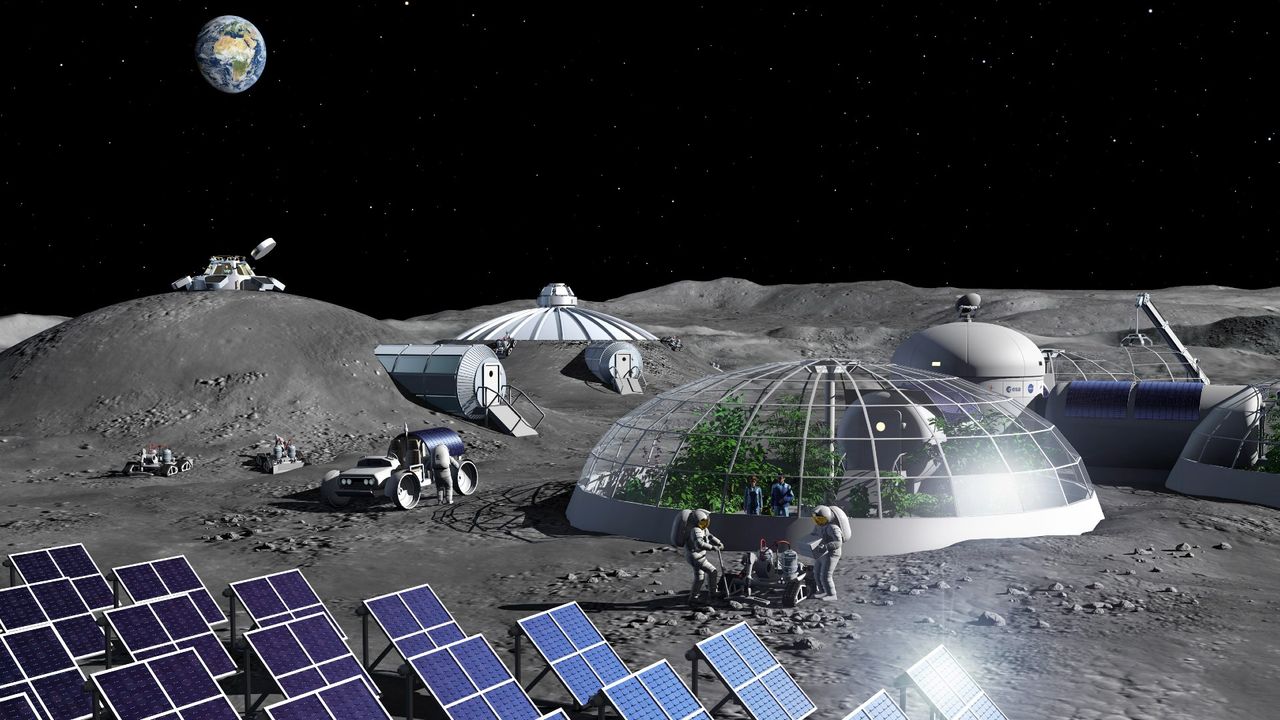
But now, as humanity prepares to put in place a "sustained presence" on the moon, how do we guarantee the safety and integrity of structures built in an environment for which no such tradition exists?
At the 26th Space Resources Roundtable held June 2-5 on the campus of the Colorado School of Mines, one expert says what's needed is a lunar building code, the development of specific design criteria for the moon.
What's shaking?
Both NASA and China's space agency are planning to build habitats, landing pads, equipment shelters, and tall towers on the moon. But all that construction could be off to a shaky start, suggests Nerma Caluk, an engineer and lunar specialist for Skidmore, Owings & Merrill, an architecture and structural engineering firm in San Francisco, California.
Caluk said there's a need to leverage terrestrial building experiences.
"On Earth, structural systems rely on strong gravitational acceleration to resist seismic lateral forces through both foundation friction and overturning stability. However, on the moon, the gravitational field strength is reduced to just one-sixth of Earth's surface gravity," Caluk told Space.com.
Because seismic inertial forces are governed purely by a structure's mass rather than its weight, the lateral demand on a structure remains fully active while its gravitational restoring capacity is substantially diminished, Caluk added.
"Low-profile surface structures risk translational sliding across poorly characterized regolith interfaces, while taller vertical structures face significant overturning vulnerability, as the moon provides only a fraction of the gravitational restoring moment available in a terrestrial seismic environment," said Caluk.
Here on Earth, structural engineers routinely design typical building systems to yield, crack, and sustain permanent inelastic deformation during a design-level seismic event.
They intentionally leverage "inelastic energy dissipation" as the primary mechanism for managing seismic demand, Caluk said. But this design philosophy is fundamentally incompatible with a crewed lunar environment, she said.
Take for example a hatch distortion or pressure seal misalignment. They constitute a mission-critical failure, and any structural breach risks catastrophic depressurization, said Caluk.
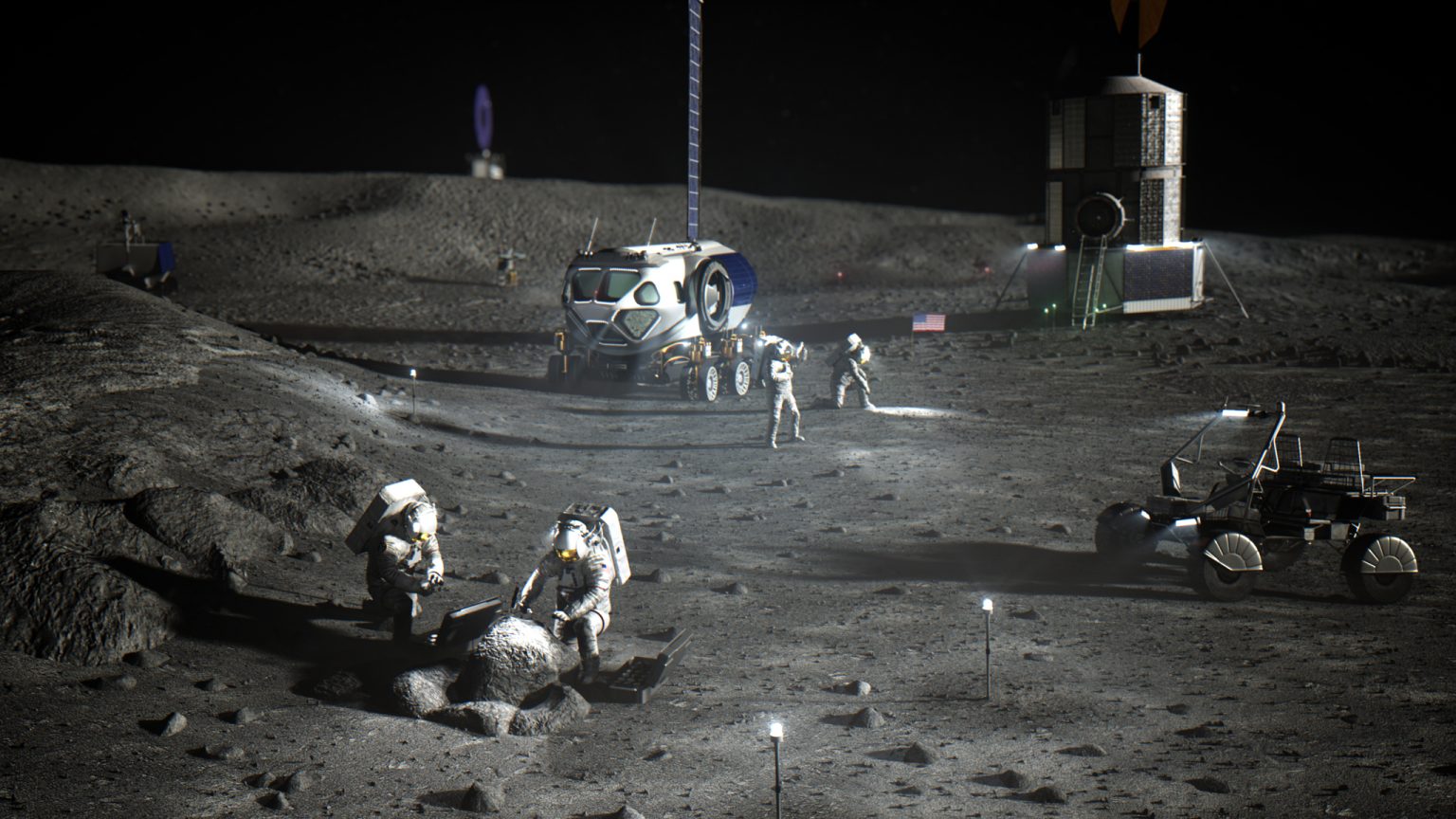
An artist's rendering of a NASA Artemis moon base with development underway. (Image credit: NASA)
A group taking on the challenge of shaping guidelines on the building of lunar infrastructure is the aerospace division of the American Society of Civil Engineers.
The group's technical committee on space engineering and construction has crafted "Infrastructure Engineering, Design, Analysis, and Construction (LIEDAC) guidelines" for the moon, Caluk said, to tackle seismic issues imposed by moonquakes.
The LIEDAC guidelines, Caluk said, characterize the unique lunar hazard environment, classify operational consequences through a risk-categorization hierarchy, and establish target performance objectives "so that safe commercial development can proceed on a defensible technical basis."
Inherent uncertainties
Caluk also outlined a "Response Spectrum Analysis" supported by NASA Small Business Technology Transfer funding that looked at the inherent uncertainties of the lunar subsurface.
The output of the analysis has developed criteria emphasizing the necessity of a local geotechnical site investigation for all structures, regardless of their seismic design category.
"These investigations are critical for identifying and mitigating risks such as seismic slope stability, seismically induced total and differential settlement, and other geotechnical hazards that may be triggered or amplified by moonquake ground motions," she reported here at the School of Mines gathering.
Moreover, the framework that Caluk and her associates have pulled together, acknowledges that lunar site conditions are not yet fully understood on a global scale.
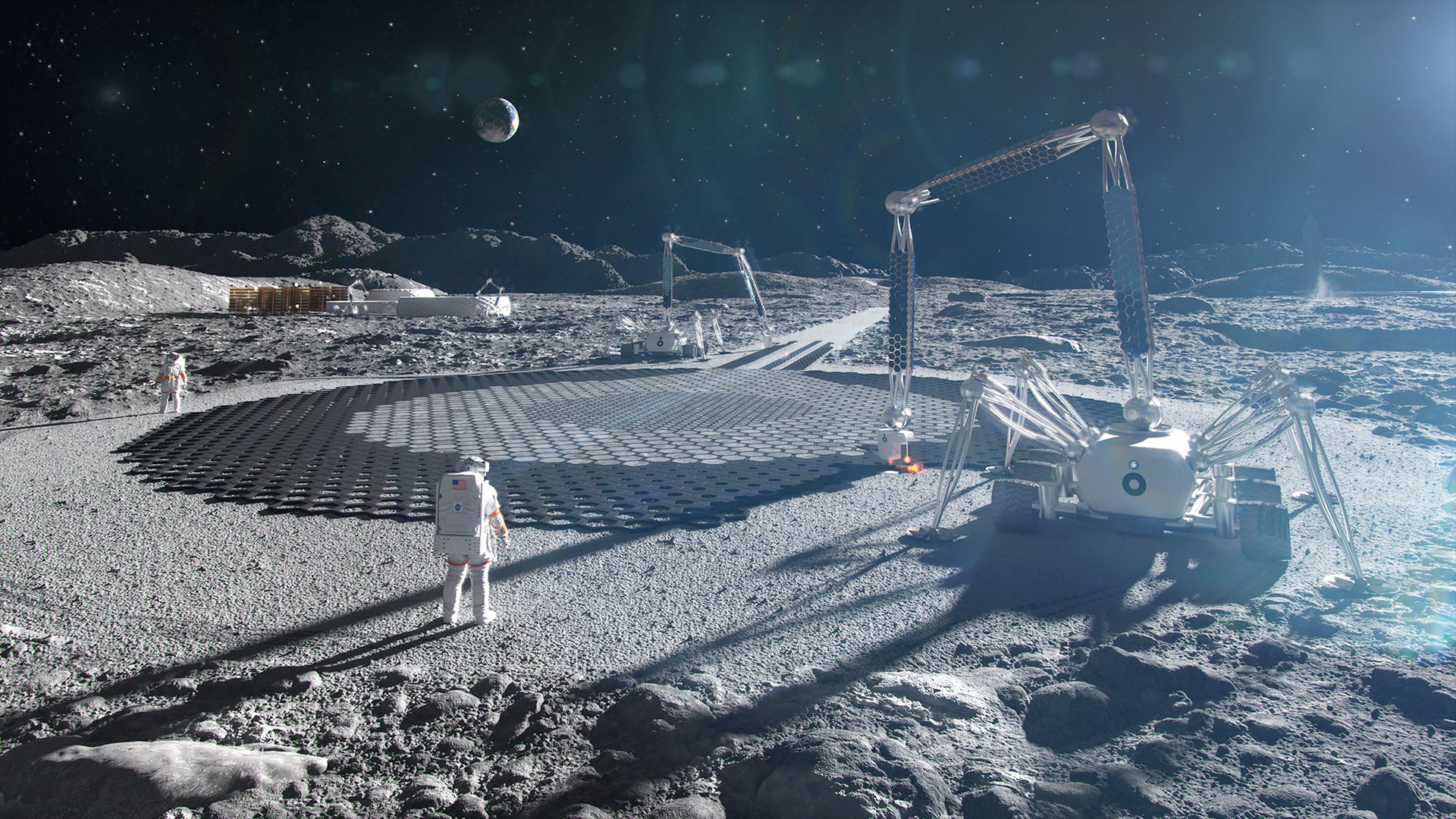
NASA envisions robotic rovers and astronauts working alongside one another to build structures on the moon. (Image credit: NASA)
Design practices
Not knowing ahead of time what lunar explorers may face is an unsure, shuddering proposition.
"Therefore, responsible design practices must account for this uncertainty through rigorous subsurface investigation whenever feasible," Caluk added. "By prioritizing localized data collection, engineers can ensure that structural foundations are robust enough to handle the unique physical properties of the lunar regolith and the specific seismic demands of the deployment site."
Caluk and her team members looked at the maximum considered moonquake, representing a more severe shaking level, to verify collapse prevention and ensure overall structural integrity under extreme lunar seismic events.
"NASA's deep institutional knowledge of human spaceflight operations and crewed mission safety," Caluk concluded, "provides the critical foundation upon which structural performance criteria for lunar infrastructure can now be formally established, with terrestrial engineering precedent offering a proven methodology for doing so even under evolving geotechnical and seismic data conditions."
An asteroid now bears the name of beloved musician Elliott Smith, thanks to one ambitious filmmaker.
Elliott Smith passed away at the age of 34 in 2003, but his impact and his music continue to connect with people around the world. And his influence has now extended to space, thanks to independent filmmaker Orlando Campopiano, who worked to get an asteroid named "Elliottsmith."
"I hope this introduces at least one new person to Elliott's brilliant discography, and I'm happy to see a permanent legacy in the stars! To have this tribute to him blessed by the estate and discoverers is also a great honor," Campopiano told Stereogum.
While listening to the song "Shooting Star," from Smith's album "From a Basement on the Hill," which was released in 2004 following his death, Campopiano had the idea to try and get an asteroid named after Smith, he told Stereogum.
He took this inspiration and ran with it, connecting with Smith's estate and working together to submit a proposal to the International Astronomical Union (IAU), which gives official names to cosmic objects, including asteroids. Maybe there are some Elliott Smith fans at the IAU, because the organization actually said yes.
With this positive response, Asteroid (861969) 2014 OS439 is now officially "Elliottsmith."
The asteroid Elliotsmith (861969) visualized in our solar system. (Image credit: NASA)
The asteroid was discovered back in 2014 by the Pan-STARRS 1 (Panoramic Survey Telescope and Rapid Response System) project in Hawai'i.
The IAU's announcement of the renaming reads: "Steven Paul 'Elliott' Smith (1969–2003) was an influential, Oscar-nominated American songwriter. His intricate music left a lasting impact on many musicians. Asteroid 861969 honors his birth date, August 6, 1969. Smith often used celestial motifs in his work, notably in the song 'Shooting Star,' which, in hindsight, symbolizes his brief but brilliant light."
As this classification states, this asteroid is more than just a random rock in the sky. Its previous, numerical name 861969 happens to perfectly mirror Smith's birthday. This cosmic alignment makes it feel like this naming was truly meant to be.

 Login