
❌

Reading view

Fossil Evidence Suggests Early Homo Had Abandoned Tree-Climbing by 1.8 Million Years Ago
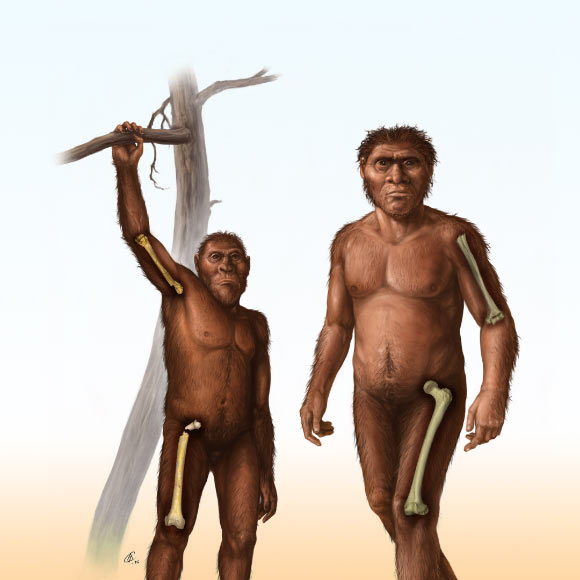
A depiction of an early Homo (right) characterized by relatively greater bone strength of the femur in the thigh compared to the humerus in the arm, and a depiction of an older human ancestor, Australopithecus (left), characterized by more equivalent strength in the bones of the arm and thigh. Image credit: Cullen Townsend.

New research led by University of the Witwatersrand and University of Southern California paleoanthropologists sheds more light on one of the most debated transitions in human evolution: when our ancestors stopped regularly climbing trees and committed fully to walking on two legs.

The post Fossil Evidence Suggests Early Homo Had Abandoned Tree-Climbing by 1.8 Million Years Ago appeared first on Sci.News: Breaking Science News.
  •  

Study: Famous β€˜Space Weather’ Train Delay Actually Happened Seven Years Later

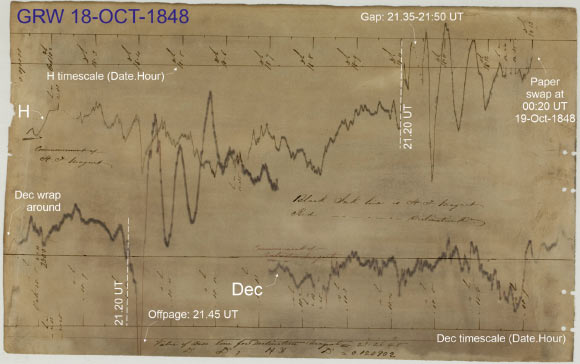
The magnetogram recorded at Greenwich Magnetic Observatory (London) from 11:20 UT on 18 October 1848 to 00:20 UT on 19 October 1848. Powerful geomagnetic disturbances are apparent on the evening of 18 October 1848 from 21:20 UT. Image credit: Wild et al., doi: 10.1029/2026SW005239.

Although the famous Carrington Event of 1859 is often described as the first major space weather event to affect technology, earlier incidents did occur. Historical records show that telegraph systems were disrupted by geomagnetic storms as early as the late 1840s.

The post Study: Famous β€˜Space Weather’ Train Delay Actually Happened Seven Years Later appeared first on Sci.News: Breaking Science News.
  •  

Paleontologists Uncover New Mosasaur Species in Egypt’s Western Desert

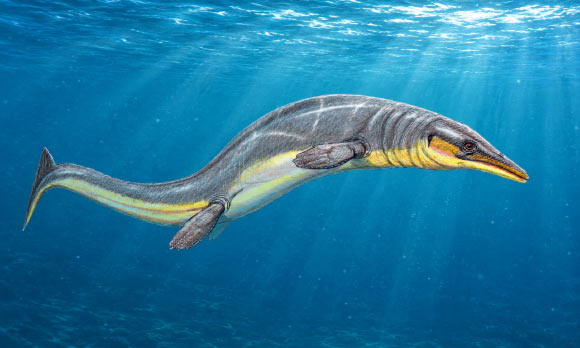
Halisaurus arambourgi, a species of mosasaur from Late Cretaceous of Marocco. Image credit: DiBgd / CC BY-SA 4.0.

Paleontologists have described a previously unknown species of mosasaur -- a group of extinct marine reptiles that patrolled Cretaceous seas alongside dinosaurs on land -- based on fossils unearthed in Egypt’s Dakhla Oasis.

The post Paleontologists Uncover New Mosasaur Species in Egypt’s Western Desert appeared first on Sci.News: Breaking Science News.
  •  

CERN Physicists Find Evidence of One of Higgs Boson’s Rarest Decays

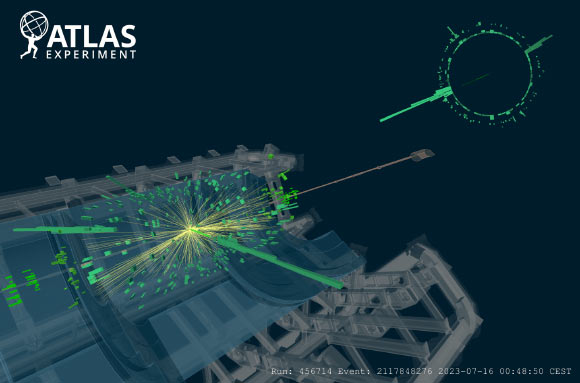
Event display of a candidate Higgs boson decay to a photon and a lepton pair, from proton-proton collisions recorded with the ATLAS detector in 2022. Image credit: ATLAS Collaboration / CERN.

Physicists from the ATLAS Collaboration at CERN’s Large Hadron Collider (LHC) have found evidence of the Higgs boson decaying into a β€˜virtual’ photon and a real photon, which in turn produces a pair of leptons.

The post CERN Physicists Find Evidence of One of Higgs Boson’s Rarest Decays appeared first on Sci.News: Breaking Science News.

  •  

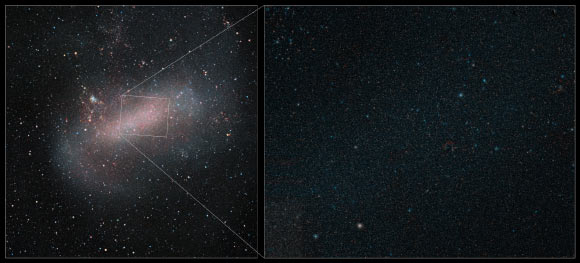
VISTA Focuses on Inner Regions of Magellanic Clouds

This image from ESO’s VISTA telescope shows the Large Magellanic Cloud. Image credit: ESO / Cioni et al.

Astronomers using ESO’s Visible and Infrared Survey Telescope for Astronomy (VISTA) have observed the densest, most crowded regions at the centers of the Large and Small Magellanic Clouds, our Milky Way Galaxy’s closest dwarf companions, offering an unprecedented look at areas that have long resisted detailed study.

The post VISTA Focuses on Inner Regions of Magellanic Clouds appeared first on Sci.News: Breaking Science News.

  •  
❌