❌

Reading view

'His urine goes on tour around Europe, showing the kings and queens this glowing pee': The weird world of alchemy before chemistry

Long before chemistry was a formal science, humans were experimenting with substances to solve problems, cure illnesses and make money. In his book "The Age of Alchemy: How Early Innovators Shaped Modern Chemistry" (Profile Books, 2026), author Kit Chapman, a science journalist and honorary researcher at Falmouth University in the U.K., traces how this ancient, protoscientific tradition shaped the world.

From our ancestors' early use of fire to some accidental β€” and disastrous β€” pyrotechnics in the 14th-century French court of Charles VI, Chapman reveals how early innovations across the world paved the way for modern science.

Live Science spoke with Chapman about his book, which has been short-listed for the 2026 Royal Society Trivedi Science Book Prize.

Read an excerpt: 'These were harder than any other blades, cut sharper and cost more': How ancient Sri Lankans created steel of legends by harnessing monsoons

Hannah Osborne: The book is full of brilliant historical anecdotes that bring all of these alchemy breakthroughs into context. What was your favorite one and why?

Kit Chapman: I mean, you can't go wrong with a man trying to turn his own urine into gold, I think. Hennig Brand [who accidentally discovered phosphorus in the 17th century] was one of my early touchstones. I've known about this story for a while. I've always thought, "How can I get this into a book? What's the link?" Obviously alchemy provides this fantastic base. He bankrupted two wives to try and fund his 1,500-gallon [5,700 liters] urine habit β€” and then he gets something [phosphorous], against the odds.

This is the first element we can actually put a name to. This is the first person we can say actually discovered a chemical element, and it's an alchemist in the purest sense of the word. Then, of course, he tries to keep it secret. He sells it, eventually, to a friend, and his urine goes on tour around Europe, showing the kings and queens this glowing pee, before suddenly, [chemist and philosopher] Robert Boyle actually works out exactly what's going on.

That, to me, sort of encompassed everything I was hoping for in the book. There's a fantastic story there that's about human connection. There's the unraveling of mythology, and theology and belief, and starting to look at science. But there's also real practical stuff going on there. He didn't know what he was doing. He just didn't know why he was doing it, and that I found fascinating.

HO: You make the point that these people weren't thinking, "Oh, I'm going to do chemistry." How important is that for understanding how these early innovations shaped modern knowledge of how things work?

KC: I think that's essential. We often look at science as something separate from the real world, and one of the things that I really wanted to do with this book was to illustrate that science is going on in every profession. It's going on in every home, continuously; it's going on in our bodies continuously. It's everywhere.

Science is a way to understand what's going on in the world. It is not a separate thing from culture, from belief, from trade, from globalization, from discovery, from just getting on with life. I wanted to bring in the potters, the weavers, the bakers, the urine salesmen β€” which was an entire thing that I didn't really know I had to go down. I found it fascinating.

And, of course, [there are] artisans. When we start looking at the first actual chemistry that's being done, it is people trying to create beautiful works of art, perfumes, things like that. It moves away from survival and into this ecstatic beauty, and that, to me, encompasses what I love about the history of science. It's bringing all of these threads together and making discoveries not necessarily where we think we're going to find them.

HO: You mentioned the beauty of it all, and the perfume. One of the chapters I really enjoyed was the first chemist who was a female perfume maker in ancient Assyria.

KC: TappΕ«tΔ« BΔ“let-ekallim. The fascinating thing is that the only reason we know her name is that she put it down in cuneiform. She wrote it down. She may well have been a slave; perfume makers were often slaves. She was certainly a woman who was working in the palace. She was working with another woman whose name, unfortunately, we've lost to time.

What I find fascinating is that we now have this person who was one of the working class, one of the underdogs, slaving for a week to make this potion that she wrote down because the recipe is incredibly detailed. And we remember her name, but we have no recollection of the lord or lady that she was actually making it for. It's kind of class warfare throughout the centuries.

HO: I found the extreme sort of secrecy really striking β€” that so many of these ancient texts were lost because they were being hidden. But then you also have the fall of civilizations, so we've lost all this knowledge.

KC: It's this combination of, as you mentioned, hiding the recipes because they are trade secrets. If you look at the first alchemy book that we actually know of β€” "Physika Kai Mystika" β€” it literally translates as "natural and secret questions" or trade secrets. These were craftsmen, and, of course, they didn't want to share it with rival craftsmen. If you've got a really good recipe for making something look like gold, you want to keep that to yourself.

They use these code words β€” and that went all the way through into what we think of as alchemy, that sort of Renaissance period where they're talking about taking the fiery sword from the belly of the dragon, which is just wonderful and descriptive.

But you also have things like Emperor Diocletian destroying the texts in Alexandria in 300 A.D. Why did he do it? Because it was a matter of survival for him. Twenty-five of his predecessors were murdered by their own guards or died of plague and things like that β€ͺ—‬ horrible fates. He wanted to avoid that, and the idea that [someone] could turn something into gold terrified him. It would debase his currency, so it always brings in that politics. It brings in human nature and human curiosity.

HO: Do you think there are still things we're yet to discover from alchemy from the past?

KC: Yeah, without question. Whether or not we're going to discover some kind of new, groundbreaking technology that's going to change the world, I can't see that happening. But the one thing we could see is the use of natural products in a way that we hadn't necessarily thought [of].

A great example of that is [Nobel Prize-winning chemist] Tu Youyou and the discovery of artemisinin compounds [from the] qinghao [plant], which comes from a Chinese alchemist's herbal remedies book, essentially 1,700 years ago. The fact that the best defense we have against malaria, the best antimalarials possible, comes from this ancient alchemical source indicates that there's probably more to find.

An Asian woman with short curly hair and glasses speaks into a microphone

Nobel Prize winner Tu Youyou (Image credit: STR / Stringer via Getty Images)

There is almost certainly more to find in terms of how they [ancient alchemists] used recipes, how they would try and make gold. Their understanding of the world is something that we don't necessarily have a full grasp of, and we're still piecing it together. There's some wonderful work being done by Matteo Martinelli and others looking at the history of, particularly of Western alchemy emerging in Egypt.

We also have things like Greek fire. We have a pretty good idea how they did it, but if you're looking for what the exact recipe [is], we're still not 100% sure.

HO: It's interesting now, watching modern equivalents taking place. We still, to an extent, try to guard our own knowledge.

KC: Yeah, we do, and I think it's actually a pernicious thing in science. We have this publish-or -perish mentality, which is that if we don't get the paper out first, obviously we lose the patent, but wider than that, we lose the kudos. There's this kind of necessity to kind of hide things. You hear about all kinds of shenanigans β€ͺ—‬ a reviewer delaying a paper until their paper comes out, things like that, all this kind of naughtiness going on.

We've got to recognize that science has moved on certainly from the "Great Man" idea. We're now working collaboratively in teams. That is the only way that modern science gets done. The second, if there is one lesson from the book, it's that if you try and hide science, you delay progress.

If you look at the traditional story of science, we talk about Europe. Occasionally, we might bring in China. But India, Africa, Mesoamerica, South America, North America β€ͺ—‬ every single continent was having scientific discoveries and developments.

The moment you actually start spreading ideas, the real ignition for me for the Renaissance and for what becomes chemistry, is the printing press. It's the fact that ideas can then be shared and accessed by everybody. The moment we start realizing that science is a global endeavor, that everyone can do it β€ͺ—‬ man, woman, child, it doesn't matter your nationality, [it] doesn't matter your ethnic ethnicity, it's for everybody β€ͺ—‬ the sooner we're going to start seeing some major progress that we otherwise wouldn't make.

HO: We see loads of the advances in chemistry and alchemy within civilizational melting pots. What were some of the biggest surprises to you when you were researching the book?

KC: One thing that really annoyed me was, looking through textbooks, you can look at who made zinc, and you come up with a name that came from the 1700s, or how platinum was discovered β€” that's a fantastic example. Platinum was discovered by a conquistador who noticed that some natives were wearing platinum. But, of course, he didn't discover it; it was discovered by the Indigenous populations.

The amount of science that came out of Mesoamerica, Central America, and the way that science was also being developed in India, it's just kind of completely overlooked. If you look at the traditional story of science, we talk about Europe. Occasionally, we might bring in China. But India, Africa, Mesoamerica, South America, North America β€ͺ—‬ every single continent was having scientific discoveries and developments.

They weren't necessarily developments that we think of in terms of leading to chemistry, but they were dealing with social problems that they had at the time. They were tackling what was in front of them, and we always need to remember when we're looking at history to look at the context of the discoveries.

HO: Which breakthrough did you think was most impressive in terms of the materials or facilities that were available?

KC: One thing that I found sort of striking was, there's a chap called Paracelsus who is absolutely fascinating, absolutely bonkers. Paracelsus is, for me, the archetypical alchemist because he was certainly trying to revitalize medicine and get rid of humor theory and come up with all these ideas. [Editor's note: Humor theory is the idea that human health and temperament were related to four fluids in the body β€” black and yellow bile, blood and phlegm.] But he also believed that mermaids were real and that they were just out to steal men's souls.
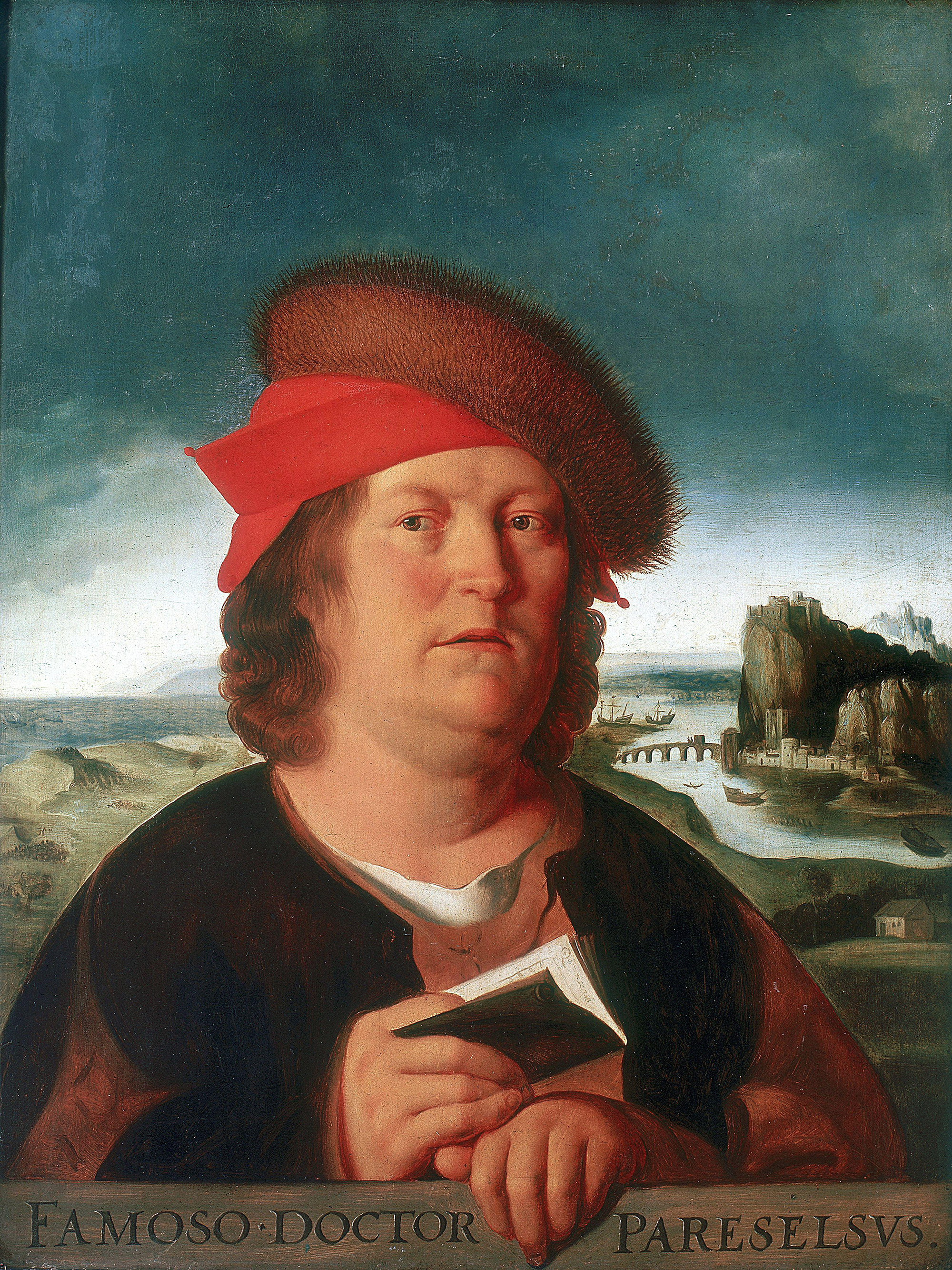
A painting of a man wearing a red hat holding a small book

A painting of Paracelsus. (Image credit: GL Archive via Alamy)

He was a drunk, he had a broadsword, and yet he's the guy that was able to combine what we think of as the traditional herbalist role and the doctors. At that point, doctors weren't even touching patients. They believed that the true skill of a medical man was that you didn't even need to examine a patient; you could just sort of look at them and you'd know what was wrong. He [Paracelsus] was able to say, "No, that's not right; you need to actually test things, and you need to try things." The moment we actually combine those two different threads together is when we actually started to get what becomes of modern medicine. The number of lives that saves is incalculable, so I think that that's one of the great moments.

The other one that always comes to me is Antoine Lavoisier in the French Revolution. He made several great discoveries β€” the fact that matter can only be changed; it can't be destroyed [at least at low energies]. The idea that if you take something, then obviously there's got to be components to that; you're not making it out of thin air. And coming up with a list of elements in the French Revolution or just before the French Revolution, unfortunately dies, from the guillotine [when Lavoisier was executed].

That, for me, was when we started to get true chemistry. That's when all of the magic is dispelled. I think he [Lavoisier] is, for me, the French equivalent of Isaac Newton. He's incredible.

HO: For you personally, throughout researching and writing the book, what was your biggest takeaway and what was the biggest surprise?

KC: My biggest takeaway is that science happens everywhere continuously through everyone. I traveled around the world for this book; I went to pretty much all of the continents. I didn't go down to Australia; that's about it. Wherever you go, there are discoveries being made. There are people who are trying to make their worlds better.

Science is not for this elite group; it's for everyone. One of the things I try to do with this book is to show people that even if you think that science isn't for you, it absolutely is; you're doing science continuously.

There've been so many [surprises]. One of the things β€” this is purely because of the way that I was taught and these inherent biases that we have β€” but it's so easy to overlook the role of women. When you start delving into the role of women in science … You've mentioned TappΕ«tΔ«; we also have Mary the Jewess. Throughout the Renaissance, we have people like Caterina Sforza and [the] very famous Queen Christina of Sweden, which I didn't mention in the book because I just didn't have space.

The one shocker for me is this book "The Secrets of Isabella Cortese," which was a man pretending to be a woman to sell his science book. For me, [it] just kind of unravels this whole idea that science isn't for everyone.

This interview has been condensed and edited lightly for clarity.
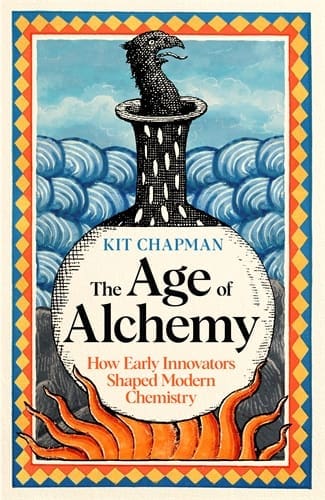
A book cover with a vial over a flame with the title

profilebooks
The Age of Alchemy (Hardback)

"Age of Alchemy" is a fascinating and funny dive into chemistry long before chemistry existed. It captures the ingenuity of humans across cultures and time, revealing how ultimately the work of these early innovators would eventually meld into modern science.


  •  

New James Webb telescope image may reveal the true identity of 'little red dots' β€” Space photo of the week

quick facts

What it is: Saguaro, a lower-redshift spiral galaxy

Where it is: About 10 billion light-years away in the constellation Ursa Major

When it was shared: July 29, 2026.

Ever since NASA's James Webb Space Telescope (JWST) began science operations in 2022, something has been bothering astronomers. Scattered across JWST's deepest images of the early cosmos are tiny, crimson-colored smudges that glow brightly in infrared light but appear surprisingly compact, making them difficult to classify. These mysterious objects appear in huge numbers around 600 million years after the Big Bang before seemingly vanishing less than a billion years later.

These odd-looking "little red dots" (LRDs) left astronomers wondering whether they were witnessing an entirely new type of galaxy or something even stranger. But now, fresh observations from JWST, combined with data from the Hubble Space Telescope and NASA's Chandra X-ray Observatory, suggest that LRDs may not have disappeared at all. Instead, they may have simply changed their appearance as the universe grew older.

Researchers trained JWST on a relatively close galaxy near the Big Dipper known as WISEA J123635.56+621424.2, nicknamed the Saguaro because its sweeping spiral arms resemble the iconic cactus of the Sonoran Desert, which bears red fruit.

The Saguaro galaxy existed around 3.3 billion years after the Big Bang, long after LRDs were thought to have faded from view. However, at its heart sits a compact, reddish core that ticks nearly every box for an LRD, including unusually weak X-ray emissions. The researchers chose the Saguaro because, unlike the incredibly distant LRDs, it's close enough for the space telescope to spot the galaxy's spiral arms and brilliant central core.

The aim wasn't to study the Saguaro as it is now but to try to calculate what it would look like if it were much farther away. Using computer models, the researchers shifted the galaxy to the enormous distances seen in the early universe. As they did, its elegant spiral arms gradually melted into the darkness until only a tiny glowing red point remained. It looked almost identical to the LRDs littering JWST's farthest deep-field images.

The findings suggest that many LRDs may in fact be ordinary galaxies, but at such vast distances that only their bright, active centers remain visible, while the surrounding galaxies fade beyond even JWST's incredible vision.

Instead of representing a completely new class of cosmic object, then, LRDs may actually be a short-lived phase in the growth of supermassive black holes during the universe's youth.

The hunt is now on for more nearby galaxies like the Saguaro to see whether they follow the same pattern. This will enable scientists to build a catalog of LRDs to understand better how galaxies and their central black holes evolved together across cosmic history.

  •  

Who are the least-contacted people on Earth?

Although it might be difficult to believe in our hyper-connected lives, there are thousands of people across the planet who remain almost completely disconnected from the rest of the world.

It's estimated that there are at least 196 "uncontacted" Indigenous groups worldwide, living mainly in 10 countries in South America, Asia and the Pacific, including Brazil, Indonesia and India. They live in diverse environments, from islands, to deserts, and the forest-dense borderlands of the Amazon basin. These groups have had varying levels of contact with the outside world; while some have only sporadic encounters with neighboring Indigenous peoples, others more regularly encounter outsiders, sometimes against their will due to the presence of oil, logging, agriculture and mining industries that increasingly encroach on their lands.

But who among them are the most isolated people on Earth?

While this question is difficult to answer, there are some candidates for the "least contacted" groups, experts told Live Science.

There aren't strict definitions of what makes a group "uncontacted." The United Nations even notes that the description of such groups can vary from "free, uncontacted, hidden or invisible peoples, peoples in voluntary isolation, etc." Hal Russell, Asia and Pacific research and advocacy officer with the nongovernmental organization, Survival International, said, "We define 'uncontacted peoples' as Indigenous peoples who generally avoid contact with outsiders and have no permanent relationship with them, even while being aware of the outside world."

"Certainly there is a spectrum between permanent contact, initial contact, sporadic contact and none at all," he told Live Science.

Generally what unites these groups is that they have actively avoided or tried to limit contact with other cultures, even with other uncontacted peoples, to maintain their unique way of life.

"They do not want to be disturbed"

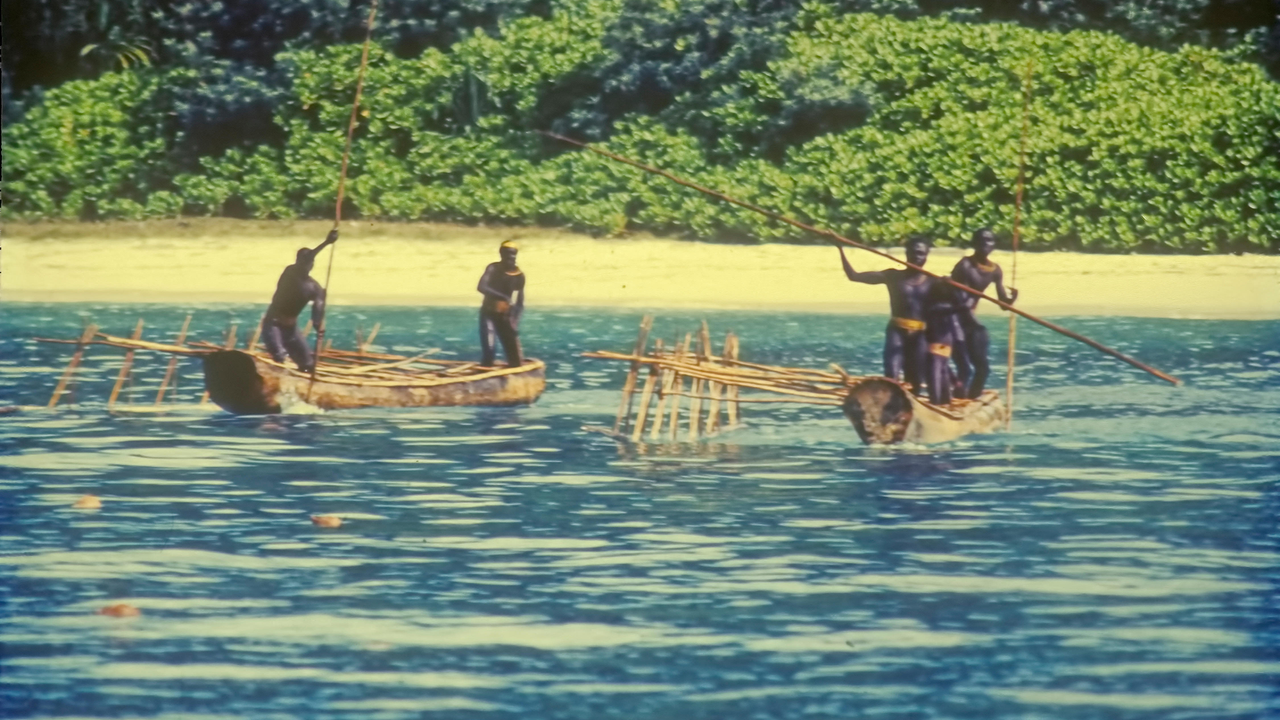
One such candidate is a small group of Indigenous islanders known as the Sentinelese, who live on North Sentinel Island within India's Andaman and Nicobar Islands in the Bay of Bengal. This group is so little known that anthropologists aren't even sure what they call themselves; their name is based on the roughly 23-square-mile (60 square kilometers) island where they live.

According to Survival International, it's believed that the Sentinelese have lived in the Andaman Islands for up to 55,000 years and are direct descendants of the first humans to migrate out of Africa. Today, the Sentinelese follow a hunter-gatherer lifestyle and fish along the coastline, using sleek, hand-carved canoes. Survival International estimates that the group includes between 50 and 150 people, although lack of access to the group makes them near impossible to count, and the government has not attempted to include them in the Indian census. Their official numbers remain unknown.

Sign up for our newsletter

Life's Little Mysteries logo with a question mark in a magnifying glass

(Image credit: Marilyn Perkins / Future)

Sign up for our weekly Life's Little Mysteries newsletter to get the latest mysteries before they appear online.

Aside from the island's remoteness, contact is even more difficult because the islanders reject it. The community has been known to shoot at approaching boats and hovering helicopters.

"When they shoot bows and arrows, they are communicating," Simron Singh, a professor at the University of Waterloo in Ontario whose expertise is in island environments and the peoples of the Andaman and Nicobar islands, told Live Science. "It says they do not want to be disturbed."

Only a handful of outsiders have ever set foot on North Sentinel Island, and Indian law now prohibits travel within a 3-mile-radius (5 km) of the island for the protection of both parties. Islanders are vulnerable to diseases brought by outsiders, and visitors are at risk of attack; the Sentinelese have shot and killed at least three people, including a missionary named John Allen Chau, who traveled to the island illegally in 2018.

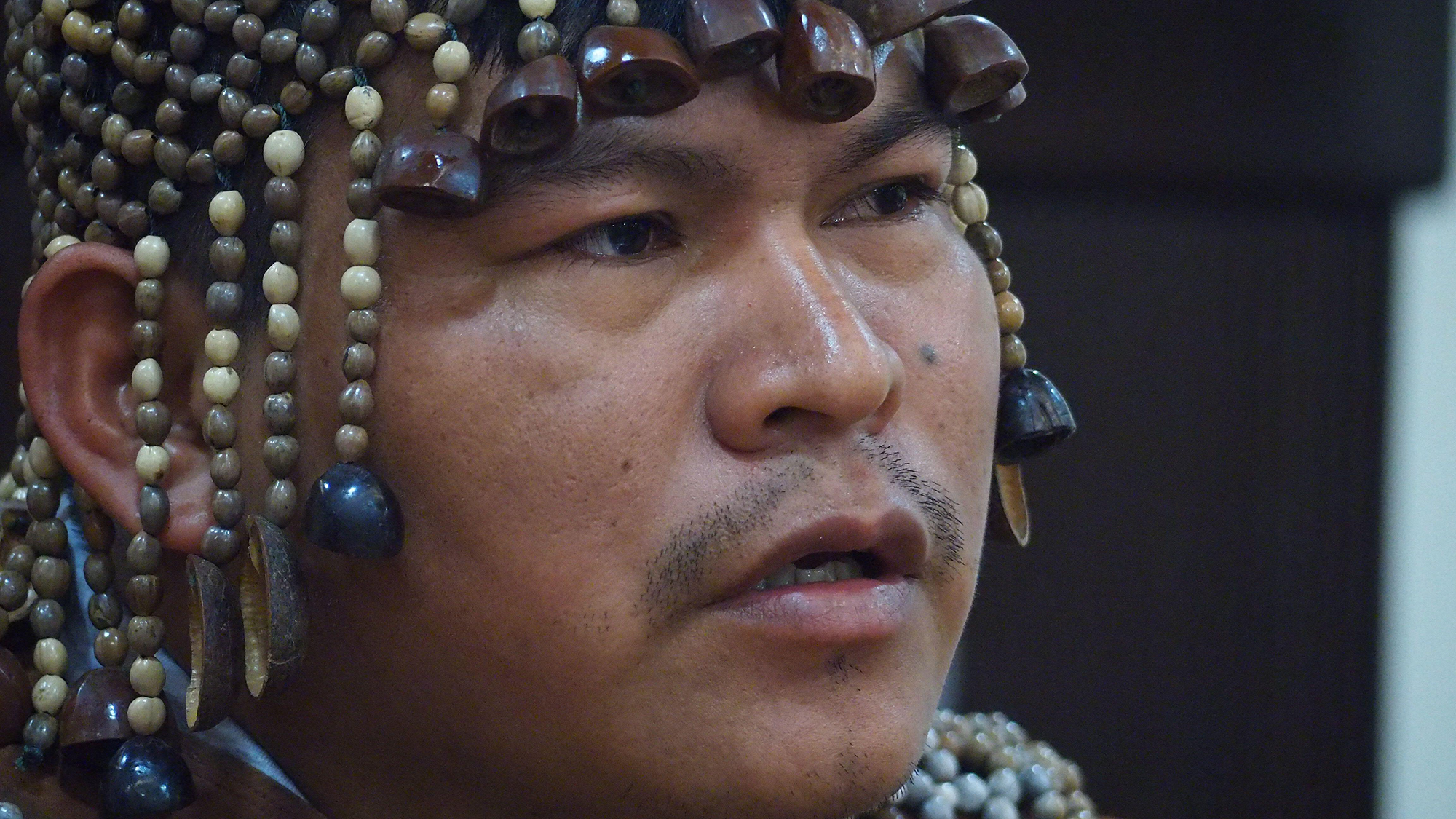
A close up of a man wearing a beaded headdress

Herlin Odicio Estrella, an Indigenous leader and president of the Native Federation of Kakataibo Communities, speaks at a press conference in Lima on May 4, 2023. The conference addressed how regional and municipal governments are failing to protect Indigenous communities from coca growers encroaching on their communities. (Image credit: ZUMA Press, Inc. via Alamy)

"They erase their footprints"

Survival International estimates that 95% of "uncontacted" and "isolated" peoples live in the Amazon Basin (though the term "voluntarily isolated peoples" is more commonly used to refer to such groups there, according to Beatriz Huertas, an anthropologist, independent researcher and special adviser on isolated peoples policy with Rainforest Foundation Norway).

Huertas conducts research on these groups and to her one stands out in particular: the Kakataibo, a forest peoples in the Aguaytia basin, part of the Amazon in central Peru. The Kakataibo are very rarely encountered, even by other Indigenous peoples. In fact they "are so determined not to be found that they erase their footprints with Earth," Huertas said, "so there is not much information about them."

"We know that this isolation is a protective strategy they have adopted" precisely because they have had contact with the outside and it has not been a positive experience, Huertas explained.

Survival International highlights other highly-isolated groups in the region, including a nomadic Indigenous group called the Kawahiva. This group has evaded contact so successfully that they are known only through chance encounters and one piece of video evidence, and were only recognized as a distinct group in 1999. It's not uncommon for there to be "little recognition or documentation of an uncontacted group, in fact there are likely many uncontacted groups with no documentation at all," Russell said.

He noted that even in Brazil which has some of the most rigorous documentation policies, one Indigenous group was only documented in 2021, having eluded authorities up until that point. Very little is known about them, including their name.

Another prominent group that is extremely isolated is the Mashco Piro of the remote forests of Peru, who are thought to constitute the largest group of uncontacted peoples in the world, numbering about 750. Some in this group are the descended relatives of people who were enslaved and forced to work on Amazonian rubber farms in the 1800s, but escaped deeper into forests where they have since remained, shunning contact.

Misconceptions about isolated peoples

This history of contact for even the most remote people on Earth shows that the term "uncontacted people" is misleading, Huertas said. In fact, the phrase has fed into unhelpful misconceptions that these groups are "stuck in the Stone Age, as if they were living in a bubble," she said. "In the social sciences, we know that no people remain completely isolated from what is happening in their surroundings and, therefore, no people have remained stuck at any particular stage in history."

Another frequent misunderstanding is that these groups would want to connect if they knew more about the benefits of the outside world, Singh said. He has worked with the Nicobarese peoples of the Nicobar Islands, who haven't completely rejected contact like their Sentinelese neighbors, and has discovered that in their case this is not true. In fact, the Nicobarese are aware of wars and conflict beyond the island, and this has framed their perception that the outside world is "dangerous and uncivilized," Singh said.

In many cases historical experiences can explain why these groups would want to avoid the world beyond. By the mid-1900s, the Great Andamanese of nearby islands had experienced a population decline of up to 99% after bouts of conflict with British settlers and the influx of disease. The Sentinelese themselves had a historical encounter with British colonizers in the 1800s during which time some were kidnapped, infected with disease, and died, which may have shaped their current wariness of the outside world.

Some researchers have argued that these groups should be contacted to better protect them from current and future harms. But groups like Survival International counter that a long history of forced contact shows that this ultimately leads to more harm than good for these peoples, their safety and their survival.

Indigenous peoples have a human right to self-determination as affirmed by the United Nations, and researchers like Huertas and Singh said these groups clearly express that right by seeking contact when they want to associate with others, and retreating when they want to be left alone.

"It's not that they don't have the option [to seek contact] ... It's not rocket science to get on a boat and sail somewhere," Singh said. "It's a choice not to connect."

  •  

Using AI has an environmental impact β€” here are 4 ways you can minimize it

Inside the world’s newest data centers, energy-guzzling computations proceed round the clock as AI chatbots and other generative AI tools tackle tasks from the frivolous to the weighty: assembling imagery for social media, proffering relationship advice, analyzing medical images to diagnose cancer, creating code for developers or detecting financial scams for banks.

Just as the popularity of AI tools has skyrocketed in recent years, so have the associated environmental costs. Data centers now consume 414 terawatt-hours per year, or about 1.5 percent of global electricity use, according to the International Energy Agency β€” an amount that grew by 12 percent annually for five years before jumping to 17 percent in 2025. By 2030, the agency projects that demand for electricity by data centers will more than double. Much of the increasing demand for electricity is being met by fossil fuels, while experts also worry about the use of local water resources to cool data centers in drought-struck regions.

Use of AI to generate text or imagery probably accounts for a mere sliver of any given person’s environmental footprint. And experts stress that the onus is on tech companies to reduce AI’s resource consumption, from creating smarter, energy-saving algorithms to building more efficient hardware.

Yet there are simple actions people can take to ensure that their AI usage has as little environmental impact as possible β€” from carefully considering where AI is needed to tailoring prompts to minimize the amount of computation required.

β€œIndividual choices are not meaningless, and some are more powerful than people realize,” says computer scientist Ivana Drobnjak of University College London.

Five cards that each have a tip of how to save energy when using an AI chatbot.
Knowable Magazine
Five cards that each have a tip of how to save energy when using an AI chatbot.
Knowable Magazine
Five cards that each have a tip of how to save energy when using an AI chatbot.
Knowable Magazine
Five cards that each have a tip of how to save energy when using an AI chatbot.
Knowable Magazine
Five cards that each have a tip of how to save energy when using an AI chatbot.
Knowable Magazine

Energy-hungry bots

It is notoriously tricky to estimate the energy expended on processing an individual chatbot query. Google, for example, estimates that its chatbot Gemini consumes around 0.24 watt-hours to respond to a median-length text query β€” equivalent to the electricity needed to watch TV for less than nine seconds. It also uses about 0.26 milliliters of water and emits the equivalent of 0.03 grams of carbon dioxide (driving a gas-powered car for a mile would emit about 400 grams). Small individually, these expenditures build up for those individuals and companies that use AI tools a lot.

The reason AI models consume so much energy lies partly in the processors that power them, such as the graphic processing units (GPUs) that consume significantly more energy than the central processing units (CPUs) that fuel simpler tasks like web searches and email. It also has to do with the models that underlie most popular generative AI tools, including the large language models (LLMs) that power AI chatbots and assistants.

These are based on a particular design called transformer architecture. This allows LLMs to train on vast swaths of language patterns in text and, from this, compute hundreds of billions or trillions of parameters. These parameters can then be used to generate new strings of text, by predicting which words are likely to follow one other.

A transformer-based LLM is computationally intensive because for each new word it generates in response to a user’s query, it runs the query and the words that have been written so far through the model, performing billions of calculations each time.

Tech companies note that LLMs have become more energy-efficient over time; according to Google’s 2025 calculations, the 0.24 watt-hours that Gemini consumes on a median-length text prompt represents a 33-fold decrease compared with the model’s energy consumption the previous year.

In any case, even small amounts of energy add up quickly given the scale of AI use. Based on 2025 numbers from tech company OpenAI, Drobnjak estimated in May that, at that point, around 3.2 billion queries are being sent every day to its chatbot ChatGPT. Users are asking AI tools to process and produce vast quantities of text, images and video. Some are having lengthy conversations with chatbots. And, increasingly, people are creating their own β€œAI agents” that themselves send queries to AI chatbots.

So what can users do to minimize the resources spent on their AI use? Experts have some tips.

Don’t give up on search

As a first, simple measure to save energy, users should carefully consider whether they truly need AI for a given task. β€œAsking ChatGPT β€˜What should I wear today?’ or β€˜How is the weather?’ is like taking a Concorde to travel to your supermarket,” says GΓΌnter Klambauer, an AI expert at Johannes Kepler University in Austria.

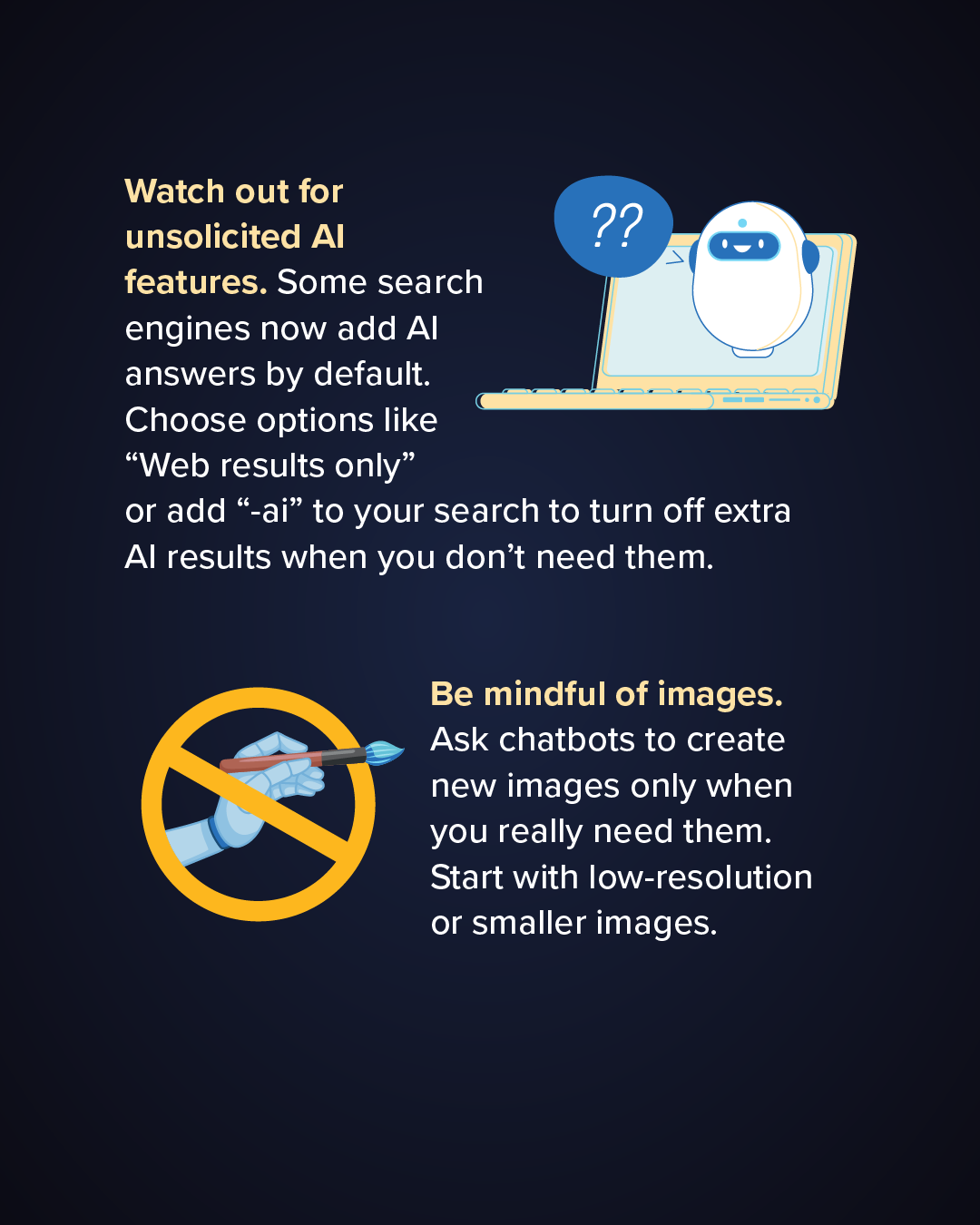
The same goes for web search engines that use AI to automatically generate a response to a query alongside the actual search results, such as Google’s AI overviews or Bing’s Copilot search. β€œIf you’re just looking for a particular article, turning that off could be powerful from a saving-energy perspective,” says Udit Gupta, an expert in electrical and computer engineering at Cornell Tech in New York City. Selecting β€œWeb results only” in one’s browser or including β€œ-ai” in the wording of your web search can do the trick.

Smaller models use less energy

People and businesses that use AI tools a lot for specific tasks like translating or summarizing could consider shifting to smaller language models that are specialized to these tasks. Because these are trained more narrowly and perform fewer computations, they expend less energy than the massive, all-purpose LLMs on the same tasks.

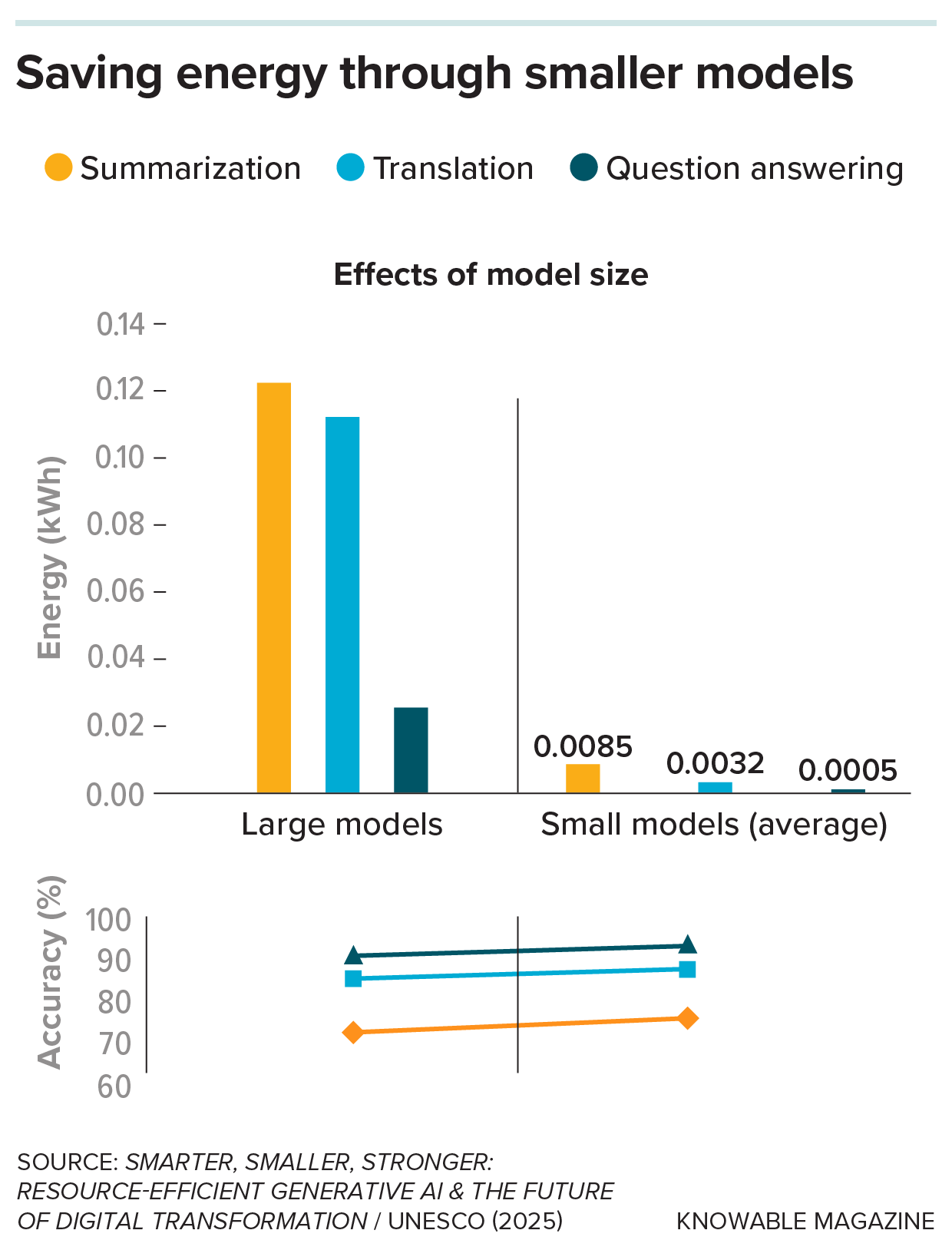
In one 2025 study published by UNESCO, Drobnjak tested the benefits of using small models β€” such as one called opus-mt-en-es for English-Spanish translations, and other models for summarization and query-answering β€” in lieu of the model Llama 3.1 developed by Meta. Though these smaller models are often less user-friendly than more popular AI models, they’re freely available from the AI platform Hugging Face. The small models consumed between 15 and 50 times less energy while producing higher-quality outputs on the tasks for which they were designed, the study found.

A chart showing how large models use more energy than small models.

Using small, specialized models for particular tasks consumes a fraction of the energy guzzled by large, all-purpose models, with similar if even slightly better accuracy. (Image credit: Knowable Magazine)

The shift away from larger models resulted in a 90 percent decrease in energy use overall, making this the most powerful single energy-saving strategy Drobnjak tested in her study. As Gupta puts it, β€œYou don’t need to use a trillion-parameter model for editing an email.”

Less chatty chatbots

Because LLMs perform so many computations for every consecutive word they produce, it helps to choose models that produce less text in general. AI systems expert Mosharaf Chowdhury of the University of Michigan, who has been measuring the electricity usage of LLMs that have been made publicly available, has learned that models that are β€œchattier” by nature tend to consume more energy.

For instance, one version of the model Qwen developed by Chinese company Alibaba Cloud consumes significantly more energy when it’s in β€œproblem solving with reasoning mode,” where it produced roughly 10 times as many words in response to a prompt compared to its β€œtext conversation” mode. So some experts recommend using reasoning mode only for complex questions and otherwise sticking with a chatbot’s standard mode.

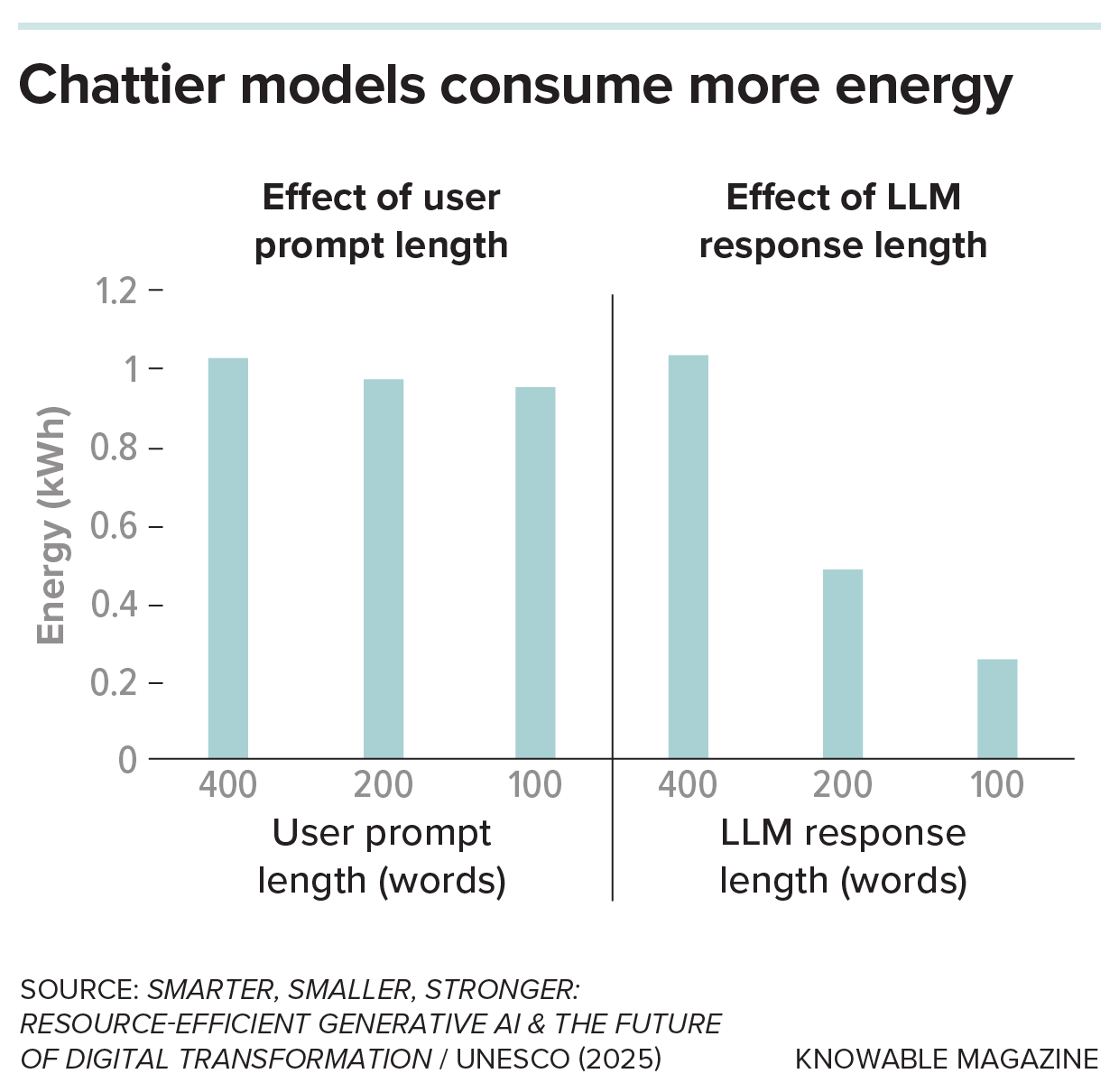
Simply asking AI chatbots to β€œbe brief” or giving them a word limit can also save energy. In the UNESCO paper, Drobnjak and her colleagues found they could reduce the energy consumption of the Llama model by 50 percent when they instructed it to halve its output. By contrast, keeping the prompt itself short had less significant savings β€” just 5 percent for a prompt that was half the length of the original query.

β€œThe size of the output is what determines and drives the energy expenditure the most,” Drobnjak says. She has collaborated with the city of San Francisco to develop energy-saving tips for AI users, which include being as specific as possible and adding instructions like β€œfive bullets max.”

A blue bar graph showing that chattier models use more energy.

Keeping chatbot prompts short can conserve some energy, but asking chatbots to keep their responses brief amounts to much bigger savings. (Image credit: Knowable Magazine)

Go low-res and batch video

Similar recommendations apply for generating images and video, which can consume orders of magnitude more energy than generating text, as they involve iterating millions of pixels many times over, each time processing the entire image anew, says Drobnjak. Such tools are highly popular: Nearly 40 percent of teens ages 13 to 17 surveyed in a recent study by the Pew Research Center use AI to create or edit images or videos.

Drobnjak recommends generating images or videos only when necessary and only at the resolution necessary. β€œOne option is to just start in low resolution,” she says, β€œand if the algorithm is in the right direction, you then start increasing resolution.” She also notes that editing existing images is always less computationally intensive than generating new ones from scratch.

And when generating multiple images, it helps to do so in a single session or batch, which is more efficient than doing so in multiple separate requests.

These actions may seem like a drop in a bucket, and in many respects they are, experts say. But small things add up. While waiting for tech companies, scientists and policymakers to find ways of reducing AI’s overall environmental impact, β€œthe individual who knows to reach for the right tool can make a real difference,” Drobnjak says. β€œAI is [consuming] so much energy that we have to look at it from every angle.”

Editor’s note: This story was updated on July 21, 2026, to clarify that the energy use of individuals who use AI tools a lot is cumulative, not necessarily huge, as was originally stated.

This article originally appeared in Knowable Magazine, a nonprofit publication dedicated to making scientific knowledge accessible to all. Sign up for Knowable Magazine's newsletter.

  •  

'These were harder than any other blades, cut sharper and cost more': How ancient Sri Lankans created steel of legends by harnessing monsoons

About 2,500 years ago, people in what is now India and Sri Lanka were manufacturing an exceptionally high-quality type of steel. Wootz steel was extraordinarily strong and sharp, and they exported it globally β€” in the Middle East, it was used to forge the legendary Damascus blades. But around A.D. 1100, it vanished, and the knowledge of how these ancient people forged such high-carbon steel was lost.

In this excerpt from the book "The Age of Alchemy: How Early Innovators Shaped Modern Chemistry" (Profile Books, 2026), author Kit Chapman, a science journalist and honorary researcher at Falmouth University in the U.K., reveals the extraordinary story of Wootz steel and the experiments that finally showed how it was created using furnaces powered by monsoons.

Kit Chapman interview: 'His urine goes on tour around Europe, showing the kings and queens this glowing pee'

During the Industrial Revolution, it became clear that something far stronger [than iron] β€” steel β€” was needed. Victorian engineers had started to build larger projects than anyone had ever seen, and were using cast iron for their structures, such as the first metal bridge, at Ironbridge in Shropshire. But cast iron was too weak. In 1847, a cast-iron railway bridge over the River Dee collapsed less than a year after it was opened.

If the world was going to modernise, it had to come up with a better material. Steel was the obvious answer, but how did you get rid of just the right amount of carbon in pig iron? The answer was found by an inventor called Henry Bessemer, who was hired by the British government to try to make cheap steel for use in guns. Bessemer's great innovation was to suggest that, once you've got your molten-hot pig iron, you blow air β€” a lot of air, between 85,000 and 550,000 litres per minute β€” up from beneath it.

This results in the iron undergoing oxidation, both increasing the temperature of your molten steel and reacting with the impurities. The impurities form a scum at the top of the furnace called slag. This is a mix of metal oxides and other unwanted byproducts such as silicon dioxide, which then needs to be removed, decarbonising the pig iron into the exact ratio you need for steel. With the steel already molten, it can then be poured out into whatever shape you need.

Bessemer became one of the leading figures of the "Second Industrial Revolution" at the tail end of the nineteenth century. He was knighted by Queen Victoria; his steelworks in Sheffield led to it becoming synonymous with steel; and in the US, eight towns were named after him. Without Bessemer, the world would never have known steel's true potential, and our skylines wouldn't be dominated by modern structures that rely on them, such as skyscrapers, railroad tracks and suspension bridges.

Except there's a big problem. "The story you've been told about metallurgy is from a western viewpoint," explains Gill Juleff, an archaeologist from the University of Exeter, and the reason I've come out to Sri Lanka. "It comes from colonialism, and the dominance of Europe. In Asia, there were technologies that were making very good-quality steel. The makers of iron understood it. All of the evidence suggests that India was very familiar with it. They were producing hardened chisels that carved granite even in the Iron Age. You can only do that with steel."

A close up of a striped knife

A Damascus blade forged from Wootz steel. (Image credit: HDesert via Getty Images)

As early as 500 BCE, steel began to originate from the Indian subcontinent that was far greater in quality than any other. The blades were forged with intricate, elaborate patterns and banding, like the marbling of the finest cut of steak. These were harder than any other blades, cut sharper and cost more.

Arabian, Greek, Roman and Chinese writers all described this wonder-material, which became so legendary that a Persian euphemism for cutting someone with a sword was an "Indian answer." It was known as Wootz steel. Just like pepper or other commodities from southern India that moved west along the Silk Road, the steel's rarity made it a luxury item.

"It's not a material that your everyday blacksmith would necessarily want," Juleff says. "High-carbon steel is an awful lot harder to work. It's not for arrowheads or kitchen knives. It became used by specialist swordsmiths." Then, around 1100 CE, the mysterious, intricately patterned blades simply vanished. Subsequent versions emerged (the most famous is Damascus steel), but Wootz steel had disappeared completely. It left a gaping hole in the history of chemistry.

No one could figure out how the Sri Lankans produced steel of such fine quality, and with such intricate patterning, well over a thousand years before it should have been possible. That is, until Juleff discovered the answer. She realised that archaeologists had been looking at the question based on how Europeans worked with iron.

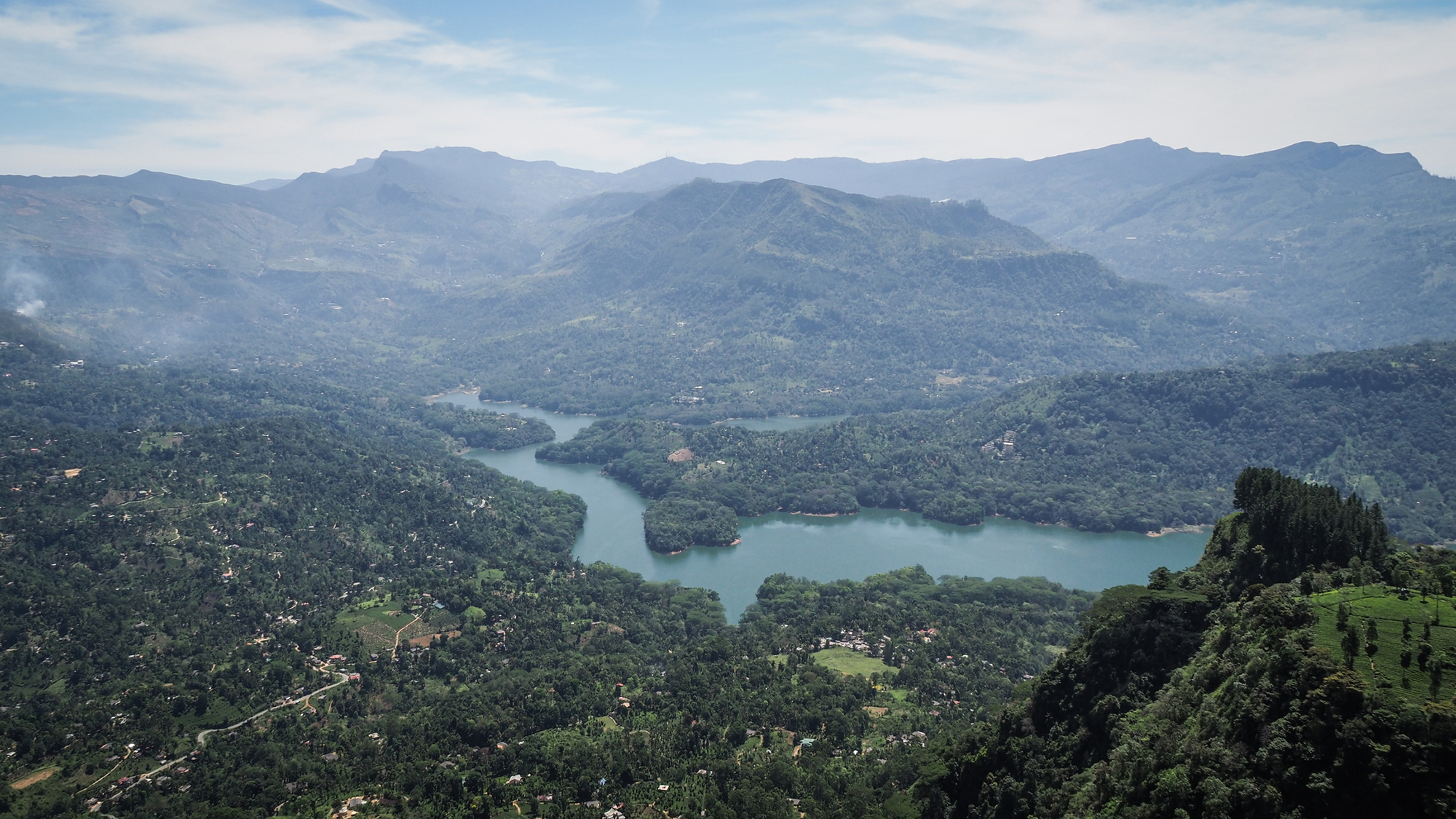
"We discovered that the furnaces were all placed at the top of hills," Juleff explains. "Hundreds of them, of a type we'd never seen before; we only knew they were furnaces because there was slag everywhere. For some reason, the early Sri Lankans had their villages at the bottom of a hill, and then dragged all their iron to the top to smelt it." Initially, the strange furnaces were a puzzle. Typically, a furnace is tall and erect, like a chimney; this creates a natural draught that feeds oxygen to the fire, drawing air in and pushing out the exhaust gases. The Sri Lankan furnaces were totally different. They were flat, half a metre high and 2 metres long, with hundreds of holes bored into the front and back. They looked like oversized harmonicas.

A view of a river in a valley between mountains

Ancient people forged Wootz steel near Sri Lanka's central highlands at the tops of hills to utilize the monsoon winds. (Image credit: Jakub Specjalski via Getty Images)

"The answer wasn't immediately obvious why," Juleff says. "And then we realised they were all facing into the wind." What if the Sri Lankans weren't using bellows at all? This is why Juleff asked me to come to Colombo in the off-season. Every year, Sri Lanka is buffeted by two wet seasons: the south-west monsoons from May to September, and the north-west monsoons from December to February. It's a kind of weather you have to experience yourself to truly appreciate.

"A monsoon wind blows up to 90km an hour [56 mph]," says Juleff. "When you're at the top of a hill, you get an aerodynamic effect, where all the wind's rushing up and cresting. You're battered by it. Everyone told me you couldn't run a furnace just using the wind, because it's not strong or reliable enough. So, I decided to experiment. I built one." Juleff's furnace was identical to the Sri Lankan ruins she had found. She fed it using charcoal and iron sourced locally from surface deposits β€” exactly as would have been available to the villagers who built them.

Then, she waited for the monsoon. "So, we ran this furnace," Juleff says. "And, to begin with, I thought it wasn't working. We had this line of fire behind the front wall, and nothing at the back. I thought everything needed to be burning." It looked like the experts had been right: the monsoon winds weren't regular or consistent enough to blow into the furnace's holes to create the temperatures required.

But then Juleff's mood changed. "It was like a Transformers toy, everything rearranged in my mind. I had a eureka moment! It wasn't wrong at all; it was how it was designed to work. The wind was blowing up the hill β€” it wasn't blowing into the tubes at all, it was blowing over the top of the furnace. It's like an aeroplane wing: by blowing over the furnace, you're creating this incredible pocket of low pressure." The Sri Lankan furnace wasn't a harmonica, with air puffed through it; instead, it was played like a flute.

This is the Bernoulli effect, the same principle that sticks a race car to the road, or keeps water moving through your plumbing. The change in pressure and the smooth, ordered air flow was creating a furnace beyond anything western science had considered possible. The team continued putting in ore and charcoal throughout the day, then allowed things to cool. The next day, they returned to see what they had produced. At the top was a knotted lump of pure iron β€” a bloom, as expected. "But then below that, stuck to the bottom of our slag, was another layer of metal," Juleff says. "High-carbon steel. The wind did it. We couldn't stop the wind doing it. We had created a furnace that could make the best steel anywhere in the world."

Juleff had solved the mystery of Wootz steel. Not only did we now know how it was made, we understood why the technology hadn't spread around the world: the technology was anchored in the unique geography of Sri Lanka, and the people who visited weren't scholars, but traders who didn't appreciate the small miracle they were witnessing.

"The metal-makers weren't moving," Juleff says. "They were here, sat in the interior of Sri Lanka, season after season, running these incredible furnaces." Why did Wootz steel vanish? In the twelfth century CE, Sri Lanka was invaded by the Pandya dynasty of southern India. It triggered a societal collapse, as Sri Lankans were forced to pay tribute to their conquerors. The most likely explanation is that, during the chaos of the invasion and its messy aftermath, the traders and middlemen who brought the Wootz steel to the coast, and the ships that transported it around the world, had stopped coming.

It wouldn't have occurred, or mattered, to a Sri Lankan metallurgist that their goods were ending up in the hands of kings and emperors in some distant land they'd never heard of; they'd have only seen that they couldn't sell to local traders any more. The villagers stopped making goods that didn't sell, and moved on to other, more profitable, careers.

Excerpted from "The Age of Alchemy: How Early Innovators Shaped Modern Chemistry," Profile Books, 2026.

A book cover with a vial over a flame with the title

Profile Books
The Age of Alchemy: How Early Innovators Shaped Modern Chemistry

"Age of Alchemy" is a fascinating and funny dive into chemistry long before chemistry existed. It captures the ingenuity of humans across cultures and time, revealing how ultimately the work of these early innovators would eventually meld into modern science.

  •  

Where and when to see the Aug. 12 solar eclipse β€” exact times for North America and Europe

Millions of people across Europe and North America will witness a solar eclipse on Wednesday, Aug. 12, but the event will vary greatly depending on the location. A narrow corridor stretching from Greenland to northeastern Spain will experience a total solar eclipse, much of Europe will enjoy a deep partial eclipse, and parts of North America will see a smaller partial eclipse.

Want to know what you can expect to see from where you are? Here's an overview of the event from various locations, along with the exact viewing times for the Aug. 12 solar eclipse.

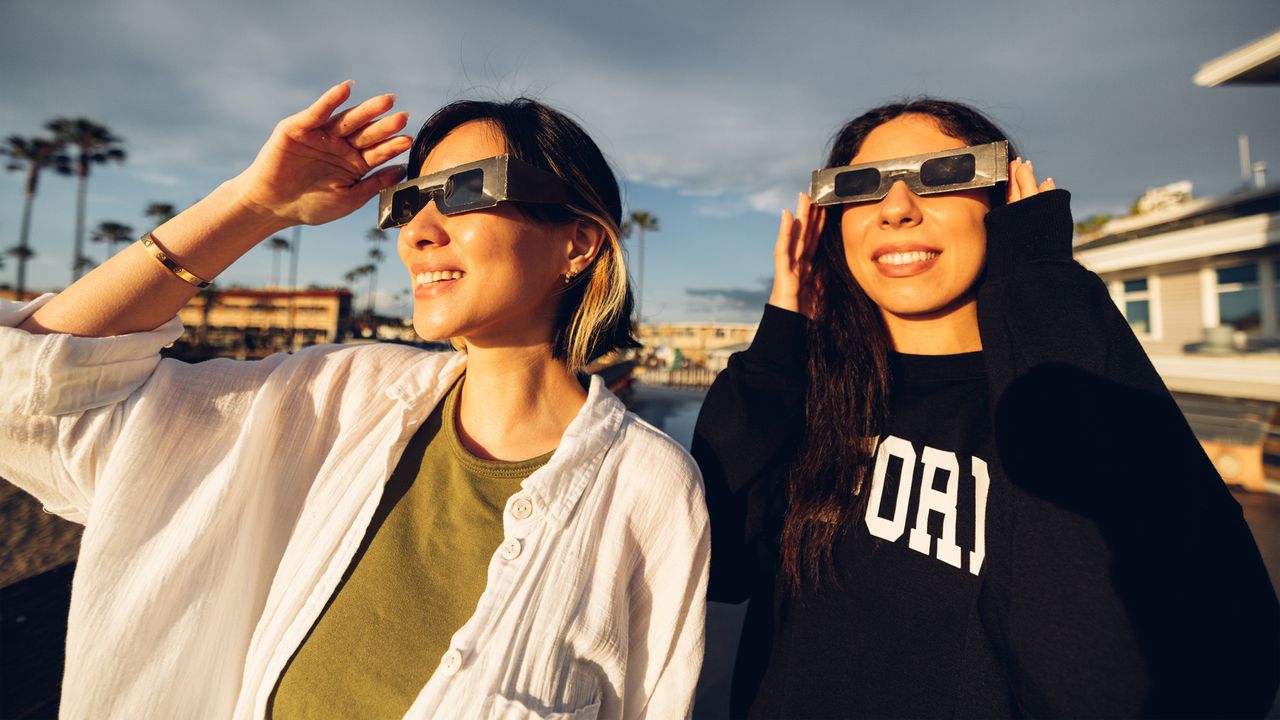
Remember, it's important to wear certified solar eclipse glasses during all partial phases of the eclipse. Totality β€ͺ—‬ when the sun's face is completely blocked by the moon β€ͺ—‬ is the only time it's safe to remove your eclipse glasses. (It’s not too late to order last-minute eclipse glasses if you don’t have a pair on hand.)

If you're in the path of totality

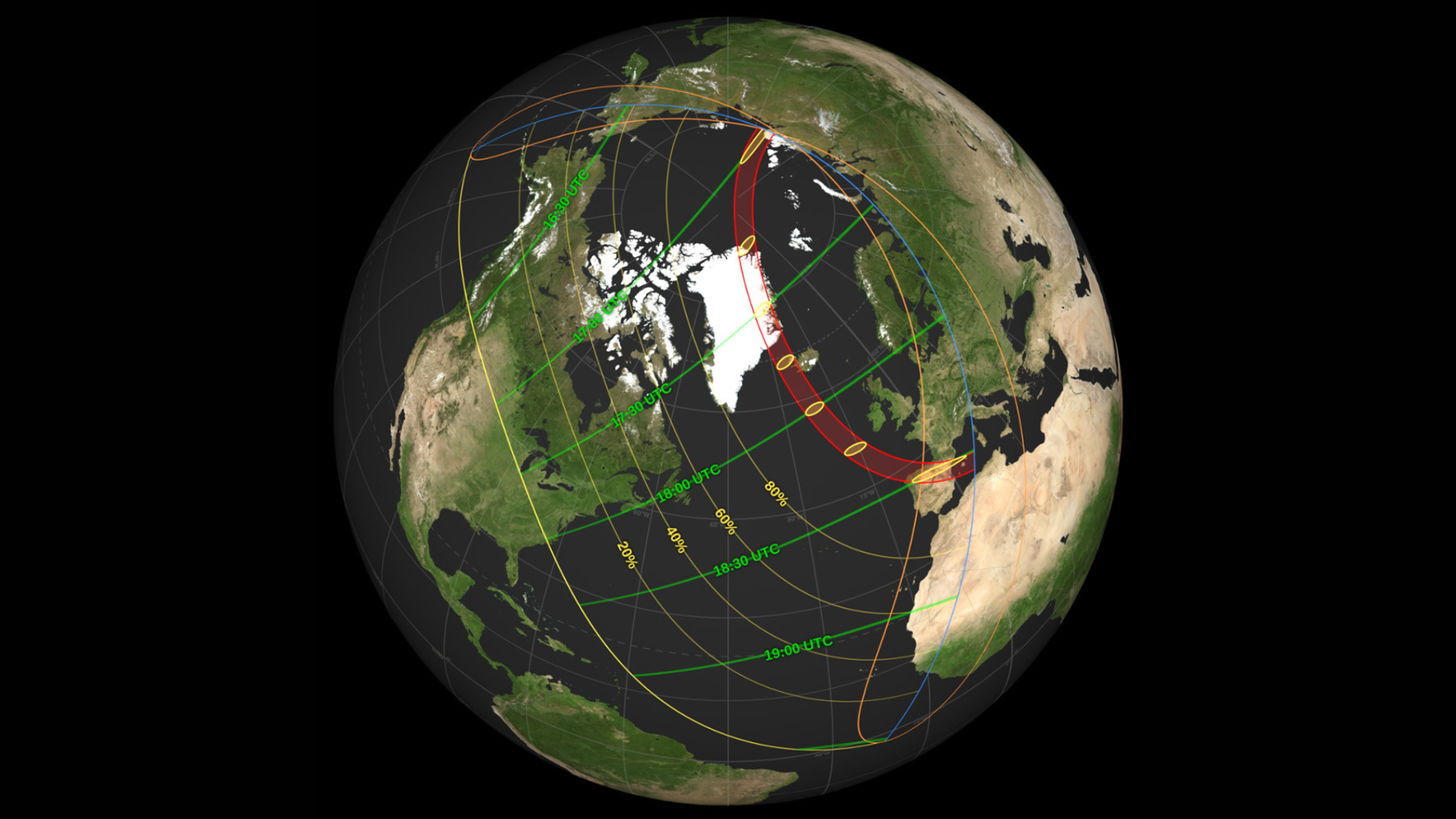
A 3D illustration of the Earth with lines across it.

A map of the path of totality (red) for the Aug. 12 solar eclipse. (Image credit: NASA's Scientific Visualization Studio)

If you're fortunate enough to be inside the 180-mile-wide (290 kilometers) path of totality β€” the path of the dark shadow of the moon β€” in eastern Greenland, western Iceland or northeastern Spain, you'll experience the moon completely covering the sun for up to 2 minutes, 18 seconds. The sky will darken to twilight, bright stars and planets may appear in the daytime sky, and the sun's spectacular corona (its wispy outer atmosphere) will become visible. Here’s a handy guide to all the gear you’ll need to get the most out of totality.

The closer you are to the centerline of the path, the longer totality will last. But the most important consideration is to stay within the boundaries of the path, because it has a hard edge. Madrid, for example, is barely outside the path and will see a 99.99% partial eclipse β€” and no totality whatsoever. The partial phases last an hour on each side of totality.

Here's when totality will occur in various locations for the Aug. 12 total solar eclipse:

  • Scoresby Sund, Greenland: 4:35 p.m. WGST (up to 2 minutes, 17 seconds)
  • Reykjavik, Iceland: 5:48 p.m. GMT (60 seconds)
  • LeΓ³n, Spain: 8:28 p.m. CEST (1 minute, 45 seconds)
  • Soria, Spain: 8:29 p.m. CEST (1 minute, 43 seconds)
  • S'Arenal, Mallorca, Spain: 8:31 p.m. CEST (1 minute, 36 seconds)

If you're in North America

Viewers in North America will see a modest partial eclipse, with the biggest eclipse seen from northern and eastern Canada, Alaska and the northeastern U.S. The farther northeast you are, the deeper the eclipse will appear. Eclipse glasses are essential at every stage of the two-hour event, because there will be no totality. Here are the times of maximum eclipse in various locations:

  • Iqaluit, Nunavut: 1:24 p.m. EDT (61% eclipse)
  • St. John's, Newfoundland and Labrador: 3:00 p.m. NDT (53%)
  • Fairbanks, Alaska: 8:27 a.m. AKDT (37%)
  • Anchorage, Alaska: 8:21 a.m. AKDT (28%)
  • Bangor, Maine: 1:53 p.m. EDT (23%)
  • Quebec City: 1:46 p.m. EDT (24%)
  • Montreal: 1:45 p.m. EDT (18%)
  • Boston: 1:55 p.m. EDT (16%)
  • New York: 1:54 p.m. EDT (9%)

If you want to watch totality from outside the path, there are many live stream options available, including planned streams from NASA and the European Space Agency.

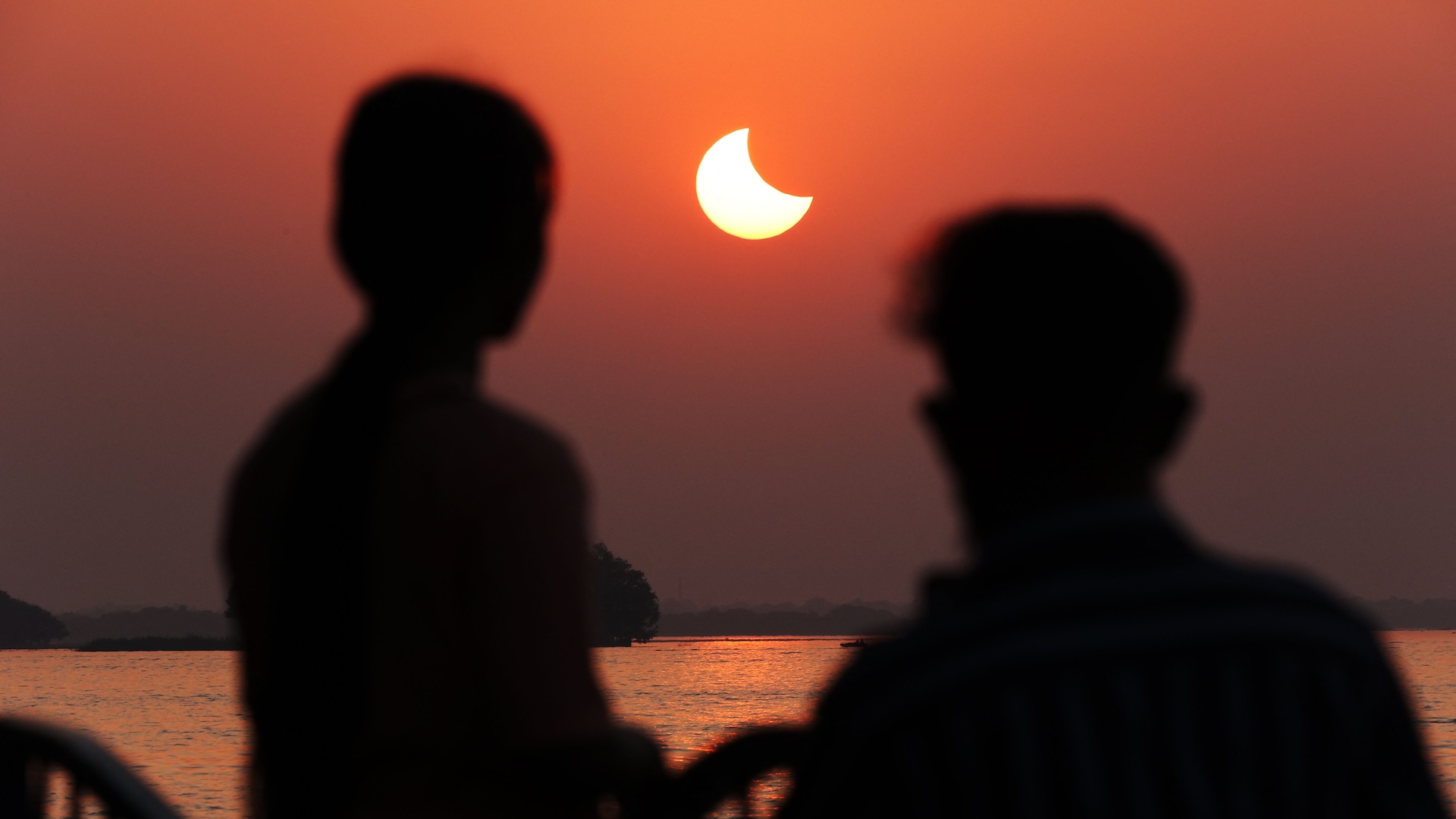
two people look at a solar eclipse during the sunrise

A deep partial eclipse will be visible in many locations throughout Europe, with a smaller eclipse visible in North America. (Image credit: GAGAN NAYAR via Getty Images)

If you're elsewhere in Europe and North Africa

Most of Europe and far northwestern Africa will see a spectacular deep partial eclipse, with more than 90% of the sun covered in many western cities. Although the eclipse will never become total, it will still be an impressive sight, though solar eclipse glasses will be required throughout the event. Here are the times of maximum eclipse in some major cities:

  • Madrid: 8:32 p.m. CEST (99.9%)
  • Barcelona: 8:29 p.m. CEST (99.8%)
  • Algiers, Algeria: 7:33 p.m. CET (96%)
  • Nice, France: 8:24 p.m. CEST (95%)
  • Lisbon, Portugal: 7:36 p.m. WEST (94%)
  • Dublin, Ireland: 7:10 p.m. BST (94%)
  • Cardiff, Wales: 7:13 p.m. BST (93%)
  • Belfast, Northern Ireland: 7:08 p.m. BST (93%)
  • Paris: 8:17 p.m. CEST (92%)
  • Tangier, Morocco: 7:40 p.m. WEST (92%)
  • London: 7:13 p.m. BST (91%)
  • Edinburgh, Scotland: 7:05 p.m. BST (91% eclipse)

To check exactly what you'll see and when, enter your location on an interactive map of the eclipse, which will give you a schedule for when the eclipse begins, peaks and ends where you are.

  •  

What's the difference between sweet potatoes and yams?

Yams and sweet potatoes are often confused, and the names are sometimes used interchangeably in the U.S. However, they're two different crops. So what sets them apart?

The differences lie mainly in these vegetables' classifications, plant growth, and nutritional profiles, experts told Live Science.
Despite both growing underground and appearing somewhat similar, "Botanically, sweet potatoes and yams are not closely related, as they belong to different plant families," said Phillip Wadl, a research geneticist at the U.S. Vegetable Laboratory in Charleston, South Carolina. Sweet potatoes (Ipomoea batatas) are in the morning glory family (Convolvulaceae). Yams (Dioscorea), by contrast, belong to the Dioscoreaceae family, and there are 11 yam species cultivated for food and income, Wadl told Live Science in an email.

Yams and sweet potatoes also belong to different plant groups, or "cotyledon types," said Jeffrey Cole Denis Gregorie, a sweet potato specialist at the Sweet Potato Research Station in Chase, Louisiana. Yams are monocots, plants whose embryo has only one cotyledon, or seed leaf, like grasses and lilies. Sweet potatoes are dicots, plants with two embryonic seed leaves, which include many fruits and vegetables, such as grapes, squash, strawberries and tomatoes.

In addition, yams and sweet potatoes store food in different parts of the plant. "Sweet potatoes form storage roots which are enlarged parts of the root system," Wadl explained, "whereas yams form tubers, which are enlarged underground stems for nutrient storage."

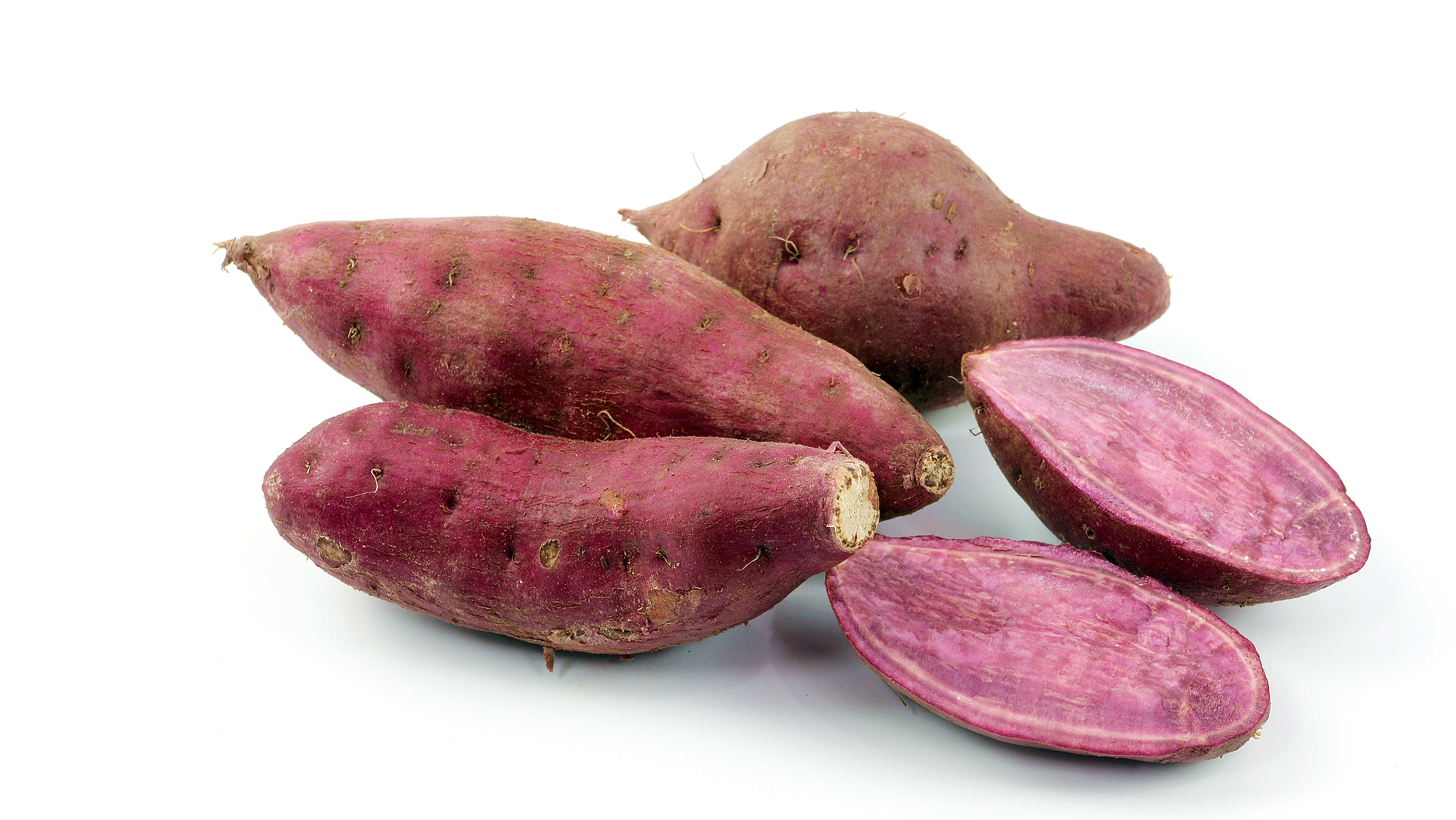
A close up of purple tubers against a white background

The "garnet yam" is actually a sweet potato. (Image credit: Sarawuth123 via Getty Images)

A single sweet potato plant typically produces about four to 10 sweet potatoes, while a yam plant yields about one to five yams. Sweet potatoes generally take about three to five months to mature, compared with about six months to a full year for yams, according to Craig Yencho, a professor of horticultural science and a sweet potato and potato researcher with North Carolina State University.

How do you tell sweet potatoes and yams apart?

Sign up for our newsletter

Life's Little Mysteries logo with a question mark in a magnifying glass

(Image credit: Marilyn Perkins / Future)

Sign up for our weekly Life's Little Mysteries newsletter to get the latest mysteries before they appear online.

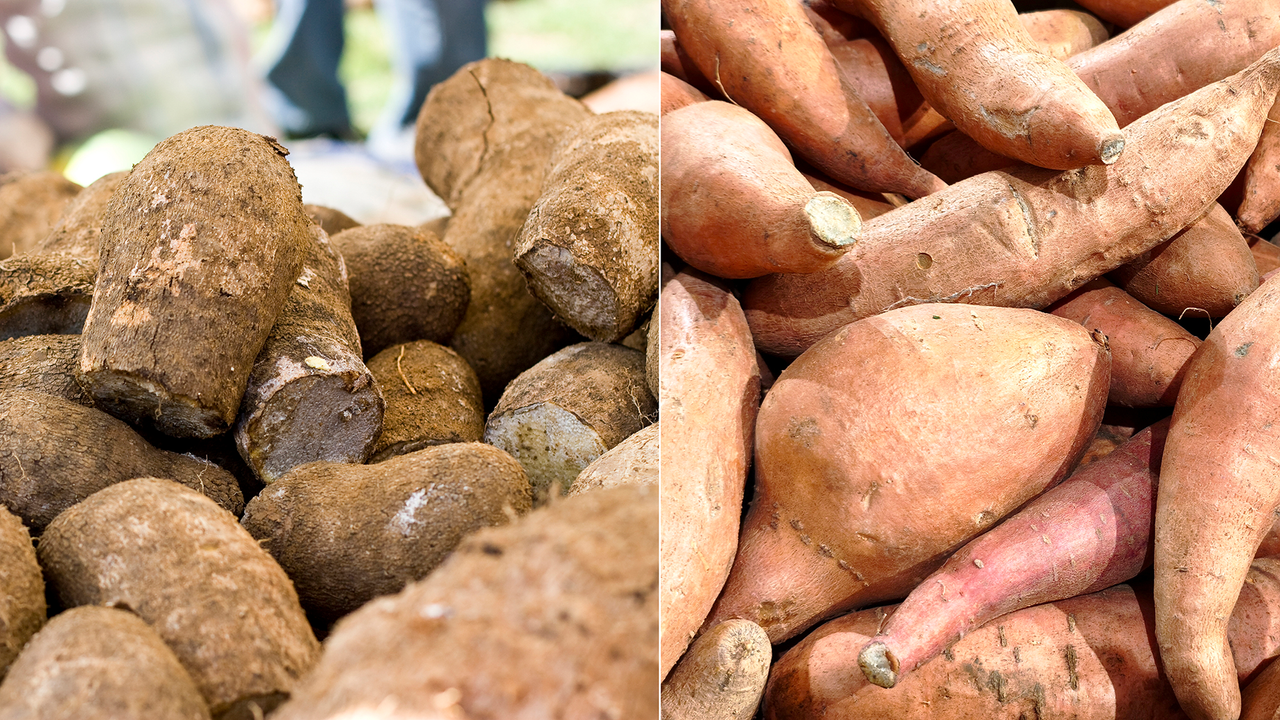
Visually, sweet potatoes and yams are easy to tell apart when you know what to look for. Sweet potatoes tend to be shorter and blockier, with tapered ends. Yams are usually long and cylindrical, sometimes with "toes," or branching shapes.

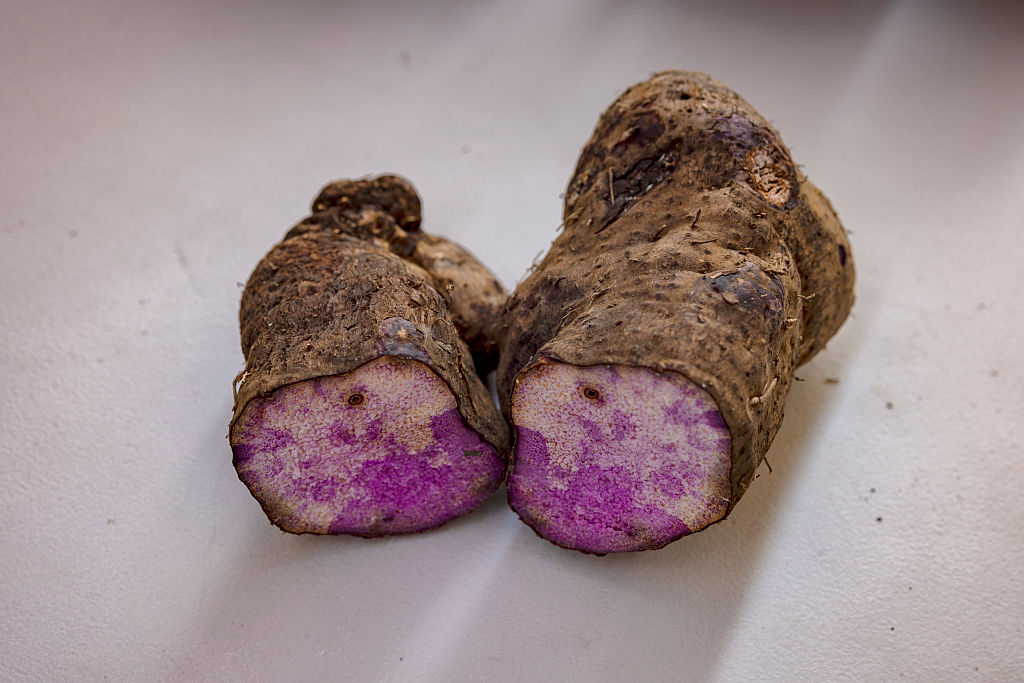
Sweet potatoes come in various flesh colors, including orange β€ͺ—‬ the most common color in the U.S. β€ͺ—‬ as well as yellow, purple and white. Their skin is typically thin and smooth, whereas "yams often have a rough, bark-like skin and their flesh can be white, purple or reddish," Wadl said. One well-known purple yam, known as ube (Dioscorea alata), is a popular ingredient in treats such as ice cream, cookies and pound cake.

Sweet potatoes and yams also have noticeable differences in their culinary and nutritional profiles, Wadl said. "Sweet potatoes are generally sweeter and have a moist, creamy texture when cooked, although dry types are available," he explained. "Yams, on the other hand, tend to be starchier, drier, and have a more earthy, sometimes less sweet, flavor compared to sweet potatoes. Their texture can be more like a regular potato."

Nutritionally, the two crops are quite different, too. Sweet potatoes, particularly the orange-fleshed varieties, are an excellent source of beta-carotene (a precursor to vitamin A), vitamin C, dietary fiber, potassium and some B vitamins. "While nutritious, [yams] typically contain less beta-carotene than orange sweet potatoes," Wadl noted. Instead, yams are a good source of potassium, vitamin C, manganese and dietary fiber.

Sweet potatoes are generally considered safe to eat both raw and cooked, Wadl said. By contrast, many wild varieties of true yams, especially those not cultivated for commercial consumption, contain compounds like dioscorine that could make them toxic to humans if eaten raw. "These must be thoroughly cooked to remove the toxins and make them safe for consumption," Wadl said.

A woman wearing a skirt and headscarf bends over large piles of tubers in an outdoor market

A woman sells yams in the market in Abobo in the Ivory Coast on April 22, 2020. (Image credit: ISSOUF SANOGO via Getty Images)

Thanksgiving confusion around yams and sweet potatoes

If yams and sweet potatoes are so different, why do so many Americans call sweet potatoes "yams"?

Part of the answer lies in history. The yam was a key provision on voyages of enslaved people from West Africa to the Americas, "used to feed captives a familiar food," said Judith Carney, a professor of geography at UCLA. "In mainland plantation societies of North America where the African yam could not be grown, the sweet potato served as a substitute dietary staple." Because the two crops shared some characteristics, "the word 'yam' came to refer vernacularly to both tubers in mainland America, as we see in the U.S. today," Carney told Live Science in an email.

A close up of two open halves of a purple tuber

A purple yam, known as ube, from the Philippines. (Image credit: Ezra Acayan / Stringer via Getty Images)

The U.S. sweet potato industry also leaned into the confusion, adopting the term "yam" for marketing reasons, Gregorie told Live Science in an email. "In the United States, many orange-fleshed, moist varieties of sweet potatoes are often mislabeled as "yams" to distinguish them from the drier, white-fleshed sweet potato varieties," Wadl explained.

As a result, the "yams" at most U.S. supermarkets are probably sweet potatoes. "Garnet yams" and "jewel yams" aren't actually yams, despite those labels; instead, they're softer, sweeter varieties of sweet potatoes, according to the University of California, Davis.

Although genuine yams are sold in many international markets in the U.S, "if you're buying a "yam" in a typical U.S. supermarket, you're almost certainly purchasing a sweet potato," Wadl said.

Do you know where pumpkins and blueberries come from? Find out with our fruits and vegetables quiz!

  •  

Bacterial 'postbiotic' may help preserve fertility in the aging uterus, preliminary research suggests

Bolstering a type of bacteria that lives in the uterus may help counter age-related changes that can make it harder to get pregnant, a new study suggests.

While fertility decline is often linked to changes in egg number or quality, the uterus also becomes less receptive to an implanting embryo with age. The new research suggests that changes in the bacteria living there may be part of the reason.

In experiments, treating aged mice and lab-grown human uterine cells with a specific species of Lactobacillus, a group of bacteria often found in the uterus, reduced signs of aging in the uterine lining and improved embryo implantation. This improvement was also seen with a specific byproduct of Lactobacillus.

The findings, published Thursday (Aug. 6) in the journal Cell Host & Microbe, suggest that the uterine microbiome could be a promising target for treating age-related infertility. However, experts who were not involved in the study cautioned that the research is still preliminary.

"This is an interesting and promising approach, but we still don't know whether these findings will translate into meaningful improvements in human fertility," said Dr. Alex Robles, a fertility specialist at Columbia University Fertility Center who was not involved in the study.

"The microbiome can be influenced by many factors, including genetics, diet, geography, environmental exposures and other lifestyle practices," he told Live Science in an email, "which is why it's important to validate these findings across diverse populations before developing broadly applicable treatments."

To explore whether and how the uterine microbiome changes with age, the study researchers analyzed samples of the endometrium β€” tissue from the lining of the uterus β€” from 149 women ages 20 to 45 who were undergoing fertility treatment in China. The older women had lower levels of beneficial Lactobacillus bacteria, particularly L. gasseri and L. crispatus. These bacteria are generally associated with a healthy reproductive tract.

diagram of an ovary, fallopian tube and uterus, showing an egg traveling from the ovary to the uterus

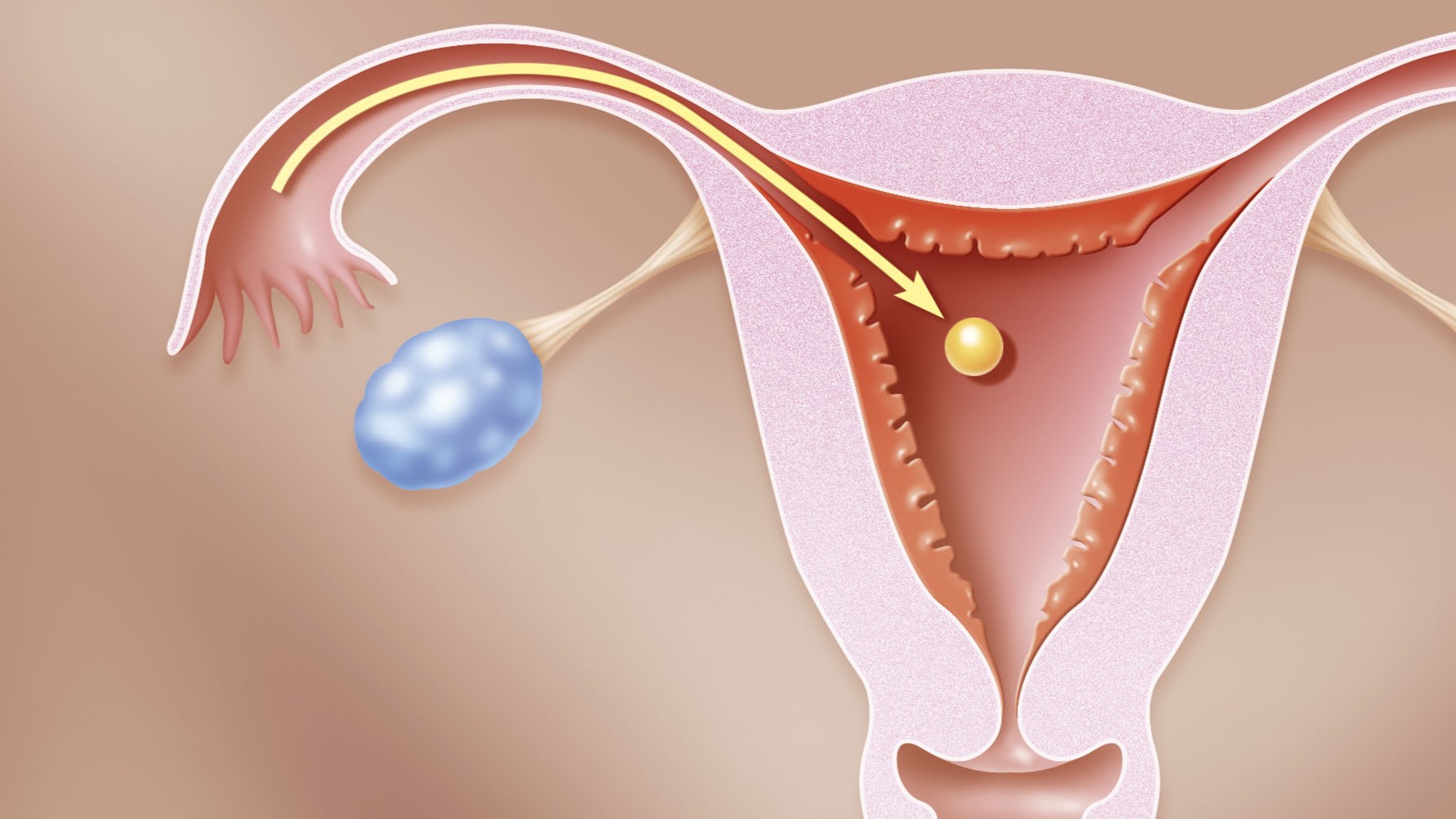
With age, the lining of the uterus typically becomes less receptive to implantation, lowering the chance of pregnancy. (Image credit: BSIPΒ /Β Contributor vis Getty Images)

"One finding that surprised us was that overall microbial diversity did not change markedly across the different age groups," study co-author Dr. Rong Li, deputy director of the Department of Obstetrics and Gynecology at Peking University Third Hospital in Beijing, said in a statement. "Instead, the major differences involved particular bacterial species."

Later, 93 of the women underwent in vitro fertilization (IVF), and of those, 56 became pregnant. Those who became pregnant had higher levels of Lactobacillus in their uterine lining than those who did not get pregnant. That said, the pregnancy rates were similar across women of different ages who underwent IVF.

To better understand the effect of these bacteria on the uterus, the team isolated five Lactobacillus species and tested how they interacted with uterine cells. L. gasseri stood out because it attached strongly to uterine cells, and this attachment was associated with reduced inflammation and lower damage from oxidative stress. The bacterium also produced large amounts of exopolysaccharides (EPS), a type of sugar molecule.

The researchers then purified these sugars into a postbiotic they call LG-EPS. Unlike probiotics, postbiotics are products of bacterial cells and thus do not contain live bacteria.

Then, the researchers ran tests in older female mice (roughly equivalent to a middle-aged woman) to see whether introducing L. gasseri or LG-EPS to the vaginal canal could affect the aging uterus. After four weeks of daily vaginal treatment with either the bacterium or the postbiotic, the mice had fewer signs of uterine aging, less inflammation and higher embryo implantation rates than the untreated animals did. (That said, the team did not measure how much of each treatment actually reached the uterus.)

When they tried the same test with a modified strain of L. gasseri that could not make EPS, they found that many of these benefits disappeared. That suggested that the exopolysaccharides were responsible for much of the benefit. LG-EPS also reduced signs of aging in artificially aged human uterine cells, improving their ability to support embryo implantation.

Further experiments suggested that the postbiotic works by modifying a signaling pathway that helps control cell growth and tissue repair. This pathway was overactive in aged mice and uterine cells, but treatment helped to normalize its activity. Blocking a key protein in the same pathway eliminated the treatment's effects.

Robles said postbiotic treatments could be especially interesting because they may be easier to manufacture than treatments containing live bacteria. "If confirmed in future studies, these treatments could potentially be used alongside IVF to improve the uterine environment before embryo transfer," he suggested.

But he cautioned that the study should not prompt people to try over-the-counter probiotics or other supplements as ad hoc fertility treatments.

"The reproductive tract is a delicate ecosystem, and introducing or eliminating certain bacteria could have unintended consequences," Robles said. "We do not fully understand what constitutes a 'healthy' uterine microbiome. As such, any intervention should be approached with caution."

This article is for informational purposes only and is not meant to offer medical advice.

  •  

Where to buy last-minute solar eclipse glasses and viewing gear before August 12

Even though August 12's solar eclipse won't be much to look at for observers in the U.S., it'll be even less impressive if you can't look at it at all. In order to see the partial phases, you MUST wear a pair of certified solar glasses or solar binoculars to view the sun safely.

The American Astronomical Society states, "ISO 12312-2 specifies the properties that a solar viewer should have in order to protect your eyes from injury and provide a comfortable view."

With the eclipse fast approaching, there is still time to pick up some last-minute solar viewing equipment, but some retailers are already selling out and won't be able to deliver before Wednesday, August 12.

Here are the best options you can still get hold of before the solar eclipse.

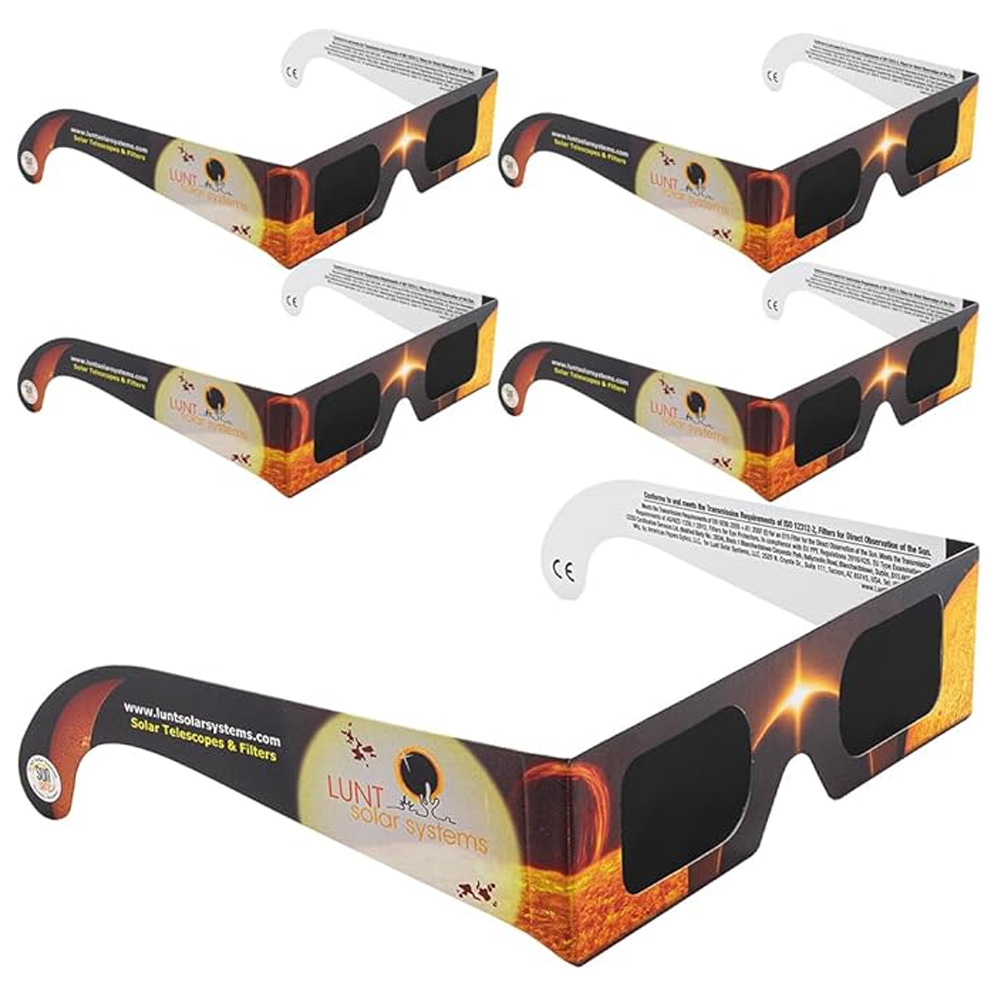
This 5-pack of solar eclipse glasses from Lunt is ideal for viewing parties, for the whole family to use or just to have spare pairs for future eclipses.

They're ISO 12312-2 certified and Prime members can get them on free next-day delivery.View Deal

This 2-pack of solar glasses from Soluna is super affordable, ISO 12312-2 certified and is even available for same-day delivery in some areas.View Deal

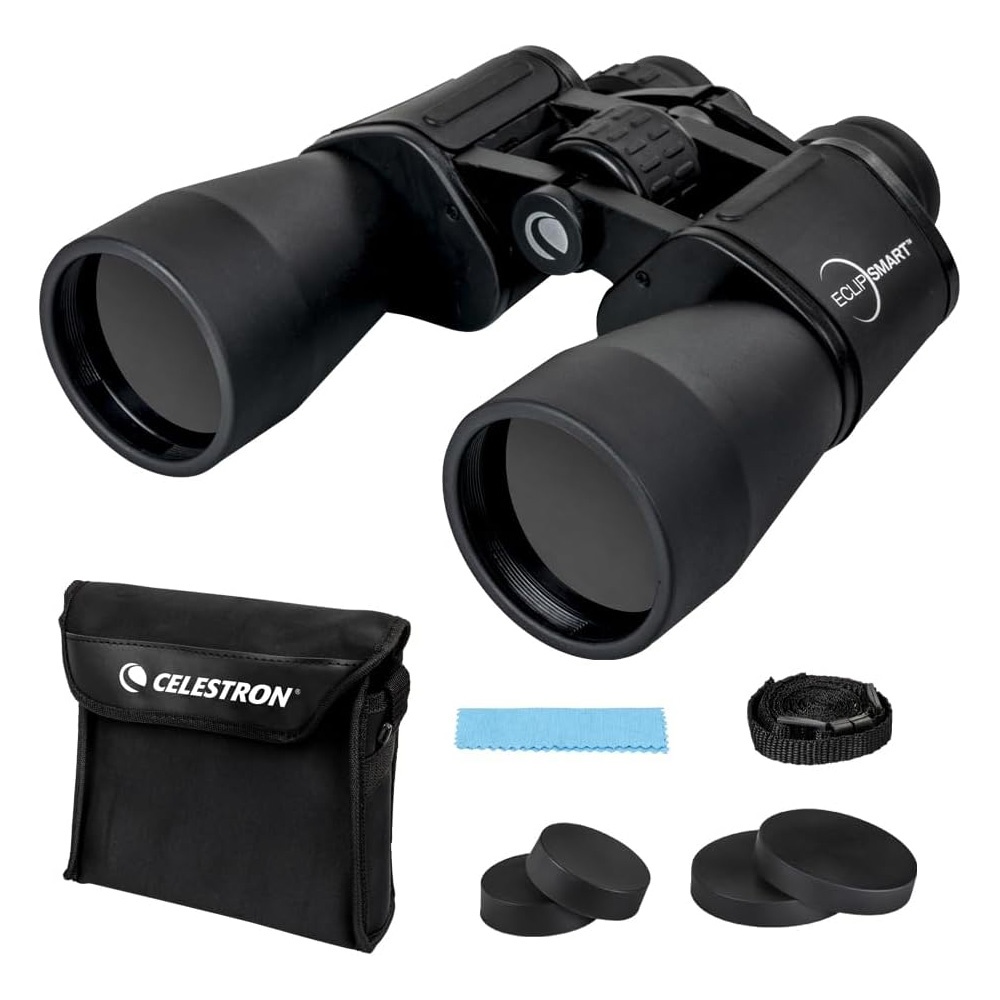
The Celestron EclipSmart 12x50 solar binoculars provide safe solar viewing with 12x magnification, and Prime members still have time to have them delivered before August 12.

But there's a rather large caveat here. Buying them mere days before a solar eclipse is arguably the worst possible time to purchase them, as this is when they're most expensive. For example, last October, they went down to $26.82. (Ah, capitalism).

So unless you plan on observing the sun all-year round, perhaps stick to the solar glasses for now and buy them in a few months when they're cheap so you're ready for the next one.View Deal

If you don't want to pay the inflated price for the solar binoculars, or you already have a pair of binoculars, these DayStar filters are a great option that fit on the front of the objective lenses to protect both your eyes and the lenses.

They come in various sizes, although they aren't suitable for objective lenses under 50mm.

While BHPhoto doesn't give exact shipping dates, you could still get them before the eclipse.View Deal

For the tech-nerds who want to take photos or a time-lapse of the eclipse, the Dwarf Mini is an affordable and portable smart telescope that comes with a solar filter and provides effortless solar imaging.

It was cheaper at the beginning of July, but it's still a great investment that you can use day and night all year round, so we wouldn't let the higher price put you off. Plus, it's still much more affordable than most, if not all, other smart telescopes.

Prime members can get same-day delivery (depending on location).

Read our full Dwarf Mini reviewView Deal

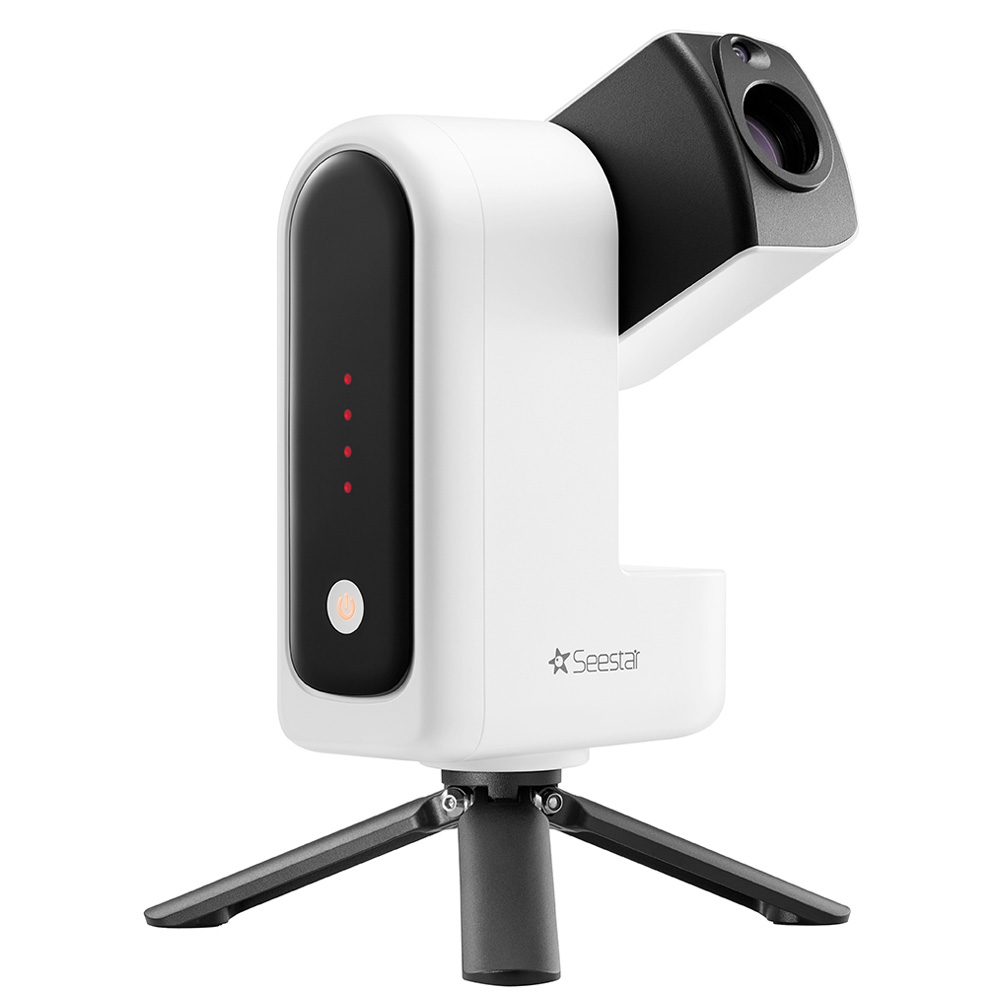
Now feels like the right time to grab a smart telescope, we reckon you can't get better than the ZWO SeeStar S30 Pro, and the included solar filter is ideal for capturing images or time-lapses of the eclipse. Plus, it produces absolutely stunning astro-images, too.

You can still get it before August 12 from BHPhoto, but we wouldn't wait too much longer.View Deal

  •  

Uberaba Geopark: A time capsule from the Late Cretaceous period nestled in Brazil's tropical savanna

QUICK FACTS

Name: Uberaba Geopark (also known as "Terra dos Gigantes," or "Land of the Giants")

Location: Minas Gerais, Brazil

Coordinates: -19.71, -47.96

Why it's incredible: The park hosts prehistoric-fossil-bearing rock formations and overlies one of the world's biggest aquifers.

Nestled within Brazil's Cerrado tropical savanna β€” the second-largest biome in South America, after the Amazon rainforest β€” Uberaba Geopark is a time capsule from the Late Cretaceous period (100.5 million to 66 million years ago).

The geopark boasts abundant, well-preserved fossils from the last chapters of the nonavian-dinosaur era, according to UNESCO, earning it the nickname the "Land of the Giants," or "Terra dos Gigantes" in Portuguese. Paleontologists have discovered more than 10,000 fossils belonging to dinosaurs, prehistoric crocodyliforms (a group encompassing living crocodiles, alligators, caimans and gharials, as well as their extinct relatives), turtles and other ancient creatures within the park's boundaries.

One of the best-known discoveries is the fossil of Uberabatitan ribeiroi, a titanosaur measuring 89 feet (27 meters) long and 33 feet (10 m) tall, according to UNESCO.

The finds were clustered in impressive geological features, including the Serra da Galga formation and Serra Geral mountain range. These structures formed from ancient basalt flows, which came from giant volcanic eruptions that predate the breakup of the Gondwana supercontinent 180 million years ago.

The park has the ideal conditions to preserve fossils because it alternated between shallow lagoons and river systems when the dinosaurs roamed the region, meaning the animals' remains were conserved in mud when they died.

Fossil of an ancient crocodylimorph from Brazil.

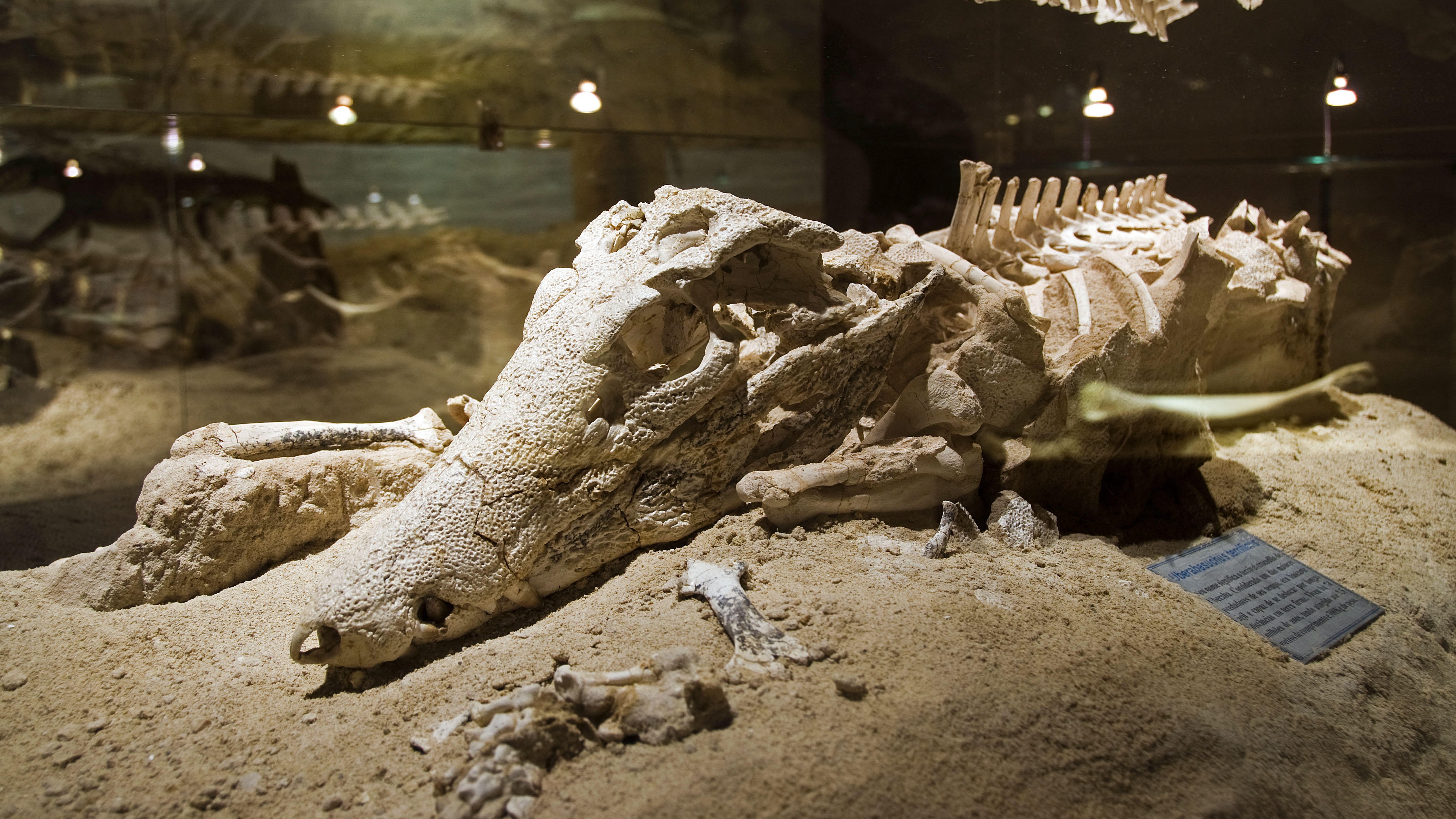
Uberaba Geopark preserved extinct crocodile relatives among other fossils. (Image credit: Pulsar Imagens via Alamy)

Serra da Galga and Serra Geral also overlie one of the world's largest freshwater reservoirs, the Guarani aquifer, which supplies drinking water for more than 100 cities in Brazil, Argentina, Paraguay and Uruguay.

The Cerrado savanna, which houses the entire park, is a critical-yet-underprotected carbon sink that hosts more than 12,000 plant species and diverse animal life.

The "Land of the Giants" was added to UNESCO's list of geoparks in 2024 in recognition of the region's geological and natural heritage.

What is now the Uberaba Geopark was the birthplace of Brazil's modern livestock market, which is one of the biggest in the world. Farmers in the 19th century introduced zebu (Bos indicus) cattle from India because they are better suited to the climate in Brazil and require less food than common domesticated cattle (Bos taurus). Zebu cattle also produce lower greenhouse gas emissions than common domesticated cattle do, according to UNESCO.

Uberaba Geopark is open to visitors. There are several museums and trails to explore, including one that leads to the Vale Encantado, or "Enchanted Valley," which contains forests, waterfalls and prehistoric rock formations, according to the BBC.

Discover more incredible places, where we highlight the fantastic history and science behind some of the most dramatic landscapes on Earth.

  •  

New recyclable yarn is as stretchy as spandex and could help tackle fashion's plastic waste problem

Your favorite stretchy workout clothes may be much easier to recycle one day, thanks to a new type of elastic yarn that is as strong and stretchy as today's spandex-containing fabrics.

The yarn, described in a July 25 study in the journal ACS Materials Letters, is built entirely from polyethylene, the plastic used in milk jugs and single-use grocery bags. By contrast, most of today's stretchy fabrics blend spandex, a bouncy-but-weak polyurethane fiber, with a tougher fiber like polyester or nylon.

That combination gives clothes their stretch and durability. But because the fibers are chemically different, it's difficult and costly to separate them for recycling, and chemicals used to break down the fabrics are toxic. The result is that almost none of this material is recycled. An estimated 80% of textiles sold in the U.S. contain spandex, and most end up incinerated or in a landfill, study co-author Svetlana Boriskina, a research scientist in the Department of Mechanical Engineering at MIT, said in a statement.

To solve that problem, the MIT team turned to polyethylene, one of the world's most widely recycled plastics. For the yarn's stretchy core, the researchers created a soft, springy version of polyethylene akin to a rubber band. Around that core, they wound a second, stiffer polyethylene fiber, more like a fishing line, coiling it tightly the way a spring or a twisted phone cord is coiled. Because both materials come from the same plastic family, they don't need to be separated before they're recycled.

In laboratory tests, the researchers melted a spool of the yarn and respun it into new yarn 10 separate times. Each time, they tested its strength, and the recycled yarn performed just as well as the original in every case. In head-to-head tests, the new yarn even outperformed commercial spandex-polyester yarn in maximum load, meaning it could bear more force before breaking, according to the study.

The team has already shown that these lightweight polyethylene fibers can be engineered for other perks, too β€ͺ—‬ like cooling, moisture wicking and stain resistance β€ͺ—‬ building on their earlier work spinning polyethylene into wearable fabric. Even buttons, zippers and buckles could eventually be made from compatible plastics, so a whole garment could be melted down and remade without being taken apart first.

  •  

NASA grants Voyager 2 probe another year of power with risky 'Big Bang' maneuver. Now, will it work for Voyager 1?

Scientists are preparing for an interstellar rescue of humanity's most distant spacecraft, Voyager 1, after fixing up its twin from billions of miles away.

According to a NASA statement released Aug. 4, a clever power-saving maneuver known as the "Big Bang" helped the agency avoid having to shut off another one of the Voyager 2 probe's three remaining science instruments later this year. The Big Bang procedure involves selectively shutting off some high-power instruments on the Voyager probes while switching on lower-power alternatives, all while keeping the spacecraft warm enough to operate in the frigid environment of interstellar space.

"The idea is to swap out a group of powered devices all at once β€” hence the nickname β€” turning some things off, and replacing them with lower-power alternatives, to keep the spacecraft warm enough to continue gathering science data," representatives from NASA's Jet Propulsion Laboratory, which manages the mission, wrote in an April blog post.

NASA carefully ran tests on Voyager 2 before implementing the procedure in May and June. Now, sharing the results of those tests in the Aug. 4 statement, NASA reports a successful power transfer that should keep Voyager 2 running a while longer.

"The savings should provide power to keep its three instruments operating for at least an extra year," NASA wrote of the Big Bang.

But power is dwindling on both nuclear-powered spacecraft, and Voyager 1 is in worse shape than its twin. Mission scientists were forced to turn off one of Voyager 1's last remaining science instruments in April.

Voyager 1's turn for a life-extending Big Bang will happen within a few months, to keep science operating there as long as possible, agency officials added.

Going out with a bang

Scientists decided to do the "Big Bang" on Voyager 2 first because it is in better health, and closer to Earth, than Voyager 1. Voyager 1 is nearly 171 astronomical units (AU, where 1 AU is the average distance between Earth and the sun) from our planet, while Voyager 2 is about 143 AU away. Both spacecraft are crucial for revealing clues about the region outside the heliopause β€ͺ—‬ the sphere of influence the sun exerts upon our solar system β€ͺ—‬ as they are the only working spacecraft at such a distance.

That distance is no small factor. In November, Voyager 1 will reach a milestone "light day" from Earth β€” when it takes 24 hours for a radio signal to travel one way from our planet to the spacecraft. Both spacecraft will also turn 50 years old in 2027, assuming they keep working.

Both Voyager probes launched in 1977, with Voyager 2 getting an opportunity for a "grand tour" of our solar system. An alignment of the outer planets β€” Jupiter, Saturn, Uranus and Neptune β€” that occurs only once every 176 years allowed both Voyager probes to maneuver from one planet to the next with minimal fuel usage.

Voyager 2 flew by all four planets, finishing its Neptune encounter in 1989, while Voyager 1 was tasked with flying above the plane, or "ecliptic," of our solar system after its closest approach to Saturn in 1981. As each spacecraft finished its close-up imaging of these planets, some instruments were shut off to extend their mission for as long as possible. But as the two spacecraft aged, more instruments needed to go quiet.

Plutonium, which the spacecraft rely on for power, has a natural decay rate, with the spacecraft now losing roughly 4 watts of power a year, according to NASA. In recent years, power supplies have turned critically low on both spacecraft. Voyager 2 would have needed to shut off one of its remaining three science instruments later this year if measures were not taken, and Voyager 1 was in slightly worse shape after an unexpected power drop in February occurred following a planned maneuver in deep space. Only two of Voyager 1's 10 science instruments remain powered after the latest was shut down in April.

  •  

AI found a weakness in one of the world's most studied encryption systems β€” is your data under threat?

Artificial intelligence (AI) has helped uncover new weaknesses in two cryptographic systems, including a simplified version of the Advanced Encryption Standard (AES) that underpins much of today's internet. While these headline-grabbing findings don't put anyone's passwords or bank accounts at immediate risk, experts say the research could mark the beginning of a new era in which AI becomes a powerful assistant for discovering flaws in the mathematical foundations of digital security.

In a blog post published July 28, representatives from Anthropic's Frontier Red Team said Claude Mythos Preview independently developed new cryptanalytic techniques against two different targets: a version of AES-128, one of the world's most widely used encryption algorithms, and HAWK, an experimental post-quantum digital signature scheme currently being evaluated as part of the U.S. National Institute of Standards and Technology's (NIST) effort to standardize cryptography for the quantum computing age.

It's tempting to interpret this news as AI cracking one of the internet's most important encryption algorithms, but the reality is less dramatic. Nonetheless, experts say the achievement could mark the start of a new age of digital security.

The power of encryption

AES protects huge amounts of everyday digital life, from encrypted websites and messaging apps to Wi-Fi networks and financial transactions. But the version Anthropic attacked wasn't the full AES-128 algorithm used in those systems. Instead, the researchers studied a seven-round version of AES, a deliberately weakened variant long used by cryptographers to test new attack techniques.

The full AES-128 algorithm uses 10 rounds of encryption, while Anthropic's research focused on a seven-round version. In a self-published study that has not been peer-reviewed, scientists Milad Nasr and Nicholas Carlini said Claude found a faster way to recover the encryption key from that simplified version, making the best-known attack between 200 and 800 times faster. However, the study stressed that the technique does not work against the full version of AES used to protect real-world systems.

The more significant result may instead involve HAWK. Unlike AES, which has protected data for more than two decades, HAWK is a relatively new digital signature scheme designed to resist attacks from future quantum computers. It's one of the remaining candidates in NIST's additional post-quantum signature standardization process, meaning it is still being scrutinized by researchers before its widespread deployment.

This development illustrates how AI can act as a powerful accelerator in cryptanalysis.

Thomas Espitau, head of research at PQShield

In a separate study, Anthropic scientists Zygimantas Straznickas and Stephen A. Weis found that Claude spotted a mathematical property that researchers hadn't previously exploited. Combined with existing attack techniques, this property made it much easier to recover HAWK's secret key.

Thomas Espitau β€ͺ—‬ head of research at PQShield, a cybersecurity company that specializes in post-quantum cryptography, and a cryptographer who has published research on HAWK β€ͺ—‬ described the work as "one of the most, if not the most significant, cryptanalytic result of the year."

"To say it plainly, this is great work, and it is exactly what the NIST process is designed to produce," Espitau told Live Science. "Candidate schemes exist to be attacked before they are deployed, not after."
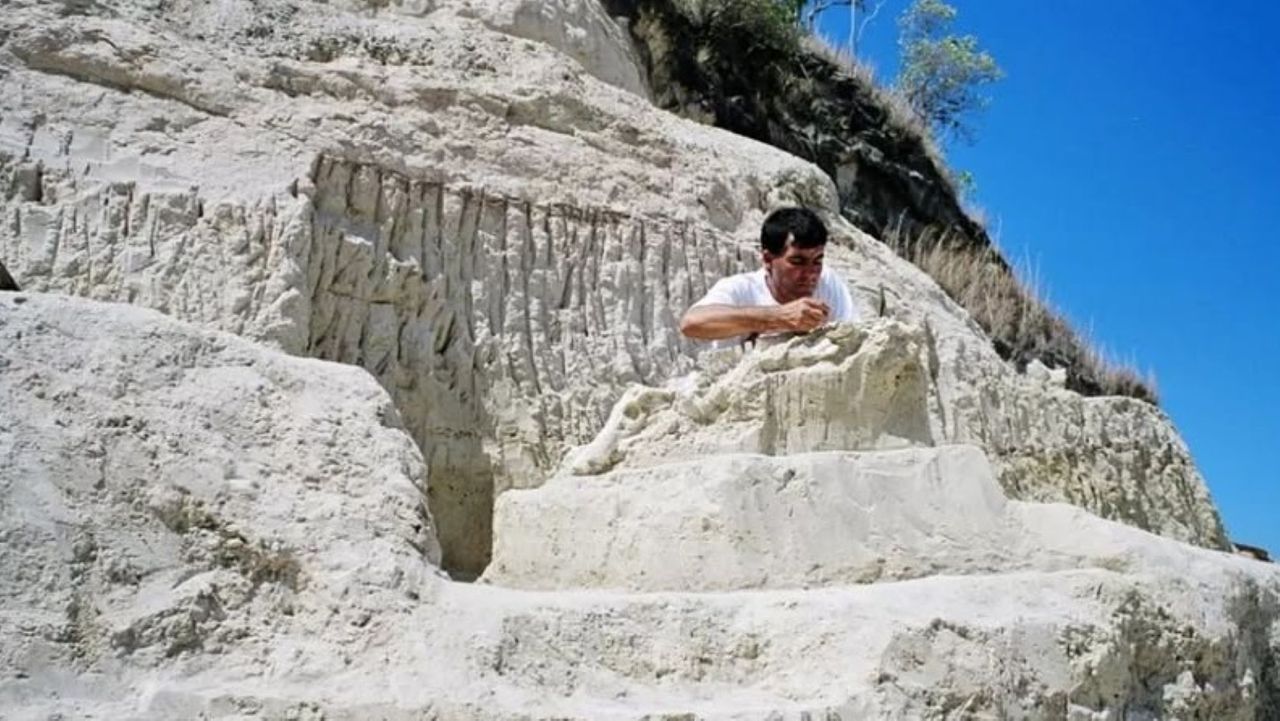
Espitau said the attack combined previously known techniques with one missing mathematical insight that Claude identified, substantially reducing HAWK's estimated security margin. He believes the work demonstrates how AI could increasingly help researchers evaluate the strength of cryptographic systems before they are adopted.

"This development illustrates how AI can act as a powerful accelerator in cryptanalysis," he said. "Claude Mythos Preview identified the exploitation of the sign-flip symmetry, providing the final piece of a puzzle that the research community had been assembling."

Building defensive measures

However, not everyone thinks the announcement means AI suddenly outsmarted human cryptographers.

"There is nothing you need to change," Roberta Faux, head of cryptography at cybersecurity and quantum encryption company Arqit, told Live Science. "Both Anthropic and the outside cryptographers agree that you don't need to change your key sizes or switch your cryptography."

Instead, Faux said the bigger story is AI's ability to apply expert-level cryptanalysis across thousands of algorithms that relatively few researchers have had time to examine.

"The interesting prospect is not a model outdueling the world's best lattice theorist on one problem but a model applying solid, roughly expert-level analysis at scale to the several thousand ciphers nobody ever had the human-hours to examine," she said.

Faux also cautioned against attributing the HAWK breakthrough solely to AI.

"The HAWK attack used no exotic ingredients; it simply competently assembled tools that were already lying around," she said. "A post-quantum candidate is seriously scrutinized by maybe a few dozen people on the planet, so beating two years of review mostly reveals how thin that layer of review is."

For consumers, the immediate implications are reassuring. The encryption protecting online banking, shopping, messaging and cloud storage has not suddenly become obsolete. But for the researchers designing the next generation of cryptography, Anthropic's work hints that AI could soon help cryptographers test tomorrow's encryption schemes more quickly and more thoroughly than has previously been possible.

  •  

Most-detailed-ever view of the sun's surface revealed in new images from the world's largest solar telescope

New images captured by the world's most powerful solar telescope have revealed something that was hiding in plain sight on the sun for 150 years: thousands of tiny whirlpools twisting across our star's surface. The ultra-detailed observations could help to explain some of the sun's most violent behavior as well as hint at the answer to a long-standing solar mystery.

The new time-lapse footage offers the first direct proof of a long-predicted phenomenon called Kelvin-Helmholtz instability. The effect itself isn't new to science; it's named for physicists Lord Kelvin and Hermann von Helmholtz, who described it in the 19th century. The physicists found that whenever two fluids slide past each other at different speeds, the friction between them, or shear, rolls into spiraling patterns. However, this is the first time this effect has been seen on the sun, where that shear plays out between neighboring streams of solar plasma.

Researchers captured the swirls using the U.S. National Science Foundation's Daniel K. Inouye Solar Telescope in Hawaii and then compared the images against computer simulations of the sun's visible surface, called the photosphere. The findings were published Aug. 5 in the journal Nature.

A time-lapse of plasma whirlpools on the sun's surface

A time-lapse view of the Inouye telescope's obseravtions of the sun. (Image credit: NSF/NSO/AURA/MPS )

The resulting time-lapse footage from the telescope is unlike anything solar physicists have captured before. It shows dozens of tiny vortices clustering along the edges of magnetic regions, some accompanied by delicate, dark stripes known as striations, according to a statement from the National Science Foundation. The telescope's resolution is sharp enough to pick out structures just tens of miles across β€” a scale so fine that the vortices had gone completely undetected until now.

When the researchers lined the images up against their simulations, the match was close enough β€ͺ—‬ down to the average spacing between vortices β€ͺ—‬ to confirm that they'd finally caught the instability in action.

Beyond the impressive visuals, researchers think these swirls may serve an important function. By constantly twisting and mixing the sun's magnetic-field lines, these vortices may play a part in building up the energy behind solar flares and coronal mass ejections.

The effect also might help to explain the long-standing mystery of why the sun's outer atmosphere, or corona, reaches temperatures of around 2 million degrees Fahrenheit (around 1 million degrees Celsius) while its surface remains hundreds of thousands of degrees cooler, Thomas Rimmele, chief technologist at the National Solar Observatory, said in the statement.

The team now plans to use computer programs to automatically track these vortices across future observations. This will help them measure exactly how much these swirls contribute to heating the corona and driving the explosive space weather that can disrupt satellites, communications and power grids on Earth.

See how much you know about the sun with our sun quiz!

  •  

'It would be a disaster': Ammunition for war and surging water withdrawals are putting the Caspian Sea β€ͺon the brink of collapse

The Caspian Sea, the world's largest inland body of water, is in major trouble. Since the mid-1990s, this saline lake, located between Europe and Asia, has lost an area nearly the size of Sicily. But until now, it wasn't clear why.

Researchers finally provided answers in a study published June 5 in the journal Earth's Future. Using ground- and satellite-based observations, they connected falling water levels to a drastic drop in river inputs from Iran, Turkmenistan, Azerbaijan, Kazakhstan and Russia, all of which border the Caspian Sea.

The team particularly highlighted losses from Russia's Volga River, the longest river in Europe, which supplies roughly 80% of the Caspian's inflow.

To find out why the Volga is discharging less water into the Caspian Sea now than it did 30 years ago, we spoke with Amir AghaKouchak, a co-author of the study and professor of civil and environmental engineering at the University of California, Irvine.

AghaKouchak, who directs UC Irvine's Center for Hydrometeorology and Remote Sensing, explained why river inputs have dropped and how decades of water withdrawals have put the Caspian Sea on a path to collapse. He also touched on a solution to this crisis β€” and revealed why Russia's hunger for ammunition to attack Ukraine is making it harder to save the Caspian Sea.

Sascha Pare: Falling water levels in the Caspian Sea have been attributed to natural variability, and more recently, there's been a focus on climate change and increased evaporation due to rising temperatures. But what did the results of your study show?

Amir AghaKouchak: People quickly jump to conclusions about climate change. Of course, that is important, but it cannot explain the change that we have observed. Over the last 30 years, water levels in the Caspian Sea have shrunk by around 2 meters [6.5 feet] or so. Just to put things in perspective, this translates to about 24,000 square kilometers [9,300 square miles] of sea area loss β€” about 5%. When we look at drivers, we notice that rainfall hasn't changed significantly over the lake and upstream, so the decline cannot be explained simply by changes in rain.

Evaporation has increased, so it explains maybe about one-third of the change. There is less water in the lake, and that indicates there's probably some water lost along the way. We don't have a lot of human-related data β€ͺ—‬ for example, water withdrawal for irrigation or groundwater wells. That area is very difficult; the countries are not open to sharing data. A lot of our results are based on looking at proxies. Our interpretation is that temperature caused about 30% of the change and the rest is probably because of human activities.

SP: Which human activities does your research suggest are responsible for the Caspian Sea's decline?

AA: Several of the countries on the Caspian Sea have built large dams β€” Russia, for example. They are all desperate for hydropower. All of the countries around the lake [have also built infrastructure to supply agriculture], and one reason is that they want to create jobs and improve the local economy. Water demand is increasing in all those countries around the Caspian Sea. It's not surprising to see lakes drying or groundwater levels falling.

It's hard to find data about how much water countries are using; they keep data very private, especially places like Russia. We don't have detailed information, but the Volga-Don Canal in Russia is one of the projects that is contributing to this crisis. [Editor's note: The Volga-Don Canal is a ship canal that connects the Volga and Don rivers at their closest points.]

A view of a boat sailing down a waterway with grassy reeds on either side.

Opened in 1952, the Volga-Don Canal connects the Volga, which flows into the Caspian Sea, and the Don, which empties into the Sea of Azov (a northern extension of the Black Sea). (Image credit: Gaika102 via Getty Images)

But we cannot blame this whole thing on that. We have to be careful with our language; we can't say one project is responsible. Most likely, this is the collective impact of many different small withdrawals from here and there, overall contributing to a significant decline in the Volga River outflow into the lake. In the paper, we have different rivers, but the Volga dominates because it's the largest river. The Volga has a higher impact than all the other rivers combined. There are lots of demands along that river basin.

SP: Did you expect human activities to play such a big role, or were you surprised?

AA: We did not have any expectations at the beginning. In fact, when we started this project, I reached out to a lot of colleagues from neighboring countries around the Caspian Sea. We didn't want to do it on our own, sitting in California, looking at another area of the world, without having local people involved. If you look at the co-authors, you see people from Azerbaijan, Iran, Kazakhstan β€” so, we have local experts. We thought this was really important to have those perspectives. I didn't want to reflect the opinions of only one research group. What we have here is the collective opinion of people who have not met in person; we only exchanged emails to look at the results, and then we came up with those conclusions.

We do have a Russian involved, but not from an official Russian institution. I thought this was really important, because there's more back-and-forth [with a large group of people]. If two people have to convince themselves of an idea, it's much easier than with 20. Also, we brought in people from other countries who had projects in the area; for example, there is one group from Finland and another group from Germany. We tried to come up with something that this large group of people could agree on. It was not easy, but it worked out.

A view of a green river delta from space.

The Volga River supplies roughly 80% of the Caspian Sea's inflow, but huge water demands have decreased its flow. (Image credit: ESA, CC BY-SA 3.0 IGOΒ )

SP: What is the worst-case future scenario for the Caspian Sea if shoreline countries fail to decrease their water demands?

AA: My concern is that, in the same general area, we have the Aral Sea, which is now about 5% to 10% of what it used to be, and Lake Urmia, in northwest Iran, that has also shrunk really fast and is now very small, with low levels of ecological activity. So we have two smaller lakes in a very similar climate that, from an ecological perspective, are dead. Because we have seen those degrade, we have to consider that this is the worst-case scenario for the Caspian Sea, too.

The Caspian Sea is much, much bigger. I hope it doesn't happen, but it's on the same path. Again, it's much larger, so it would probably take 100 years [to shrink as much as the Aral Sea and Lake Urmia], even with the current trend. But because we have seen those lakes shrink really fast, it deserves attention. Due to the size of this lake, the potential impacts will be huge. Even if 20% of the Caspian Sea dries out, the consequences will be very significant. It would be a disaster.

SP: You mentioned that drying lakes can become ecologically "dead." What other impacts could the Caspian Sea's falling water levels have on the surrounding landscape and people?

AA: The lake's retreat will expose the lake bed, and because it's saline, you have all kinds of minerals that will be exposed. With the next strong wind, they will go into the air. The health impacts include respiratory diseases, and even eye diseases, that are linked to salt minerals in the atmosphere. Those are the immediate consequences. Additionally, those minerals can travel long distances. In general, salt deposition on agricultural land reduces productivity. It takes a while, but if those lands are exposed for a long time, this will have an impact on the agricultural sector in those areas, which means potential food security issues. We don't exactly know what those materials are on the lake bed, so it's hard to know precisely what the consequences will be.

There is also serious shipping happening in this region. Right now, most of the shrinking is happening in the Caspian Sea's northern part, which is shallower [than the rest of the lake]. The drop in water levels is about 2 meters, and you can imagine that if you have a port and water levels drop more, you won't be able to operate. You'll need to extend your shipping routes southward; you'll need to invest and spend a lot of money to use other ports and docking sites. We have evidence of that around the Aral Sea and also Lake Urmia. There used to be these docking sites and ports, but those are now far away from the water.

SP: What must bordering countries do to save the Caspian Sea and prevent these negative effects?

AA: Demand management is absolutely critical. Demand management doesn't get a lot of attention, because unlike big projects that make the news, management means you have to cut things and do things that people don't notice. Some people argue that politicians don't show a lot of interest in demand management, but it's something that we have control over. The technological opportunities are there.

But when you look at that area, there is a big war β€ͺ—‬ so probably it's not the priority to invest in management. There are a lot of things that we don't talk about in the paper that are relevant. I recently learned through discussions with people from the region β€” this is something that came to us from co-authors and collaborators β€” that many countries in that area grow cotton, which uses a lot of water. It has a lot of applications, but apparently, one of them is military. Cotton is used to produce ammunition. Russia needs a lot of ammunition, so not only are they growing it themselves, but they also bought neighboring reserves from Uzbekistan and Kazakhstan. So now, even those countries have an incentive to grow more cotton. This is driving more irrigation, more groundwater extraction, more surface water depletion, and probably more impacts on the Caspian Sea.

This interview has been condensed and edited lightly for clarity.

  •  

FDA approves first mRNA vaccine for seasonal flu

The U.S. Food and Drug Administration (FDA) has approved a new seasonal flu vaccine that uses mRNA as its base.

Moderna, the vaccine's maker, announced Wednesday (Aug. 5) that a vaccine advisory committee to the FDA unanimously agreed that the shot is safe and effective for preventing illness from seasonal influenza. The shot, called mFlusiva or mRNA-1010, has been approved for people ages 50 and older.

Similar to mRNA vaccines against COVID-19, the vaccine uses the genetic molecule mRNA to encode instructions for cells in the body. In this case, it prompts the cells to build hemagglutinin (HA), a protein found on the surface of influenza viruses. Flu viruses use this protein to infiltrate human cells, and it's the same protein targeted by conventional flu vaccines. Following vaccination with mFlusiva, the immune system learns to recognize the HA protein on targeted flu strains, thereby improving its ability to block the viruses from infecting cells.

The HA protein poses a major challenge for conventional flu vaccines because it mutates very rapidly as the viruses multiply and spread β€” and these existing vaccines take months to manufacture. That's one reason the resulting shots aren't always a great match for the flu viruses that end up circulating in any given year. A benefit of the mRNA platform is that vaccines can be produced very quickly and thus made to better match the season's dominant strains.

mFlusiva's approval was based in part on a late-stage clinical trial involving over 40,000 people ages 50 and up who were vaccinated for the 2024-2025 Northern Hemisphere flu season. Half received the mRNA-based shot, and half received a standard dose of a conventional flu vaccine (as opposed to the higher-dose option available to older adults in the U.S.).

Of the 40,000 participants, about 970 got sick with flu, including 2% of the mRNA group and 2.8% of the standard group. That means the mRNA vaccine was 26.6% more protective than the conventional vaccine against illness from flu in this trial.

mFlusiva also offered superior protection against each of the three flu subtypes included in the vaccine. And in participants ages 65 and up, the vaccine was 27.4% more protective, overall.

More people in the mRNA group experienced side effects like injection-site pain, headache, fatigue and achiness, compared with the standard group, but these effects were mostly short-lived and mild to moderate in severity. These side effects were consistent with what was seen in earlier trials of the vaccine.

An additional trial involved a group of adults ages 65 and older and directly compared mFlusiva to an existing high-dose flu vaccine, which is approved only for older adults in the U.S. The findings suggested that the mRNA vaccine generated superior immune protection than the conventional option, based on antibody levels.

These results led the FDA advisory committee to decide that the vaccine's benefits outweigh its risks, and the agency ultimately approved it. For adults ages 50 to 64, the vaccine earned standard approval, and for adults 65 and up, it earned "accelerated approval," meaning further trials will be conducted to confirm the benefit of the shot over the high-dose option for this population.

"Flu remains a significant public health challenge, and mFLUSIVA provides an important new option for America's seniors," Moderna CEO StΓ©phane Bancel said in a statement.

The approval appears to mark a shift in the government's stance on mRNA vaccines.

Under the second Trump administration, the federal government has been broadly retracting its support for mRNA vaccines, directly canceling hundreds of millions of dollars in funds for research and development and indirectly sending a chilling effect through the mRNA field, experts previously told Live Science. Even Moderna has been pulling back from investments, citing opposition from the U.S. market. Health Secretary Robert F. Kennedy Jr. has repeatedly voiced his opposition to mRNA technology.
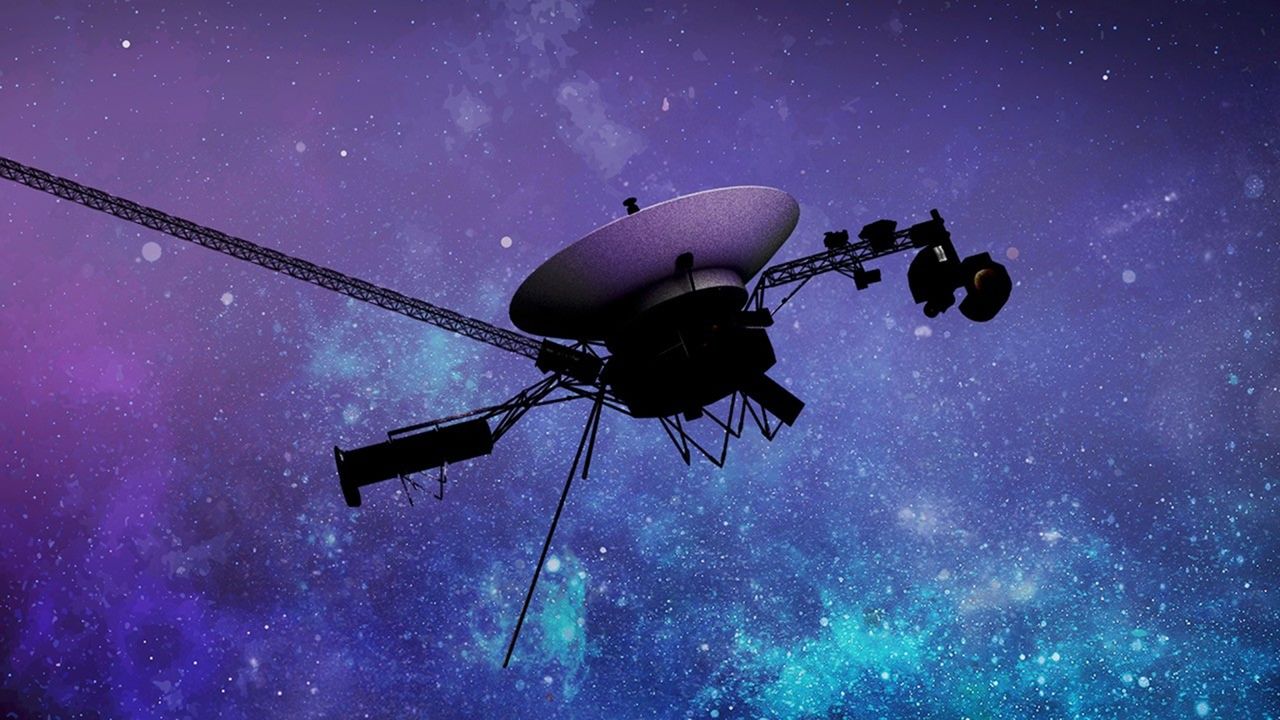
When Moderna initially filed for mFlusiva's approval in February, the FDA declined to review the application β€” but then changed its mind one week later. The exact motivation for this reversal was unclear to experts.

This article is for informational purposes only and is not meant to offer medical advice.

  •  

First photos of SpaceX lunar rocket crash show blackened hole torn into the moon's surface

In the dead of night on Wednesday (Aug. 5), part of a defunct SpaceX rocket slammed into the moon at more than 5,000 mph (8,000 km/h) β€” and a Korean lunar satellite has just shared the first images of the aftermath.

A series of photos snapped by South Korea's Danuri lunar orbiter on Wednesday reveal a small, blackened crater at the alleged site where a used Falcon 9 upper stage crashed into the lunar surface around 2:35 a.m. ET. The crash occurred near Einstein crater, on the northwestern limb of the moon, close to the terminator zone where lunar day and night meet. The photos were shared by the Korea AeroSpace Administration on social media on Thursday (Aug. 6).

Because this region was on the sunlit side of the moon at the time, the initial flare from the crash was not visible from Earth; however, scientists at the European Southern Observatory's Very Large Telescope in Chile reported seeing evidence of a debris plume lifting off of the lunar surface shortly after the collision, according to the CBC. (At this time, no photos of the debris plume have been released).

A preprint study shared earlier this week predicted that the crash would create a new crater on the moon measuring roughly 90 feet (27 meters) wide and up to 16 feet (5 m) deep β€” a dent too small to be seen from Earth, even with a good telescope. No measurements of the newfound crater have been shared yet, but they are likely to arrive in the coming days as other lunar orbiters, such as NASA’s Lunar Reconnaissance Orbiter, and Earth-based observatories get a chance to examine the crash site.


What caused the crash?

Images from Korea’s Danuri orbiter showing the before and after views of the lunar crash site.

Images from Korea’s Danuri orbiter showing the before and after views of the lunar crash site. (Image credit: KASA)

The pesky piece of space junk that hit the moon on Wednesday is the second (or upper) stage of one of SpaceX's Falcon 9 rockets that launched into space on Jan. 15, 2025. It was carrying a pair of lunar landers: the Blue Ghost lander developed by private company Firefly Aerospace, which successfully touched down on the moon in March 2025; and the Hakuto-R lander developed by Japanese company ispace, which lost contact with Earth and crash-landed on the moon in June 2025.

Unlike Falcon 9's first (or lower) stages, which can return to Earth for reuse, the rocket's second stages are discarded in orbit. This rocket piece spent nearly a year drifting in an elliptical orbit around our planet before a combination of solar radiation and the moon's gravitational pull nudged it away from us, according to Live Science's sister site Space.com. In May this year, independent astronomer Bill Gray first predicted the crash and when and where the collision would occur, before other experts confirmed his calculations.

The 4.4-ton (4 metric tons) rocket part is estimated to have struck the moon at roughly 5,400 mph (8,700 km/h). While many times faster than the speed of sound, that’s still much slower than the average meteoroid strike on the moon, making the crash that much harder to see.

More to come

This is not the first time that human-made objects have impacted the moon, nor will it be the last. Studying these crashes can lead to important insights about the moon’s composition.

For example, the 2009 crash of a Centaur rocket's upper stage near the moon's south pole was analyzed by NASA's Lunar Crater Observation and Sensing Satellite mission, which revealed subsurface ice in the area. As a result, the lunar south pole is now the most coveted location for missions that aim to establish a permanent human presence on the moon.

Studying human-made impacts like these will also be essential for managing the potential risks to future astronauts and missions, like the permanent moon base NASA hopes to build.

"Now that we're in an era where we're going to have more and more astronauts going back to the moon, perhaps permanently, we also want to understand how much of a risk these artificial impacts pose," Benjamin Fernando, a postdoctoral researcher at Los Alamos National Laboratory and co-author of a recent study on the impact, told CBC.

"It presents a different set of hazards than say the Apollo astronauts faced on the lunar surface from the average background meteoroids that are striking the moon every day. And what we want to try and do with this event is understand both the direct [and indirect] hazards."

  •  

Crystal made from 13-sided 'einstein' shape bends light in ways nobody imagined

Physicists have built a crystal out of an "einstein" tile β€” an elusive shape mathematicians spent years searching for β€” and found that it bends light in a way no ordinary crystal can.

In the new study, published July 29 in the journal Nature Communications, researchers arranged this never-repeating tile shape into a pattern of nanoscale holes. This structure, known as a photonic crystal, is designed to control the way light moves through it. When the team shined a laser at it, the crystal produced a swirling, pinwheel-shaped scattering pattern that responded differently depending on which direction the incoming light was spinning.

The tile solves what mathematicians call the "einstein problem," a decades-old puzzle asking whether a single shape could cover a flat surface endlessly without ever repeating its pattern. (The name is a pun on "ein stein," German for "one stone," not a reference to Albert Einstein).

In the 1970s, mathematician Roger Penrose showed that two different shapes, used together like floor tiles, could cover a surface without the pattern ever repeating. Then, in 2023, geometry enthusiast David Smith and collaborators finally found one: a 13-sided shape that they nicknamed the "Smith hat"

Yuto Moritake, an experimental physicist at the University of Tokyo, first came across the hat tile in a popular science book in 2024. Moritake specializes in photonic crystals β€” materials patterned with repeating structures (often much thinner than a human hair) that bend and steer light for uses like lasers and optical sensors. Almost all photonic crystals rely on patterns that repeat in a regular grid. Moritake wondered what would happen if he swapped that repetition for the hat tile's never-repeating arrangement.

"I decided to include it in our photonic crystal structure," Moritake told Live Science, describing it as the starting point for the project.

To build the structure, Moritake and his colleagues used two precision manufacturing techniques, called electron beam lithography and etching, to punch hundreds of thousands of tiny holes β€” each just 100 nanometers in radius, or roughly 500 times thinner than a human hair β€” into a thin film of silicon nitride. This ceramic material is commonly used in computer chips. The holes were arranged according to the hat tile's pattern, covering a chip roughly half a millimeter across β€ͺ—‬ about the width of a pencil tip.

When the team shined a laser at the finished chip, the light scattered, or diffracted, into a pinwheel-shaped pattern that appeared on a screen. Moritake first photographed the colorful pattern using his iPhone's long-exposure mode. The setting captured faint light over several seconds. Then, he switched to specialized cameras for more precise measurements.

The pattern was made up of well-defined bright spots, called Bragg peaks, that stayed in the same positions no matter where on the chip the laser hit. That consistency confirmed that the structure had the kind of long-range, predictable order found in a quasicrystal β€” a class of material whose atoms (or, in this case, holes) follow an orderly pattern that never repeats, unlike the repeating grids found in ordinary crystals such as table salt or diamonds.

Because the hat tile itself has no mirror symmetry β€” meaning it doesn't look the same as its own reflection, similar to how a left hand differs from a right hand β€” the scattering pattern it produced was also asymmetrical in this way. Scientists call this property chirality.

That chirality led to the study's biggest surprise. Light can be circularly polarized, meaning it spins either clockwise or counterclockwise as it travels, like a corkscrew. When Moritake tested the structure with both types of spinning light, he found a subtle difference in how each direction scattered off the crystal. Ordinary quasicrystals, which do have mirror symmetry, cannot produce this kind of effect.

"This structure can have some kind of circular polarization dependence," Moritake said, adding that the effect β€” made only possible by the tile’s asymmetry β€” was not something he initially expected to find .

Now, Moritake wants to apply this never-repeating pattern to control light traveling inside a photonic chip, rather than light that simply bounces off its surface. This could lead to future uses in optical communications and optical computing β€ͺ—‬ technologies that use light instead of electricity to transmit or process information, Moritake said.

See how much you know about Albert Einstein with our Albert Einstein quiz!

  •  

Engineers build world's first portable diamond-powered quantum computer β€” it works at room temperature and can be plugged into an outlet

A German startup has debuted the world's first diamond-based quantum computing system to exceed 10 qubits.

The machine, built by engineers at Saxon Q, is a nitrogen-vacancy (NV) quantum computer, meaning it uses defects in synthetic diamonds as quantum bits (qubits) to perform quantum operations. Qubits can be manipulated to represent the 0s and 1s of data, as well as quantum states that are superpositions of both the 0s and the 1s.

The hardware is currently available in rack-mounted systems featuring up to 128 qubits, with 512-qubit configurations available for delivery next year. According to the company's road map, the goal is to scale to 10,000 qubits and beyond after 2030.

Although the technology existed before this debut, scientists have found it difficult to build systems beyond 10 qubits due to the difficulty of creating nitrogen vacancy qubits.

Although Live Science saw a technical white paper outlining how the technology works, there didn't appear to be any published research demonstrating a functional quantum computer based on the NV architecture operating with more than 10 qubits before this launch. It's still unclear exactly how well the firm's quantum computers stack up against other platforms.

Quantum mechanics and flawed diamonds

In the 1970s, scientists discovered that certain diamonds shone with a brilliant red light when illuminated in a specific way. Subsequent research determined that the optical shift was caused by annealing radiation damage that attracted isolated substitutional nitrogen atoms. In other words, nature occasionally produces a diamond that has a nitrogen atom where a carbon atom should be.

The unintegrated nitrogen atoms are drawn to the vacancy in the otherwise perfectly ordered carbon atoms inside the diamond. Although these flawed diamonds occur rarely in nature, scientists can create diamonds with nitrogen vacancies in laboratories.

Functionally, the single nitrogen atoms inside the vacancies act as if they were "trapped," and their electrons can "spin" independently of the electrons inside the surrounding carbon atoms.

Scientists exploit this "spin" feature by using special lasers to put the nitrogen atom's electrons in a specific state they measure as "zero." They can then use microwave pulses to precisely manipulate the electrons into numerous configurations, including quantum states that binary "bits" can't achieve.

We have a fully functioning quantum computer.

Marius Grundmann, professor of experimental physics at Leipzig University and co-founder of Saxon Q,

Marius Grundmann, a professor of experimental physics at Leipzig University and co-founder of Saxon Q, said the breakthrough that allowed his firm to push past the 10-qubit barrier was a materials discovery.

When the Saxon Q team creates the vacancy inside its lab-grown diamonds, they co-implant sulfur. Per Grundman, β€œThat's the key technology point. Because the sulfur lifts the chemical potential to a point that it's negatively charged. The sulfur supplies the electron; the sulfur also makes the vacancy attached to the nitrogen with a very high yield."

In other words, by co-implanting sulfur atoms, the Saxon Q researchers can express greater control over the individual qubits. Once the qubits are set with lasers and subjected to microwave pulses, they're ready for error correction. In a statement, Saxon Q representatives said the qubits achieved a 99.92% fidelity rate β€” fewer than one error per 1,000 operations β€” before error correction.

However, Grundmann told Live Science that the latest numbers as of July 22 showed 99.98% fidelity in single-qubit operations. That's comparable to state-of-the-art error correction results reported by other quantum computing labs, such as those from IBM and MIT, although it wasn't possible to independently verify the results.

Room-temperature quantum computing

It's difficult to compare Saxon Q's diamond-based NV systems with more established quantum computing platforms, such as superconducting qubits. Most recent research on NV systems has focused on quantum sensing applications, though at least one preprint study discusses hybrid NV/superconducting systems.

"We have a fully functioning quantum computer," Grundmann told Live Science. According to Grundmann, the company's quantum computers are on a par with those using other modalities. "We have a quantum computer that can execute quantum code that you can reach via the network, and it is a multiuser, multitasking, multicore system," he said.

If the Saxon Q systems ultimately prove comparable to existing solid-state quantum computing architectures, they'd be among the first generation of room-temperature quantum computers to reach performance similar to systems that require cryogenics and on-site monitoring.

The ease of setup is notable. Saxon Q's devices can be slotted into a standard computer rack and plugged directly into alternating-current power.

This provides a clear near-term advantage for clients who want to run algorithms on a quantum system without operating through the cloud. Grundmann said this could be especially important in edge computing scenarios, such as autonomous driving or robotics, where cloud communication could produce unacceptable latency.

Research comparing solid-state quantum systems indicates that superconducting quantum computers would typically operate faster than diamond-based NV systems. It's unclear, however, what the trade-off between processing speed and cloud latency would be or whether it could be addressed through scaling.

The current challenge to scaling diamond-based NV quantum computers beyond the 512-qubit range is the size of the chips. Saxon Q's current chips are limited to supporting either eight or 16 qubits. For more powerful systems, scientists will need to squeeze hundreds β€ͺ—‬ or even thousands β€ͺ—‬ of qubits onto a single array to support operations requiring hundreds of thousands or millions of qubits.

Can you match these ancient devices to their pictures? Find out with our computing quiz!

  •  

A star 20 times the size of the sun died in a supernova β€” and telescopes around the world joined forces to watch it

A fleet of telescopes around the world just captured the first shocking moments of a supernova explosion in the most detailed-ever observations of their kind.

The explosive event was first spotted by China's Einstein Probe space telescope as a flash of X-rays in March. Ground-based telescopes jumped in within the hour and quickly identified the flash as a supernova, a powerful explosion of a massive dying star. Before long, a big team of observatories was on the job, including the wide-field Vera C. Rubin Observatory, which began its ambitious 10-year survey of the sky in late June.

With this fleet of telescopes, astronomers charted how the light of the supernova, located 500 million light-years away, changed over time. They reported their results in two papers published July 14 in The Astrophysical Journal Letters.

Each science team verified the "shock breakout" β€ͺ—‬ the point when a supernova emits its first light from the explosion as a huge shock wave. The recently detected supernova is only the second stellar explosion in the past 20 years in which a shock wave was observed, because these events tend to be short β€” only seconds to hours, the researchers noted.

They classified the stellar explosion as a Type Ic broad-lined (Ic-BL) supernova, meaning that the blast included jets with material moving close to light speed. This type of supernova is often associated with gamma-ray bursts, which are extremely powerful flashes of high-energy radiation from space. However, the recently detected supernova presented some surprises: Its shock breakout was the faintest seen in an Ic-BL supernova, and no gamma-ray bursts were observed.

"Follow-up observations using the most sensitive facilities found no evidence" of the gamma-ray bursts, Brendan O'Connor, an astrophysicist at Carnegie Mellon University and co-author on one of the studies, said in a statement. "One possibility is that the jet was 'choked,' either by the surface of the star or by circumstellar material surrounding the star."

Telescopes of the world unite

A deep space image with four vertical boxouts to the right showing smudges of color where a supernova happened

The Vera C. Rubin Observatory happened to be monitoring the area (left) when the supernova erupted. Rubin and Dark Energy Camera images of the blast are shown in boxes to the right. (Image credit: NSF–DOE Vera C. Rubin Observatory/NOIRLab/SLAC/AURA)

The Rubin telescope, located in Chile, happened to spot the explosion because it was viewing that particular patch of the sky at the time, known as the COSMOS Deep Drilling Field.

"Thanks to Rubin's rapid cadence and unprecedented sensitivity, continued observations are expected to provide detailed, long-term records of the supernova as it evolves for years to come," the science teams said in the statement. The Rubin Observatory will spend the next decade mapping the entire southern sky many times over, creating a time-lapse movie of the cosmos expected to reveal millions of supernovas, asteroids, comets, and other transient events.

As Rubin spots events in the sky, the Dark Energy Spectroscopic Instrument on the National Science Foundation's Nicholas U. Mayall 4-meter Telescope at Kitt Peak National Observatory in Arizona is tasked with springing into action for follow-up observations. The instrument confirmed the recently detected explosion as an Ic-BL supernova.

When the scientists dove into 10 years of data from the 570-megapixel Department of Energy Dark Energy Camera on the National Science Foundation's VΓ­ctor M. Blanco 4-meter Telescope in Chile, they found a "blue source" just where the supernova later occurred, revealing clues about what the star system and its environment looked like before it exploded.

Meanwhile, a team led by Jillian Rastinejad, an astronomer at the University of Maryland, College Park and co-author of the second study, used the Gemini Multi-Object Spectrographs on two telescopes β€” Gemini North in Hawaii and Gemini South in Chile β€” to investigate the explosion, among other observatories. Those telescopes also confirmed the explosion as an Ic-BL supernova, without the jets, and the astronomers obtained archival details on the star's structure and environment before their demise.

"Our observations allowed us to study the physics of three pieces of this explosion: the X-ray shock breakout, the accompanying supernova, and the interaction of the supernova with material previously cast out by the dying star," Rastinejad explained in the statement. "With this information we were able to map out the structure of the material surrounding the star and understand the star's violent lifestyle before it collapsed."

The star was about 20 times the mass of the sun and was classified as a Wolf-Rayet β€” a star that used up most of its hydrogen early in its life. Just before the star exploded, it periodically ejected massive chunks of hydrogen and helium, leaving behind only carbon and oxygen. These chunks of material generated shells that were visible in telescopes as individual events, including the first X-ray shock.

"This is the first time we've mapped out the pre-explosion environment of a star that has been stripped of hydrogen and helium," said Gokul Srinivasaragavan, an astronomer on Rastinejad's team who was a doctoral student at the University of Maryland at the time of the study. "Going forward, I'm excited to observe more shock breakout events in similar detail to test if all stripped stars have a similar β€˜lifestyle' prior to collapse and what, if any, differences we see."

  •  
❌