❌

Reading view

The unsavoury rise of ‘populist physics’: here’s how best to respond

So you’re at a family gathering and a distant, well-educated relative comes over to talk about physics. Despite being a non-scientist, this person knows quite a lot about your field. You must be disappointed, the relative says, because dark matter, your life’s work, is proven not to exist. Furthermore, you’re told your field is crammed with dishonest people who are only in it for the money.

This is what happened to Dan Hooper, a physicist and cosmologist at the University of Wisconsin, Madison, who specializes in dark matter himself. It was the first time he’d encountered what Hooper calls a “new narrative” about physics, though other colleagues told him that they also had heard it. Some believers in this narrative, Hooper found, were so angry about the state of physics that they threatened him and his colleagues with violence.

Hooper’s response is his forthcoming book The Attack of the Science Populists: In Defense of Fundamental Physics. Published by Harvard University Press, it aims to counter what Hooper calls the “growing torrent of criticism directed at the state of contemporary physics”.

So who exactly are the critics? Hooper mentions several podcasters and YouTubers who use their “wealth and fame” to make “sensationalist” claims about modern physics that, he says, amount to “little more than noise”.

Other critics have no scientific credentials at all. There is, for example, the actor Terrance Howard who villainizes the scientific community, promotes his own loopy theory called “Terryology”, and even thinks 1 × 1 = 2.

Still others have “scientific credentials”, such as Sabine Hossenfelder. A former academic theoretical physicist, she’s now a YouTuber who accuses scientists working in supersymmetry as guilty of scientific malpractice and who makes other claims about that field that “have little to do with reality”.

Another of Hooper’s targets is the venture capitalist Eric Weinstein. Weinstein does have a PhD in mathematics but uses his popular tabloid podcasts to attack contemporary theoretical physics and promote an evidence-free “theory of everything” that he calls “Geometric Unity”.

These and other influencers, according to Hooper, claim that theoretical physics is stagnant and riven with “many blind spots, biases, and misaligned incentives” created by “the dishonesty and opportunistic behaviour of the scientists pursuing this research”.

The attacks, Hooper goes on to say, are amplified by “social media, videos, and podcasts” and amount to “carefully orchestrated and highly effective campaigns of science populism” reaching increasingly large audiences. Most of Hossenfelder’s videos on YouTube, for instance, have hundreds of thousands of views.

What’s new about these attacks on science, Hooper writes, is that they are directed not against specific theories but against “the scientists and institutions of science” that develop these theories. Hooper labels it “populist physics” and calls it a global threat not only to physics but to expertise and rational behaviour.

Others have also noticed the trend. In the Wall Street Journal, the Science writer Dan Kagan-Kans has called it “conspiracy physics”, while the University of Rochester astrophysicist Adam Frank wrote in the New York Times about “conspiracy-tinged mazes rooted in misinformation” emitted by the “manosphere”.

Three responses

So is populist physics being peddled by only a few contrarians? Or is there really a growing, culture-wide anti-science movement? You can’t really tell from Hooper’s book. What is most interesting about the book, in my view, is how Hooper responds to the critics.

I can imagine three types of response. One is to ignore or laugh. That, I think, is the attitude of most physicists. I knew a physicist at Brookhaven National Laboratory who, when asked by a neighbour if the lab was studying a crashed UFO, responded, “I wouldn’t be surprised”. It was just easiest, he told me, and he didn’t want to get into a fight with a neighbour.

Physicists aren’t trained to deal with gullible people, so why bother? However, ignoring people with exaggerated and wrongheaded opinions encourages them and can be read as implicitly admitting guilt. Ignoring the attacks, too, tolerates and may even promote scientific illiteracy in ways that can ultimately affect political support and thus the field itself.

A second response is to engage the opponents on their own epistemological and rhetorical turf, becoming as aggressive and polemical as they are. If you haven’t yet seen the British broadcaster Piers Morgan’s podcast in which the theoretical physicist Sean Carroll brawls with Weinstein, you must. The encounter lives up to its billing as a “fight club”. It evokes the advice that one should never wrestle with pigs: you get dirty, you never win, and the pig likes it.

But it’s inspiring to see Carroll willing to get into the pen and stand his ground. It makes us wish that we, too, had the guts and demeanour to be as wicked and witty while at the same time calm, cool and collected. Most of us are not, unfortunately, and if you lose in that pen you lose big.

A third response is to sigh and give an earnest account of what you are doing and why, as well as what you’ve accomplished and didn’t. This aims to counter criticism by emphasizing the integrity of the profession. Hooper’s book takes this route.
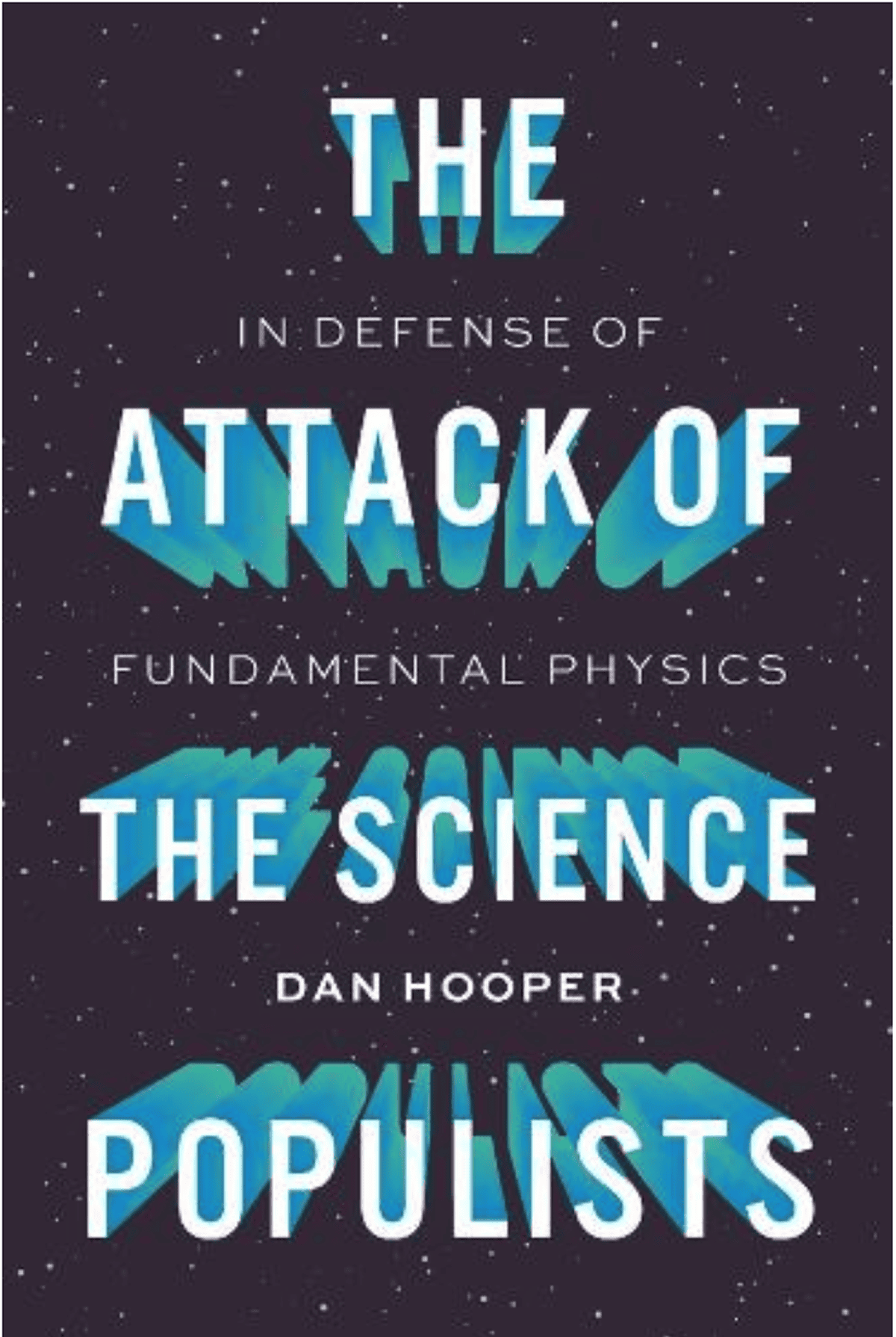
Dan Hooper's book cover
Action, reaction Dan Hooper’s book, due out in early 2027, is a staunch defence of science. (Courtesy: Harvard University Press)

Despite its title, The Attack of the Science Populists is in fact a popular-science book and a very good one at that. It distinguishes itself from other popular-science books by not only explaining contemporary physics but also emphasizing its failures.

Physicists hoped for great things from the Large Hadron Collider (LHC), Hooper writes (he’s aiming his book at readers who don’t know what the LHC is). But while it has made amazing discoveries, such as the Higgs particle, Hooper also describes the fundamental things that it was expected to find but didn’t, such as supersymmetry particles that might have explained why the Higgs has the mass it does.

In another chapter he writes that string theory seemed like a good bet because it is able to handle quantum gravity, but that “this bet has not paid off”. Hooper explains in clear language the aims and disappointments of the LIGO gravitational-wave detector, Modified Newtonian Dynamics (MOND), the Standard Model of particle physics, supersymmetry, the multiverse and other theories. But he also makes clear how their flaws relate to the boldness of their ambitions.

If your friends ask for popular books summarizing the current state of theoretical physics, include Hooper’s on the list.

The critical point

I think “populism” is the wrong word here. To me, the term suggests widespread and genuine if incompletely articulated grievances, whether it’s about the need for cheaper homes, more jobs or better healthcare. But is Hooper really talking about the masses? What does Terryology have in common with Geometric Unity? In the Venn diagram of Howard, Hossenfelder and Weinstein, how big is the audience overlap?

Many of the field’s assailants seem not to be motivated by widely shared grievances but more like individual self-aggrandizing types who say, “Pay attention to my theory!” Even Hooper calls them “fringe” and “outsider mavericks” who make for a good story. It’s not populism or conspiracy when a bunch of glam narcissists stand out only because of their large social media following.

So what would genuine “populist physics” be? It would, I think, be a shared concern and insistence by non-scientists that the billions of dollars spent on physics, on the hundreds of thousands of professional physicists, and on all their labs are used in ways that return something to the people who are paying for it.

Such a return doesn’t necessarily have to result in improving our material ways of life, but might involve providing answers to questions that we all have at one time or another about the origin, nature and future of the universe. Populist physics therefore would arise in opposition to wealthy influencers who dominate social media to promote merely sensationalist and self-interested claims.

In this sense, what Hooper is doing with his new book is seeking to reassure readers that populist physics is what his field has been up to all along.

The post The unsavoury rise of ‘populist physics’: here’s how best to respond appeared first on Physics World.

  •  

Get your teeth into the cutting edge of materials science

Illustration of three teeth with various textures
Dental work Fitting false teeth, bridges and crowns requires an empirical understanding of how ceramics, metals and other materials interact. (Courtesy: Shutterstock/Ihnatovich Maryia)

My dentist, Dr Albora, told me I needed a new tooth. He made me bite down on a U-shaped tray filled with polyether, an elastomeric material that’s been used in dentistry for decades. I tried not to gag while the gooey stuff set. Albora then waggled it off and sent the imprint to a company on Long Island that makes false teeth. But as my tooth’s colouring was unusual, Dr Albora said I had to go there myself.

A week later I drove to Marotta Dental Studio, where Igor Binshteyn sat me in a chair, lifted my lip and inspected a tooth to the side of my upper jaw. He was helping to fabricate its replacement and needed to get the exact colour.

As Binshteyn finished, I remarked teasingly on the company’s car park, which was chock full. Do you need that many people to make false teeth? What could possibly be involved to make things smaller than the nail on my little finger?

Binshteyn laughed. “Follow me”.

Dental workshop with Lenny Marotta and Steven Pigliacelli
Warm welcome Lenny Marotta (left), who founded Marotta Studio in 1981 and his brother-in-law and Marotta’s vice-president, Steven Pigliacelli in the lab. The flags are for the nationalities and national backgrounds of the 50 or so technicians working there. (Courtesy: Robert P Crease)

He opened a door to a huge undivided warehouse-like space about 1200 square metres in size. Some 50 people were working at lines of tables where the steady hum of conversation was punctuated by the noise of ovens, lathes and grinding machines; imagine the sounds of a metalworking shop in a busy train station.

“Do you want a tour?” Binshteyn said.

Of course I did.

Open wide

My tour guide was Marotta’s vice-president, Steven Pigliacelli, who teaches prosthodontics at New York University. A prosthodontist is a dental specialist who has completed dental school and, in the US, has had at least three additional years of advanced training to focus on restoring and replacing missing or damaged teeth. As I learned, prosthodontists must practice materials science.

The lab has two paths for making teeth, Pigliacelli explained, each with different materials and methods. The first is known as “porcelain-fused-to-metal”, or PFM. It begins with technicians applying gypsum – hydrated calcium sulphate – to create stone replicas of the jaw and teeth from the impressions given to them by dentists such as Albora.

Gypsum has different coefficients of expansion for different dental purposes, and textbook formulas give the amounts of liquid for each kind. But Marotta employees found that tiny amounts of water must be added or subtracted to the gypsum to compensate for things like humidity and temperature before the gypsum is used. “It took us months,” Pigliacelli explained, “to realize that how it’s shipped, how it’s stored, what season it is – all these affect the material.”

I watched as a technician sectioned a stone jaw replica to cut out a tooth, turn it into a master model called a die, and test it in an articulator that mimics jaw movements. I saw another wax that die, use a lost wax technique to create a solid gypsum frame, and cast a silver-palladium alloy. That creates the metal inner core for the tooth, called a coping, which is shaped and finished before porcelain is applied. Porcelain is baked onto the coping in another area of the lab.

“The metal and porcelain need closely matched coefficients of thermal expansion or the porcelain can separate from the metal,” Pagliacelli told me. “Every once in a while a company tells us ‘We’ve got this really cool new alloy!’, but we need to match the coefficients of expansion in the ceramic material. We’re working with sensitive materials for sensitive applications, and we have to experiment with and adapt them. This stuff about materials you don’t learn in school but work out in the lab.”

Smile for the camera

The second path to making a tooth involves scanning the teeth rather than waxing a die. The electronic files are worked on in the computer, printed out, reworked and rescanned, and milled by a CAD machine using materials such as zirconia – nicknamed “ceramic steel” – and EMAX, a lithium disilicate glass-ceramic. Zirconia is extremely hard and used for teeth that endure heavy grinding forces, while EMAX is more aesthetically pleasing and often used for front teeth.

“So we have two parallel paths, PFM and digital scans”, Pigliacelli said. “It’s usually a personal choice of the dentist”. But external pressures are driving a move away from PFM, he said. Five years ago the price of palladium – a key component of the PFM alloy – soared as it was increasingly used in devices to reduce auto and other emissions. “That’s cut down on the PSM market.”

Igor showing teeth staining
Say cheese Igor Binshteyn shows off his tooth colour guide. (Courtesy: Robert P Crease)

In another corner of the lab I ran into Binshteyn again, who was using different porcelains and ceramic stains to create colours. “Teeth are not a solid colour,” he said, “but vary in shade from reddish near the gum line to lighter colours toward the biting edge. They also vary in translucency.” (Check this out yourself.) Furthermore, the colour of a tooth must match not its neighbours but the corresponding tooth on the other side of the mouth. To make a natural-looking tooth, Igor picks out a base colour and then layers in shades of porcelain.

As my lab tour went on, Pigliacelli showed me different materials for different applications. One challenge is making teeth for a person with bulimia, whose acidic oral environment can corrode dental materials. Other challenges arise with people who have had failed implants, or temporomandibular joint – or TMJ – a disorder involving jaw joints and muscles.

On the way out I met Lenny Marotta, Pigliacelli’s brother-in-law, who had founded Marotta Studio in 1981. Marotta is fascinated by the history of dental materials, which include bone, ivory, wood, gold and silver. He showed me his collection of early prosthodontic instruments, including milling machines, furnaces, hammers and air compressors.

Later, Marotta also pointed out a strange-looking oven. “That’s for processing vulcanite, a hardened rubber material widely used for dentures before modern plastics.” But he’s been unable to find a museum interested in old prosthodontic stuff. “Nobody knows we exist,” he complained.

The critical point

I’d assumed that materials science was required to make prosthetic teeth biocompatible, corrosion resistant, and able to withstand mechanical motions such as crushing, biting and grinding. I also knew that teeth have to be made economically enough to be widely available, aesthetic enough to be desirable, and versatile enough to withstand a variety of oral environments.

But I had no idea how much materials science was required to bring all these properties together.

Back in his office, Dr Albora installed the tooth and handed me a mirror. I had to pull up my lip to see it way on the side of my mouth. “I’d have to smile before somebody notices it,” I complained. “Well,” he said, “that’s for just in case you do.”

The post Get your teeth into the cutting edge of materials science appeared first on Physics World.

  •  

Seven writers, four physicists, one room, lots of plushies

How many times have you wanted to throttle a journalist? Do you ever get incensed about articles, podcasts or videos that simplify, dumb down or belittle your research? Don’t you ever want to teach a science writer the basics?

Earlier this summer the US quantum physicist Christopher Fuchs got the chance. Thanks to some funding at the end of a grant cycle, Fuchs arranged a face-off between science journalists and writers, and a philosopher (me) at Royal Holloway, University of London. But the meeting wasn’t all about Fuchs having a big fat moan; he also gave the journalists the chance to push back.

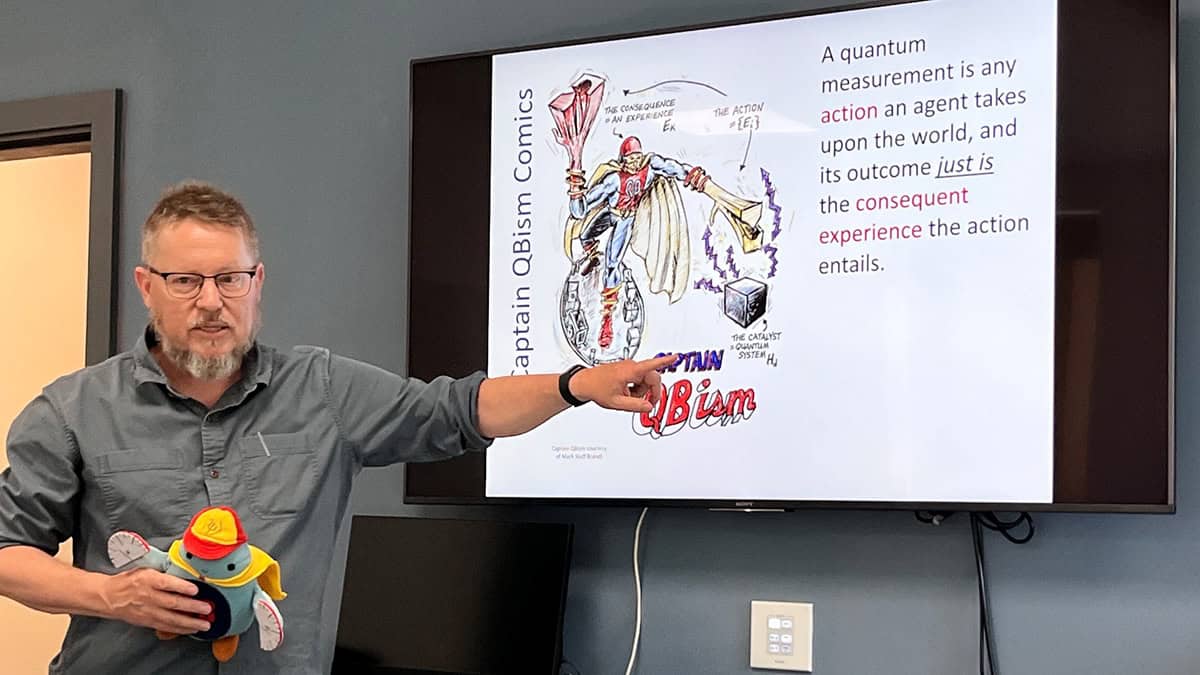
Fuchs, who is from the University of Massachusetts, Boston, is the principal expositor of QBism, originally an acronym for “Quantum Bayesianism”, a research programme devoted to trying to figure out what the world must be like if quantum formalism is correct. But even top-flight writers, Fuchs thinks, get it wrong. And so emerged his idea for the workshop, called “Communicating QBism”.

Attendees at the workshop, besides Fuchs himself, included his collaborator Rüdiger Schack from Royal Holloway – the gracious host of the meeting. There was also John DeBrota, who’s a postdoc at Ludwig Maximilian University, Munich, and Matthew Liefer, associate professor at the Institute for Quantum Studies at Chapman University, California.

The science writers were all experienced. One was Philip Ball, the author of some 30 books who has a PhD in physics and contributes regularly to Physics World. Jo Marchant, the sole female writer to attend, has a PhD in genetics and medical microbiology and is a New York Times bestselling author who recently wrote for New Scientist on QBism.

The four other writers were Robert Henderson, who has a PhD in quantum field theory; George Musser, who has a PhD in planetary science and is a contributing editor at Scientific American; Ulf von Rauchhaupt, a science editor at the Frankfurter Allgemeine Zeitung who has a PhD in extraterrestrial physics; and Zack Savitsky, a physics correspondent for Science.

I was invited at the last minute as a philosopher and writer who might find value in the event. I did.

Pugnacious and self-deprecating

Royal Holloway’s wooded campus on the western outskirts of London is dominated by the Founder’s Building, a beautifully ornate late-19th-century red-brick castle-like structure modelled on a French chateau with a central courtyard. But that’s only where we ate. Fuchs’s face-off, which took place on June 18–19, was holed in a modest modern science building down the hill.

Fuchs, whom I’ve met and written about several times, including for Physics World and a philosophy journal, is charmingly pugnacious. He approaches talks and conversations with unwavering zest and easily out-talks critics. He is relentless in pointing out even years-old mistakes to journalists and writers [editor’s note: I can confirm this]. Yet Fuchs can also be endearingly self-deprecating.

If you didn’t know Fuchs, you might be forgiven for thinking that he had an inquisition in mind. “I explain the ideas until I’m blue in the face,” the invitation ran, but you journalists are “pretty deficit in getting QBism right”. He continued, “What is it that makes QBism so damned hard to understand for journalists and the lay public?”

Fuchs then described himself as “communication impaired” – which was disingenuous. Based on Shack’s estimate, he’s sent about 150,000 QBism-related e-mails, he’s got “3 Million Miler” status from American Airlines thanks to his trips to give talks, and he was a lead speaker at the Helgoland conference on the centenary of quantum mechanics last year.

Some invitees were cautious, even sceptical. “QBism isn’t just another quantum physics interpretation”, Marchant replied to Fuchs’s invitation. “You’re challenging ideas of what physics is even about and requiring a radically different conception of what nature is”. Ball, meanwhile, perceptively reminded Fuchs that QBism is so novel that “the misrepresentations don’t just come from journalists”.

As for Musser, he warned Fuchs that the encounter may not be pleasant. “We will need to have free, open and frank discussions”, he responded, that may be “infuriating to you”. He counselled Fuchs to bring “plenty of plushy toys” for participants to safely throw at each other.

Fuchs’s invitation, however, also expressed warm and genuine respect for the coterie of science writers, who all agreed to come. Still, Fuchs brought a box of plushies just in case.

Speaking about science

On the meeting’s first day, the writers listened and learned. Schack opened the workshop by going over QBism’s vocabulary. “Probability” is not a property of things but refers to the expectations that an experimentalist has about outcomes of an action they are about to take. “Measurement” is that outcome.

“Quantum formalism”, meanwhile, is a tool that any experimentalist can use for making the best estimate they can about which outcome they will get. “Quantum states” are not properties of the world but compendia of probabilities to inform the agent about which actions they ought to take to achieve their goals.

Royal Holloway, London
Scene of the action Royal Holloway, University of London, was the venue for the stand-off between scientists and science journalists. (Courtesy: Robert P Crease)

After Schack, Fuchs gave a talk showing that QBism is neither a philosophical add-on to quantum theory nor something motivated by an attempt to resolve issues to do with entanglement, Bell inequality violations, and so on. Rather, QBism is the only satisfactory coherent account of what the world must be like if the quantum formalism is correct.

Fuchs quashed the idea that QBism is solipsistic; quantum formalisms, he pointed out, have been hammered out for a century and can be picked up by anyone as the best guide to their laboratory experience. He vented ire over stories that use the word “observe” and visual images to characterize what experimentalists do as if they were flies on the wall rather than actors in measurement events.

When Fuchs complained about a clause in an article by Savitsky which suggested such an interpretation, the writers cried “Foul!”. They accused Fuchs of “niggling” about a few words in a lengthy 4000-word article. When Fuchs replied, “I want to niggle over words!” he dodged a plushie.

Learning about writing

On the second day of the meeting, it was the scientists’ turn to listen and learn. Henderson talked about his struggle to “think like a QBist”, explaining how, during the Covid-19 pandemic, he joined Fuchs’s weekly Zoom sessions known as “QBukis”. These made him feel like he had come across “a more advanced civilization of aliens maybe, to whom premises I’d never thought to question were deemed antiquated and naïve”.

Henderson had an epiphany one day when he saw a bird hopping across his snow-covered lawn. The bird, he realized, was not a thing-in-itself but “the designation of a bundle of expectations” that he was bringing to bear to recognize it. What’s most challenging in learning to think like a QBist, Henderson concluded, is that QBism is “playing a different game than the rest of physics, or even science”.

Marchant followed with a talk entitled “Why QBism keeps getting misheard”, in which she showed a picture of a tennis player about to smash a rocketing tennis ball. What was happening, she said, wasn’t just body movements and ball trajectories – but a process of unfolding and continually updated predictions of actions.

QBism sees experimentalists like that tennis player, Marchant said, shepherding new events into the world, but it’s unintuitive to think that way. “QBism isn’t just another quantum physics interpretation,” Marchant said; “you’re challenging ideas of what physics is even about and requiring a radically different conception of what nature is and how we are related to it”. This, she concluded “is always going to be difficult”.

Ball pointed out that journalists are forced to keep in mind “mental attractors” that entice the public, journalists and even scientists to think in classical rather than quantum terms.

Between talks, the writers cited other constraints, such as time, money, audience and the space allotted by editors, all of which shape and dictate their output. Furthermore, writers are sometimes forced to use words whose meanings vary from their technical use.

At one point Fuchs showed a slide of Marchant’s New Scientist article and complained about the word “perspectives” in the standfirst. But Marchant and others objected that Fuchs’s “Gotcha!” play was again committing a foul; writers must lead readers gently into difficult stories with prose that sometimes must violate what researchers mean. “We have to write so people keep listening,” Marchant pointed out.

Impressed, Fuchs had to admit that he does something similar in his lectures, not leading with his most radical ideas but holding off until later.

One scientist then asked why writers don’t routinely run stories by sources before publication. Even if you accurately regurgitate the sources’ words, the writers replied, they often insist on changes, demand that their editors alter or retract the story, heap abuse on you, or even threaten to sue, causing the magazine to drop your article.

Christopher Fuchs at Royal Holloway
Tread carefully QBism is an alternative interpretation of quantum mechanics, but woe betide anyone whose explanation of it fails to live up to Christopher Fuchs’s standards. (Courtesy: Robert P Crease)

When a writer asked why scientists should even care about representations of their work in the media, the answers were difficult to synthesize. They ranged from the noble wish to nurture a scientifically literate public to the self-interested hope that good coverage might influence public perceptions and thus lead to more money from funding agencies.

But what’s hardest writing about QBism, explained the writers, has to do with Henderson’s “civilization of aliens” and Marchant’s “keep ‘em listening” points. Readers instinctively think, contra QBism, that the world has permanent residents and chiselled-in laws. The tennis player’s dive for the ball can always be reconstructed afterwards from a god’s-eye perspective in terms of classical physics, and it’s second-nature for both the public and even scientists to assume that the end of physics is to make such reconstructions.

The critical point

Years ago I wrote a column “The press is a foreign country” whose message was that communicating science is like engaging with another culture. Science and the media, I wrote, are separate institutions with different values, traditions and methods and reasons for seeking and justifying knowledge. The cross-cultural interaction, though, cannot always be made trouble-free, with all conflicts reconcilable by facilitators or relationship counsellors.

Given the qualifications of the participants at “Communicating QBism” – all but Zack had PhDs – one might have thought that the cross-cultural interaction at the workshop would be relaxed. It was, for the most part. But good scientific communication, it emerged, is not always a matter of clear explanations, demonstrations of relevance, dazzling imagery, or scientifically literate journalists.

Positive interactions may require constantly negotiating trade-offs between accuracy and comprehensibility, as well as setting up flinty encounters in which both scientists and writers actively hunt down and expose their own assumptions. These encounters must risk conflict and discomfort on both sides. Good science communication, in short, can use some genial pugilism, and Fuchs’s workshop was an excellent example.

The post Seven writers, four physicists, one room, lots of plushies appeared first on Physics World.

  •  

Tell us what science you need to know to be ‘cultured’

The New York Times recently published a 124-page special issue of its Style Magazine entitled “How to be cultured”. According to the cover of this glossy, ad-driven supplement, the contents were “idiosyncratic” but amounted to a “compendium of what you need to know right now”. The material had been “chosen by experts” for the purpose of “teaching readers how to be more cultured”.

Curious as to what would be included, my hopes were raised by the magazine’s lead editorial. It said that the issue “celebrates expertise, a quality ever less valued in our culture today, where learnedness and firsthand research can be overshadowed by slick presentation and dumb certainty”.

Now, I’m not naïve. I know that the New York Times Style Magazine caters to advertisers, who in turn cater to wealthy readers who feel the need to spend gobs of money to get culture. It didn’t therefore surprise me to have to leaf through 40 pages of adverts for jewellery, champagne, watches and home furnishings before finally coming across the table of contents.

I saw headings for film, food, music, theatre, fashion and the visual arts. Shakespeare showed up several times: over half a dozen plays, sonnet #94 and one of his monologues. There were entries for 1930s movies, animated videos and films from Brazil. One page on food and drink covered porridge from Norway, meat from Mexico, lemonade from Vietnam and wine from Austria.

There was no mention of science in “How to be cultured”, nothing at all

Novels from the US, UK, France, Japan, India and Brazil made the list, as did selections of music from medieval times to opera and hip-hop. Samples of theatre, puppetry and architecture made it in too. But there was no mention of science, nothing at all. The closest I found were architectural materials such as plaster, glass, steel and textiles.

Snow’s lament

The absence of anything scientific should not have shocked me; in fact, it reminded me of the British scientist and novelist C P Snow’s 1959 essay The Two Cultures and the Scientific Revolution. Even back then, Snow lamented that humanists and scientists were living in two separate cultures divided by a “gulf of mutual incomprehension”.

In the essay’s most famous passage, Snow wrote that “a good many times I have been present at gatherings of people who, by the standards of the traditional culture, are thought highly educated and who have with considerable gusto been expressing their incredulity at the illiteracy of scientists”.

“Once or twice,” he went on, “I have been provoked and have asked the company how many of them could describe the Second Law of Thermodynamics. The response was cold: it was also negative. Yet I was asking something which is about the scientific equivalent of ‘Have you read a work of Shakespeare’s?’”

Snow did not stop there. “I now believe,” he continued, “that if I had asked an even simpler question – such as, ‘What do you mean by mass, or acceleration’, which is the scientific equivalent of saying, Can you read? – not more than one in ten of the highly educated would have felt that I was speaking the same language.”

“So the great edifice of modern physics goes up,” he concluded, “and the majority of the cleverest people in the western world have about as much insight into it as their neolithic ancestors would have had.”

Culture club

Snow’s tone was snobby and arrogant, but he was on to something. Can someone who knows nothing about, say, Einstein’s equation E = mc2 or about Heisenberg’s uncertainty principle really be called cultured? Sure, cultured individuals don’t need to know much about these topics. But they ought at least to realize that those equations concern how mass and energy work and the inherent limitations to what humans can know.

I’d say those are principles fundamental to the formation, maintenance and fate of the universe – and ones that a cultured person ought to know something about. Indeed, references to them are routinely found in arts and popular culture. Einstein’s equation has made the cover of Time magazine, while the uncertainty principle has been taken up by novelists, theologians and comedians.

Shouldn’t a cultured person be acquainted in some way with the existential threats facing the world?

Further, shouldn’t a cultured person be acquainted in some way with the existential threats facing the world? Wouldn’t such a person have to have an inkling of the way a carbon molecule absorbs and emits heat, of how vaccines work, and of safe and unsafe levels of substances toxic in high doses? How cultivated can an ostrich be?

Of course, there was nothing about the second law in “How to be cultured”, or about any other science of the sort Snow had in mind.

Nothing about scientific equations, experiments, theories or facts that a cultured person ought to know.

No discussion of dark matter, dark energy or of quantum physics, genes or vaccines. Nor about the Pythagorean Theorem or the double-slit experiment.

The critical point

Culture refers to the influences and values that are embedded in the way we live. Judging such influences and values – deciding which influences and values ought to be so embedded – is a tempting but arrogant game.

So let’s play. Imagine that you are among the experts charged with compiling a “compendium of what you need to know right now”. What would you include of science – and why? Send me your contributions, and tell me why they are what we need to know, and I’ll write about them in a future column.

Illustration of thought bubble with lines of text

What science do you need to know to be cultured?

Send your thoughts to Robert P Crease at robert.crease@stonybrook.edu.


The post Tell us what science you need to know to be ‘cultured’ appeared first on Physics World.

  •  

Meet the demons: four mythical creatures that inhabit science

Four cartoon demons
Meet the family Demons come in four types: one-off, law-governed, instructional and place-holder. (Courtesy: iStock/ringo sono)

Demons might be mythical, but for hundreds of years these imaginary creatures have been fantastically useful for thinking about science and the humanities. For physicists, the most famous demon was dreamed up by James Clerk Maxwell in 1867. His creature appeared to violate the second law of thermodynamics by letting hot molecules in a box of gas go in one direction through a trap door, leaving cold molecules behind.

Inspired by the rich history of demons, my Stony Brook University colleague Elyse Graham and I created what we believe is the first university course that both studies demons and teaches students to code them. We taught the course, entitled “Demons to think with”, for the first time in spring 2025 and again in spring 2026, each time to almost 100 students. The course proved to be a great way of getting students in the humanities and sciences to talk to, work with, and learn from each other.

We surveyed demons from ancient times to the present and discussed their presence throughout art, literature and religion, where they prey on human vulnerabilities to steal souls. We also taught students about what computer engineers call “daemons”, whose malicious members prey on human vulnerabilities via clickbait and other temptations to steal passwords and social-security numbers. But what struck Graham and me most was the sheer number, variety and ambition of scientifically informed demons.

Fictional and frictional

One species was what we might call one-off demons, which explain puzzles about a specific phenomenon. Back in the early 1950s, explanations that rely on this kind of demon were parodied by the American psychologist Wendell Johnson in his 1946 book People in Quandaries: the Semantics of Personal Adjustment.

Once upon a time, Johnson wrote, people were puzzled by the fact that they could rarely find a lead pencil when they needed one – and when they did, its sharpener was sure to be filled with pencil shavings. A committee was appointed to develop a theory to explain this conundrum.

According to this made-up theory, there are lots of little people called plogglies who live underground. “At night, when people are asleep,” Johnson wrote, “the plogglies come into their houses. They scurry around and gather up all the lead pencils, and then they scamper over to the pencil sharpener and grind them all up. And then they go back into the ground.”

Even though it was impossible to know when, where and on what the plogglies will act, Johnson pointed out, this was a brilliant theory as it accounted for two mysteries at once.

Another species of demon comprises law-governed demons. The Princeton University physicist Eric Rogers gave an example in his 1960 book Physics for the Inquiring Mind. Demons cause friction, in this explanation, because they “stand in front of things and push to stop them from moving”. These demons are transparent and too small to see, and the more demons there are, the greater the friction.

Oil reduces friction because it drowns the demons, while heavy objects crush their bones. The laws of friction spring from the fact that the demons have strict habits in the way they rush out of the pores of a surface and get crushed or drowned, and multiply and return to duty at a steady rate.

Law-governed demons play what I think of as a metaphysical role, for they explain the agency behind the regularities of a phenomenon in a way that can be divorced from the regularities themselves. Scientists can study and apply the laws of friction, for example, independently of the demons that cause it. The laws can be studied in what philosophers call the “immanent frame”, apart from whatever transcendent features are involved in putting them in that frame. That lets philosophers and scientists go their separate ways.

Stand-ins and tutors

A third category of demons are what we might call placeholder demons. In 1959 the US physicist David Pines proposed the existence of a massless, chargeless quasiparticle that is an out-of-phase collective excitation of electrons. With a nod to Maxwell, he named it Pines’ demon, reinforcing the term with an improvised acronym (Distinct Electron Motion + on).

Back in 2023 a team of researchers at the University of Illinois Urbana-Champaign discovered the particle – a kind of plasmon – using specialized electron spectroscopy in strontium ruthenate. Pines’ creature was a placeholder demon because it simply gave a name for something that we know is lurking in the immanent frame and only have to find it.

The emergence of quantum physics at the start of the 20th century spawned a new generation of instructional demons

Physicists, finally, use instructional demons. Its most famous member is Maxwell’s demon, mentioned at the beginning of this article. Even a century and a half later it still teaches theorists about the intersection of energy, entropy and information. But the emergence of quantum physics at the start of the 20th century spawned a new generation of instructional demons, including two from Nobel-prize-winning physicists.

In 1911 Marie Curie wondered about a demon that could manipulate quantized packets of energy, while in 1935 Arthur Compton imagined a demon that could open a door for “good” photons and slam the door on “bad” photons that might trigger a stick of dynamite. Working out how far these demons could get – whether law-abiding, law-breaking or law-bending – teaches physicists much about the intersection of information, entropy and quantum mechanics. Instructional demons teach theorists not so much about pieces of the immanent frame as about the structure of the frame itself.

The critical point

As the science historian Jimena Canales showed in her 2020 book Bedeviled: A Shadow History of Demons in Science, demons inhabit even the most methodical and evidence-based thinking. Scientific demons are like other kinds of demons in that they are wily supernatural creatures with superhuman powers. They are unlike other kinds of demons, however, in that they don’t try to take advantage of human vulnerabilities to change us but try to take advantage of nature’s vulnerabilities to change it.

Postulating demons with supernatural powers is a way that scientists have used to explore nature. Studying scientific demons therefore not only tells us about nature but scientific thinking itself.

The post Meet the demons: four mythical creatures that inhabit science appeared first on Physics World.

  •  

What a modern-day US Declaration of Independence should say

Displayed in a sealed case at the National Archives Museum in Washington DC, the US Declaration of Independence is – alongside the Constitution, the Emancipation Proclamation and the Gettysburg Address – one of America’s most sacred documents. Just a single sheet of parchment, it was signed on 4 July 1776 by 56 representatives of 13 colonies, declaring themselves free of British rule. Even though years of fighting followed and Britain did not officially recognize the colonies’ independence until 1783, America dates its birth to that signing.

For many American citizens, the Declaration of Independence is greatly revered. I remember my grandfather had a copy mounted in the entryway to his home, and when I was 10 years old offered me $1 if I memorized it. I had no trouble with the start, for the document’s first sentence is arresting. “When in the Course of human events, it becomes necessary for one people to dissolve the political bands which have connected them with another”, decency requires that “they should declare the causes which impel them to the separation”.

The second sentence is equally exhilarating and unforgettable: “We hold these truths to be self-evident, that all men are created equal…”.  I didn’t discover until years later that this evidently didn’t include women, slaves, or the people referred to as “merciless Indian Savages”. Four truths later, the signatories zoomed in. When a government destroys “life, liberty and the pursuit of happiness” it is the “Right of the People to alter or abolish it”.

King George III was doing just that, they claimed, and the signatories followed with a laundry list of appalling grievances that amounted to tyranny. These included: obstructing justice, bending judges to his will, sending agents to harass and murder people, giving amnesty to those agents, transporting people overseas, cutting off trade with the rest of the world, making the military responsive to himself alone, and on and on.

Current US president Donald Trump claims that the Declaration of Independence led to “the greatest political journey in human history”. The document, he adds, set an example for the world. “The Story of America Makes Everyone Free,” he writes on an official website that has been counting down the days, hours, minutes and seconds to the 250th anniversary of the signing.

Destroyers of Earth

The enormous attention that the US administration is paying to this anniversary has made me wonder, however, whether a government today could destroy life, liberty and the pursuit of happiness badly enough to make it necessary to alter or abolish it. The answer was staring me in the face. What if it destroyed science enough to make citizens vulnerable to natural threats?

I’ve therefore been trying to imagine a revised declaration. Among the self-evident truths, I think, is that human beings are endowed with the right to protection against nature, that the purpose of science is to understand nature and its threats, and that a sovereign’s duty is therefore to foster science and act appropriately on its findings. A no-brainer, right?

These truths are more important than ever in the 21st century, I envision the document saying. Until recently in human history, nature could be treated as an inert stage for human activity. But human activity can now interact with nature in a destructive way to threaten human life, liberty and the pursuit of happiness.

We experience such destruction in the degradation of the Earth’s atmosphere, in rising sea levels, in the spread of infectious diseases, in the increasing pollution of land, sea and air, and in coastal floods and water shortages. The current US administration, I’d continue, is not only doing nothing to prevent this destruction, but also actively campaigning against people who are fighting it and trying to make the world safer.

Human freedom and independence require developing science to understand and cope with nature’s threats. When science is ignored, nature rules

The administration claims that stopping these attempts increases the freedom of US citizens. It does not, however, and instead enslaves us to nature. Human freedom and independence require developing science to understand and cope with nature’s threats. When science is ignored, nature rules.

Yet the current US sovereign, a wannabe King, has made unprecedented attacks on science. His ignorance, denials and repudiations have unleashed untold damage and destruction to the health, welfare and safety of citizens. His actions threaten not only our lives but human lives elsewhere. His actions even threaten the global conditions that make human life possible at all.

Our grievances

My revised declaration would follow with a long and easily verifiable list of modern-day grievances. These would include the fact that Trump has declared that threats whose existence is scientifically well-established are hoaxes, scams and have “no basis in fact”. He has prevented agencies from investigating these threats and from developing technologies to use against them.

He has fired people who study these threats and installed political appointees to oversee funding of research. Despite publicly denying and ridiculing findings about climate change and rising seas, he has admitted their truth when it comes to protecting his own golf course.

The US administration has also declared, contrary to scientific findings, that claims of outbreaks of disease have been “fabricated” and that vaccines do not work. It has cancelled grants to develop vaccines, attacked vaccine makers, revoked recommendations that children be vaccinated, fired experts in vaccines, and damaged the process of vaccine development.

The US administration has sought to gut or close the most important US science agencies. He has withdrawn the US from international agencies that track and address the most important threats to human life and health. He has invented false facts about nature and forced US agencies to agree with him. And he has damaged and extorted America’s top universities by trying to dictate their research, hiring, admissions, courses and curricula.

The critical point

My document would reach a rousing conclusion.

A people, it would say, are only truly free and independent when they and their offspring are able to live in a safe environment, not stalked by disease, and educated freely without government interference. A sovereign who ignores and damages science is unfit to be a ruler by exposing the people to the enslavement of nature. Citizens in a democracy have the right to a leader who does not enslave them to nature.

The final sentence of the document would be: “Let us take those rights back.”

Like the Declaration of Independence 250 years ago, my imagined one may seem revolutionary but only expresses what Thomas Jefferson, the author of the original, called “the common sense of the subject.”

The post What a modern-day US Declaration of Independence should say appeared first on Physics World.

  •  
❌