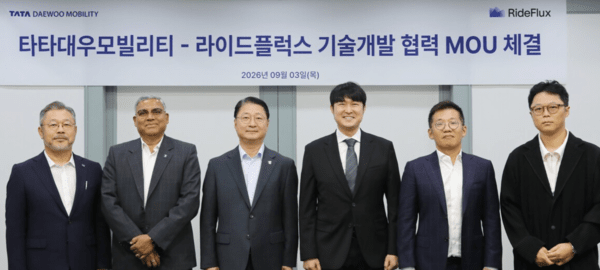
RideFlux and Tata Daewoo Mobility executives pose after signing an MOU to cooperate on Level 2+ driver assistance systems for commercial vehicles and Level 4 autonomous driving. From left: Tata Daewoo R&D chief Lee Yoon-kyu, Tata Daewoo Vice President Anil Sinha, Tata Daewoo President Kim Tae-sung, RideFlux CEO Park Jung-hee, RideFlux CFO Kang Hyuk and RideFlux Strategy Division Head Lim Jong-chul. (Photo: RideFlux)
RideFlux and Tata Daewoo Mobility executives pose after signing an MOU to cooperate on Level 2+ driver assistance systems for commercial vehicles and Level 4 autonomous driving. From left: Tata Daewoo R&D chief Lee Yoon-kyu, Tata Daewoo Vice President Anil Sinha, Tata Daewoo President Kim Tae-sung, RideFlux CEO Park Jung-hee, RideFlux CFO Kang Hyuk and RideFlux Strategy Division Head Lim Jong-chul. (Photo: RideFlux)
Autonomous driving AI company RideFlux has signed a memorandum of understanding (MOU) with commercial vehicle maker Tata Daewoo Mobility to cooperate on Level 2+ (L2+) driver assistance systems for commercial vehicles and Level 4 (L4) autonomous driving.
Under the agreement, RideFlux’s software for five key highway driving functions will be installed on Tata Daewoo Mobility’s XEN and KUXEN heavy-duty truck platforms, with the companies pursuing mass production of L2+ driver assistance systems. Tata Daewoo Mobility will provide the vehicle platforms and vehicle control interfaces, while RideFlux will lead advance development of Driver Control Assistance System (DCAS) software compliant with the UN R171 international standard.
The L2+ driver assistance system integrates longitudinal and lateral vehicle control for functions including lane keeping, lane changing, highway junctions and merging, overtaking and tollgate passage. RideFlux expects to establish a data feedback loop that uses real-world driving data collected from vehicles after mass production to simultaneously improve L2+ performance and validate L4 technology.
The companies have also outlined a roadmap for fully driverless L4 commercialization. Building on what RideFlux said is Korea’s first paid freight transportation service using heavy-duty autonomous trucks, the company plans to develop robotruck conversions before moving to mass production of fully driverless L4 trucks.
The partnership also includes plans to establish a foothold in the global commercial vehicle market by linking the technology with the software-defined vehicle (SDV) architecture of Tata Motors, Tata Daewoo Mobility’s parent company and the largest commercial vehicle maker in India.
RideFlux said that following Korea’s first paid autonomous-truck freight service with Hanjin in July, supplying autonomous driving software to original equipment manufacturer (OEM) Tata Daewoo Mobility gives it a new business-to-business (B2B) revenue stream. The company said the deal also signals that the autonomous driving industry is moving from government-led demonstration projects, or B2G, toward commercialization, providing further momentum for its planned KOSDAQ initial public offering (IPO).
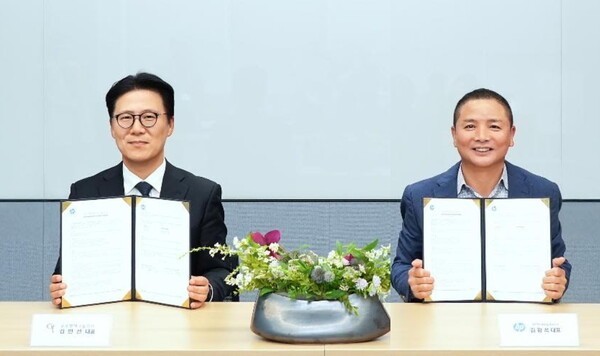
Global Technology CEO Kim Min-sun, left, and HP Printing Korea CEO Kim Kwang-seok sign a memorandum of understanding for technical cooperation in printing systems.
Global Technology CEO Kim Min-sun, left, and HP Printing Korea CEO Kim Kwang-seok sign a memorandum of understanding for technical cooperation in printing systems.
HP Printing Korea said on Sept. 7 that it has selected semiconductor design company Global Technology as its hardware engineering technical support partner for printing systems and signed a strategic partnership agreement. The companies plan to jointly advance electronic component and circuit development as well as artificial intelligence (AI) technologies while strengthening their technological competitiveness.
The two companies will collaborate on the design and development of electronic components and circuits and jointly develop AI-based technologies. Global Technology will also take full responsibility for hardware engineering technical support for HP Printing Korea’s research and development organization.
Global Technology will provide technical support throughout the product development process, including design changes and prototyping for printed circuit assemblies (PCAs). The company said it will operate an integrated technical support system based on its own engineering capabilities and a network of proven Korean partners.
The companies plan to gradually expand the scope of their partnership and jointly develop next-generation main controllers for printing systems, leveraging Global Technology’s system semiconductor and application design capabilities.
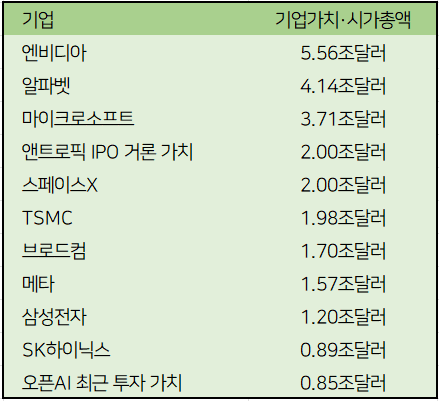
A $2 trillion IPO valuation for Anthropic would be roughly equivalent to the combined market capitalization of Samsung Electronics and SK hynix. (Source: THE ELEC, based on Sept. 4 closing prices)
Leading artificial intelligence (AI) companies in the US and China have begun the process of going public.
Anthropic could launch its initial public offering (IPO) as early as October and list before the US midterm elections in November, Reuters reported. China's Moonshot AI has also reportedly filed confidentially for a Hong Kong IPO this year. The moves put leading frontier AI companies from both countries under direct scrutiny from capital markets.
According to Reuters, Anthropic plans to release its prospectus around late September for an IPO in mid-October. The timetable has been pushed back from an earlier expectation for a prospectus release in early September. IPO marketing is expected to begin in mid-October following the prospectus release.
Anthropic confidentially submitted a draft S-1 registration statement for the IPO to the US Securities and Exchange Commission (SEC) in June. The company said at the time that the number of shares and offering price had yet to be determined and that the listing would depend on market conditions and other factors.
Anthropic could seek a valuation of as much as $2 trillion in the IPO. That would be more than double the $965 billion valuation it received in its most recent funding round.
A $2 trillion valuation would put Anthropic's IPO close to the $2 trillion market capitalization of SpaceX, which went public in the first half of this year. It would effectively make the offering one of the world's largest IPOs. As of the Sept. 4 close, TSMC was valued at $1.98 trillion and SpaceX at $2 trillion.
A $2 trillion IPO valuation for Anthropic would be roughly equivalent to the combined market capitalization of Samsung Electronics and SK hynix. (Source: THE ELEC, based on Sept. 4 closing prices)
Anthropic's potential $2 trillion valuation reflects its rapid growth, including its first quarterly profit in the second quarter and annual recurring revenue (ARR) of about $65 billion in July.
When Anthropic raised $30 billion in a Series G round in February at a $380 billion valuation, ARR stood at $14 billion. By its $65 billion Series H round in May, its valuation had reached $965 billion and ARR had surpassed $47 billion. ARR surged from $14 billion in February to $47 billion in May and $65 billion in July, driving up its revenue multiple.
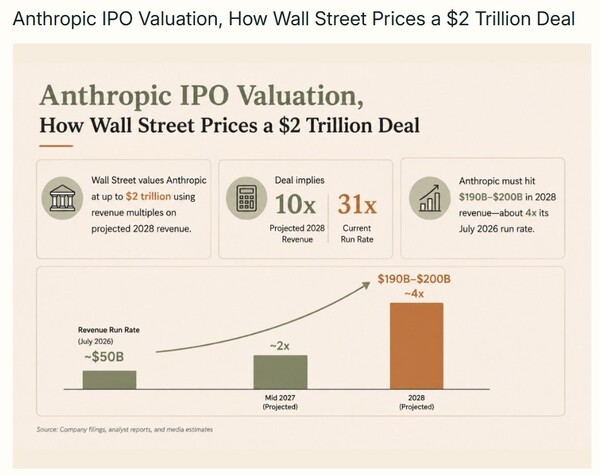
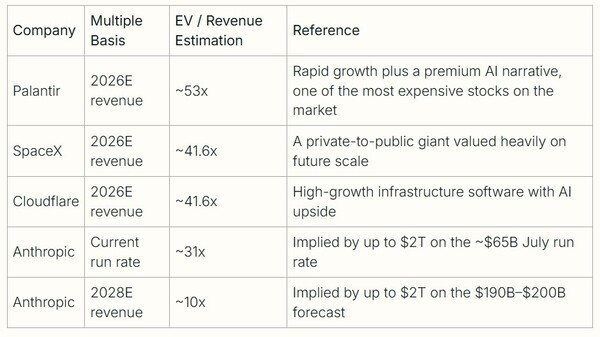
The market expects Anthropic's ARR to reach about $100 billion to $120 billion by the end of this year. Reuters said the $2 trillion valuation is based to a significant degree on projections for revenue of $190 billion to $200 billion in 2028.
That pace of growth is widening the valuation gap with OpenAI, which is valued at $1 trillion. OpenAI had also considered going public this year but is pushing its IPO to 2027 or later so it can list when it can command a $1 trillion valuation, according to Bloomberg and the New York Times.
OpenAI is valued below Anthropic because its ARR cited in recent reports is about $40 billion. According to the Financial Times, Reuters and other reports, OpenAI's ARR stood at $21.4 billion at the end of last year, more than $25 billion at the end of February and about $40 billion in August. The market currently assigns greater potential to Anthropic's revenue scale and future growth prospects.
Basis for Anthropic's potential $2 trillion IPO valuation. (Source: GraniteShares)
Anthropic is also preparing a $15 billion revolving credit facility ahead of the IPO. Morgan Stanley, Goldman Sachs, JPMorgan and Citi are among the banks involved, according to Reuters. Anthropic is seeking a financial structure that combines equity raised through the IPO with a large credit line to support continued investment in computing infrastructure.
Anthropic's governance structure could also become a factor in the IPO. The company has a special body called the Long-Term Benefit Trust (LTBT), which has authority to appoint four of the seven members of its board. The structure is intended to prioritize AI safety and long-term public benefit over short-term profits.
Once Anthropic becomes a public company, shareholders are likely to demand higher valuations and improved profitability, potentially creating tension with the LTBT's focus on long-term safety and public benefit. The IPO will also test whether a governance structure designed around AI safety can be maintained at a publicly traded company valued in the trillions of dollars.
An IPO valuation depends on the multiple applied to expected revenue. Anthropic's multiple would be relatively low compared with Palantir or SpaceX. (Source: GraniteShares)
In China, which is competing with the US for AI leadership, Moonshot AI, developer of Kimi K3, is reportedly preparing to enter Hong Kong's capital market.
According to Reuters, Moonshot AI confidentially filed for an IPO with the Hong Kong Stock Exchange on Sept. 3, targeting about $3 billion and potentially as much as $5 billion in proceeds. About three years after its founding, Moonshot is valued at roughly $50 billion. The timing of the IPO will depend on regulatory approval in China and market conditions. Moonshot has raised more than $5.5 billion from investors including Alibaba, Tencent, Meituan, China Mobile, IDG Capital and HSG.
◇Moonshot AI, Developer of Kimi K3, Expected to Pursue Hong Kong IPO This Year
The most important technological asset in Moonshot AI's IPO is Kimi K3, unveiled in July. K3 is an open-weight model with 2.8 trillion parameters, making it one of the largest open-weight models. It combines performance competitive with US frontier models with an open-weight strategy.
While frontier AI companies such as Anthropic and OpenAI primarily use closed models to generate revenue from application programming interfaces (APIs) and enterprise services, Moonshot AI releases its model weights to expand its ecosystem and generates hosting and service revenue on top of it. K3 has also helped challenge the perception of Chinese AI models as lower-performance, low-cost alternatives.
Moonshot AI has recently been in talks with US cloud service providers (CSPs) over Kimi K3 services, potentially helping it address computing capacity constraints while strengthening its position as a global platform.
Within 48 hours of Kimi K3's launch, user traffic and API requests exceeded expectations, prompting Moonshot AI to temporarily suspend new paid subscriptions for individual users to maintain service stability for existing subscribers. The 2.8-trillion-parameter model rapidly strained GPU clusters and inference capacity, resulting in delayed API access and queues.
According to foreign media reports, Moonshot AI is negotiating with Microsoft, Amazon and Google over cloud hosting and revenue sharing for Kimi K3. Moonshot AI is reportedly seeking as much as 30% of revenue from K3-related services.
The talks are still at an early stage and no outcome has been finalized, but an agreement could bolster Moonshot AI's Hong Kong listing. Rather than spending heavily to build its own global cloud infrastructure, the company could secure sustainable recurring revenue and a stable overseas cash cow by sharing revenue with US CSPs.
The negotiations are also reportedly subject to an annual commercial threshold of $20 million. Under the structure, companies or partners operating a Model-as-a-Service (MaaS) business that generate more than $20 million in annual revenue using K3 would be required to enter into a separate commercial agreement and formal revenue-sharing negotiations with Moonshot AI.
The arrangement would also carry broader significance for the AI industry. It would create a structure in which major US cloud providers host a frontier model developed by a Chinese AI company and share the resulting service revenue with that company.
Meanwhile, the Hong Kong Stock Exchange is attracting Chinese AI companies seeking access to a broader pool of investment capital. With US restrictions on China and geopolitical uncertainty increasing, Hong Kong has emerged as a major alternative for raising global capital.
Foreign investors face strict restrictions on access to mainland Chinese stock markets in Shanghai and Beijing, while Hong Kong allows global institutional investors and international funds to participate more freely. The Hong Kong Stock Exchange's global liquidity pool is particularly attractive to AI companies that require large amounts of overseas capital.
Hong Kong's adherence to internationally recognized accounting and disclosure standards also provides overseas partners and investors with a more familiar governance structure. That is encouraging Chinese companies such as Moonshot AI, which is pursuing revenue-sharing agreements with US CSPs and expansion of its global ecosystem, to seek Hong Kong listings.
Chinese AI companies including Z.AI and MiniMax have listed on the Hong Kong Stock Exchange this year. According to London Stock Exchange Group (LSEG) data, Hong Kong IPOs raised $41.2 billion through mid-August, up 142% from a year earlier. Reuters said Chinese technology companies have led the surge and that Moonshot AI restructured from an offshore entity into a mainland Chinese entity as part of preparations for its Hong Kong IPO.

 Login