Login

Alphabet's Q2 Results in Focus as Investors Scrutinize AI, Cloud and $190 Billion Spending Plan
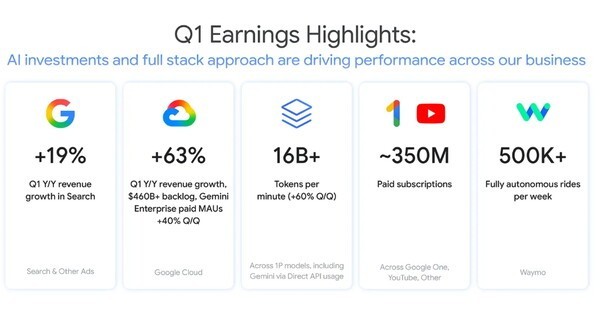
Investor attention is focused on Alphabet's second-quarter earnings report, with markets looking for evidence that the company's aggressive artificial intelligence (AI) investments are translating into sustainable revenue growth.
Alphabet is scheduled to report its second-quarter results after US markets close on July 22 (around 5:00 a.m. Korea time on July 23). While the company's strong first-quarter performance reassured investors, the second quarter has raised fresh concerns over delays to the flagship Gemini 3.5 Pro AI model, the departure of key AI researchers and rising infrastructure investment costs.
Alphabet will webcast its earnings conference call at 5:30 a.m. Korea time on July 23 through its investor relations website and YouTube channel. According to Reuters, investors are primarily looking to determine whether Alphabet's record data center investments and Gemini AI strategy are generating tangible financial returns. As a result, growth in the company's cloud business has become the most closely watched metric.
Cloud revenue expected to grow 64% year over year
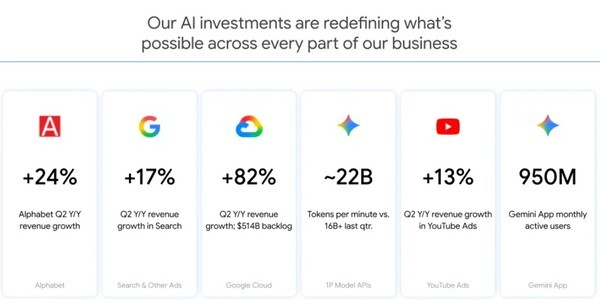
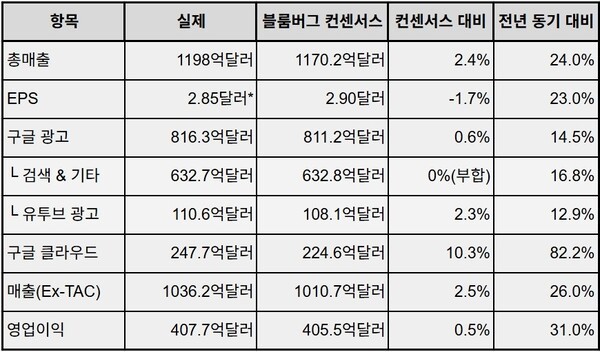
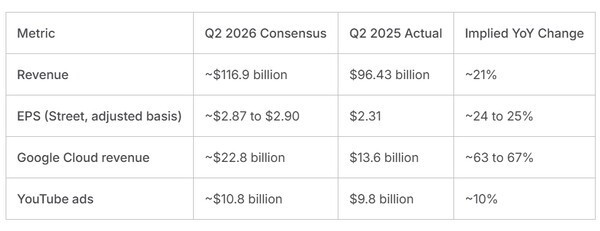
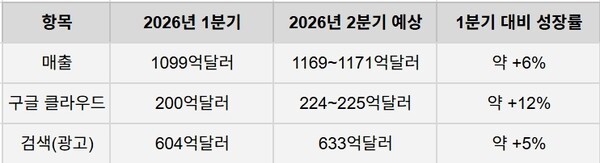
According to estimates from LSEG, Alphabet is expected to post revenue of $116.93 billion for the April-June period, up 21.3% from a year earlier. Google Cloud revenue is forecast to increase 64%, while advertising revenue is expected to grow 13.7%.
Other market consensus estimates are broadly similar. FactSet expects revenue of about $117 billion, with Google Cloud revenue growing 63% to 70%. Visible Alpha forecasts revenue of $117.19 billion, representing growth of more than 20%, while projecting Google Cloud revenue of approximately $22.5 billion, up more than 65%, and advertising revenue from Search and related businesses of roughly $63.29 billion.
Advertising, including Google Search and YouTube, remains Alphabet's largest source of revenue, generating more than three times the sales of its cloud business. Nevertheless, investors are paying closer attention to cloud growth because Alphabet's enormous capital expenditures (CAPEX) must ultimately be justified by accelerating revenue. The company has guided for $180 billion to $190 billion in CAPEX this year.
Even if consensus expectations are met, representing growth from both a year earlier and the previous quarter, investors are likely to demand more. Market participants expect that even a solid earnings report could disappoint if Google Cloud's growth rate fails to exceed expectations.
Cloud performance seen as a barometer of the global AI investment cycle
The results are also expected to influence sentiment across the broader AI ecosystem. If Google Cloud growth surpasses expectations, investors may interpret that as confirmation that the AI infrastructure investment cycle remains intact, supporting continued demand for graphics processing units (GPUs) and benefiting suppliers of optical modules and networking equipment.
The key question is whether Alphabet has maintained investor confidence in its AI strategy. During the earnings call, analysts are expected to ask whether management will maintain its full-year CAPEX guidance. Investors are also seeking updates on the launch schedule for Gemini 3.5 Pro, Google Cloud's order backlog and expansion of the company's in-house AI processors, or tensor processing units (TPUs).
A significant portion of Alphabet's massive CAPEX is being directed toward AI model development. On July 16, reports that Google had delayed the launch of a new version of Gemini, the centerpiece of its AI strategy, sent Alphabet shares down nearly 4%.
Investor sentiment failed to recover afterward, with the stock falling another 2.2% in the following trading session on July 17. Some analysts estimated that Alphabet's market capitalization declined by roughly $200 billion on July 16 alone.
The decline reflected not only concerns over the Gemini delay but also broader investor anxiety about intensifying AI competition and the scale of Alphabet's AI-related capital spending.
At Google I/O 2026 in May, Google introduced the lightweight Gemini 3.5 Flash model and said Gemini 3.5 Pro, its flagship model, would launch in June. The product, however, has yet to be released, with its launch repeatedly delayed.
While Google has rolled out lighter and lower-cost models, including Gemini 3.6 Flash, Gemini 3.5 Flash-Lite and Gemini 3.5 Flash Cyber, the flagship Gemini 3.5 Pro remains unavailable. Bloomberg and other media outlets have reported that the delay could extend for several months.
Gemini flagship delayed over coding performance
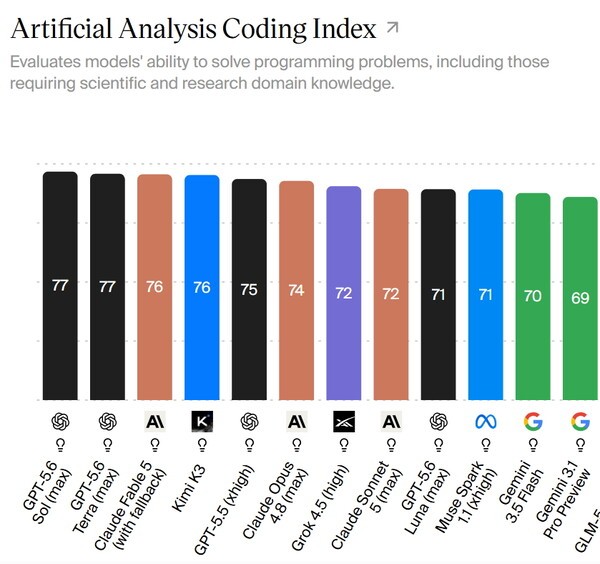
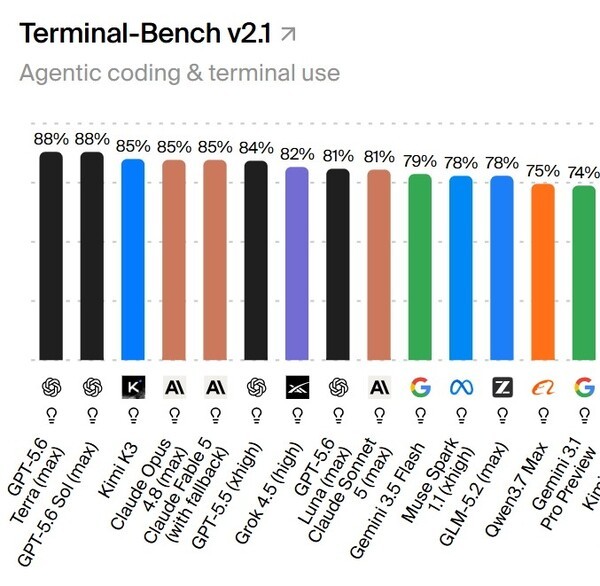
The primary reason for the delay is believed to be coding performance. According to Bloomberg and Reuters, internal testing showed that Gemini 3.5 Pro failed to meet Google's expectations in coding tasks, prompting the company to postpone its release. Coding capability has become a defining benchmark for frontier AI models because it is closely linked to agentic AI functionality.
Google is therefore believed to be delaying the launch until the model reaches its internal performance targets.
Adding to investor concerns has been the recent departure of several key AI researchers.
While movement of AI talent between major technology companies and startups is common, one of the most significant departures was Noam Shazeer, one of the co-leaders of the Gemini project. Shazeer joined OpenAI, prompting Reuters to describe the move as the loss of a key leader behind Gemini.
Another high-profile departure was John Jumper, chief scientist at Google DeepMind, who joined Anthropic. Jumper shared the 2024 Nobel Prize in Chemistry with Google DeepMind CEO Demis Hassabis for developing the AI protein-structure prediction system AlphaFold.
In addition, two core Gemini researchers, Jonas Adler and Alexander Pritzel, joined Anthropic in June. Combined with the delay of Gemini 3.5 Pro, these departures have intensified investor scrutiny of Google's competitiveness in AI models at a time when rivals continue introducing increasingly capable systems.
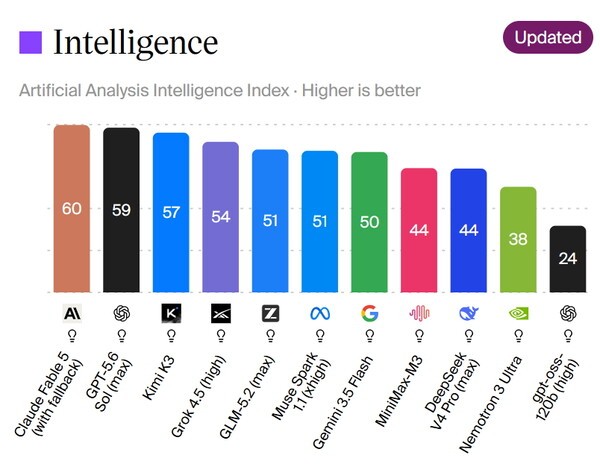
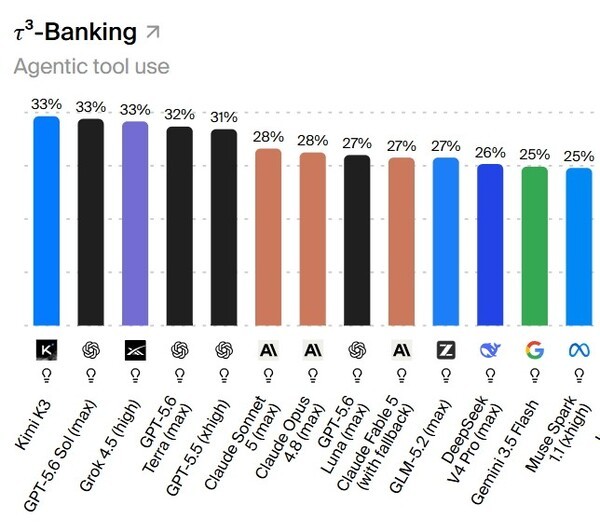
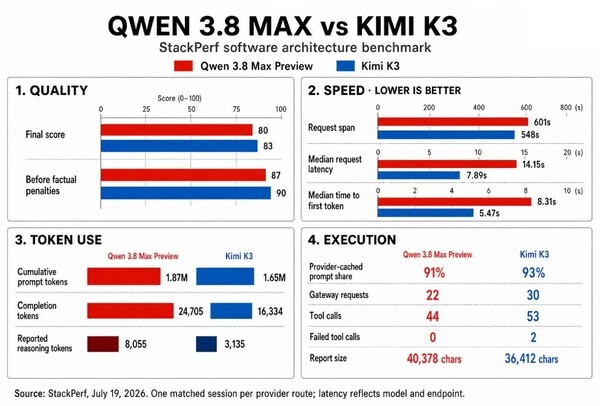
Following Anthropic's Claude Fable 5, competitors including OpenAI with its GPT-5.6 family, xAI with Grok 4.5 and Meta with Muse Spark 1.1 have released US models with significantly enhanced coding and agentic capabilities, while China's Moonshot AI unveiled Kimi K3 on July 16, sending shockwaves through the US AI industry. Gemini 3.5 Pro will need to demonstrate performance at least on par with those offerings.
AI search impact on advertising also under scrutiny
Another major topic expected to dominate the earnings call is the outlook for Alphabet's advertising business.
Advertising remains the company's primary revenue source. Revenue from Search, YouTube and related businesses is expected to approach $70 billion this quarter, although growth is projected at only 13% to 14%. Investors are increasingly focused on whether AI-powered search features, including AI Overviews and AI search advertising, are cannibalizing Google's traditional advertising business or creating new monetization opportunities.
One potential catalyst for improving investor sentiment is Google's next-generation AI chip strategy. According to The Information, Alphabet is developing a new AI server chip under the codename Frozen v2.
The chip is reportedly not a direct successor to Google's existing TPUs but a specialized processor designed to complement them by improving inference performance for Gemini models.
According to The Information, Frozen v2 is intended to implement certain Gemini functions directly in silicon, allowing AI models to run more efficiently on hardware. Reuters reported that Google declined to comment on the report.
Wall Street analysts continue to view Alphabet's greatest competitive advantage as its full-stack AI ecosystem and consumer base. The company uniquely combines Search, YouTube and Android with a vast global consumer base, proprietary AI models, Google Cloud and custom AI chips under one roof. Analysts argue that no other AI or cloud provider—including Amazon Web Services (AWS), Microsoft, Meta, OpenAI or Anthropic—currently possesses such a comprehensive and integrated AI ecosystem.