Google DeepMind CEO Demis Hassabis is pushing for the US AI industry to self-regulate, with the support of government, as a starting point for an international creating shared international standards. In a blog post, he called for a focus on artificial general intelligence (AGI) and national security.
But it is precisely that focus on national security that may make the results of such an effort, assuming it happens, less than palatable outside of the US.
“The rapid progress we’re seeing in AI requires a new approach to testing frontier AI model capabilities that is dynamic, adaptable, and rigorous,” Hassabis wrote. “The US is well positioned, given its economic and technical standing, to take the first step in developing such a framework. It could establish a new Standards Body modelled on a federally overseen public-private partnership or self-regulatory organization, much like the Financial Industry Regulatory Authority (FINRA), with a board that includes independent leading technical experts and open-source representatives.”
He noted, however, that the funding would need to be substantial, and would most likely come from industry, to allow the new body to attract world-class technical talent and obtain the necessary compute resources for large-scale testing.
Hassabis proposed that the organization “be responsible for developing assessment protocols and working with appropriate federal agencies and the US National Labs to conduct testing in areas relevant to national security,” and that AI vendor participants be encouraged to adopt best practices such as publishing model cards with technical details, maintaining strong internal cybersecurity, vetting key personnel, and providing sufficient resourcing for safety and security research.
DeepMind was involved in an earlier US government initiative evaluating AI safety, alongside Microsoft and xAI (now SpaceXAI) working with the Center for AI Standards and Innovation (CAISI), a division of the US Department of Commerce. It allowed CAISI to conduct pre-deployment evaluations and targeted research to “better assess frontier AI capabilities and advance the state of AI security.”
The rest of the world may have concerns
Analysts and consultants were mixed about the move, with most expressing concerns about whether an industry-focused group would prioritize the public’s best interests.
“Self-regulation is not viable because it implies everyone is able to regulate themselves and will do so in line with the best interests of the public. Most tech vendors don’t have the capacity to self-regulate. They would just prefer a set of rules within which they can operate,” said Gartner VP analyst Nader Henein. “For-profit organizations are required to do what is best for their shareholders, and external regulation ensures that those organizations are never in a conflict of interest where they have to choose between what is good for their shareholders and what is good for the public.”
And, said Sanchit Vir Gogia, chief analyst at Greyhound Research, given the international nature of AI models, an effort coordinated by the US government might alienate other countries.
“National security is the proposal’s accelerator in Washington and its poison pill abroad: the framing that opens the only gate available at home invites foreign capitals to read the institution as an instrument of American strategy,” he pointed out.
“The map is already plural,” he said. “Brussels switches on enforcement powers over general-purpose models [starting in August 2026], London runs the AI Security Institute, and Beijing licenses on its own terms. California and New York have legislated for frontier models at home. The durable route is shared technical evidence with sovereign enforcement, sealed through mutual recognition rather than deference, with India and the other major non-Western markets holding authorship rather than seats.”
Gogia added that the rules enacted by even such a group may not address all of the key concerns of enterprise IT. A US government effort along the lines that Hassabis is proposing would result in testing that “sits close to intelligence and industrial policy, and those functions will not stay neatly separated. A model can pass every catastrophic-risk test and still fail the enterprise on privacy, reliability, and liability,” he noted.
Walmart’s former director of cybersecurity Steven Eric Fisher, who is now an independent cybersecurity consultant, said he found the proposal “well-intentioned, but it addresses a highly polarized topic at a time when commercial interests carry unprecedented political influence, which is not always applied benevolently.”
He added, “an exclusive US standard that is not globally respected or enforceable would likely fail to achieve its core purpose and would place US companies at a competitive disadvantage.”
Aman Mahapatra, chief strategy officer for Tribeca Softtech, a New York City-based technology consulting firm, said that a deep dive into how FINRA operates today is illustrative of what IT leaders can expect from this effort, assuming the industry adopts that model.
“When the CEOs of the five companies that would be regulated are also the primary drafters of the standards, the standards will reflect those companies’ interests. FINRA has an independent board, but the operational reality is that member firm perspectives dominate the working groups that write the actual rules,” he said. “There is no reason to expect an AI equivalent to work differently, and every reason to expect it to work worse, because AI standardization is happening faster than any industry has ever attempted to standardize itself, and speed is the enemy of independent oversight.”
Carmi Levy, an independent technology analyst, was even more emphatically opposed to the Hassabis proposal.
“Asking Big Tech companies to self-police is analogous to allowing foxes to guard the henhouse. It hasn’t worked to date, and it won’t work going forward. Expecting these organizations to somehow change their ways at this point in time represents the height of naïve thinking,” Levy said. “The framework proposed by Demis Hassabis is a self-serving roadmap for an industry bent on racing to the AI horizon regardless of the harms caused along the way. It is impossible to quantify the dangers to broader society should frameworks allowing self-regulation become the norm.”
Some love the proposal
An almost completely opposite stance came from Yuri Goryunov, CIO of consulting firm Acceligence, who applauded the proposed move.
“This is one of the rare setups where industry self-regulation has a real shot, and enterprise IT should be enthusiastically rooting for it,” he said. “It fails when harms are externalized, such as in social media content moderation. Or when the overseer outsources judgment to the overseen, such as the FAA’s delegation to Boeing before the 737 MAX. It works when everyone in the industry shares the catastrophic downside.”
He suggested, however, that the best precedent here isn’t FINRA, it’s INPO, the Institute of Nuclear Power Operations, which the nuclear industry created within months of the 1979 Three Mile Island partial reactor meltdown “on the logic that an accident anywhere is an accident everywhere. INPO peer-reviews every US plant, its evaluations move insurance premiums, and it sits on top of the NRC’s statutory floor. That is a public-private stack very close to what Hassabis is describing. Frontier AI has the same structure: one lab’s catastrophic failure brings regulation down on all of them.”
For enterprise CIOs and other IT executives, Goryunov said, that model has the potential for being a big win.
“Today, every enterprise duplicates the same AI diligence of red-teaming, eval suites, governance committees and each does so with less information than any certifying body would have,” Goryunov said. “A credible standards regime does for AI what UL did for electrical equipment and SOC2 did for cloud: it converts an unknowable risk into a procurable product and gives boards a defensible standard of care. That’s not red tape. That’s peace of mind with an audit trail.”
However, Mahapatra said, “the countervailing view is that the alternative to industry-led standards is probably not thoughtful legislation. It is probably no standards, or state-by-state fragmentation, or the current pattern of ex-post enforcement actions where regulators surface concerns years after harm has already occurred.”
Thus, he noted, “Hassabis is making the reasonable argument that imperfect fast standards are better than perfect slow ones, and there is genuine merit to that view for topics like agent identity, evaluation methodology, and interoperability, which are exactly the areas OpenClaw is also targeting.”
The US Cybersecurity and Infrastructure Security Agency (CISA) has urged organizations to immediately secure Microsoft SharePoint deployments after warning that three vulnerabilities affecting the on-premises collaboration platform are being actively exploited.
A recent advisory from the federal cybersecurity watchdog asked administrators to patch vulnerable servers, review Microsoft’s mitigation guidance, and assume that internet-facing SharePoint instances remain attractive targets for attackers seeking an initial foothold into enterprise environments.
While applying patches remains the immediate priority, security experts caution that organizations should view the advisory as more than another Patch Tuesday exercise.
“This is what separates an IT incident from a business crisis,” said Chris Boehm, field CTO at Zero Networks. “One compromised SharePoint box is a ticket. That same box, with a clear path to your domain controllers, backups, and file shares, is how you end up with an encrypted infrastructure and a disclosure event. Segmentation stops the first from becoming the second.”
CISA’s advisory highlights CVE-2026-332201, CVE-2026-45659, and the newly added CVE-2026-56164, all of which have now been confirmed as exploited in the wild and added to the agency’s Known Exploited Vulnerabilities (KEV) catalog.
Exploitation tells a different severity story
The latest addition to CISA’s KEV catalog is CVE-2026-56164, an elevation-of-privilege vulnerability affecting Microsoft SharePoint Server. Although assigned a CVSS score of 5.3, the flaw can be exploited remotely without authentication, making it significantly more dangerous in practice than its severity rating alone suggests.
Microsoft has released security updates for supported SharePoint versions and recommended enabling the Antimalware Scan Interface (AMSI) integration to help detect malicious requests associated with exploitation attempts.
CISA also advised organizations to follow Microsoft’s incident response guidance, hunt for indicators of compromise, and rotate SharePoint machine keys where appropriate, acknowledging that patching alone may not fully remove attacker persistence from already compromised servers.
Older vulnerabilities remain active entry points
Alongside the newly disclosed flaw, CISA reiterated the urgency of addressing CVE-2026-45659, an insecure deserialization vulnerability allowing RCE that Microsoft had marked as “exploitation less likely” in its advisory in May. Another old bug CISA flagged is CVE-2026-32201, an improper input validation flaw that allows spoofing over a network.
Both of these flaws are being actively exploited in the wild.
CISA called out organizations failing to catch up with SharePoint updates, adding that attackers are increasingly targeting N-days rather than relying exclusively on newly discovered zero-days.
On concerns of patching speed, Boehm noted resilience is becoming an architectural challenge as much as an operational one.
“Stop measuring this in patch speed,” he said. “That’s a race you eventually lose. Some of these landed as zero-days with no fix on day one, and the window between disclosure and exploitation keeps shrinking. So the board-level question isn’t whether a server gets compromised. Assume one will. It’s how much of the business a single-owned system can take down with it.”
Boehm argued that limiting network reachability through segmentation should sit alongside patch management and threat hunting as a core defensive strategy. Reachability, he said, is a control that organizations own, not patch timing. CISA has given Federal Civilian Executive Branch (FCEB) agencies three days to remediate CVE-2026-56164 under Binding Operational Directive (BOD) 22-01.
Thinking Machines Lab, the San Francisco startup founded by former OpenAI CTO Mira Murati, has released Inkling, its first general-purpose AI model. The launch adds another US-developed entrant to an open-weight market where Chinese developers produce several leading coding and reasoning models.
Inkling uses a mixture-of-experts architecture with 975 billion total parameters, of which 41 billion are active during processing. It supports a context window of up to 1 million tokens and was pretrained on 45 trillion tokens spanning text, images, audio, and video. Thinking Machines said it also trained the model for coding, tool use, and multimodal tasks.
The release follows the October 2025 launch of Tinker, Thinking Machines’ first product and an API-based platform for customizing AI models. Developers can fine-tune Inkling through the platform.
In a June 2026 assessment, AI model routing platform OpenRouter highlighted DeepSeek V4 Flash, GLM 5.2, MiniMax M3, and Nvidia Nemotron 3 Ultra as four notable open-weight models. Nemotron was the only US-developed model in the group.
Performance and developer access
Thinking Machines Lab’s benchmark table shows mixed results. Inkling scored 77.6% on SWE-Bench Verified, behind DeepSeek V4 Pro and GLM 5.2 but ahead of Nvidia Nemotron 3 Ultra. It also recorded 74.1% on MCP Atlas, 77.1% on BrowseComp with context management, and 79.8% on IFBench.
Thinking Machines said Inkling’s result used a bash-only harness, while the comparison figures were reported by the competing models’ developers.
The model includes a reasoning-effort setting that developers can adjust from 0.2 to 0.99. Thinking Machines said the setting allows users to balance performance against the number of generated tokens. In the company’s testing, Inkling matched Nemotron 3 Ultra’s Terminal Bench 2.1 score while generating about one-third as many tokens.
Developers can fine-tune Inkling through Tinker using context lengths of 64,000 or 256,000 tokens and test it through the Inkling Playground. The model is available through APIs from Together AI, Fireworks, Modal, Databricks, and Baseten. It is also supported by inference software, including SGLang, vLLM, TokenSpeed, llama.cpp, and Hugging Face Transformers.
Inkling’s full weights are available on Hugging Face as the original checkpoint and as a quantized NVFP4 checkpoint. Thinking Machines also previewed Inkling-Small, which has 276 billion total parameters and 12 billion active parameters. The company said it would release the smaller model’s full weights after completing testing.
Enterprise impact
Inkling’s differentiation lies in its open weights, multimodal capabilities, controllable reasoning, and integration with Tinker, rather than benchmark leadership, according to Biswajeet Mahapatra, principal analyst at Forrester.
“Enterprises are most likely to benefit in workloads where domain adaptation matters more than generic model performance, including knowledge-intensive copilots, multimodal customer service, document understanding, operational workflow automation, and agentic tasks that require organization-specific data, policies, and processes,” Mahapatra said.
Inkling’s US origin could also influence adoption among Western enterprises, according to Pareekh Jain, CEO of Pareekh Consulting. He said many Western organizations face regulatory or procurement barriers when considering Chinese-developed AI models.
“Inkling gives those organizations a US-developed open-weight option that they can deploy on their own infrastructure,” Jain said.
However, the benefits will need to be weighed against the cost of deploying the full model.
Running Inkling on private infrastructure requires a GPU cluster with at least 2 TB of aggregated VRAM for the BF16 checkpoint, according to the model card. Thinking Machines lists configurations of eight Nvidia B300 GPUs or 16 H200 GPUs. A quantized NVFP4 checkpoint lowers the requirement to at least 600 GB and can run on four B300 GPUs or eight H200 GPUs.
“Because Inkling is a massive model with 975 billion total parameters, running the full model still requires significant GPU infrastructure, making closed-model APIs more economical for many organizations,” Jain said.
Jain said Inkling-Small may be a more feasible option for many enterprises because it could reduce infrastructure costs and latency while retaining useful performance across key workloads.
Safety and governance
Thinking Machines said it trained Inkling for calibration, instruction following, and resistance to censorship. The company said the model showed “strong patterns of censorship non-compliance” when evaluated by Cognition on its Propaganda and Censorship Eval.
Inkling scored 98.6% on StrongREJECT, which Thinking Machines described as a test of whether models refuse unambiguous harmful requests.
The model’s safety behavior should be retested after an enterprise customizes it, according to Jain. “Model fine-tuning can weaken safety filters, so companies should retest safety after customizing the model rather than assuming it stays safe,” Jain said.
He added that self-hosted and modified versions could diverge from Thinking Machines’ official model over time without receiving automatic updates.
“CIOs need to ensure every AI agent action is logged, auditable, and governed by human approval for high-risk tasks,” Jain said.
It’s not so much generosity that’s behind Anthropic’s decision to extend free access to its most advanced model, Fable, for paid subscribers until July 19, analysts say. Its a last-minute move to grab users, data and model evaluation results.
After the free-access period, Anthropic plans to convert Fable to a pay-per-use model, at $10 per million input tokens and a whopping $50 for 1 million output tokens.
That is double the price of its next most advanced model, Opus 4.8, for input and output tokens. “We’re extending Claude Fable 5 access on all paid plans, as well as keeping Claude Code’s weekly rate limits 50% higher, through July 19,” Anthropic’s team said in a July 12 tweet.
Anthropic keeps extending Fable because it does not yet know what its flagship is worth, said Sanchit Vir Gogia, principal analyst at Greyhound Research. “A vendor confident in its price does not move the same cutoff twice in six days, both times at the wire,” Gogia said.
Anthropic is essentially pushing deadlines to test its products, while users gain by being able to put their toughest tasks to Fable, Gogia said.
Anthropic, which did not immediately reply to a request for comment about the situation, has already seen plenty of action with Fable and its sister model Mythos. Both have been touted as the company’s most advanced models yet.
Fable stumbles, then reappears
Fable was officially launched June 9. Just three days later, on June 12, the US government put export controls on it after Amazon researchers bypassed Fable’s safeguards, prompting the model to identify software vulnerabilities and demonstrate an exploit.
Fable’s freebie extension comes after OpenAI’s latest model, ChatGPT 5.6 Sol, became generally available July 9. Sol is cheaper at $5 per one million tokens input, and $30 for 1 million output tokens.
Anthropic and OpenAI are competing aggressively to build market share, said Jack Gold, principal analyst at J. Gold Associates. “Anthropic and OpenAI are looking to go public and the more users they have, the more attractive it is — even if they are not yet producing income,” he said.
In some ways, the two companies are following a well-trodden path to get customers hooked on their products and turned into paying customers. That’s what Meta, Google and Microsoft, for instance, have done over the years with various “free” offers that later morphed into paid products.
Plus, said Gold, ”The more users you have, the better you can train your models across multiple data sets.”
That’s a potential boon for proprietary large language model (LLM) vendors offering free tokens in a bid to lock enterprises and vendors into their AI environments. But numerous experts have warned enterprises not to fall for that tactic. Instead, they argue enterprises should diversify AI development across multiple AI and cloud vendors, and adopt open-source models.
An LLM space race?
According to LLM benchmarks maintained by Artificial Analysis, Fable is the most intelligent model currently available, with Sol just behind it in second place. One benchmark by LiveBench places Sol as being better in reasoning, with Fable better at math, data analysis, instruction following and language. Both models have advantages in coding.
Meanwhile, Cursor and SpaceXAI on July 8 unveiled Grok 4.5, which the companies said can “handle difficult, long-running tasks that require creatively using tools to solve problems, whether in software engineering, data science, finance, legal work, or anything else you do on a computer,” the company said in a blog entry.
Its pricing is even more aggressive than Fable and ChatGPT 5.6 Sol. Grok 4.5 charges $2 for 1 million input tokens and $6 for 1 million output tokens.
There are growing concerns about tokenmaxxing, where enterprises rack up billions of dollars in token spending, blowing past usage limits before finance controls are implemented.
Enterprises might decide to spend more on models such as Mythos and Fable — if the benefits are tangible, said Max Leaming, head of data science and AI solutions at ManpowerGroup. Fable and Mythos may “actually be less expensive to use in spite of the spiked token cost because it’s far more efficient,” he said.
A company might find that the models use fewer tokens, are faster, and can reduce compute time, he said. “Even though the per-token costs may go up, we may see overall costs go down,” Leaming said.
Enterprises that use AI in hiring and firing decisions continue to be under scrutiny, and this time it’s Meta under the microscope.
A legal complaint filed on July 13 in a US District Court in California alleges that Meta used AI systems that unfairly and illegally selected workers for termination while they were out on protected leave.
More than two dozen anonymous plaintiffs are seeking a preliminary injunction that would prevent the company from finalizing their separations or altering their compensation, benefits, or protected leave status.
Meta has countered that the claims lack merit and that its workforce decisions were, and continue to be, made by people, not AI.
An important lesson
These allegations should serve as an important lesson to other businesses using AI in their HR decision-making, analysts note.
“Enterprises must begin by rejecting the convenient assumption that AI improves workforce decisions simply by touching them,” said Sanchit Vir Gogia, chief analyst at Greyhound Research.
There is “scant independent proof” that AI makes layoff choices more accurate or more lawful, he said. “It makes them faster, and faster has never been shown to be fairer.”
The claims against Meta
The complaint states that, on May 20, 2026, Meta began notifying roughly 10% of its workforce (around 8,000 employees) that they had been selected for termination. The company also announced that several thousand more would be reassigned to new AI initiatives. But this came even as Meta reported record revenues in Q1 2026 ($56.31 billion, a 33% year-over-year increase), and pledged to spend upwards of $100 billion on AI this year.
In addition to questioning the need for staff cuts, the filing alleges that Meta used a “constellation” of internal AI systems to score, rank, and select employees for termination. These tools included Meta’s internal AI coworker, “Metamate,” employee-trained “second-brain” agents that replicated their output, algorithms tracking keystrokes and other digital activity, and AI token usage dashboards.
“Meta did not assemble the termination list through the considered judgment of managers who knew the work,” the complaint claims.
The 26 plaintiffs, all current or former employees, requested, took, or were approved for “statutorily protected” leave within 24 months of the workforce reduction, and claim they were “disproportionately selected” for layoff based on scoring that essentially penalized them for exercising their legal right to take leave.
These practices are prohibited by federal and state law; The US Family and Medical Leave Act, for one, prohibits the use of protected leave as a “negative factor” in employment decisions. Further, the plaintiffs allege that Meta violated the US Worker Adjustment and Retraining Notification (WARN) Act that requires employers with 100 or more employees to provide written notice 60 calendar days in advance of mass layoffs.
This notice gives employees reasonable time to seek alternate employment; however, the complaint argues, an employee undergoing “significant medical treatment” or providing “around the clock care” for a “weeks old newborn” or other loved ones “cannot also be told that during this exact same time period they must look for new work.”
In one scenario, according to the filing, a scientist was identified for termination just two days before she gave birth while on pregnancy leave. In another, an engineer’s manager tied his performance rating to “broken time” when an injury prevented him from working. In a third, a researcher was called out after requesting time off following a medical diagnosis.
The plaintiffs are seeking a preliminary injunction pending an independent audit of the “algorithmically assisted selection process” and “resolution of the merits of their claims” in arbitration.
Once terminations are finalized, the harm to plaintiffs “cannot be undone by money damages alone,” the complaint states. For employees out on leave, “every day that goes by constitutes additional harm, in that Meta is taking away the entire purpose of a protected leave.”
Considerations for enterprises
Any system that materially influences who keeps a job is not an HR tool, Gogia noted. “It is high-risk enterprise infrastructure.”
An “AI-determined” process delegates the outcome to the system, while an “AI-assisted” one gives the system the ability to rank, recommend, and summarize, with a human formally making the final decision. Exposure arises in either model, Gogia pointed out, because the output has often been compressed and eliminates detail by the time of executive approval.
There must be one non-negotiable role in the process, Gogia said: A single executive with the authority to halt the process, suspend the model, and delay decisions when evidence does not hold. This person should be “a meaningful reviewer [who] understands the model’s limits, knows the actual work, and holds the authority to challenge the recommendation, with every override visible and reviewable,” he said. At the same time, the objective is to “govern the machine and the manager together,” since human judgement brings its own “risks, favoritism, and proximity” bias.
Gogia advised enterprises to retain fixed memory for auditing, determine who chose the auditor, what was excluded, and whether the result can be reproduced. They should also inventory every source feeding the model and its origins, and run adverse-impact analysis before making any firing decisions.
Leave details must never be identified as inactivity or weak adoption; a protected absence is not ordinary missing data, and the system has to be informed of this. Rather, these circumstances belong in an “independent review lane,” where human reviewers get enough context to “neutralize” the period without receiving specific leave details, Gogia said.
He pointed to another important question: What should the “second brain” AI agent that ingested the employee’s communications and documents to replicate the employee’s output be allowed to do when humans are away, and who owns that output?
Ultimately, said Gogia, “the safest position is not to ban AI from workforce planning. Used with discipline, it can expose duplicated work and inconsistent assessment, and it can challenge human bias rather than automate it.”
How employees can protect their rights
Employees, for their part, need a genuine window in which to challenge inaccurate data before separation becomes “irreversible,” and they should “fight the record, not the algorithm,” Gogia advised.
That means that, while the model cannot explain itself, documented evidence can. Employees should lawfully retain their own reviews, leave approvals, and severance documents, and build a chronology of events: When leave was requested, when performance language changed, when new metrics appeared, Gogia said.
Impacted workers should ask in writing which criteria were used in the decision, whether automated systems materially influenced it, how protected leave was treated, and what information about them influenced the result and how that information was verified.
Further, it’s important to take note of deadlines; the federal discrimination window is typically six months, although that is extended to 10 in many places, and internal processes are “not obliged to respect it,” said Gogia.
His ultimate advice for workers: “Preserve the lawful record, and protect the deadline.”
Google DeepMind CEO Demis Hassabis on Tuesday reiterated his push for an AI industry self-regulation effort, led by the US government, that is particularly focused on artificial general intelligence (AGI) and national security.
But it is precisely that focus on national security that may make the results of such an effort, assuming it happens, less than palatable outside of the US.
“The rapid progress we’re seeing in AI requires a new approach to testing frontier AI model capabilities that is dynamic, adaptable, and rigorous,” Hassabis wrote. “The US is well positioned, given its economic and technical standing, to take the first step in developing such a framework. It could establish a new Standards Body modelled on a federally overseen public-private partnership or self-regulatory organization, much like the Financial Industry Regulatory Authority (FINRA), with a board that includes independent leading technical experts and open-source representatives.”
He noted, however, that the funding would need to be substantial, and would most likely come from industry, to allow the new body to attract world-class technical talent and obtain the necessary compute resources for large-scale testing.
Hassabis said he would propose that the organization “be responsible for developing assessment protocols and working with appropriate federal agencies and the US National Labs to conduct testing in areas relevant to national security,” and that AI vendor participants would be encouraged to adopt best practices, such as publishing model cards with technical details, maintaining strong internal cybersecurity, vetting key personnel, and providing sufficient resourcing for safety and security research.
This is not the first time Hassabis has expressed worries about AGI. He has already worked on a US government initiative evaluating AI safety, which involved DeepMind, Microsoft and xAI (now SpaceXAI) working with the Center for AI Standards and Innovation (CAISI), a division of the US Department of Commerce. It allowed CAISI to conduct pre-deployment evaluations and targeted research to “better assess frontier AI capabilities and advance the state of AI security.”
The rest of the world may have concerns
Analysts and consultants were mixed about the move, with most expressing concerns about whether an industry-focused group would prioritize the public’s best interests.
“Self-regulation is not viable because it implies everyone is able to regulate themselves and will do so in line with the best interests of the public. Most tech vendors don’t have the capacity to self-regulate. They would just prefer a set of rules within which they can operate,” said Gartner VP analyst Nader Henein. “For-profit organizations are required to do what is best for their shareholders, and external regulation ensures that those organizations are never in a conflict of interest where they have to choose between what is good for their shareholders and what is good for the public.”
And, said Sanchit Vir Gogia, chief analyst at Greyhound Research, given the international nature of AI models, an effort coordinated by the US government might alienate other countries.
“National security is the proposal’s accelerator in Washington and its poison pill abroad: the framing that opens the only gate available at home invites foreign capitals to read the institution as an instrument of American strategy,” he pointed out.
“The map is already plural,” he said. “Brussels switches on enforcement powers over general-purpose models [starting in August 2026], London runs the AI Security Institute, and Beijing licenses on its own terms. California and New York have legislated for frontier models at home. The durable route is shared technical evidence with sovereign enforcement, sealed through mutual recognition rather than deference, with India and the other major non-Western markets holding authorship rather than seats.”
Gogia added that the rules enacted by even such a group may not address all of the key concerns of enterprise IT. A US government effort along the lines that Hassabis is proposing would result in testing that “sits close to intelligence and industrial policy, and those functions will not stay neatly separated. A model can pass every catastrophic-risk test and still fail the enterprise on privacy, reliability, and liability,” he noted.
Walmart’s former director of cybersecurity Steven Eric Fisher, who is now an independent cybersecurity consultant, said he found the proposal “well-intentioned, but it addresses a highly polarized topic at a time when commercial interests carry unprecedented political influence, which is not always applied benevolently.”
He added, “an exclusive US standard that is not globally respected or enforceable would likely fail to achieve its core purpose and would place US companies at a competitive disadvantage.”
Aman Mahapatra, chief strategy officer for Tribeca Softtech, a New York City-based technology consulting firm, said that a deep dive into how FINRA operates today is illustrative of what IT leaders can expect from this effort, assuming the industry adopts that model.
“When the CEOs of the five companies that would be regulated are also the primary drafters of the standards, the standards will reflect those companies’ interests. FINRA has an independent board, but the operational reality is that member firm perspectives dominate the working groups that write the actual rules,” he said. “There is no reason to expect an AI equivalent to work differently, and every reason to expect it to work worse, because AI standardization is happening faster than any industry has ever attempted to standardize itself, and speed is the enemy of independent oversight.”
Carmi Levy, an independent technology analyst, was even more emphatically opposed to the Hassabis proposal.
“Asking Big Tech companies to self-police is analogous to allowing foxes to guard the henhouse. It hasn’t worked to date, and it won’t work going forward. Expecting these organizations to somehow change their ways at this point in time represents the height of naïve thinking,” Levy said. “The framework proposed by Demis Hassabis is a self-serving roadmap for an industry bent on racing to the AI horizon regardless of the harms caused along the way. It is impossible to quantify the dangers to broader society should frameworks allowing self-regulation become the norm.”
Some love the proposal
An almost completely opposite stance came from Yuri Goryunov, CIO of consulting firm Acceligence, who applauded the proposed move.
“This is one of the rare setups where industry self-regulation has a real shot, and enterprise IT should be enthusiastically rooting for it,” he said. “It fails when harms are externalized, such as in social media content moderation. Or when the overseer outsources judgment to the overseen, such as the FAA’s delegation to Boeing before the 737 MAX. It works when everyone in the industry shares the catastrophic downside.”
He suggested, however, that the best precedent here isn’t FINRA, it’s INPO, the Institute of Nuclear Power Operations, which the nuclear industry created within months of the 1979 Three Mile Island partial reactor meltdown “on the logic that an accident anywhere is an accident everywhere. INPO peer-reviews every US plant, its evaluations move insurance premiums, and it sits on top of the NRC’s statutory floor. That is a public-private stack very close to what Hassabis is describing. Frontier AI has the same structure: one lab’s catastrophic failure brings regulation down on all of them.”
For enterprise CIOs and other IT executives, Goryunov said, that model has the potential for being a big win.
“Today, every enterprise duplicates the same AI diligence of red-teaming, eval suites, governance committees and each does so with less information than any certifying body would have,” Goryunov said. “A credible standards regime does for AI what UL did for electrical equipment and SOC2 did for cloud: it converts an unknowable risk into a procurable product and gives boards a defensible standard of care. That’s not red tape. That’s peace of mind with an audit trail.”
However, Mahapatra said, “the countervailing view is that the alternative to industry-led standards is probably not thoughtful legislation. It is probably no standards, or state-by-state fragmentation, or the current pattern of ex-post enforcement actions where regulators surface concerns years after harm has already occurred.”
Thus, he noted, “Hassabis is making the reasonable argument that imperfect fast standards are better than perfect slow ones, and there is genuine merit to that view for topics like agent identity, evaluation methodology, and interoperability, which are exactly the areas OpenClaw is also targeting.”
When Apple sued OpenAI last week, the argument it made was that former employees had stolen Apple data and then used it to benefit OpenAI.
The technical details — an employee used “a rare, previously unknown authentication bug to access Apple’s shared network folders” — are interesting. But the larger story is Apple’s ridiculous attempt to stop its people from using anything they learned at Apple in other jobs.
“Hiring managers don’t mind some files being brought into the org during onboarding, but suddenly take umbrage when that same employee exits with some files later on,” said Mike Wilkes, enterprise CISO at Aikido Security. “Legal should be equally concerned about both events.”
The lawsuit focused on Chang Liu, an employee who had been recruited to work at OpenAI after working at Apple for eight years as a Senior System Electrical Engineer. The full text of the filing depicts a comedy of errors by Apple, offering the perfect “do not do” list of handling employee resignations — especially when they’re going to a direct competitor.
“When Apple contacted Mr. Liu to sign Apple’s confidentiality reminder, schedule an exit interview, and confirm that he had returned his devices and complied with other exit procedures, Mr. Liu did not respond.” And “after leaving Apple, Mr. Liu failed to return an Apple-issued work laptop that he had previously authenticated to Apple’s network.”
First, typical procedure for handling departures is to tie the return of all equipment and the signing of documents to any final payments. With Apple, that is likely to be a large amount of money. The lawsuit does not say whether Apple exerted any financial pressure on their employee for compliance.
But in terms of equipment with high-level access, why weren’t all privileges revoked, both for the employee and any and all company-issued devices? Did they not maintain a remote-wipe capability for these devices? Although remote-wipe is usually used when devices are missing or stolen, it should work as well when a departing employee refuses to return company equipment.
According to Apple, Liu apparently had help at Apple from Tang Yew Tan, who was supposedly also interviewing with OpenAI. “While employed by OpenAI, [Liu] accessed and used his former colleague’s Apple-issued work computer that was authenticated to Apple’s network, without Apple’s authorization.”
Apple tried to make much of this Liu’s fault. Legally, yes, there might be liability there; still, Apple made itself look as if it couldn’t protect its own data. “Upon discovering that he had this unauthorized access to Apple’s systems, [the former employee] did not report it, return his stolen Apple-issued work laptop or delete the program that allowed the access.”
Really, Apple? Your data-protection plan relies on ex-employees to “delete the program that allowed the access”? I’m not so sure you didn’t bring some of this data-leakage on yourselves.
This gets worse: “Over several weeks, while developing hardware for OpenAI, Mr. Liu surreptitiously accessed and downloaded dozens of Apple’s confidential hardware-related files, including voluminous, detailed information about unreleased products, engineering presentations, technical specifications, and proprietary project data.”
Setting aside the issue of privileges, access, and unreturned equipment that apparently had its own privileges, that statement points to massive data exfiltration from Apple systems. Even if it is coming from a current employee, why didn’t that raise any red flags?
Let’s get back to the broader implications. When professionals move from one company to another, they — of course — are bringing their experience and knowledge with them. Can Apple reasonably tell them that they can’t do so? Isn’t that experience and knowledge exactly why another company would want to hire them?
Now, to be sure, stealing diagrams and product spec sheets is a clear violation. Let’s say Apple spent a lot of money on some hardware research projects. A member of that technical team would learn an awful lot, all on Apple’s dime.
But is it fair and reasonable for Apple to say that the former employee can’t leverage that knowledge at his or her next job?
This brings us back to the point Wilkes made: If Apple is going to try to prevent any former employee from leveraging on-the-job experience, then it should instruct all new employees not to use anything they learned in a previous job.
That would be ridiculous. Companies pay for experienced talent because of that experience. Why pay for expertise if you insist employees not leverage any of it?
Then there’s the amorphous nature of knowledge. So, it’s wrong to take detailed diagrams and spec details and hand them over to a new employer. But what if that worker heading out the door memorizes the documents (photographic memory) a day before resigning? Is a person prohibited from using something from memory?
There’s also the fruit-of-the-poisonous tree legal argument. Even if a former employee doesn’t directly use stolen data, what if their knowledge leads to other money-saving insights for the new employer?
Given that Apple hires as many specialists as it loses to rivals, wouldn’t it make sense to leverage everything your workforce knows and then let new employers do the same? But before you do that, Apple, tighten your exiting employee tech controls.
Then maybe you wont’t have to file lawsuits like this down the road.
OpenAI’s first device will be a screenless home AI system that can play music, control appliances, and respond to messages and questions, according to Bloomberg. I can’t help but ask what makes this device different from Apple’s HomePod with SiriAI?
The OpenAI product is intended to be the first of a family of solutions and is expected to use the recently-introduced GPT-Live large language model (LLM). The latter is an advanced model capable of processing information swiftly and of providing natural responses to conversations.
A potential gold mine for hackers
This expertise might help it deliver more accurate responses to requests, though the information could also become a gold mine for data brokers, hackers, and advertisers if there turns out to be any way they can get their hands on it. It’s not yet known how — or even if — OpenAI proposes protecting user privacy within its systems.
The device, which is still under development, is explained as being a home companion that also includes a built-in camera and sensors so it can gather contextual information about where you are, becoming an expert on you and your needs. It also features autonomous mechanical elements that physically shift on their own, intended to give the product a “personality,” rather than being a boring black box.
Can we live without this?
While OpenAI’s development is not yet complete and things could change before it reaches market, based on Bloomberg’s report I’m not terribly clear how unique it is going to be. After all, as LLM support is introduced in existing smart speaker systems from Apple, or even Amazon, what unique features does this device bring that consumers can’t live without? More particularly, what problems does it solve and why does it exist?
That suggests either that its inaugural “home companion” will seem incredibly expensive (as so many of the products Jony Ive has designed since leaving Apple seem to be), or that OpenAI will sell these things at a subsidy.
Bloomberg suggests the systems will cost $200 to $300. That seems low given the current component market, expected design quality and the technology used if the plan is to make something good. And it leaves me wondering how deeply investors will underwrite hardware sales, given the eye-watering losses the company is already making.
Apple’s trade secrets case
Given ongoing speculation that Apple plans something similar in the form of a hybrid HomePod/iPad equipped with AI and limited mobility, the recent lawsuit strongly suggests Apple feels some of OpenAI’s plans cross the line into using proprietary technologies and ideas Cupertino has spent years pursuing. Apple’s lawsuit seems to bring much more meaningful evidence than just an argument concerning product design.
Betting the farm on Ive
We also don’t know the extent to which consumers will be open to semi-sentient AI devices lurking in their lives. While Apple can lean into its loyal customer base and broaden its offering with rock-solid promises concerning user privacy, OpenAI has less to bring to the launch party.
That means it is attempting to pivot millions who use its services into investing in its hardware. It presumably hopes that it will be able to drive that transition by using the design involvement of acclaimed Apple designer Jony Ive as a form of magic talisman.
The challenge is that while Ive is a big name in Apple history, Apple users are extremely loyal and may react against the involvement of their favorite designer. It’s like finding out someone you thought was on your team actually supported someone else.
It will be different outside Apple, where less loyal cohorts might see the product introduction as a chance to put a design from Ive through its paces without signing up to a Mac, iPhone, iPad, or HomePod.
For the rest of us, the question will be whether OpenAI’s Ive-designed product channels the successful design ethic of the iMac, or that of the far less successful hockey puck mouse. Like (timely World Cup klaxon) France against Spain, OpenAI’s investors have to hope the best version of Ive’s design principles show up, because their risked fortunes potentially depend on it.
The best time for tech workers to unionize was 20 years ago, when they had plenty of leverage. The second-best time is now, when they don’t.
Mass layoffs, AI-driven displacement, corporate surveillance, workplace disillusionment have created conditions that have made organizing compelling for tech professionals. But the federal labor board that has historically protected workers’ right to organize has been weakened, and the companies that once feared it are openly defying it.
Here’s how organizers and labor experts describe the pros and cons to organizing — and how you can get started.
The single biggest benefit of a union contract for most tech workers isn’t pay — it’s protection against arbitrary termination, especially in the wake of recent mass layoffs in tech. In the United States, nonunion “at-will” workers can be fired at any time without a stated reason, while unionized workers negotiate protections written into their contracts.
“That fear of the company letting you go for anything at any time…with a union they just can’t do that,” says Zak Thompson, a senior software engineer at Kickstarter and union steward at Kickstarter United. Now that Kickstarter employees are unionized, people are less worried that saying something negative will result in termination.
“I’ve been shocked at the willingness of my co-workers to speak up against what they see as poor or controversial business decisions,” Thompson says.
Beyond job security, unions can deliver concrete material gains.Kickstarter United was formed in 2020, although getting there wasn’t easy: two employees were fired during the organizing campaign — which itself became a galvanizing event. And while the union hasn’t been able to prevent layoffs, it did negotiate better terms: four months of severance pay and four to six months of continued health insurance, versus the two to three weeks per year of work that management had initially proposed.
Other benefits include a four-day work week; AI protections; a minimum pay floor; and standards for raises, promotions, and time off for the company’s 59 employees.
Unions can give tech workers a voice in decisions that affect their daily work — including how AI tools are deployed. “Nobody I’ve spoken to is against new technology or getting trained in it,” says Max Belasco, a business systems analyst at the University of California Los Angeles School of Law and co-chair of the UCLA chapter of the University Professional and Technical Employees/Communications Workers of America (UPTE-CWA) Local 9119.
“But when new technology is being implemented, we want to know: what’s the five-year vision, the 10-year vision? Are we implementing this in a way that betters staffing, increases efficiency, or eases the lives of people already working? Or are we trying to take away jobs, automate people out of their pension or paycheck?” Belasco says.
The challenges are real. Tech professionals are less inclined to leave their jobs in the current market because wages haven’t been increasing as fast as they once were, and it can take longer to land another job.
“Tech moved from a very tight labor market in 2022 (1.85% unemployment rate) to a noticeably weaker one in 2024–2026 (3.49%),” although that’s still better than the national unemployment rate of 4.36% through May of this year, says Liya Palagashvili, senior research fellow and director of the Labor Policy Project at the Mercatus Center at George Mason University.
Liya Palagashvili of the Mercatus Center at George Mason University
Mercatus Center at George Mason University
Flexibility is a concern. The more substantive challenge, raised by economists including Palagashvili, is that traditional union contracts impose uniform terms across an entire bargaining unit, limiting the flexibility that many tech workers — and their employers —currently enjoy. Tech firms need to move fast, adjusting teams, products, and roles on the fly.
“Collective bargaining agreements can make those adjustments much more difficult, whether by making them slower, costlier, or inconsistent with the contract,” she says.
Workers skeptical of unions in a survey of 1,900 tech professionals conducted by the career site Blind cited specific concerns: that unions are “not meritocratic,” “prevent innovation,” and “hold back earnings of top performers.”
Thompson from Kickstarter United pushes back: “We have nothing in our contract about ‘you can’t bend down and pick up a piece of trash because that’s someone else’s job.’ The company is free to give bonuses and individual raises as much as they like. This is all just up to the people who are bargaining the contract from the union side.”
Organizing carries potentially serious personal risks. During negotiations for a second three-year contract in 2025, Kickstarter United went on strike for 42 days. A few months later, the company announced layoffs.
“They let go strong union leaders, including a person who had bargained our last contract,” Thompson says. The union appealed, and the issue is now going to arbitration.
If you form a union, don’t expect much support from the National Labor Relations Board, the agency that certifies US labor unions and protects workers’ right to organize, in terms of prosecuting complaints of unfair labor practices, Thompson warns. “We’re in a political moment in this country with a pretty weakened NLRB. You have to be ready to organize and withhold worker power without any guarantee of safety.”
Organizers are up against an enormous union avoidance industry. Organizers can expect fierce pushback as soon as the business discovers that organizing is underway.
“There’s a multi-billion-dollar industry in union avoidance,” says Alan McAvinney, a Google software engineer and organizing chair, Alphabet Workers Union-CWA, a 1,400-member minority union of Alphabet employees. (Google is a subsidiary of Alphabet.)
US employers spend roughly $1.7 billion a year on union avoidance consultants and law firms, according to a May 2026 report by the Economic Policy Institute and LaborLab.
Expect hardball tactics. Management may play hardball during the time between when organizers announce their intention to unionize and the actual vote. For example, management can threaten to fire foreign-born workers in the US on H-1B visas if they support the union. Those workers would then have just 60 days to find a new sponsoring employer or lose their H-1B status, according to a recent Tech Workers Coalition blog post.
And at venture capital-backed startups, investment agreements sometimes require management to attest there is no union activity — meaning a public organizing drive can trigger funding withdrawal. Or, if a unionized company is acquired, the new management can dissolve the union overnight by reclassifying unionized workers as new hires.
With these sobering facts in mind, here is how organizers who have done it describe the process of creating a union.
Step 1: Start a conversation with your co-workers
At the University of California, a two-tier system had evolved where some tech workers were unionized and some weren’t, Belasco says. Management created new titles that fell outside the union even though they had similar job descriptions and responsibilities to those in the union. Those nonunion employees received lower pay and benefits than their unionized peers, which created resentment and instability.
Belasco and other organizers wanted to eliminate that division by bringing everyone under the same contract. But when they began their unionization drive, “the biggest barrier we faced wasn’t management opposition — it was that people felt this was just the best-case scenario realistically available: ‘We have this job at the university, we have concerns about automation and layoffs, but what can we really do about it?'” he says.
The antidote to that fatalism, organizers say, is simple: “Just start talking to your immediate co-workers. Are they experiencing the same challenges you are experiencing?” says McAvinney. “There’s no need to start talking about a union at this point.”
Just get a consensus and start building a group of like-minded individuals, Thompson advises. “Always start with one-on-one conversations, and that’s what you should do the whole time. That’s the key to organizing,” he says.
Tech workers often think they’re a special case, says Thompson, and therefore that unionization isn’t a good fit. “You’re not special. You are a company of workers, you are organizing, and there is a playbook for that. Trust the process, because it tends to work pretty well,” he says.
Step 2: Who’s on board, and who’s not? Map your workplace, but keep it quiet
Once there’s a consensus, continue to grow your network. Keep a list of everyone you’ve spoken with and note their disposition: “Is this person union-friendly or anti-union? Would they be a strong organizer?” Thompson says.
Maintaining secrecy early on is essential, because anti-union tactics will start immediately, and that can stop union organizing before it can gain momentum.
“Generally, employers do not want to share power with their workforce,” McAvinney says. Employers will deploy every means at their disposal to stop organizing efforts and peel away potential yes votes.
“If you look at historical examples, having 70% approval before the employer finds out about you results in a high percentage of wins when you actually cast the vote. Historically, that’s an effective buffer,” he says.
There’s a real threat of firing and layoffs. The traditional tech worker belief that job mobility makes collective action unnecessary is now being tested by a tighter job market, McAvinney says, noting that workers who many believe were fired for speaking out back in 2019 were a galvanizing factor in his union’s formation.
“You generally don’t want to be in a situation where the employer feels comfortable firing everyone. Part of that is thinking from a cynical standpoint about what the consequences would be to the employer if they did fire everyone,” he says.
One-on-one conversations that include personally asking co-workers to keep conversations confidential are key to keeping things quiet, Belasco says. When 2,100 UC tech workers voted to unionize in May, 96% voted in favor. To stay out of earshot of managers, avoid employee surveillance tools, and sidestep conference calls that could be recorded, organizers met with workers in their homes.
“That tactic is probably what made the difference between winning the election and getting the majority we got,” he says.
Step 3: Find the right union affiliation or go it alone
“Running a campaign against major employers requires the resources and expertise of the larger labor movement, even if workers publicly present as independent,” says Kate Bronfenbrenner, director of labor education research and senior lecturer emeritus at Cornell University’s School of Industrial and Labor Relations.
The Alphabet Workers Union decided early on to affiliate with CWA. “They gave us a bunch of support early on in our campaign with no strings attached,” McAvinney says.
Kickstarter is organized through OPEIU, Thompson says. “They’ll usually have resources and staff that can help you through the next steps: collecting signatures in support of a union, bringing that to management, holding a vote — the more formalized things that interact with US labor law. They’ll also help with organizing along the way,” he says.
For workers at institutions where a union already exists, there may be a faster path. Organizers at UCLA did what’s called a “unit modification,” aligning with UPTE. By organizing under UPTE, the workers didn’t have to negotiate a new contract from scratch — they joined an already-negotiated contract covering existing UPTE tech members, which put them in “a much stronger position” than starting fresh, Belasco says.
Step 4: Choose your union model: majority vs. pre-majority or minority
Assess what’s practical for your organizing effort. In a majority union, more than 50% of all workers in a defined bargaining unit must vote to join the union through an NLRB-supervised election in the private sector, or a Public Employment Relations Board (PERB)-supervised election for public sector workers.
The NLRB must certify the union, which then operates under its legal protections. This means, for example, that the employer must bargain, negotiated contracts are enforceable, violations must go to the NLRB or arbitration, and workers can’t be dismissed without just cause.
A pre-majority or minority union is a minority labor organization operating without NLRB protections or collective bargaining agreements. “Pre-majority means that workers are able to demonstrate majority support — through signed cards, petitions, a walkout, or everyone wearing solidarity T-shirts — without going through a formal election,” Bronfenbrenner says.
Kate Bronfenbrenner from the School of Industrial and Labor Relations, Cornell University
ILR School/Cornell University
The Alphabet Workers Union-CWA (AWU-CWA) formed as a pre-majority union because achieving majority status across a globally distributed workforce of over 100,000 was not a realistic near-term goal. “An underground model where you try to reach 70% support across a workforce of over 100,000 people isn’t realistic,” McAvinney says.
A pre-majority union can still make a difference, he says. For example, the Alphabet Workers Union-CWA convinced management to offer voluntary exit packages — buyouts — prior to announcing layoffs.
For smaller organizations, a majority union may be the more practical option — it’s more attainable, McAvinney says. “I don’t think [the pre-majority union model] is the correct thing to do in all situations. I certainly would not recommend it to a 200-person shop.”
Kickstarter, which had fewer than 100 employees, was able to form a majority union, with 55% voting to organize.
Ultimately, says McAvinney, “there’s no inflection point where you go from being able to win nothing to winning everything, even with a contract and a supermajority. But the more people you have who are willing and able to fight for what they want, the more you’ll be able to get.”
Step 5: Who should — and should not — be in your union?
Belasco’s situation at UCLA illustrates a broader strategic choice that every organizing campaign must make. He had been in a union position in educational technology when he was told his role would be reclassified as a non-union position.
“I was given a choice: apply to the new non-union position to continue doing the work I’d trained for, or stay in my union position doing service desk work I wasn’t used to,” he says. “Essentially, it was a choice between job security and career progression.”
Belasco joined a “wall-to-wall” union, which represents a broad range of university professional and technical employees across the UC system rather than a single job category, such as engineers or tech professionals.
Kickstarter United is another example of a wall-to-wall union. “It’s not just the engineers who are unionized, but also customer support, designers — everyone,” Thompson says.
Wall-to-wall unions are more powerful, but they’re also more difficult to achieve. Under US labor law, “professionals have to vote separately on whether they want to be combined with other workers,” says Bronfenbrenner. “You can never have a wall-to-wall unit without giving professionals the chance to decide whether they want to be separate.”
The law’s “professional employees” category includes roles like software engineers and developers but not necessarily others. For example, customer support specialists and QA analysts would fall into the “non-professional workers” category.
“For decades, the pattern was either to organize everybody except the engineers, or manage to organize the engineers and fail to bring in everybody else — neither of which builds real worker power,” says Simone Robutti, an organizer with Tech Workers Coalition Global, an international branch of TWC based in Berlin.
Step 6: You won the vote. Get ready for what comes next
Winning a union vote means having a seat at the table, says Thompson. “Once the workers have come together and agreed they want that seat, you bring that to management, and they have a chance to voluntarily recognize a union,” he says.
But in most cases employers contest the results, which must be certified by the NLRB or PERB. That process, in which the employer uses various tactics to challenge the legitimacy of the outcome, can take weeks or months.
In the meantime, some companies may disregard negotiated contracts, which can lead to lengthy legal appeals or extended arbitration.
“The NLRB can still force an election, but it can’t force a contract, and companies are saying they simply won’t comply,” Bronfenbrenner says. This is where the expertise and resources of affiliation with a major union can help, she adds.
As a result, contract negotiations can take far longer than workers might expect. At Kickstarter, for example, two years and four months elapsed from the time of the union vote to the first contract, and that was at a 59-person company with a relatively cooperative employer. At larger companies with more aggressive legal teams, the timeline will be longer.
Forming a union is hard work, Robutti says. “It’s not a service you pay for and they protect you. It doesn’t happen spontaneously, and it doesn’t happen magically. It’s the choice to take responsibility for improving your workplace.”
Widgets, widgets, widgets. Has there ever been an Android feature so full of promise that went unloved by Google for so very long?
Okay, so maybe there has been — erm, lots of times, actually. But even so, Android’s widgets system is a perfect example of an exceptional advantage that Google basically buried, abandoned, and left on the brink of extinction up until its overdue revival in 2021’s Android 12 update. (And that revival, by the way, happened for no apparent reason whatsoever. Just a totally random, unprompted change of heart after a decade of indifference. Riiiiiiiiight.)
Google may have given up on widgets for a while, but the good news is that (a) they’re back, baby — still now, more than ever, even in our overly AI-obsessed 2026 timeline — and (b) the Android developer community keeps chuggin’ along and coming up with ever-more creative new ways to embrace widgets beyond what Google itself sees fit to give us. That means no matter what Android version your favorite phone is running, you can step up your own Android widget game and give yourself some fresh and fruitful paths to make the most of your phone’s framework.
Here, my dear, are some fantastic beyond-the-basics ways to put your favorite Android widgets to use and change the way you get stuff done on your phone.
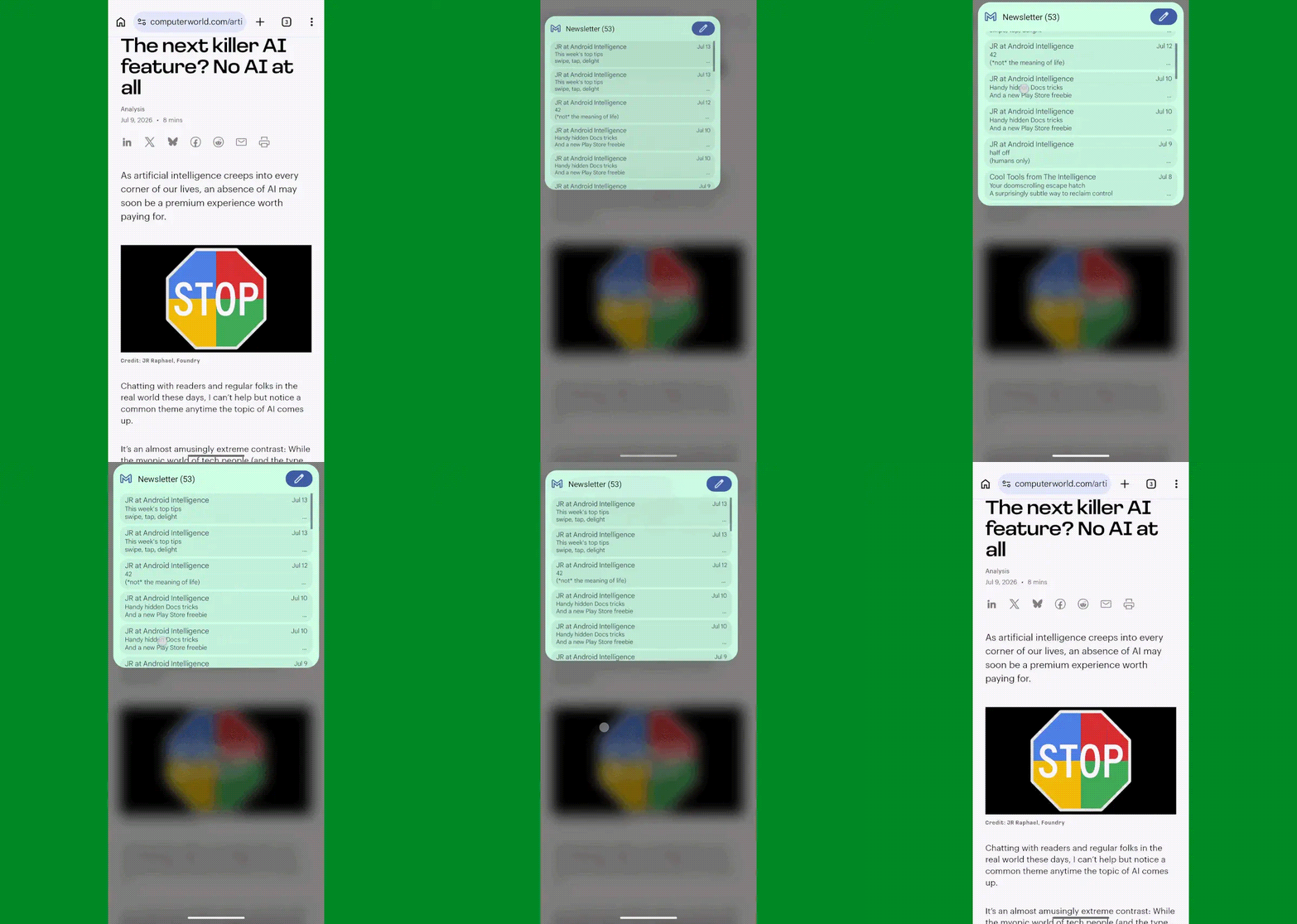
Android widget enhancement #1: The on-demand home screen pop-up
Widgets are a wonderful way to interact with all sorts of info without ever having to open up apps, but having too many widgets can quickly lead to a cluttered and overwhelming home screen.
Well, here’s a neat way to give yourself the benefit of a widget while still maintaining a neat and minimal space for working: An excellent app called Popup Widget lets you create an on-demand pop-up widget (get it?!) that looks like a regular ol’ icon on your home screen but then loads any widget you want when tapped.
See?
Any widget, anytime — with Popup Widget on Android.
JR Raphael, Foundry
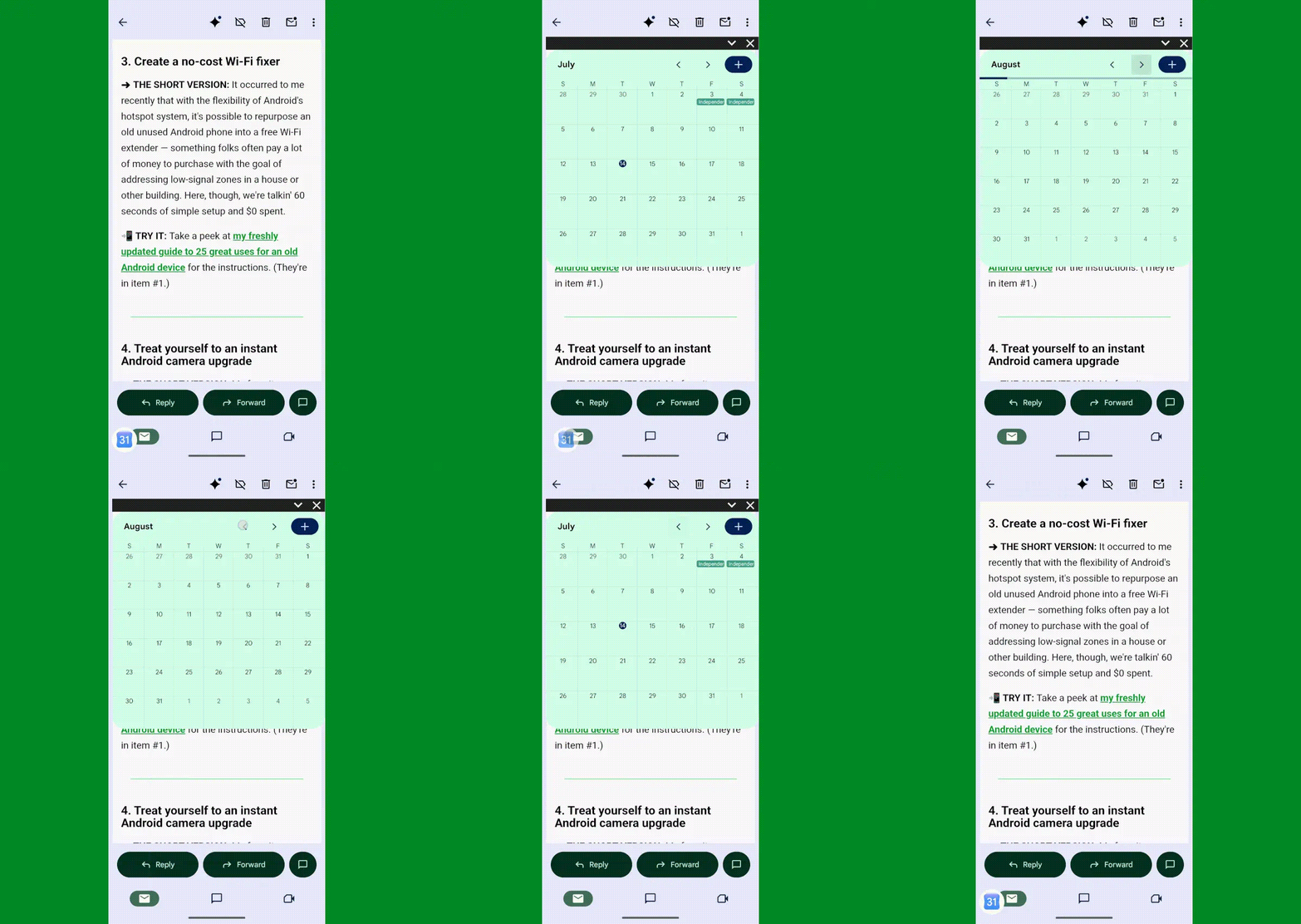
You can even get really wild and set up a single icon that opens multiple widgets at the same time — like your inbox and your calendar together:
Popup Widget can even let you summon two widgets together with a single tap.
JR Raphael, Foundry
Not bad, right?
Popup Widget costs two bucks and doesn’t require any special permissions or manners of access. And it’s pretty simple and self-explanatory to set up: Once you install and open the app, it’ll walk you through adding in whatever pop-up widgets you want. You can choose the name and even the icon associated with each one along with its precise placement on your screen and how much the screen behind it should dim when it’s loaded.
The app will offer to add the shortcut directly onto your home screen for you then, or you can also find all of your Popup Widget creations by pressing and holding the main Popup Widget icon in your app drawer.
Alternatively, if you’re already using a custom Android launcher like Smart Launcher or Niagara, you can find similar options for summoning widgets on demand within their settings — no separate apps even required.
And that, my widget-loving wallaby, is but our first winning widget possibility.
Android widget enhancement #2: The on-demand universal pop-up
If you like the idea of having a widget on demand but would rather have it be available to summon from anywhere instead of just from your home screen, this next wacky widget option is just the thing for you.
It comes from a spectacular app called Edge Gestures, which works in conjunction with Popup Widget to take that same concept and make it universally accessible. (I told ya it was wacky!)
When you first install Edge Gestures, the app will prompt you to enable it as a system accessibility service and to grant it the ability to display over other apps. These permissions sound scary — and they should! — but in the case of this specific utility, they’re absolutely appropriate and necessary in order for it to operate. The former is the only way an app is able to create a custom system-wide gesture, which we need for this setup to work its magic, and the latter is how your widget is able to be shown on top of whatever else you’re doing.
(If you’re at all worried, note that Edge Gestures doesn’t request any other significant system permissions. Beyond that, it’s reputable, it’s been around for quite a long while, and it has a large number of overwhelmingly positive reviews.)
Where were we? Oh, right: Once you’re inside the Edge Gestures configuration area, you’ll be able to select exactly what gesture you want to use for pulling up your widget. I’d think carefully about finding something that won’t interfere with anything else, like the system-level Android gestures, and that’ll be convenient to access without being a command you’re likely to trigger by mistake.
So, for instance, you might make the gesture a simple swipe downward along the left side of your screen. To do that, you’d find the “Swipe down” option within the app’s “Left” tab, and you’d set it to “Popup Widget” — and then create or select whatever Popup Widget item you want. And remember: You can select one widget or multiple widgets, too.
Prepare yourself for some serious oohing and ahhing:
Your favorite widgets are never more than a swipe away with Edge Gestures on Android.
JR Raphael, Foundry
As you can see, this opens up a whole new world of mobile multitasking potential. I mean, really: How could you not love that?!
The final thing worth doing is going into all the other gesture options in that same configuration area and tapping “Clear” for each of ’em to get rid of Edge Gestures’ default actions. I’d also go into whichever side of the screen you aren’t using — left or right — and tap the toggle to turn the gestures for that side off entirely. That way, you won’t inadvertently activate any gestures that you don’t actually want or need.
Edge Gestures costs $2 to use.
Android widget enhancement #3: The physical key call
Next, here’s an interesting twist on that same on-demand Android widget idea: You can make any widget especially easy to access from anywhere without even having to mess around with any on-screen swiping by setting one of your phone’s physical keys as a trigger for the widget’s appearance.
I’ll give you a second to catch your breath and process the sheer splendor of that sorcery.
Back? Cool. So, the key to this feat (har har) is the combination of the aforementioned Popup Widget and a handy Android contraption called Key Mapper — which makes it easy to map your phone’s physical keys to all kinds of crazy custom actions.
In this case, we’ll set it up so that pressing and holding one of your volume keys causes whatever widget you want to be summoned, like so:
Yes, your volume key can cause a widget to appear (whoa!).
JR Raphael, Foundry
Pretty nifty, no?
I’ve got step-by-step instructions for making this happen in this separate guide.
Android widget enhancement #4: The floating bubble
If you like the notion of having a widget always available but aren’t so keen on the hidden gesture concept, an app called Overlays will let you create a small floating bubble that you can position anywhere on your screen and then tap to pull any widget up when you want it — just like with Android’s recently revived Bubbles multitasking system, only compatible with any Android device and version and with the simplicity of a widget instead of the complexity of an entire app.
Check it out:
Overlays puts a floating icon on your screen for easy ongoing widget access.
JR Raphael, Foundry
By default, Overlays gives you a bunch of its own little widgets to choose from, but the real power comes from adding in widgets from the Android apps you actually rely on. To do that, tap the “Triggers” tab at the bottom of the Overlays configuration area, then tap the red plus button in the lower-right corner of the screen. Select “Manual,” then type in whatever name you want for your widget and tap the icon to pick any icon you like.
Tap “Save,” then select “Widget” and find the widget you want from the list. At that point, you’ll see a preview of the widget. Move or resize it if you like, then hit the arrow in the upper-left corner of the screen to exit out of that interface. Last but not least, tap the name of your newly made widget on the screen that comes up next to change its status to “Always on.”
As soon as you head out of the app and back to your home screen, your fancy new widget should pop right up. All you’ve gotta do is tap the little downward-facing arrow in its corner to minimize it down to a bubble, which you can then press and hold to move anywhere your widget-worshipping heart desires.
Overlays can also create widgets that automatically appear based on context — so you could have something show up every time you connect to a certain Bluetooth device or Wi-Fi network, for instance. To explore those options, just follow the same steps from above but pick “Event” instead of “Manual” when you reach the “Triggers” tab configuration.
Overlays is free with an optional $4 in-app upgrade that removes some ads from the configuration tool and unlocks a handful of advanced features.
Android widget enhancement #5: The widget stack
Last but not least in our collection of wacky Android widget possibilities is one of my favorite widget wonders — and that’s the ability to stack multiple widgets and then swipe between ’em on your home screen without having ’em take up any extra space.
Check it out:
The space-saving simplicity of stacked widgets, as seen in Smart Launcher.
JR Raphael, Foundry
This enhancement presents a bit of a choose-your-own-adventure-style path:
First, if you’re using a reasonably recent Samsung Galaxy gizmo, the option is should already be present and available in your standard Samsung home screen setup. Just press and hold any open space on your home screen and then select the option to add a widget — then, once the widget is added, press and hold it and look for the “Create stack” command.
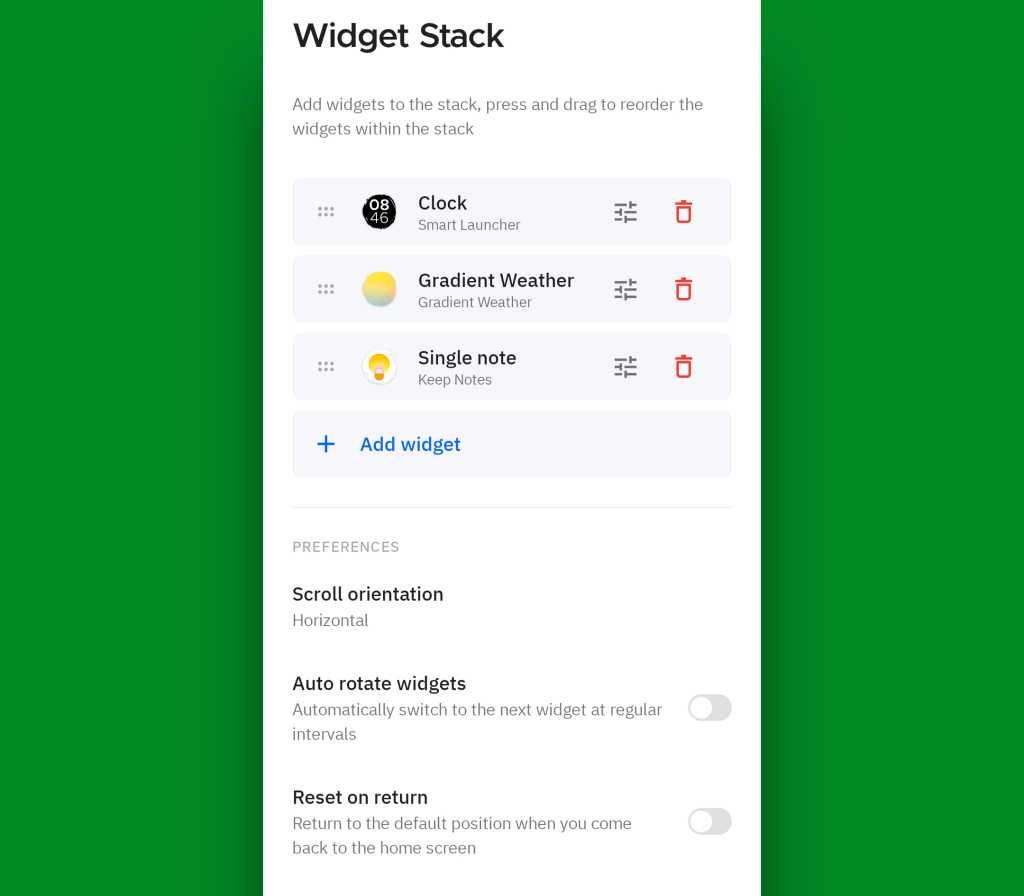
Those launchers replace your phone’s entire home screen environment and give you all sorts of interesting new possibilities for optimizing your interface and making it especially well-suited for you. And the stacked widget feature is just one small sliver of what they offer and how they’ll transform your Android experience.
The setup interface for a widget stack within Smart Launcher.
JR Raphael, Foundry
So there ya have it: five wacky, wild, wonderful ways to make widgets even more wow-inducing. Some days, you’ve just gotta love Android and the endless customization, control, and power it provides.
Passkeys have been around for some time, but enterprise-wide adoption to this point has been slow for a number of reasons. But soon, many Microsoft customers won’t have a choice.
Starting September 1, Microsoft will roll out passkeys as the default authentication method in its cloud-based identity and access management (IAM) service Entra ID. And following a transition period, Microsoft-provided SMS and voice authentication will officially end on February 1, 2027.
With this move, Microsoft seems to be underlining the urgent need for a more secure authentication standard, as attackers up their game with AI.
This is an “important milestone,” because it moves passwordless authentication from an optional security enhancement to the expected standard, noted Ensar Seker, CISO at SOCRadar. “That shift is significant as attackers increasingly rely on AI to automate phishing campaigns, generate convincing login pages, and conduct large-scale credential theft.”
Microsoft’s six-month passkey roll-out
Passkeys require users to authenticate via a fingerprint, facial scan, or lock screen mechanism, rather than a password. They can be stored on physical USB keys (like YubiKey), or as digital credentials on computers, phones, or in cloud accounts.
This method, Microsoft contended, reduces reliance on phishable authentication tools like SMS and voice, and hardens protection against credential theft.
Passkeys “work better for users and worse for cyberattackers,” Nadim Abdo, Microsoft corporate VP for identity and network access engineering, wrote in a blog post.
Microsoft’s announced timeline for rolling out passkeys is relatively aggressive:
September 1, 2026: All SMS or voice-enabled users will be “auto-enabled and nudged” to register a passkey upon multifactor authentication (MFA) sign-in.
September 18, 2026: Pricing, commercial terms, and a list of supported telecom providers will be shared for scenarios that still require SMS or voice authentication due to regulation or technical or operational challenges.
October 30, 2026: Enterprises still using SMS and voice must select and configure a supported telecom provider through the Microsoft Security Store. From then on, they will be responsible for any telecom-related costs.
February 1, 2027: Microsoft-provided telecom delivery for SMS and voice authentication ends as a native Microsoft Entra capability.
After February 1, enterprises that require SMS or voice for MFA must register a passkey before sign-in. There will be no opt-out option.
It’s important to note that these dates apply to public cloud-hosted Entra ID. Support for other cloud environments will follow a separate timeline; additional guidance and dates are to come.
While SMS and voice have served their purpose well, Abdo said, bringing MFA to billions of users who otherwise would have had none, the threat environment has changed in “speed, scale, and sophistication,” necessitating this move to passkeys.
The benefits of passkeys
SOCRadar’s Seker pointed out that passkeys fundamentally change the attack surface because, unlike with passwords, there is no transmission of shared secrets that can be stolen by threat actors. Authentication requires possession of the user’s device, along with biometric verification or a PIN.
“Even highly convincing AI-generated phishing pages cannot simply trick users into handing over a passkey the way they can with passwords or one-time codes,” he said.
So why haven’t we seen widespread enterprise adoption? Identity ecosystems are “fragmented,” Seker noted, and many enterprises still rely on legacy applications that only support passwords. They also struggle with cross-platform compatibility, lifecycle management, recovery processes, shared accounts, and employee onboarding and offboarding.
Further, “until recently, many organizations viewed passkeys as a consumer technology rather than an enterprise identity strategy,” he said.
Microsoft’s move changes that equation, because Entra sits at the center of many organizations’ identity infrastructure, Seker noted. Default settings are typically the strongest drivers of security adoption, so when passwordless authentication becomes required rather than optional, organizations are far more likely to deploy it at scale.
Its biggest benefit would be a “dramatic reduction” in credential-based attacks, Seker said. He pointed out that most successful compromises still begin with stolen credentials obtained through phishing, infostealer malware, password reuse, or adversary-in-the-middle attacks. Passkeys “eliminate or significantly reduce” many of those attack paths, while reducing password fatigue and the help desk costs related to password resets.
In addition, rather than trying to continuously improve users’ ability to detect increasingly sophisticated phishing attempts, passkeys remove the credential from the equation altogether, Seker noted. “That represents a more sustainable long-term security strategy than relying solely on user awareness training.”
Still, passkeys are not a silver bullet, as they do not stop endpoint compromise, session token theft, malicious insiders, or attackers who already have control of a trusted device. Enterprises must complement passkeys with endpoint protection, continuous monitoring, conditional access policies, and identity threat detection, Seker advised.
How enterprises can prepare
To prepare for the shift to passkeys, Microsoft advised enterprises to review their authentication policy and identify the groups still using SMS or voice authentication. They should then select the best authentication method for user devices and workflows, and ensure all employees are given passkeys and security keys.
Entra ID supports both synced passkeys (those stored in platform credential managers like iCloud Keychain and Google Password Manager), and device-bound passkeys such as Microsoft Authenticator passkeys, Entra passkey on Windows, or FIDO2 security keys.
Seker advised enterprises to evaluate support for FIDO2 and passkeys across their identity infrastructure, and to develop clear enrollment and recovery procedures. They should also educate users on what’s changing, how passkeys work, and how they can complete registration. Further, Seker said, it’s important to establish secure device management practices and to continue enforcing least privilege, conditional access, and risk-based authentication policies throughout the transition.
Ultimately, he pointed out, the move is crucial. “Over the next several years, organizations that continue relying primarily on passwords will likely face higher operational risk as AI continues to lower the cost and increase the effectiveness of credential-based attacks,” he said.
Apple has released the first public betas of its “27” series of operating systems, and feedback so far suggests they’re already very stable builds, even at this early end of the release cycle.
For most intrepid public beta testers, the big attractions here are Siri AI and the heavily improved Apple Intelligence tools – though Siri AI is not yet available in Europe due to regulatory problems there. Overnight social media commentary has been highly positive, with Siri widely seen as delivering on what we always thought it should be rather than the limited product it became.
Caveat emptor
Once installed, the new operating system is fast and better performing on the iPhone, though there are some limitations anyone considering the beta should consider first:
This is beta software; things can and sometimes do go wrong. So don’t install it on your primary device unless you know how to restore your device and its data.
Some critical apps such as banking tools, VPNs and some smart home management software are reported to be unstable at times.
Once the public beta is first installed, there’s a lengthy period during which your device will rebuild its database; this can take many hours and performance will be affected.
As the OS beds in, users might experience sudden battery drain or the device might seem warmer than usual.
You’ll need to join a lengthy Siri waitlist before you can install the updated Siri AI.
Siri AI requires significant hardware capabilities and only runs on iPhone 15 Pro, iPhone 16 and iPhone 17 models. Alternatively, you must have an M1 or later Mac or an iPad running an M1 chip or later, or A17 Pro (iPad mini).
Siri AI is a big improvement
Siri AI is the big reward here. Joanna Stern called it “significantly better.” It will provide you with much better responses than its predecessor, and its contextual understanding is sophisticated and advanced.
That’s because Siri can search across your messages, emails, photos and more to help you find what you’re looking for and has some understanding of where you are and what you are doing to help it make even more accurate decisions. It is faster than it’s ever been with a dedicated app (which includes logs of your interactions) and a new glowing design when activated.
The assistant can now hold an ongoing conversation with you, understands what’s on screen, and take some actions in apps. One way that might be useful is if you are looking at a recipe online, you can ask Siri to write up a shopping list for the recipe ingredients and paste it in a Note. Siri has become much more knowledgeable than in the past thanks to its expanded and updated world knowledge database.
Apple Intelligence has been beefed up, too, with keyboard tools much improved on the last version. Siri can even reflect your personal tone and style based on the person you’re communicating with when sending a Mail or Messages post.
Apple and the image
The Camera app now has a new Siri mode; it can do things like identify objects and people, or import event details from a leaflet. You can easily search or ask questions about what’s around you, and there are useful new actions you can take, such as getting nutritional insights about a plate of food.
Image Playground wasn’t terribly impressive when it first appeared, and a lot of people did little with it. It seems much better now, capable of generating photo-realistic images in virtually any style from natural language prompts or editing existing images. It’s a useful step up.
Another impressive feature is Spatial Reframing. This lets you shift the composition of a photo after you’ve taken it, using AI to create accurate renditions of what is outside the frame. A new Extend tool lets you expand images, which is useful for adjusting aspect ratios or creating Lock Screen wallpapers.
The future on your wrist
If you use an Apple Watch, you’ll be impressed, as the contextual AI extends to that device. So, you can have context-savvy conversations with your watch and ask it to do tasks on your behalf. It makes it feel like a bona fide computer on your wrist and bodes well for other future wearable products from the company.
There are lots of other interesting features in the beta. Call Context can automatically surface the information you need, like a confirmation code or reservation number, when calling up a business. And a new Notify Me feature in Safari lets you know when a web page changes, so you can watch for stock availability or ticket sales.
How to install the beta
If you’re interested in installing the new OSes, Apple’s Beta Software Program website should be your first port of call. You’ll need to sign in to access the betas using your Apple Account. Once you’ve done that, open Settings and go to Software Update; there you can select Beta Updates and choose the 27 series Public beta. Tap Update Now and the installation will begin.
The company clearly needs to do something. And last week it did, though not what you might expect. It laid off 4,800 people, a little more than 2% of its worldwide workforce, with its Xbox division hit hardest. And it’s not reducing its massive spending on AI data centers or other AI-related costs.
The New York Timesexplained the cuts this way: “It is Microsoft’s latest employee culling as it plows tens of billions of dollars into the infrastructure for building artificial intelligence.”
Was cutting back on gaming (while still going all-in on AI) the right move for Microsoft? To answer that, let’s take a look at the details of the company’s July layoffs.
A year of layoffs
The recent cuts come in the wake of larger Microsoft workforce reductions over the last year or so. In May 2025, the company laid off 6,000 employees, about 3% of its workforce. Then a few months later, it laid off 9,000 more, about 4% of its workers. In both rounds of cuts, the company’s gaming division was hit — though it wasn’t the primary target.
This year, in April and May, the company rolled out its first voluntary retirement program for US employees. Approximately 3,000 people took the money and ran.
Then came last week, when Microsoft primarily targeted gaming. When the cuts take full effect over the next year, 2,850 gaming employees will be let go. In addition, Microsoft is cutting loose several of its gaming studio brands, which will become independent companies or be sold to buyers.
The layoffs hit the two remaining gaming studios, Activision Blizzard, which makes the big-selling games Call of Duty and Candy Crush, and ZeniMax Media, which publishes series including Fallout and The Elder Scrolls. Three years ago, in 2023, Microsoft bought Activision Blizzard for $69 billion. That followed its purchase of ZeniMax Media in 2020 for $7.5 billion. Both seemed like sizable acquisitions at the time.
Compared to Microsoft’s AI spending now, they’re chump change.
Of the cuts, she wrote: “The “why” is this: our business is changing because the world around it is changing. The way technology is built, deployed, and used is transforming faster than at any point in my time here. Our customers’ needs are shifting, the business models that serve them are shifting, and that means the work itself — what we do, where we focus, and how we’re organized — has to transform, too.
“Our customers are navigating this same shift, and they’re counting on us to help them through it.”
That sounds like a substantial amount of money. But it’s only a drop in the bucket of how much money the company plans to spend on AI. In April, Microsoft told investors it would spend $190 billion on data centers and other AI infrastructure this year, a 60% increase over what it spent last year. At the same time, Microsoft said it would shrink its workforce.
Its latest layoffs are clear-cut evidence of that. It’s also evidence that the company recognizes how badly Xbox has performed, and that it needed to do something about it.
In early June, Microsoft sent a memo to everyone in its Xbox division entitled “Next 100 Days: XBOX Reset.” The memo laid out the problems with its ailing game business and pulled no punches. It noted that beyond the $69 billion the company spent three years ago to buy Activision, “Over the past five years, we have spent over $20 billion on ongoing investments in our content, platform, and hardware subsidy, but our annual revenue has declined nearly half a billion during that time. Going forward, this cannot continue.”
The layoffs and spinoffs were the first steps. They won’t be the last.
There’s no doubt this is just the beginning of Microsoft’s disinvestment in gaming. The issue isn’t just that the company’s investments haven’t paid off. It’s that Microsoft’s AI ambitions are so large and expensive that it can no longer afford to seriously fund gaming.
Ultimately, it was the right thing to do, at least from a business perspective. The future is AI. It’s not in gaming.
So, for the foreseeable future at Microsoft, when it comes to AI — the sky’s the limit. But when it comes to gaming, things look much less rosy.
A newly documented phishing-as-a-service platform distributed through Telegram is lowering the technical barrier to Microsoft 365 account takeovers by giving less-skilled attackers automated tools to evade some authentication controls and retain access after compromise.
The platform, called Forg365, uses AI-assisted lure creation alongside device-code abuse and adversary-in-the-middle techniques, according to research published by security company ZeroBEC.
Forg365 was offered with a five-day free trial, followed by subscriptions priced at $400 per month or $3,800 per year, the researchers said.
Customers can build phishing lures and control email delivery through a single operator panel. They can also manage captured account data and monitor compromised Microsoft 365 mailboxes. The service includes templates that impersonate widely used business platforms such as DocuSign, Adobe Acrobat Sign, SharePoint, and OneDrive.
“Phishing-as-a-service has been around for quite a few years,” said Jonathan Ong, senior analyst for managed security services at Omdia. “But the degree to which AI is integrated into Forg365 and enables users is what makes it concerning.”
Forg365’s significance lies in the industrialization and productization of the operator workflow, according to Devashri Datta, a cybersecurity researcher. “It integrates AI-assisted lure creation, evasion, and post-compromise mailbox operations into a subscription service distributed through Telegram,” Datta said.
How Forg365 works
ZeroBEC said the campaign it investigated began with an email built around a business-document and remittance-approval pretext. The message relied on legitimate cloud and email services before sending the recipient through several redirects.
Forg365 classified visitors before deciding whether to display a device-code phishing page, an adversary-in-the-middle flow, or a harmless decoy.
In the device-code attack, the victim is directed to a legitimate Microsoft authentication process and persuaded to enter a code that authorizes a session controlled by the attacker. The involvement of genuine Microsoft infrastructure can make the request appear credible.
The platform can also relay authentication through an adversary-in-the-middle attack and capture session information. ZeroBEC said suspicious visitors were diverted to a benign page, helping the operators conceal the phishing flow from researchers and automated security tools.
Complicating incident response
A browser extension called ForgCookie allows attackers to generate and refresh Microsoft single sign-on cookies from their own browsers, ZeroBEC said.
Forg365 also advertises tools for keeping sessions active and monitoring a compromised inbox. Read-only access to the mailbox can then be shared through a password-protected link.
As a result, resetting a password may not remove the attacker. Stolen refresh-token material or an attacker-controlled session could remain usable after the password is changed. Any devices registered during the compromise must also be investigated.
“CISOs should treat two controls as co-equal priorities rather than sequential ones,” Datta said, referring to tightly restricting device-code authentication and deploying phishing-resistant MFA such as FIDO2 or WebAuthn passkeys.
Organizations that do not require device-code authentication should consider blocking it in Microsoft Entra ID, said Keith Prabhu, founder and CEO of Confidis. This can disrupt the device-code component of a Forg365 campaign, although it would not stop attacks that rely on adversary-in-the-middle techniques or stolen session cookies.
Companies that still depend on device-code authentication should identify legitimate uses before imposing a broader restriction. Exceptions may be needed for some command-line tools, conference-room systems or other devices with limited input capabilities.
Deploying phishing-resistant authentication may also require hardware security keys or managed smartphones and could increase support requests during the transition, Datta said.
After detecting a compromise, response teams should revoke active refresh tokens and terminate existing sessions. Prabhu also recommended reviewing and revoking unauthorized OAuth permissions. Because ForgCookie runs in the attacker’s browser, defenders should look for repeated silent sign-ins and non-interactive Microsoft Graph activity from unfamiliar addresses, according to ZeroBEC.
Mailbox forwarding rules and delegated access should be reviewed for unauthorized changes, Prabhu said. Such changes could allow attackers to monitor communications or retain access after a password reset.
“IR teams should audit newly registered devices and remove any that cannot be attributed to the user,” Datta said. Teams should also check whether an attacker enrolled an unauthorized authenticator application or passkey during the compromise, she added.
ZeroBEC found that some devices registered during its investigation had names beginning with “Forg365,” giving defenders a possible indicator of compromise.
OpenClaw’s announcement that it has become a nonprofit foundation is generating IT excitement because of the potential for governance and development consistency that the popular platform has thus far lacked. Still, some worry about the risks created by the move.
“Our ambition is for OpenClaw to be the Switzerland of AI. Neutral ground where every model and every lab can plug into the technology and collaborate on standards in the era of agents,” OpenClaw said in a post. “That work is already underway in Foundation-convened councils on agent identity, agent profiles, evals, and enterprise deployment.”
The statement, co-authored by OpenClaw creator Peter Steinberger, pointed out, “the great open source projects of our time — Linux, Apache, Mozilla — endure because a neutral steward stands behind them. That is the role we are taking on to keep OpenClaw MIT licensed, open, and independent so that everyone building on it can trust it will be here for the long term.”
But it reassured users that the original OpenClaw leadership is still in charge.
“Peter built this thing and Peter keeps making the calls, especially the technical ones. Since joining OpenAI earlier this year, he has continued to steward OpenClaw as an open and independent project, and OpenAI has made a commitment to keep it that way,” the post said. “The foundation is here to serve: good governance, stable funding, and paying the people who keep the claws alive.”
However, some analysts and consultants were skeptical about how much true independence Steinberger would have, given his salaried role with OpenAI.
Neutrality claim in question
“The Switzerland of AI neutrality claim collapses under its own announcement,” said Noah Kenney, principal consultant at Digital 520. “OpenAI runs a team [at OpenAI] called Claw Labs that Peter leads and OpenAI is a major donor to OpenClaw. The ‘neutral steward’s’ chief technical decision maker is employed by one of the competing labs it is supposed to be neutral with.” To OpenAI, he said, OpenClaw is closer to a tax-exempt nonprofit subsidiary than it is to a neutral ‘Switzerland of AI.’
He pointed out that, in addition, Microsoft is shipping the enterprise version of OpenClaw, and Nvidia is shipping the hardware bundle. “This is being called the Switzerland of AI, but Switzerland does not have its central bank run by France,” he observed.
Kenney said that what the new OpenClaw has actually built is “a shared dependency that several competitors fund, staff, and steer, wrapped in a nonprofit structure. Enterprise IT should understand that structure, because treating OpenClaw as neutral is a mistake,” adding that CIOs need to look at this development devoid of the emotional component.
“There is a strategic irony here that CIOs should sit with,” Kenney said. “If OpenClaw succeeds at becoming the universal agent substrate, then every model plugs into the same identity layer, the same profiles, and the same deployment plumbing. The thing every vendor is racing to own becomes a commodity that nobody owns.” He pointed out that, in the short term, that is genuinely good news for buyers because it means less lock-in and more portability.
“But,” he said, “when the connective tissue is free and natural, the only labs that benefit are the ones with the best models and the deepest distribution. Commoditize the layer below you and you compete on the layer where you are already strongest. The foundation is not a charity. It is the biggest players agreeing to stop fighting over the plumbing so they can fight over the water, and the enterprise is the one paying the water bill either way.”
Good news, bad news
Jason Andersen, principal analyst at Moor Insights & Strategy, liked the potential consistency that could emerge from the structural change, given the complexity of agent development today.
“We are seeing a lot of OpenClaw variants hit the market, such as those from Nvidia as well as competing products from cloud and SaaS vendors. A common base helps solidify the common parts,” Andersen noted. “That said, a common challenge is the sustainability of these open source foundations over time. In addition to releasing code, these foundations need funding to evolve and grow. And that funding needs to come from continued momentum to incentivize existing members to increase investment and recruit new members to join.”
Andersen stressed that IT buyers need to keep an eye on the roadmap for any OpenClaw variant they choose to deploy, “as that will directly impact the foundation, and the momentum of the foundation and common base. If the common base loses momentum, it can lead to forks, or just a loss of innovation. When that happens, members tend to back away, which puts customers in limbo.”
But not everyone sees the promised structure as entirely good for IT.
Ishraq Khan, CEO at coding productivity tool vendor Kodezi, said, “most CIOs do not want to bet their future entirely on a single model vendor. They want Claude for some workloads, GPT for others, open models for sensitive environments, and potentially internally fine-tuned systems for specific use cases. The problem is that every vendor currently brings its own identity system, tool interfaces, permissions model, and operational assumptions. That fragmentation does not scale.”
He said, “the risk if standards fail is straightforward: every vendor builds its own closed ecosystem, enterprises become locked into individual stacks, and security becomes dramatically harder. The opportunity if OpenClaw succeeds is equally significant: enterprises get portable agents, common identity standards, interoperable tooling, and a healthier competitive market around models rather than ecosystems.”
Will it remain a nonprofit?
However, said Justin Greis, CEO of consulting firm Acceligence, one of the key details that IT executives will want to keep in mind is that OpenAI also began as a nonprofit, but it was quickly seen as not adhering to nonprofit objectives.
“OpenAI’s transition from a nonprofit research organization into a more complex structure highlighted the challenge of maintaining mission alignment while scaling technology, capital, partnerships, and commercial operations,” Greis said. “OpenClaw has the opportunity to address some of those governance questions earlier by establishing clear principles around neutrality, transparency, and decision-making before the ecosystem becomes even larger and more valuable.”
He noted, “we have seen this pattern before with technologies like Linux and Kubernetes. The strongest open ecosystems succeeded because they created trusted foundations that enterprises could build upon. The technology was important, but the governance model that underpinned it was equally critical.”
Risks are ‘squarely in IT’s lap’
Consultant Brian Levine, executive director of FormerGov, echoed Greis’ concerns.
“CIOs shouldn’t assume that this nonprofit will always be a nonprofit, or confuse being a nonprofit with actually being neutral or unbiased,” he said. “The risks are squarely in IT’s lap: autonomous agents ‘with their own identity’ acting on a user’s behalf blow straight through traditional IAM assumptions. Issues, such as agent identity, auditability, secret handling. Identity boundaries have not yet been reliably solved. Until they are, enterprises should treat OpenClaw agents like privileged service accounts, not like a browser plugin.”
Independent cybersecurity and risk advisor Steven Eric Fisher pointed to another IT exposure that might come from this OpenClaw transition: Cost.
“OpenClaw currently has a very high token burn rate in usage, which presents a significant cost consideration for large-scale enterprise adoption,” he said. “The skills marketplace introduces a new supply chain threat that enterprises will need to manage. Threat management, and specifically handling external marketplace elements, can be highly challenging for open-source operations. Ultimately, at scale, enterprise adoption could become a difficult balancing act between managing high operational costs and securing an expanded security surface.”
Except for the second user/refurbished smartphone markets, AI means the days of cheap phones are over, with huge price pressures putting low-end vendors out of business.
Omdia data confirms that Apple and Samsung are undisputed kings of the hill, combining for 42% of the market even as smartphone sales overall have seen a 4% average decline.
The two companies increased market share by 4% (Apple) and 2% (Samsung) compared with 2Q25. Meanwhile, the situation is becoming much worse for smaller vendors as memory prices spiral, leaving their businesses under immense strain. Data from Counterpoint Research tells a similar story, indicating Apple growth against a background of market decline.
It’s important to put the impact of raised RAM costs into perspective. While Apple and Samsung make products at the kind of scale that enables them to cut better deals, smaller makers don’t have the same advantage, leaving them far more exposed to memory price driven pressures.
Memory prices are crushing the low end
And they really are exposed; not only are sales declining, but Omdia analyst Runar Bjorhovde notes that vendors at that end of the market are dealing with hugely destructive DRAM price hikes over just the past year — up to four or five times higher in some cases. That degree of increase is the kind of business-focused tsunami that drives people out of the market altogether and certainly leaves companies exposed to M&A activity.
Right now, memory and storage can account for more than 60% of the product cost, Bjorhovde said. And as costs continue to increase, what profitability that does exist in the low-cost, high competition lower end smartphone space is being utterly mauled. Omdia forecasts a 22% decline in the sub-$400 smartphone segment as a result.
“Samsung Electronics and Apple — the two market leaders — made huge market share gains…, whereas most players beyond went through steep volume declines,” Bjorhovde said.
From volume to value
Apple’s decision to expand its addressable market with the iPhone ‘e’ series just adds pressure, while Samsung’s enduring popularity helps make it difficult for smaller vendors to generate profit through market scale. “To adapt, vendors are shifting their strategies from volume to value by reoptimizing portfolios and adjusting retail pricing,” he said.
“Although memory and storage costs are the biggest challenges for vendors, they are far from the only challenge,” Bjorhovde said. “New semiconductor bottlenecks, such as within foundries, are adding further cost pressures.”
With the cost of manufacturing set to continue to rise, it’s generally accepted that we’ll see the average selling price of smartphones climb in the coming 12 months, with Apple set to lead the market toward higher cost builds with the new Pro and Ultra iPhones this September.
Apple’s decision to hold smartphone prices so far has added another price pressure to low-end vendors; the longer it holds its prices down, the longer and more painful will smaller vendors hang onto their own low-price structure to compete.
Future shock: AI hardware
A further wild card is in Apple’s recent lawsuit against OpenAI, which accuses the ChatGPT maker of “illegal reliance on misappropriated trade secrets” in its hardware plans. OpenAI is thought to be planning an AI-driven iPhone competitor.
We’ve heard speculation about these plans before, of course. But what seems to be emerging in the wake of Apple’s litigation are hints OpenAI intends to introduce its first AI hardware product at some point in 2027.
Assuming that schedule remains on track, OpenAI will likely impose further component pricing pressure across the whole industry. After all, Apple’s customer loyalty leads the industry, and Samsung has built something similar. So, the companies with the most to lose to OpenAI will be the same set of smaller vendors who are already struggling with component price-driven market complexity.
OpenAI products will demand the same memory, similar processors, manufacturing, and other components as other devices, prompting further pricing pressure. That’s likely to put some small vendors out of business entirely, even as standard smartphone prices increase.
Fragmentation will be next
Those outcomes won’t be universal, as the desire for sovereign data services and growing mistrust of US tech companies suggest OpenAI’s products might see limited adoption in most markets. But they could serve to accelerate divergence in smartphone purchasing patterns worldwide, while adding to market pressure.
The feature was part of the new AI image generator, Muse Image, and allowed AI-generated images to be created using content from public Instagram accounts. By specifying a public account with an @mention, users could let the AI model use the person’s images as a reference without informing the account holder.
The launch quickly prompted concerns about privacy and the risk of abuse, with critics saying the feature could be used to create manipulated or offensive images based on other people’s public content.
Meta said its the goal was to give users a creative tool where they could decide for themselves whether their public content could be used. But it removed the feature after feedback that the feature did not meet expectations.
“For a very long time, spreadsheets forced you to learn spreadsheet syntax and spreadsheet ways of working,” said Eric Birnbaum, director of product management for Google Sheets. “But think about how many people need to use spreadsheets at work and don’t have the skill set to create the kinds of spreadsheets that can be really helpful for them.”
The addition of artificial intelligence can help handle that issue, he said, making the software more accessible to a wide range of office workers. “AI is unlocking the power of spreadsheets, taking on a lot of the difficult work that’s required to use them. That can be incredibly empowering for users,” said Birnbaum.
Gemini in Sheets is available at no extra cost to Google Workspace subscribers, though a paid AI Expanded Access add-on – costing $30 per user each month – is required to remove certain usage limits.
Features that have rolled out in recent months include the ability for a Gemini agent in Sheets to carry out multi-step actions such as formatting, analysis and data entry, and, more recently, the ability to create entire spreadsheets from a single prompt. A Fill with Gemini feature builds on the existing AI function, enabling users to automatically populate selected cells by detecting intent from information within a spreadsheet as well as from the web.
Another feature, Sheets Canvas (currently available in alpha), lets users generate interactive apps that update in real-time based on changes to spreadsheet data. This could be a kanban board for a sales pipeline, for instance, or an analytics dashboard that uses Sheets as its back-end data source.
Google claims users already see a range of benefits from Gemini in Sheets. According to an August 2025 survey of 200 Sheets users conducted by the company, the majority of knowledge workers (89%) said AI features in Sheets save them at least an hour a week, and 88% believe AI features have made them more confident in their data analysis skills.
The most popular AI use cases include creating spreadsheets and charts, analyzing data, and fixing broken formulas. How widely these features are actually used is unclear; Google declined to provide weekly usage statistics for Gemini in Sheets.
As the company embeds Gemini deeper into Sheets, questions remain about just how much businesses can trust AI tools to handle important business data, as well as what increased automation means for those who spend much of their day wrangling data.
Eric Birnbaum, director of product management for Google Sheets.
Google
Computerworld recently talked with Birnbaum about the potential benefits and challenges of the latest evolution of spreadsheet software. This interview has been condensed and edited for clarity.
As businesses become more focused on seeing value from AI investments, what measurable benefits are customers seeing from Gemini in Sheets – for example, time saved or other forms of return on investment? “Spreadsheets remain one of the universal languages for businesses, and we don’t anticipate that’s going to change anytime soon. But by bringing AI into the product where people work, we think it can significantly reduce the technical tax of data: the time spent understanding it, sourcing it, analyzing it, visualizing it.
“Historically, data professionals spent — let’s estimate it at 80% of their time — on the mechanical groundwork, data cleaning, crafting formulas, formatting, troubleshooting, and maybe only 20% of their time on actual strategic decision-making.
“We think that by offloading the manual, time-consuming, error-prone data work to Gemini, we can flip that ratio a bit, so humans can focus on the things that really matter: the high-value questions to ask and the judgment calls and decisions that get made from them. We’re starting to see evidence of that in our own user base and customer base.
“The second point to make is that AI can democratize data analysis to some extent, and make it available to many more users. For so many years, the spreadsheet was a gatekeeper; if you couldn’t speak the rigid language of spreadsheet formulas, you couldn’t extract the value from data. But by introducing these natural language interfaces, AI is separating the analytical capability from the technical literacy.
“If you can ask the right questions, or describe what you want in plain language, Gemini and Sheets can help you achieve your goals in a spreadsheet, even if you have minimal spreadsheet skills yourself.
“What we’ve seen so far from users and customers is that it’s incredibly empowering for people who might have been scared off by data analysis or dreaded opening spreadsheets in the past. You don’t need to go and wait for a data analyst to help you; you can go and do this work yourself in a spreadsheet.”
The flip side is, how confident can businesses be if more junior employees can take on higher-level analysis tasks by relying on AI? Given the propensity for AI models to hallucinate, to what degree can businesses trust that these tools won’t introduce errors into important business data? “It’s something we spent a ton of time thinking about. We’ve gone to great lengths to build these AI tools to collaborate with you, to show their work, explain what they did, and make sure that you can take over where they leave off.
“Our Sheets agent, for example, lays out a really explicit, transparent plan for you to review and approve before any data manipulation happens. It’s designed to do that in plain natural language in a way that the average user could understand, and then it gives you back that final summary, so you know exactly what it did and where it did it.
“The other thing is that the model is great at explaining things. If you inherit a spreadsheet that has some complex formula that you don’t understand, for example, the model does an amazing job of explaining how it works and what it’s doing.
“In many ways AI is not only making these features more accessible, but helping users feel more confident in the output. Human error is an inherent risk in manual data management, with or without AI. One misplaced comma or broken cell reference can completely corrupt an entire financial model, and it can be completely undetected.
“Our approach with AI in Sheets is to create this deliberate verification loop. You now have another spreadsheet expert working along with you, reducing the likelihood of these mistakes.”
Even if humans produce errors too, does it ultimately come down to accountability when AI is involved? “Our point of view here is that AI should be partnering with the knowledge worker who’s doing the work here. And everything that we’ve built is designed to be that partner. You might be able to offload tasks to the model, but we’re citing sources, we’re providing plans and explanations. We’re ultimately relying on the user to do that final verification.
“We spend a humongous amount of time focused on quality. We know that for AI to be useful in spreadsheets, it has to be reliable. When we launched Sheets Gemini Agent, for example, we were really proud that we set a state-of-the-art benchmark on the full SpreadsheetBench data set, which at the time exceeded competitors and near-human expert ability.
“But we know quality is never ‘good enough’ or done. We’re constantly working to improve quality for our users and customers, and for the use cases where they’re relying on AI most.”
What potential do you see for more agentic functionality in Gemini Sheets — for example, bringing in data from other sources, creating recurring reports, or taking more actions independently? “We’re listening closely to customers and users and building what they’re telling us they need. The agent is already capable of doing very complex multistep workflows, and we see users discover that the agent is extremely capable of doing end-to-end spreadsheet tasks. In terms of connectors, in an alpha we have connections available to HubSpot, Salesforce, and Mailchimp. We hope to expand that over time.
“There’s no path to have AI replacing analysts. I think AI is giving analysts more time back to actually do the more valuable parts of their job. Analysts that I work with are way more productive and impactful than they ever were before, because they can push that uninteresting spreadsheet grunt work off to the model, freeing up time for more interesting and impactful work.
“A great example: the visualizations I’m getting back from analysts nowadays are canvases instead of static charts that I can explore myself. It’s way more informative and useful than what I was accustomed to before.”
Looking ahead, do you expect a larger share of spreadsheet work to be carried out by agents, with humans setting goals and reviewing results? What will be the biggest change in how people use spreadsheets with AI? “The tasks are likely to stay similar and the use cases for spreadsheets are likely to continue to be relevant. The biggest change will be the ability to push the uninteresting spreadsheet grunt work off to a model and free up time for the user to do things that are more impactful, more interesting, more meaningful to the business.
‘Spreadsheets have historically been these like static containers where data goes to rest. I think AI can turn spreadsheets into these dynamic, localized software applications. And I do actually think this sort of changes the game for how people might use spreadsheets moving forward.
“It’s not just a passive grid full of numbers; spreadsheets are evolving to become these live, long-lived, collaborative applications. Employees can build these on the fly, like a basic CRM or supply chain dashboard in seconds. This is an area of investment for us moving forward, and we’re really excited to see how this evolves.”
AI assistants and agents, such as ChatGPT or Claude, might be able to analyze spreadsheet files and business data without users working inside a spreadsheet application. What do you think will keep Sheets central to the workflow, rather than simply making it one part of a wider AI-driven process?“We’re in constant touch with customers and users; it’s clear work is still happening in spreadsheets. I think spreadsheets remain incredibly popular tools. If we can bring the AI capabilities users need directly into the product where they already are, we’ll transform the way they work.
“I think we can be the front-end for some of this great AI innovation and the products that users are accustomed to today. Everything we build is guided by user feedback: users are telling us right now they want AI to help them do their everyday or more complex tasks, and they’re starting in Sheets today.”
Apple surprised the tech industry after financial markets closed Friday with news the company has sued OpenAI, alleging theft of trade secrets for ChatGPT hardware. The lawsuit particularly targets some senior ex-Apple employees now working at OpenAI.
Apple’s suit names two former employees — Chang Liu and Tang Tan, former vice president for product design, iPhone and Apple Watch — as well as OpenAI and that company’s recently-acquired firm, io Products, alleging “trade secret misappropriation and breach of contract.”
For its part, OpenAI issued a brief statement in response to the litigation. “We have no interest in other companies’ trade secrets,” the company said. “We remain focused on building innovative technology that empowers people everywhere.”
The allegations against Tan
Some of the claims and allegations included in Apple’s lawsuit include:
That in the months before leaving Apple, Tan met with OpenAI or its collaborators and discussed meetings with a key Apple supplier.
He emailed himself information about suppliers and internal summaries.
When interviewing former Apple staffers for jobs, he used confidential information, such as internal project code names, to gain even more knowledge.
He asked candidates to bring actual parts from Apple to interviews to discuss — and a then-Apple employee screenshotted and downloaded files concerning a highly confidential Apple project before attending an OpenAI recruitment session.
Tan asked Apple employees to bring CAD/design artifacts to their interviews.
Tan allegedly instructed new hires on how to avoid scrutiny when leaving Apple, such as instructing them not to tell the company they had taken jobs at OpenAI.
The ‘so funny’ laptop bug
The lawsuit also claimed that after quitting Apple for OpenAI in January 2026, Chang Liu managed to keep or “otherwise acquire” an Apple-issued notebook which he used to access confidential data on the company’s private network while at OpenAI. “LOL, I found out I can access the [server], so funny,” Liu texted a friend still working at Apple.
The suit alleges that he made no effort to report the situation, which was a bug in the system he had uncovered. Apple eventually discovered the exfiltration was taking place and took steps to prevent it, but Liu allegedly downloaded more than 1,000 pages of data, including “confidential technical presentations, spreadsheets, PDFs, and written work product,” Apple said.
“Only OpenAI and Mr. Liu know all the ways they have been exploiting the trove of Apple confidential information he stole, and to the extent they have not concealed or destroyed the evidence of these misappropriations, it will be investigated thoroughly in discovery.”
Apple’s lawsuit also alleges Liu was simultaneously coaching a current Apple employee named Alyssa Peng on how to copy files from Apple workstations without triggering the security team, asking her to get specific confidential information and using Apple’s stolen data to help her get ready for an eventual OpenAI interview.
Why this could get bigger
There’s much in the litigation that it will garner serious international attention as it unfolds. Apple’s argues that a competitor with access to so much of its own proprietary information could “bypass years of independent research and development, skip the capital expenditure required to build genuine expertise, and bring products to market faster and at lower cost, harming the value of Apple’s investments.”
It’s not just the secrets behind actively-used processes Apple is protecting; the company is also asserting its rights to regain control of information it has assembled over time concerning processes and manufacturing attempts that have failed. That’s understandable – you can invest a lot of money in finding out what doesn’t work and knowing that is a trade secret in itself.
“OpenAI coaches candidates to prepare for their interviews by studying Apple’s confidential engineering documentation, internal presentations, and proprietary technical materials,” the litigation claims. “OpenAI then uses its insider Apple information to ask detailed questions to extract more: about Apple’s proprietary tools, vendor management processes, engineering methodologies, manufacturing workflows, and supplier relationships, for example.
“OpenAI has turned to trade secret misappropriation to free-ride off Apple’s decades of innovation,” Apple said. “This is the tip of the iceberg.”
The lawsuit also confirms that Apple often designs and customizes the specialized machinery used in its suppliers’ factories, and that trade secrets concerning those efforts have been grabbed. The suit notes that OpenAI works with established Apple suppliers Foxconn, Luxshare, and Goertek on its own hardware.
The lawsuit points out that OpenAI now employs more than 400 Apple engineers and executives (including the company’s former Vision Pro Vice President), suggesting its entire approach to hardware recruitment is based on extracting Apple’s proprietary knowledge from potential hires.
“Apple lacks visibility into what’s been happening behind closed doors at OpenAI, where such misconduct is normalized and exemplified by leadership,” the lawsuit argues. “This much is clear, however: at every level, from members of its Technical Staff to its Chief Hardware Officer, and in coordination with business partners, OpenAI has been stealing Apple’s trade secrets and confidential information. As a natural result, OpenAI’s nascent hardware business now rests on the shakiest of foundations, rotten to its core by its illegal reliance on misappropriated trade secrets.”
With hundreds of billions in AI investment already racked up for 2026, it’s important to remember the entire industry is currently built on a mountain of debt — and much of this borrowed money is being spent on data center capacity. That’s true, even though consumers would probably rather have a cheap Mac than spend money on an AI subscription service.
All this debt is being amassed because a small number of people at a very small number of firms have decided to make huge investments in the tech, which at present requires huge quantities of energy, memory and data center capacity to run.
But it won’t always be this way.
A mountain of debt, but we’re short of memory
Look, the industry as it is now just doesn’t seem sustainable. Trillions are being spent and memory vendors are shifting capacity to make the high-value, high-bandwidth memory these server farms require — at the expense of traditional consumer electronic suppliers.
The rapid rollout just creates AI tech will need to be replaced, likely at greater cost, in a few years’ time. In a nutshell, the industry is spending trillions to make billions; Sequoia’s David Cahn estimates the AI revenue gap between infrastructure expenditure and the revenue to justify it has already fallen $600 billion a year short.
At some point, the VC money will run dry, after which it is inevitable deployment will slow and demand for all the components — including memory used in these large language model (LLM) data centers will fall. Some analysts think capex growth in the sector could halt by mid-2027.
At that point, memory vendors will have expensive production facilities and extensive defaults on their order books. If the 2027 prediction is true, those vendors will feel this impact in the form of reduced forward orders by the end of 2026.
The problem is that the investments have become so vast that any slowdown will have consequential effects across all sections of the economy.
After the gold rush
Almost certainly, the technology will continue to improve, and the problems we’re looking to solve today might no longer be challenges once fresh innovation strikes. So, what happens next?
Let’s think about memory, the biggest pain point at the moment and where we will (hopefully) find future innovation. At present, some of the largest LLMs sit inside data centers supported by vast quantities of memory. These machines are built to handle really complex tasks, but most of the time are used to search the web, deliver writing assistance and summarize documents. Those frequently-transacted tasks barely stretch the capabilities of these services and Apple, and others have already figured out how to run such tasks on device.
That’s the first obvious space in which to innovate – to invest in 1-bit data LLM systems to miniaturize and distill models so they actually run on the device you’re using, rather than relying on all those remote servers.
The Apple shopping list
Apple’s interest in 1-bit data LLM pioneer PrismML speaks volumes about where the iPhone maker sees LLM development going, as did its acquisitions of Kuzu Inc., WhyLabs Inc, Pointable Inc., and Datakalab Inc. in recent years.
The beauty of PrismML’s tech is what it can do. It was recently used to compress Alibaba’s huge 27-billion-parameter Qwen 3.6 model from 54GB down to under 4GB, running with all 27 billion parameters active simultaneously — all without sacrificing benchmark performance.
The kicker? It managed to run that advanced, sophisticated AI model on an iPhone 17 Pro. My take? Just as music used to be captured on reel-to-reel tape and is now digitized and in the air, AI will move from the data center to the device, possibly faster than people expect.
Apple has three pillars for AI: On-device for most of what you need, on Private Cloud Compute servers for most of the rest, or via third-party server-based systems for the most demanding tasks. That’s a blueprint for how the industry will evolve as technologies represented by PrismML tend toward bringing more of that intelligence to the device. Over time, those local tasks will become more sophisticated, eroding the available market for today’s heavily-indebted AI incumbents.
Emerging priorities such as the need for privacy, data sovereignty, and trusted cloud will also spur the emergence of a multipolar AI future in which no one vendor dominates, further complicating their journey to profitability. It’s a model that favors the kind of service-agnostic, edgeAI approach Apple has taken.
EdgeAI for the rest of us
In the end, I don’t think there will be a need for much of the AI data center capacity now being built, because Apple and others will figure out how to use data minimization to transact sophisticated AI tasks on the device. For the most part, EdgeAI will deliver the consumer AI experience, while data centers cater to more sophisticated use. One day, after this gold rush has run its course, we’ll peer outside of our basements to see which of today’s AI firms actually are the chosen ones.
They may not be the ones you expect.
You can follow me on social media! Join me on BlueSky, LinkedIn, Mastodon, and subscribe to the human-curated daily Apple news briefing at The Core.

 Login