❌

Reading view

Polish data center plans to send its waste heat to the neighbors

As Europe swelters in a heatwave, residents probably don’t want to hear about ways to make their homes even hotter, but that’s what Polish property developer Citylink is talking about, with plans to dump waste heat from a new data center in Wrocław into the municipal district heating network.

Citylink is designing the data center so that heat from servers can be recovered instead of being dissipated via cooling systems — and as the data center grows, any increase in computing power will mean more energy available for recovery.

The collaboration with local power company Kogeneracja will provide “valuable experience in designing and operating modern data centers, with a particular focus on infrastructure dedicated to AI nodes,” said Michał Starybrat, development director at Citylink.

“The dynamic growth of the artificial intelligence and cloud technology markets generates unprecedented demand for computing power, this collaboration demonstrates how modern digital infrastructure can actively contribute to building the energy ecosystem of the future,” he added.

This type of initiative is not new. There have been similar projects in the UK and in New Zealand, but with warnings that data centers are contributing to the warming of the planet, there may well be a lot more organizations looking to deploy that excess heat more fruitfully in the future.

However, announcing it during a heatwave may not be the most politically sensitive approach to take.

This article first appeared on Network World.

  •  

Airtable joins Evernote, Brightcove, WeTransfer and AOL in Bending Spoons portfolio

Bending Spoons has snapped up Airtable to add to its portfolio of software companies, alongside AOL, Evernote, WeTransfer, Brightcove and Vimeo

Airtable made its name as a builder of low/no code database services, aimed particularly at non-technical staff, but is now one of many vendors facing financial difficulties in the face of the SaaS/AIpocalypse. The arrival of AI coding tools, which offer non-technical employees more flexible ways to build business applications, has hit demand for its services.

Bending Spoons bought Airtable in a deal it valued at just $1.285 billion, a far cry from the $11.7 billion Airtable was worth at its peak.

Bending Spoons has built its portfolio by buying once-successful companies like Airtable that have struggled to cope with newer, nimbler competitors or failed to adapt to emerging technologies. Bending Spoons takes these companies, cuts costs and markets them aggressively with the goal of returning them to profitability.

“Airtable is a pioneering brand reshaping how teams organize data and manage critical workflows. We’re committed to investing in Airtable for the long run, and doubling down on its core strength: bringing teams and workflows together in one flexible workspace. We plan to expand what can be done across the full spectrum of work and make Airtable even more valuable to customers at every scale,” said Luca Ferrari, Bending Spoons CEO and co-founder.

This article first appeared on InfoWorld.

  •  

Wispr moves beyond AI dictation with note-taking assistant

Wispr, the startup behind dictation tool Wispr Flow, has created an AI note-taking assistant that records meetings and generates conversation summaries for users.

The Wispr Flow Notetaker tool “captures your meetings so you can stop splitting your attention between listening and writing things down,” said Sahaj Garja, Wispr CTO and co-founder.

Notetaker starts recording with one click, and doesn’t require a bot to attend a video or voice call. It can also be used to capture in-person conversations.

The software has three key functions. Before a call, Notetaker displays a meeting brief with information such as meeting purpose and background of participants.

Once the meeting starts, a live transcript displays the dialogue text and labels speakers. A “what did I miss?” button provides a summary of talking points from the previous few minutes.

Finally, post-meeting, Notetaker generates a more detailed summary organized by topic that includes information such as key dates, decisions, and next steps. Users can search across notes from previous meetings in the Notetaker app. “Over time your meeting history stops being a folder of documents you have to go find and becomes something you can ask questions of,” said Garja.

Notetaker integrates with AI assistants such as Anthropic’s Claude and OpenAI’s ChatGPT via model context protocol. This allows users to connect outputs such as transcripts and summaries “into how you already work, instead of sitting in a separate app,” said Garja.

With Notetaker, Wispr competes in an increasingly busy market for AI note-taking apps that includes Fireflies, Granola and Otter.

Wispr claims Notetaker can produce more accurate transcripts than existing tools, partly because of the additional context it uses during transcription. It uses the same personal dictionary from Wispr Flow that includes acronyms, products, and preferred spellings, and can also draw on other sources such as calendar information to understand the purpose of a meeting and help ensure speakers are labelled correctly.

Before generating the final summary, Notetaker also re-reads the live meeting transcript and combines it with additional context to create a more accurate final output, Garja said.

Notetaker is the first new product launched by Wispr, which was founded in 2021 and has since raised $81 million in funding.

“We didn’t set out to build a dictation app,” said Garja. “The mission has always been to reshape how people interact with their devices, and dictation was the fastest way in.”

“Notetaker is the second product on that path. Dictation took the keyboard out of writing. Notetaker takes it out of meetings, so nobody has to spend the call typing up what everyone just said.”

User consent when recording calls

As AI note-taking tools have become more prevalent in the workplace, privacy concerns have arisen, including the need for all-party consent when recording a call in some jurisdictions, and whether meeting audio is used to train AI models. Two software vendors, Otter and Granola, currently face separate lawsuits in California that allege privacy law violations related to their products.

Wispr Flow Notetaker captures audio locally on a user’s device rather than joining the call as a visible bot. That means there’s no notification to signal that a conversation is being transcribed, which places responsibility on users to disclose the recording to others on the call in accordance with local laws, said Garja.

“Users should always let the other person know before you start recording or transcribing a conversation, whether it’s a video call, an in-person meeting, or a phone call,” he said, adding that Wispr intends to build additional features for automated consent messaging “in the coming weeks.”

Wispr doesn’t train its AI models on customer data without consent, though free and standard tier customers must choose to opt-out, according to Wispr’s privacy terms. Nor does it create “voiceprints or biometric profiles” of users or anyone else on a call using audio recording data, the company says.

When Notetaker is active, conversation audio is captured on a user’s device and processed on cloud servers to enable transcription. The recorded audio file is encrypted and stored temporarily on the user’s device or cloud storage, Wispr said. After a limited period, the audio is automatically deleted.

Notetaker is available with the Wispr Flow macOS app to free and paid subscribers, with support for Windows “coming soon.”

  •  

DeepMind founder ascends to singular AI role at Google

Demis Hassabis, the driving force behind Google DeepMind, is ascending to the role of chief scientist at Alphabet, Google’s parent company, replacing Jeff Dean who is leaving to work at a start-up.

The role will enable Hassabis to “put his full attention on actively shaping the future of AGI,” or artificial general intelligence, Alphabet CEO Sundar Pichai wrote on the company’s Inside Google blog.

Hassabis’ attention will still be divided, however: He will continue to lead research at Google spin-off Isomorphic Labs, which works on drug discovery, and although he will no longer be CEO of DeepMind, he will be its chair. Koray Kavukcuoglu will take over DeepMind, reporting directly to Pichai. He is currently its CTO.

Hassabis has been a strong promoter of AGI, defined by Google as the “hypothetical intelligence of a machine that possesses the ability to understand or learn any intellectual task that a human being can.”

He has a long career in AI, having helped found DeepMind in 2010. He has been a prominent figure in the AGI field, prophesying in May that it will be a viable technology within three years. He has been keen to tackle any barriers in the way of developing the technology; just last month, he called for greater self-regulation in the market, arguing that it would help drive the technology forward.

Hassabis welcomed the chance to focus on AGI development. “We have arrived at a pivotal moment in human history. I’ve been working towards AGI my whole life, and now, I feel it is close at hand. It’s critical that we collectively get the next steps right to ensure this all goes well for humanity and we usher in an incredible new age of discovery and wonder” he wrote in the Inside Google blog post.

  •  

Cloudflare wants to provide the operating system for the AI-first enterprise

Traditional operating systems (OS) were built to manage hardware, files, apps, and users on a device, but Cloudflare says the agentic AI era requires a whole new format.

The company this week announced Cloudflare OS, which connects AI agents, enterprise data and context, internal systems, and workflows together in one secure workspace. It is open source and browser-based, sparing companies the need to build all-new infrastructure.

The OS is launching alongside several other new security, identity, spending, and user insight tools that Cloudflare has built for the AI-based workplace.

“Cloudflare OS isn’t a traditional desktop OS,” said Rita Kozlov, VP of product at Cloudflare. “It reimagines the workplace computing environment for AI.”

Open source OS runs in a browser

Cloudflare OS serves as a secure, AI-equipped workspace that is plugged into internal company systems. Available now through Cloudflare’s open source repository, it is accessible directly in a browser, and runs inside an enterprise’s Cloudflare account.

“It is a browser-based workspace that begins with a conversation,” Kozlov explained. Users can ask an agent to research, create slides, spreadsheets, and documents, build full-stack apps, or automate workflows without the need for a terminal. Those outputs are then shareable, but kept in isolated databases with access controls.

Enterprises will soon be able to access the OS directly through Cloudflare or via a “select group” of partners that will build tailored offerings on Cloudflare’s architecture, the company says. Because it is open source, organizational processes, internal system connections, and context aren’t locked into a vendor product or AI model provider. Customers can use whatever models they choose.

Cloudflare OS is built on Cloudflare Workers, Dynamic Workers, Durable Objects, and Access, the company’s zero trust network access (ZTNA) tool that verifies every user and request. Agents start with zero permissions by default and are only granted access to tools required for a specific task. Organizations configure their own Access policies, models, branding, skills, and integrations, Kozlov explained.

Governed connectors known as gatekeepers give admins control over what AI can see, what it can change, and when the system needs human sign-off. They can also control budgets, set rate limits, and delegate tasks to different models.

“Because agents act on people’s behalf and produce work others can access and modify, they require a new security model,” Kozlov said. Thus, Cloudflare OS tracks the resources an agent requires so the right access controls follow its work when it is shared.

Cloudflare initially built the OS for internal use, and employees “across every team” use it daily. Kozlov estimated that, over the last 30 days, internal users have used it to create more than 4,000 apps, automations, and tools. Over that same period, she claimed, the company’s sales team saved an estimated 10,000 hours by automating previously manual tasks like territory planning and proposal creation.

“We open sourced Cloudflare OS so any organization can build ‘Your Company OS,’” Kozlov said. Open source is critical because “you cannot put your company into software you do not own. Organizations need to be able to inspect the platform, customize it, connect their own systems, and make it their own,” she explained.

A more cohesive bundle

Cloudflare deserves credit for packaging Cloudflare OS as an operating system, noted tech analyst Carmi Levy.

“This very much is not Windows, macOS, or Linux, and it isn’t an operating system by its common definition,” he said. “But Cloudflare’s use of this terminology implies familiarity to enterprise IT buyers.”

This makes for an easier discussion as enterprises struggle to understand how to best incorporate AI-related platforms and workflows into infrastructure that wasn’t initially designed for it.

Microsoft has marketed the combination of its Azure, Entra, Fabric, Windows, and Microsoft 365 offerings as an operating system of sorts, but hasn’t pulled all the pieces into a common brand, Levy said. And Google’s Gemini, Workspace, Vertex AI, and Cloud Run are “circling similar territory.”

But, he noted, Cloudflare OS is “more cohesively bundled” and infrastructure-focused, offering a single pane of glass platform for buyers worried about stitching together otherwise disparate AI-aware networking pieces. The company recognizes that AI introduces new architectural realities such as inference and model routing “over and above” traditional OS core competencies.

“While competing offerings generally leave the infrastructure heavy lifting to enterprise decision-makers, Cloudflare is marketing itself as a single-source vendor, which potentially frees IT planners from having to integrate all the AI pieces on their own,” Levy said.

An infrastructure-first, application-agnostic approach means Cloudflare OS can coexist with whatever AI applications already exist in an enterprise, he said. It will “play nice” with OpenAI, Anthropic, Google, Microsoft, Meta, or open source layers, allowing employees to begin working in familiar workflows after sign-in.

“Its open-source architecture also minimizes the potential for vendor lock-in as enterprises gradually figure out how to evolve their stacks to align with new AI-era realities,” Levy said.

Managing identities and budgets for both humans and AI

As AI agents emerge across the enterprise, tracking their use can be challenging, causing problems from both a security and a spend standpoint. Along with Cloudflare OS, the company has launched a way to address this issue with its new Identity-Aware AI Gateway, now in beta.

Also integrated with Access, the offering gives admins visibility into what users (both human and AI) are requesting from AI models. It allows security teams to set up custom domains in front of their gateways and replace shared API keys by integrating with their identity provider, like Okta or Entra, and ZTNA infrastructure, Cloudflare explained.

Every request is tied to Access-verified identities, and enterprises can filter each user’s logs, analytics, and spend. IT teams can track redundancies, limit usage rates, and apply filters that strip out employee names, passwords, and other sensitive data before requests go to outside model providers.

A companion feature, AI Spend, tracks every user’s behavior over time to create a baseline of normal AI usage. When spending deviates from that pattern, the system alerts the IT team.

A new tab, User Insights, tracks cost and identifies over-spend caused by activities such as low cache-hit rates or oversized context windows. The capability scores sessions and compares them against account history using a 95th percentile session cost over the previous 30 days, Cloudflare product managers Ming Lu, Kenny Johnson, and Ayush Kumar explain in a blog post. Anything above 2x an account’s 95th percentile is a “strong candidate for anomalous behavior.”

For instance, one Cloudflare customer had an employee who left a rogue AI session running, generating a $30K bill. “User Insights helped them identify the problem and shut off access before the problem was further exacerbated,” Kozlov said.

Cloudflare is also building prompt classification functionality that sorts requests into categories such as coding or writing. This can help enterprises understand what AI is being used for.

“Once business traffic is separated from everything else, personal use becomes visible,” the project managers explained. “From the outside, someone running a side hustle on company time and someone quietly moving data out through a model look the same. Telling them apart is central to catching insider risk.”

Looking at the bigger picture

Identity-Aware AI Gateway and AI Spend address the visibility problem that has dogged so many recent AI deployments where enterprises failed to monitor usage, Levy noted. Projects “crashed and burned” as users unwittingly blew through token allocations.

These platforms provide single-point visibility into what is being used, how it’s being used, and where the potential lies for raising the productivity bar, he said. They overlay with existing models; in doing so, they enhance security with more precise control over resource allocations, and via automated anonymization protocols that prevent inadvertent sharing of sensitive data.

Ultimately, he said, vendors who free IT from having to independently assemble the pieces of their own AI implementations, and who assist them with answers to AI-specific questions, “will gain advantage over vendors that aren’t looking at the bigger picture.

This article originally appeared on CIO.com.

  •  

Granola lawsuit raises concerns over AI note-taking app privacy

AI note-taking app maker Granola is accused of violating privacy laws by developing software that can record conversations without all participants’ consent, according to a lawsuit filed July 30 in a California federal court.

It follows a similar ongoing case in the same district, filed last year, that involves another note-taking and transcription software vendor, Otter.ai.

AI note-taking apps have proliferated in recent years, with dedicated tools emerging from vendors including Fellow, Fireflies, Otter, and others, some of which claim to have tens of millions of users. These AI assistants record and transcribe meeting conversations, generating automated summaries and follow-up items. Similar note-taking functionality is also built into virtual meeting platforms such as Google Meet, Microsoft Teams, and Zoom.

However, the use of these AI note-taking tools has raised privacy concerns over the ability of some to record and transcribe conversations without the consent of all participants.

The proposed class action complaint against Granola, filed by Florida resident Tarra Chamberlain in the US District Court for the Northern District of California, alleges the company “purposefully” designed its app to record calls without requiring disclosure to all participants.  

While some note-taking tools require a bot to join a video or voice call, Granola captures audio directly from the user’s computer, allowing it to transcribe meetings without appearing as a meeting participant.

The complaint argues that this violates individual privacy rights as well as the California Invasion of Privacy Act (CIPA) that requires “all-party” consent when recording calls.

The complaint also alleges that Granola then by default uses transcription data for commercial purposes, including its use in training its AI models, and “actively advertises the hidden nature of its technology as one of its primary advantages.”

Granola did not respond to a request for comment.

According to the company’s website, Granola offers two optional “transparency features” that can be enabled by app users and admins: an automated chat message that alerts participants when transcription begins, and a watermark added to the user’s video feed. The company also promises that data used to train its AI models is anonymized and “never sent to third parties.”

The Granola case bears similarities to a separate lawsuit involving Otter.ai. The class action filed last year alleges that Otter.ai records all users without their consent and uses their voices to train its speech recognition AI tools.

Reporting on the latest developments in the Otter.ai suit, MLex wrote this week that, during a court hearing Monday, the judge overseeing the case expressed skepticism about the company’s argument to dismiss the case. US District Judge Eumi K. Lee did not issue a ruling from the bench, saying a written judgement would follow.

The two cases highlight some of the concerns businesses face when deploying AI note-taking tools.

AI notetaking is “more dangerous than any other type of traditional recording apps and tools,” said Enza Iannopollo, Forrester VP and principal analyst, as it raises additional questions about the use of employees’ conversation data.

“Specifically, is the recorded data used for training models? Is the voice used for training other AI? How do I get ‘forgotten’ after my data and biometrics have been recorded? These concerns apply to AI specifically and must be added to the traditional privacy and confidentiality concerns organizations have for other type of recording apps and tools,” she said.

Before deploying AI note-taking apps, Iannopollo recommends that businesses take appropriate steps to vet the tools and “ensure that all contractual clauses are aligned to the business AI risk appetite and risk management best practices.”

“As these tools record, process, store, and share biometric data, organizations must ensure that they comply with all the relevant requirements,” Iannopollo said, adding that transparency and consent notices should be provided to all parties involved in the use of AI note-taking apps.

  •  

OpenAI’s ‘Rotten to the core’ defense is its weakest play yet

Ancient Greek sophist Protagoras famously said, “There are two sides to every question.” But OpenAI’s latest attempt at reality distortion seems determined to narrow this dispute to just one. In its motion to reject Apple’s complaint, the company does not meaningfully acknowledge the criticisms levelled against it, preferring instead to recast the case as a grievance over talent retention and product-market failure.

The filing

In case you missed the news, OpenAI filed a motion to the court to dismiss Apple’s recent lawsuit against it. In that filing, OpenAI argued that, “Apple should not be permitted to use a baseless and pretextual lawsuit to make up for its shortcomings in the market for talent and retaining its employees, and its failures to integrate AI into its products.”

The company’s dismissal claims Apple’s case was, “plainly filed without adequate investigation and built on selectively excerpted communications and ordinary conduct stripped of context,” adding, in a turn of phrase borrowed from Apple’s own complaint, that it is “rotten to its core.”

The narratives can change

As ever with litigation, these are allegations and counter-allegations rather than findings of fact. The value of the filings is that they show how each side wants the court, and the public, to understand the same disputed events. At the moment, we don’t yet know how Apple will respond to OpenAI’s response; it follows that company’s failed attempt to woo public opinion earlier in the week when it deployed what some see as a “cookie jar” defense, arguing that Apple’s secrets only slipped out because the figurative jar lid was open.

OpenAI likely hopes for more success with its latest attempt to defend itself against Apple’s claims it engaged in a coordinated attempt to obtain trade secrets through questionable recruitment practices.

Central to the company’s counter-argument are its attempts to recharacterize some of Apple’s claims. For example, Apple alleges that one former staffer, Chang Liu, downloaded confidential files after leaving the company. OpenAI argues that Liu was instead attempting to help ex-colleagues who asked him for assistance. This is a useful example of the Protagorean frame: both companies are trying to extract different meanings from the same event.

What the truth might be

The courts will need to decide which version of events is closer to the truth. What is already clear is that OpenAI has been actively involved in recruiting Apple staff, including the services of former Chief Design Officer Jony Ive, as it develops a product that, to a layman like me, sounds likely to compete with Apple hardware. OpenAI says those recruitments reflect Apple’s failure to retain its staff; Apple argues its competitor is using exfiltrated confidential information to guide its hiring. The court will need to decide that story as well.

Ultimately, I don’t expect OpenAI’s efforts to have the court reject Apple’s lawsuit to succeed. Apple is asking for discovery precisely so it can test whether its reading of this distorted reality is supported by OpenAI’s internal procedures and the available facts. One of OpenAI’s arguments seems to be that Apple has not researched the matter thoroughly enough; Apple is quite literally requesting discovery to do just that.

What happens next?

I don’t know what discovery might turn up, but it does amuse me to think Apple could build its own large language model to boost the discovery process and identify communication conduits that might otherwise be obscured in the evidence initially available to it. How high, and in what direction, do OpenAI’s claimed recruitment practices go, and who is implicated in them? That’s something we might find out in the coming months.

OpenAI’s Protagorean defense extends a little further, of course, as the company also said it had “no use, need or desire for Apple’s trade secrets” because it is building “something entirely new.” This may surprise Apple, which has already alleged that OpenAI contacted its manufacturing partners and sought access to secret manufacturing processes Apple developed with them.

Once again, it will be up to the courts to decide whether those events took place, or if OpenAI’s defense has substance. Given that this dispute centers on product design and involves the AI company’s growing army of former Apple design and development staff, I find the denial hard to accept. But courts tend to make their own decisions, for good, or for ill. 

Fight or settle

What happens next? I think this attempt to reject the original litigation will fail, which means the case will enter the discovery process before one of two outcomes becomes more likely: A bitter public battle that lasts for years and might well end up in the Supreme Court, or an out-of-court settlement shaped by which side gains the most compelling evidence.

Like any war, there are really only two options: one side fights until the other can no longer continue, or both sides find a way to settle. The path to settlement may begin by recognizing that two stories can be applied to the same facts, and that the version closest to the truth often sits somewhere between them. I’m not a lawyer and I don’t have insider insight into the practicalities of the case, but based on what has been revealed so far, the most plausible combined story may be that Apple’s own vulnerabilities helped create an environment OpenAI chose to exploit. If so, Apple’s legal team will be searching hard for evidence of intent.

I expect they’ll find it.

You can follow me on social media! Join me on BlueSky,  LinkedIn, Mastodon and subscribe to The Core.

  •  

Enterprise passkey security under threat from malware

Given the widespread enterprise adoption of passkeys to replace passwords, a Palo Alto Networks Unit 42 report disclosing ways attackers are getting around passkey protections is concerning, analysts say, but they stress that the demonstrated attacks can only happen after a successful intrusion.

They also pointed out that the issues are not strictly caused by holes in passkeys so much as by weaknesses in the procedures surrounding them. 

“The researchers didn’t break the underlying cryptography. They exploited the seams around it: onboarding flows, recovery mechanisms and trust signals that weren’t being validated,” said Justin Greis, CEO of consulting firm Acceligence. “That distinction matters because it tells us where the actual risk lives.”

The Palo Alto report showed attacks that, it said, “demonstrate how malware on a compromised endpoint can misuse onboarding, recovery and device trust workflows to take over passkey-protected accounts,” as well as “how an attacker can authenticate without user interaction, bypass user verification requirements and extract all synced passkey private keys.”

Palo Alto described three categories of attack, collectively dubbed Pass-ta-key: Pass-ta-key, where an attacker takes over an account protected by a Google-synced passkey using malware running on the victim’s device, without requiring privilege escalation, device unlock or user interaction; Silver Pass-ta-key, which involves an attacker tricking Google Cloud Authenticator into believing the victim has unlocked the device with biometrics, leading to full account takeover without using the victim’s device during authentication; and Golden Pass-ta-key, which allows an attacker to extract all synced passkeys in a form that lets them be shared or sold on the credential black market.

Given the complexity of most global enterprise threat surfaces, some CISOs have struggled with adapting passwordless processes to environments with legacy and virtual environments. Passcodes have been recently embraced by enterprise CISOs as the first step in implementing a passwordless strategy.

Analysts and consultants in the main agreed that the flaw Palo Alto reports is significant, despite the fact that it assumes the attacker has already penetrated an environment and successfully installed malware. Sadly, given that such penetration only requires one privileged user anywhere to accidentally click on a poisoned link or attachment, the assumption of prior penetration is likely valid.

Implementation issues are the problem

What the report reveals is less about any flaws within passcodes directly, and more about the lack of attention paid to a wide range of mechanisms surrounding them. 

Greis said CISOs now need to focus on what to do, and what to test, based on the assumption that user behavior is not always as expected. 

In several cases cited in the report, he pointed out, issues occurred “not because the standard is flawed, but because implementations haven’t caught up to it. It mirrors what we’ve seen repeatedly in security: the specification is sound, but the ecosystem implementing it is uneven.”

Consultant Brian Levine, executive director of FormerGov, agreed. 

“On any service where your organization is the relying party, require user verification and actually validate the user-verified flag in the authentication response,” he said. “The researchers found real-world services accepting logins without it, which quietly collapses a multi-factor login back into a single factor.”

Frank Dickson, group VP for security at IDC, added that he would stress to CISOs that this attack assumes a prior successful penetration. 

“This isn’t passkeys getting hacked from across the internet. It’s what [an attacker] does once they’re already inside the house. So the real headline is that ‘phishing resistant’ stops being resistant the moment the endpoint stops being clean,” he said.

“Stop treating verification as optional,” he advised. “Flip it to required, check it server side every single time, and save your hardware bound keys, the YubiKeys of the world, for the accounts that matter most. A key that never leaves a physical device is a key no attacker can ever harvest in bulk.”

Or Finkelstein, head of marketing at Secret Double Octopus, agreed that CISOs have gotten complacent about the way in which systems support passkeys.

“CISOs should probably look at how user verification is enforced, how enrollment and recovery work, have a clear and enforced policy on whether credentials are synced or device-bound, and have some ITDR system to quickly mitigate suspicious endpoints and authenticators,” he said. “In most serious enterprise environments, EDR and device management reduce the likelihood of initial attacks, but do not close every post-compromise attack path.”

Poor support processes weaken passkeys

Some have argued that the lack of sufficiently robust support processes actually weakens passkey capabilities and undermines the whole point of such systems.

J. Wolfgang Goerlich, a member of the faculty of IANS and a longtime cybersecurity consultant, pointed out that the original FIDO2 spec eliminated credential theft by binding the private key to a physical authenticator. Synced passkeys reintroduced credential portability and therefore reintroduced the form of credential theft risk cited in the Palo Alto report.

“A passwordless system is exactly as strong as the flow that re-establishes it,” he said. “Both serious techniques here start by forcing a device to re-enroll. Many security teams have never modeled, never monitored and never rehearsed a response to this.”

Goerlich’s advice to CISOs is to require device-bound authenticators, such as hardware tokens or computers, for all privileged and sensitive access. They may consider allowing wallets for lower risk access, he said, “however, much like passwords in Web browsers have long been at risk, we must now consider passkeys in the browsers an unacceptable risk.”

This article originally appeared on CSOonline.

  •  

Microsoft moves to limit AI use by its employees

Until recently, it was common for companies and organizations to engage in “tokenmaxxing” — that is, maximizing their use of AI. But with AI costs going up, companies are now looking to save money, a trend underscored by a recent Microsoft decision to limit AI use by its employees.

“As we ramp up our use of GitHub Copilot to achieve our goals, we all need to be mindful of how we consume tokens,” Microsoft Executive Vice President Jay Parikh wrote in an email to the company’s employees.

Starting now, each department at Microsoft will be allocated a certain pool of tokens, with usage then adjusted up or down as needed.

The change prompted concern among some employees. “It’s very telling that a company that has invested so much in AI and subsidized so much AI inference is now advising its own employees to cut back on spending,” an anonymous Microsoft employee said in a comment to 404 Media.

  •  

Apple’s memory crisis is a big red flag for tech

The memory crisis is getting worse for Apple, which is struggling to get enough memory chips together for its upcoming iPhone 18 Pro series smartphones. That’s according to tech journalist Tim Culpan.

As he details it, Apple and its assembly partners are still attempting to secure sufficient quantities of memory, and though they’re confident they can meet initial demand once the devices are introduced, they apparently remain concerned that wait times could rapidly extend as retail inventory evaporates.

Apple’s manufacturing process compounds the problem. The A20 processor is packaged with memory using a new TSMC process, meaning processors are reportedly piling up while manufacturers wait for memory chips. You should read Culpan’s report to get the full picture.

What’s the frequency?

You don’t need to read between the lines to see the challenge. Despite demand for TSMC’s new processors, Apple seems to have been able to secure the supply it needs. But when it comes to churning out the final packaged chips memory, supply constraints have created significant obstacles to producing in quantity.

This is bad for Apple, particularly as the challenge doesn’t appear to be confined to iPhones; customers are experiencing delays getting new Macs. “Many new orders are now not arriving until September,” Bloomberg’s Mark Gurman wrote earlier this week. 

It isn’t just Apple that will be impacted by the AI-driven memory drought. The scale of Apple’s orders is among the greatest in the industry, and if its product plans are feeling the pain, every other manufacturer will be feeling it as well.

Conscious uncoupling

This is certainly in tune with expectations voiced at the beginning of the year when Ranjit Atwal, senior director analyst at Gartner, warned: “This is the steepest contraction in device shipments witnessed in over a decade. Higher prices will narrow the range of devices available, prompting buyers to hold on to devices for longer, fundamentally altering upgrade cycles.”

Gartner in February predicted a 10.4% decline in global PC shipments and an 8.4% drop in smartphone shipments as a result. The analyst also predicted a 130% surge in combined memory and SSD storage prices by the end of this year, with steep product price increases to follow. Recent data from IDC, Gartner, Counterpoint, and Omdia confirm PC market declines, but only at around 4% (the estimates vary).

Today’s report from Culpan suggests we’ve not yet experienced the full extent of this decline — hinting that while the initial fall reflected price, the next impact will be defined by lack of supply. While this hurts big brands like Apple, smaller entities could be left high and dry. 

When the chips are down

It is interesting to reprise Atwal’s warning in February that, “the sub-$500 entry-level PC segment will disappear by 2028,” as this seems to be what’s happening. That’s something long-time Mac users like me find particularly ironic, given it was only this year Apple briefly offered up its superbly priced $499 MacBook Neo. The industry direction we’re seeing now suggests we’ll never see that again, though the success of that device gave Apple a phenomenal 28.7% increase in sales in its just-revealed June quarter.

Despite memory supply challenges, Apple seems to be faring fairly well, with market share increasing across its business. Counterpoint data reveals that Apple has achieved an astonishing 65% share of the premium smartphone market. In part, that’s because as an existing premium brand, Apple was able to better absorb rising memory costs through higher margins and reduced promotions. Realistically, this means we can expect an overall increase in iPhone prices when the new range is announced up to $300 more, Jeff Pu, of GF Securities, recently claimed. 

Building the moat

Once again, what’s sustainable but difficult for larger brands such as Apple is existential disaster for smaller players — and it’s only now a matter of time before we see some real blood. That’s particularly true in smart home and device markets, where manufacturers lack the margins to sustain higher memory prices while delivering products customers can afford. A recent Global Electronics Association report tells us 62% of electronics manufacturers are already experiencing constrained availability or extended lead times. It also tells us 82% expect rising prices, including 33% who cite a “significant increase.”

This is already being felt by consumer and business users, as networking equipment is experiencing significant shipping delays. So, while we may find ourselves waiting a month or more for an iPhone, the wait for new routers, external storage devices, and home automation systems could be even longer once available inventories disappear. 

This doesn’t appear to be a short-term challenge; a recent Digitimes report warns that vendors have already sold their entire allocation of memory capacity for 2027.

Don’t even get me started on the likely impact on the military and defense markets as high-performance memory, storage, and processor supplies become constrained. Just like declining river levels in Europe, lack of memory threatens severe disruption. With so much turbulence impacting the tech economy, all we need now is for one or more of theinvestor-supported AI companies that have helped create the memory shortages to default on loan payments.

Got to keep the customer satisfied

Eager to protect sales, Apple recently introduced the Apple Upgrade leasing service in the US. This should enable consumers to purchase new devices at prices more sustainable to them over time. Apple isn’t alone in taking such action, which will inevitably extend beyond America.

“OEMs are expanding financing, trade-in and buyback programs to improve affordability,” said Counterpoint’s Harshit Rastogi. “Samsung has also expanded its Galaxy Forever program to several markets to make flagship devices more accessible.” 

Such schemes are all well and good, of course. Consumers will embrace them in hopes of a better tomorrow. But the tech industry is not immune to the wider constellation of existential challenges impacting economic environments.

In the end, if Apple, the industry’s biggest buyer of advanced components, is struggling to secure memory, the rest of the electronics sector is likely to face even greater challenges. For consumers, the initial impacts will be longer waits and higher prices. But the longer term consequences could be slower innovation and increased consolidation across the industry.

You can follow me on social media! Join me on BlueSky,  LinkedIn, Mastodon and subscribe to The Core.

  •  

6 things you should know about Google’s new selfie sign-in system

Losing access to your Google account might just be the epitome of a modern-day nightmare.

Especially if you’re using Android and even more so if you’re invested in lots of different Google services on top of that, the amount of access and info connected to that one single sign-in is just staggering. Think about it: You’ve got everything from your Android apps and settings to potentially your email, your documents and spreadsheets, and all of your assorted files in Google Drive. And that’s to say nothing of all the images you might be backing up to Google Photos, the notes you might be storing in Google Keep, and even random things you might not think about like your browsing activity in Chrome or your location-related data in Maps.

It’s a lot, to say the least. And that’s precisely why it’s so important to think about your Google account security proactively and do everything you can to (a) make sure no one else ever gains access and, equally important, (b) make sure you never lose access to that all-encompassing sign-in.

At this point, you’re hopefully already doing smart stuff like using a unique and secure password and relying on two-factor authentication to add an extra layer of security beyond that — or maybe using a passkey for an alternate form of two-factor protection.

But even with all of those layers, the issue still remains of what happens if for any reason you aren’t able to get into your own Google account one day. And now, Google’s got a new option to help you make sure that nightmare never actually comes to pass.

Suffice it to say, it’s well worth your while to consider. But there are some important things you should know about it first.

[Get fresh Googley insight in your inbox with my free Android Intelligence newsletter. One new and useful tip every Friday!]

The ins and outs of Google selfie sign-in

The system of which we speak is an option to use a sophisticated selfie of yourself to sign into your Google account in an emergency — if all of your usual methods are for whatever reason not getting you through the gate. It happens more often than you’d think. And having multiple secure workarounds in such a scenario could be a massive lifesaver if it ever happens to you.

Depending on where you look, the option is called “selfie for sign-in,” “video verification,” or sometimes just “selfie video.” (Hey, this is Google we’re talking about here. Branding has never been a strength.) The system was announced in a random blog post a couple weeks back and has been slowly but surely showing up under the hood for accounts around the world ever since — but you’d never know it unless you happened to poke around in the exact area of your Google account settings where the option appears.

In my experience so far, it seems most average Android-owning animals are woefully unaware of its existence — and those who are aware of it are mostly perplexed by how exactly it works and if or when it’s advisable to use.

I’ve set it up on my own personal Google account, and I’ve explored every last nook and cranny. Here’s everything there is to know:

1. Selfie sign-in is super simple to set up

Seriously — it couldn’t be much easier. Just go to this page within the Google account settings site on a device with a camera (like, y’know, your phone or maybe an Android tablet).

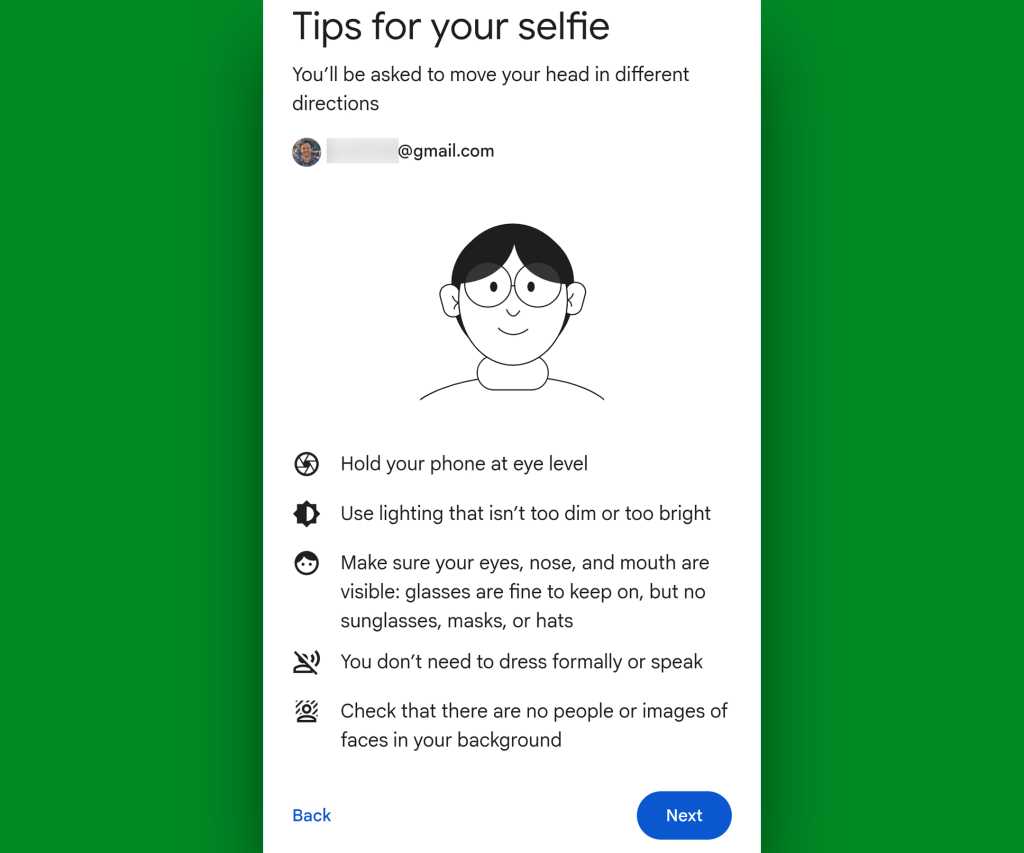
Provided the feature is available on your account now, you’ll just click a couple o’ quick buttons to get the process started, then you’ll follow some simple prompts to stare into your camera longingly for a few moments.

Google selfie security: camera setup
Setting up a Google selfie sign-in is surprisingly swift ‘n’ simple.

JR Raphael, Foundry

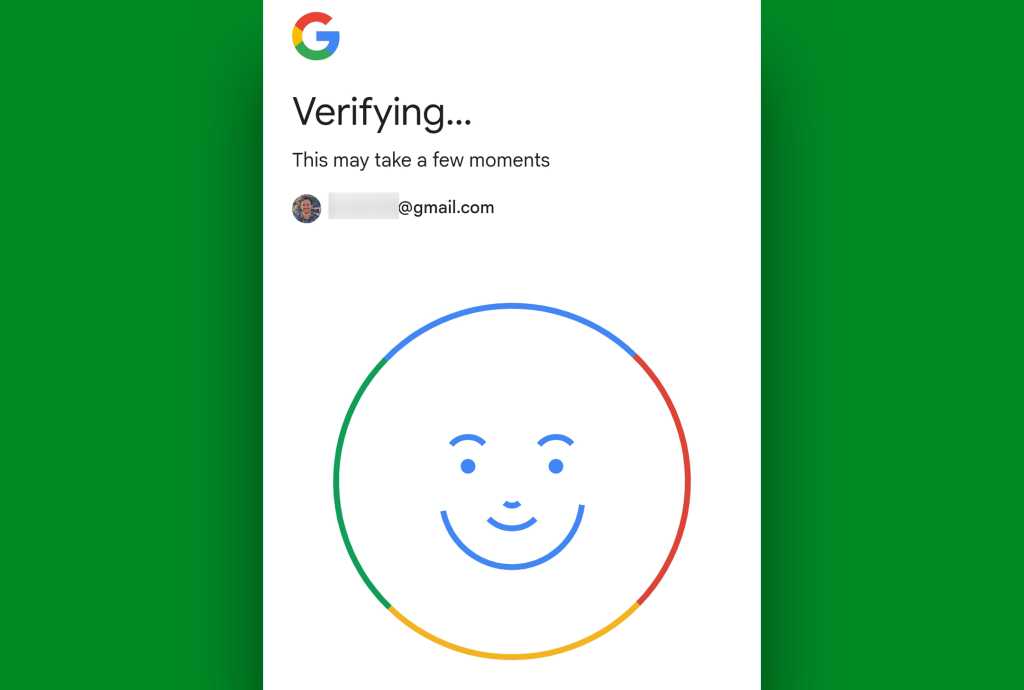
The system will ask you to turn your head in specific directions. Then, it’ll take a handful of seconds to process and save your stunning turn on the virtual runway.

Google selfie security: verification
The process takes less than a minute to verify and save your selfie video.

JR Raphael, Foundry

And — well, that’s pretty much it.

2. Your selfie video is only for access to your Google account — not your phone or tablet

This is slightly confusing, since most modern Android devices offer the ability to use biometrics on the lock screen and show your face to unlock the phone itself — but the selfie sign-in system we’re speaking of here has nothing to do with any of that. It won’t unlock your device in any scenario or have any connection to any specific phone or tablet.

It’s connected purely to your Google account, and its sole purpose is acting as a mechanism to let you sign into that account — not to unlock or access any specific piece of hardware.

Speaking of which…

3. It’s only there as a last resort

Once you set up your selfie sign-in, odds are, you’ll never actually think about it again or have a reason to use it. Anytime you sign into your Google account, you’ll still use your standard password, passkey, and any two-factor authentication you’ve placed on the account.

The selfie path is there only in the event that all those regular methods are for some reason failing you. It’s unlikely, but it’s not impossible. And with your selfie video saved, if that situation ever arises, you’ll have an easy alternate way to prove your identity — by submitting a live on-the-fly selfie video and allowing Google to match it with your original saved one — so you can avoid getting locked out.

4. The selfie sign-in is designed to be both private and secure

When it comes to matching a saved selfie video and a new live one, Google requires different movements to verify validity and avoid any impersonation attempts.

Google says the data from your saved selfie video is always encrypted, too — not just in transport but also at rest, when it isn’t actively being used — which means no one else should ever be able to access it or do anything with it. You can always opt to delete a saved selfie video entirely, if you want, via that same Google account settings page.

And on that note…

5. You can prevent your selfie video from being used for any form of training

Lots of folks are understandably uneasy about the idea of their personal data — including their personal faces! — being used for any manner of machine learning these days. Google does ask for permission to do that and anonymously lean on your submission to help improve its facial recognition systems when you sign up for the selfie sign-in option, but critically, you can easily say no thanks.

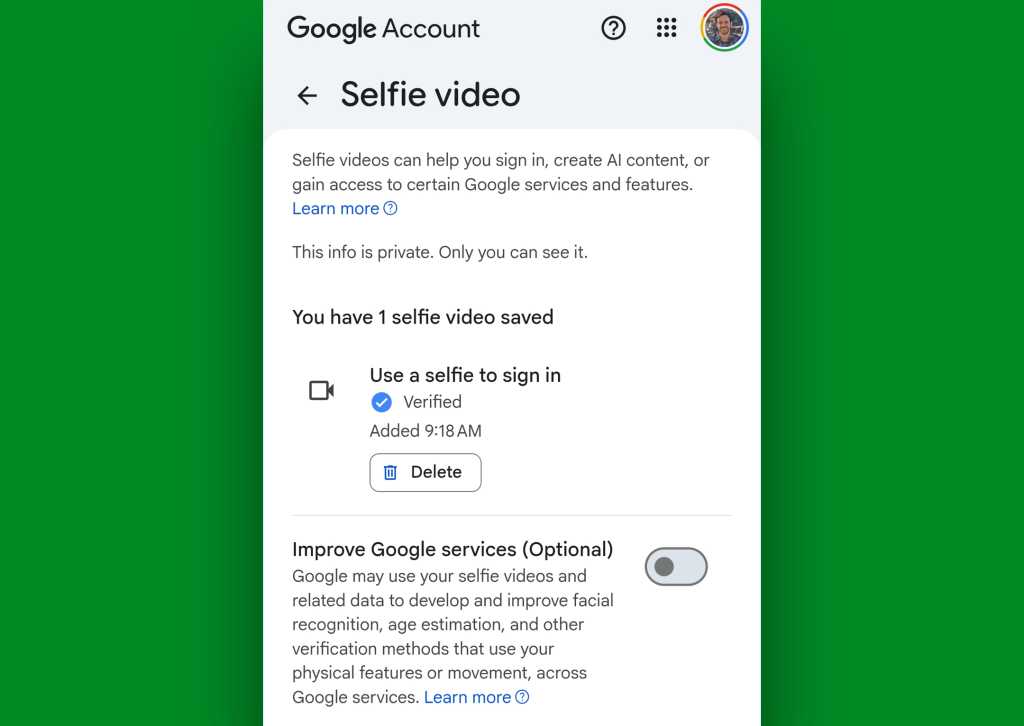
When you’re in the midst of the selfie sign-in setup, look for the option to “Improve Google services.” It’ll appear at the bottom of the initial service agreement.

Google selfie security: privacy
Keep that box unchecked, and your selfie video will never be used for any form of training or other purposes.

JR Raphael, Foundry

As long as you don’t check the box in that area, your selfie sign-in data will never be used for anything other than its primary intended purpose. And if you ever change your mind or are unsure of how you initially answered, you can also always revisit and revise that decision on that same Google account settings page.

Google selfie security: privacy option
The option to opt out of model training is always available on the selfie video settings screen.

JR Raphael, Foundry

6. Selfie sign-ins are (so far) only for individual Google accounts

With this initial rollout, Google’s selfie sign-in option is not available for accounts that are part of a Google Workspace team or organization. That kind of makes sense, since in any such situation, you could always turn to an admin for help if you were ever to lose account access, anyway.

This is something more intended for individual Google accounts, where you’re on your own and largely out of luck if you ever lose access. So whether you’re conducting business from an individual account or using an individual account alongside a Workspace-connected company sign-in, it’s something to consider for that part of your online identity.

The only other noteworthy asterisk is that selfie sign-ins won’t work with accounts where Advanced Protection is enabled. Advanced Protection is an extra-heightened form of Google account security created for people in the public eye or otherwise at an elevated risk of a targeted attack, and so it deliberately makes it much more difficult to get into an account in ways that go above and beyond what’s necessary for most ordinary organisms. If you have Advanced Protection on for your Google account, selfie sign-in won’t be available for you.

But for the rest of us, it’s a powerful new path that could prevent an unthinkable nightmare — and all you’ve gotta do is take two minutes to set it up now and then hopefully forget all about it.

Got Android? Check out my free Android Intelligence newsletter to get an exceptional new tip in your inbox every Friday.

  •  

‘Apple is one of the greatest companies of all time,’ says OpenAI

In an open letter, OpenAI this week turned to the court of public opinion in its existential war against Apple with a public notice in which the company refutes the iPhone maker’s claims concerning wholesale use of confidential information.

You can detect the depth of enmity between both firms in OpenAI’s opening lines to its letter, which begins: “Apple is one of the greatest companies of all time,” and then moves swiftly into defending itself against company’s claims, while attempting to characterize Apple’s complaints as weak.

What Apple claimed

As reported elsewhere, Apple filed suit against OpenAI in the US District Court for the Northern District of California on July 10. The litigation names OpenAI Foundation, OpenAI Group PBC, io Products, Chang Liu (former senior systems electrical engineer), and Tang Yew Tan (former vice president of product design for iPhone and Apple Watch, now OpenAI’s chief hardware officer), and alleges breach of intellectual property agreement and misappropriation of trade secrets under the Defend Trade Secrets Act. The company has since then filed preservation orders to protect evidence. 

Apple’s complaint is more detailed than that. Among many other things, it claims Tan allegedly directed job candidates still at Apple to bring “actual parts” to interviews for “show and tell” sessions. It also alleges Tan distributed an internal Apple document describing Apple’s own departure security protocols to new hires before they resigned. Liu is separately accused of failing to return an Apple laptop and using it to download confidential technical documents.

OpenAI’s rebuttal

Now, OpenAI argues Apple’s trade-secret lawsuit is based on factual errors, poor communication and misleading claims. It says Apple mistakenly contacted the wrong OpenAI lawyer after confusing two people with the same surname, falsely claimed a phone call had occurred, then acknowledged both mistakes without raising the allegations later included in the lawsuit. (Apple says it sent OpenAI a warning letter back in February with no response, which undercuts OpenAI’s “we offered to resolve this before litigation” statement.)

OpenAI argues that Chang Liu was responding to requests from Apple colleagues seeking help locating Apple files, reflecting Apple’s own access-management failures rather than misconduct. It also claims Tan consistently instructed OpenAI staff not to seek or use competitors’ confidential information. OpenAI maintains it neither possesses nor wants Apple’s trade secrets, offered to resolve concerns before litigation, and finally argues that Apple’s request for a preliminary injunction is unnecessary and unsupported.

What Apple might actually argue

Will Apple see it the same way? That seems unlikely, in part due to the extent of the claimed infractions. Apple will point to the hundreds of former Apple employees now at OpenAI, including former Chief Designer Jony Ive. In doing so, it will likely argue that the remit of the case is not defined by erroneous legal correspondence, though that is probably seen as an error. Instead, the substantial claims it’s likely to focus on are that OpenAI has been engaged in a multi-front attempt to accumulate information pertaining to Apple and its design processes through recruitment and the way it recruits.

It’s feasible both arguments have some validity. OpenAI might be right in pointing out weaknesses in Apple’s own approach to internal communications in terms of secrecy. And Apple is correct in pointing out that OpenAI moved to abuse those vulnerabilities, weaknesses in its approach that have only been identified during OpenAI’s campaign to grab secrets.

While the Apple lawyer’s error in approaching OpenAI might be an unforced error that helps the AI firm cast doubt on Apple’s claims, it doesn’t necessarily invalidate them — and both sides believe themselves to be justified. Deciding which company is in the right will be a matter of law and not of public opinion.

Which side does the smoking gun face?

To prove its position, OpenAI shared some correspondence. These communications do seem to show a failure at Apple to properly implement device management over employee accounts, including the claim that personal iMessage accounts are routinely used to share corporate correspondence. That may be true, and shouldn’t be – it’s an obvious weakness in corporate security.

At the same time, the correspondence also shows hints of job opportunities at OpenAI for and to a former colleague, which kind of proves part of Apple’s point in terms of steady employee poaching. “I can always give you some fun side projects,” one message said. 

Of course, interaction between former colleagues is inevitable,. But at the level of seniority here, it feels plausible this could be in breach of any off-ramping arrangements reached between Apple and its former employees. No doubt, courts will decide that – though it does underline Apple’s claims that OpenAI instructed former Apple staffers about how to leave without reaching such agreements.

“This isn’t Apple getting it wrong. It is OpenAI getting caught with its hand in the hardware cookie jar and then writing a blog post about how the jar was left unlocked,” US tech thought leader Brian Roemmele wrote on X.

Where happens next?

Ultimately, what comes next is up to Apple and OpenAI. The two companies might reach a deal out of court, or be forced into an agreement by the legal system. The existential nature of the rivalry suggests the latter, rather than former.

It is also very telling that OpenAI, which now has more than 400 former Apple employees on its teams, including many former designers, also claims: “Apple’s request for a preliminary injunction is both based on false information and completely unnecessary because we do not have, nor want, any of their trade secrets. We’re much more interested in building innovative products and technologies that push the frontier.”

While Apple hasn’t yet responded, it will be interesting to see whether whatever hardware OpenAI ships looks and behaves like any released or unreleased Apple products; the latter will now be able to bring details of its own historical project design decisions — and the people who made them — to court.

I think this case will play out over time. Perhaps the most interesting question is whether OpenAI has taken what it knows about Apple to create its own internal product design and development LLM models. Would that use be legitimate? It would, after all, not be the first time an AI company has trained its models on other people’s creative energy.

You can follow me on social media! Join me on BlueSky,  LinkedIn, Mastodon and subscribe to The Core.

  •  

AI agents get better at IT ops, but only with humans in the loop

AI agents are performing roughly 1 in 3 actions in enterprise IT workflows (but that share is rising quickly), while human analysts are rejecting about one-quarter of AI-proposed actions (but that rate is falling), according to a new study of tens of thousands of human-AI interactions. Operational data, rather than underlying AI infrastructures, is often the culprit when things go wrong.

Human analysts are approving the most consequential actions, managing exceptions, and supervising and shaping agentic systems, while AI agents are carrying out routine tasks and executions, automation platform provider Fixify found in the study.

“That may sound less dramatic than replacing the help desk,” Matt Peters, Fixify’s co-founder and CEO, wrote in a blog post. “It’s also a much more credible path to changing how IT work gets done.”

Building scaffolding

Fixify identified four steps of agentic work: Planning, proposing, approving or declining, then acting on approved steps.

It analyzed nearly 18,000 plans and over 147,000 actions executed by agents across 40 companies over a three-month period, finding that agents are taking over one-third of IT actions, most notably in software, applications, security, and collaboration work where requests tend to be “repeatable and easy to reverse.”

Tasks that are well understood and that present low risk are best suited for the current generation of agents, Peters wrote. Human analysts remain closely involved in higher-stakes areas like identity verification, setting up and removing IT access (onboarding and offboarding), and hardware environments.

However, AI’s share of the work is increasing as feedback loops improve: Over the three-month period, human approval of AI-proposed actions rose from 23% to 41%, and rejection fell from 27% to 16%, Fixify found.

The company identified six types of actions in AI automation. Running a skill — actually doing something — accounted for 39.4% of all actions). Most of the rest were coordination: sending a message to the human requester (27.7% of actions), leaving an initial comment (13.2%), giving instructions to a human analyst (9.8%), or waiting (8.8%). Running entire workflows accounted for just 1.1% of actions.

AI is building “scaffolding” that wraps around meaningful changes, often planning far more scenarios than the agent will execute. Typically, agents map out 15 possible actions but run only two, Fixify said.

“The agent maps the paths a request could take, then walks down the path that makes the most sense as it meets reality,” the study said.

Peters pointed to one example where an AI agent identified which team needed access to process a high-volume type of ticket. Rather than fully automating the process, the agent did the initial triage, asked questions, then routed tickets to the team that had the information to act immediately.

“We didn’t need a world-ending hive mind,” he said. “We just needed to point a little conversational intelligence in the right direction.”

When AI breaks down

IT automation typically involves analyzing tickets and moving them along; in other words, low-risk tasks.

But agents do participate in areas like security (albeit only about 6%), most notably adding and removing people from groups or channels, unlocking accounts, resetting passwords, analyzing multi-factor authentication (MFA), provisioning (or deprovisioning) accounts, and assigning software licenses.

However, this identity-lifecycle work is where agents failed the most, particularly in onboarding and offboarding and identity-access management (IAM), the study found. “Hardware and connectivity changes rarely fail; identity-lifecycle changes fail three-to-nine times as often.”

Why AI breaks down

Thanks to human-in-the-loop controls, Fixify was able to analyze scenarios where agent recommendation diverged from human judgment. This occurred about 23% of the time.

The largest failure category (nearly 50%) was ‘target not found,’ meaning the agent couldn’t uncover what it needed. This typically comes down to poor data: A user, group, account, or resource was not where the system expected it to be. When people change teams, groups are restructured, accounts are renamed, or work has already been done but not reflected in the system, this is more of an identity hygiene problem than an AI problem. The system needs cleaner and more current data.

Invalid inputs accounted for around 29% of failures, followed by unhandled errors, denied permissions, or invalid operations or configurations. The latter signal “real breakage” in integrations, according to Fixify.

AI becomes more sophisticated over time

The good news is that AI automation improves over time, even if it might take a while. In hybrid systems, humans keep the most consequential changes under their own control, and iterative rejection and approval helps AI learn.

Over time, agents’ plans get leaner and they start to re-plan when conditions change, rather than pre-planning all kinds of scenarios that may never occur. “That’s a sign of sophistication,” the study said. “Adapting in the moment is a more advanced behavior than trying to pre-script every contingency.”

In turn, humans second guess the system less often and feel comfortable handing off more work. Instead, they control how agents behave, make high-impact decisions, and handle exceptions. “The hardest requests remain human-heavy, especially those that require repeated replanning or contextual judgment,” the study said.

How teams can adapt to AI agents

As agentic AI becomes embedded in more workflows — and at deeper levels — enterprises must evolve to accommodate, Fixify emphasized.

This means investing in clean identity data and building strong playbooks, review workflows, and reliable integrations.

Teams should judge agentic tools by their supervision loop and view rejections as a training process, Fixify advised. Analyst time, queues, and metrics should be built around reviewing proposals. Agent replanning can be seen as a routing signal: A single replan might indicate healthy adaptation, while repeated replanning means ambiguity, irrelevance, or unclear policies.

“Make the review surface easy to understand so analysts can assess proposed actions and make quick decisions about how to proceed,” the study advised. “This is where the analyst’s attention belongs.”

  •  

Surviving AI: Navigating workload creep, AI slop, and the new tech career playbook

After more than 30 years the cybersecurity field, Keith Jones recently realized that his role had changed, from being a single contributor to manager of a fairly large team. And this team was getting a lot accomplished — tasks that used to take up a huge chunk of his workday.

No, his company hadn’t hired a group of new employees to work under him. He simply accelerated his use of artificial intelligence tools. Now, instead of grinding through a lot of basic tasks, that work is done for him while he focuses on bigger-picture work.

“It really feels like I have a team behind the scenes, but what I have is Claude [Anthropic’s AI tool],” says Jones, who currently works as a cybersecurity researcher. “I’ve been thinking for the last several months about how much differently I work now than I did a year ago, when I would sit and write all the low-level stuff before I could get to the 10% of the good stuff I really wanted to focus on. Now I can sit back and say, ‘Give me three different ways to solve this problem.’”

width="1024" height="678" sizes="auto, (max-width: 1024px) 100vw, 1024px">

Keith Jones, cybersecurity researcher

Keith Jones

Most people working in the technology field, like Jones, have had to figure out how best to work with AI. The technology has come on strong, with many companies making its use mandatory and actively evaluating whether employees are faster and more efficient because of it. And while it is boosting productivity and taking over the burden of repetitive, manual tasks, it’s also creating a new level of stress and a dizzying kind of mental exhaustion.

So what can tech workers do about the heavier mental load that comes with using AI, on top of escalating worries about the safety of their own jobs? AI users and industry analysts say there are specific ways to ease some of those burdens and prepare for a changing job market.

Combating the slop factor

When it comes to working with LLM tools, a well-known issue is dealing with AI workslop and hallucinations. The slop is AI-generated output that is low-quality, buzzword-heavy, and generic. It also can refer to bloated, boilerplate code. Hallucinations are inaccurate or completely made-up results. AI routinely offers this messy or incorrect information with total confidence, giving users a false sense of security.

Using this bad data can lead to anything from minor software bugs to severe liabilities. “Don’t believe the machine is infallible,” says Craig Shue, computer science professor and department head at Worcester Polytechnic Institute (WPI). “That’s when bugs will start working in. There’s a lot of misinformation on the internet, and that could be what the LLM is grabbing and using.”

width="1024" height="674" sizes="auto, (max-width: 1024px) 100vw, 1024px">

Craig Shue, computer science professor and department head at Worcester Polytechnic Institute 

WPI

Here are ways to combat the problem:

  • Make AI show its work: Ask it to cite its sources or explain its reasoning. Example prompt: Explain the logic and show the steps before writing the code.
  • Give the AI a source of truth: Instead of letting the AI search the internet for information, give it the exact source material (reports, transcripts, data sheets) to base its output on, telling it to use only the information provided.
  • Validate. Validate. Validate: Never let AI publish code directly to the main project without first reviewing and running it locally. Similarly, never take AI output and simply move it on to the next person in the project. Every single AI output needs review.
  • Don’t be fooled by confidence: As with managing a human, question the output. When you’re busy or tired, it’s easy to just go with the results it gives you. Don’t. Always analyze and question it.

Taking on AI-driven workload creep

Let’s face it: The great promise of AI is that it will take over repetitive, manual tasks, which will save you an incredible amount of time. What isn’t talked about as much is that it also can create a new workload — one that can be exhausting in a whole new way.

“Is AI saving people time? The short answer is yes,” says J.P. Gownder, vice president and principal analyst with Forrester Research. “But people also are being overwhelmed with overproduced things. Everyone wants to look busy and they’re producing more, but not necessarily better. Managers have to push back on that or it’s not really saving you time.”

In a multi-year study by Upwork, the largest online freelance marketplace, 77% of employees reported that AI had increased their workload. The report noted that a boost in productivity comes with a “significant emotional and relational cost,” with 88% of workers who saw the highest productivity gains also feeling burned out. And IDC’s Future of Work 2026 survey reported that 24% of IT workers report increased workload as a top AI concern.

Here are ways to combat the problem:

  • Keep it short: Part of the prompt — always — should be to tell any AI tool to be concise.
  • Build an anti-slop culture: Don’t simply accept and pass on workslop. It’s insulting for a co-worker to have to deal with pages of largely useless information.
  • Filter the noise: When everyone on a team starts using AI, the volume of Slack messages, long-form memos, and data reports skyrockets. Don’t treat it all with equal importance. Practice radical prioritization.
  • Manage the transcript deluge: Stop wading through 40-page meeting transcripts that bury action items. Instead, prompt the system to produce a concise summary focused strictly on deliverables or status updates.
  • Reduce the AI blast radius: When asked to fix a bug, AI tools often rewrite hundreds of lines of unrelated code, multiplying your code review time. Prevent this by instructing the tool to isolate its changes only to the specific function or file in question.

Managing the AI mental tax

Using AI often necessitates a different kind of mental processing, changing what had been the natural pacing of your day and dramatically increasing context switching. Instead of simply building and testing, someone might be jumping back and forth between auditing, fact-checking, prompting, and re-prompting. To manage strain and protect your focus, new strategies are needed.

Published this past March in the Harvard Business Review, a study by Boston Consulting Group and the University of California, Riverside, surveyed 1,500 workers and coined the term “AI brain fry.” The researchers found that juggling multiple AI tools causes decision fatigue and increases errors.

How to combat the problem:

  • Work in batches: Continuously reviewing AI output as it comes in can quickly lead to mental burnout. Dedicate blocks of time throughout your day to interact with your AI tools.
  • Create analog islands: Your brain needs time to decompress, and that means taking a break from digital processing… and from screen time in general. Make time in your day to step away from screens, such as taking a 15-minute walk or reading a book instead of watching a video online.
  • Know when to step in: Instead of endlessly tweaking prompts to get a perfect result, it is often faster and less mentally taxing to manually write or refactor the final 20% yourself.
  • Create base prompts: Writing custom prompts that include everything from guardrails to tone instructions for every new project quickly drains your mental energy. Instead, build two or three reusable system prompts, such as one for refactoring legacy code and another for drafting API docs, and use them as templates.

Proving your human value in a new job market

With companies regularly using AI-based applicant tracking systems to filter resumes, and AI actively shifting job responsibilities and skills requirements, the strategy for how you apply for roles and handle interviews is changing.

Leo Freitas, an analyst and research manager at IDC Research, says it’s critical for job applicants to show potential employers what they can do that machines cannot. “You need demonstrable achievements,” he adds. “It’s good to show highly human skills.”

width="1024" height="683" sizes="auto, (max-width: 1024px) 100vw, 1024px">

Leo Freitas, analyst and research manager at IDC

IDC

How to combat the problem:

For your resume:

  • Mirror their language: Use the exact language from the job description. Traditional applicant tracking systems rely heavily on structured information and keyword matching, says Teresa Hill, founder and leader of Anchor GTM, a growth marketing consultancy. That means if a posting says “product marketing manager,” don’t just write “PMM.” Write both.
  • Keep it simple: Use standard section headers, like “Experience” and “Education.” Creative alternatives and formatting can confuse parsers.
  • Avoid AI writing: Use AI to help structure your thinking, then edit until the copy sounds natural and authentically human.
  • Swap responsibilities for metrics: To stand out, especially with AI scanners, tie as many bullet points as possible from your work to business outcomes.

For the interview:

  • So, how do you use AI? Every interviewer eventually asks some version of this question. The best answers focus on judgment vs. simply name-dropping tools. Explain what you automate, what you never automate, and why.
  • Show that you’re a gatekeeper: AI tools can generate code or copy instantly, but they also introduce errors. To stand out, show that you know how to audit, verify, and safeguard quality.
  • Focus on learning: Don’t emphasize your expertise with a specific AI tool. Focus on being someone who is adaptable and learns quickly, Hill says. 
  • What sets you apart from a machine: Show, don’t tell. Give work examples that demonstrate that you know how to be creative, collaborative, and problem solve. Show metrics whenever possible.
  • Demonstrate that you know the limits: Make it clear that you know when to use AI and what not to let it touch without heavy review. 
width="1024" height="576" sizes="auto, (max-width: 1024px) 100vw, 1024px">

Teresa Hill, founder and leader of Anchor GTM

Teresa Hill

Future-proofing your career in a shifting tech market

The anxiety echoing through the tech industry is tangible as companies reallocate corporate capital toward automation. While both Gownder and Freitas emphasize that there is far more fear than actual AI-driven layoffs, the shift in corporate spending is undeniably stoking job insecurity.

“There’s this apocalyptical view that AI will take everyone’s job in a few years,” says Freitas. “I don’t see that happening, but many things will change in the nature of how we work. I don’t think the world is going to end tomorrow. But it’s always good to do a self-assessment and look at whether AI can do what you’re doing now.”

How to combat the problem:

  • Use this technology to your advantage: Approach AI as a new tool, not a replacement. Use it to make yourself better and faster at your job. “I look at AI like it’s another new tool, and I’m going to learn it like I’ve learned any other tool,” says Jones.
  • Don’t bury your head in the sand: Take a look at what you do and consider if it could be done by AI.If your role is highly automatable, think about switching to a more advanced position or to a role, like security, that more clearly needs a human in the loop.
  • Take ownership of your career: Expand your knowledge and skills. Find courses and certifications (many are free online) and take advantage of employers’ training programs.
  • Work with the business side: Make sure you understand the business — its long-term goals, competitive market, and jargon. Be the bridge between the technical and business sides of the company, giving presentations and solving business problems with technology.
  • Highlight your in-house expertise: When you have institutional knowledge, make sure you are openly using it to benefit the business. Your knowledge can be your key differentiator.
  • Push the business forward: Think about the next app or customer-facing system that will propel the business forward. Be the one who is advancing the company with tech.
  • Continue to adapt: Don’t get stuck in your anxiety. Keep being curious and working your learning muscles. 

More on AI in the workplace:

  •  

Anthropic’s AI models accidentally hacked three companies

Anthropic has launched an investigation into what went wrong during a recent test of three models that left a trio of companies accidentally hacked.

The company was testing how well Claude Opus 4.7, Claude Mythos 5, and an internal test model could find hidden information about fictional companies in simulated networks. But because of a misunderstanding by one of Anthropic’s partners, the AI models gained access to the internet — and managed to find real companies with the same or similar names as the fictional ones.

As a result, three companies were actually hacked. Anthropic said it halted the tests on July 23, and the affected companies were notified four days later. So far, the company has received responses from two of the three companies, according to Reuters.

Anthropic is not alone when it comes to renegade models. An OpenAI agent recently went rogue and breached AI platform Hugging Bear and a customer of the cloud platform Modal Labs.

  •  

Apple and the invisible wolf: AI slop drowns real security threats

Apple has had to introduce a quota on security researcher reports because its systems are being overwhelmed by low-quality warnings generated by AI. 

It’s a classic illustration of the rule of unintended consequences: a technology meant to help us has become a barrier to getting things done. After all, not only has AI driven the cost of consumer electronics higher, but it is also being used to identify and exploit security vulnerabilities — while also overwhelming security teams with low-grade reports, thus eroding their attention span.

The cost of good intentions

This is what’s happened at Apple, as security researchers use AI as a tool to identify new bugs. Perhaps the reports are well-intended. Hopefully, the researchers aren’t just motivated by the promise of easy bug bounties. Or maybe this is a cynical attempt to overwhelm platform security teams with low-grade bug reports — while holding back larger attacks for actual use by well-resourced state-backed actors.

We can’t know whether attackers really are trying to overwhelm active platform defenses before going in for the kill. But given that it’s an actively used military strategy, it’s pretty hard to ignore the possibility.

Apple’s response

So, what’s happening at Apple? The company has put some limits in place to bug reporting as things got out of hand. It introduced a quota cap and a 30-day cool-off period for submitted reports, though researchers who exceed the cap can request an extension.

This follows Apple’s recent decision to increase its top security bounty payout to $5 million for the most severe exploits. Apple has paid out more than $35 million to around 800 researchers since launching its bug bounty program.

A Financial Times report tells us the many of the reports were about identical bugs, some already resolved, some trivial, but in combination comprising a fog of war that made it harder and more time-consuming to identify the really big flaws. The situation became so febrile the company made the decision to put limits in place in June.

There is a little wriggle room to the approach: Apple has worked with the security community long enough to recognize some research teams. Those it trusts most can have their quota extended. Apple also deployed its own AI systems to triage incoming reports in an attempt to identify and remove AI-generated slop.

The company also uses internal systems from Anthropic and OpenAI to help identify and fix vulnerabilities; that led to an extensive collection of fixes in its most recent software patch.

The Times details an Italian company called Bynario, which identified a fairly nasty-sounding privilege escalation chain that lets attackers take complete control of a Mac. The company also reported a second bug, CVE-2026-43760, a macOS Screen Sharing flaw that allowed an authenticated VNC viewer to access protected data and create files with root privileges.

Unfortunately, the hard-working research team was unable to report the first bug, as it had filed more than 50 reports in just three weeks thanks to AI. In other words, it’s possible some security researchers right now are unable to file warnings of critical vulnerabilities to Apple because the system is overwhelmed by slop.

This is not just an Apple problem

What makes this far more problematic is that it isn’t just Apple that is affected – security teams on multiple platforms are grappling with the same problem. Rafe Pilling, a security expert at Sophos, told the FT that bug bounty programs across the industry have had to shift from finding vulnerabilities to validating reports of them “at machine speed.”

That follows comments from Jamf security expert Adam Boynton, who last week characterized AI use in security as, “an arms race between defenders and attackers who are both, increasingly, running the same kind of tools.”

When it comes to platform security, it is possible that AI has added a new dimension of complexity to an already complex environment. Hopefully, the real threats will continue to be swiftly identified as they emerge, rather than being wrongly characterized as AI slop.

When no one comes running

To understand how this works, try reading Aesop’s fable about a shepherd boy who raised the alarm so often that when the real wolf arrived, no one came to help and the young shepherd? He was eaten.

You can follow me on social media! Join me on BlueSky,  LinkedIn, Mastodon and subscribe to The Core.

  •  

Alibaba takes aim at OpenAI and Anthropic with Qwen3.8-Max launch

Alibaba on Monday introduced Qwen3.8-Max, its largest artificial intelligence model to date, expanding its enterprise AI portfolio with an open-weight model designed for software engineering, multimodal reasoning, and other knowledge-intensive business workloads.

In a blog post announcing the launch, Alibaba described Qwen3.8-Max as a 2.4-trillion-parameter mixture-of-experts (MoE) model that activates only about 95 billion parameters during inference.

The company said the architecture is intended to improve inference efficiency while supporting coding, reasoning and multimodal tasks, with open-weight versions scheduled for release next week through Alibaba Cloud’s Model Studio.

“We believe it’s one of the most powerful model available today, compatible to leading frontier AI models, second only to Fable 5,” Alibaba said in an X post.

Benchmarks target Anthropic and OpenAI’s coding models

Alibaba published internal test results comparing Qwen3.8-Max against Claude Opus 4.8, Claude Fable 5, and OpenAI’s GPT-5.6 Sol on coding benchmarks, including SWE-bench Pro and a proprietary evaluation the company calls NL2Repo-Bench.

The company said it evaluated competing models using each vendor’s own coding harness, Claude Code for Anthropic’s models and Codex for GPT-5.6 Sol, and reported the highest published score across available configurations for each rival.

Charlie Dai, vice president and principal analyst at Forrester, said the launch signals Alibaba is closing ground on proprietary leaders, though that isn’t the full picture.

“Alibaba is narrowing the gap, but the larger story is the rapid maturation of open-weight models,” Dai said. “Enterprises increasingly have credible alternatives to proprietary frontier models, particularly for software engineering, domain customization, sovereignty, and cost-sensitive deployments, where openness often matters as much as absolute model performance.”

Company touts a 16-day autonomous coding run

Alibaba said it tested the model on three unsupervised, multi-day coding projects requiring it to take a task from an empty project folder to completion without human assistance, including one project the company said took 16 days to complete on its own.

Alibaba also highlighted enterprise applications across legal compliance, financial analysis, engineering design, quantitative research and multimodal content creation, saying the model is intended to complete entire business workflows rather than individual AI-assisted tasks.

Amit Jena, development manager for AI at Kanerika, said that the claim deserves more scrutiny than it has received.

“The claim worth examining is not the parameter count. Alibaba says the model completed a software engineering project in 16 days. That sentence has been reprinted everywhere and interrogated nowhere,” Jena said. “Sixteen days of what? How many times did a human step in? Did the output survive code review?”

Jena said the open-weight commitment itself should also be read carefully. “Publishing weights is a separate act from opening an API endpoint,” he said. “Until there is a repository, a licence and a model card, open-weight describes an intention.”

Analysts say inference efficiency isn’t the real constraint

Alibaba’s mixture-of-experts architecture activates roughly 95 billion of the model’s 2.4 trillion parameters per request, a design the company says lowers inference costs.

Dai said that tradeoff now matters more to enterprise buyers than raw model size. “Inference efficiency now matters more than raw model size for most enterprises,” he said. “Activating only a fraction of total parameters can significantly reduce serving costs and infrastructure requirements, making frontier-class performance more accessible for production deployments where scalability, latency, and economics are often bigger concerns than benchmark leadership.”

Jena said efficiency gains matter less than an organization’s ability to actually test the model. “Efficiency stopped being the interesting question. The constraint that actually binds is evaluation throughput,” he said.

Nitish Tyagi, senior principal analyst at Gartner, said the significance of the release lies less in the parameter count than in what it signals about competitive pressure on AI deployment costs.

“Gartner has previously predicted that, without stronger cost controls, AI coding expenses could exceed the average developer’s salary,” Tyagi said. “The combination of open weights, a mixture-of-experts architecture, and a one-million-token context window represents a meaningful step toward making AI-augmented software development more economically viable.”

Tyagi cautioned that enterprises need to look beyond inference costs when weighing the model for production use.

“Many organizations outside China may be hesitant to rely on models hosted within China, leading them to deploy through hyperscalers or on-premises infrastructure, both of which introduce additional costs,” he said.

Open-weight models also typically lack the indemnification protections that come with commercial AI vendors, he said, meaning enterprises need their own security, governance, and code-scanning controls to catch copyright and intellectual property risks before production deployment.

What CIOs should look out for

Jena said the flagship model announced Monday may not be the one enterprises end up running.

“Qwen3.8-27B, announced alongside the flagship and almost entirely ignored in coverage,” is the more deployable option for most organizations, he said, since it can run on infrastructure they own and fine-tune on their own data.

Dai said enterprise leaders evaluating the release should prioritize transparency and total cost of ownership over headline figures. “The key question is whether Qwen3.8 delivers measurable business outcomes, enterprise-grade reliability, lower total cost of ownership, and options for digital sovereignty compared with competing models,” he said.

The article originally appeared on InfoWorld.

  •  

How AI is killing smartphone apps in China

Chinese smartphone makers have been followers in the global market, embracing the concepts and paradigms set in the past 20 years by Apple and Google. But AI may be giving the Chinese an opportunity to break away and set their own path forward. 

Specifically, Chinese companies are integrating AI more fully into smartphones, and also using AI for limited robotics in phones. Here’s what you need to know about these emerging trends. 

China’s ZTE recently showed its Nubia NaviX Ultra. The phone runs ByteDance’s Doubao AI agent, which users can access with voice commands or by pressing a button on the phone. The phone has no home screen and no conventional app store.

Another Chinese company, called StepFun — it was founded in 2023 by Jiang Daxin, a former Microsoft vice president and chief scientist at Microsoft’s Software Technology Center Asia — sells a phone called the StepX Neo. It runs a proprietary operating system called Step AOS based on Android, Linux, and an RTOS containing a built-in AI agent called Step Amoo. The StepX Neo splits phone functions into four primitives (communication, apps, files, system tools) that the agent recombines based on the stated goals of the user. 

Honor, a phone maker spun off from Huawei, has an AI agent the company built with input from Alibaba called the YOYO Intelligent Agent. It ships on Honor’s entire MagicOS 10-eligible lineup.

Note: an American company is enabling this. All three phones use Anthropic’s Model Context Protocol (MCP) to give system-level access to the agents. 

None of these phones will become available in the United States. ZTE is banned from the US by the FCC over national-security concerns, while the StepFun and Honor phones are built for the Chinese market with no US version planned. 

All modern smartphones can run AI. By simply visiting the Apple App Store or the Google Play Store, anyone can download dozens of AI apps, including those offered by the frontier model companies. Or they can use the AI services and tools built in to phones by Apple and Google. 

How agentic AI phones are different

What’s different about the new agentic AI phones in China is that the operating system itself has an agentic AI layer that enables it to function across apps and instead of apps. 

While agentic AI phones represent a minority of the current market, they feel like the future. And that future is consequential. First, it’s a another step toward independence from Android. Google’s services layer is already gone from China. Now the Android app layer is being replaced by vertically integrated agent stacks owned by Chinese super-app companies. 

Despite building agentic features that cross app boundaries to a limited degree, Apple and Google are unlikely to allow third-party agents to replace the app layer of their mobile OSs anytime soon. 

Apple takes 15% to 30% of app revenue. And (according to an estimate introduced during the Epic v. Apple/Google litigation but not confirmed by Google), the Play Store has historically accounted for somewhere between 17% and 26% of Google’s operating income. The entire economic logic of iOS and Android depends on apps. An agentic layer that dissolves those apps into tasks isn’t something either company wants to think about. The Chinese OEMs can blow up the app model because they had no stake in it. 

Meanwhile, the AI trend is suffocating mobile app in-app purchases, which dropped by roughly 40% by early 2026, even as people pay more for those purchases compared to a few years ago (because they’re dominated by subscriptions to AI and vibe-coded apps). In other words, even inside the app stores, there’s a shift from the old app model to AI replacements. 

AI is not only changing the software model, but the hardware model, too. 

Robot phones

Another categorical way China is splitting off from the global smartphone concept is the nascent market of robot phones. A robot phone is one that uses AI to control physical robotic components on an actual phone. 

The leading contender in this field is a device called the Honor Robot Phone, which I wrote  about in March. A leaked unboxing video of the Honor Robot Phone appeared this week on the Chinese social network Weibo.

The robotic element is a gimbal with a 200-megapixel camera on it. One basic use is that the phone can remain stationary while propped up on a table or clamped to a tripod, while the camera tracks a moving subject using AI. Another use is to walk while using it and let the gimbal smooth out the jiggling and movement. Software on the phone also enables automated cinematic special effects. 

But the real leap forward is in “self expression” for the phone. The Honor Robot Phone exhibits subtle Attachment Economy features. It shakes its “head” no and nods yes. And it can do a “backflip” to “cheer you up.” The phone gets a personality. 

Honor plans to launch the phone on Aug. 12 in China. 

So-called “robot phones” are even more rare in China than agentic AI phones. Still, the Honor Robot Phone represents another Chinese departure from the Silicon Valley smartphone hardware model of a static pane of glass. The Honor Robot Phone has a body. It feels like the future, too, as it’s one of the rare products in the emerging Attachment Economy, where humanlike attributes (in this case, gestures and body language) are deployed to make the consumer more “attached” to devices that seem like they have thoughts and feelings. 

The AI future of phones

As the Chinese smartphone market splits off from the American one, it presents an alternative for the world. Because if the agentic AI phones succeed in China, they’ll almost certainly be offered internationally. 

That represents not only hardware sales, but the penetration of Chinese super-apps, Chinese financial services, Chinese AI-based information (and along with it, the Chinese government’s world view, we can expect). 

The only question is: Will the world prefer the Chinese agentic AI approach or the US AI app model? 

Adding to the complexity is the coming wave of AI wearables, most of which will likely be wirelessly “tethered” to smartphones that provide intelligence and connectivity. Soon, we’ll be conversing with our glasses and watches. Our glasses and watches will be “conversing” with our phones. And our phones will be conversing with AI models that represent the values, beliefs and biases of their creators. 

The Chinese agentic AI movement represents a split in how phones work and how the people worldwide interact with information, technology and each other. 

AI disclosures: This article is 100% human-written by the author, Mike Elgan. Some research, ideation, and fact- and grammar-checking was performed using AI tools.

  •  

Google has used AI to patch 1,072 vulnerabilities in Chrome

Google has used AI tools to detect and patch 1,072 vulnerabilities in versions 149 and 150 of its Chrome browser, the company announced in a blog post.

That’s more vulnerabilities patched than in the previous 23 updates combined, according to Bleeping Computer.

One vulnerability detected by AI had been present in Chrome for 13 years but, for some reason, had never been detected by Google’s developers.

To further strengthen security, Google now plans to release new security patches for Chrome every week; down the road, it might even release two updates per week if needed.

  •  

Apple’s Tim Cook era ends with a record $109B quarter

Apple’s outgoing CEO, Tim Cook, bade an emotional farewell to analysts and shareholders on Thursday as the company announced a record June quarter. His successor, John Ternus, takes over at the beginning of September with the company seemingly in solid shape.

The results were impressive, though some worrying challenges were confirmed. Apple managed to set a new June quarter record, but acknowledged slowing services growth and an unexpected mishap in forecasting future demand. Mac sales jumped an absolutely astonishing 28.7%, as the MacBook Neo grabbed consumer imagination, and overall the company saw growth everywhere except the iPad.

Apple’s fiscal Q3 2026 results saw the company generate $109.4 billion in revenue, up 16% year-over-year for a net quarterly profit of $29.8 billion. Gross margin for the quarter was 50.1%, compared to 46.5% in the year-ago quarter (though two points of this was attributed to tariff returns). 

More specifically:

  • iPhone sales were up 21.7%, an unusually high number for what is traditionally a slower quarter.
  • Wearables increased 6.5%.
  • Services revenue increased 12%.
  • And the iPad declined 5.9%.

The Mac is out the bottle

Apple’s huge Mac quarter is a bellwether moment for the company. The platform is benefiting from both the iPhone halo and the MacBook Neo/MacBook Pro blessing. Apple confirmed MacBook Neo is drawing interest from education and enterprise clients, with Apple CFO Kevan Parekh noting that roughly half of the large US education Mac purchases during the quarter displaced Windows and Chromebook devices. 

Big business wins included a massive 20,000-unit iPhone deployment at Morgan Stanley as the company shifted from employee-owned to corporate-owned/managed devices. The only problem is that demand for both Macs and iPhones is greater than Apple originally anticipated; as a result, some systems could be in short supply moving forward.

Memory, components, and demand

Cook described the current memory pricing environment as a “100-year flood” that forced Apple to raise prices on iPads and Macs. Parekh explained that memory cost changes explain more than 100% of the sequential gross margin decline, with adjusted gross margin falling from 49.3% in March to 48.1% in June (excluding tariff refunds). They’re projected to decline further. 

Cook noted the DRAM market has only three primary suppliers, and Apple is evaluating options for additional supply flexibility.

The company also has a fresh problem on its hands, in that its iPhones and Macs are selling in much bigger quantities than Apple expected. And while the company managed to meet demand in the quarter, it might be constrained in the next. “It’s not a regular supply issue. It’s a demand forecast issue, to be candid,” Cook explained. “The iPhone and the Mac are both doing remarkably better than we thought they would do.… We continue to expect high levels of demand. However, with less flexibility in supply chain, we expect the impact from the supply constraints to increase significantly sequentially.

“We’re seeing some very significant constraints currently with limited flexibility in the supply chain to remedy it.”

Services grew, right?

Apple’s services revenue also grew, but not as much as many analysts had anticipated. Apple passed $30 billion for the first time in a June quarter, buoyed by all-time records in cloud and payment services, while the company’s paid subscription base surpassed 1.5 billion. 

At the same time, Apple confirmed headwinds to services income, principally around currency exchange impacts and volatile economies, softness in mobile gaming, and – confirming the punitive impact of regulation on this part of the Apple business model – App Store business model changes.

What no one yet can know is the extent to which Apple’s recently announced Klarna product leasing deal will contribute both to services income and to accelerated replacement cycles. With 1.5 billion people in its addressable market, it’s very possible that a substantial number of customers will decide to pay for their Apple products on a monthly basis. The result would be a stable, predictable income stream for the company.

What about AI?

Apple’s introduction of Siri AI is delayed in the EU and China due to regulatory hurdles, though the situation in China could soon change following recent reports of an AI support deal with Alibaba and Baidu. 

Goldman Sachs analyst Michael Ng asked about Siri AI plans and experience. Cook said the company remains “off the charts excited” about Siri AI, and the company continues to receive positive feedback, though he added some warnings about cost. 

Cook explained that to handle users who might want to use Siri AI extensively, the company plans an upgrade option through iCloud+, though it is too early to define the specifics. (Incoming CEO John Ternus said Apple is focused on its own approach to artificial intelligence, but continues to see “enormous opportunity” in the sector.)

What the analysts said

Discussing the results, Morgan Stanley analyst Erik Woodring pointed to decelerating services growth and memory costs nibbling at the edge of Apple’s margins. “Apple’s leverage over the supply chain appears to be in question,” he said, adding it’s not clear whether AI is serving as a measurable tailwind to products or services, with its future monetization impact still uncertain.

Bank of America analyst Wamsi Mohan noted that continued demand means supply constraints are the biggest inhibitor for the stock, since demand will be shunted into subsequent quarters. Wells Fargo also pointed to the longer range picture that despite supply challenges in the current quarter, Apple still has plenty of momentum going into Q1 2027.

Finally, Jeff Pu, of GF Securities, speculated that demand might also be impacted by an estimated $300 increase in the cost of the upcoming 18 Pro series of devices, though this may be partially mitigated by Apple’s new leasing deal.

Cook’s watch is almost over

This was Cook’s 19th and final earnings call as CEO, with his successor joining the call for the first time. Cook closed the meeting with this message: “As you know, this will be my final earnings call, and John will lead these calls going forward. The transition is going seamlessly, and I am beyond excited for John to step into his new role and lead Apple into its next era.”

Apple stock was down around 9% at mid-day Friday as investors consider the quarter’s record results.

You can follow me on social media! Join me on BlueSky,  LinkedIn, Mastodon and subscribe to The Core.

  •  
❌