Autistic children showed earlier and less age-related refinement in the brain signals involved in processing faces. A child looks at a face, and within milliseconds the brain begins sorting its features, expression, and identity. Researchers have now traced that process across the entire scalp in one of the most comprehensive studies of face perception in [...]
A new Google Earth tool allowed the creation of A.I. deepfake maps. The tech giant quickly pulled it back after a backlash and concerns about disinformation risks.
Arts Council England is facing a backlash for splurging millions of taxpayers' pounds on projects like queer cabaret, gender-diverse kids' shows and identity workshops while traditional museums are closing their doors.
En 1845, deux navires taillés pour affronter la banquise quittent l’Angleterre pour forcer le mythique passage du Nord-Ouest. À leur bord, 129 hommes commandés par Sir John Franklin. Aucun ne reviendra.
"When a group of teenagers set out to hike British Columbia's famed Howe Sound Crest Trail in early July, Google Maps suggested the trek would take about five hours," reports SFGate.
"Instead, the hike stretched deep into the night, leaving the group exhausted, dehydrated, injured and in need of a helicopter rescue..."
Although the approximately 18-mile route with a 6,000-foot elevation gain can be completed by experienced trail runners in a day, search and rescue officials generally recommend hikers treat it as a two-day backpacking trip. The teenagers, all 17 years old, believed Google Maps' estimate that the route would take about five hours. The printed directions they were carrying, which were shared publicly by Lions Bay Search and Rescue, gave simple instructions for two legs of the trail, but didn't account for the terrain or elevation. "[Google Maps] is calculating the time that you're walking a straight road on pavement," [said Maria Masiar, training officer and search manager with Lions Bay Search and Rescue]. "When you get into outdoor terrain, that no longer holds true."
Expecting only a short outing, each hiker carried about half a liter of water and limited food. There are no reliable water sources along the trail, meaning hikers must carry enough supplies for the entire route. As the group climbed, they began suffering from dehydration and muscle cramps but continued onward despite falling dramatically behind schedule. Eventually, the group made the decision to turn back and abandon making it to the end of the trail — and as the sun began to set and the group started to descend, fatigue took its toll. According to Masiar, members of the group had already stumbled and fallen several times while trying to race the coming dark, and only one hiker had a headlamp. Eventually, another hiker slipped about 10 feet off a boulder, injuring his tailbone badly enough that he could no longer continue. Search and rescue crews responded, ultimately evacuating him by helicopter.
"A major scientific review is challenging the idea that more protein is always better," reports ABC News:
The review, led by pathologist and biomedical researcher Dudley Lamming and published in the journal Cell Press Blue, examined more than 350 studies involving humans, mice, insects, yeast, and other organisms. The review found that eating less protein, or less of certain amino acids that make up protein, may turn on body processes linked to healthier aging, as well as metabolism, the process by which the body turns food and drinks into energy...
For adults who already get enough, eating more protein may offer little benefit, while some research suggests that eating less protein could support healthier aging... Lamming reviewed the effect of reducing protein in many body processes. One of the processes involves a hormone called FGF21. "There's an increase in a hormone called FGF21 that promotes energy expenditure [when protein intake is reduced]," Lamming said. "It essentially increases thermogenesis in your adipose tissue, so you don't just store fat, but actually burn it as fuel." This may help explain why some studies connect lower-protein diets with less body fat, better blood sugar control and a healthier metabolism. Eating less protein may also affect signals that tell cells when to grow, repair damage or recycle old cell parts. These jobs may play a role in aging.
However, protein restriction is not the same as protein deficiency. The goal is not to deprive the body of an essential nutrient. Instead, the research raises the possibility that avoiding unnecessary excess could benefit some people who already consume enough... Before reaching for another high-protein product, a better question may be: How much protein does my body actually need?
American heiress Jamey Carney was found dead in her Killarney home in July, after her teenage daughter discovered her body. Her Jordanian asylum seeker boyfriend is now the prime suspect.
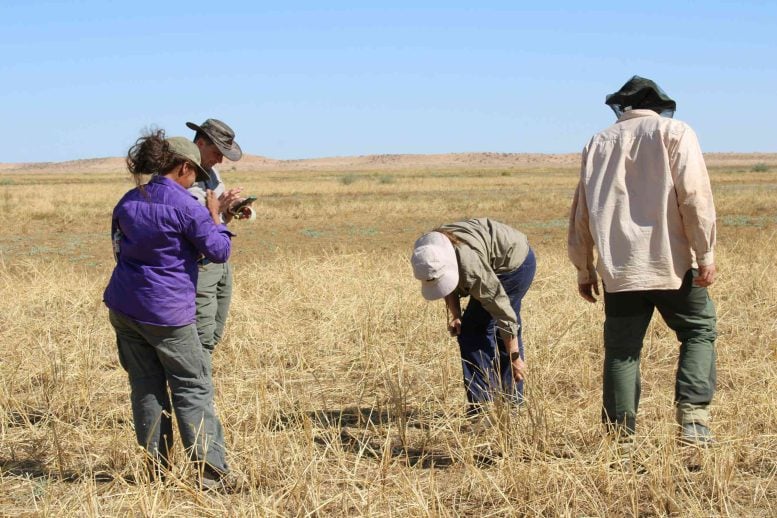
A native Australian millet may carry the genetic fingerprints of thousands of years of Aboriginal harvesting, storage, and plant management. Seen from the air, Channel Country resembles a vibrant and vast tapestry, with a network of waterways crisscrossing the land. Spread across more than 280,000 square kilometers in outback Australia, it is one of the [...]
For years, ruthenium dioxide (RuO₂) has kept physicists confused. Depending on which experiment they looked at, the metallic oxide either appeared magnetic or not magnetic at all.
This uncertainty has made it difficult to determine whether RuO₂ belongs to an unusual new class of materials known as altermagnets, which could one day power faster and more energy-efficient electronics.
Now, in a new study, researchers have shown that the missing piece may not be the material itself—but how tightly it is stretched. By growing an ultrathin RuO₂ film just two nanometers thick and keeping its crystal lattice under strain, they detected clear signs of magnetic order that had remained hidden in thicker, relaxed samples.
The findings suggest that magnetism in RuO₂ is not a fixed property but something scientists may be able to switch on simply by engineering the material’s atomic structure. “RuO2 has attracted renewed interest due to expectations of prominent altermagnetic spin splitting,” the researchers said.
The debate over an unusual magnetic material
RuO₂ is already widely used as an industrial catalyst and is valued for its excellent electrical conductivity.
However, over the past few years, it has become the focus of an intense debate because some experiments suggested it might be an altermagnet—a recently proposed type of magnetic material that combines features of conventional magnets and nonmagnetic materials.
Unlike an ordinary bar magnet, an altermagnet has almost no overall magnetization even though its electrons remain magnetically ordered. Previous studies, however, produced conflicting results.
Some reported magnetic order, unusual Hall effects, and efficient spin-charge conversion, while others found no evidence of magnetism in bulk crystals or relaxed thin films. A recent study even concluded that RuO₂ showed no altermagnetic behavior down to films 5 nanometers thick.
However, no one had directly examined fully strained films thinner than about four nanometers using techniques capable of measuring both the motion and spin of electrons at the same time.
“The spin structure of RuO2 remains largely unexplored in the ultrathin limit,” the study authors note.
Stretching atoms to uncover hidden magnetism
To explore that missing regime, the researchers grew atomically smooth RuO₂ films only two nanometers thick on titanium dioxide-based substrates. Since the substrate’s atomic spacing differs slightly from that of RuO₂, the ultrathin film is forced to stretch to match it—a condition known as epitaxial strain.
You can think of it like laying a small wire mesh over a frame with slightly different spacing. The mesh has to stretch to fit, subtly changing the positions of every junction. In a crystal, those tiny shifts alter how electrons move and interact.
The team then used spin-resolved angle-resolved photoemission spectroscopy (spin-ARPES), which shines light on the material to eject electrons. By measuring each electron’s energy, momentum, and spin, scientists can map the material’s electronic structure in remarkable detail.
To ensure the results were genuine, they repeated the measurements in two different experimental geometries to separate real magnetic signals from possible measurement artifacts. Additional X-ray and optical experiments confirmed that the films remained fully strained and revealed their crystal symmetry.
Hidden magnetic signals emerge
The measurements uncovered an unusual momentum-dependent spin texture, meaning the direction of an electron’s spin changed systematically depending on how it moved through the crystal.
After performing a detailed symmetry analysis, the researchers ruled out nonmagnetic explanations, including effects caused by the crystal’s polar structure or by the measurement process itself.
As the study authors note, “A comprehensive symmetry analysis rules out nonmagnetic origins of this spin texture. These findings suggest an emergent nonrelativistic spin structure enabled by epitaxial strain in the ultrathin limit, marking a distinct departure from the behavior of relaxed or bulk RuO₂.”
The observed behavior was consistent with either weak ferromagnetism or altermagnetism, indicating that strain fundamentally changes the electronic ground state of RuO₂.
Strain as a new control knob
The findings suggest that strain could become a practical way to switch magnetic properties on in materials that normally do not display them, opening new possibilities for low-power spintronic devices based on electron spin instead of electric charge.
However, the experiments were carried out at around 15 kelvin (about −258°C), so it is still unknown whether the same behavior persists at room temperature.
Future studies will need to determine exactly which magnetic state emerges and whether it can be reliably controlled in real-world devices.
The study is published in the journal Science Advances.
Entre aplicações para seguir o Sol no eclipse, jogos e apoio ao exercício físico, as aplicações que a equipa do TEK Notícias escolheu esta semana podem dar uma ajuda a refrescar o seu smartphone ou tablet.
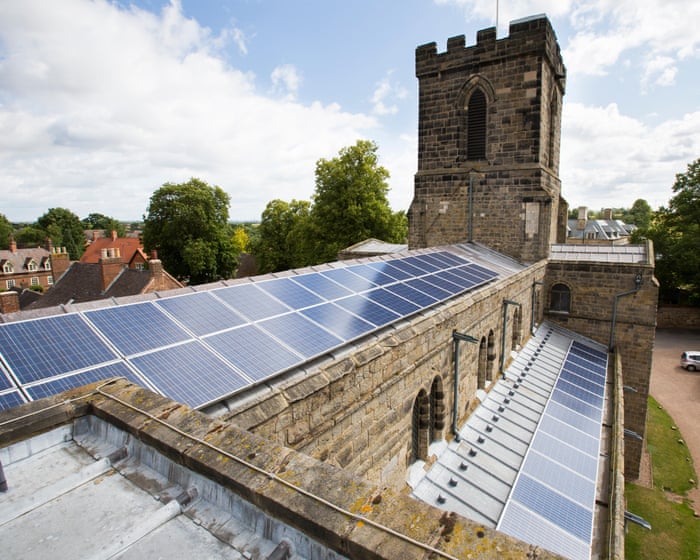
Farms and rooftop panels contribute 14.4% to the grid – and figures reveal a surge in new installations
Solar energy supplied more power to Great Britain’s grid in July than in any previous month as households turned to rooftop panels to cut their energy bills.
Solar farms and rooftop panels provided 14.4% of the country’s electricity after some parts of the UK recorded almost twice the average sunshine hours for the time of year.
"Scientists say they have detected promising signs that a planet orbiting a star 49 light-years from Earth could have an atmosphere," reports CNN, "making it potentially suitable for life."
Called LHS 1140b, the object is about five times the mass of our planet, or a "super-Earth." This planet orbits around its star in the "Goldilocks zone," also known as the habitable zone, meaning its surface temperature is not too hot or too cold for liquid water to exist... "It appears to be consistent with Earth, meaning it might have an iron core and a silicate mantle, plus some sort of low-density component, which is probably a combination of water and, now we know, an atmosphere," [said Collin Cherubim, a planetary scientist and lead author of a paper on the finding, published July 16 in the journal Science]... If further observations confirm the findings, LHS 1140b would mark the first discovery of an atmosphere on a rocky planet in the habitable zone of another star...
There is no evidence of life or a life-supporting atmosphere on LHS 1140b now, but Cherubim said he believes it's a formidable candidate for potential signatures of extraterrestrial life. "I think it's the best place to look for life outside the solar system at this point," he said. "It's mostly rocky, it's at the right temperature to support liquid water on the surface, and it has an atmosphere — those are the three key ingredients we look for..." Confirming the existence of an atmosphere on a rocky planet orbiting a red dwarf would be particularly exciting, Cherubim said, because the possibility of that happening is an open question in astronomy. "Can rocky planets have atmospheres around red dwarfs? This is the first bona fide yes," he said. "It's kind of a sigh of relief for a lot of us. But the jury's still out. Maybe this is a weird planet, and it's an oddball, or maybe it's the first of many. We don't know yet."
Now "The James Webb Space Telescope is going to look at it," Cherubim told CNN, and "Hubble's going to look at it. Basically, everybody who can see it is going to be training their eyes on it."
Michaël Gillon, research director of the Astrobiology Research Unit at Belgium's University of Liège warned CNN that no definitive proof exists that LHS 1140b possesses a substantial atmosphere. But if the detection of helium can be confirmed, the implications would be profound. "Until now, we had only limited evidence for atmospheres on temperate rocky exoplanets. Demonstrating that LHS 1140 b has retained a substantial atmosphere over billions of years would show that at least some habitable zone Super-Earths around red dwarfs can survive the intense early activity of their host stars."
Waze e Google Maps são as duas principais opções para lidar com o trânsito entre os apps de navegação. Ambas as ferramentas pertencem ao Google, mas têm particularidades e podem atender a diferentes públicos.
O Maps é uma plataforma mais abrangente, com suporte a diferentes tipos de transporte, enquanto o Waze é uma alternativa sólida para quem se locomove com carros e motos. Os dois apps trazem dados atualizados sobre congestionamento e rotas alternativas para o dia a dia.
O Canaltech comparou os diferenciais de cada plataforma e explica os melhores cenários para usar cada app:
Disponibilidade
Recursos
Atualizações ao vivo
Diferenças nas rotas
Waze ou Google Maps: qual escolher?
Disponibilidade
Esse é um fator praticamente idêntico para ambas as plataformas: Waze e Google Maps têm aplicativos para celulares (Android e iOS), sistemas automotivos e uma versão Web. É possível sincronizar os dados na mesma conta, então o histórico entre aparelhos pode ser compartilhado.
No caso dos celulares com Android, o Maps vem instalado como padrão, enquanto é necessário baixar o Waze pela Play Store.
Recursos
A experiência básica é muito parecida nos dois apps: digitar o endereço de destino, escolher uma das rotas e seguir as instruções. Recentemente, os apps receberam integração com a IA do Gemini para comandos de voz mais elaborados.
Por outro lado, cada plataforma tem ferramentas exclusivas que diferenciam as experiências de uso.
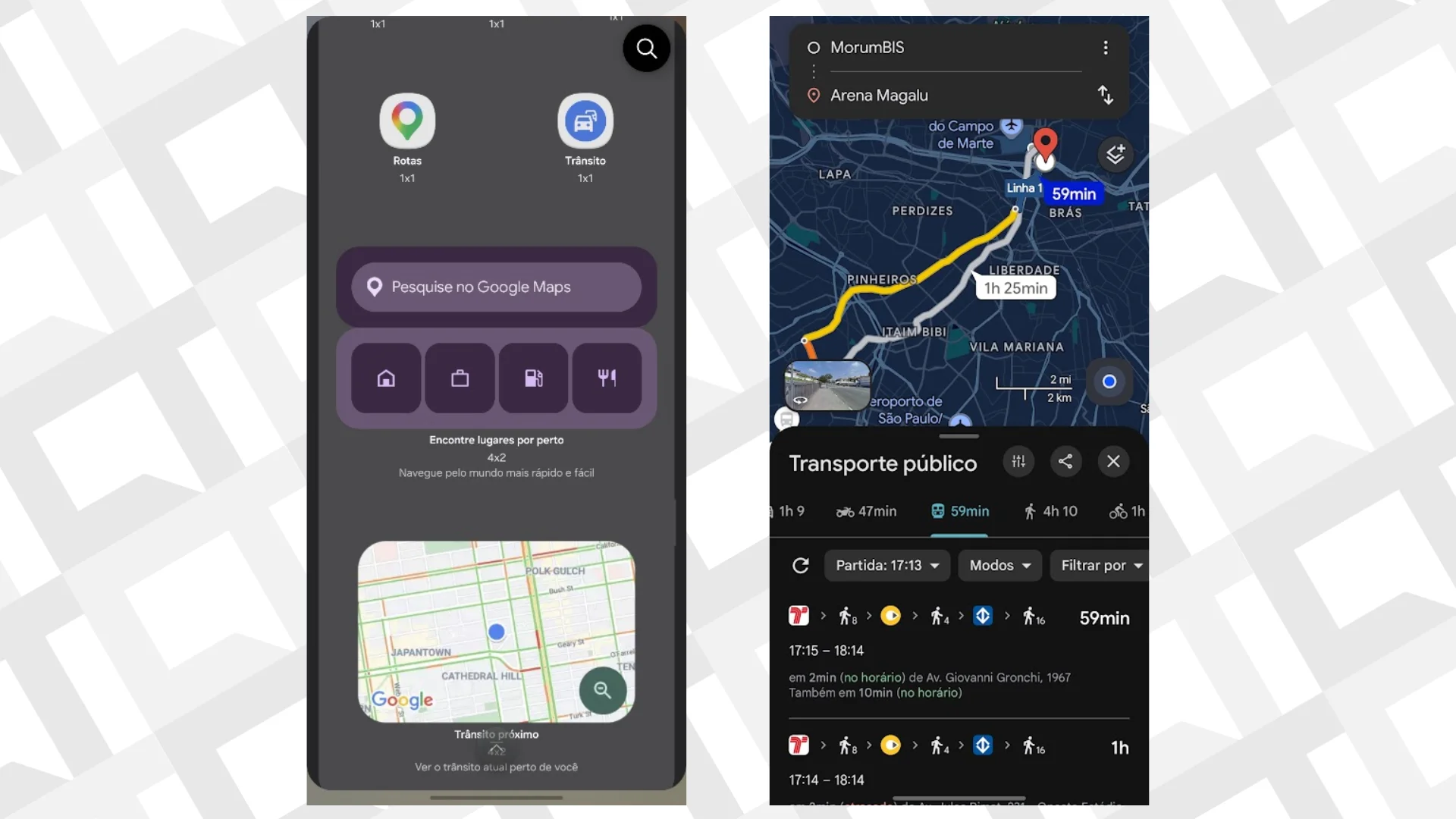
Os destaques do Google Maps são:
Informações detalhadas sobre estabelecimentos comerciais e pontos de interesse
Download de mapas para navegação offline
Rotas personalizadas para carros, motos, bicicletas, transporte público (com detalhes sobre linhas de ônibus e metrô) e a pé
Widgets de tela inicial no Android e no iOS
Mais formas de visualização dos mapas, incluindo o Street View
Os pontos favoráveis ao Waze são:
Maior acervo de vozes para personalizar a navegação
Preferências por tipo de combustível e lista de preços em postos próximos (atualizada pela comunidade)
Alertas de trânsito mais específicos como lombadas, buracos na pista
Personalização de rotas para evitar conversões difíceis e vias não pavimentadas
Colaboração em tempo real com a comunidade
Atualizações ao vivo
Em metrópoles com muito congestionamento, como São Paulo e Rio de Janeiro, os alertas sobre trânsito são essenciais em horários de pico. Esse é um ponto muito favorável ao Waze, que recebe atualizações em tempo real pela comunidade sobre obras na pista e outros incidentes no dia a dia.
O Google Maps também pode incluir alertas de radares móveis e obras, mas opera com menor frequência e importa dados do rival Waze.
Diferenças nas rotas
É comum ver comentários de pessoas que preferem o Google Maps porque o Waze pode sugerir rotas incomuns. Ambos podem compartilhar dados similares e rotas parecidas na hora de traçar um caminho, então esse é um risco possível para os dois aplicativos.
Por padrão, o Waze sugere três opções de trajetos, incluindo opções sem pedágios ou que evitam rodovias. O Maps pode recomendar menos caminhos.
Waze ou Google Maps: qual escolher?
A decisão varia de acordo com o que cada pessoa procura no aplicativo.
O Google Maps se destaca por ser uma opção mais ampla: o mesmo app concentra informações sobre trânsito, transporte público e estabelecimentos como restaurantes, mercados e pontos turísticos. É uma boa alternativa para quem não usa somente um meio de transporte, por exemplo.
O Waze, por sua vez, é recomendável para quem precisa usar carro ou moto com frequência no dia a dia. Por trazer dados atualizados e contar com uma comunidade muito ativa, é ideal para evitar contratempos no trânsito, enquanto não tem informações tão detalhadas sobre estabelecimentos ao redor como o rival.
O tipo de viagem também é um fator importante na decisão. Vai pegar a estrada para uma longa viagem e sinal instável de internet? O Maps pode ser uma opção melhor pelo download de rotas. Trabalha como motorista de aplicativo ou fica em constante deslocamento em horários de pico? O Waze se destaca por trazer todos os alertas.
USE O CUPOM SCHWARZA E GANHE ATÉ 15% DE DESCONTO EM TODO SITE: https://creators.insiderstore.com.br/SCHWARZA
#insiderstore
ESFERAS INVADINDO O BRASIL! - OBJETO SE MOVENDO NA LUA Na notícia de hoje: Sonda da NASA capta movimentação incomum no lado oculto da Lua?
Depois das imagens registradas sobre o Mendanha, no Rio de Janeiro, outras pessoas começaram a enviar novos vídeos mostrando objetos semelhantes no céu
Asteroide pode ser formado por três corpos unidos, dizem astrônomos
Novas observações do asteroide (44) Nysa revelaram que ele pode ser o primeiro "binário de contato triplo" já identificado — ou seja, um único objeto formado pela união de três corpos menores. As imagens, obtidas com telescópios de alta resolução, mostram duas regiões estreitas que sugerem a fusão desses três blocos.
Contato PROFISSIONAL: canaldoschwarza@gmail.com
Contato para palestras: juliana@vesperassessoria.com.br
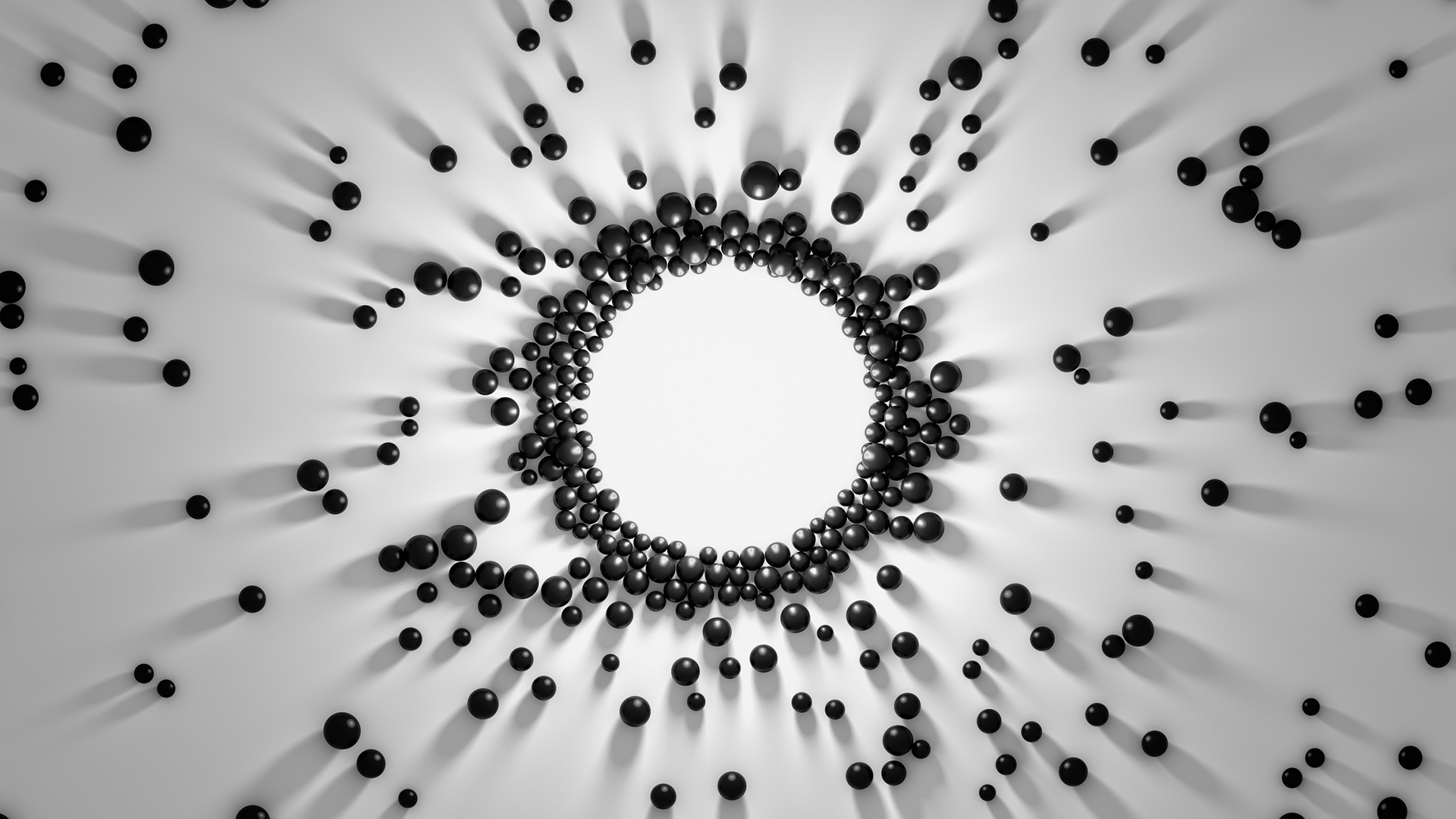
A physicist built a mini-universe out of cold atoms and used it to test where time comes from. It made big headlines a few weeks ago, and I almost skipped it, as most "universe in a lab" stories are nonsense. But then I actually read the paper. Let's take a look.
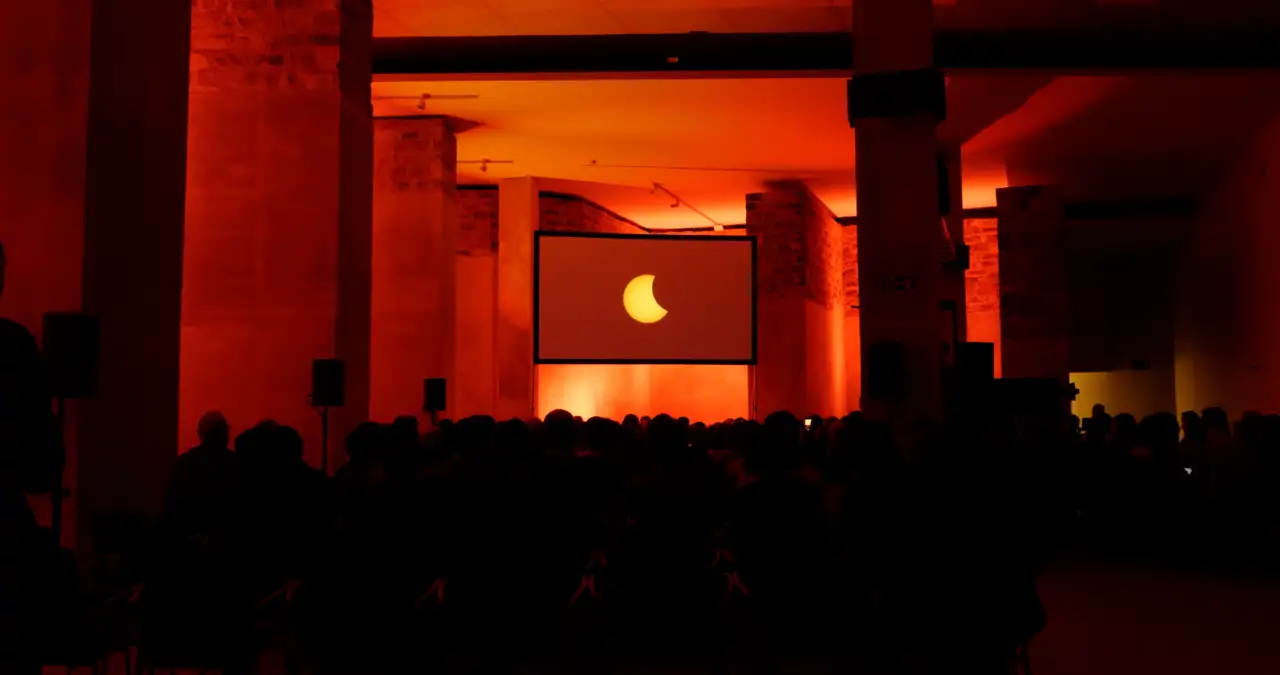
Hacían poco más de 7 grados en Pamplona cuando, el 12 de enero de 2026, cientos de personas se reunieron en la Sala Principal de Baluarte, el Palacio de Congresos y Auditorio de Navarra, para hablar del eclipse solar total. Faltaban siete meses para la cita, pero la comunidad ya había dado el pistoletazo de salida a lo que muchos consideran el acontecimiento astronómico del siglo.
Aquel encuentro sirvió para recordar cómo se vivió el eclipse de 1905 y, en los siguientes días 12 de cada mes, las distintas conferencias abordaron también la relación de este fenómeno con el arte, el cine, el periodismo o el mundo animal. En total, más de 13.000 personas participaron de las actividades.
“Hemos construido mes a mes una mirada compartida de un acontecimiento que en Navarra no se va a volver a vivir hasta el 2180. Se trata de algo realmente extraordinario, histórico. Hay gente que piensa que cuando se habla de ciencia es algo elevado, pero también hemos visto cómo jóvenes acudían a las conferencias y el interés era tan grande al punto de que se agotaron absolutamente las entradas todos los meses”, cuenta Paula Noya, directora de Infraestructuras Culturales de NICDO, a National Geographic. Esta sociedad pública del Gobierno de Navarra integra, entre otros equipamientos, el Planetario de Pamplona.
La expectativa por el eclipse solar total
Bajo el nombre de Proyecto Eklipse, se diseñó una programación de actividades y talleres concebida como un gran ejercicio de divulgación científica para mantener vivo el interés del público durante todo el año. Uno de sus principales atractivos ha sido el simulador virtual del eclipse. En Navarra, además, se jactan de haber sido los primeros en sacar a licitación pública la adquisición de gafas homologadas para garantizar una observación segura en los puntos oficiales.
La red de 20 espacios habilitados para seguir el eclipse cuenta con capacidad para unas 50.000 personas. Las entradas, desde 6 euros, incluyen aparcamiento y gafas certificadas. Entre los lugares más singulares figuran las Bardenas Reales y el parque de naturaleza y ocio Senda Viva, que ofrecerá 22 actividades complementarias relacionadas con el eclipse, desde exposiciones científicas y talleres hasta espectáculos de magia, circo, clown, cuentacuentos y música. Además, permanecerá abierto hasta la una de la madrugada para que los visitantes puedan disfrutar también de la lluvia de estrellas de las Perseidas.
La enorme expectación que despierta el fenómeno no impide que existan preocupaciones.
“A pesar de que hemos estado trabajando muchísimo en la concienciación, todavía te cruzas con amigos o familiares que te preguntan ‘¿puedo ver el sol con gafas normales?’ Por eso seguimos repitiendo siempre el consejo de utilizar gafas homologadas”, señala Noya.
Las principales inquietudes para el 12 de agosto
Otra de las inquietudes está relacionada con el riesgo de incendios al ser en pleno mes de agosto y ante la llegada masiva de visitantes a entornos rurales. Entre las recomendaciones difundidas por las autoridades figuran no aparcar sobre vegetación seca, ya que el calor del motor puede provocar su ignición; evitar hogueras, barbacoas y cualquier uso recreativo del fuego; no utilizar gas en zonas de camping; apagar correctamente las colillas; recoger los residuos y no dejar botellas de cristal expuestas al sol.
El gran desafío para Navarra será, sin embargo, la gestión de la movilidad y la logística. Noya explica:
“Sabemos que desde hace meses hay puntos en el sur que ya tienen el cartel colgado de ocupación al 100%, pero queda alguna habitación disponible en otras partes. Si tú sabes que desde tu municipio, tu pueblo o tu casita lo vas a poder ver, la recomendación es que no te muevas para verlo desde otro sitio”.
Como una ironía del destino, los habitantes de Pamplona tendrán que desplazarse para contemplar el eclipse total, ya que la capital quedó situada en la franja de parcialidad. Tampoco habrían podido seguirlo desde su emblemático planetario, cerrado por obras desde enero de 2025, cuando un incendio causó graves daños en las instalaciones. Desde entonces, el centro permanece cerrado mientras se somete a una remodelación.
“Con el incendio hemos convertido una catástrofe en una oportunidad, pues tenía 30 años y el proyecto de rehabilitación integral venía desde antes porque era el momento de reflexionar sobre su futuro para que siga siendo un centro de referencia. Vienen momentos muy ilusionantes”, concluye Noya. Tan ilusionantes como los que se esperan para el próximo 12 de agosto y como los que Navarra comenzó a vivir desde aquel frío día de enero.

 Login

 Autistic children showed earlier and less age-related refinement in the brain signals involved in processing faces. A child looks at a face, and within milliseconds the brain begins sorting its features, expression, and identity. Researchers have now traced that process across the entire scalp in one of the most comprehensive studies of face perception in [...]









 There's no avoiding microplastics.
