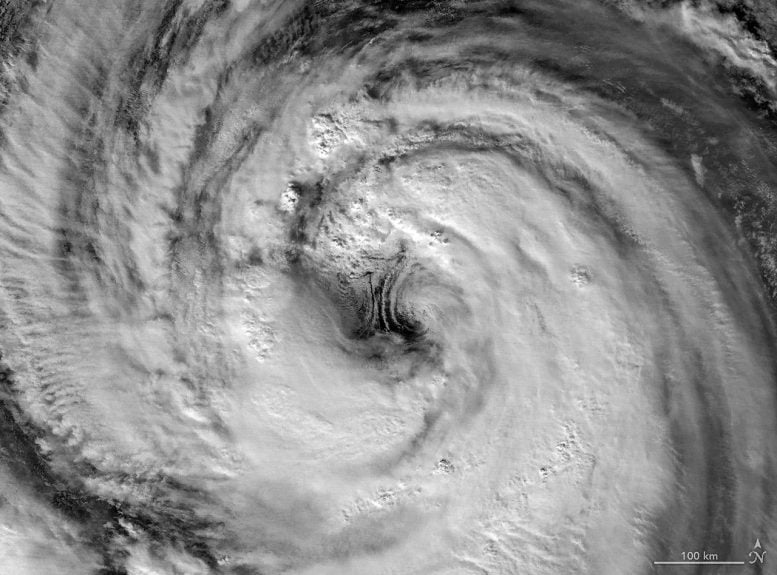
Typhoon Jangmi dazzled from space with a giant swirling eye while drenching parts of Japan with heavy rain. From late May into early June 2026, Typhoon Jangmi slowly tracked north-northwest across the Philippine Sea on a path toward southern Japan. Although the storm moved at a relatively slow pace, it spread intense rainfall across a [...]
Tesla has pushed the planned public demo of its next-generation Roadster to August or later, according to a report from The Information citing four people with knowledge of the program. It marks yet another delay for the vehicle first unveiled as a prototype nearly nine years ago.
The demo, expected to take place in Texas, is meant to showcase the SpaceX cold gas thruster system that Tesla claims will allow the Roadster to achieve extreme acceleration and even lift off the ground.
In the Electrek Podcast, we discuss the most popular news in the world of sustainable transport and energy. In this week’s episode, we discuss Tesla Semi nailing a big test, BMW iX3’s range impressing in a new test, Xpeng catching up to Tesla, and more.
A rapidly intensifying super typhoon sent giant atmospheric ripples skyward, revealing a hidden connection between extreme weather and near-space. In April 2026, Super Typhoon Sinlaku swept across the North Pacific, bringing torrential rain and flooding to parts of the Mariana Islands. The storm intensified into a “violent typhoon,” the highest category used by the Japan [...]
The short-eared dog is one of the Amazon’s least-known carnivores. In Bolivia, it’s also one of the hardest to find. The species has a fox-like snout, small rounded ears, partially webbed toes, and a long bushy tail that often drags on the forest floor. In Spanish, it’s sometimes called perro fantasma, or ghost dog, a name that reflects how rarely even field biologists encounter it. A long-running camera-trap study has now brought the species into sharper focus, reports Iván Paredes Tamayo. Over more than two decades, researchers recorded the short-eared dog in Bolivia’s lowland Amazonian forests, in piedmont forests near the Andes, and in large protected and Indigenous-managed landscapes. The results suggest the animal may be present in more places than earlier records showed. That is useful evidence, although it doesn’t make the species common. It remains scarce, elusive, and closely linked to well-preserved forest. For conservation groups, land managers, and funders, the findings suggest the short-eared dog depends on large, connected areas of habitat. Small forest fragments are unlikely to provide what it needs. Its presence can help identify places where forests are still functioning well, especially where protected areas and Indigenous territories keep intact habitat at scale. The finding also shows why long-term monitoring matters. Rare species are easy to miss in short surveys. A camera trap may sit for months without recording one. A study that runs across years, landscapes, and management types can reveal patterns that would otherwise remain hidden. The short-eared dog will probably never…This article was originally published on Mongabay
Au Computex, Jensen Huang n’est pas seulement venu présenter une nouvelle puce ARM pour Windows. À travers RTX Spark, le patron de Nvidia dessine surtout une vision beaucoup plus ambitieuse de l’avenir du PC, qui serait destiné à devenir comme R2-D2.
From human-elephant coexistence to an alternative conservation model from the Democratic Republic of Congo, from teen innovators in Kenya to Guinea’s complicated experience with mining, the stories that attracted the most readers in the first five months of 2026 reflect the richness of Mongabay’s Africa coverage on World Environment Day, June 5, 2026. They also showcase the talents of a diverse reporting team and a strong and growing network of resident contributors. Electric fences help farmers and elephants coexist in Zambian borderlands: Contributor Ryan Truscott reports from eastern Zambia on an initiative aimed at protecting farmland from elephants, even as the pachyderms are forced into narrower corridors as habitats shrink. A unique clearing in Central Africa draws elephants from the dense forests: Mongabay Africa’s program director David Akana takes readers to the forest clearing of Dzanga Bai in the Central African Republic. A place where the naturally elusive forest elephants gather, sometimes in the hundreds, forming a “village of elephants.” Descendants of people pushed out for DRC national park lead forest conservation efforts: Contributor Jérémie Kyaswekera brings a story of hope from the DRC, where descendants of families that had to leave the forests of what is today an area in and around Maiko National Park are leading efforts to protect biodiversity through local conservation efforts. Teen innovators in Kenya turn farm waste into award-winning vehicle exhaust filter: Kenya-based contributor Mary Mwendwa teamed up with Mongabay Africa editor Malavika Vyawahare to profile young innovators who developed an exhaust filtration system…This article was originally published on Mongabay
NASA has told crew aboard the International Space Station (ISS) to resume normal operations, ending a roughly two-hour period in which five astronauts sheltered inside a docked SpaceX capsule. The shelter order came Friday morning as a precautionary measure to protect crew while Russian cosmonauts attempted a fix on the Zvezda service module’s transfer tunnelContinue reading "ISS crew back to normal after emergency shelter order"
NASA announced new contracts for the rovers and landers that will lay the groundwork for the agency’s proposed $30-billion Moon Base — some of which they plan to launch as soon as this fall — during a May 26 press conference. The announcement offered the most detailed look yet into the Moon Base plan NASAContinue reading "How NASA plans to build a Moon Base"
Les beaux jours s'installent et Amazon frappe fort pour vous aider à rafraîchir votre jardin sans vider votre compte en banque ! Le kit de piscine hors sol Bestway Steel Pro Max Frame Kit bénéficie d'une superbe remise.
More than a decade ago, conservationists began working to preserve a unique population of desert pampas cats that has adapted to the mangroves of Peru’s northern coast. This small, isolated population roams the San Pedro de Vice dry mangroves, a Ramsar Site and South America’s southernmost mangrove ecosystem. “This is a very unique population, because as far as we know, [it] is the only Pampas cat population that lives in a mangrove [habitat],” Alvaro Garcia, co-coordinator of the Pampas Cat Working Group and the Peruvian Desert Cat Project, told Mongabay in an email. The desert pampas cat (Leopardus garleppi), distinctive for its broad face, ranges along a relatively thin band snaking southward from Colombia through Peru and Bolivia, to northern Chile and Argentina. The species is acclimated to dry conditions, so inhabits deserts, grasslands and dry forests, and isn’t found living in mangroves anywhere else aside from this region of Peru. Dry mangrove forests, also called scrub or dwarf mangrove forests, grow in highly saline soils in upper intertidal zones, so lack regular daily flushing by ocean tides. At first, it was thought the dry mangrove-acclimated cats were faring well: “[I]n the mangrove [habitat], we put cameras out for a week, and we got tons of photos,” whereas in other parts of the felid’s range, conservationists barely capture one desert pampas cat image per month, said Cindy Hurtado, co-coordinator of the Pampas Cat Working Group and the Peruvian Desert Cat Project. Based on the photos, the research team assumed the…This article was originally published on Mongabay
JUNEAU, Alaska (AP) — The Trump administration’s push to expand oil and gas development in Alaska faces a new test Friday. That’s when the latest lease sale is set for the Arctic National Wildlife Refuge. A coalition of conservation groups sent a letter to oil company leaders ahead of the sale, urging them to stay away and citing risks such as ongoing litigation around the leasing program. Opponents of drilling in the refuge have pointed to a lack of major industry interest in prior lease sales. But supporters of drilling see the refuge’s coastal plain as a potential untapped resource that could boost oil production and generate new revenue. Banner image: FILE – The Kaktovik Lagoon and the Brooks Range mountains of the Arctic National Wildlife Refuge are seen in Kaktovik, Alaska, Oct. 15, 2024. Image by Lindsey Wasson via Associated Press.This article was originally published on Mongabay
The Dutch company ASML is the only company that produces a special type of machine used to produce microchips, which are a key component of many modern technologies. Now, companies across the globe are looking to break ASML’s monopoly using a wide variety of new processes. Let’s take a look at this microchip manufacturing melee.
Em ecrãs de smartphones, monitores ou televisores, as gamas referem-se à capacidade de reproduzir cores. Quanto mais ampla essa gama, mais vivas e precisas, um indicador que se torna essencial para trabalhos profissionais ou consumo de multimédia.

 Login

 Typhoon Jangmi dazzled from space with a giant swirling eye while drenching parts of Japan with heavy rain. From late May into early June 2026, Typhoon Jangmi slowly tracked north-northwest across the Philippine Sea on a path toward southern Japan. Although the storm moved at a relatively slow pace, it spread intense rainfall across a [...]













 This may follow a 19th-century paradox.
