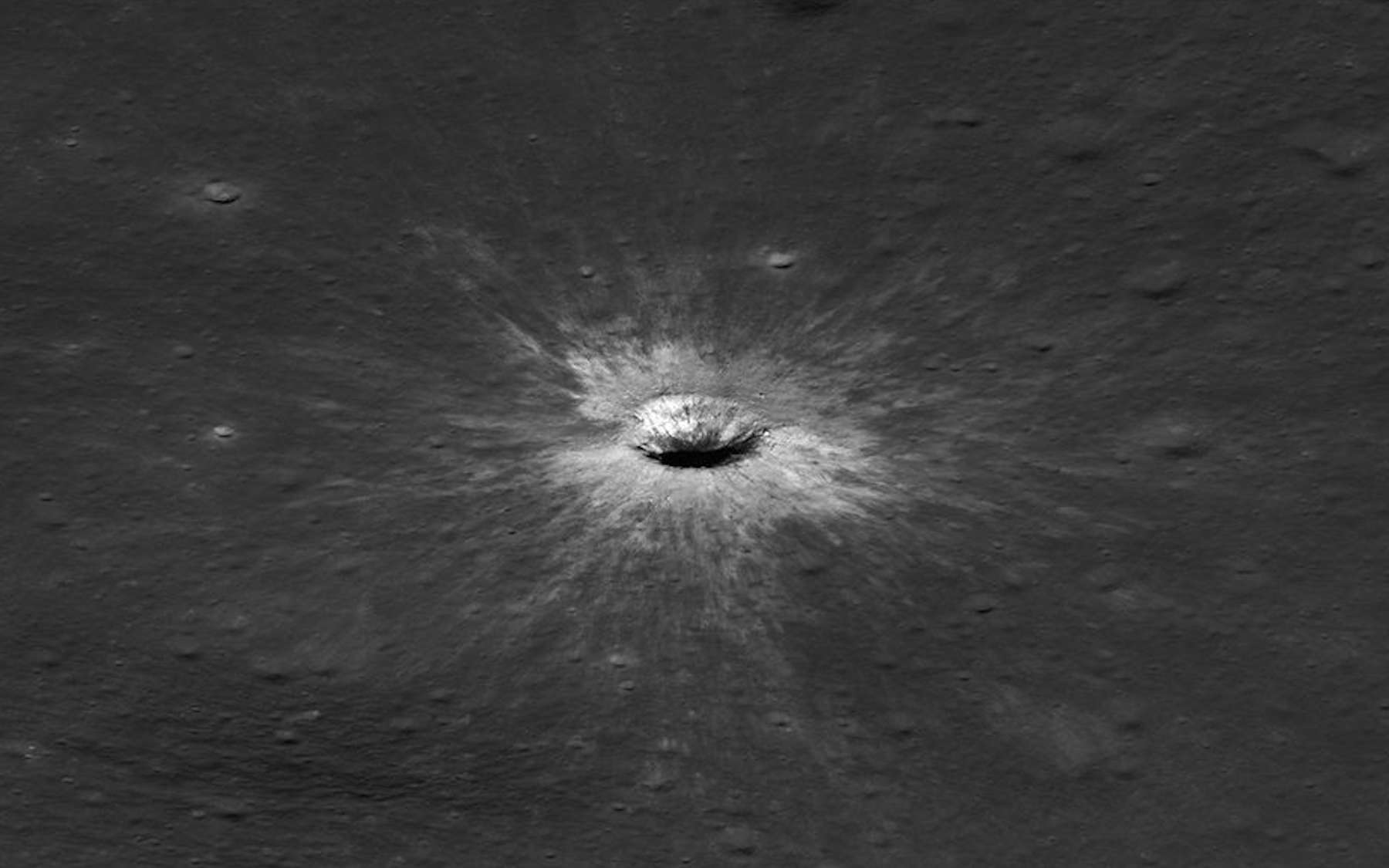
« Cela n’arrive qu’une fois par siècle » : la Nasa vient de découvrir sur la Lune le plus grand cratère récent du Système solaire !


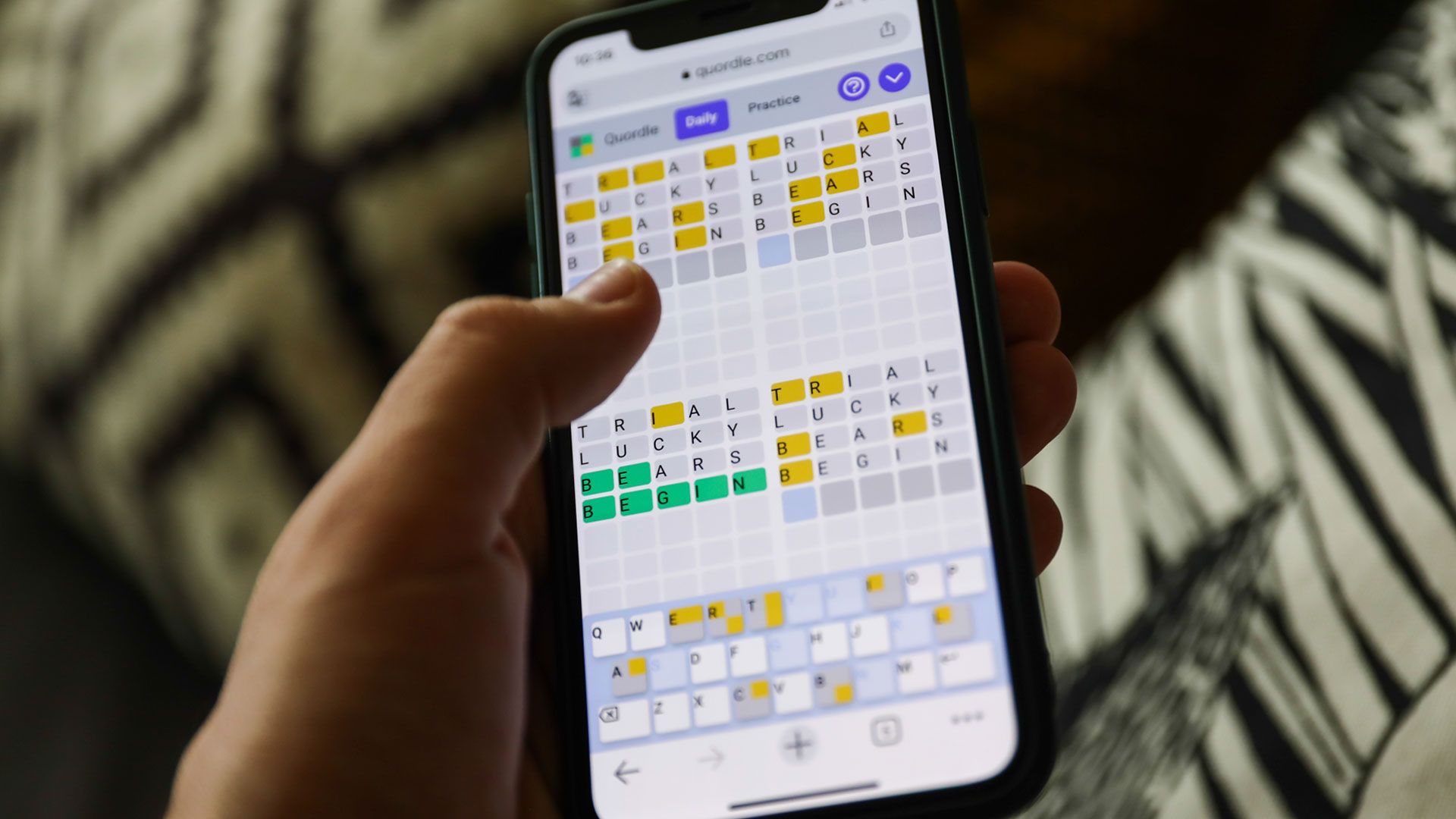
A new Quordle puzzle appears at midnight each day for your time zone – which means that some people are always playing 'today's game' while others are playing 'yesterday's'. If you're looking for Wednesday's puzzle instead then click here: Quordle hints and answers for Wednesday, September 16 (game #1696).
Quordle was one of the original Wordle alternatives and is still going strong now more than 1,500 games later. It offers a genuine challenge, though, so read on if you need some Quordle hints today — or scroll down further for the answers.
Enjoy playing word games? You can also check out my NYT Connections today and NYT Strands today pages for hints and answers for those puzzles, while Marc's Wordle today column covers the original viral word game.
SPOILER WARNING: Information about Quordle today is below, so don't read on if you don't want to know the answers.
• The number of different vowels in Quordle today is 2*.
* Note that by vowel we mean the five standard vowels (A, E, I, O, U), not Y (which is sometimes counted as a vowel too).
• The number of Quordle answers containing a repeated letter today is 2.
• No. None of Q, Z, X or J appear among today's Quordle answers.
• The number of today's Quordle answers starting with the same letter is 2.
If you just want to know the answers at this stage, simply scroll down. If you're not ready yet then here's one more clue to make things a lot easier:
• C
• C
• N
• F
Right, the answers are below, so DO NOT SCROLL ANY FURTHER IF YOU DON'T WANT TO SEE THEM.

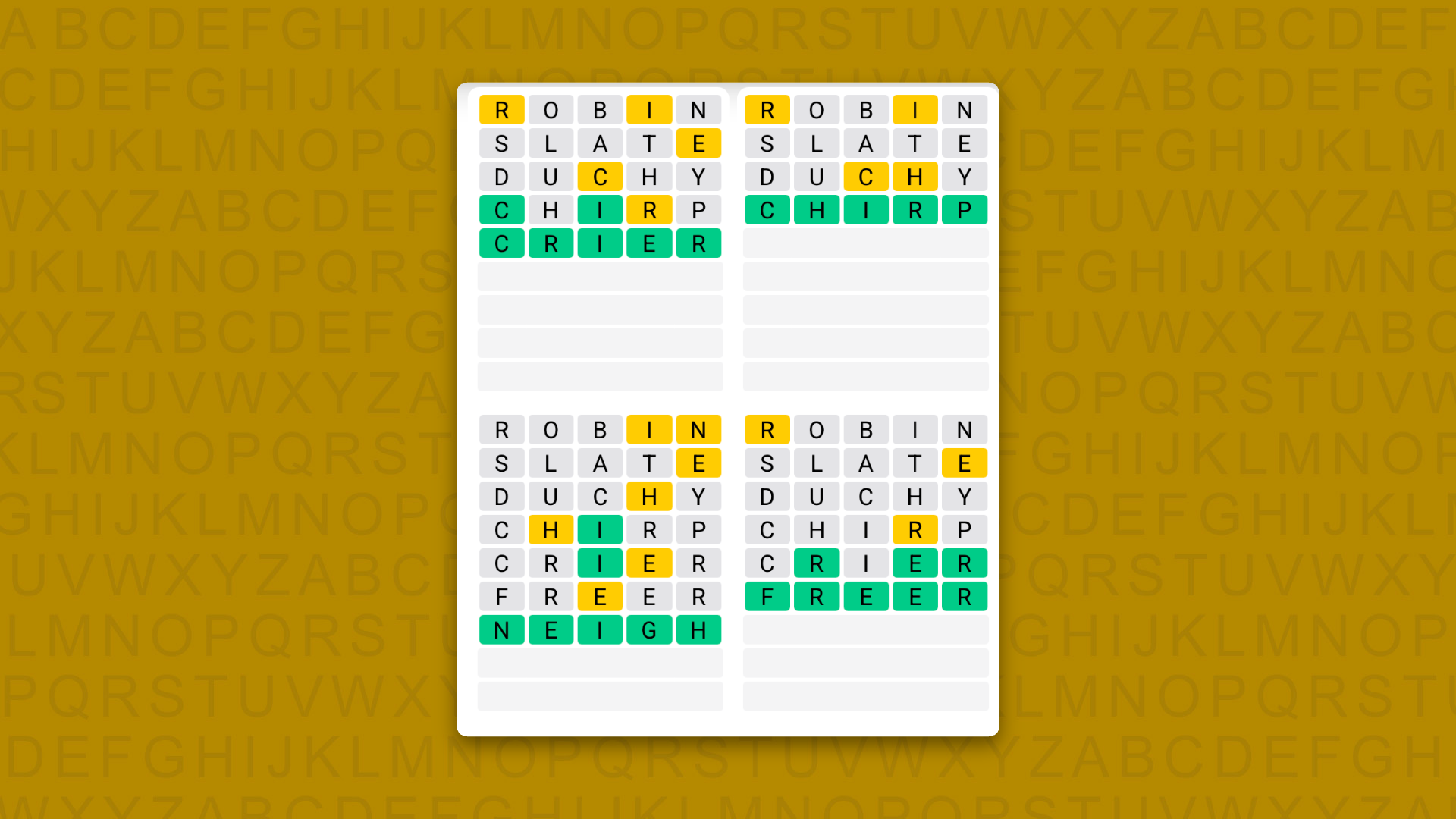
The answers to today's Quordle, game #1697, are…
A very taxing game despite its heavy use of the letter R and lack of vowels.
NEIGH was the hardest to get to, but once I entered N-E-I onto the tiles I realized there was no other possibility.

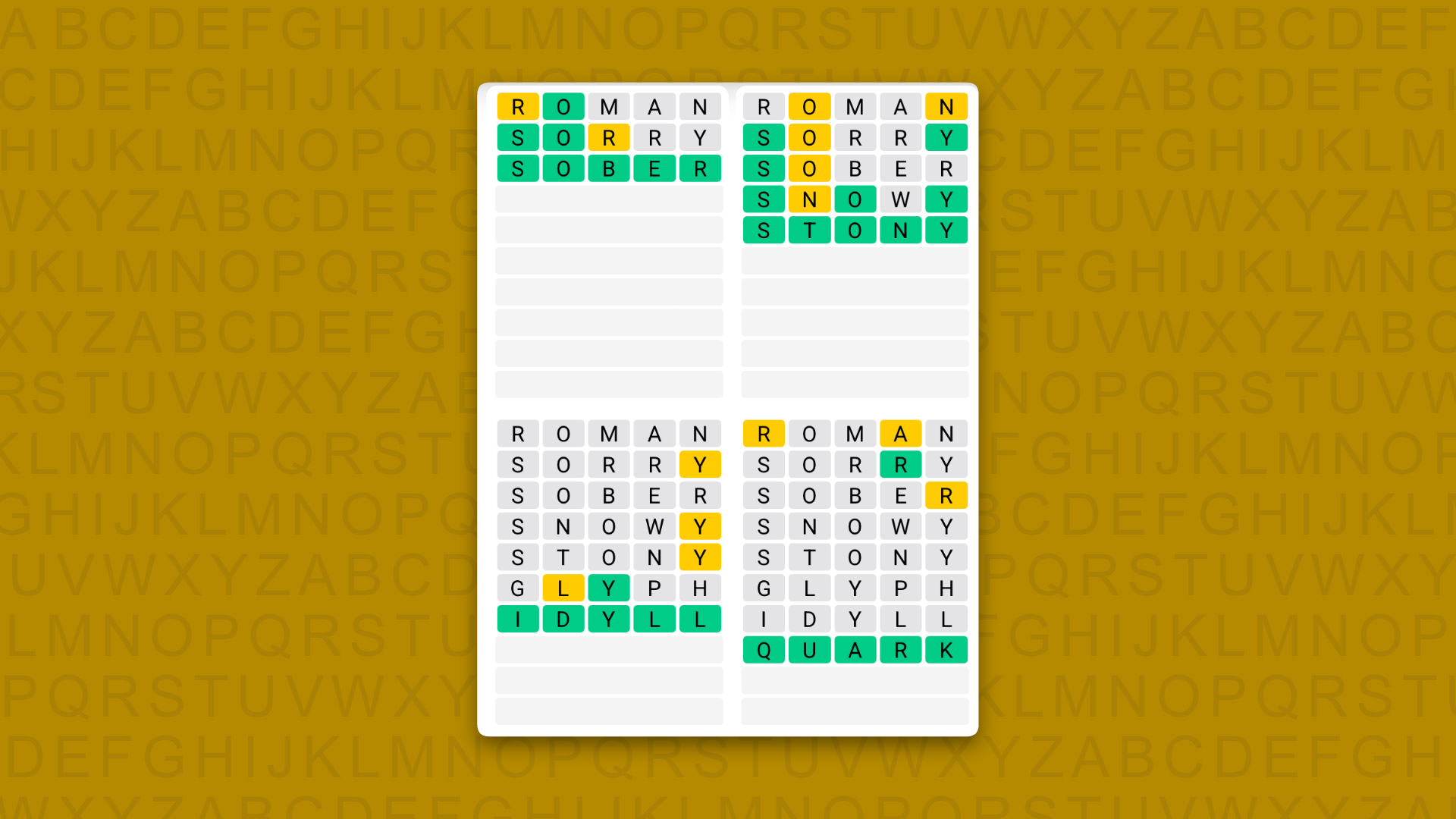
The answers to today's Quordle Daily Sequence, game #1697, are…
A new NYT Strands puzzle appears at midnight each day for your time zone – which means that some people are always playing 'today's game' while others are playing 'yesterday's'. If you're looking for Wednesday's puzzle instead then click here: NYT Strands hints and answers for Wednesday, September 16 (game #927).
Strands is the NYT's latest word game after the likes of Wordle, Spelling Bee and Connections – and it's great fun. It can be difficult, though, so read on for my Strands hints.
Want more word-based fun? Then check out my NYT Connections today and Quordle today pages for hints and answers for those games, and Marc's Wordle today page for the original viral word game.
SPOILER WARNING: Information about NYT Strands today is below, so don't read on if you don't want to know the answers.
• Today's NYT Strands theme is… A little comic relief
Play any of these words to unlock the in-game hints system.
• Spangram has 13 letters
• First side: top, 1st column
• Last side: bottom, 6th column
Right, the answers are below, so DO NOT SCROLL ANY FURTHER IF YOU DON'T WANT TO SEE THEM.

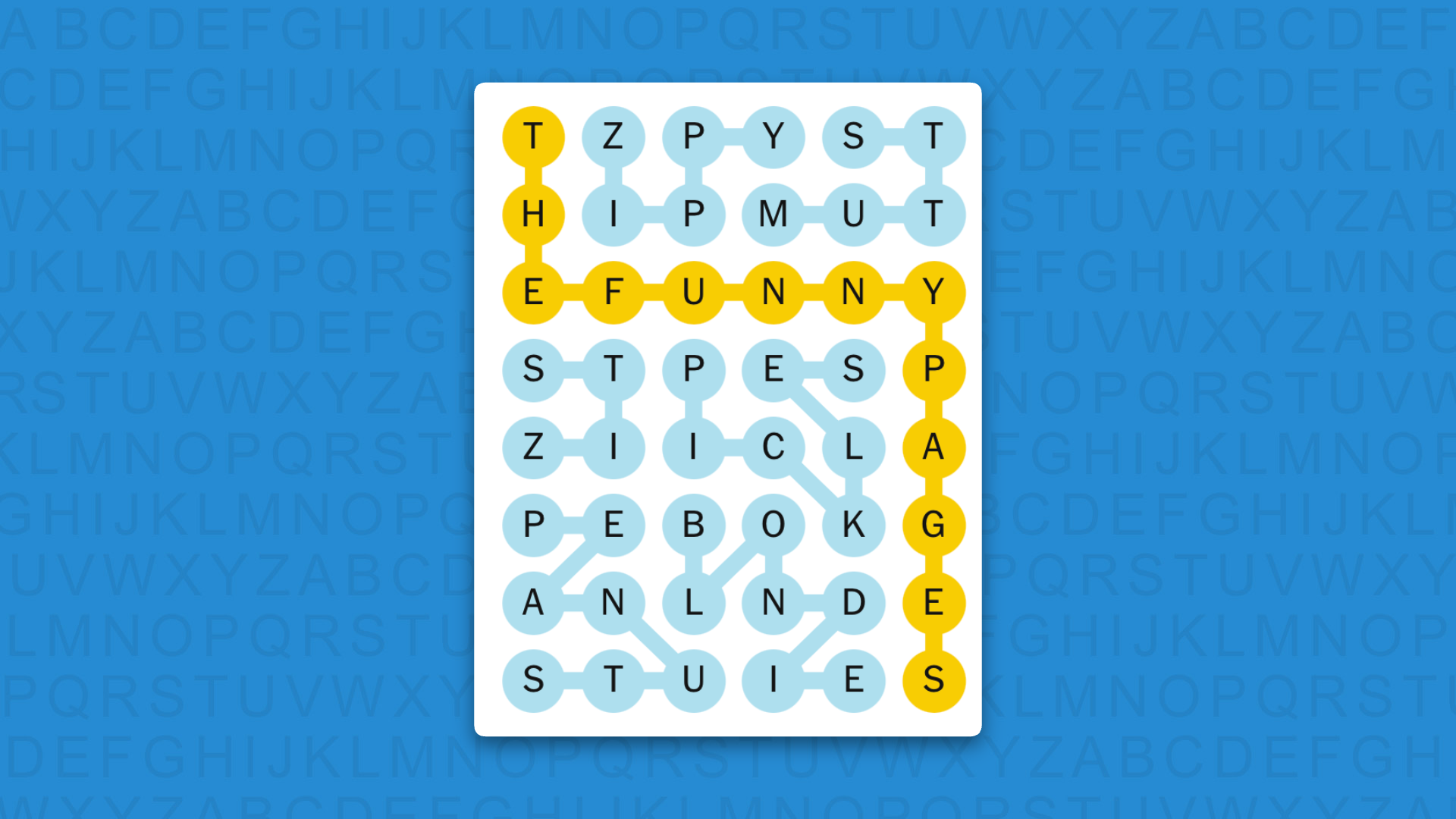
The answers to today's Strands, game #928, are…
After missing out on getting an easy Spangram-first yesterday I was on a mission to spot it today and it ended up being far easier than I thought.
I was unsure exactly what the theme meant, but seeing the word 'funny' in the middle of the board and then the word 'the' in the top-left-hand corner helped me connect THEFUNNYPAGES.
This, though, was where my good fortune ended, as I needed three hints to find all of the comic strip names, being familiar with only Peanuts.
Comic strips were less of a big deal in the UK, where I grew up, although the cartoon strips on the back page along with the TV listings section were the only parts of the newspaper I read as a kid. Ours, though, were the adventures of a world-weary viking called Hägar.
Strands is the NYT's not-so-new-any-more word game, following Wordle and Connections. It's now a fully fledged member of the NYT's games stable that has been running for a year and which can be played on the NYT Games site on desktop or mobile.
I've got a full guide to how to play NYT Strands, complete with tips for solving it, so check that out if you're struggling to beat it each day.
A new NYT Connections puzzle appears at midnight each day for your time zone – which means that some people are always playing 'today's game' while others are playing 'yesterday's'. If you're looking for Wednesday's puzzle instead then click here: NYT Connections hints and answers for Wednesday, September 16 (game #1193).
Good morning! Let's play Connections, the NYT's clever word game that challenges you to group answers in various categories. It can be tough, so read on if you need Connections hints.
What should you do once you've finished? Why, play some more word games of course. I've also got daily Strands hints and answers and Quordle hints and answers articles if you need help for those too, while Marc's Wordle today page covers the original viral word game.
SPOILER WARNING: Information about NYT Connections today is below, so don't read on if you don't want to know the answers.

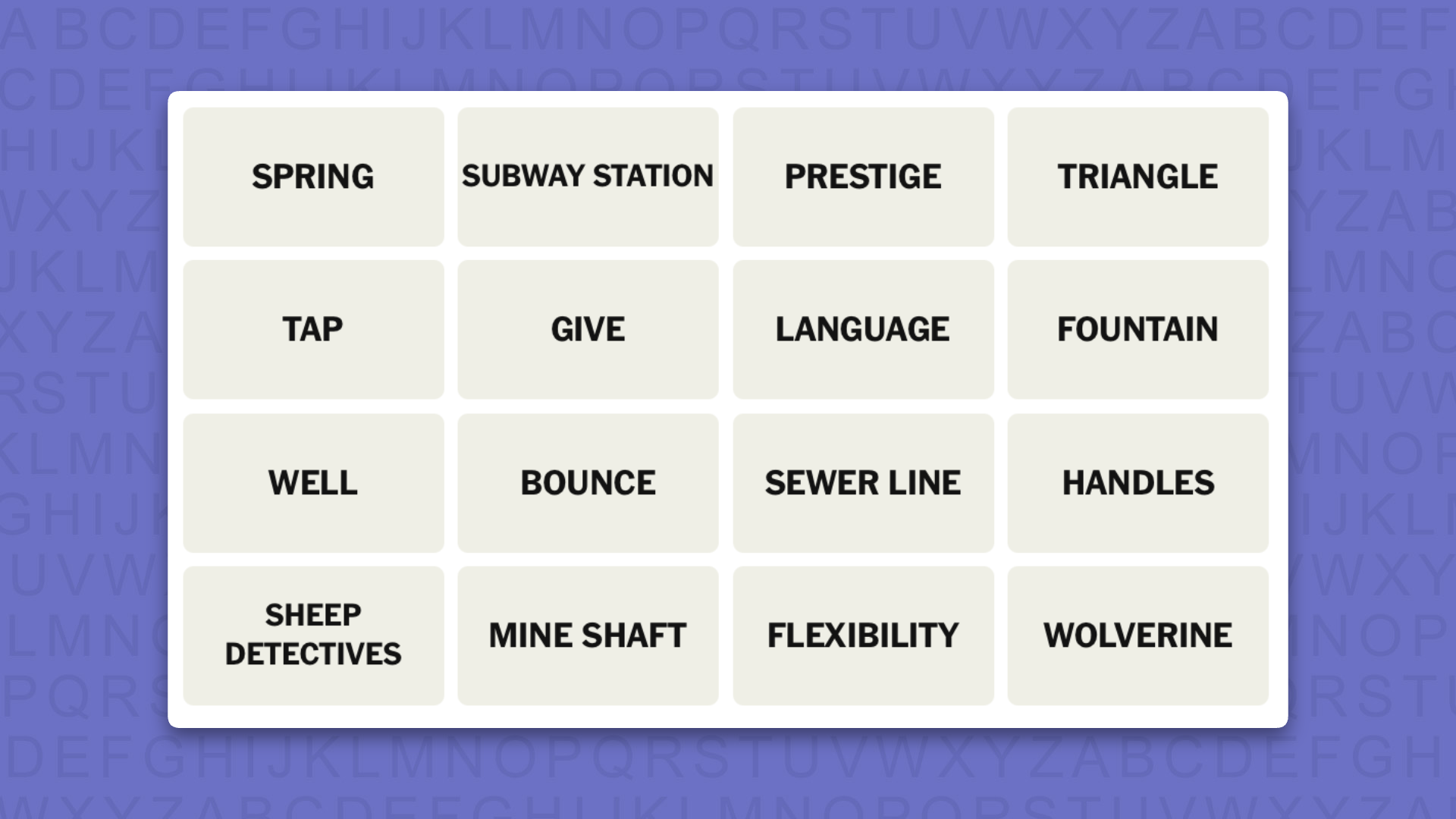
Today's NYT Connections words are…
What are some clues for today's NYT Connections groups?
Need more clues?
We're firmly in spoiler territory now, but read on if you want to know what the four theme answers are for today's NYT Connections puzzles…
What are the answers for today's NYT Connections groups?
Right, the answers are below, so DO NOT SCROLL ANY FURTHER IF YOU DON'T WANT TO SEE THEM.

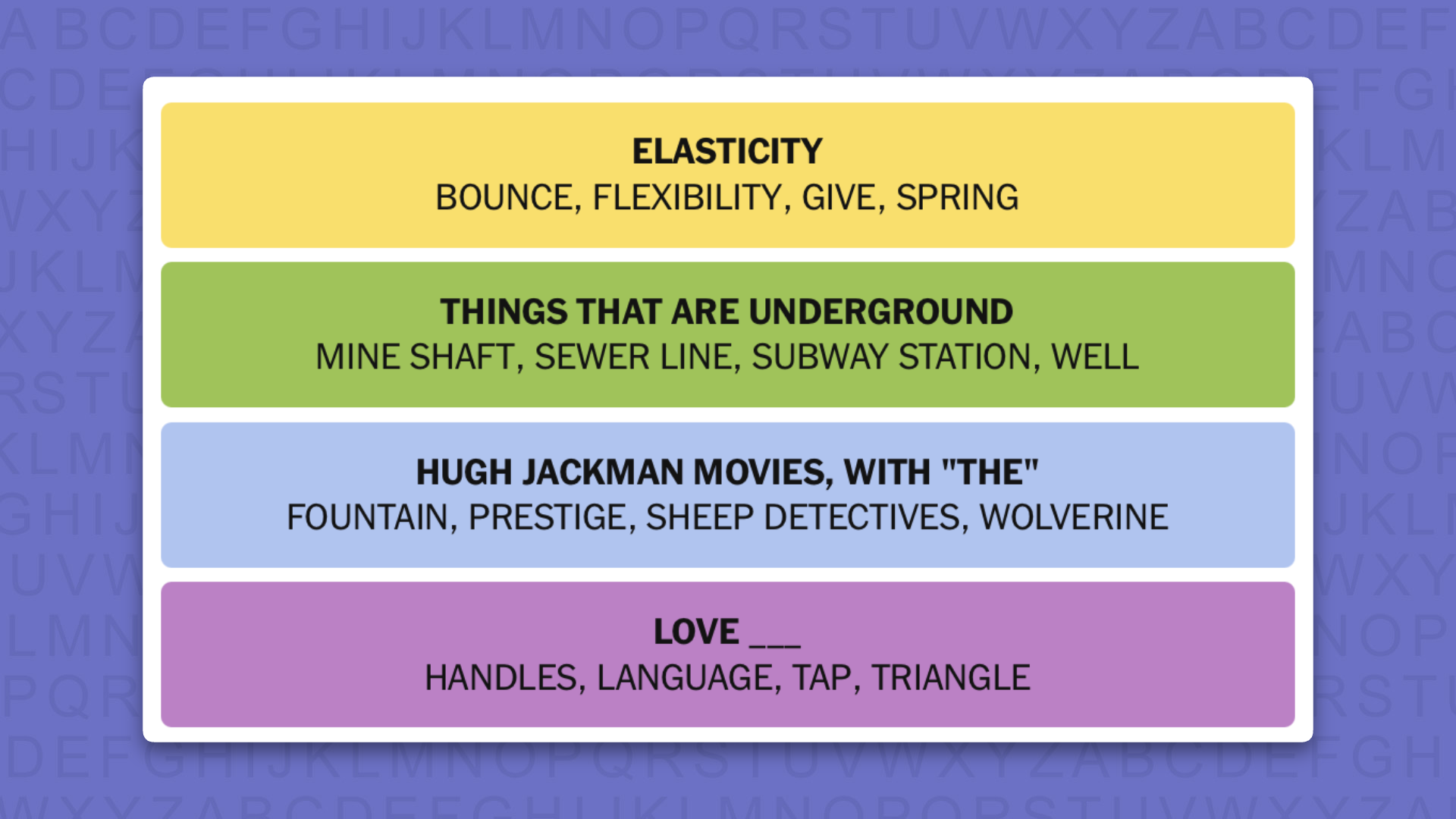
The answers to today's Connections, game #1194, are…
My first mistake could have been a group of ways to access water — SPRING, TAP, WELL and FOUNTAIN — but drew a complete blank.
Thinking of a different meaning for SPRING helped me find the other words describing ELASTICITY, but I flopped again, adding TAP instead of WELL to the group that became THINGS THAT ARE UNDERGROUND.
Finally, I did not know that I was collecting HUGH JACKMAN MOVIES, WITH “THE” but I knew that PRESTIGE, SHEEP DETECTIVES and WOLVERINE were all films and took a gamble that FOUNTAIN was too.
NYT Connections is one of several increasingly popular word games made by the New York Times. It challenges you to find groups of four items that share something in common, and each group has a different difficulty level: green is easy, yellow a little harder, blue often quite tough and purple usually very difficult.
On the plus side, you don't technically need to solve the final one, as you'll be able to answer that one by a process of elimination. What's more, you can make up to four mistakes, which gives you a little bit of breathing room.
It's a little more involved than something like Wordle, however, and there are plenty of opportunities for the game to trip you up with tricks. For instance, watch out for homophones and other word games that could disguise the answers.
It's playable for free via the NYT Games site on desktop or mobile.
California is on the verge of accepting $1.86 billion in federal broadband grant funds, despite the Trump administration telling states they cannot enforce net neutrality rules on any Internet service provider that gets a piece of the grant money.
When the Trump administration overhauled the $42 billion Broadband Equity, Access, and Deployment (BEAD) program last year, it ruled that states must agree not to enforce any rate regulation or net neutrality rule on ISPs that receive funding. This is particularly problematic for California, which previously won a yearslong court battle to defend its state net neutrality law.
Similar to federal net neutrality rules repealed during the first Trump administration, California's law prohibits ISPs from blocking or throttling lawful traffic and says ISPs may not require fees from websites or online services to deliver or prioritize their traffic to Internet users. While the first Trump administration lost its attempt to preempt state net neutrality laws, the second Trump administration is trying to achieve a similar result by making federal broadband money conditional on whether states agree not to enforce net neutrality.


© Getty Images | Yuichiro Chino
In recent years, there has been a lot of excitement about the potential for studying human diseases in what are called "organoids." These small patches of tissue, formed using stem cells, appear to produce many of the same cell types and at least some of the structures normally formed in actual organs, and thus can provide a better model for diseases that rely on the sometimes complex interactions among multiple specialized cell types that are a feature of the human body.
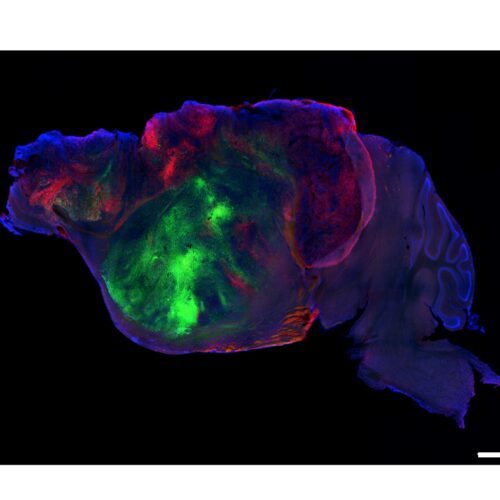
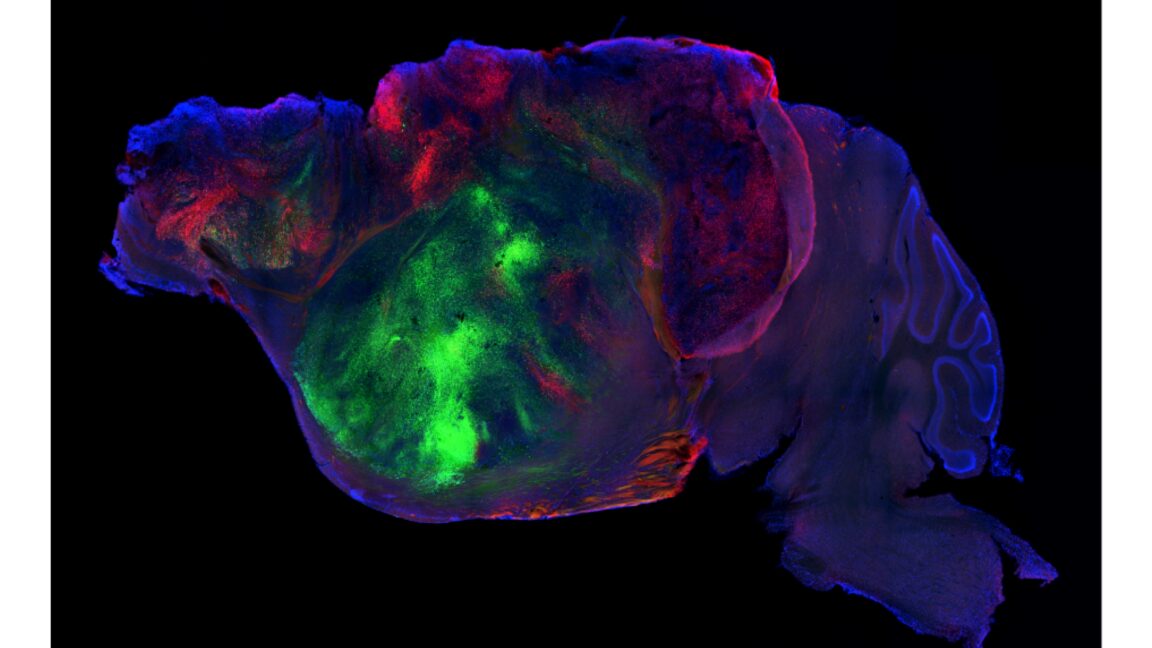
But even the most sophisticated organoids lack a lot of the features of a real human body. This is especially true for brain organoids, which don't form any of the connections with specialized brain structures needed to behave "normally." On Wednesday, a research group at Stanford University described a possible way to study brain organoids in a somewhat more natural context: They genetically wiped out a large portion of the mouse brain and replaced it with human brain organoid cells.
Organoids, because they adopt a three-dimensional tissue structure and consist of various specialized cells, provide a much better model for an intact tissue than simply having a bunch of disassociated cells lying flat on a culture dish. But they still have a lot of limitations—they're not hooked up to a circulatory system that allows the liver to process chemicals the organoid produces and don't have immune cells moving through them, to give just a couple of examples.


© S. Pasca lab, Stanford University

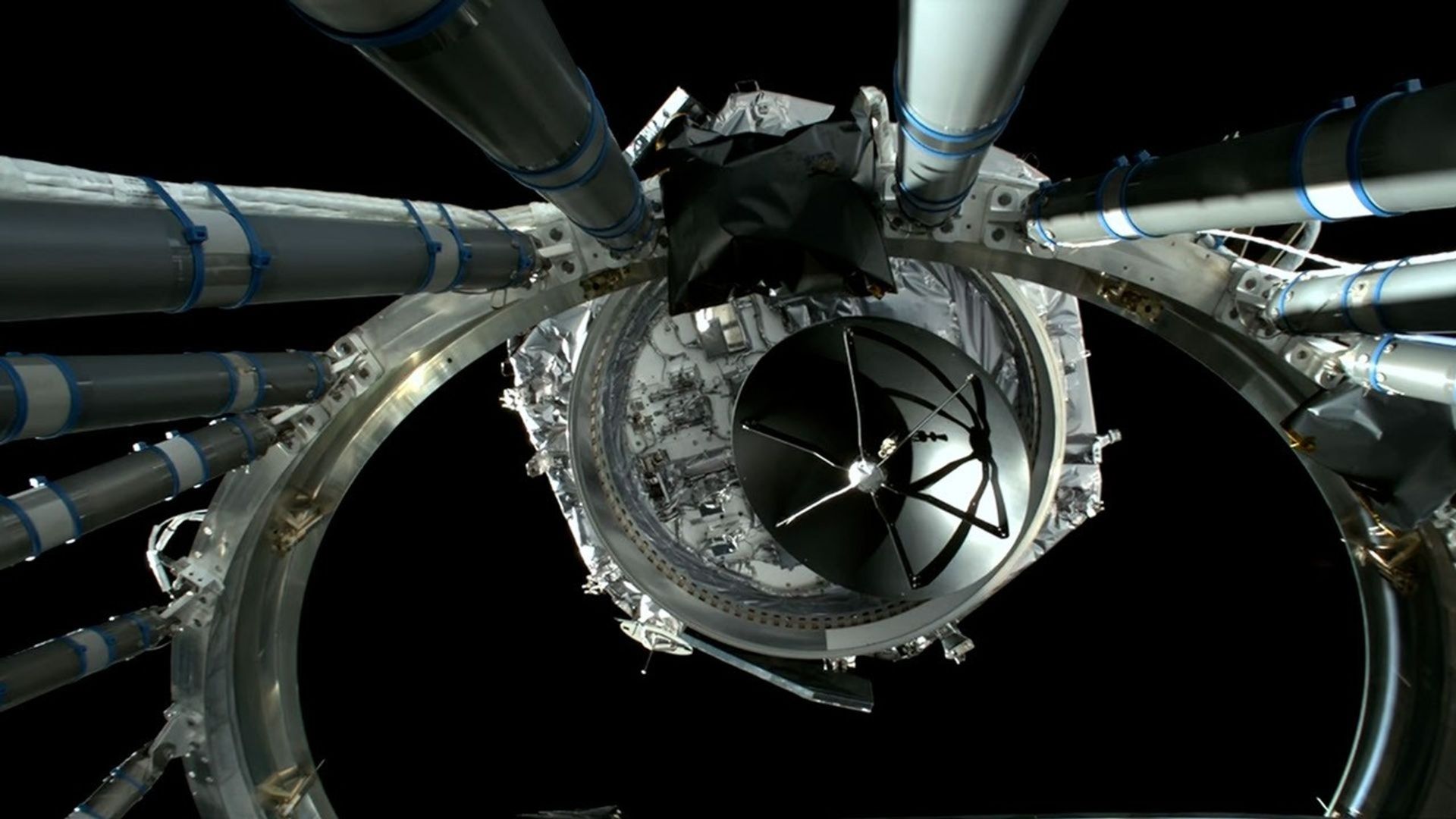
As the newest heavy hitter in orbital observatories continues the journey to its final destination, NASA has begun the process of switching the spacecraft on.
The Nancy Grace Roman Space Telescope launched on Aug. 30, and is on a three-month long trek to Lagrange point two (L2). L2 is a relatively idle orbital sweet spot almost a million miles from Earth that will allow Roman to remain on the planet's night side and keep the bright sun to its back. It's an optimal location for the telescope to operate its two primary instruments, the Wide Field Instrument (WFI) and its Coronagraph Instrument.
Neither are ready to begin collecting science, and will undergo another month or so of calibrations and tests before Roman can begin its mission, but initial downlinks from the telescope indicate nominal readings on its components as NASA teams continue its commissioning. "This is a huge milestone for the team at Goddard, our industry teams at BAE Systems, Inc. and Teledyne, and our science centers," said Josh Schlieder, the Wide Field Instrument scientist at NASA's Goddard Space Flight Center, in a statement.
The WFI is a 300-megapixel infrared camera designed to survey enormous swaths of the sky. Scientists plan to use the imager to take fast snapshots of the cosmos, study dark energy, and map the distribution of matter throughout the universe. It uses 18 infrared detectors that NASA says combine for a sensing area about the size of a laptop; by comparison, a typical digital camera imaging sensor covers about the size of a postage stamp.
Before engineers could switch on the WFI, they spent about 10 days allowing the instrument to dry out and shed contaminants that may have accumulated prior to launch. The WFI was kept at a relatively warm (for space) -85 degrees Fahrenheit (-65 Celsius). On Friday (Sept. 11), Roman teams turned off the instrument's heater to allow it to cool to around -225 Fahrenheit (-143 Celsius), at which point it was cold enough to activate its infrared detectors. The detectors continued cooling afterward toward their eventual operating temperature of about -300 F (-183 C).
Following the successful activation of its infrared sensors, engineers moved on to calibrate the WFI's element wheel, which filters individual wavelengths for detection using a system of prisms and other optic mechanisms. And, on the morning of Sept. 13, Roman teams confirmed the focus components were functioning nominally.
Roman's coronagraph also completed its first major steps toward operation. The instrument is controlled by the Coronagraph Commanding Center at Caltech/IPAC in Pasadena, California, where operators were able to verify that they could remotely operate the instrument’s electronic and mechanical systems. The coronagraph functions using a series of mirrors, masks and sensors to block the light of a distant star in order to detect the much fainter light of planets in that star’s orbit.
Tests on the coronagraph also included warming the device to 72 degrees Fahrenheit (22 Celsius) — nominal for operating conditions in controlled environments on Earth, but quite warm compared to the WFI’s -300 F (-183 C) operating temperature. The extra heat allows the Coronagraph to maintain conditions similar to those inside NASA test chambers so engineers can more easily simulate tests on Roman's deformable mirrors.
"Now that this test is complete, we've been decontaminating: sitting idle with our detectors warm so anything that’s stuck to the surface, such as water or trace chemicals, will tend to leave it,” said Eric Cady, an optical engineer leading commissioning efforts for the Roman Coronagraph at NASA's Jet Propulsion Laboratory.
Decontamination procedures on Roman's coronagraph will continue for 30 days, along with periodic checks and other minor calibrations. That will occupy a portion of the observatory's remaining journey to L2, which is expected to last about 12 more weeks. NASA says Roman remains on track to release its first science images in early 2027. And, thanks to the precision of Roman's SpaceX Falcon Heavy launch vehicle and fuel savings during Roman's early trajectory corrections, the telescope is expected to have enough propellant to operate for the next 22 years.