 Login

All the Ways to See The Story of Everything
The options have grown to the point that it’s hard to imagine there’s anyone with Internet access who can’t find it.

 The Rolling Stones: Lyrics from “Foreign Tongues” (2026) “Mr Charm” When I was oh-so-young, I used to want to go to Mars And burn the rubber on the road And drive around in fancy cars When who would take you into space? Who would you really trust? Is it Boeing, is it […]
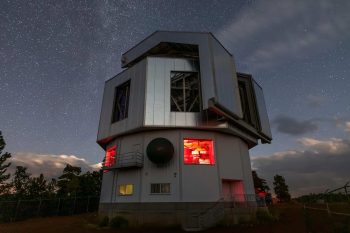 Scientists at the Lowell Observatory in Flagstaff, Arizona report they detected a plume from the impact August 5 from that errant SpaceX rocket stage. “We can safely say that we measured a response from the rocket stage impact as a sodium and lithium gas plume a few 10’s of kilometers in size lasting between 5 […]
 Planting boots on Mars is hard enough. But getting “breathing room” on the Red Planet without inhaling toxic dust is yet another issue. Given the outlook that future human crews will strut their right stuff across the Red Planet, NASA assembled earlier this year a Martian Dust Limit Working Group. Their task was to review […]
 The Moon is in the cross-hairs of a SpaceX rocket stage, slamming into our celestial neighbor on August 5 at roughly 2:35:37.5 AM (US) Eastern Daylight Time reports astronomer, Bill Gray of Project Pluto. That high-speed impact “may produce potential observables,” according to research led by Benjamin Fernando at Los Alamos National Laboratory. — The […]
 Meet the Neighbors – Life on Mars and How to Find It by Steven A. Benner; Allen Lane, (an imprint of Penguin Books); July 2026; 416 pages (Hardcover); $40.99 (Amazon). Talk about a “cold case” – nothing like dealing with life on Mars where the temperature can drop like a rock to roughly – 89°C at […]
 What’s shaking about water ice deposits on the Moon? Turns out that assessing how seismic waves propagate on the Moon could be used to locate and map ice buried beneath the lunar surface. A new study by geologists at the University of Maryland (UMD), Lawrence Berkeley National Laboratory and the University of Hawaii shows that […]
 Dig this! An expansion of a partnership is expected to help establish a Moon Base by delivering autonomous mobility and heavy-duty excavation tools for a permanent settlement on the lunar surface. Interlune, a Seattle-based group, and the Vermeer Corporation of Pella, Iowa, have detailed the plan for development and delivery of subscale prototypes of lunar […]
 Next week, Earth’s moon is due for a human-made, high-speed thumping of an identified flying object – a spent SpaceX Falcon 9 upper stage. The event is a literal “dust up” on the lunar landscape. That Falcon 9 upper stage is a leftover from the launch that sent Firefly’s Blue Ghost-1 lander to the moon […]
 If you have a dim view of the future, take a look at a new batch of NASA Innovative Advanced Concepts (NIAC) program awards – all 18 of them But heads up – one of the bright idea awardees is suggesting how best to dim the Sun using a controllable dust cloud to reduce solar […]
 It came from outer space, exploding high above the South Atlantic off the coast of Argentina. That incoming meteor — also termed as a bolide — was observed by a pair of civilian lightning imagers aboard geostationary weather satellites, thereby supplementing the use of space-based military surveillance satellites. The April 1 event was viewed by […]
 Autistic children showed earlier and less age-related refinement in the brain signals involved in processing faces. A child looks at a face, and within milliseconds the brain begins sorting its features, expression, and identity. Researchers have now traced that process across the entire scalp in one of the most comprehensive studies of face perception in [...]
Arts Council England is facing a backlash for splurging millions of taxpayers' pounds on projects like queer cabaret, gender-diverse kids' shows and identity workshops while traditional museums are closing their doors.
The post Arts Council Blasted for Funding ‘Woke’ Projects While Traditional Museums Close appeared first on The Daily Sceptic.



Read more of this story at Slashdot.
Read more of this story at Slashdot.
American heiress Jamey Carney was found dead in her Killarney home in July, after her teenage daughter discovered her body. Her Jordanian asylum seeker boyfriend is now the prime suspect.
The post American Heiress ‘Murdered by Asylum Seeker Boyfriend’ Who Fled Ireland on One-Way Ticket appeared first on The Daily Sceptic.
