❌

Reading view

Beyond rare earths: this new magnet material could reshape motors

In our latest episode of Lexicon, we sat down with Tom Grainger, Commercial Vice President at Niron Magnetics,  to explore the hidden role permanent magnets play in modern technology and electrification.

From electric vehicles and wind turbines to smartphones and speakers, these components are essential to countless devices we rely on every day. Tom also discussed the growing strategic importance of rare earth magnets and the risks associated with highly concentrated global supply chains.

Also, subscribe to IE+ for premium insights and exclusive content!

Reinventing the magnet

Permanent magnets rarely make headlines. Yet, as Grainger explained to us, they sit at the core of modern electrification.

“Pretty well every modern electronic device relies on permanent magnets,” he told us. “The car you drive, the speakers you’re hearing me come out of right now, the microphone that’s picking up my voice, all of those are permanent magnet devices,” he added.

“Relying on rare earth magnets today means relying on a supply chain that is over 90 percent concentrated in China. Single point of failure geopolitically,” he said.

But it turns out the issue is not limited to mining.

“All through the supply chain, you see that concentration,” he explained. The result is what he calls a pinch point. “You’ve got a pinch point on which the global economy hinges,” he added.

A magnet-hungry world

Furthermore, the demand side only intensifies the pressure. “As cars install more speakers and compete on infotainment and a great in-cab experience, doubling the speakers doubles the magnets,” Grainger told us. 

“Imagine as you move from an F-35 to a swarm of drones, you’re saving a lot of money, saving a lot of material, but you are greatly increasing your magnet consumption,” he added.

Even in a stable geopolitical climate, supply would be strained. “Even if everything is peachy globally, there are just not enough rare earths to solve this magnet-hungry global economy,” he added.

“For some critical rare earths, China put in place export controls,” he said. Those elements are required for high-temperature applications, which represent roughly 80 percent of use cases. Automotive production slowed. Defense programs accelerated alternative sourcing efforts. Phones, he recalls, were “ringing off the hook.”

“Magnets may already be as strategically important as semiconductors,” he added.

Forty years without a new material

Beyond supply risk, Grainger argues, there is a deeper technological constraint. The last major breakthrough in magnetic materials came in the 1980s with rare-earth magnets.

“The last time we had a new magnetic material that has had any sort of real commercial impact was rare earth magnets in the 1980s,” he told us.

That means four decades of motor and generator design constrained by the same materials. He uses a culinary analogy. “You can imagine you are a chef. You’ve been working with four ingredients. Suddenly, you have another option. It is just an unlock for breakthroughs in motor design,” he added.

“We’ve spent four decades without a new key and without a new door open,” he said. That new key, according to Niron, is iron nitride.

Iron nitride to the rescue

According to Grainger, iron nitride is not a brand-new discovery, being first identified in the 1950s. Later attempts in Japan produced promising but inconsistent results. The missing piece was the ability to understand and control the material at the nanoscale.

“We did not have the technology at the time to be able to explain, just from a physics perspective, what makes iron nitride so magnetic, and then to reliably produce iron nitride in this magnetic phase,” Grainger told us.

Advances in imaging and characterization in the 2000s and early 2010s changed that. “The ability to see what you’re doing when you make an experimental attempt to measure it was unlocked by advances in characterization imaging,” he added.

From there, it took more than a decade to move from laboratory research to bulk, commercially viable magnets. “It was a decade from that program to actually having commercially viable bulk permanent magnets,” he said.

The potential upside is significant. “For a rare earth permanent magnet made of neodymium, that number is about 1.6 Tesla,” he explained. “For iron nitride, that equivalent limit is 2.4 Tesla,” he added.

“That ceiling is 50 percent higher than rare earth permanent magnets,” he said.

Temperature performance is another factor. Rare earth magnets rely on scarce heavy rare earth elements such as dysprosium and terbium to maintain performance at high temperatures. “Iron nitride, just by virtue of its underlying crystal structure and properties, gets that temperature stability for free,” Grainger said.

Unlocking variable flux motors

One of the most intriguing applications discussed in the episode is the variable flux motor. Traditional permanent magnet motors use a technique called flux weakening at high speeds, which requires continuous electrical input. 

Grainger described it with a metaphor: “think of it as holding a spring. If you move your hand, it pops right back up. And so you’re using power to do that.”

Variable flux offers a different approach. “Instead of continuous energy expenditure holding down that spring, it’s like a ratchet. You push down the spring once, and you lock it into place,” he said.

The result is improved efficiency across the speed range. In electric vehicles, that translates directly to range and battery savings. “You get a 2 percent decrease in battery materials. The cost savings on that don’t just pay for your magnets, that pays for your whole motor,” he added.

The same logic applies to appliances and data centers. Efficiency gains compound quickly when systems operate continuously.

Scaling manufacturing

Moving from breakthrough to production required another leap. “Niron has been introducing iron nitride permanent magnets, and we’re doing so on a nano scale,” Grainger told us. 

“Our lab breakthrough was then the second breakthrough, which is really the process. And the process in that case becomes the product,” he said. The goal is modular scalability. Facilities can be replicated in multiple regions, reducing geographic concentration risk.

Iron nitride is composed of iron and nitrogen. Both are abundant and widely sourced. “Anywhere you have an industrialized society, you’ve got an opportunity for iron nitride domestic magnet production,” he said.

A strategic shift

Looking at the bigger picture, Grainger drew a historical analogy to the Haber-Bosch process, which enabled synthetic fertilizer production and reduced reliance on guano mining. “What iron nitride is, is that shift,” he said. “So, what if we could avoid all of that digging. What if we could avoid the reliance on what is fundamentally any mine has a shelf life,” he added.

So, instead of finite ore bodies, he describes a factory-built approach. “This is innovation as a cookie-cutter. Sort of the abundance philosophy around magnets,” he told us.

And, defense customers have taken notice. Programs initially planned for five to seven-year development timelines were “suddenly on 18-month fast tracks” after export controls tightened.

What the next decade has in store

Looking ahead, Grainger defines success in pragmatic terms. “Success for iron nitride is that we’re not talking about magnets as a scarce or critical pain point in global supply chains,” he added.

Beyond stability, he anticipates innovation. New motor and generator designs built around the expanded magnetic ceiling. Localized manufacturing in Asia, Europe, and North America. Reduced vulnerability and expanded design freedom.

“It can be hard sometimes to think about, can new things be done that aren’t just new assembly or new software?” he told us. “And absolutely they can.”

  •  

TO SEM PALAVRAS ... TERCEIRO LOTE FOI LIBERADO!

💾

USE O CUPOM SCHWARZA E GANHE ATÉ 30% DE DESCONTO EM TODO SITE: https://creators.insiderstore.com.br/SCHWARZA
#insiderstore

TO SEM PALAVRAS ... TERCEIRO LOTE FOI LIBERADO! Na notícia de hoje:Entre os materiais presentes na terceira divulgação de arquivos sobre OVNIs, um dos casos mais recentes chama atenção por ter ocorrido em julho de 2025, no nordeste dos Estados Unidos.

De acordo com o relato oficial, por volta das 21h no horário local, uma testemunha retornava do trabalho quando observou uma luz intensa nos fundos de sua propriedade. O fenômeno estava posicionado sob uma fileira de árvores, a cerca de 7,6 metros de altura e aproximadamente 27 metros de distância.

Candidato à Presidência do Brasil afirma que pode divulgar arquivos sobre OVNIs se for eleito

Durante entrevista ao programa American Alchemy, o ex-ministro da Defesa e candidato à Presidência, Aldo Rebelo, afirmou que o Brasil possui registros oficiais sobre fenômenos aéreos não identificados e declarou que poderá divulgar documentos atualmente sigilosos caso seja eleito.

Contato PROFISSIONAL: canaldoschwarza@gmail.com

Contato para palestras: juliana@vesperassessoria.com.br


Fontes:

https://www.war.gov/UFO/

https://revistafenomenoufo.com.br/arquivos/4565
  •  

ShinyHunters Hacked 100+ Organizations By Exploiting an Oracle PeopleSoft 0-Day

ShinyHunters claims it exploited a critical Oracle PeopleSoft zero-day to compromise more than 100 organizations, including the University of Nottingham, where it says it stole 40GB of student and billing data. "ShinyHunters posted the UK university on its data leak site on Tuesday before publishing the stolen files later that same day, presumably because the school refused to pay the extortion demand," reports The Register. From the report: "University of Nottingham on our leak site is one of the first publicly confirmed incidents," a ShinyHunters spokesperson told us. "We have only just started outreach to affected orgs and are actively looking to reach an agreement with affected orgs." They didn't say when they planned to post the other 100 or so claimed victims. A Google threat intelligence report published Thursday afternoon corroborated ShinyHunters' claims to have compromised more than 100 organizations. Google said it spotted malicious activity, "consistent with the exploitation of CVE-2026-35273," between May 27 and June 9, and notified more than 100 global orgs "whose IP addresses correlated with potentially vulnerable endpoints." Most of these, we're told, are based in the US and 68 percent are in the higher-education sector. Oracle has released a "patch availability document," but it's unclear whether a patch is currently available.

Read more of this story at Slashdot.

  •  

Bornean ferret badger only lives in Borneo. Could it be a conservation symbol?

The Bornean ferret badger is a small carnivore with the slinky body of a ferret and a face mask like a badger. A new study confirms that it lives only in the mountains of Sabah, a Malaysian state on the island of Borneo.  Ferret badgers are nocturnal carnivores, widespread across Southeast Asia, but the Bornean ferret badger (Melogale everetti) lives only in a narrow mountain range on the island of Borneo. A group of researchers from the Bornean Carnivore Programme, part of the University of Oxford’s Wildlife Conservation Research Unit (WildCRU), Sabah Forestry Department, and Sabah Parks set out to understand the Bornean ferret-badger’s distribution within Sabah. Between 2021 and 2024, the research team set up 188 camera-trap stations across Sabah’s western highlands and recorded the badgers more than 400 times, discovering a new population in the process. The new population in the Nuluhon-Trusmadi Forest Reserve of Malaysian Borneo, expanded the known range of the species, but photo-traps and habitat modeling showed that Bornean ferret badgers are only found within the greater Sabah’s Kinabalu-Crocker-Trusmadi mountain landscape.  “I grew up in Tambunan and had never seen or even heard of the Bornean ferret badger,” said Mohammad Aliyuddin bin Jaini, field manager of the Bornean Carnivore Programme in a press release. “I decided to place some camera traps around my family’s farm simply to see what wildlife might be there, and I was amazed when a Bornean ferret badger appeared in the photographs. To discover that an Endangered species found only in…This article was originally published on Mongabay

  •  

Mozambique completes first white rhino breeding population in decades

On June 6, nine female white rhinos arrived in Mozambique’s Zinave National Park following a two-day translocation. Their arrival marks the culmination of nearly 10 years of rhino reintroduction efforts in the park, aimed at rebuilding a viable breeding population of the mammals in Zinave after decades of local extinction. The white rhinos (Ceratotherium simum) were transferred from the Manketti Game Reserve in South Africa and join another 30 white rhinos and 22 black rhinos (Diceros bicornis) introduced to Zinave since 2022. “[The translocation] went fantastically well,” Antony Alexander, a regional manager for the conservation nonprofit Peace Parks Foundation, which manages Zinave and organized the translocation, told Mongabay by phone. “I’m sure they’re happy to be in the wild again.” Zinave, which covers around 4,090 square kilometers (1,580 square miles) in the southern province of Inhambane, has previously been called a “silent park” after decades of civil war wiped out much of its wildlife. “You could almost sense the very low levels of life with insects and birds and smells and sounds,” said Alexander, describing Zinave before wildlife restoration efforts began. “That’s changed dramatically over the last 10 years.” Among the species reintroduced since 2016 are the critically endangered black rhino and Selous’ zebra (Equus quagga selousi), as well as the endangered African savanna elephant (Loxodonta africana), vulnerable leopard (Panthera pardus) and spotted hyenas (Crocuta crocuta). The rhinos help maintain Zinave’s ecosystem as they are bulk grazers, eating a high volume of grass. This helps prevent fire risk, as overgrown…This article was originally published on Mongabay

  •  

PC Gamer SALVA Mulher de Bala Perdida em Caso Inacreditável #PCGamer#Reddit #Computador

💾

PC gamer salva mulher de tiro? Parece roteiro de filme, mas essa história aconteceu de verdade. Uma bala atravessou a parede de uma casa e teve sua trajetória desviada por um computador gamer, evitando uma tragédia. Segundo o relato, o disparo teria sido causado por um cachorro que mexeu em uma arma. Entenda todos os detalhes desse caso impressionante.

Palavras-chave: PC gamer, tiro, bala desviada, computador gamer, curiosidades, tecnologia, Reddit, hardware, memória RAM, história real.

#PCGamer #Tecnologia #Curiosidades #Hardware #Reddit #Computador #Gaming #TechNews #HistoriaReal #Shorts#TecMundo
  •  

POR QUE o LIMÃO pode MANCHAR a PELE?

💾

Por que mexer com limão no Sol pode deixar manchas e queimaduras na pele? Neste vídeo, a gente investiga uma reação curiosa que envolve frutas cítricas, luz solar e a química do corpo humano.

O resultado pode parecer uma queimadura comum, mas o mecanismo por trás dela é bem diferente do que a maioria das pessoas imagina.

Uma curiosidade científica que pode evitar um problema bastante desagradável no verão, na praia ou até durante um churrasco no quintal.

#limão #saúde #pele #dermatologia #sol

Seja membro deste canal e ganhe benefícios:
https://youtube.com/channel/UCKHhA5hN2UohhFDfNXB_cvQ/join

► Inscreva-se: https://youtube.com/user/iberethenorio?sub_confirmation=1
► Canal de cortes: https://youtube.com/channel/UCzBTlYfHYMwVEru4hmLM8hg

REDES SOCIAIS
Instagram: http://instagram.com/manualdomundo
TikTok: https://www.tiktok.com/@manualdomundo
Facebook: http://facebook.com/manualdomundo

Instagram Mari: http://instagram.com/amarifulfaro
Twitter Iberê: http://twitter.com/iberethenorio

Dúvidas e sugestões: contato@manualdomundo.com.br
Imprensa e convites: assessoria@manualdomundo.com.br
Negócios: comercial@manualdomundo.com.br

CRÉDITOS

Direção Geral e Apresentação
IBERÊ THENÓRIO

Direção de Estratégia e Marca
RUBENS ISHARA

Direção de Conteúdo Educacional
FERNANDO SOUZA

Direção de Produção
TIAGO CÉSAR SILVA

Direção Financeira
KATIA HATSUMI

Roteiro
BEATRIZ HERMINIO

Conteúdo
FERNANDA T. WAIMBERG
ALISON SOUSA (Estágio)
DANIEL R. UNZELTE (Estágio)
JULIA MARTINATO (Estágio)

Produção
DANIEL PEDROSO
LUCAS VALLADO

Fotografia
JANSEN BISPO

Edição e Finalização
GUSTAVO GIROTTO
NILTON SILVA (Estágio)

Arte
ANDRESSA GONÇALVES

Mídias Digitais
ALEX TERUEL (Estágio)

Distribuição
RODOLFO VIANNA

Comercial
NAYARA CRISTINA FERREIRA

Infraestrutura e Serviços
MARIA OLIVEIRA

Copyright© Manual do Mundo®. Todos os direitos reservados.
  •  

Google Sues Chinese Cybercrime Operation That Used Gemini AI To Send Scam Texts

An anonymous reader quotes a report from TechCrunch: Google is suing to dismantle the infrastructure behind an alleged massive AI-powered cybercrime operation. On Friday, the tech giant announced a lawsuit against an alleged Chinese cybercrime network called Outsider Enterprise, which Google says uses AI in its campaigns to send scam text messages impersonating Google and other brands to steal passwords and credit card numbers. Outsider Enterprise has financially scammed "hundreds of thousands of victims" with losses "estimated in the millions." The group deployed 9,000 fake websites, 1 million fraudulent web domains, and 2.5 million texts sent to Android users in a two-week period, according to Google. "55,000 spam texts were flagged by Android users in just two weeks this past May -- that's more than two text spam complaints a minute," Google said. Google said it uses "AI-powered tools to fight AI-powered scams", which enable the company to detect scams and alert users of suspicious calls and text messages, leading to the interception of more than 10 billion scam messages a month. The company said it has been collaborating with AT&T, T-Mobile, and Verizon to block the scam text messages and said it is coordinating with the FBI, which is taking unspecified law enforcement actions.

Read more of this story at Slashdot.

  •  

US scientists create highest-resolution 3D map yet of a particle shaping matter

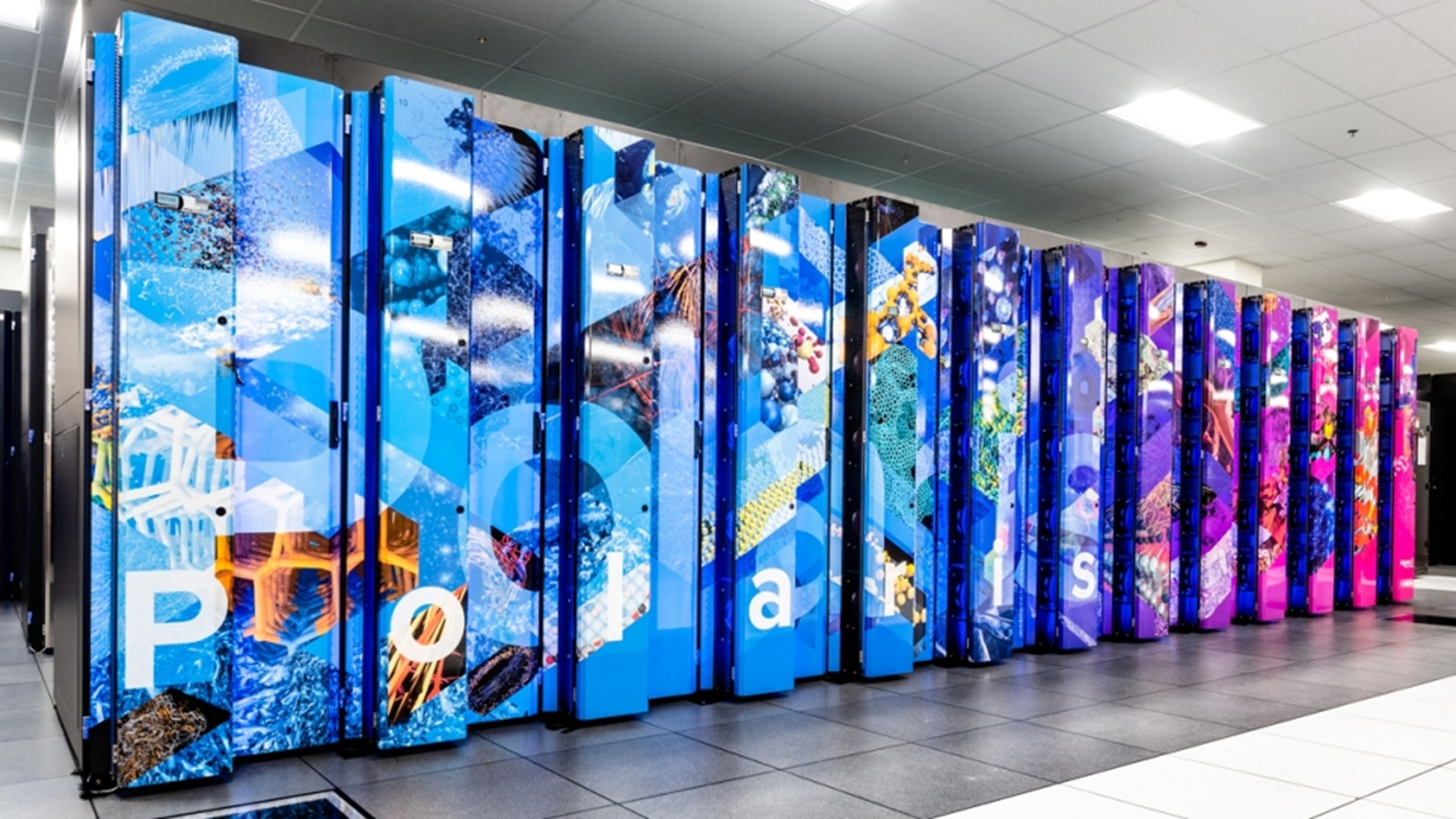
Scientists in the US have utilized the Polaris supercomputer to generate the most detailed three-dimensional (3D) images of the pion, the lightest particle made of quarks.

The study, which helped reveal the internal structure of a pion in unprecedented detail, was conducted by a research team at the US Department of Energy’s (DOE) Argonne National Laboratory (ANL).

Pions are subatomic particles that play a significant role in holding atomic nuclei together. “Pions mediate the strong force that binds nucleons, that is, the protons and neutrons that account for an atom’s mass,” Yong Zhao, PHD, an ANL physicist and principal investigator of the project, said.

According to the Zhao and the team, the findings reveal not only how quarks are arranged within the particle, but also offer new clues on how visible matter forms from fundamental particles. The latter is considered one of the biggest mysteries in physics.

Mapping the pion

Pions are among the lightest and simplest subatomic particles. They are governed by the strong force, which binds protons and neutrons together inside the atomic nuclei. This force accounts for 98 percent of the mass of the visible universe.

They’re also composed of a quark and an antiquark. Yet, despite their importance, scientists have struggled to examine their internal structure because experimental data remains limited. To overcome this challenge, ANL and Brookhaven National Laboratory researchers turned to large-scale computer simulations.

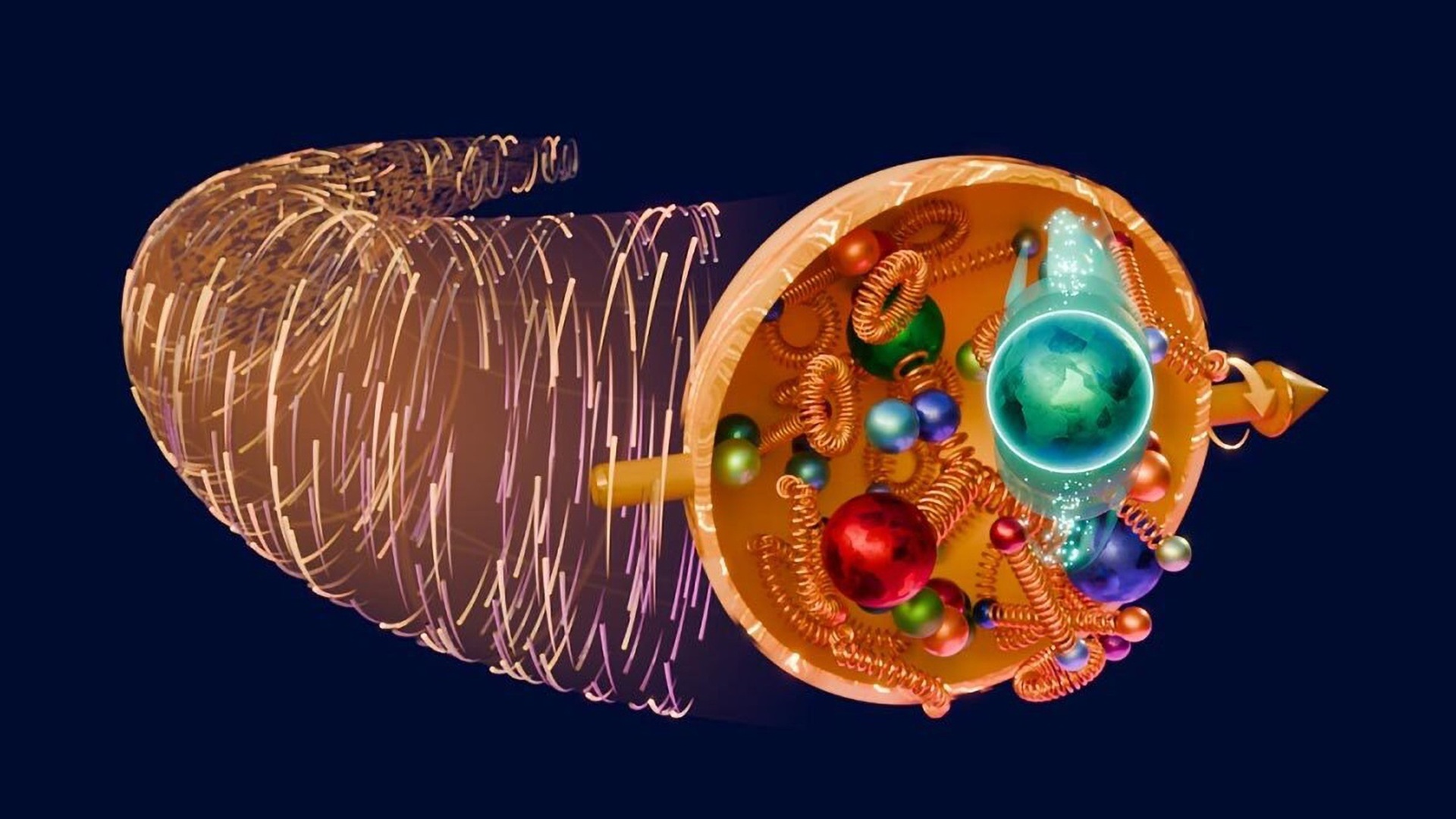
Graphic showing the transverse motion of a quark (green sphere) inside a proton whose spin is aligned to its direction of motion (large yellow arrow).
Graphic showing the transverse motion of a quark (green sphere) inside a proton whose spin is aligned with its direction of motion (large yellow arrow).
Credit: Valerie Lentz / Brookhaven National Laboratory.

The team combined advanced theoretical models with the computing power of Polaris. This reportedly recreated the pion’s internal structure in remarkable detail.

Zhao pointed out that examining the pion’s multidimensional structure provides a deeper insight into the particle’s fundamental properties. “By probing the pion’s internal structure, we gain a deeper understanding of how quarks and gluons are confined to create visible matter,” he said.

The simulations generated high-resolution 3D images that showed how quarks are distributed throughout the particle. Understanding this structure is essential for explaining how quarks and gluons combine to create the visible matter that makes up the universe.

A new perspective

For the project, the group simulated hundreds of snapshots of four-dimensional (4D) spacetime with lattice quantum chromodynamics. This is a technique that places particles and fields on a vast computational grid.

“This is a task possible only with large-scale parallel computing power like that of ALCF supercomputers,” Zhao said in a statement. “We thereby obtained high-resolution images of the quark structure in a moving pion.” The images showed how quarks carrying different fractions of the pion’s momentum are distributed across the particle.

The team modeled how quarks move both along the pion’s direction of motion and across it. The simulations relied on lattices with millions of grid points. “The simulation captures hundreds of snapshots of our 4D spacetime, represented on a lattice with millions of grid points,” Zhao added.

The calculations revealed the quark generalized parton distribution (GPD) of the pion. This is a mathematical framework that describes how quarks are distributed in both momentum and space. The resulting maps provided a detailed 3D picture of the particle.

As per Zhao, one notable finding was that the pion’s transverse size decreases as its momentum increases. The team also found that the pion appears smaller than the proton at moderate momentum values.

“Our next step is to use the ALCF’s Aurora supercomputer to map the proton in three dimensions,” Zhao concluded. “Protons, together with neutrons, make up all the atomic nuclei that compose the visible matter in our universe.”

The study has been published in the Journal of High Energy Physics.

💾

Researchers in the US have used the Polaris supercomputer to create the most detailed 3D images yet of a particle known as a pion.

Graphic showing the transverse motion of a quark (green sphere) inside a proton whose spin is aligned to its direction of motion (large yellow arrow).
  •  

Votre vie privée à portée de clic ? Une enquête révèle numéro de Sécu, IBAN, rendez-vous médicaux… par simple recherche !

Désormais n’importe qui peut trouver en quelques secondes où vous habitez, votre numéro de téléphone portable, et même vos informations bancaires ou médicales. Certains ont compilé les récentes fuites de données pour en faire un moteur de recherche. Ou plutôt des moteurs de recherche, car il...

  •  

TUDO PRA ACOMPANHAR O HEXA!

💾

Um dos recebidos tem 1TB de espaço, outro pode comandar a festa e o último promete precisão nos jogos. 👀 Qual deles ganhou sua atenção?

🔥 Garanta o produto que mais gostou!:
- Creator Pro Portable SSD SanDisk 1TB: https://amzn.to/4xcNC3G
- JBL PartyBox Encore 2: https://meli.la/1eUUyxo
- Mouse Acer Predator Cestus 327: https://tidd.ly/4ellSlI

NOS ACOMPANHE:
- Guia de Compras TecMundo: https://www.tecmundo.com.br/guia-de-compras/
- Newsletter do Guia de Compras: https://mailchi.mp/nzn/newsletter-guiadecompras
- Entre no nosso canal de ofertas no WhatsApp:
- Os melhores cupons Online para você! https://www.tecmundo.com.br/cupons

CRÉDITOS
Roteiro: Lívia Tomé
Apresentação: Lívia Tomé
Imagens e áudio: Bruno
Produção: Sara Helen da Silva e Guilherme Barbosa
Edição de vídeo: Joaquim Macruz
  •  

Touchscreen Macbook '100% Confirmed,' Says Reputable Leaker

A leaker with a strong Apple rumor track record says a touchscreen MacBook is "100% confirmed. If true, it would mark a major reversal for Apple, which has long argued that the Mac is built for indirect input rather than reaching up to touch a vertical screen. MacRumors reports: Instant Digital has a good track record for Apple rumors and has provided some strikingly accurate information in the past, so it's always worth noting what they have to say about Apple's plans. The claim is also backed by several recent reports. [...] Touchscreen support is expected to be one of several major upgrades coming to Apple's next-generation high-end MacBook Pro models. Other rumored features include M6 Pro and M6 Max chips, an OLED display, a Dynamic Island (i.e., no notch), and a thinner design. The new laptops could also adopt MacBook Ultra branding. Notably, macOS 27 Golden Gate also introduces a more touch-friendly interface, since Apple's Sidecar feature now allows users to tap and interact with macOS interface elements using a finger on their iPad. Apple apparently is not going to advertise the new MacBook Pro/Ultra as a touch-first device like the iPad -- it will be "touch-friendly, not touch-first," according to [Bloomberg's Mark Gurman]. In that sense, Apple will let customers use touch and mouse gestures interchangeably for all functions. Further reading: Steve Jobs Was Wrong About Touchscreen Laptops (2012)

Read more of this story at Slashdot.

  •  

NASA-Funded Research Follows Bird Flight; Birds Follow Their Noses

A person wearing a helmet with lights on the front holds a small black bird in his palm.
Lead researcher Federico De Pascalis of the Italian Institute for Environmental Protection and Research (ISPRA) holds a Mediterranean storm petrel.
A. Benvenuti

You might think birds skimming over the ocean wouldn’t seek wind unless it was pushing them in the right direction, but NASA-funded researchers have learned that storm petrels find stiff crosswinds worth the slowdown, in return for the clues and cues the gusts carry.

In a paper published by the Royal Society’s Biology Letters May 13, researchers from Woods Hole Oceanographic Institution (WHOI) and the Italian Institute for Environmental Protection and Research (ISPRA) found that Mediterranean storm petrels actively sought out crosswinds, which carried odors the birds used to navigate toward prey. The birds were effectively trading the extra energy needed to fly in a crosswind for the information it blows toward them.

These sparrow-sized birds routinely undertake foraging trips hundreds of miles over the sea, returning to the breeding colony to relieve their partners from incubation duties. Until recently, their small size has precluded researchers’ ability to tag them, keeping their journeys a mystery. In 2020 and 2021, working on the Italian island Sardinia, the team, led by ISPRA and WHOI, attached lightweight GPS sensors to the birds, adding just 3.3% of the birds’ weight as they set out over the Mediterranean Sea.

This finding could help reveal how changing winds might impact seabirds’ feeding, breeding, energy levels, and survival, adding insights about patterns of nutrients in the sea — and the forces that create them.

~Karen Romano Young

The post NASA-Funded Research Follows Bird Flight; Birds Follow Their Noses appeared first on NASA Science.

  •  

Microsoft Surface Flaw Allowed Unprotected Devices To Be Bricked By a Single Packet

Longtime Slashdot reader Dotnaught shares a report from The Register: For the past 90 days, Microsoft has been quietly patching a firmware flaw in Surface devices that allowed the hardware to be bricked with a single packet, though only for those who have disabled Secure Core and Secure Boot. And the company's Copilot AI software inadvertently helped identify the faulty firmware. According to Jack Darcy, a security researcher based in Australia, his instance of Microsoft Copilot stumbled across the bug after being asked to adjust the screen backlighting on a Surface device. The Copilot-conjured Python script ended up rendering the researcher's laptop inoperable by overwriting the embedded controller firmware. "Copilot autonomously created and executed four progressively aggressive Python scripts during a probe for backlight control values that sent raw SSAM ioctl commands (SSAM_CDEV_REQUEST = 0xC028A501) directly to the SAM microcontroller through the SAM software path," Darcy explained to The Register. [...] "We appreciate the work of Jack Darcy and The Register for reporting this issue under a coordinated vulnerability disclosure," a Microsoft spokesperson said in a statement. "Our investigation found that a deprecated UEFI interface could trigger a boot loop on some devices. To trigger this loop, the user must have administrator privileges and have already disabled the Secure Boot security feature. We have released updates to address the issue for most impacted devices." That means managed devices are not at risk. But those using Linux, or Windows users who have disabled Secure Core and Secure Boot for gaming, or who use custom Windows drivers, or who have USB boot enabled, may still be vulnerable if their systems haven't received the update. We're uncertain about the range of Surface devices affected. Our source said it appears to be all of them (Surface Laptops 3-6, Surface Book 1-3) except for Surface Go models. ARM variants, however, have not been tested. The report notes that Microsoft is planning to move the Surface stack to a more secure architecture based on Rust code. "Our most recent Surface for Business hardware features a major architectural shift in terms of improved reliability and security that spans our embedded controller, UEFI, but also some of our drivers," said David Abzarian, chief architect for Microsoft Surface. "We're investing in the most secure foundation for a PC by building our embedded controller firmware from the ground up in Rust (as part of leveraging and contributing to the Open Device Partnership (ODP)) in addition to a rewrite of the UEFI DXE Core in Rust; these projects are known as Secure EC and Project Patina respectively." "We're also not only shipping some of our drivers written in Rust, but also helping co-develop the framework Windows Drivers in Rust (WDR) to help enable a broad set of partners in the Windows ecosystem to capitalize on these benefits. I will also note that all of these efforts are open-source promoting one of our key security principles around transparency."

Read more of this story at Slashdot.

  •  

Ancient Meteorite Reveals a Forgotten Planet That Existed 4.5 Billion Years Ago

Comet on Fire Meteor EarthA rare meteorite recovered from the Sahara Desert has revealed compelling evidence for a long-lost world that existed during the solar system’s earliest days. About 4.5 billion years ago, a large planetary body, potentially as large as the Moon or even Mars, orbited the Sun before colliding with another object and breaking apart. Now, researchers [...]
  •  
❌