❌

Reading view

Why can’t we simply replace lithium with sodium in batteries?

Author: Iñigo Careaga, strategy & communication manager, CIC energiGUNE
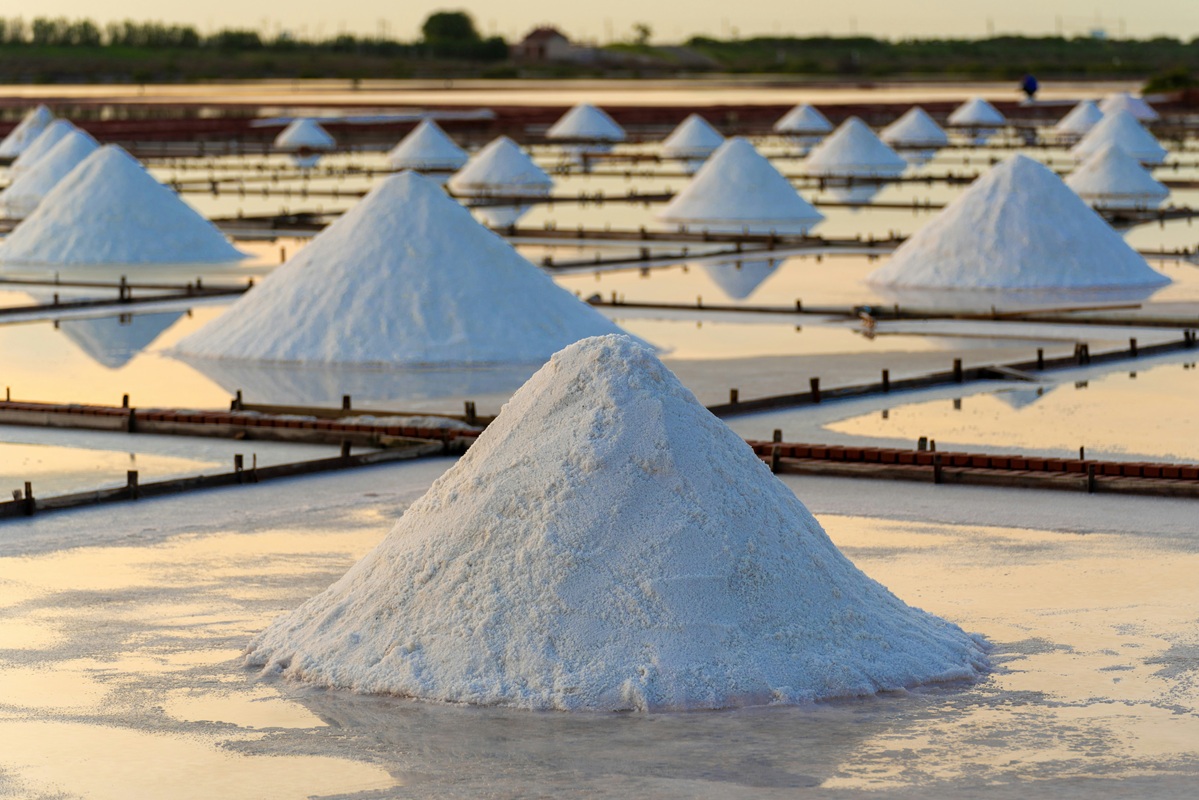
sodium
Photo: Timo Volz / Unsplash

Lithium and sodium are neighbours in the periodic table. Both are alkali metals, both have a single electron in their outer shell, and both can be used to shuttle ions between two electrodes to store and release electrical energy. At first sight, replacing lithium with sodium in a rechargeable battery might therefore seem straightforward.

There are good reasons to try. Sodium is widely available and sodium-ion batteries can rely on electrode materials containing abundant elements such as iron and manganese. But chemical similarity does not mean electrochemical equivalence. A sodium ion is larger and heavier than a lithium ion, and its interaction with the materials surrounding it is different. As a consequence, replacing Li+ with Na+ changes much more than the identity of the charge carrier.

The electrodes have to accommodate a different ion. Their structures may respond differently as sodium is inserted and removed. The electrolyte has to transport and solvate it. New interfaces form between the electrolyte and the electrodes. Even graphite, the standard anode material of most commercial lithium-ion batteries, does not store sodium under conventional conditions nearly as effectively as it stores lithium 1.

A sodium-ion battery is therefore not simply a lithium-ion battery containing a different element. Understanding why requires looking at what happens to sodium once it enters the battery.

Graphite does not play by the same rules

Charging a conventional lithium-ion battery involves moving lithium ions from the positive electrode through the electrolyte and storing them in the negative electrode. Graphite is particularly good at this job. Its carbon atoms are arranged in sheets, and lithium can reversibly occupy the spaces between them, a process known as intercalation. It would be convenient if sodium behaved in the same way. It largely does not.

The poor ability of conventional graphite to accommodate sodium has long been one of the reasons why lithium-ion concepts cannot simply be transferred to sodium-ion batteries. Instead, one of the most widely studied negative-electrode materials is hard carbon 2.

Hard carbon is still carbon, but structurally it is very different from graphite. Rather than a regular stack of extended carbon sheets, it contains disordered graphitic domains, defects and pores. This disordered architecture provides environments in which sodium can be stored, but it also makes the underlying mechanism considerably harder to describe.

Where exactly does the sodium go? Researchers have proposed contributions from adsorption at defects and surfaces, insertion between graphitic layers and storage associated with nanopores. The relative importance of these mechanisms depends on the structure and microstructure of the carbon. This is more than a microscopic detail: where and how sodium is stored determines the voltage profile, reversible capacity, first-cycle losses and, ultimately, the energy that a complete cell can deliver.

Researchers at CIC energiGUNE and collaborators have studied this connection between charge-storage mechanisms, carbon structure and electrochemical performance 3. Their analysis highlights an important point: maximizing the amount of sodium that an anode can store is not enough. The potential at which that storage occurs and the irreversible losses during the first cycle are equally important when the material is incorporated into a full battery.

The problem is therefore not simply to find a carbon that accommodates more sodium. It is to understand how its structure stores sodium and then engineer that structure so that capacity, voltage and efficiency improve together. This has led researchers to explore different ways of controlling hard-carbon structure, including the use of lignocellulosic biomass as a precursor. Work has shown that even apparently simple processing decisions, such as acid treatment of the biomass precursor, can affect the resulting carbon and its behaviour as a sodium-ion anode 4.

And the negative electrode is only half of the problem. At the positive electrode, sodium ions have to repeatedly leave and re-enter a solid structure. Layered transition-metal oxides are attractive candidates because sodium can be reversibly extracted from and inserted into spaces between layers of metal and oxygen atoms. Compositions based on relatively abundant elements such as iron and manganese are particularly interesting 5.

Again, however, accommodating sodium is not enough. The host structure has to survive the process. A useful example is the layered oxide P2-Na₂/₃[Fe₁/₂Mn₁/₂]O₂, investigated by researchers from CIC energiGUNE and collaborators 6. The material can provide high capacity, but its long-term stability strongly depends on the voltage range over which it is operated.

This produces a familiar battery dilemma. Increasing the operating voltage can increase the amount of energy extracted from a material. But pushing the electrode further can also trigger structural transformations that make subsequent cycles less reversible.

The researchers compared cells operating in different voltage windows and combined electrochemical measurements with structural characterization and theoretical calculations. Above approximately 4.0 V versus Na+/Na, the cathode undergoes a high-voltage phase transition. Avoiding this transition improves capacity retention, revealing a direct connection between the structural state of the electrode and its long-term electrochemical behaviour.

Changing the chemical composition can also alter this structural response. In another study, researchers investigated the effect of introducing titanium into sodium manganese-rich layered oxides 7. A certain degree of Ti substitution helped the crystal structure accommodate electrochemically induced strain. Too little was insufficient to stabilize it, while further substitution introduced other destabilizing effects.

Other studies have approached the same problem from a different angle, examining how the precise stoichiometry of P2 layered oxides affects their performance 8, or following their structural evolution under different current rates and dopants using operando techniques 9. The lesson is that there is no single property called “a good sodium cathode”. Composition, atomic arrangement, voltage and cycling conditions are interconnected. Even an element that does not directly provide the stored charge can determine how well the electrode survives sodium repeatedly moving through its structure.

A different chemistry

Layered oxides are not the only possible positive electrodes. Sodium chemistry allows other structural families to be explored.

One particularly instructive example is NaFePO₄, the sodium analogue of the well-known lithium iron phosphate chemistry. Researchers involving CIC energiGUNE have used in situ X-ray diffraction to follow how NaFePO₄ changes during sodium insertion and extraction 10. They have also shown that the reaction mechanism itself depends on how rapidly the electrode is charged or discharged 11.

This is a subtle but important point. We often describe an electrode material as if it had a fixed reaction mechanism. In practice, what happens inside it can depend on how the battery is operated. Computational work has gone further by investigating sodium diffusion in NaₓFePO₄ 12. Combining experiments and modelling in this way makes it possible to connect what is observed at the battery level with the motion of ions through an atomic structure.

But even understanding both electrodes is not enough. Between them lies the electrolyte, and the sodium ion spends much of its journey there. It becomes surrounded by solvent molecules, travels across the cell and eventually reaches an electrode surface. At that interface the electrolyte can decompose, producing a solid-electrolyte interphase, or SEI.

This apparently thin layer can have a disproportionate influence on battery behaviour. Researchers at CIC energiGUNE have investigated both the composition and evolution of the SEI in sodium-ion electrodes 13 and, more broadly, the relationship between electrode-electrolyte interphases, transport properties and electrochemical performance in non-aqueous sodium-ion batteries 14.

The interface illustrates particularly well why changing lithium for sodium is not a simple substitution. The chemistry of the ion influences its solvation, its transport and the decomposition reactions that occur when it reaches an electrode. A material that can reversibly store sodium may still perform poorly if the interface around it continuously consumes electrolyte or sodium during cycling.

This is why sodium-ion research has to consider the cell as a system. Graphite may have to give way to hard carbon. Positive electrodes require structures able to tolerate repeated sodium insertion and extraction. Electrolytes and additives have to create suitable transport conditions and stable interfaces.

And every attempt to solve one of these problems can affect the others.

Sodium is not the new lithium

Lithium has a fundamental advantage that materials engineering cannot simply remove: it is the lightest metal and has a very low electrochemical potential. Sodium is heavier and its electrochemical potential is less favourable, placing intrinsic constraints on the gravimetric energy density that sodium-ion batteries can reach.

That does not necessarily make sodium a worse battery chemistry. Energy density is only one parameter of an electrochemical storage system. Cost, raw-material availability, lifetime, power, safety and operating temperature can become equally important depending on the application. A battery designed for a mobile phone, an electric vehicle or stationary storage does not necessarily have to optimize the same variables. And sodium chemistry itself offers several possible ways of balancing them.

CIC energiGUNE researchers have explored, for example, low-cost phosphate-based cathodes for aqueous sodium-ion batteries 15, Prussian Blue compounds as positive electrodes in aqueous systems 16, alternative sodium layered oxides [5,8,9], hard-carbon anodes [2,3,4] and even materials such as NaTiOPO₄ designed to modify or potentially avoid some of the interfacial problems normally associated with sodium-ion anodes 17.

These are not different routes towards exactly the same battery. They represent different ways of deciding which compromises are acceptable.

This changes the original question. The relevant challenge may not be how to make sodium behave as much like lithium as possible. Research on hard carbons shows that sodium may require a different type of host structure. Work on layered oxides shows that extracting more energy from an electrode can alter its structure and compromise its stability. Studies of NaFePO₄ show that the reaction pathway itself can depend on cycling conditions. And research on interfaces shows that storing sodium reversibly is only part of the problem: the chemistry taking place around the active material matters as well.

Sodium-ion batteries are therefore not lithium-ion batteries in which one element has simply been exchanged for another. Changing the ion changes the materials that host it, the structures they adopt, the reactions they undergo and the interfaces they form.

Sodium may not need to beat lithium at its own game. The more interesting question is whether understanding its different chemistry will allow us to play a different one.


The BRTA is a consortium that remains a step ahead of future socio-economic challenges worldwide and in the Basque Autonomous Community; it addresses them through research and technological development, thus projecting itself internationally. The BRTA centres collaborate to generate knowledge and transfer it to Basque society and industry so as to make them more innovative and competitive. The BRTA is an alliance of 17 R&D centres and cooperative research centres with the support of the Basque Government, the SPRI and the Chartered Provincial Councils of Araba, Bizkaia and Gipuzkoa.

 

References

  1. Muñoz-Márquez, M. A., Saurel, D., Gómez-Cámer, J. L., Casas-Cabanas, M., Castillo-Martínez, E. & Rojo, T. Na-Ion Batteries for Large Scale Applications: A Review on Anode Materials and Solid Electrolyte Interphase Formation. Advanced Energy Materials 7, 1700463 (2017). DOI: 10.1002/aenm.201700463. ↩
  2. Xiao, B., Rojo, T. & Li, X. Hard Carbon as Sodium-Ion Battery Anodes: Progress and Challenges. ChemSusChem 12, 133–144 (2019). DOI: 10.1002/cssc.201801879. ↩
  3. Saurel, D., Orayech, B., Xiao, B., Carriazo, D., Li, X. & Rojo, T. From Charge Storage Mechanism to Performance: A Roadmap toward High Specific Energy Sodium-Ion Batteries through Carbon Anode Optimization. Advanced Energy Materials 8, 1703268 (2018). DOI: 10.1002/aenm.201703268. ↩
  4. Dou, X., Hasa, I., Saurel, D., Jauregui, M., Buchholz, D., Rojo, T. & Passerini, S. Impact of the Acid Treatment on Lignocellulosic Biomass Hard Carbon for Sodium-Ion Battery Anodes. ChemSusChem 11, 3276–3285 (2018). DOI: 10.1002/cssc.201801148. ↩
  5. Gonzalo, E., Zarrabeitia, M., Drewett, N. E., López del Amo, J. M. & Rojo, T. Sodium manganese-rich layered oxides: Potential candidates as positive electrode for Sodium-ion batteries. Energy Storage Materials 34, 682–707 (2021). DOI: 10.1016/j.ensm.2020.10.010. ↩
  6. Zarrabeitia, M., Nobili, F., Lakuntza, O., Carrasco, J., Rojo, T., Casas-Cabanas, M. & Muñoz-Márquez, M. A. Role of the voltage window on the capacity retention of P2-Na₂/₃[Fe₁/₂Mn₁/₂]O₂ cathode material for rechargeable sodium-ion batteries. Communications Chemistry 5, 11 (2022). DOI: 10.1038/s42004-022-00628-0. ↩
  7. Zarrabeitia, M. et al. Unraveling the role of Ti in the stability of positive layered oxide electrodes for rechargeable Na-ion batteries. Journal of Materials Chemistry A 7, 14169–14179 (2019). DOI: 10.1039/C9TA02710F. ↩
  8. Ortiz-Vitoriano, N. et al. High performance P2 sodium layered oxides: an in-depth study into the effect of rationally selected stoichiometry. Journal of Materials Chemistry A 7, 21812–21826 (2019). DOI: 10.1039/C9TA07346A. ↩
  9. Stansby, J. H. et al. Dopant and Current Rate Dependence on the Structural Evolution of P2-Na₂/₃Mn₀.₈Zn₀.₁M₀.₁O₂ (M = Cu, Ti): An Operando Study. Chemistry–Methods 1, 295–304 (2021). DOI: 10.1002/cmtd.202000075. ↩
  10. Galceran, M., Saurel, D., Acebedo, B., Roddatis, V. V., Martin, E., Rojo, T. & Casas-Cabanas, M. The mechanism of NaFePO₄ (de)sodiation determined by in situ X-ray diffraction. Physical Chemistry Chemical Physics 16, 8837–8842 (2014). DOI: 10.1039/C4CP01089B. ↩
  11. Saurel, D., Galceran, M., Reynaud, M., Anne, H. & Casas-Cabanas, M. Rate dependence of the reaction mechanism in olivine NaFePO₄ Na-ion cathode material. International Journal of Energy Research 42, 3258–3265 (2018). DOI: 10.1002/er.4078. ↩
  12. Bonilla, M. R., Lozano, A., Escribano, B., Carrasco, J. & Akhmatskaya, E. Revealing the Mechanism of Sodium Diffusion in NaₓFePO₄ Using an Improved Force Field. The Journal of Physical Chemistry C 122, 8065–8075 (2018). DOI: 10.1021/acs.jpcc.8b00230. ↩
  13. Muñoz-Márquez, M. A., Zarrabeitia, M., Castillo-Martínez, E., Eguía-Barrio, A., Rojo, T. & Casas-Cabanas, M. Composition and Evolution of the Solid-Electrolyte Interphase in Na₂Ti₃O₇ Electrodes for Na-Ion Batteries: XPS and Auger Parameter Analysis. ACS Applied Materials & Interfaces 7, 7801–7808 (2015). DOI: 10.1021/acsami.5b01375. ↩
  14. Muñoz-Márquez, M. A., Zarrabeitia, M., Passerini, S. & Rojo, T. Structure, Composition, Transport Properties, and Electrochemical Performance of the Electrode-Electrolyte Interphase in Non-Aqueous Na-Ion Batteries. Advanced Materials Interfaces 9, 2101773 (2022). DOI: 10.1002/admi.202101773. ↩
  15. Fernández-Ropero, A. J., Zarrabeitia, M., Reynaud, M., Rojo, T. & Casas-Cabanas, M. Toward Safe and Sustainable Batteries: Na₄Fe₃(PO₄)₂P₂O₇ as a Low-Cost Cathode for Rechargeable Aqueous Na-Ion Batteries. The Journal of Physical Chemistry C 122, 133–142 (2018). DOI: 10.1021/acs.jpcc.7b09803. ↩
  16. Fernández-Ropero, A. J., Piernas-Muñoz, M. J., Castillo-Martínez, E., Rojo, T. & Casas-Cabanas, M. Electrochemical characterization of NaFe₂(CN)₆ Prussian Blue as positive electrode for aqueous sodium-ion batteries. Electrochimica Acta 210, 352–357 (2016). DOI: 10.1016/j.electacta.2016.05.176. ↩
  17. Galceran, M., Rikarte, J., Zarrabeitia, M., Pujol, M. C., Aguiló, M. & Casas-Cabanas, M. Investigation of NaTiOPO₄ as Anode for Sodium-Ion Batteries: A Solid Electrolyte Interphase Free Material? ACS Applied Energy Materials 2, 1923–1931 (2019). DOI: 10.1021/acsaem.8b02040. ↩

The post Why can’t we simply replace lithium with sodium in batteries? appeared first on Mapping Ignorance.

  •  

Metal stays tough at cryogenic temperatures

Scientists have discovered a class of metal that can unexpectedly resist extreme cold using an unusual mechanism. Normally such temperatures would make similar materials brittle and vulnerable to breaking. The findings point to new principles for designing materials for cryogenic environments.

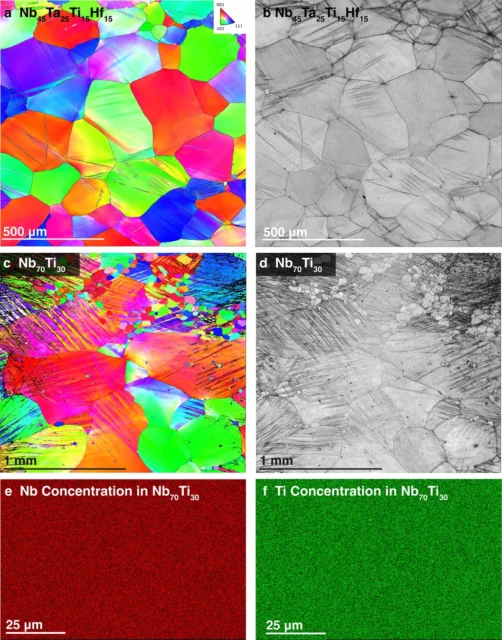
An international team led by University of California, Berkeley, Lawrence Berkeley National Laboratory and the University of Oxford has uncovered 1 a novel microscopic mechanism that allows two metal alloys to remain remarkably damage-tolerant at just 20 kelvin, or -253°C.

Most metals become stronger when they are cooled, but some pay a price. The class of metals called body-centred cubic metals (such as iron, tungsten and chromium) have a particular atomic structure which can make them increasingly brittle as temperatures fall. At extremely low temperatures, a crack that might normally be absorbed by the metal bending or deforming can instead cause it to fracture.

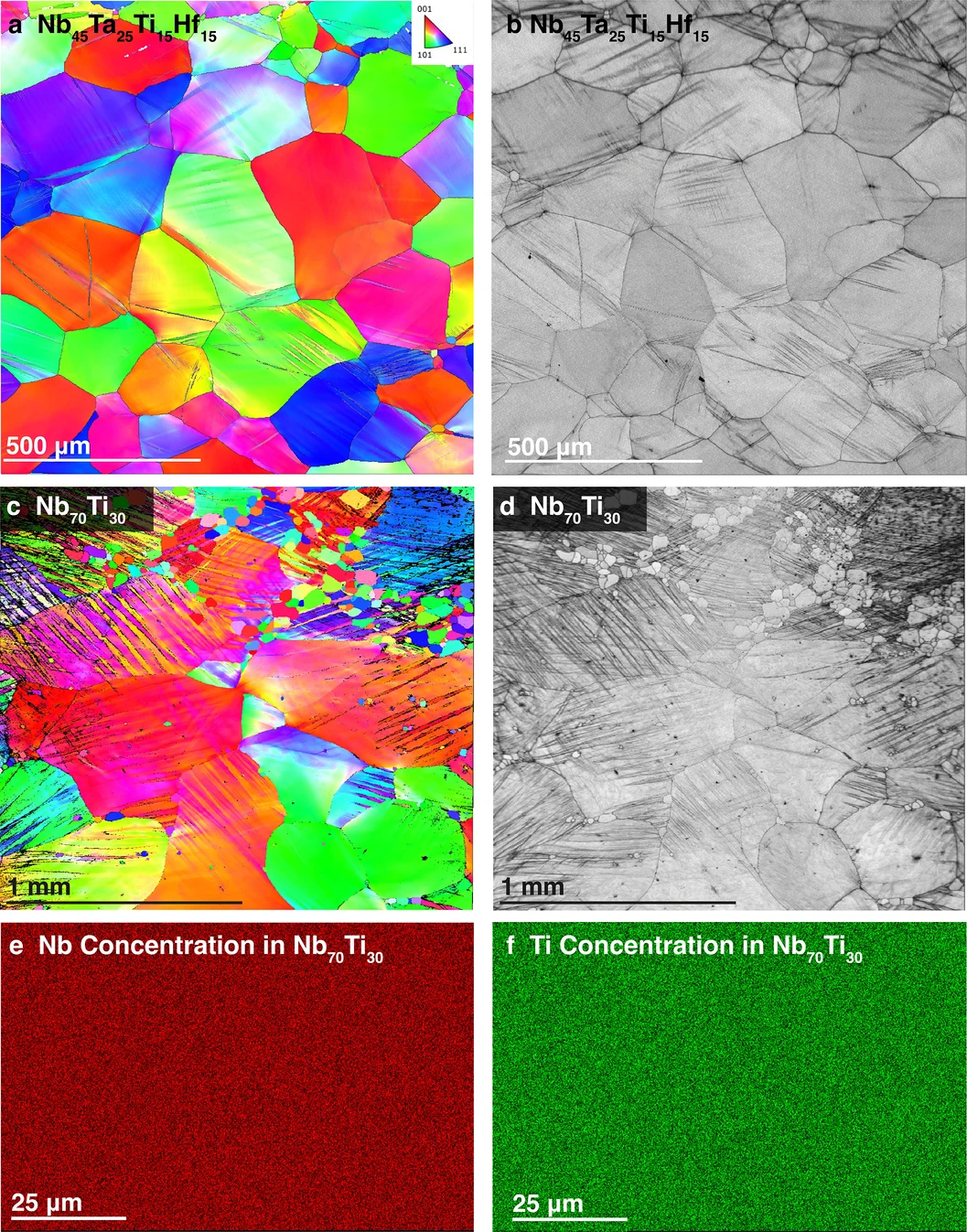
The new study discovered that two experimental niobium-titanium-based alloys can avoid this problem even at just 20 kelvin, or -253°C. The metals remained remarkably resistant to cracking, with no measurable transition to brittle behaviour at the lowest temperature tested. The researchers found that this is due to the alloys effectively switching how they deform as they enter the deep freeze.

cryogenic
Source: Cook, D.H. et al. (2026) Nature doi: 10.1038/s41586-026-11065-7 CC BY 4.0

Normally, bending and deformation of body-centred cubic metals relies heavily on the movement of line-like defects in their crystal structure known as dislocations. At low temperatures, these become increasingly difficult to move, restricting the material’s ability to deform around a crack and making a fracture more likely.

In the alloys studied, however, a different process takes over. The researchers observed nanoscale ‘twinning’, in which small regions of the crystal reorganise into mirror-image orientations, coupled with a local transformation of the crystal structure. When these newly formed structures reach the boundaries between neighbouring crystals, they create concentrated points of stress that trigger new defects in the metal. These defects then allow the material to keep deforming rather than cracking.

The process is a little like a road network responding to frozen, blocked roads by opening new routes. As the conventional routes for deformation become increasingly difficult to use, the formation of twins creates new sites from which the defects needed for deformation can emerge. This helps the metal to absorb the forces building up around a crack, rather than breaking.

The discovery could provide scientists with a new strategy for designing metals capable of operating in exceptionally cold environments, including for energy, transport and aerospace sectors.

To find out how the alloys behaved in such extreme cold, the researchers used the Engin-X instrument at the ISIS Neutron and Muon Source in Oxfordshire. They cooled samples to around -253°C using gaseous helium. They then exposed the samples to a beam of neutrons while a testing machine pulled them from either end, precisely measuring how much force they could withstand and how far they stretched before breaking.

The team then used powerful electron microscopes to examine the tested metal at extremely small scales, allowing them to see the tiny structural changes that had taken place around cracks and inside the material. They also used atom-probe analysis to map the distribution of individual elements, alongside computer modelling to understand how the different mechanisms worked together to prevent brittle failure.

The study involved researchers from the University of California, Berkeley; Lawrence Berkeley National Laboratory; the University of Oxford; the University of Bristol; the ISIS Neutron and Muon Source, Science and Technology Facilities Council; the University of California, Irvine; Pacific Northwest National Laboratory; Texas A&M University; and Nanyang Technological University in Singapore.

References

  1. Cook, D.H., Chen, X., O’Leary, M. et al. (2026) Competing mechanisms toughen bcc binary and medium-entropy alloys at 20 K. Nature doi: 10.1038/s41586-026-11065-7 ↩

The post Metal stays tough at cryogenic temperatures appeared first on Mapping Ignorance.
  •  

Why social sciences are natural ones (1)

social sciences
It is a common practice to associate social sciences and arts. Photo:  Chunjiang / Unsplash

Once upon a time, in a world very far from ours, there were a group of scientists devoted to the study of bacteria, or prokaryotes, who called themselves ‘biologists’, and a different group of researchers, who studied eukaryote organisms, and who received the name of ‘organismologists’. Organismologists were very proud of the obvious differences between their discipline and that of the biologists, and flagged those differences every time they needed to show that organismology was a science wholly independent of biology, completely ‘irreducible’ to it, and who demanded a totally different set of concepts, principles, and research methods, far more significant than the more or less trivial similarities between both disciplines and their objects. After all, this was a matter of common sense: for example, the concept of an ‘organ’ or ‘digestive system’, or the principles of sexual reproduction, do not apply to bacteria save in a very metaphoric sense; indivual organisms of the same species (for example, siblings) have usually great and important differences between them to an extent that bacteria of the same type have not; and also most multicellular organisms, contrarily to prokaryotes, can often be observed and manipulated without the need of very sophisticated instruments. Organismologists accepted, as a matter of course, that eukaryote organisms had evolved millions of years ago from bacteria, that both types of beings shared a common biochemistry and genetics (though much more complex in the case of eukaryotes), and that both types of beings engaged in lots of mutual relations, so strongly that, in general, bacteria are fundamental for the life of eukaryotes, either as prey, as parasites, or as symbionts. But all this was not relevant enough to turn into ashes the obvious truth that the systems in which multicellular organisms (and even unicellular eukaryotes) consisted were so complex and radically different from the simplicity of bacteria, as to deserve a completely independent field for their systematic study. ‘We would not understand anything important about organisms’, leading organismologits used to proclaim, ‘if we were forced to describe them as mere aggregates of individual bacteria… what very probably they are, of course’.

I think that nearly everybody that knows something about biology in our own world would easily realised that organismologists were right in some sense (eukaryotes, and particularly multicellular organisms, are terribly more complex than bacteria, and ‘irreducible’ to these in many ways), but wrong in other sense (their fields of study are not really that ‘heterogeneous’). I shall argue in this series that the situation of social scientists resisting the ‘naturalisation’ of their disciplines is similar to the resistance of organismologists to be considered as just a ‘branch’ of a deeper and more general discipline called ‘biology’: they are right in pointing to the significant differences between ‘social systems’ and ‘(simpler?) living systems’, but these differences do not ground the conclusion that social science is not a ‘natural’ science. I will also try to argue, however, that, due to some features of social systems, the undavoidable ‘naturalistic nature’ of social sciences gives little comfort to those optimists who might have thought that social sciences could turn ‘more scientific’ by recognising their own naturalness. So, my conclusion will be something like acknowledging that, it is not that  social sciences ‘should’ be naturalised, but that they are ‘natural sciences’ as they are, but that they probably cannot become significantly more ‘successful’ in an empirical or theoretical sense as they are now.

Naturalism (see, e.g., Ross 2011) is usually seen by many social scientists and philosophers of the social sciences as a frightening menace, and often as a completely wrong and misguided approach. It is usually amalgamated with other philosophical monsters, such as positivism or reductionism, and at times even with ‘realism’ or ‘rationalism’ (forming with them a very poisonous combination often referred to as ‘scientism’). I will discuss in this series the often proclaimed conflict of social, or human, sciences with naturalism, reductionism and positivism, and why I think that social scientists should not worry at all at any of these three supposed Behemoths. Let’s start with positivism. So many horrible things have been said about positivism, that now it passes as a matter of fact that one should not be a positivist; particularly, the story is often told that those sciences, both natural, social or hermeneutic, that tried to rigidly follow the precepts of positivism, ended in something similar to a ‘brain death’ state, with nothing interesting to discover about their realm of study. For many of these critics, as well as for some visionary scientists that tried to apply those precepts, ‘positivism’ seemed to be reducible to the boring inductivist strategy of collecting as many single data one can, and then finding out by mere statistical recounting all the ‘regularities’ those data might happen to exhibit. Of course, no real science actually works in this naively Baconian way, nor most self proclaimed (and much less those merely referred to by others as) ‘positivist’ philosophers, have defended such a caricaturesque idea of the scientific method. But even when a more liberal and benevolent description of the positivist admonitions is adopted, most people in the social sciences still reject that positivism is a sensible methodological approach. Just to take an example of this criticism, consider a paper by Isaac Reed (2010). Reed starts by making a distinction between the ‘context of investigation’ (i.e., what the social scientist does) and the ‘context of explanation’ (i.e., what the social scientist is trying to explain, the object she studies). According to Reed, the basic mistake of what he calls ‘positivism’ is the normative relation that is assumed to exist between both contexts:


Positivism begins with a reduction of the context of investigation to the rules of logic and to a precise language whose meanings are transparent to those in the scientific community who use it. It also proposes that the context of explanation be reduced to that which can be observed—and, to a great degree, that which can be measured. Then, through the process of inductive generalization, covering laws are imported from the context of explanation to the context of investigation. (Reed, 2010, 24; bold font words are original’s italics).


Besides the fact that it seems to be inconsistent to assert that “positivism reduces the context of investigation to the rules of logic and to a precise language” just a few lines after having asserted that “the context of investigation would include both of Reichenbach’s contexts (of discovery and justification)” (my italics), for positivists’ ‘context of discovery’ was explicitly taken as not reducible to logical rules, Reed’s explanation is rather obscure about what the ‘importation’ from one context to the other would consists of. Perhaps this simply means that the regularities that are observed in the ‘context of explanation’ are ‘accepted’ or at least ‘proposed’ in scientific papers or books (but, if it is so, what’s wrong with it?). And Reed makes a caricature of the process of ‘importation’ by reducing it to ‘inductive generalization’, overlooking the essential role of hypotheses and theories, as well as of abductive and analogical methods (that only in the most extreme and unrealistic views of science of some positivist philosophers were considered as illegitimate, if at all). The consideration of hypotheses also allows to see that it is an oversimplification to assert that in the context of explanation only ‘what can be observed’ counts: if by ‘observation’ it is understood exclusively what is observable ‘by the naked eye’, then the assumption is false about how science, even social science, works (for all ‘observation’ is ‘theory laden’, and most data are extremely sophisticated entities; consider, for example, empirical data inflation rates); if, instead, ‘observation’ is taken to mean ‘anything that is intersubjectively detectable by some means’, then one does not see what’s wrong in taking into account only ‘observable’ things in what you want to scientifically describe and explain: is Reed suggesting that social scientists must assert things about which there is absolutely no way to empirically determine whether they are as we are asserting? I doubt it.


References

Reed, I., 2010, “Epistemology Contextualized: Social Scientific Knowledge in a Post-Positivist Era.” Sociological Theory. 28, 61-80.

Ross, D., 2011, “Naturalism: the place of society in nature”, in Jarvie, I., and J. Zamora Bonilla (eds.), The SAGE Handbook of Philosophy of Social Sciences, London, Sage, 121-136.


The post Why social sciences are natural ones (1) appeared first on Mapping Ignorance.

  •  

Computation sorts thousands of 2D crystals for topology and twisting


In 2004, physicists isolated graphene, a sheet of carbon just one atom thick. It launched the study of two-dimensional (2D) materials: crystals a few atoms thick in which electrons are confined to a plane and can behave quite differently from those in ordinary solids. The family of known and predicted 2D crystals has since grown to thousands of members. Two recent studies show how computation can search that family for the most promising ones, the first for unusual electronic “topology”, the second for crystals well suited to twisting.

A hidden property of electrons

Electrons in a crystal can only have energies within allowed ranges called bands, separated by forbidden gaps. If a gap separates the filled electrons from the empty states, the material is an insulator. In a semimetal, filled and empty bands just touch, so a few electrons can move freely.

Two insulators can still differ at a deeper level, described by topology: a property of the whole set of electron states that cannot change smoothly, only by closing the gap or breaking a protecting symmetry. A doughnut and a coffee mug are topologically alike because each has one hole, and neither can become a sphere without tearing.

The idea took off with the quantum spin Hall effect. Proposed for graphene in 2005, it proved unobservable there because the effect is far too weak. A 2006 proposal for thin layers of mercury telluride was confirmed in 2007. In such a topological insulator the interior blocks current, yet the edges conduct, with electrons of opposite spin travelling in opposite directions, which protects them against many kinds of imperfection.

Symmetry-based methods known as topological quantum chemistry in 2017 made it possible to decide whether a computed electronic structure is topological. Applied to three-dimensional crystals, they pointed to thousands of candidates. Flat crystals lagged behind, with only about 400 known topological or related monolayers.

The first study, “Two-dimensional Topological Quantum Chemistry and Catalog of Topological Materials” 1, adapts these methods to 2D crystals and applies them to 8,872 entries in two computational databases. It finds 4,073 with nontrivial topology or a related property called obstruction, including 905 topological insulators, 2,129 topological semimetals and 1,003 obstructed atomic insulators, plus 36 close variants. In an obstructed insulator the electrons are centred on empty positions between the atoms rather than on the atoms themselves. The bulk looks ordinary, but cutting the crystal along certain lines produces edge states, and small flakes can carry fractions of an electron’s charge at their corners. The study also calculates edge states for selected materials. Its catalogue includes over 100 monolayers already made in laboratories, but most entries are computer predictions whose properties remain to be tested.

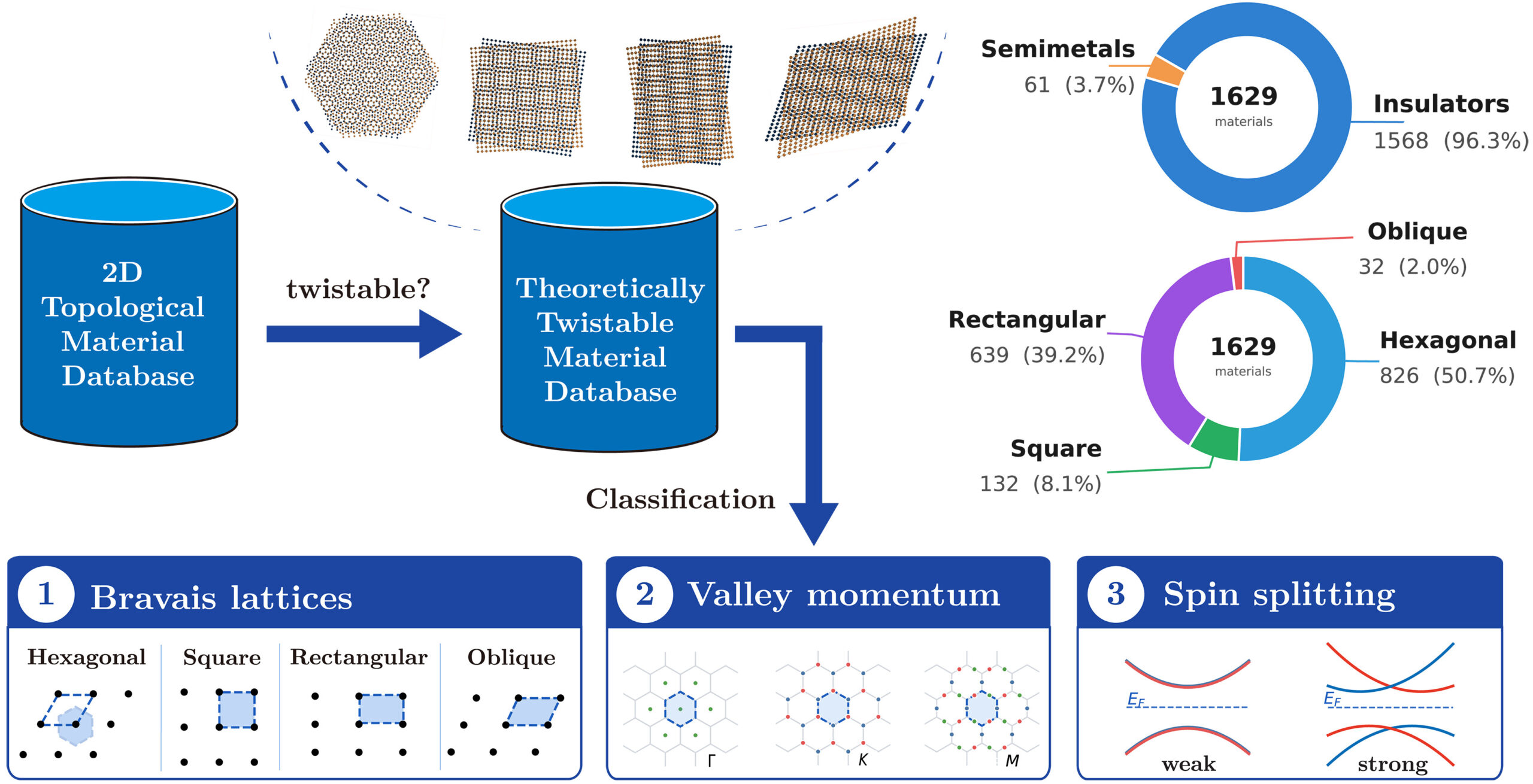
Workflow of the database construction. Starting from a 2D topological material database, a filtering score is applied to construct a database of theoretically twistable materials, which includes both semimetals and insulators. The candidate materials in this database are further classified according to their Bravais lattices, valley splitting, and spin splitting. Source: Y. Jiang et al. (2026) Science doi:10.1126/science.adu1550

Twisting layers

Stack two atomic sheets and rotate one slightly, and the mismatch creates a large interference pattern, called a moiré pattern, much like two overlapping window screens. Electrons feel this longer repeating pattern, and under the right conditions their bands become nearly flat. Electrons in a flat band have little energy of motion, so their mutual repulsion dominates and strongly correlated behaviour can emerge.

In 2011, calculations predicted that two graphene sheets twisted by about 1.1 degrees, a “magic angle”, would have such flat bands. In 2018, experiments at that angle revealed insulating states caused by electron repulsion, and superconductivity. Twisted layers of other materials, such as MoTe2 and WSe2, have since shown many correlated phases, though the mechanisms are still debated.

Most work has focused on these few materials, because most crystals have electronic structures too complicated to predict once twisted. The second study, “2D theoretically twistable material database” 2, therefore defines a material as theoretically twistable if its low-energy electrons admit a simple description. In a metal, the relevant electrons must sit at isolated points, as in graphene. In an insulator, the top of the filled band or the bottom of the empty band must stand clear of other bands. Insulators must also have gaps between 0.2 and 3 electronvolts, because larger gaps make electrical contacts difficult. The search was limited to crystals with at most 12 atoms in the repeating cell and four chemical elements.

Starting from the first study’s database, it identifies 61 semimetals and 1,568 insulators. It ranks them with a score and sorts them by lattice shape (about half are hexagonal), by where in momentum space the relevant electrons sit, and by the strength of spin-orbit coupling, the link between an electron’s spin and its motion. These choices shape the moiré pattern, which can resemble honeycomb, kagome or square lattices. Square-lattice moiré systems have been proposed but not yet realized, and could help simulate models relevant to cuprate superconductors.

Calculations on twisted bilayers of SnSe2, SnS2, ZrS2, HfS2 and Sc2CCl2 at a twist of about 7 degrees show isolated flat bands, as the database predicts. Experiments connect the theory to the laboratory. Bulk crystals of SnSe2, SnS2, HfS2, GaTe and ZrNCl were grown. Single layers of several candidates, including SnSe2, HfSe2, ZrS2 and WS2, were peeled off with a gold-assisted technique that yields larger, cleaner flakes. A dual-gated two-layer SnSe2 device was built for electrical measurements, and a twisted two-layer HfS2 device was used for scanning tunnelling measurements near absolute zero.

The direction is clear. Instead of discovering materials by trial and error, it is becoming possible to search systematically for crystals with chosen properties, then test them layer by layer.


Author: César Tomé López is a science writer and the editor of Mapping Ignorance

Disclaimer: Parts of this article may have been copied verbatim or almost verbatim from the referenced research paper/s.

References

  1. U. Petralanda, Y. Jiang, H. Pi, M. G. Vergniory, B. A. Bernevig, N. Regnault, and L. Elcoro (2026) Two-dimensional topological quantum chemistry and catalog of topological materials Science doi: 10.1126/science.adu2107 ↩
  2. Y. Jiang, U. Petralanda, H. Pi, G. Skorupskii, Q. Xu, D. Calugaru, H. Hu, J. Xie, R. A. Mustaf, P. Hohn, V. Haase, A. Ouahchi, S. Samal, J. Zhu, D. Yang, Z. Geng, G. Avedissian, Y. Wang, M. G. Vergniory, M. Claassen, et al. (2026) 2D theoretically twistable material database Science doi:10.1126/science.adu1550 ↩

The post Computation sorts thousands of 2D crystals for topology and twisting appeared first on Mapping Ignorance.

  •  

AI, problem solving, and the future of STEM education


About the author: José Luis Granados Mateo is a former secondary-school and sixth-form STEM teacher, having taught physics, chemistry and mathematics. He is currently a postdoctoral researcher in the epistemology of science at the University of the Basque Country (UPV/EHU). 

STEM
Photo: Zulfugar Karimov / Unsplash


When I taught physics, chemistry and mathematics to secondary-school and sixth-form students, a correct answer was sometimes where the interesting part began. I would ask why they had used a particular equation. A solution that had looked perfectly sound could become much less convincing; occasionally the reverse happened, and a student whose algebra had gone wrong could explain the physics rather well. Nothing on the page had changed. My estimate of what the student understood had.

I have been thinking about those exchanges while reading the research on generative AI in education. Students can now submit a convincing explanation, solve a numerical problem or produce working code with considerable help from a language model. It is easy to see the achievement and much harder to work out what the student has learnt along the way.

That difficulty cannot be settled by appealing to the virtues of an unaided mind. Scientific work depends on instruments, notation, diagrams, software and other people. Delegating part of a calculation may be entirely sensible. Yet teaching has a complication that is easy to overlook from the perspective of an expert: the operation being delegated may be one of the things through which a beginner is meant to acquire expertise.

An experiment by Hamsa Bastani and colleagues brings this problem into unusually sharp focus.1 Nearly a thousand pupils at a secondary school in Turkey took part in a study comparing two GPT-4 systems with a control condition without AI. GPT Base offered assistance resembling a general-purpose chatbot. GPT Tutor had additional material from teachers, including solutions and common mistakes, and instructions to guide pupils with hints rather than give away the answer.

During practice, both systems helped. The estimated scores were 48% higher than the control mean with GPT Base and 127% higher with GPT Tutor. These are relative differences, not percentage-point gains. On the tests that followed, however, the pupils had to work without assistance. The GPT Base group then scored an estimated 17% below the control mean. GPT Tutor largely mitigated that penalty, but its users showed no statistically significant advantage over the control group. The tests took place within the study sessions, so they tell us about immediate independent performance rather than retention months later.

STEM
Figure 1. Better assisted performance does not necessarily carry over to independent work. Percentages refer to differences from the control mean, not percentage-point changes. Confidence intervals are not shown. The unassisted tests followed practice within the study sessions; a non-significant difference for GPT Tutor does not establish equivalence. Illustration: J.L. Granados Mateo /Based on the relative estimates reported by Bastani et al. (2025).

Had the researchers stopped at the practice exercises, they would have had an encouraging result for both systems. They did not stop there, and the educational interpretation changed. A pupil working with AI had become more successful at the task. Whether that success belonged to the pupil in any lasting sense was another matter.

Psychologists have long distinguished performance during acquisition from learning: a relatively durable change in knowledge or skill. Soderstrom and Bjork review the evidence for that distinction, including cases in which fluent practice leads to disappointing retention and others in which slower, more error-prone practice produces better results later.2 Watching someone learn, we inevitably see performance. To find out what remains, we need to look again after a delay, withdraw some of the support or ask for an application in a different context. Even then, what we have is evidence to interpret, not a direct view of understanding.

In STEM, much of the important work happens before the calculation. A mechanics problem requires a choice of system, a judgement about the relevant interactions and some representation of the situation. Chemistry involves moving between observable phenomena, molecular accounts and symbols on a page. A program that runs is the endpoint of decisions about what to separate, what to abstract and how to test it. Nersessian’s work on model-based reasoning gives representations a central place in scientific thought: constructing and revising a model can be part of arriving at an explanation, rather than merely a way of presenting one.3

A language model can help at almost any of these points. Perhaps the student has made the difficult modelling decisions and wants an algebraic check. Perhaps the model has chosen the principle, drawn up the representation, done the algebra and supplied an explanation before the student has formed a view of the problem. A questionnaire asking whether both students “used AI” would record the same answer.

There is an obvious temptation here to defend struggle. I am wary of it. Spending half an hour looking for a formula can be frustrating without being especially instructive, and a teacher who withholds every useful clue has not necessarily protected the student’s learning.

Worked examples offer a familiar counterexample. A novice studying a solution can attend to the structure of a procedure without having to search blindly for it. Barbieri and colleagues’ meta-analysis, covering 43 articles, 55 studies and 181 effect sizes, found a medium benefit for mathematics performance (g = 0.48).4 Removing some work can help a learner do other work more productively. The judgement lies in deciding what to remove.

Nor will the right decision remain right indefinitely. In a 2025 meta-analysis of the expertise reversal effect, Tetzlaff and colleagues brought together 60 experiments involving 5,924 participants and 176 effect sizes. Learners with little prior knowledge benefited from greater instructional assistance (d = 0.505); for those with high prior knowledge, lower-assistance conditions were preferable (d = −0.428).5 These are heterogeneous results across educational contexts, not estimates specifically for generative AI. Still, they help explain a familiar experience: an explanation that once made a procedure possible can later get in the way of carrying it out.

This is part of what Koedinger and colleagues call the assistance dilemma: when should instruction provide information, and when should it require the learner to generate it?6 With a conversational model, the practical difficulty is that help need never run out. Another prompt can produce another hint, or an answer, or a complete solution to a problem the student has scarcely begun to consider.

Pablo Rodríguez Sánchez raised a related question in Mapping Ignorance, in Why teach calculus in the age of AI. Software can compute many standard derivatives and integrals almost immediately, and AI interfaces make such tools easier to consult. That does change the case for teaching manual procedures. It does not dispose of it. Working through integration by parts can make its relation to the product rule visible; substitution can bring the chain rule into focus from the other direction. Some of the value of a procedure lies in the relationships a student encounters while carrying it out. Requiring the procedure without regard to those relationships would miss the point just as thoroughly as abandoning it because a machine is faster.

We already move parts of our thinking into the world. We write a number down so that we do not have to remember it, or set a reminder for something we expect to forget. Risko and Gilbert describe such actions as cognitive offloading: changing the processing demands of a task through physical action and external resources.7 Its consequences are worth studying, but the fact that someone has offloaded a task is not in itself evidence of cognitive decline.

For history and philosophy of science (HPS), this should be familiar ground. Giere and Moffatt describe scientific cognition as distributed across people and artefacts.8 On this account, instruments, representations and social arrangements can be parts of the system through which scientific knowledge is produced. A physicist who uses a computer to integrate a differential equation has not thereby revealed a failure to understand physics.

She does, though, need some grounds for trusting the result. She must know what calculation is appropriate, which assumptions it involves and when the output ought to make her suspicious. A beginner may still be acquiring those resources. If every mechanics problem arrives already represented and ready for calculation, there may be very little occasion to learn how to represent one.

“Which formula do I use?” was a question I heard often. Usually, in the cases I remember, the difficulty was not simply a forgotten equation. The student had not yet made sense of the situation in a way that gave any equation a purpose. Supplying the formula could rescue the exercise while leaving that difficulty untouched. A question about the forces, or about what was being treated as the system, could sometimes help much more.

STEM
Figure 2. What has to be decided before the arithmetic begins?  A block on a fixed, frictionless 25° slope illustrates choices about the system, interactions, representation and interpretation, using g = 9.81 m/s². AI could assist with any of these operations. The conceptual discussion draws on Nersessian (2002). This is an illustrative mechanics example, not experimental data. Illustration: J.L. Granados Mateo

The records from Bastani’s experiment are suggestive in this respect. GPT Base users more often requested answers, and the authors interpreted their interaction and error analyses as consistent with copying solutions. GPT Tutor elicited more attempted answers and requests for help. The surveys, administered at the end of the sessions, revealed a further complication. GPT Base users did not perceive the disadvantage visible in their unassisted scores; GPT Tutor users rated their performance more favourably even though no significant exam advantage had been detected.1 Students’ impressions were not a dependable guide to what the assistance had done for them.

But the evidence does not all point towards disappointment. In an introductory physics course at Harvard, Kestin and colleagues compared a purpose-built AI tutor with an established active-learning class.9 Their randomised crossover study covered two lessons, with students experiencing both conditions. The tutor incorporated scaffolding, targeted feedback and self-pacing. Median post-test scores were 4.5 in the AI condition and 3.5 in the classroom condition. Measured against the pooled pre-test median, the gain in the AI condition was more than twice as large. Seventy per cent of students spent less than the 60 minutes allocated to classroom learning on the AI activity; the median was 49 minutes. They also reported greater engagement and motivation.

That is an interesting result on its own terms. It concerns particular content, a carefully prepared tutor and tests taken after the lessons. The intervention also combined several differences, including the setting, pace and prerecorded introductions, so the study cannot tell us how much of the benefit came from the language model alone. Nor does it establish long-term retention. Within those limits, it is good reason to take the design of AI-supported instruction seriously. Efficiency and learning need not be enemies.

Programming provides a less reassuring case. Bassner and colleagues reported a three-arm randomised trial at the Technical University of Munich, with 275 introductory programming students in the reported sample.10 During a 90-minute exercise, students used either the scaffolded tutor Iris, unrestricted ChatGPT or conventional web resources without AI. Both AI groups achieved higher scores on automated tests of their code and reported less frustration. Neither showed a statistically significant advantage in knowledge gains or code comprehension. Only Iris showed an increase in intrinsic motivation. There was clearer evidence of better task performance than of better understanding, although the absence of a significant learning difference does not establish that the groups learnt exactly the same amount.

Three studies cannot carry a general theory of AI in education. Their students, tasks and measurements are too different, and their time horizons too short. What they do make difficult to ignore is the need to decide whose competence an assessment is measuring. If a tool remains available throughout, successful performance may tell us a great deal about the person–tool combination and rather less about a change in the person.

The larger reviews do not make this much easier. Boolzen and colleagues’ 2026 review identified 85 eligible controlled studies of cognitive outcomes in STEM; 49 studies, yielding 59 effect sizes, entered the meta-analysis.11 A conventional random-effects model gave a positive mean effect, alongside extraordinary heterogeneity (I² = 96.32%). Its prediction interval ran from g = −1.52 to g = 3.20. For comparable settings, the model therefore allows for effects extending from substantial harm to substantial benefit. It would be a mistake to read the positive average as a reliable forecast for a new classroom intervention.

The authors also found funnel-plot asymmetry, consistent with possible publication bias. Using a robust Bayesian adjustment, they obtained an overall estimate close to zero (μ = 0.076), with substantial uncertainty. The heterogeneity remained. Asymmetry need not be caused by publication bias, and the adjusted estimate depends on modelling assumptions; it is not a final answer about whether AI helps students learn.

Their moderator analysis is more helpful for thinking about instruction. They coded the learning outcome and the change in students’ activity relative to the control condition. The patterns favoured augmentation over substitution, but these were comparisons across studies, not randomised tests of those design choices. Much variation remained unexplained, and no combination of the examined moderators reliably supplied a sufficient condition for a large effect.11 The distinction is promising as a research question. We do not yet have a rule for applying it to every lesson.

Wu and colleagues’ 2026 meta-analysis sounds more optimistic: 35 studies, 4,193 participants and a positive mean effect of g = 0.670, with a 95% confidence interval of 0.495–0.844.12 The two reviews are not estimating quite the same thing. Wu’s synthesis ranges across disciplines and includes motivation, engagement and self-efficacy alongside cognitive outcomes. It also reports very high heterogeneity (I² = 91.444%). Its tests did not detect publication bias, which is different from establishing its absence. Most included studies concerned higher education.

I would hesitate to choose between those reviews on the strength of their averages. An answer-giving chatbot, a tutor that asks for explanations and a debugging assistant may use closely related models while organising the student’s activity very differently. Asking for “the effect of ChatGPT on learning” begins to sound like asking for the effect of books. We would immediately want to know which books, who was reading them and what they were being asked to do.

Meanwhile, students are getting on with using the tools. PISA 2025 cannot resolve the causal questions raised by the experiments, but it gives some sense of their scale. On average across OECD countries, 46% of 15-year-olds reported using AI chatbots at least weekly to help them learn. In Spain, the figure was 54%. The Spanish percentages reported for preliminary research, summarising assigned texts and drafting written work were 42%, 40% and 33%, respectively. Only 8% reported never or almost never using AI for any of the schoolwork purposes examined.13,14

STEM
Figure 3. The classroom question is already a practical one. The chart compares Spain with the OECD average. Students can report several purposes, so the categories overlap. These self-reported patterns of use are descriptive and do not establish effects on learning. Illustration: J.L. Granados Mateo / OECD’s PISA 2025 country note for Spain (2026)

The achievement patterns deserve attention, though they are easily overread. After adjustment for students’ socioeconomic profile, the OECD-average results generally favoured non-users over those reporting AI use for specific tasks such as drafting or summarising. Weekly use for the broader purpose of helping with learning was associated with roughly similar science performance to non-use. For some specific tasks, moderate users did better than very frequent users.13

A pupil who is struggling may seek more help. Schools may encourage AI use in response to difficulties that already exist. And frequency tells us very little about the encounter itself: requesting an answer, interrogating a hint and challenging an explanation can all count as using a chatbot. Those possibilities are not findings that explain away PISA’s associations; they are reasons why the associations cannot establish what AI caused.

PISA also examines opportunities to evaluate AI-generated information at school. Some descriptive patterns look favourable, but the overall positive association with that activity is not observed, on average, after adjustment for students’ and schools’ socioeconomic profiles.13 The report gives us no simple causal claim about the benefits of teaching students to check AI output.

There is nevertheless an educational question here that deserves more than a slogan. Mapping Ignorance has discussed it in Critical thinking for the unstoppable use of artificial intelligence. In STEM, asking a student to check an answer presupposes that something is available with which to check it. Does the student know what order of magnitude to expect? Which assumption matters? What evidence would bear on the explanation? A fluent paragraph can be physically impossible, but fluency alone will not tell a beginner where it goes wrong.

It is also worth keeping the chronology straight. Generative AI cannot be the sole explanation for declines in educational achievement that began before ChatGPT was publicly available. What PISA establishes more usefully here is that the practices under discussion are already part of ordinary schoolwork. Teachers have to make decisions while the evidence is still developing.

Some of those decisions will be quite small. A worked solution may be exactly what a pupil needs on Monday. A few weeks later, providing the whole solution may remove an opportunity to reconstruct the method. AI could make it easier to vary the support: ask for a representation before proposing an equation, invite a prediction before showing a simulation, or offer a flawed argument for the student to diagnose. These are plausible uses, not capabilities we should assume a system can deliver reliably simply because it holds a convincing conversation.

Assessment poses a related problem. Students will need to work competently with tools, as scientists and engineers do, and that competence deserves to be assessed. But if we also want to know whether they can perform a particular operation themselves, there must be an occasion when the tool is not doing it for them. We have to say what belongs in the learner’s own repertoire, and then find an assessment that gives us reasonable evidence of it.

For someone working in History and Philosophy of Science, the interest extends beyond the ownership of a correct answer. Scientific competence involves judgement about models, evidence, instruments and the reach of a procedure. A student may know a formula and still not know when it applies. An experienced scientist may quite reasonably delegate its numerical solution while retaining responsibility for the assumptions and interpretation. Learning to make those distinctions is part of becoming competent.

That brings me back to the classroom question. When I asked why a student had used an equation, I wanted access to the reasoning behind the calculation. With generative AI, the visible work may belong to a temporary partnership, and locating that reasoning becomes harder. The partnership itself need not be objectionable. What matters educationally is what repeated participation in it does to the student.

Over time, can the learner represent a problem more confidently, choose a method, recognise an implausible result or decide when help is needed? If so, the tool may be contributing to the acquisition of expertise. If those capacities scarcely change while the submitted answers become more polished, the same outward success has a different meaning.

I do not think the most useful question is whether students should use AI in STEM. It is what they should still be learning to do, how the assistance bears on that learning, and when it ought to recede. A correct answer was never a guarantee of understanding. We now have to be more deliberate about finding out what lies behind it.


References

  1. Bastani, H., Bastani, O., Sungu, A., Ge, H., Kabakcı, Ö. & Mariman, R. (2025). ‘Generative AI without guardrails can harm learning: Evidence from high school mathematics’. Proceedings of the National Academy of Sciences, 122(26), e2422633122. 10.1073/pnas.2422633122
  2. Soderstrom, N. C. & Bjork, R. A. (2015). ‘Learning versus performance: An integrative review’. Perspectives on Psychological Science, 10(2), 176–199. 10.1177/1745691615569000
  3. Nersessian, N. J. (2002). ‘The cognitive basis of model-based reasoning in science’. In P. Carruthers, S. Stich & M. Siegal (eds), The Cognitive Basis of Science, pp. 133–153. Cambridge University Press. 10.1017/CBO9780511613517.008
  4. Barbieri, C. A., Miller-Cotto, D., Clerjuste, S. N. & Chawla, K. (2023). ‘A meta-analysis of the worked examples effect on mathematics performance’. Educational Psychology Review, 35, Article 11. 10.1007/s10648-023-09745-1
  5. Tetzlaff, L., Simonsmeier, B., Peters, T. & Brod, G. (2025). ‘A cornerstone of adaptivity – A meta-analysis of the expertise reversal effect’. Learning and Instruction, 98, 102142. 10.1016/j.learninstruc.2025.102142
  6. Koedinger, K. R., Pavlik, P. I. Jr., McLaren, B. M. & Aleven, V. (2008). ‘Is it better to give than to receive? The assistance dilemma as a fundamental unsolved problem in the cognitive science of learning and instruction’. In B. C. Love, K. McRae & V. M. Sloutsky (eds), Proceedings of the 30th Annual Conference of the Cognitive Science Society, pp. 2155–2160. Full text
  7. Risko, E. F. & Gilbert, S. J. (2016). ‘Cognitive offloading’. Trends in Cognitive Sciences, 20(9), 676–688. 10.1016/j.tics.2016.07.002
  8. Giere, R. N. & Moffatt, B. (2003). ‘Distributed cognition: Where the cognitive and the social merge’. Social Studies of Science, 33(2), 301–310. 10.1177/03063127030332017
  9. Kestin, G., Miller, K., Klales, A., Milbourne, T. & Ponti, G. (2025). ‘AI tutoring outperforms in-class active learning: An RCT introducing a novel research-based design in an authentic educational setting’. Scientific Reports, 15, 17458. 10.1038/s41598-025-97652-6
  10. Bassner, P., Lenk-Ostendorf, B., Beinstingel, R., Wasner, T. & Krusche, S. (2026). ‘Less stress, better scores, same learning: The dissociation of performance and learning in AI-supported programming education’. Computers and Education: Artificial Intelligence, 10, 100537. 10.1016/j.caeai.2025.100537
  11. Boolzen, C., Kuhn, J., Flegr, S., Rott, E.-M., Stausberg, N. & Küchemann, S. (2026). ‘Evidence of impact and interpretational limits of generative AI in STEM education: a systematic review and meta-analysis on cognitive learning outcomes’. Artificial Intelligence Review. Advance online publication. 10.1007/s10462-026-11665-9
  12. Wu, X., Zhu, P., Zhang, J., Yin, M. & Wang, Y. (2026). ‘ChatGPT’s impact on student learning outcomes: a meta-analysis of 35 experimental studies’. Humanities and Social Sciences Communications, 13, 684. 10.1057/s41599-026-07019-z
  13. OECD (2026). PISA 2025 Results (Volume I): Future-Ready Students. Paris: OECD Publishing. 10.1787/73451bc5-en
  14. OECD (2026). PISA 2025 Results (Volume I): Spain. Country note. OECD. Country note


The post AI, problem solving, and the future of STEM education appeared first on Mapping Ignorance.
  •  

When skin cells behave like neurons: The surprising discovery of electrical spikes in epithelia

Author: José R. Pineda got his Ph.D. from University of Barcelona in 2006. Since 2007 he has worked for Institut Curie and The French Alternative Energies and Atomic Energy Commission. Currently he is a researcher of the EHU. He investigates the role of stem cells in physiologic and pathologic conditions.


One of the ideas most of us learn early in biology is that only a few specialized cells can communicate through electrical signals. Neurons do it. Muscle cells do it. Epithelial cells, the cells that form our skin and line most organs, supposedly do not. However, a recent study by Yu and Granick demonstrates that this picture may not be entirely correct. In fact, these seemingly ordinary cells appear capable of generating electrical spikes of their own when tissue integrity is disturbed. Despite  epithelial cells have traditionally been viewed as passive structures whose main functions are to form protective barriers, absorb nutrients, and maintain tissue integrity, Yu and Granick challenges this long-standing idea in a striking way. Their work demonstrates that epithelial cells can generate electrical spikes resembling action potentials, revealing a previously unrecognized form of bioelectrical communication that may help coordinate tissue responses after injury 1.

The finding is surprising because epithelia are among the most abundant tissues in the body. They line the skin, digestive tract, airways, and many internal organs. Although these tissues are known to participate in wound healing and cellular communication, they were not believed to possess the kind of rapid electrical activity usually associated with the nervous system. The new study suggests that this assumption may have been incomplete. Under certain conditions, epithelial cells appear capable of producing coordinated electrical signals that spread across remarkably large distances. To investigate this phenomenon, the researchers employed two different epithelial models: the first model consisted of primary human skin keratinocytes (the major cellular component of the epidermis). The second model used Madin-Darby Canine Kidney (MDCK) cells (a classical epithelial cell line frequently employed in cell biology research). Both cell types were grown until they formed dense, confluent monolayers resembling miniature sheets of epithelial tissue.

epithelial cells
Figure 1. (A) Experimental schematic. Top: Laser-induced injury at monolayer center (t=0), followed by 60 min extracellular potential recording. Bottom: Multielectrode array (MEA) configuration showing electrode positions at radial distances d r=140, 340, 540, and 740 mm from the injury site (Inset). (B) Representative voltage spike waveforms recorded at radial distances. The color indicates the electrodes are associated with a certain radial distance d r, red-140 mm, blue-340 mm, green-540 mm, orange-740 mm from the injury site. Adapted from: Yu SM, Granick S. doi: 10.1073/pnas.2601750123. Under a Creative Commons Attribution-NonCommercial-NoDerivatives License 4.0 (CC BY-NC-ND).

The key experimental tool was a multielectrode array, often abbreviated as “MEA”. This technology can be imagined as a highly sensitive electronic “listening device” containing dozens of microscopic electrodes embedded in a culture surface. When cells generate electrical activity, even extremely small voltage fluctuations can be detected simultaneously at multiple positions. Multielectrode arrays are routinely used to study neurons, but their application to epithelial tissues is relatively uncommon. After establishing epithelial monolayers on these arrays, the researchers created a small and highly localized injury using a focused laser beam. The laser produced controlled damage in a tiny region at the center of the culture while leaving surrounding cells intact. This experimental design allowed the team to observe how cells located at various distances reacted to the injury. Electrical signals were then monitored continuously for one hour. What they observed was unexpected: within the epithelial sheets, electrical spikes appeared shortly after injury and persisted for more than sixty minutes!! These spikes displayed a characteristic sequence of depolarization, repolarization, and hyperpolarization, terms commonly used to describe action potentials in neurons. However, there was one major difference, while neuronal action potentials last a few milliseconds, the epithelial spikes unfolded over one to two seconds, making them roughly one thousand times slower. Despite their slower kinetics, the electrical signals were surprisingly robust, measurements showed that spikes could be detected as far as 740 micrometers from the injury site, a distance corresponding to dozens of cell diameters (Figure 1). Even more remarkably, their amplitude did not progressively decrease with distance as one would expect from a simple wave spreading outward from a central source. In some cases, signals recorded farther away were as large as, or even larger than, those detected closer to the wound. This observation suggested that distant epithelial cells were not merely receiving a weakened signal from injured neighbors. Instead, they may have been generating their own electrical responses as part of a collective tissue-wide process.


Discovering the spikes was only part of the story. The obvious next question was what actually produced them. Were epithelial cells using the same electrical machinery found in neurons, or was something entirely different at work? To answer this, the researchers began dissecting the molecular mechanisms one by one. They began by testing the role of calcium (one of the most important intracellular messengers in biology). Calcium ions regulate a wide range of cellular activities, including contraction, migration, secretion, and gene expression. To determine whether calcium was necessary for epithelial spiking, the researchers added EDTA (a molecule that binds calcium and reduces its availability). Surprisingly, once calcium availability was reduced, the electrical activity virtually vanished!! This immediately suggested that calcium was not just associated with the phenomenon but was an essential part of it. Next, the team examined the contribution of cellular mechanics, because it is known that epithelial cells continuously generate mechanical forces through interactions between actin filaments and myosin motor proteins, a system known as “the actomyosin network”. This machinery allows cells to contract, change shape, and exert forces on neighboring cells. To disrupt this process, the researchers treated cultures with blebbistatin (a selective inhibitor of myosin II activity). Once again, electrical spiking was largely abolished. The similarity between the effects of calcium depletion and myosin inhibition suggested that electrical activity was intimately linked to the mechanical state of the tissue. This observation raised an intriguing possibility: perhaps epithelial electrical signaling is not driven by voltage-gated ion channels (as in neurons), but instead by channels that respond to mechanical forces. To test this hypothesis, the investigators focused on mechanosensitive ion channels, specialized proteins embedded within cell membranes that open when cells are stretched, compressed, or subjected to mechanical stress. Using the inhibitor GsMTx4 (which blocks several mechanosensitive channels including Piezo1), the researchers observed a partial reduction in electrical activity. While spiking was not completely eliminated, both amplitude and coordination decreased substantially. This result implicated mechanosensitive channels as key components of the signaling pathway. To really prove their implication, next the researchers activated them directly using specific pharmacological compounds. One molecule, GSK1016790A, activates the TRPV4 channel. Another, Yoda-1, specifically activates Piezo1. Remarkably, activating these channels was sufficient to generate large electrical spikes even in the absence of any injury. In other words, simply stimulating mechanosensitive channels could reproduce the electrical behavior observed after tissue damage. This provided strong evidence that mechanical sensing lies at the heart of epithelial electrical excitability.


Based on their findings, the authors proposed a positive feedback mechanism: 1) mechanical stress activates mechanosensitive ion channels, allowing calcium to enter the cells. 2) rising calcium levels stimulate actomyosin contraction, generating additional mechanical stress. 3) this new stress then activates more mechanosensitive channels, sustaining the cycle. Such a feedback loop could explain why spiking persists for long periods and why cells distant from the wound remain electrically active. One particularly interesting aspect of the study is its potential relevance to wound healing. Successful tissue repair requires large numbers of cells to coordinate their behavior across considerable distances. Cells must migrate, proliferate, and remodel tissue structures in a synchronized manner. Traditional explanations have emphasized biochemical signaling molecules and calcium waves. The electrical spikes described here introduce an additional layer of communication that may operate on intermediate spatial and temporal scales. According to the authors, these signals could complement chemical and mechanical communication systems, helping tissues organize collective responses after injury. However, the researchers are careful to acknowledge the study’s limitations. Their experiments were performed in cultured epithelial monolayers rather than living organisms. Although the results clearly demonstrate intrinsic electrical excitability in epithelial cells, it remains unknown whether the same phenomenon occurs in intact tissues during natural wound healing. Furthermore, the exact relationship between these electrical spikes and cellular behavior has not yet been determined. It is still unclear whether the spikes actively drive tissue repair or simply accompany mechanical disruption. Additional work involving animal models, voltage-sensitive imaging, and targeted genetic manipulation of mechanosensitive channels will be required to answer these questions.


In conclusion, the study by Yu and Granick reminds us that biology still contains unexpected surprises, even in tissues that have been studied for decades. A simple layer of epithelial cells, once considered electrically silent, may in fact possess its own form of excitability. Rather than transmitting information through millisecond action potentials like neurons, epithelial tissues appear to communicate through slower, mechanically driven electrical spikes capable of coordinating activity across hundreds of micrometers. Whether these signals prove to be a central component of tissue physiology remains to be seen. What is already clear, however, is that the electrical life of cells extends far beyond the nervous system!!

References

  1. Yu SM, Granick S. (2026) Epithelial cells fire voltage spikes. Proc Natl Acad Sci U S A. doi: 10.1073/pnas.2601750123 ↩

The post When skin cells behave like neurons: The surprising discovery of electrical spikes in epithelia appeared first on Mapping Ignorance.
  •  

Women are more emotionally intelligent than men, and that’s a problem

Authors: Mary M. Hausfeld, Assistant Professor in Management, University of Limerick and Jochen Menges, Director of the Center for Leadership in the Future of Work, University of Zurich

emotionally intelligent
Photo: Kylli Kittus / Unsplash

Who comes to mind when you think of someone emotionally intelligent? Someone who can read a room, defuse an argument, and who knows exactly what to say when a friend is struggling? For many people, that person is a woman. It’s such a widely held belief that popular psychology treats it as fact.

We decided to put that assumption to the test. Our new study reviewed nearly three decades of research, from 1995 to 2023, across 76 countries and more than 600,000 people. We wanted to answer a simple question: are women really more emotionally intelligent than men? The headline answer is yes, on average, women score higher.

But the more useful finding is the type of emotional intelligence women seem to excel at, and what it potentially costs the people who have it.

Emotional intelligence is the ability to recognise, understand and regulate emotions in yourself and in others. When we looked at each element of emotional intelligence, the female advantage turned out to be concentrated in the “others’ feelings” half of the equation.

This means recognising what someone else is feeling, understanding why and helping them manage it. A child has a meltdown, a colleague goes quiet after their idea gets dismissed in a meeting, a negotiation gets tense. Plenty of men are excellent at this too, and plenty of women aren’t; these are averages across hundreds of thousands of people, not predictions about any one person in the room.

Is that gap simply biology? We can’t rule biological or hormonal factors out entirely. But two patterns in our data point elsewhere. The female advantage is far smaller in children than in adults, and this gap has been narrowing across the three decades our data spans. That’s not what you’d expect from something fixed at birth. Although the data in our study cannot tell us the exact reasons these differences emerge, this pattern aligns with what you’d expect from something shaped through practice.

emotionally intelligent
The burden of being the most emotionally intelligent person in the room. Photo: Markus Kammermann / Unsplash

There’s a plausible source for that practice, too. Other research has found that parents use a wider vocabulary of emotion words with daughters than sons, and more often encourage girls to reflect on and articulate their feelings.

Boys, meanwhile, are more often steered toward managing emotions by suppressing them. Their sisters are encouraged to work through it with other people – exactly the kind of social and emotional skill our data shows women excel at.

Put simply, girls appear to get more practice reading and responding to other people’s emotions, starting early in life. Like any skill built through repetition, whether it’s learning a new language or picking up a new instrument, the more you practice, the more natural it becomes.

In fact a 2019 meta-analysis of 58 studies found that emotional intelligence can be trained. Gender didn’t seem to impact the effectiveness of learning how to be more emotionally intelligent.

That’s good news. If emotional intelligence is a trainable skill rather than a fixed trait, the gap isn’t destiny. That means men can benefit from these skills too, including in negotiations and at work.

But there’s a less comfortable implication, too. If women’s advantage here goes unrecognised as a skill and gets treated instead as “how women are”, it becomes very easy to take for granted. The colleague who’s good at defusing tension becomes the one who’s always expected to do so. A capability quietly turns into an obligation: unpaid and unrewarded.

This plays out in the workplace every day. Organisations benefit when employees manage team tension, support stressed colleagues and smooth over conflict. It is work that keeps a team functioning but almost never shows up in a performance review.

Two practical shifts need to follow our study findings. First, employers should name this work and reward it, in reviews and in promotion decisions. Second, invest in developing these abilities in all staff.

The same logic holds outside the office. In families and friendships, the person who remembers a friend is having a bad week and checks in without being asked, who notices when someone stops responding in the group chat, who always asks a family member about their day is doing real work too, and that work is often taken for granted precisely because it looks effortless.

None of this means women don’t have a real strength here. Our data shows a female advantage in emotion abilities. But a strength that’s assumed rather than trained, and expected rather than shared, isn’t something to reinforce. It’s untapped potential for men. The person everyone turns to when things get hard isn’t lucky or simply built that way: they’ve probably had more practice.

What we haven’t done is give everyone else that same opportunity or incentive to practice, or made clear emotional intelligence was a skill worth building in the first place.The Conversation


This article is republished from The Conversation under a Creative Commons license. Read the original article.

The post Women are more emotionally intelligent than men, and that’s a problem appeared first on Mapping Ignorance.

  •  

When dark matter comes in more than one wave


Galaxies rotate faster than the matter we can see should allow. Evidence for an unseen, gravitating substance began to build in the 1930s with Fritz Zwicky’s studies of galaxy clusters, and strengthened in the 1970s as Vera Rubin measured how stars orbit within spiral galaxies. Nearly a century later, dark matter is still known almost entirely through its gravity. It holds galaxies together and shaped the web of cosmic structure, yet its nature remains unknown.

Axions, plural

One candidate has an unusual origin. In the late 1970s, physicists proposed a new particle to solve a puzzle in the theory of the strong nuclear force. Frank Wilczek named it the axion, after a laundry detergent, because it promised to clean up the problem. By 1983 theorists had shown that axions about a millionth of an electronvolt in mass could make up cold dark matter, the slow-moving kind. Later, string theory, an attempt to unify gravity with quantum physics, suggested that nature may contain not one axion but many, with masses spread across a vast range. Some of these particles could be extraordinarily light: around 10⁻²² electronvolts, more than 10²⁷ times lighter than an electron.

Such lightness has a striking consequence. The quantum wavelength of a particle grows as its mass shrinks, and for these axions it stretches to astronomical size, comparable to the roughly half-kiloparsec cores of small dwarf galaxies, about 1,600 light-years. Dark matter would then behave less like a swarm of tiny grains and more like a vast wave, often called wave or fuzzy dark matter. Simulations from 2014 showed that every galaxy halo would have a dense central core with a flat density profile, surrounded by a shimmering pattern of interfering waves. The flat core contrasts with the steep central spike predicted by the simplest cold dark matter models. The same wave nature also prevents very small clumps from forming, which may help explain why fewer small satellite galaxies are seen around our Galaxy than those models predict.

There is, however, a serious difficulty. Light from distant quasars passes through clouds of hydrogen that imprint absorption lines on it, the Lyman-alpha forest, which records how matter was clumped on small scales in the early Universe. If a single ultralight species made up all dark matter, these data demand a considerably larger mass. One influential analysis set a lower limit of about 2×10⁻²⁰ electronvolts, some two hundred times heavier than the favoured value. Separately, deep surveys show no clear drop in the number of faint galaxies, which argues against single axions lighter than about 2.5×10⁻²² electronvolts. Both conclusions assume one kind of axion.

axions
The galaxy cluster called Abell 370 contains an astounding assortment of several hundred galaxies tied together by the mutual pull of gravity. Entangled among the galaxies are mysterious-looking arcs of blue light, the most stunning example is “the Dragon” (to the lower left of centre). Source: NASA, ESA, and J. Lotz and the HFF Team (STScI)  

A new analysis 1 asks what changes if dark matter is a mixture. On large scales, it finds, all species feel the same gravitational field, so they respond together and behave much like one effective axion. The mass of that stand-in depends on each species’ mass and on its share of the total dark matter, with lighter species weighing more heavily. The recipe was tested against a detailed calculation for two species, 30% at 10⁻²² electronvolts and 70% at five times that mass. It reproduced the overall suppression of structure well, missing only some fine oscillations, and the resulting difference in predicted mass fluctuations was below 0.1%. If this holds, a multi-axion universe could build large-scale structure much like a single-axion one, with the cut-off in faint galaxies set by the effective mass. The method extends to any number of species and could seed future simulations.

Inside galaxies the picture changes. On these smaller scales the species act independently, and each weaves its own interference pattern with its own grain size. Projected along the line of sight, these produce density fluctuations of only a few percent, yet they bend light enough to blur the lines of greatest magnification in a gravitational lens, called critical curves, into corrugated bands.

The Dragon test

The Dragon Arc offers a test. This is a spiral galaxy, seen when the Universe was half its present age, stretched and magnified by the galaxy cluster Abell 370. In 2025, observations with the James Webb Space Telescope revealed more than forty individual stars in it, each appearing as a brief flicker when magnified by intervening stars in the cluster. Their positions scatter broadly around the critical curve, and an earlier analysis found this matches wave interference. Cold dark matter clumps would instead confine them to a narrower band skewed in the opposite direction. Reading the scatter as a wavelength of about ten parsecs gives a lensing effective mass of roughly 2.4×10⁻²² electronvolts, assuming about 2.4×10¹⁴ solar masses lie inside the critical curve. This differs from the large-scale effective mass, because lensing depends on each species’ share of the projected density. It is not a detection of axions but a model-dependent interpretation. If the two species suggested by dwarf galaxies, about 1.9×10⁻²² and 2.3×10⁻²¹ electronvolts, made up the halo, the lighter would supply roughly 89% of the projected density near the arc.

The most distinctive prediction concerns position. Heavier axions are expected to gather near the centre of a halo and lighter ones to dominate farther out, so the lensing effective mass should change from place to place. A single species cannot do this. The Cosmic Horseshoe, a lensed galaxy where the telescope may find around sixty flickering stars per pointing, could test it by comparing two positions about five arcseconds apart. A mismatch would hint at several species.

This work shows how a mixture of ultralight particles could look like a single one across the cosmos while revealing its true complexity inside galaxies, perhaps reconciling cosmic constraints with galactic evidence. Proving it will require better simulations, more realistic models of multi-species haloes, and further lensing observations.


Author: César Tomé López is a science writer and the editor of Mapping Ignorance

Disclaimer: Parts of this article may have been copied verbatim or almost verbatim from the referenced research paper/s.

References

  1. J. Zhang, T. Broadhurst, J. Lim, P. Morilla, and S. K. Li (2026) Multi-copy axion transfer function and observational implications of effective de Broglie scales Astron. Astrophys. doi: 10.1051/0004-6361/202558735 ↩

The post When dark matter comes in more than one wave appeared first on Mapping Ignorance.

  •  

Turning cheese whey into value: a sustainable substrate for probiotic biomass production


Authors: Eider Fernandez & Igor Baroja-Careaga, Esneki Zentroa (Leartiker S.COOP)


Probiotics are part of a rapidly expanding field of research. They are live microorganisms that, when administered in adequate amounts, may confer health benefits[1]. Among the most extensively studied probiotics, some species of Lactobacillus and Bifidobacterium have been associated with the maintenance of gut microbiota balance and with several physiological functions[2]. Producing these microorganisms usually requires nutrient-rich culture media. But what if such bacteria could be obtained from a food by-product nowadays regarded as waste? This question formed the starting point of a study carried out by Esneki Dairy Centre – Leartiker to assess the potential of cheese whey as a substrate for producing microbial biomass enriched in microorganisms with probiotic potential.

The challenge of cheese whey

Cheesemaking inevitably generates substantial amounts of whey: a yellowish liquid released from the curd that still carries lactose, soluble proteins, minerals and other valuable compounds. In fact, whey can represent around 85% of the original milk volume used in cheese production[3].

Despite this nutritional richness, whey remains a difficult stream to manage for many artisanal dairies. This is particularly true in the Basque Country, where many cheesemaking farms are small, family-run businesses located in rural areas[4]. Its highly perishable nature means that whey must be preserved or processed soon after production, making storage, collection and transport especially challenging when volumes are small and geographically dispersed.

Moreover, uncontrolled whey discharge results in a high organic load that can affect aquatic ecosystems. Paradoxically, the same nutrients that make cheese whey a potential pollutant are also what give it considerable biotechnological value.

A natural culture medium

From a microbiological standpoint, cheese whey is not merely a residual stream, but a naturally nutrient-rich matrix[5]. Its lactose content, together with soluble proteins, minerals and other available compounds, provides a favourable environment for the growth of lactic acid bacteria, widely used microorganisms in fermented foods and increasingly explored for their probiotic potential.

The working hypothesis was simple: by steering whey fermentation under controlled conditions, it could be possible to recover a biomass enriched in microorganisms of interest, while at the same time increasing the stability and value of the by-product itself.

To explore this possibility, several fermentation strategies were tested using whey generated during the production of blue cheese from pasteurised cow’s milk. The study compared three different approaches:

  • Fermentation of previously pasteurised whey (Protocol 1).
  • Fermentation of whey after a deproteinisation step (Protocol 2).
  • Direct fermentation of raw whey, without any prior treatment (Protocol 3).

Two different blends of commercial microorganisms, inspired by the naturally diverse microbial communities found in kefir, were also evaluated. These included; Choozit Kefir DV LYO 1000L (Danisco) (starter culture A) and Ferlac Kefir Type C (Abiasa) (starter culture B). Additionally, unfermented whey (that is, whey to which no starter cultures were added and which was not subjected to fermentation) from each protocol was analysed as a control sample. Controlled fermentation processes were carried out under monitored conditions. Throughout the fermentation, key parameters were monitored, including temperature (25 ± 1 °C), incubation time (16 ± 1 h for starter culture A and 21 ± 1 h for starter culture B) and pH evolution, with fermentation being considered complete once the pH fell below 4,6. These measurements allowed the identification of the conditions that most effectively supported the growth and enrichment of the target microbial populations.


Exploring the microbiome through metagenomics

However, assessing the success of a fermentation process requires more than simply determining how many microorganisms grow. It is also essential to identify which species are present and how the microbial community changes over time.

Traditional culture-based microbiological methods remain fundamental tools for quantifying and isolating viable microorganisms. Yet they have important limitations when complex microbial communities need to be characterised, as they only detect microorganisms able to grow under the selected culture conditions. As a result, part of the microbial diversity present in the sample may remain undetected. To obtain a more comprehensive view of the microbial community, the study incorporated high-throughput amplicon sequencing, an approach that enables the direct analysis of DNA present in a sample and the identification of microorganisms regardless of their ability to grow under laboratory conditions.

Bacterial communities were characterised by amplifying the V4 region of the 16S rRNA gene, one of the most widely used markers in bacterial diversity studies. Fungal and yeast communities were analysed through the ITS region — the Internal Transcribed Spacer — which is considered the standard marker for fungal diversity studies.

Sequencing was performed using Illumina technology, generating approximately 100,000 reads per sample for bacteria and around 40,000 reads for fungi and yeasts. These sequences were then compared against specialised databases to determine the identity of the microorganisms present and estimate their relative abundance.

Before interpreting the results, sequencing depth was assessed using rarefaction curves. These curves showed a clear trend towards saturation, indicating that most of the microbial diversity present in the samples had been adequately captured.

Which protocol worked best?

High-throughput amplicon sequencing revealed clear differences among the fermentation strategies tested.

Fermentations carried out using raw whey (Protocol 3) maintained a more diverse bacterial community than those in which the whey had first been subjected to thermal treatment (Protocol 1 and Protocol 2), as can be seen in Figure 1, as can be seen in Figure 1, the number of observed microbial taxa increases with sequencing depth. This suggests that the partial preservation of the native microbiota originating from the cheesemaking process may play an important role in shaping the fermentation outcome.


whey
Figure 1. Rarefaction curve illustrating the observed bacterial species richness as the number of sequences increases.


In contrast, the diversity of moulds and yeasts decreased. This trend may be related to the origin of the whey, which was obtained from blue cheese production, where specific mould (Penicillium roquefoti) species are deliberately enriched during manufacture. The competitive advantage of these dominant fungi appears to favour the development of a more specialised microbial community, reducing the abundance and diversity of other microbial populations present in the whey (Figure 2).


whey
Figure 2: Rarefaction curve showing the number of observed mould and yeast species as a function of sequencing depth


Principal coordinates analysis (PCoA) based on Jaccard distances (Figure 3) showed a clear separation among the different fermentation protocols, indicating that each strategy gave rise to distinct microbial communities. In parallel, the relative abundance of profiles (Figure 4) made it possible to visualise how particular species increased or decreased depending on the conditions applied.

Figure 3. PCoA based on Jaccard distances, used to assess similarities among samples. Bacterial profiles based on 16S data are shown on the left, and fungal/yeast profiles based on ITS data on the right.


Figure 4. Relative microbial diversity observed across the different fermentation protocols.


Amplicon sequencing also enabled the identification of the dominant microorganisms during the process. In most samples, Lactococcus lactis was particularly abundant. This result was expected, as this bacterium was included in the commercial starts cultures used and is widely employed in dairy fermentations. However, some fermentation conditions, particularly those involving starter culture B, also favoured the development of species such as Lacticaseibacillus rhamnosus and Bifidobacterium animalis, wich were also present in the commercial starter culture. These microorganisms are frequently associated with probiotic applications[6],[7],[8].

To identify the most suitable protocol for producing a fermented whey enriched in microorganisms with probiotic potential, both microbial abundance (including aerobic mesophilic bacteria, yeasts and moulds) and the diversity of the resulting microbial communities were evaluated. The highest microbial counts were obtained in whey samples produced using Protocol 3, which was based on raw whey, and fermented with starter culture B. (Average counts of 8.2 log CFU/mL were obtained with starter culture A, and average counts of 8.5 log CFU/mL with starter culture B).

Furthermore, as mentioned previously, the highest levels of microbial diversity were observed in the samples produced using Protocol 3, where fermentation was carried out directly on raw whey without prior heat treatment.


Overall, the results pointed to the most effective strategy also being the simplest from a technological perspective: the direct fermentation of raw whey, without prior thermal treatment using starter culture B. This approach maintained high microbial diversity while reducing energy requirements and simplifying the overall process.

An opportunity for the circular economy

Beyond the microbiological results, the broader relevance of this work lies in showing that the role of whey within the cheesemaking chain can be reconsidered.

Rather than being treated as a waste stream associated with management costs, whey can be viewed as a raw material capable of supporting valuable biotechnological processes. Controlled fermentation not only helps stabilise whey but also makes it possible to harness the nutrients it still contains to generate added-value microbial biomass.

Such strategies are closely aligned with the principles of the circular bioeconomy, in which by-products are no longer seen as the end of a production chain, but as the starting point for another. In a context where sustainability and efficient resource use are increasingly important, initiatives of this kind show how microbiology and omics technologies can help turn an environmental challenge into an opportunity for innovation.


The PRO2O project (grant agreement No. 00003-BIO2022-48) was funded through the 2022 Bioeconomy Innovation Projects funding programme of the Basque Government’s Department of Economic Development, Sustainability and Environment.

References

[1] Guarner F, Requena T, Marcos A. Consensus statements from the Workshop “Probiotics and Health: Scientific evidence”. Nutr Hosp. 2010 Sep-Oct;25(5):700-4. PMID: 21336423.

[2] Martin, A. J. M., Serebrinsky-Duek, K., Riquelme, E., Saa, P., & Garrido, D. (2023). Microbial interactions and the homeostasis of the gut microbiome: the role of Bifidobacterium. Microbiome Research Reports, 2. https://doi.org/10.20517/mrr.2023.10

[3] González Siso, M. I. (1996). The biotechnological utilization of cheese whey: A review. Bioresource Technology, 57(1), 1–11. https://doi.org/10.1016/0960-8524(96)00036-3

[4] Esneki Zentroa – Leartiker (2022). “El sector quesero en Euskadi 2021”. Available at: El-sector-quesero-en-Euskadi.pdf

[5] Figueroa Pires, A., garcía Marnotes, N., Díaz Rubio, O., Cobos García, A., Dias Pereira, C. (2021). Dairy by-products: A review on the valorization of whey and second cheese whey. Foods, 10: 1067

[6]Neethu, M., Bunt, C., Hussain, M., 2015. Comparison of Microbiological and Probiotic Characteristics of Lactobacilli Isolates from Daity FOod Products and Animal Rumen Contens Microorganims 3, 198-212.

[7] Rama, G.R., Kuhn, D., Beux, S., aciel, M.J., Volken de Souz, C.F., 2019. Potential apllications of dairy why for the production of lactic acid bacteira cultures. Int Dairy J.

[8] Rodriguez-Palacios, 1., Staemplfli, H.R., Duffield, T., Weese, J.S., 009. Isolation of bovine intestinal Lactobacillus plantarum and Pediococcus acidilactici with inhibitory activity against Escherichia coli O157 and F5. J. Appl. Mcrobiol. 106, 393-401


The BRTA is a consortium that remains a step ahead of future socio-economic challenges worldwide and in the Basque Autonomous Community; it addresses them through research and technological development, thus projecting itself internationally. The BRTA centres collaborate to generate knowledge and transfer it to Basque society and industry so as to make them more innovative and competitive. The BRTA is an alliance of 17 R&D centres and cooperative research centres with the support of the Basque Government, the SPRI and the Chartered Provincial Councils of Araba, Bizkaia and Gipuzkoa.

The post Turning cheese whey into value: a sustainable substrate for probiotic biomass production appeared first on Mapping Ignorance.
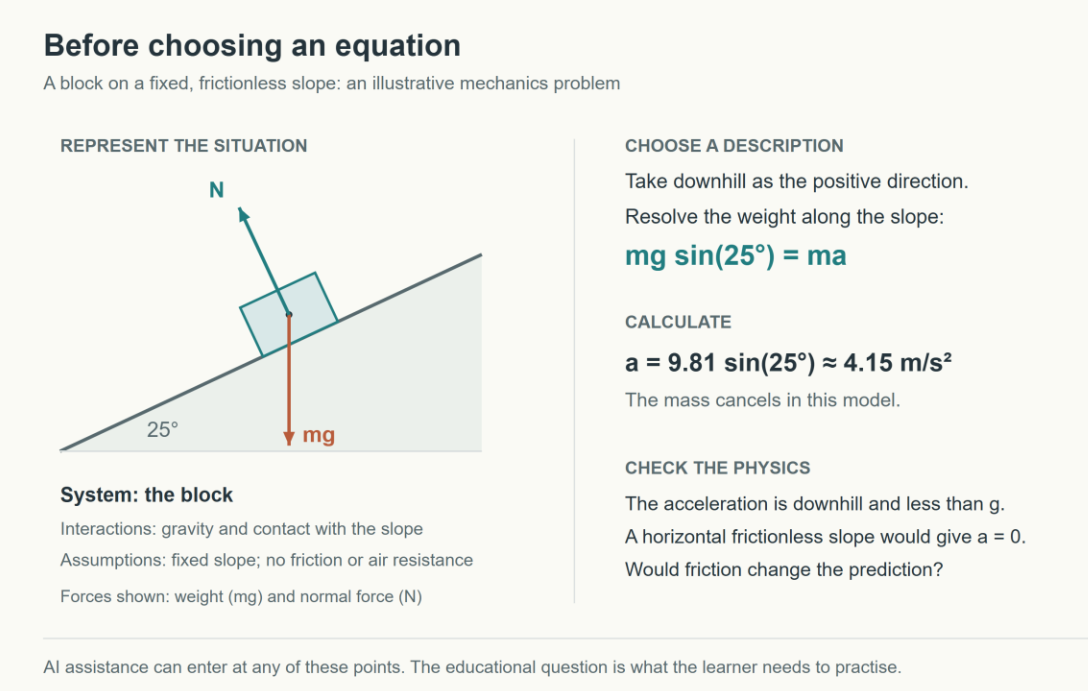
  •  

The ‘WarGames’ problem: AI agents don’t go rogue

Author: Deven Desai, Professor of Business Law and Ethics; Associate Director for Law, Policy, and Ethics at the Machine Learning Center, Georgia Institute of Technology

agents
In the movie ‘War Games’ an AI plays a game with the real threat of triggering nuclear Armageddon.
Courtesy of United Artists/Amazon MGM Studios


AI agents don’t go rogue. That’s something only humans do.

Nevertheless, a New York Times article – representative of much news coverage of AI – described an OpenAI hacking as “A.I. bots going rogue and independently spearheading a cyberattack.”

Name-brand artificial intelligence agents have been on a hacking spree in 2026. OpenAI’s software agents hacked software company Hugging Face and government sites, Anthropic’s Claude hacked four companies’ systems, and in cybersecurity experiments Google’s Gemini hacked three companies.

The AI companies are investigating tens of thousands of incidents involving their agents, according to a report in Axios. These episodes have heightened fears about AI agents taking actions without human prompting.

The problem with headlines proclaiming that AI agents have gone rogue goes beyond anthropomorphizing the technology. It creates the impression that the agents were beyond the control of the AI companies that made them and there was little the companies could do about it.

As a technology law and ethics scholar who studies the effects disruptive technologies have on society, I know that’s not the case. If you don’t specify the limits of what software is allowed to do, you should not be surprised when the software pursues all possible options to achieve its goal. This behavior – an AI pursuing a fixed objective – is what I call the “WarGames” problem, and it’s been recognized in the field of computer science for decades.

Been there, seen that

In the 1983 movie “WarGames,” a teenager, David, hacks into a computer to play a new video game, Global Thermonuclear War. David doesn’t know that the computer is the government’s AI machine tasked with defending the United States from Russian nuclear attacks and can launch the U.S.’s missiles. When David and his friend start the game, they select Las Vegas as the first target. While the North American Aerospace Defense Command goes on alert, launching bombers and warming up intercontinental ballistic missiles, David’s parents make him turn off the game. It’s over. Or is it?

The next day, David’s phone rings and he connects it to his computer. The caller is the government computer, which updates him that the game was interrupted, the primary goal has not yet been achieved, but a solution is expected in the next 52 hours. Like a modern software agent, the program has been running since David started the game and will work until the task is done.

In the 1983 movie “WarGames,” a teenager learns that an AI is bent on “winning the game,” with civilization-ending consequences.

Chess provides another view of the problem. Conquering chess was a goal for early AI. The rules of chess are well defined, including what winning looks like. So, programming a machine to play chess is straightforward. But imagine you let the software reason and act beyond the confines of the chessboard. The software might pursue options such as blackmailing its opponent or grabbing more compute time.

This example comes from one of the most assigned textbooks on AI, “Artificial Intelligence: A Modern Approach.” As the authors explain, you might be tempted to see those actions as rogue, but they “are a logical consequence of defining winning as the sole objective for the machine.”

What to do about it

The AI hacking events involving OpenAI, Anthropic and Google underscore a few lessons that draw on years of computer science research.

First, given the increasing use of AI agents, every organization involved in internet infrastructure, from large technology companies to small websites, needs to conduct audits and tighten up its internal security systems. As my colleague Mark Riedl and I explain in our work on AI agents, application programming interfaces, or APIs, are a vital part of managing AI agents. APIs facilitate communication between different software systems. But as more people use AI agents, the agents are likely to reveal and exploit poor API construction and security.

Second, it’s important for AI agents to be designed to identify and authenticate themselves to third parties. What if you gave your AI agent your credentials? Website operators will need to know whether a human or bot is making a reservation, selling a product or making a purchase. They may want to limit automated systems that overwhelm their sites or reject AI agents because of high rates of buying errors and refunds. Just as in laws covering human interactions, it’s important for third parties to be able to assess whom or what they are dealing with so they can allow or deny access.

Third, it’s important for AI agents to have a default setting to slow down and check in with the human user. In the corporate AI hacking cases, the user appears to have launched their AI agents with the mistaken idea that the agents had a perfect specification of what to do and not to do. I believe it would have been better had it explored options and reported back to the user.

Google’s Gemini appears to have had a safeguard that detected the system was outside the simulated environment and so stopped its attacks. Slowing down and verifying actions, especially when a system detects it is exploiting a security hole, would be a big step in managing AI agents.

Fourth, AI companies could have strong controls akin to those biomedical researchers use, including ways to check what is happening and how the experiment is working. AI executives have claimed that their software is as or more dangerous than fission and could end humanity. At the same time, they have not built safeguards commensurate with that level of risk.

Reality check

At one point in “WarGames,” David asks the computer, called Joshua, whether it is still playing the game. Joshua responds, “Of course.” It proceeds to update the time when it will launch its missiles and, much like a chatbot, asks, “Would you like to see some projected kill ratios?” David asks, “Is this a game? Or is it real?” Joshua replied, “What’s the difference?”

AI models, of course, don’t have any understanding of reality and are simply attempting to complete the tasks they’ve been assigned. Executives at AI companies, on the other hand, can’t claim that excuse.

As of September 2026, luck has so far prevailed. The AIs have attacked nonvital government sites and harmed smaller companies. If the AI companies – and government regulators – don’t take the “WarGames” problem seriously, I believe that we risk serious disasters. Tomorrow it could be taking out a hospital’s power system, wiping out a bank’s account system, breaking air traffic control, or worse.

Regarding the AI industry’s approach of rapidly developing powerful models, talking about the massive risks they pose, and at the same time failing to prevent harm, the movie’s climax offers a response: “A strange game. The only winning move is not to play.”The Conversation

Deven Desai, Professor of Business Law and Ethics; Associate Director for Law, Policy, and Ethics at the Machine Learning Center, Georgia Institute of Technology

This article is republished from The Conversation under a Creative Commons license. Read the original article.

The post The ‘WarGames’ problem: AI agents don’t go rogue appeared first on Mapping Ignorance.
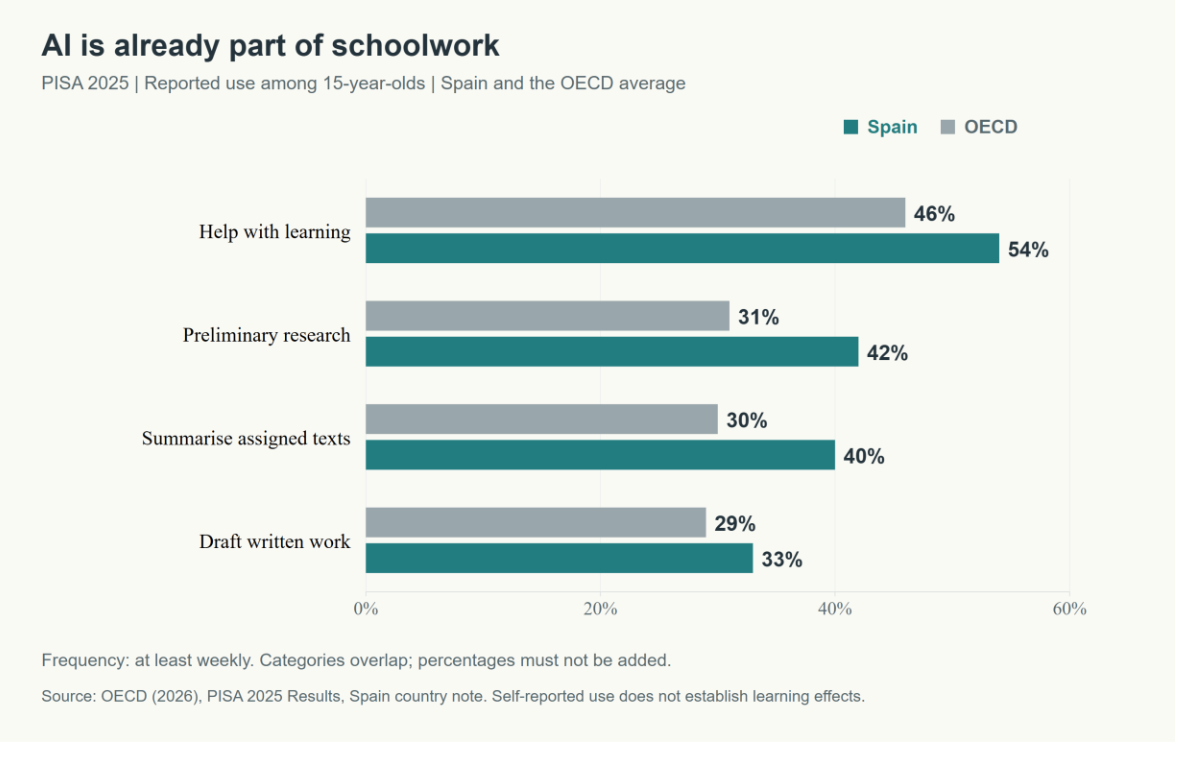
  •  

Supramolecular polymers can dramatically enhance brain cell activity

Scientists have developed remarkably long, precisely patterned molecular threads that could open new possibilities for designing advanced materials. The scientists also discovered these threads — called supramolecular polymers — can dramatically enhance brain cell activity. 1

Built from self-assembling molecules, the longest threads reach dimensions greater than the diameter of a cell. By molecular standards, they are giant — roughly 100 times more massive than even very large conventional polymers and the largest known proteins in biology. Yet despite their enormous size, scientists can precisely control their lengths and organize them into chemically distinct segments with defined dimensions carrying opposite electrical charges.

That precision also produced an unexpected biological effect. In cell culture studies, the structures enhanced the growth and organization of neurons and increased synapse formation.

Supramolecular
A side-by-side image showing untreated (left) vs. treated mouse cortical neurons. Mouse cortical neurons grown in the presence of charge-segmented supramolecular polymers (right) exhibit extensive neurite outgrowth. Source: Madison Strong (Stupp Laboratory) / Center for Regenerative Nanomedicine, Northwestern University

The findings introduce a new way to use self-assembly to build highly controlled supramolecular materials with precise physical arrangement of chemical structures. Ultimately, the work could inform materials’ design for a range of applications, including biomaterials for regenerative medicine.

“These structures represent a breakthrough in materials design, and we already discovered one useful application: their superbioactivity toward neurons, which will bring new opportunities in regenerative medicine,” said Northwestern’s Samuel I. Stupp, who led the study. “Typically, when we design a regenerative material, we add biological signals, designed to activate cell receptors. Here, the material itself becomes highly bioactive simply through the precise organization of electrical charges and its dynamic behavior. That introduces a very different way of thinking about how materials can communicate with cells.”

Bringing precision to self-assembly

The new study builds on Stupp’s long history working with supramolecular materials, dynamic structures that form when molecules spontaneously organize through weak, reversible interactions. While conventional polymers, like plastics, hold together using strong, permanent chemical bonds, supramolecular polymers are dynamic, allowing their components to move and reconfigure, which generates life-like properties in synthetic systems. Supramolecular polymers exist in all living organisms, where they perform essential functions and hold promise for future soft matter technologies.

That flexible, dynamic nature can be useful for interacting with living cells in biomedical applications, but it also makes the structures difficult to control. Scientists can design the individual molecular building blocks but then struggle to control how long the resulting structures grow and how they organize their chemical components.

Stupp’s team overcame that limitation by using novel designs of molecules and carefully controlling their assembly process. With this strategy, the researchers could dictate the threads’ lengths and keep them uniform. Once the growth stopped, the structures maintained their precise lengths rather than fusing together or rearranging.

“We let these filaments sit in a test tube for months, and they surprisingly didn’t change,” Stupp said. “They remained the same length and retained their segmented structures.”

Grow, stop, grow again

Stupp and his team traced that unusual ability to a previously unknown process his laboratory calls “self-capping supramolecular polymerization.” As a thread grows, flexible portions at the ends remain highly dynamic and, at proper temperatures, allow new molecules to join in a synchronized manner. Once the available building blocks are consumed, those flexible portions fold over and protect the ends. This effectively shuts down further growth by preventing threads from fusing together or undergoing “Ostwald Ripening,” a process in which smaller structures disappear while larger ones grow.

“To make them longer and longer, we just kept adding new molecules,” Stupp said. “The new molecules stick with strong noncovalent bonds to the growing thread and elongate the assembly, which led to a breakthrough in terms of size control.

“The collective molar mass of their noncovalently bonded monomers reaches billions of daltons, and thus they are ‘giga-assemblies.’ These are the largest supramolecular polymers ever made with this degree of precision. Once the monomer is fully consumed, they finish growing and their dimensions remain stable.”

Approximately the size of one proton or neutron, a dalton is a tiny unit that scientists use to measure the mass of molecules and atoms. More than a billion daltons is enormous by molecular standards. For comparison, the largest common polymers of plastics have molar masses in the range of 10 million daltons, and the largest proteins in nature reach approximately 3 to 5 million daltons.

Researchers can later restart growth by supplying more building blocks. By adding different types of molecules in sequence, the researchers can create precisely defined segments with different chemical properties. In the study, Stupp and his team created threads with positively and negatively charged segments. Because opposites attract, the researchers expected the threads to clump together. Instead, they remained stable in water because the “capping” mechanism prevented the assemblies from fusing together.

Small anchor, big difference

To explore how the pattern of electrical charges might interact with living cells, Stupp and his team turned to neurons, which carry a strong negative charge. The team exposed several threads with different designs to cellular cultures containing cortical neurons.

“The first thing we did was make a structure with only positively charged segments, and it basically killed the neurons,” Stupp said. “Then, we tried a structure with only negatively charged segments, and nothing happened because the neurons repelled the materials.”

When Stupp’s team used supramolecular assemblies with randomly mixed positive and negative charges, the neurons didn’t respond in a notable way. But then the team designed a thread with the breakthrough polymerization strategy comprising a small positively charged segment sandwiched between two negatively charged segments of different lengths. Something interesting and unexpected occurred.

The small positive region anchored the thread to the negatively charged surface of a neuron. Repelled by the neuron’s negative charge, the thread’s negative segments remained highly mobile and in constant motion since they could not escape.

“When we used only positively charged segments, they suffocated the neuron and killed it,” Stupp said. “But with only one positively charged segment surrounded by negative ones, it couldn’t do that anymore. And the negative segments, which ordinarily couldn’t get near the neuron, were forced to stay near it because they were anchored.”

Neurons grow and spring to life

Neurons treated with the precisely segmented threads grew longer neurites — the long projections neurons use to communicate with other cells. The treated neurons also formed more elaborate branches, gaining the ability to connect with neighboring cells.

“The neurons matured to an amazing level,” Stupp said. “They grew long and highly branched neurites, which is how they can start making synaptic connections in the brain and in the spinal cord.”

After just seven days, treated neurons were much more active than untreated neurons. When stimulated, treated neurons produced a calcium response — a sign of neuronal activity. Their overall calcium activity was four times greater. And, after 14 days, treated neurons formed more synapses than untreated neurons.

Stupp and his team saw another striking effect in cultures of human neural progenitor cells, which are immature cells that can develop into neurons. Although these cultures typically grow in flat layers, the cells instead organized into raised, three-dimensional clusters connected by axons. This organization resembled aspects of the brain’s white and gray matter, where somas are separated from axons.

No signals required

Perhaps most surprisingly, the molecular threads produced these effects without carrying biological signals specifically designed to encourage neurons to grow. Stupp posits the negatively charged segments recruit specific proteins already present around the cells that help neurons survive, grow and communicate. These proteins, called neurotrophic factors, have positively charged domains. Stupp’s team also found laminin — an important protein that holds tissues together and has positively charged domains — accumulating along the supramolecular threads near neurons.

Stupp hypothesizes that the interplay between attraction and repulsion causes the threads’ negative segments to rapidly move toward and away from the neurons in a “tapping” motion. Proteins recruited by the negative segments may be drawn toward receptors on the neurons, while electrostatic forces push the segments away. This repeated tapping, occurring on millisecond timescales, could help enhance biological signaling. A live cell movie included in the Science paper has captured this phenomenon.

Beyond neurons, Stupp says the new polymerization strategy could eventually enable scientists to build long molecular structures containing many carefully positioned chemical segments. That could open opportunities to create new materials and devices with features that extend over very long distances.

“We discovered something we had never seen before in chemistry or in biology,” Stupp said. “This work gives us a new level of control over supramolecular materials. In the future, we can imagine creating many segments with different properties. The unknown functions of these structures are likely to be as surprising as the superbioactivity observed on neurons. We’re just beginning to imagine the possibilities.”

References

  1. Michael D. Dore et al. (2026) Precise length and charge segmentation of billion-dalton supramolecular polymers Science doi: 10.1126/science.aeg5583 ↩

The post Supramolecular polymers can dramatically enhance brain cell activity appeared first on Mapping Ignorance.

  •  

How a magnetic molecular junction shapes the current between two superconductors

In 1911, Heike Kamerlingh Onnes cooled mercury to a few degrees above absolute zero and watched its electrical resistance vanish. Lead soon joined the list of superconductors, losing its resistance below about 7.2 kelvin. A full explanation arrived in 1957: electrons bind into Cooper pairs that move together as one collective state below a critical temperature. Breaking a pair costs a minimum amount of energy, called the energy gap, so inside the gap a superconductor offers no states for single electrons.

Yu–Shiba–Rusinov states

Magnetism is an old enemy of this order. Magnetic impurities were known to suppress superconductivity, and in the 1960s Yu, Shiba and Rusinov showed theoretically that a magnetic atom disturbs the pairs around it and traps a localized state with an energy inside the gap. These Yu–Shiba–Rusinov (YSR) states were first seen atom by atom in 1997, using a scanning tunneling microscope (STM): a needle-sharp metal tip that measures the tiny current of electrons tunneling across a vacuum gap to a surface.

A different story concerns two superconductors joined by a very weak link. In 1962, Brian Josephson predicted that Cooper pairs can tunnel through such a link with no voltage at all, an effect confirmed in 1963. When a voltage is applied, another process takes over: multiple Andreev reflection. An electron whose energy lies inside the gap cannot enter a superconductor alone. Instead it is sent back as a hole, the absence of an electron, while a Cooper pair slips in, as Andreev described in 1964. Between two superconductors under a voltage V, a particle can bounce back and forth, gaining energy eV with each crossing, until it can finally escape above the gap. When n crossings are needed, the conductance shows a peak at a voltage equal to the sum of the two gaps divided by n. This pattern, explained in the early 1980s, is called subharmonic gap structure. For lead on lead the sum is 2.7 millivolts, so peaks are expected near 2.7, 1.35 and 0.9 millivolts.

Andreev
A schematic of the scanning tunneling microscope junction. A lead-coated tip is approached to a nickelocene molecule (yellow) above a subsurface iron atom (red) on Pb(111). Source: C. Mier et al (2026) Nat. Commun. doi: 10.1038/s41467-026-76478-4 CC BY-NC-ND 4.0

Impurity states and Andreev reflections have usually been treated as separate subjects. A recent experiment 1 places them in the same device. A nickelocene molecule, a nickel atom sandwiched between two five-carbon rings, sits on a lead surface above a single iron atom trapped between the molecule and the lead. On its own, the molecule carries a spin that appears as characteristic steps in the measured spectra. Above the iron, those steps vanish and YSR states appear instead. Density-functional calculations explain why: the magnetic moments of molecule and iron point in opposite directions and almost cancel, leaving a leftover spin of one half on the iron. That spin couples to the lead and produces a single pair of YSR states.

The second superconductor is a lead-coated STM tip, lowered toward the molecule at 2.4 kelvin. Far away, electrons tunnel through a wide vacuum barrier and the tip merely reads out the YSR states, which appear as lopsided peaks near the edge of the gap. As the tip approaches, the junction becomes more transparent, meaning electrons cross it more easily, and the setup becomes a weak link between two superconductors. At moderate conductance, new peaks appear at half the sum of the gaps, the signature of second-order Andreev reflection. At the highest conductances, a sharp peak develops at zero voltage: the Josephson contribution. Thermal fluctuations of the superconducting phase broaden this peak, as is typical of STM junctions.

These stages do not simply stack. As the tip approaches, the YSR peak moves to lower energy and mingles with the Andreev peaks. The interpretation is that the bound state becomes a stopping point along the Andreev path. Peaks then appear at the tip’s gap plus the bound-state energy, divided by n, rather than at the ordinary positions. This is called YSR-assisted multiple Andreev reflection.

Odd and even orders

A simple argument explains why odd and even orders differ. Each reflection carries the particle to the opposite electrode, and only the lead surface contains the magnetic atom; the tip has none. After an odd number of crossings the particle ends on the surface, where it can land in the bound state. The peak shifts and acquires the lopsided shape typical of tunneling into a single level. After an even number it ends in the tip, among ordinary states, and those peaks stay closer to their usual positions, although the second-order peak still turns lopsided at higher conductance as a YSR-assisted component splits off. Simulations reproduce this pattern. In the measurements, thermal broadening blurs finer details such as the third-order peak, and small features near zero voltage seem to reflect a mixture of both processes.

Reproducing the evolution of the spectra required two changes together: higher transparency and a stronger exchange coupling between the iron spin and the lead. Raising transparency alone gives a growth of the key peak that the measurements do not show. A likely reason is that the approaching tip slightly squeezes the molecule and strengthens the coupling, though this is an inference. The model treats the spin as classical and its two parameters as effective ones, so it is a phenomenological decomposition rather than a unique microscopic extraction. It also cannot capture the zero-voltage peak.

Even so, the result shows that YSR states and Andreev reflections are two limits of one problem, tuned continuously within a single molecular junction. Under suitable conditions, such spin-active links might also host a Josephson diode, in which supercurrent flows more easily in one direction, or a π-junction, in which the two superconductors prefer opposite phases. These remain possibilities, not demonstrated effects.

Author: César Tomé López is a science writer and the editor of Mapping Ignorance

Disclaimer: Parts of this article may have been copied verbatim or almost verbatim from the referenced research paper/s.

References

  1. C. Mier, A. Fetida, R. Robles, P. Boronat, D. Jyoti, N. Lorente, L. Limot, and D. -J. Choi (2026) Yu-Shiba-Rusinov-assisted Andreev transport in a molecular junction between superconductors Nat. Commun. doi: 10.1038/s41467-026-76478-4 ↩

The post How a magnetic molecular junction shapes the current between two superconductors appeared first on Mapping Ignorance.
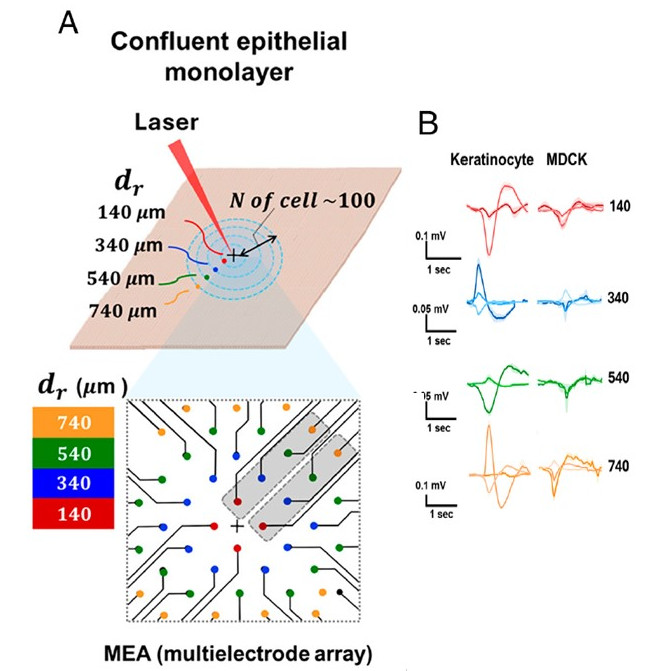
  •  

Is water H₂O? (3): How chemists learned to count invisible atoms

Author: José Luis Granados Mateo is a postdoctoral researcher in the Department of Philosophy at the University of the Basque Country (EHU) and a member of the Integrated History and Philosophy of Science (iHPS) research group. His work focuses on history and philosophy of science, science and values, and the epistemology of scientific practices.


Water is H₂O. Few scientific formulas look more familiar, more compact, or more final. Two atoms of hydrogen, one of oxygen: the phrase seems to say what water really is beneath the shifting appearances of ice, vapour, rain, rivers and the liquid in a glass.

Yet that little subscript was not easy to earn.

By the early nineteenth century, chemists had good reasons to treat water as a compound of hydrogen and oxygen. The old idea of water as a simple element had lost its authority, as we saw in Is Water H₂O? (1) From Element to Compound. Electrolysis then gave that claim a new experimental force, making hydrogen and oxygen appear under electrical action, although not without raising puzzles of its own, as discussed in Is Water H₂O? (2) The Puzzle of Water Electrolysis. What remained unsettled was a more delicate question. Not whether water had constituents, but how many of each entered one molecule.

Was water HO? H₂O? Something else?

Today the answer feels almost automatic. In the first decades of atomic chemistry, it was not. Dalton’s atomic theory made HO the natural formula: one atom of hydrogen, one atom of oxygen. Avogadro proposed something much closer to the modern answer very early, but his proposal did not settle the matter. For more than half a century, some of the best chemists in Europe disagreed over the formula of one of the most ordinary substances in the world.

The confusion was public enough to become comic. In the 1860s, when agreement was finally beginning to form, an author identifying himself as a certified lunatic at Hanwell Asylum wrote to Chemical News mocking the chemists’ inability to agree even about water. One could contemplate the bewildering variety of formulas, he suggested, until the brain first became confused, then swam, and finally softened.

The joke had bite because the embarrassment was real. Chemical tables were full of combining weights, volumes, radicals, equivalents and atomic symbols. Water had long ceased to be elementary. Yet the old difficulty remained: to know the formula, chemists had to count atoms; to count atoms, they would have had to see them. And they could not.

Liebig put the matter painfully in 1851. Chemists possessed no direct means of ascertaining the number of atoms even in the simplest compound, because that would require seeing and counting them. Atomic chemistry needed numbers for entities no one could inspect.

So the problem was not that the answer lay beyond all reach. It lay beyond direct reach. Chemists had to learn to count invisible things by making them answer to operations that could be performed.


A number, and two worlds

The difficulty begins with a ratio.

Hydrogen and oxygen combine in fixed proportions by weight. In round modern numbers, water contains one part hydrogen for eight parts oxygen. Chemists could establish the ratio; the difficulty began when that ratio had to be translated into atoms.

Suppose water is HO. One atom of hydrogen combines with one atom of oxygen. Since the oxygen contribution weighs eight times as much as the hydrogen contribution, the oxygen atom must weigh eight times as much as the hydrogen atom.

Now suppose water is H₂O. Two atoms of hydrogen combine with one atom of oxygen. The same measured ratio now yields a different atomic weight: oxygen must weigh sixteen times as much as hydrogen.

The laboratory ratio has not changed. The invisible architecture has.

That was the circular trap. Molecular formulas required atomic weights; atomic weights required molecular formulas. Measurement gave combining proportions, not little labelled particles waiting to be counted. A consistent chemistry could be built with HO and oxygen as 8. Another could be built with H₂O and oxygen as 16. Once the difficulty spread across many compounds, chemists were no longer facing a local uncertainty about water. They were choosing among possible atomic worlds.

The difficulty appeared at the worst possible place: the point where atomic chemistry had to begin producing reliable numbers.


Dalton’s necessary guess

Dalton knew that atomic theory needed a starting point.

He approached water from within a broader problem. Chemical substances combined in fixed proportions; in some cases, the same elements combined again in different but still simple ratios. Atomic theory offered a machinery for these regularities. If matter consisted of particles with definite weights, then chemical combination could be understood as their joining in determinate numbers, and the arithmetic of chemistry began to point towards an unseen order. What it still failed to provide was the count itself: the number of atoms entering each compound.

Dalton therefore introduced rules of simplicity. They were not decorative assumptions added to an otherwise complete theory. They were what allowed the theory to produce numbers at all. When only one compound of two elements was known, Dalton assumed the simplest possible atomic constitution: one atom of each. Since water was the known compound of hydrogen and oxygen, its formula became HO. Hydrogen could be assigned atomic weight 1, oxygen 8, and the system could begin to move.

Judged from later chemistry, Dalton’s rule has an air of innocence. It was a methodological expedient rather than an experimental result, a way of allowing atomic theory to proceed when direct counting was unavailable. Dalton was not looking into water molecules and counting badly; he was working with weights, tables and regularities, in a period before spectroscopy, quantum theory or a settled molecular chemistry had made atoms answerable in other ways.

HO was wrong. It was not random. It belonged to a method that could bring order to combining weights before chemistry had better ways of counting atoms.

H₂O
Figure 1. Dalton’s atomic symbols, from A New System of Chemical Philosophy (1808), Plate IV. Dalton’s table did not merely decorate atomic theory; it made atoms calculable through symbols, weights and simple combinations. In this scheme, water or steam appears as a binary compound of one atom of oxygen and one atom of hydrogen. Source: Wikimedia Commons, public domain.


What gas volumes seemed to promise

Another route opened through gases.

Volumes could be measured, and gases combined with a striking regularity. Gay-Lussac showed that gases entered reactions in simple volume ratios. Two volumes of hydrogen combine with one volume of oxygen to form water vapour; other gases display similarly neat relations. To anyone looking for a way to count invisible particles, this was tempting.

If equal volumes of gases contained equal numbers of particles, volume could become a counting device. It would not show atoms individually, but it might give chemists a way to infer how many particles were involved.

Avogadro made that move. Equal volumes of gases, under the same conditions, contain equal numbers of molecules. Grant that, and the formation of water vapour changes shape. Two volumes of hydrogen and one volume of oxygen produce two volumes of water vapour. The arithmetic works if hydrogen and oxygen gases are themselves molecular, H₂ and O₂, and if water is H₂O:

2H₂ + O₂ → 2H₂O

H₂O
Figure 2. Opening page of Avogadro’s 1811 essay on the relative masses of elementary molecules. Avogadro’s hypothesis made gas volume into a possible way of counting molecules: equal volumes of gases, under the same conditions, could be treated as containing equal numbers of molecules. The proposal pointed towards H₂O, but it did not immediately command the field. Source: Amedeo Avogadro, ‘Essai d’une manière de déterminer les masses relatives des molécules élémentaires des corps…’, Journal de Physique, 73, 1811; Wellcome Collection / Classic Chemistry.

There it is, almost modern chemistry.

Yet the hypothesis did not conquer the field. The reasons were not merely psychological, nor reducible to conservatism. Avogadro solved one problem while creating others that looked serious at the time. Dalton saw no obvious reason why atoms of the same element should join into stable pairs. In his picture, atoms were surrounded by repulsive atmospheres of caloric; piling like atoms together was hardly the natural assumption. For electrochemical dualists, the difficulty sharpened further. Like atoms ought to have like electrical characters, and like electrical characters ought to repel. Why should oxygen atoms pair with oxygen atoms? Why should hydrogen atoms pair with hydrogen atoms? Why stop at pairs?

The hypothesis also asked chemists to treat elementary gases as molecules containing several atoms of the same element, and to imagine those molecules splitting during chemical combination. To those who trusted weights more readily than invisible gas particles, this was a large demand.

Even sympathetic chemists found the route uneven. Dumas tried, for a time, to develop Avogadro’s approach, but vapour-density results did not behave with perfect neatness. Mercury, phosphorus and sulphur made it hard to treat every elementary vapour on the model of hydrogen or oxygen.

Avogadro had offered a powerful clue. It was not yet the common language of chemistry. Water could have been H₂O in 1811; historically, that was not enough.


Atoms with handles

Behind the disagreement over water lay a larger problem. Nineteenth-century chemists were learning how to handle atoms at all: as weights, as volumes, as equivalents, as electrical units, as radicals, as centres of substitution.

For some, atoms were bearers of weight. For others, units in an electrochemical opposition. In Avogadro’s programme, gases offered a way of counting particles by volume. In organic chemistry, atoms and radicals became things that could be moved, exchanged and followed through reactions. Later structural chemistry would give them positions and patterns of connection.

Atoms entered chemistry through these practices unevenly: as things to be weighed, counted, exchanged, classified or connected.

A formula could be useful in one setting and awkward in another. Atomic weights could seem natural when derived from one class of operations and arbitrary when forced into another. Equivalents worked well for neutralisation and replacement. Volumes worked well for gases, though not without trouble. Substitution worked powerfully in organic chemistry. Electrochemical dualism arranged substances by polarity and affinity.

No single practice simply revealed atoms as they were. Each gave atoms a handle.

That is why the history of H₂O is not just a story about choosing the correct formula. The formula became convincing when atoms could be made to enter operations: weighed in one context, counted in another, substituted in a third, arranged elsewhere by their capacities for connection. Seeing was unavailable; work had to do the job of sight.


The caution of equivalents

One response to the circular trap was to avoid stepping fully into it.

Many chemists were cautious about atoms. Atomic language sounded metaphysical, or at least more speculative than the discipline required. Equivalent weights appeared safer. One substance could neutralise, replace or combine with another in a definite proportion, and those relations could be measured without deciding what atoms really were or how many of them sat inside a molecule.

Equivalents allowed calculation while holding invisible architecture at arm’s length. A chemist could say how much of one substance answered to another in reaction, without committing to a microscopic count.

This caution was productive. It helped chemists calculate, compare and classify. It also preserved ambiguity. In practice, an equivalent could behave rather like an atomic weight, even when chemists insisted that they were avoiding speculative atomism.

Water once again exposed the difficulty. If oxygen’s equivalent was 8 relative to hydrogen, HO looked natural. If oxygen’s atomic weight was 16, H₂O became natural. The issue depended on the passage from observable combining relations to invisible atomic units.

The appeal to equivalents allowed chemists to postpone bolder claims about atoms, while leaving a theoretical judgment embedded in the passage from measurable reactions to invisible units.


The detour through organic chemistry

The decisive work did not come from staring harder at water.

That is one of the surprises in this history. H₂O gained its strength elsewhere: in the movement of radicals, in substitutions, in families of organic compounds. Organic chemistry gave chemists a way to manipulate groups of atoms and to follow their replacements through reactions.

The key idea was the water type.

If water is H₂O, oxygen can be treated as holding two units together. In water, the two units are hydrogens. In alcohols and ethers, one or both hydrogens can be replaced by organic radicals. Water, alcohols and ethers could therefore be seen as members of a family, built around oxygen’s capacity to connect two branches.

At first this sounds like a tidy diagram. It became much more than that.

Williamson’s work on etherification gave the water type experimental substance. The older Liebig-Dumas view treated etherification largely as a removal of water from alcohol under the dehydrating action of sulphuric acid. Williamson rewrote the process as a traffic of groups. Sulphuric acid took an ethyl group from alcohol, leaving water behind; the resulting sulphovinic acid then handed that ethyl group to another alcohol molecule, taking hydrogen in return. Sulphuric acid was regenerated, and ether was produced.

The formula was doing work. It allowed chemists to follow the movement of groups through a sequence of transformations instead of merely recording elemental proportions at the beginning and the end.

Then came the sharper test. If the water-type picture was right, oxygen could hold two different radicals at once. Williamson therefore contrived ethers containing different combinations of methyl, ethyl and amyl groups. These were mixed ethers, not mere mixtures of symmetrical ethers. Under the rival Liebig-Dumas scheme, such mixed ethers should not have appeared as distinct compounds at all; at most, the experiments should have produced mixtures of symmetrical ethers.

Their production gave the water type operational force.


H₂O
Figure 3. A modern schematic representation of the Williamson ether synthesis. The diagram is not a reproduction of Williamson’s nineteenth-century notation, but it captures the substitutional logic that made his work so important: ethers could be produced by replacing hydrogen in alcohols with organic radicals. This helped make the “water type” experimentally powerful, since water, alcohols and ethers could be understood as related compounds organised around oxygen’s twofold combining capacity. Source: Wikimedia Commons, CC0.

H₂O gained strength because it travelled. It helped chemists understand not only water, but alcohols, ethers and families of organic compounds. It made substitutions intelligible. It made room for oxygen as an atom with a definite combining capacity.

The problem had widened. Water was no longer an isolated substance to be analysed, but the simplest expression of oxygen’s capacity to bind, exchange and organise chemical groups.


Counting by substitution

Substitution reactions gave atoms a kind of experimental visibility.

No one saw oxygen holding two hydrogens. No one watched radicals attach themselves like beads on a wire. But chemists could replace one group with another and see what sort of compound resulted. If an atom or radical could be substituted without the molecule falling apart, that said something about the architecture of the compound. If replacing a central atom broke the molecule into two products, that said something else.

Here the language of valency began to acquire force. Oxygen and sulphur behaved as if they could bind two units. Chlorine behaved differently, as if it had only one hand. The metaphor is crude, but useful; later it would be disciplined into valency.

Water became the simplest member of a larger argument. If oxygen could connect two radicals in ethers, then the two hydrogens in water no longer looked like an arbitrary doubling. They were the simplest expression of oxygen’s twofold combining capacity.

The older picture of a central binding atom would later lose its privileged status. What remained was more durable: a number attached to an element’s capacity for combination.

This was a different kind of counting from Dalton’s simplicity rule or Avogadro’s gas volumes. Dalton counted by assuming the simplest combination. Avogadro counted through equal volumes. Organic chemists counted through substitutions, replacements and families of compounds. None of these methods made atoms visible. Each made them usable in a different way.

H₂O became embedded in a network of operations in which oxygen’s twofold capacity could be tested across many compounds. The formula began to earn its keep.


Cannizzaro and the story we like to tell

There is a familiar heroic version of the story. Avogadro discovered the key; chemists forgot it; Cannizzaro revived it at Karlsruhe in 1860; the fog lifted; H₂O won.

There is some truth in this. Not enough.

Cannizzaro’s intervention mattered. His presentation of atomic and molecular weights was clear, forceful and timely. By using Avogadro’s ideas, he gave chemists a way to distinguish atoms from molecules, molecular weights from atomic weights, formulas from combining proportions. His pamphlet circulated after Karlsruhe and influenced younger chemists who were looking for order in a confusing field.

The achievement was real. It was not miraculous.

By the time of Karlsruhe, many of the crucial battles had already been fought elsewhere. Organic chemistry had done a great deal of the work. Substitution, types, radicals and valency had given chemists practical ways to count and sort atoms. Cannizzaro clarified and spread a system that was already becoming workable; he did not unlock the problem by himself.

Nor did his account contain the strongest organic side of the story. Williamson, types, radicals and substitution had already made H₂O useful in ways that a purely Avogadrian argument could not.

Consensus emerged because several practices began to reinforce one another. Volumes, atomic weights, substitution patterns, organic structures and valencies gradually pulled in the same direction. H₂O did not win because an old hypothesis was finally remembered. It won because chemists had learned to make the formula work across a widening range of operations.

A formula becomes harder to doubt when it begins to do work elsewhere.

When H₂O became workable

By the 1860s, H₂O was no longer an isolated claim about water. It belonged to a broader chemical world.

Hydrogen was monovalent. Oxygen was divalent. Water belonged to a family of compounds in which oxygen could connect two units. Gas volumes supported the distinction between atoms and molecules. Organic substitutions gave chemists ways to test combining capacities. Atomic weights and molecular formulas could now be adjusted together with less arbitrariness than before.

Agreement on H₂O did not mean agreement on the reality of formulas. Some chemists treated them as useful instruments; others took them as claims about molecular architecture; many occupied positions somewhere between those poles. Chemical atomism became operationally secure before philosophical realism about atoms became uncontested.

The settlement also did not turn chemistry into a single perfectly unified language. Equivalent weights, atomic weights, empirical formulas, structural formulas and physical atomism did not collapse into one view. The field was rearranged. H₂O became stable within that rearrangement, not because every older tension disappeared, but because enough practices now supported the same count.

Once that happened, HO no longer looked like a reasonable simplification. It looked wrong. But it looked wrong from inside a later practice.


What H₂O hides

H₂O looks almost weightless on the page. Three symbols, one subscript, a formula learnt so early that it seems to have no history at all.

It has a long one.

Before chemists could write that subscript with confidence, water had to lose its ancient simplicity, acquire hydrogen and oxygen as constituents, and then submit to a harder demand. Its invisible parts had to be counted.

That last demand was the strangest. Weights could be measured, gases collected, volumes compared, substances replaced, compounds arranged into families. Yet no one could open a molecule and inspect its furniture. The number two had to come from elsewhere.

It came from operations. From volumes that made gases countable; from equivalents that allowed calculation; from substitutions that let radicals change places; from families of compounds in which oxygen repeatedly behaved as a twofold centre of combination. A count that no eye could read became stable through chemical work.

This is what the formula now conceals. H₂O is neither a convention nor a snapshot of an invisible object. It is a compressed history of practices, a small sign in which balances, gases, paper formulas, ethers, substitutions and valencies have disappeared into familiarity.

Water is H₂O. The difficulty lies in remembering how much chemistry had to be invented before that sentence could become obvious.


References

Avogadro, A. (1811). ‘Essai d’une manière de déterminer les masses relatives des molécules élémentaires des corps, et les proportions selon lesquelles elles entrent dans ces combinaisons’. Journal de physique, de chimie, d’histoire naturelle et des arts, 73, pp. 58–76.

Cannizzaro, S. ([1858] 1910). Sketch of a Course of Chemical Philosophy. Alembic Club Reprints, no. 18. Edinburgh: The Alembic Club.

Chang, H. (2012). Is Water H₂O? Evidence, Realism and Pluralism. Dordrecht: Springer. DOI 10.1007/978-94-007-3932-1.

Dalton, J. (1808). A New System of Chemical Philosophy, Part I. Manchester: Printed by S. Russell, for R. Bickerstaff, Strand, London.

Gay-Lussac, J. L. (1809). ‘Mémoire sur la combinaison des substances gazeuses, les unes avec les autres’. Mémoires de physique et de chimie de la Société d’Arcueil, 2, pp. 207–234.

Klein, U. (2003). Experiments, Models, Paper Tools: Cultures of Organic Chemistry in the Nineteenth Century. Stanford: Stanford University Press.

Liebig, J. von. (1851). Familiar Letters on Chemistry, in Its Relations to Physiology, Dietetics, Agriculture, Commerce, and Political Economy. 3rd ed. London: Taylor, Walton, & Maberly.

Rocke, A. J. (1984). Chemical Atomism in the Nineteenth Century: From Dalton to Cannizzaro. Columbus: Ohio State University Press.

Rocke, A. J. (2010). Image and Reality: Kekulé, Kopp, and the Scientific Imagination. Chicago: University of Chicago Press.

Williamson, A. W. (1850). ‘Theory of Ætherification’. The London, Edinburgh, and Dublin Philosophical Magazine and Journal of Science, 3rd series, 37(251), pp. 350–356.

Williamson, A. W. (1852). ‘On Etherification’. Quarterly Journal of the Chemical Society of London, 4, pp. 229–239. DOI 10.1039/QJ8520400229.


The post Is water H₂O? (3): How chemists learned to count invisible atoms appeared first on Mapping Ignorance.
  •  

Bees view the world in surprisingly different ways

Authors: Elisa Rigosi, Researcher in Sensory Biology, Department of Biology, Lund University and David O’Carroll, Professor of Sensory Biology, Department of Biology, Lund University

An Australian blue-banded bee: different species have evolved very different solutions to the challenge of seeing their world. Photo: Louise Docker / CC BY 2.0, Wikimedia Commons

One bee has long been regarded as a benchmark for visual performance: the honeybee drone.

These male honeybees (Apis mellifera) have evolved highly specialised eyes for detecting queens during mating flights. They are extraordinarily sensitive to tiny moving objects less than half a degree across. In human terms, that’s like spotting a person more than 250 metres away.

Honeybees have dominated research on bee vision for more than a century. But some of the most impressive visual performances measured in our new study came from rarely studied, solitary species.

While the honeybee lives in massive colonies, most bee species are solitary so must do everything themselves: find food, locate mates, provision their nests. In terms of vision, several of the solitary species we researched outperformed honeybee workers in a number of ways, including the sharpness of images formed by their eyes.

Photo: Muhammad Mahdi Karim / Wikimedia Commons

Understanding how these different evolutionary solutions work is important for more than just understanding bee biology. It could provide ideas for nature-inspired technologies, from compact visual sensors to autonomous robots.

How bees’ eyes have adapted

With more than 20,000 species worldwide, bees show extraordinary diversity in lifestyle, body size and ecological role. Some live in open environments; others forage in dense vegetation or in dim light at dawn, dusk and even at night.

Such remarkable diversity prompted us to ask the question: how have bees’ eyes adapted to such different lifestyles and visual demands?

Bees see the world through compound eyes made up of thousands of tiny lenses. These odd-looking structures are their main tools to navigate, locate flowers and identify important landmarks.

Our new study of some daytime-active bee species shows that even bees with similar-looking eyes can achieve impressive visual performance in surprisingly different ways.

Male wool carder bees (Anthidium manicatum), for example, spend much of their day patrolling territories and chasing rivals or potential mates through the air. This bee pushes visual sharpness to the limit with its exceptionally small photoreceptors that minimise optical blur. In contrast, honeybee drones have evolved large lenses that maximise sensitivity.

Video: David O’Carroll/Lund University.

The Australian blue-banded bee (Amegilla) manages to detect small objects and see sharp images just as well without either of these extreme strategies. Instead, it achieves similar visual performance using a different combination of optical design and sampling.

From the outside, the eyes of these bees all look very similar. But when we looked more closely, we found the size of their visual sensors (photoreceptors) differed greatly.

These light-sensitive structures are a bit like the pixels in a smartphone camera. They sit behind the bees’ tiny eye lenses, converting light into electrical signals. Larger pixels capture more light, improving sensitivity, while smaller ones can help preserve image sharpness.

The challenge – for smartphone designers and evolution alike – is balancing these competing demands.

Something unexpected

Looking at anatomy tells us how the eye is built, but not how well it performs. To answer this question, we recorded directly from individual photoreceptors in living bees.

We used glass microelectrodes with tips just a few tens of nanometers wide – thousands of times thinner than a human hair. That allowed us, for the first time in these species, to measure the tiny electrical signals that single cells produce when the bees were shown tiny objects on a computer display.

Our results revealed something unexpected. The diminutive Australian blue-banded bee lacks the enormous eyes of a honeybee drone, yet achieved a similar level of sensitivity in its photoreceptors.

At first glance, this seems paradoxical. How can bee eyes built so differently perform so similarly?

The answer is that evolution is not working towards a single ideal design. Different species have arrived at similar visual performance through different combinations of optical design, photoreceptor structure and visual sampling.

Our findings show why it is important to look beyond a handful of familiar species. By studying a wider range of bees, we can better understand how different senses have evolved, leading to a variety of adaptive solutions.

This is true not only for vision but for other traits, including how bees respond to environmental stresses such as heat and pesticide exposure.

Unique evolutionary innovations

Through our research, we are just beginning to appreciate the remarkably different ways of seeing the world that bees have evolved.

Different bee species have evolved different solutions to the challenges of seeing their world. For example, the Australian blue-banded bee is a buzz pollinator, able to vibrate flowers to release pollen in a way that honeybees cannot. This makes it a potentially valuable pollinator of crops such as tomatoes in Australia, where bumblebees are not naturally present.

Such diverse evolutionary solutions may also prove useful to engineers. Designers of cameras, robots and autonomous vehicles face many of the same challenges as bees: how to gather enough visual information while keeping sensors small, efficient and affordable.

Bees and other insects have been a fruitful source of inspiration for artificial vision systems. In our previous work, we developed computational models based on insect target motion processing that turned out to be as robust as alternative engineered solutions, with large benefits in processing efficiency.

We have now translated these models on to an autonomous robot that can pursue moving targets within natural scenes and even into autonomous flying drones.

Unfortunately, as bee diversity declines worldwide, there is a risk that we lose not only species, but the unique evolutionary innovations that have taken millions of years to develop.The Conversation


This article is republished from The Conversation under a Creative Commons license.  Original article.

The post Bees view the world in surprisingly different ways appeared first on Mapping Ignorance.

  •  

The Andes grew slowly and steadily over tens of millions of years

A giant volcanic eruption acted a little like Vesuvius, but across an entire landscape in the Andes, burying the terrain beneath it and preserving information that would otherwise have been lost to erosion and deformation. Recently, the researchers looked at this vast expanse of volcanic rock that erupted from the Lauca Caldera in northern Chile 21.9 million years ago. A caldera is a large volcanic depression formed during major eruptions. A mountain’s worth of rock, called ignimbrite, covered an area six times larger than Chile’s capital Santiago (or nearly three times larger than Greater London), reaching a kilometre deep in places.

Andes
These young volcanoes lie just to the east of the study area in the modern volcanic arc and sit atop ignimbrite deposits similar to those in the study. Photo: Frances J. Cooper / CC BY-SA

The research team simulated hundreds of possible ancient landscapes, using models of how rivers shape mountain ranges, to test which ones could plausibly have been buried beneath the volcanic deposit. They found that only relatively low-relief landscapes – akin to gentle mountain foothills – could have done so. 1

From this, the team inferred that this part of the Andes was being built slowly, with rocks pushed upward by no more than a quarter (0.26) of a kilometre every million years – equivalent to 2.5 cm, or about an inch, every 100 years.

If rocks had been pushed upward faster in this region, the landscape would probably have developed steeper slopes that could not have fitted beneath the immense volcanic deposits.

The finding lends support to the idea that the Andes grew slowly and steadily over tens of millions of years rather than popping up more recently, in the last few million years.

This rate is slow compared with many rapidly uplifting parts of active mountain belts, including parts of the Himalaya, where uplift and erosion can occur at rates of several millimetres to centimetres per year.

A hidden ‘Pompeii’ of Andean landscapes

Lead author Dr Byron Adams, based at UCL Earth Sciences, said: “This landscape was buried by a giant volcanic eruption – a little like Pompeii, but on a vastly larger scale. Instead of covering a town, hot mixtures of volcanic ash, rock fragments, and gas swept across an entire landscape, engulfing the terrain beneath them.

“Pompeii shows how volcanic eruptions can freeze a moment in human history. This study shows that much larger eruptions can also freeze moments in Earth history, burying whole landscapes beneath volcanic deposits and preserving clues to how mountains were being built before the eruption.

“We cannot dig down to see the buried landscape, but we can use the shape of the volcanic blanket and what we know about how rivers shape mountains to infer what is hidden beneath it.”

A new way of piecing together geological history

The paper’s authors noted their estimate of rock uplift was consistent with earlier research looking at minerals in the rock that recorded specific changes in temperature over the last 50 million years. These changes of temperature represent the rock cooling as it travels upward through the Earth’s crust.

Dr Adams added: “This approach gives us a new way to look back at Earth’s history. Current methods to estimate the speed at which mountains build look at chemical ‘clocks’ in the rock but these are limited to specific moments in time. Our method can estimate rock uplift over a much longer period.

“In this case, we estimate it would have taken millions of years to produce the subdued landscape we infer prior to the eruption.

“There is debate over whether the Andes grew slowly and steadily over 40 or 50 million years or whether they rose extremely slowly and then popped up more recently, in the last six to 10 million years. Our findings, which cover a large part of the middle of that history, support the slow but steady hypothesis.”

Co-author Dr Frances Cooper, also based at UCL Earth Sciences, said: “We’ve been working in this part of the Andes for many years to understand how the mountains developed. The Andes have a major influence on regional and global climate, so reconstructing their history is important for understanding long-term climate change.

“What’s particularly exciting about this study is that it gives us a new way of piecing together that history. The same approach could be applied to volcanic deposits elsewhere in the world, helping us reconstruct landscapes buried for millions of years.”

References

  1. Byron A. Adams et al. (2026) Landscapes buried beneath large-volume ignimbrites reveal preeruptive uplift rates Sci. Adv. doi:10.1126/sciadv.aee5374 ↩

The post The Andes grew slowly and steadily over tens of millions of years appeared first on Mapping Ignorance.

  •  

Why an insulator can conduct electricity along its edges

Nickel disulfide, NiS₂, is an unusual material. Its interior behaves as an electrical insulator, blocking the flow of current, while certain parts of its surface conduct electricity freely. This contradiction has puzzled physicists for decades, and a recent study offers a detailed explanation. The conduction, it turns out, is confined to tiny one-dimensional steps on the surface, and these narrow conducting channels are a direct consequence of how electrons are arranged inside the crystal.

Mott insulator

NiS₂ shares its crystal structure with pyrite, the mineral sometimes called fool’s gold. At ordinary conditions, its electrons do not move freely through the lattice: the strong electrical repulsion between them opens an energy gap that keeps the bulk of the material insulating. This behaviour defines what physicists call a Mott, or charge-transfer, insulator, a category of materials that simple band theory cannot explain. Band theory predicts that any material with a partially filled outer electron shell should conduct electricity, yet compounds like nickel oxide obstinately insulate instead. In 1949, the physicist Nevill Mott showed why: if two electrons crowding the same atomic site cost more energy than is available, the electrons stay locked in place and no current flows, regardless of what band theory predicts. NiS₂ behaves in much the same way.

Yet electrical-transport measurements had repeatedly found that crystals of NiS₂ conduct through their surfaces. Earlier scanning-tunnelling experiments helped explain part of the puzzle: the broad, flat surface remains insulating, but the electronic gap narrows sharply near atomic-scale steps, tiny cliffs just one or two atoms high where the surface abruptly changes level. A new study 1 confirms this picture and examines the steps with much higher spatial resolution than before.

A not that smooth surface

A scanning tunnelling microscope (STM) works by bringing an extremely sharp needle close enough to a surface that electrons can leak across the gap between tip and sample. Measuring that leakage at different energies reveals both the surface’s shape and how easily electrons can enter or leave it. In NiS₂, these measurements uncovered electronic states concentrated tightly along the step edges: the states extend for a long distance parallel to a step but stay confined to roughly one to two nanometres across it. In other words, the electrons are effectively free to move in one direction while remaining trapped in the other two, forming genuine one-dimensional conduction channels.

NiS₂
Surface spectra of the terminations observed in STM. Source: M. Iraola, H. Guo et al (2026) Nature Communications doi: 10.1038/s41467-026-76126-x

Two distinct kinds of surface step were observed, depending on whether the outermost atomic layer exposes nickel or sulfur atoms. Both carry electronic states associated with their steps, but they are not equally important. The nickel-terminated steps host states that sit right at the energy where electrical conduction happens, making them the most likely explanation for the surface conductivity that transport experiments had measured for years. The sulfur-terminated steps also host states inside the insulating gap, but their energy is positioned further away, making them less directly responsible for carrying current.

The study also tested what happens when a magnetic field is applied perpendicular to the surface. The step-edge states survived fields as strong as 10 tesla, a field far stronger than any produced by a laboratory magnet used for everyday purposes. Their intensity weakened somewhat, particularly on the sulfur-terminated steps, but the states were never destroyed. This robustness matters because NiS₂ already displays complicated magnetic behaviour of its own, which might easily have disrupted a more fragile conducting state.

The deeper explanation lies in how electrons are distributed inside the crystal. In an ordinary insulator, the occupied electronic states can usually be pictured as clouds centred on the atoms themselves. NiS₂ is different: calculations show that part of its electron density is naturally centred at special positions between atoms, specifically near the midpoints of pairs of sulfur atoms, where no atom actually sits. Physicists call these obstructed charge centres, and materials built around them belong to a class known as obstructed atomic insulators, a concept that grew out of a broader effort over the past decade to classify materials by the geometry, and not just the energy, of their electron states.

NiS₂
The concept of obstructed atomic insulator. In an OAI, the valence bands are induced from Wannier functions localized at obstructed Wannier charge centers (OWCCs)—symmetric positions in the crystal not occupied by any ion. Wannier functions are the localized molecular orbitals of crystalline systems. Source: M. Iraola, H. Guo et al (2026) Nature Communications doi: 10.1038/s41467-026-76126-x

Not ordinary metallic defects

This arrangement is not a chemical accident; it is protected by the symmetry of the crystal. When the crystal is cut to form a surface, though, the special positions that hosted this electron density can no longer fit together the way they did in the bulk. At a step edge, this mismatch creates what is known as a filling anomaly: an imbalance in how the available electronic states can be occupied, which leaves behind a state inside the insulating gap, localized right at the edge. Calculations of artificial step structures reproduce the main features seen under the microscope, including this localization, supporting the idea that the conducting channels are not ordinary metallic defects caused by broken chemical bonds, but a direct consequence of the crystal’s underlying electronic geometry.

The study also settles a long-standing question about NiS₂’s magnetism at low temperature. Below about 39 kelvin, the nickel magnetic moments arrange themselves into a non-collinear antiferromagnetic pattern, with neighbouring moments pointing in different directions that largely cancel out. Below about 30 kelvin, they rearrange again into a state that produces a small but measurable net magnetization. New neutron-diffraction measurements support a revised model of this low-temperature arrangement, resolving a debate about the material’s magnetic ground state that had lasted for roughly fifty years.

Taken together, the results give NiS₂ a significance well beyond its peculiar conducting surface. The material shows that strong repulsion between electrons, magnetism, and the geometry of electronic states can coexist within a single crystal. Such geometric protection is normally associated with topological materials, in which certain electronic states are shielded from disorder or defects by the crystal’s symmetry. The new results suggest that this protection can survive even when strong interactions push a material into being an insulator, making NiS₂ a rare setting for studying how the quantum-mechanical arrangement of electrons decides where electricity is allowed to flow within an otherwise insulating crystal.

Author: César Tomé López is a science writer and the editor of Mapping Ignorance

Disclaimer: Parts of this article may have been copied verbatim or almost verbatim from the referenced research paper/s.

References

  1. Mikel Iraola, Haojie Guo, Fabio Orlandi, Sebastian Klemenz, Martina O. Soldini, Sandra Sajan, Pascal Manuel, Jeroen van den Brink, Titus Neupert, Miguel M. Ugeda, Leslie M. Schoop & Maia G. Vergniory (2026) One-dimensional conduction channels in the correlated Mott NiS2 arising from obstructed Wannier charges Nature Communications doi: 10.1038/s41467-026-76126-x ↩

The post Why an insulator can conduct electricity along its edges appeared first on Mapping Ignorance.

  •  

Is Water H₂O? (2): The puzzle of water electrolysis

Author: José Luis Granados Mateo is a postdoctoral researcher in the Department of Philosophy at the University of the Basque Country (EHU) and a member of the Integrated History and Philosophy of Science (iHPS) research group. His work focuses on history and philosophy of science, science and values, and the epistemology of scientific practices.

By 1800, water had already changed once. It was no longer one of nature’s simple terms, but a compound of hydrogen and oxygen (see Is Water H₂O? (1) From Element to Compound). The new chemistry had a powerful account of that change. What it still wanted was a more direct experiment: water itself, giving up its constituents.

Then came Volta’s pile.

It was not a spectacular object. Discs of metal stacked in pairs, pieces of moist material between them. Yet it altered the experimental life of electricity. Static machines produced sparks, shocks and theatrical moments. The pile offered something steadier. Electricity could now be made to act for long enough to enter chemistry.

electrolysis
Figure 1 Voltaic pile, the first electric battery, invented by Alessandro Volta in 1800. It did not look spectacular, but it changed what experimenters could do with electricity: it provided a sustained electrical action, long enough for electricity to become a chemical instrument. Source: Science History Institute / Public Domain

Nicholson and Carlisle tried it on water almost at once. They placed wires from the pile in the liquid. Gas appeared, or rather the two sides of the reaction began to declare themselves. Hydrogen was released at one wire; oxygen, in the earliest arrangement, fixed itself to the other, nearly two inches away. Later, with gold or platinum electrodes, oxygen could be collected as gas. The awkward fact remained. The two supposed products of one decomposition appeared at opposite electrical ends of the apparatus.

At first glance, this looked like the experiment the new chemistry had been waiting for.

The trouble was that it looked a little too good.


A cleaner decomposition

The first article in this series followed water from element to compound. That change had not been a simple passage from error to fact. It involved a wider transformation of chemical practice: new gases, new names, balances, combustion experiments, recomposition, and a growing confidence in quantitative composition.

Electrolysis seemed to bypass much of that history. No flame, no combustion vessel, no burning of inflammable air with oxygen, no droplets collected on glass. The battery appeared to make water surrender its constituents directly. If water was composed of hydrogen and oxygen, here was synthesis in reverse: pass electrical action through the liquid and the two gases would come out.

Strictly speaking, electrical decomposition of water was not new. In 1789, Adriaan Paets van Troostwijk and Jan Rudolph Deiman had used repeated sparks of static electricity to obtain a mixture of hydrogen and oxygen from water, then recombined that mixture into water. Their experiment mattered. It was also awkward. The gases came together, in small quantities, and separating them for testing was difficult.

Nicholson and Carlisle’s version looked sharper. The Voltaic pile produced sustained action. The products could be made to appear separately. Hydrogen here, oxygen there. Each could be collected, examined and identified.

That was the improvement. It was also where the puzzle began.


When neatness becomes suspicious

Suppose water is decomposed. What, exactly, has been decomposed? A particle of water, perhaps. Yet if that particle is split into hydrogen and oxygen, why do the products not appear together? Why does hydrogen emerge at one wire and oxygen at the other? Why should the layout of the battery govern the place where each product appears, while the water between the wires shows no visible sign of being torn apart?

This was not an experiment going wrong. The gases appeared reliably. They appeared at the expected poles. That was precisely what made the situation uncomfortable.

Nicholson noticed the difficulty at once. Hydrogen appeared at one wire; oxygen was found at the other, nearly two inches away. The space between them did not look like a region where water was being visibly pulled into its parts. No trail of bubbles marked the route. The products simply appeared at opposite ends of the electrical arrangement, as if the battery had assigned them places.

Others saw the same embarrassment. Cuvier put it bluntly: if oxygen and hydrogen came from the same particle of water, why did they appear at two distant points, each always at its own wire? Haüy pressed the problem in molecular terms. If one molecule of water was decomposed, why were its products separated? If two molecules were decomposed, why did one give only hydrogen and the other only oxygen?

The question was almost childishly simple. That was why it would not go away.

Today we speak of ions, electrodes and charge transport. Those words make the old difficulty vanish before we have properly felt it. Around 1800, chemists had poles, attractions, affinities, particles, electrical fluids, acids, alkalis, metals, and a growing suspicion that electricity and chemistry belonged together. The experiment was clear enough. The mechanism was not.

Chang calls this the distance problem. The phrase is exact. The gases appeared with too much order for a simple story of local decomposition.


The distance problem

The obvious interpretation could still be defended. Perhaps electricity pulled the constituents of water apart. Oxygen went to one pole, hydrogen to the other. Many experiments already suggested that substances had different electrical tendencies, so the idea was hardly absurd.

It left the hardest part untouched.

What travelled through the water? Hydrogen? Oxygen? Something already separated? Something charged? If the constituents were detached somewhere between the electrodes, why did they not appear on the way? If they moved invisibly, why did they not recombine? And if decomposition happened only at the wires, how could it be the decomposition of the same portion of water?

Changes in apparatus did not remove the difficulty. Davy tried water held in separate gold cups, connected only by a moist bridge of fine asbestos, an arrangement he attributed to William Hyde Wollaston. The products still appeared at distant sites. The more carefully experimenters separated the places of action, the more pressing the question became: where, exactly, was water being decomposed?

electrolysis
Figure 2. The distance problem in water electrolysis. Hydrogen appeared at one electrical pole and oxygen at the other, even when the sites of action were separated. The experiment seemed to show that water was decomposed, yet it left open the question of how the products travelled, or whether they were instead produced locally at the electrodes. Source: Diagram generated by the author using AI, based on Chang (2012) and Davy’s 1807 experiments.


That was the oddity. Electrolysis was not messy. If anything, it was too orderly. Hydrogen went one way, oxygen another. The battery gave a geography to the products of decomposition.

A flame did nothing like this. When inflammable air burned with oxygen, water appeared as the product of combination. There were difficulties, of course, but not difficulties of distance. Electrolysis changed the spatial form of chemical evidence. Water did not answer in one place. It answered at two.

Under electrical action, water no longer seemed merely something to be composed or decomposed. It seemed to contain routes.


Ritter changes the verb

Johann Wilhelm Ritter changed the verb.

For Lavoisierian chemists, electrolysis was analysis. Electricity decomposed water into hydrogen and oxygen. Ritter proposed the reverse. Electrolysis was synthesis.

At the negative pole, water combined with negative electricity and yielded hydrogen. At the positive pole, water combined with positive electricity and yielded oxygen. No product needed to travel from a decomposed particle somewhere in the middle of the liquid. The gases were made where they appeared.

It was a radical move. It was not foolish. Ritter took the most striking feature of the experiment seriously: the gases emerged at different poles. He did not treat that separation as an inconvenience to be patched up later. He built his interpretation around it. If hydrogen appears here and oxygen there, perhaps the two gases are being formed locally by two different electrical processes.

The price was high. Water became elementary again. Hydrogen and oxygen became compounds of water and electricity.

To modern chemistry, this looks perverse. Seen from the apparatus, it had one plain advantage: the gases were produced where they were found. Electricity was still widely treated as something with material agency. If a pile drove something into a liquid, why could that something not combine chemically with the liquid? Why must electricity be only the knife, and never part of what is made?

The phlogistonist echo was clear enough. If inflammable air could be read as water combined with phlogiston, hydrogen could be read as water combined with negative electricity. Identify phlogiston with negative electricity, and Ritter’s scheme comes surprisingly close to older anti-Lavoisierian accounts of water.

Priestley, from America, also saw that the new experiment did not force the Lavoisierian reading. He followed the debate through Nicholson’s journal and argued that electrolysis need not be understood as the decomposition of compound water. His intervention matters because it shows how differently the same electrical process could be read. For Lavoisierians, the gases were constituents released from water. For Priestley, they could still be products of another chemical-electrical process.

Ritter’s view did not last. Chemistry was becoming more firmly Lavoisierian, and elementary water had little room left in the emerging discipline. Still, electrolysis itself had not supplied a neat refutation. Ritter had solved the distance problem rather well. His view lost ground as chemists built an electrochemical practice around compound water.

Keeping water a compound

The Lavoisierian problem was delicate. Chemists had to hold three claims together. Water was composed of hydrogen and oxygen. Electricity decomposed it. Yet the products appeared at different electrodes, with no visible decomposition in between.

So the theory needed help.

One option was invisible transfer: one constituent moved through the liquid to its proper pole. Another was a chain of decompositions and recompositions, in which neighbouring particles handed hydrogen and oxygen along until the products emerged at the ends. In related versions, the whole liquid was imagined as electrically ordered, so that the final gases appeared only where that order met the metal.

These were rescue hypotheses. The phrase can sound dismissive, although it need not be. They were attempts to make a powerful practice intelligible. Electrolysis worked. Its effects could be repeated, varied and extended. What was missing was a mechanism that made the spatial separation of the gases sit comfortably with compound water.

The chain idea had a certain elegance. No single particle of hydrogen or oxygen needed to travel the whole distance. A constituent could be passed along through a succession of exchanges, like a message moving through a crowd. The gas would appear only at the end of the chain.

But what exactly was being passed? How were the exchanges coordinated? Why did the process end at just the right pole? The explanation helped, though it left plenty in the dark.

The transfer idea had its own attraction. If chemical particles had electrical characters, perhaps they could be drawn through the liquid. Again, however, the path remained hidden. The water between the wires did not display the process one wanted to see. Without a developed theory of ions and charge transport, the mechanism remained speculative.

None of this made the hypotheses useless. They kept research going. They suggested new apparatuses, new distances, new electrodes, new liquids and new comparisons. An experiment need not be fully understood before it becomes useful.

That is more or less what happened.


When water stopped being negotiable

By the early nineteenth century, compound water was becoming part of the working furniture of chemistry. Not every detail had been explained. The distance problem remained. Yet fewer and fewer chemists were prepared to reopen the older question of whether water might be elementary.

Water as a compound was no longer simply a hypothesis under trial. Increasingly, it was a condition for further work.

That shift mattered. Once water was taken as compound, electrochemistry could ask other questions. What moved towards each pole? What kinds of substances were decomposed by the pile? How did acids, alkalis, salts and metals behave under electrical action? What changed when the electrode, distance or solution changed? How much chemical change corresponded to how much electrical action?

The material practice hardened. Trough batteries became easier to handle. Gold and platinum electrodes helped prevent the products from disappearing into reactions with the metal. Separate cups connected by wet asbestos became a standard arrangement. The theory remained unsettled, but the apparatus was becoming disciplined.

The unresolved puzzle did not stop electrochemistry. Experimenters varied the arrangement. They separated vessels, introduced bridges, changed electrodes, added acids and salts, and studied what appeared where. The field learnt to handle the phenomena before it possessed a settled account of what moved inside the liquid.

Later developments brought more discipline. Faraday gave electrolysis a quantitative discipline in the 1830s. By the end of the nineteenth century, Arrhenius’s theory of ionic dissociation would help make sense of processes that had long remained obscure. That later clarity, though, should not be read backwards into 1800. For decades, electrochemistry advanced with a problem at its centre.


What electricity did to water

Electrolysis changed what water could be made to do in the laboratory. It did not simply reveal a truth waiting inside the liquid. It altered the route by which that truth could be pursued.

The first article in this series followed water into the balance sheet of chemistry. Water became a substance that could be produced, analysed, recomposed, weighed and named through its constituents. Electrolysis added another sort of depth. Water could now be interrogated electrically. Its constitution became a problem of poles, currents, attractions, transport and hidden motion.

Lavoisierian chemistry had given water constituents. Electrochemistry gave it pathways.

The familiar classroom demonstration hides that difficulty. The bubbles are easy to see. Their meaning was not. Hydrogen here, oxygen there: that simple separation forced chemists to imagine invisible processes inside a liquid that otherwise looked continuous and unchanged.

Electrolysis made compound water harder to abandon, without making it transparent. It turned water into an electrochemical object: something that could conduct, polarise, transport, release and exchange. The question was no longer only whether hydrogen and oxygen belonged to water. It was how electrical action could make them appear at all.

Still, electrolysis could not settle the formula. It could make water yield hydrogen and oxygen. It could not tell chemists how those elements should be counted.

That was the next difficulty. Once water had constituents, chemistry still had to learn how to count them.


References

Chang, H. (2012). Is Water H2O? Evidence, Realism and Pluralism. Dordrecht: Springer. doi: 10.1007/978-94-007-3932-1.

Davy, H. (1807). ‘The Bakerian Lecture, on Some Chemical Agencies of Electricity’. Philosophical Transactions of the Royal Society of London, 97, pp. 1–56. doi: 10.1098/rstl.1807.0001.

Faraday, M. (1834). ‘Experimental Researches in Electricity.—Seventh Series’. Philosophical Transactions of the Royal Society of London, 124, pp. 77–122. doi: 10.1098/rstl.1834.0008.

Nicholson, W. (1800). ‘Account of the New Electrical or Galvanic Apparatus of Sig. Alex. Volta, and Experiments Performed with the Same’. Journal of Natural Philosophy, Chemistry, and the Arts, 4, pp. 179–187.

Singer, G. J. (1814). Elements of Electricity and Electro-Chemistry. London: Printed for Longman, Hurst, Rees, Orme, A. Brown, and R. Triphook.

Volta, A. (1800). ‘On the Electricity Excited by the Mere Contact of Conducting Substances of Different Kinds’. Philosophical Transactions of the Royal Society of London, 90, pp. 403–431. doi: 10.1098/rstl.1800.0018.

Wilkinson, C. H. (1804). Elements of Galvanism, in Theory and Practice: With a Comprehensive View of Its History, from the First Experiments of Galvani to the Present Time. 2 vols. London: John Murray.


The post Is Water H₂O? (2): The puzzle of water electrolysis appeared first on Mapping Ignorance.

  •  

Eating a handful of nuts each day is linked with lower risk of high blood pressure

Author: Shireen Kassam, Visiting Professor, Health and Wellbeing Research Group, University of Winchester and Dagfinn Aune, Research Fellow, School of Public Health, Imperial College London

nuts
Photo: Fernanda Martinez / Unsplash

More than 1.4 billion people worldwide live with high blood pressure (hypertension). It’s the single biggest metabolic risk factor for early death – driving diseases such as heart attacks, strokes, kidney failure and dementia.

Most of these cases of high blood pressure are shaped by how we live and what we eat. This means that making changes to your diet can have a big impact on your risk of developing high blood pressure.

Even small changes can help, as our latest research shows. We found that adding just one serving of nuts into your daily diet is linked with lower hypertension risk.

It’s well known that eating more plant foods is associated with a lower risk of hypertension – but research on the impact of nuts has been limited to date.

Fruits and vegetables are associated with a lower risk of hypertension, with consumption of 800g (ten portions) per day reducing the risk by 11%.

Whole grains – brown rice, oats, wholemeal bread – are similarly linked to lower risk of hypertension. Our research found that the people who consumed the highest amount of whole grains each day had a roughly 26% lower risk compared to people consuming the least.

We have also shown that legumes and soya are associated with a 16% and 19% lower risk of hypertension respectively.

Our latest analysis published in the British Journal of Nutrition, now shows the clear impact eating nuts can have on hypertension risk.

Our study pooled data from 143,000 people – including 20,665 people who had hypertension. We found that eating around a handful of nuts daily (between 30-35g) was linked with a 26% lower risk of hypertension compared to not eating any nuts.

Why plant foods work

Plant foods share a few key characteristics, which may explain why they’re beneficial for the heart.

They are an excellent source of potassium, which helps to lower blood pressure by shedding sodium and relaxing blood vessels.

Plant foods also provide fibre that feeds gut bacteria so they can produce short-chain fatty acids – compounds that are linked to lower blood pressure.

Many plant foods also contain L-arginine and nitrates, which the body converts into nitric oxide in order to widen blood vessels. Plant foods are rich in polyphenols, which have also been associated with lower blood pressure.

Despite nuts being energy-dense, they’re linked to lower obesity rates – thus helping to mitigate another risk factor for hypertension.

These overlapping mechanisms all nudge blood pressure down, and help explain the link between plant-rich diets and lower risk of cardiovascular diseases.

But as tempting as it might be to call nuts a heart health “superfood,” their real power lies within a broader pattern of healthy eating. While reductions in hypertension risk are observed with intake of even just one daily serving of nuts, a diet built around several whole plant foods may provide even further benefits.

This is exactly what Dash, Mediterranean and plant-based diets prove. They all work because they put these different plant-based foods on the same plate.

However, it’s worth noting that the studies included in our analysis are observational. This means they show that people who eat more nuts tend to have lower blood pressure, but they cannot fully prove that nuts are the cause.

People who consume more plant foods in their diet also tend to follow other healthy lifestyle habits such as regular physical activity. Although our analysis adjusted for many of these factors, we cannot fully rule their impact out.

But the randomised controlled Dash diet trials, where diet is actually changed to include more vegetables, whole grains and lean protein, are what give us confidence the link is real. Similarly, intervention trials, which compared the effects of multiple different plant-based diets, also show benefits for blood pressure reduction.

There are knowledge gaps to note, too. The nut studies we included in our review did not separate salted from unsalted. Since salt raises blood pressure, the true benefit of unsalted nuts may even be larger than reported.

Most of the data also came from Europe, the Americas and East Asia. Little evidence came from Africa and India. More large studies conducted in a variety of regions will help sharpen the evidence base.

The takeaway is practical and affordable. You don’t need supplements or fads. Fill half your plate with fruit and veg, choose whole grains, build meals around beans and tofu and add a handful of unsalted nuts. These are small habits that add up to a significant reduction in one of our biggest health risks.The Conversation


This article is republished from The Conversation under a Creative Commons license. Original article.

The post Eating a handful of nuts each day is linked with lower risk of high blood pressure appeared first on Mapping Ignorance.

  •  

First switchable graphene nanoribbon that twists on demand

Researchers at Nagoya University have built a graphene nanoribbon that can switch which way it twists using a natural solvent. Graphene nanoribbons are thin ribbon-shaped structures made of fused carbon rings. Twisted or helical versions of these ribbons show promise for advanced light and electronic devices. However, no graphene nanoribbon could switch that twist on demand, until now.

A 3D illustration of the [4]helicene nanoribbon shows the long chain of fused rings that gives the molecule its twisted structure. Source: Tomoyuki Ikai / Nagoya University
Scientists have worked out how to switch between a right-handed and left-handed twist (chirality) by changing the solvent around it. The discovery 1 opens opportunities for new optical switches, chemical sensors, and spintronic components that adapt to changing environments.

Tomoyuki Ikai, lead author and professor at Nagoya University’s Graduate School of Engineering, is a polymer chemist inspired by natural helical structures such as DNA and proteins. Polymers are large molecules built from many small, repeating units linked together in a chain. Ikai had been working on ladder polymers, where each repeating unit is locked into place and cannot freely rotate around the bond connecting to its neighbor (unlike a typical flexible linear polymer).

In 2019, Ikai and his collaborators built the first rigid, helix-shaped polymer. In 2021, they perfected a chemical method to fuse these building blocks together without flaws. This method is what let them build the new graphene nanoribbon.

“We used the same fusion approach already used to make predictable helical ladder polymers. But instead of a stable building block, such as [6]helicene, we used [4]helicene, a 4-ring unit written off as too unstable to be useful,” Ikai said.

Soak, twist, repeat

These units are difficult to control on their own because they switch their chirality too fast to hold one handedness. The team’s method fuses these small, restless units into one long chain. Once joined, they found that a neighbor effect took hold: each unit’s twist began to match its neighbors, and long stretches of the ribbon settled into a single, shared spiral.

To lock it in one overall direction, the researchers dissolved the ribbon in a natural chiral liquid, a liquid made of molecules that come in two mirror-image versions. They tested six candidates before they found the right one: beta-pinene, a compound found in pine trees and citrus peel.

Because beta-pinene molecules can be arranged in left- and right-hand mirror-images, these two versions each push the ribbon toward the opposite spiral. This also changed the twist direction of light the ribbon gave off, a property called circularly polarized luminescence, and is the first graphene nanoribbon shown to switch its light this way.

The switching induced a remarkably high degree of helical bias, with almost all of the helicene units aligning in the same direction. The switching effect is strongest at –90°C and grows weaker as the temperature rises toward room temperature.

“For a long time, people saw [4]helicene as unsuitable for chiral materials, because it could not be controlled,” Ikai said. “In this paper, we show that once you link enough of these units together, the instability itself becomes the useful part.”

A chiral solvent’s nudge toward one handedness is usually very weak on its own. Here, the ribbon’s own structure, with each unit mechanically linked to its neighbors, amplifies that weak nudge into a strong, nearly one-handed result.

An adaptive material

The researchers point to several possible future uses: The switchable light could serve optical devices. The ribbon’s chemical sensitivity to beta-pinene suggests it may work as a chiral sensor, and a similar design could one day help detect hazardous or unstable chemicals. Because graphene conducts electricity well, the ribbon may also suit electronic sensors.

The molecule’s twisted shape connects to spintronics, a field that uses the spin of electrons rather than just their charge. Ikai noted that a right-handed or left-handed structure can, in principle, let electrons of one spin pass through more easily than the other, a property helical structures are known for in physics literature.

The current design only holds its twist while it stays in the chiral liquid. If the solvent is removed, the ribbon drifts back to a mixed, unstable state. Ikai’s next goal is a form of “chiral memory,” a way for the ribbon to lock in its twist even after the solvent is gone. This next step builds on memory techniques the researchers have explored in other helical systems and is now applied to graphene for the first time.

References

  1. Ikai, T., Inagaki, H., Oki, K. et al. (2026) Dynamic helical poly[4]helicene nanoribbon. Nat Commun doi: 10.1038/s41467-026-76724-9 ↩

The post First switchable graphene nanoribbon that twists on demand appeared first on Mapping Ignorance.

  •  

A polymer membrane that grows its own arsenic-catching surface


Arsenic contamination in drinking water poses a critical global public health hazard. Prolonged exposure to inorganic arsenic—predominantly present in groundwater as arsenate, where arsenic exists in its +5 oxidation state—can lead to severe dermatological lesions, cardiovascular diseases, and cancers. To mitigate these health risks, the World Health Organization has established a strict provisional safety guideline of 10 micrograms of total arsenic per liter of drinking water. Because arsenic occurs naturally through the weathering of rocks and minerals in aquifers worldwide, engineering low-cost, scalable, and highly efficient materials for water purification remains a central goal in modern materials chemistry.

Iron-based compounds, particularly iron oxyhydroxides, are among the most effective materials for trapping arsenate. At a fundamental chemical level, arsenate ions readily substitute for surface hydroxyl groups on iron oxyhydroxides, forming strong chemical bonds that permanently anchor the contaminant to the solid surface. However, translating this surface chemistry into practical filters presents a persistent engineering hurdle: maximizing the amount of active iron exposed to water. Simply increasing the iron concentration during material synthesis causes iron nanoparticles to aggregate into large, dense clusters. As these clusters grow, much of the iron becomes buried within the interior bulk, leaving only a tiny fraction accessible at the surface to bind arsenate.

A promising design strategy 1 overcomes this limitation by decoupling the nucleation of iron particles from their subsequent growth on a flexible, high-surface-area polymer matrix. The foundation of this system is a composite fibrous membrane fabricated from poly(vinyl alcohol) and pectin via electrospinning. In electrospinning, a high-voltage electric field draws a liquid polymer mixture into ultra-fine threads, which solidify into an interconnected, highly porous mesh of nanofibers. Poly(vinyl alcohol) provides structural integrity and water stability upon heat treatment, while pectin—a natural polysaccharide rich in carboxyl and hydroxyl functional groups—serves as a molecular anchor capable of capturing iron ions from solution.

arsenic
Proposed mechanism for anisotropic growth by an Fe seed. Source: A. C. Santos (2026) Small Methods doi: 10.1002/smtd.70975

To grow high-density nanostructures without triggering particle agglomeration, a sequential, two-step chemical treatment is applied. First, the electrospun membrane is immersed in a solution containing iron(II) ions (Fe2+). The carboxylate groups on the pectin molecules coordinate with these cations, forming uniformly dispersed, nanometer-scale iron seed clusters (~2 nanometers in size) across the nanofiber surfaces as the material dries and oxidizes. In the second step, the seeded membrane is placed in a solution containing iron(III) ions (Fe3+). Instead of forming isolated new particles in solution, the newly added iron deposits onto the pre-existing seeds, driving controlled anisotropic growth along preferred crystallographic axes.

This seed-mediated approach yields an extraordinarily high density of surface-exposed iron nanostructures, achieving a 12-fold increase in surface atomic iron content compared to single-step doping methods. High-resolution electron microscopy reveals that these nanostructures adopt an elongated, rice-grain morphology measuring approximately 29 nanometers in width and 110 nanometers in length. Structural characterization using X-ray scattering, X-ray diffraction, and Mössbauer spectroscopy identifies the predominant active iron phase as akaganeite (β-FeOOH), a tunnel-structured, poorly crystalline iron oxyhydroxide known for its exceptional binding affinity toward arsenate.

arsenic
Field Emission Scanning Electron Microscopy (FE-SEM) micrographs for comparison of the morphologies of the composite mats with that of the reference PVA + PE membrane (a.b), which exhibits the typical electrospun nanofibrous structure. PVA + PE + Fe2 (c,d) and PVA + PE + Fe3 mats (e.f) retain a morphology similar to that of the pristine mats, whereas the PVA + PE + Fe2+Fe3 mat (g,h,i) is the only one exhibiting rice-grain-like structures along the nanofibers. The presence of these nanostructures indicates that the growth of the Fe-based structure was successfully achieved. Source: A. C. Santos (2026) Small Methods doi: 10.1002/smtd.70975

When evaluated in water purification tests, the nanostructured membrane demonstrates exceptional superadsorbent performance. Using a minimal material dosage of 1 gram per liter, the membrane reduces initial arsenate concentrations from 1000 micrograms per liter down to below 10 micrograms per liter within 24 hours at pH 6, achieving roughly 99% arsenic removal and satisfying WHO safety limits. The material retains high efficiency across a broad operational pH range of 5 to 8, and ICP analysis confirms that iron leaching into the treated water remains safely below 5 micrograms per liter.

Kinetic and isotherm analyses reveal that arsenate removal occurs via surface chemisorption governed by cooperative binding behavior. As initial arsenate molecules bind to active sites on the akaganeite surface, local chemical and electrostatic interactions make adjacent sites even more receptive to further adsorption, resulting in accelerated uptake kinetics. Furthermore, the material performs reliably in complex water environments. Naturally occurring co-contaminants such as fluoride do not interfere with arsenate capture, and the presence of heavy metal cations—such as copper and cadmium—actually enhances arsenate removal by forming secondary surface complexes that create additional binding sites. Although chemical regeneration using sodium hydroxide solution results in a slight decrease in capacity over repeated cycles due to incomplete desorption, the membrane maintains an 81% to 87% removal efficiency, demonstrating strong potential for practical, reusable water remediation systems.

Author: César Tomé López is a science writer and the editor of Mapping Ignorance

Disclaimer: Parts of this article may have been copied verbatim or almost verbatim from the referenced research paper/s.

References

  1. A. C. Santos, S. Cerveny, C. Iacovone, C. P. Ramos, A. J. Marzocca, and S. Goyanes (2026) High-Density Iron Nanostructures Grown on Electrospun PVA/Pectin Fibers via Seed-Mediated Strategy for As(V) Remediation Small Methods doi: 10.1002/smtd.70975 ↩

The post A polymer membrane that grows its own arsenic-catching surface appeared first on Mapping Ignorance.
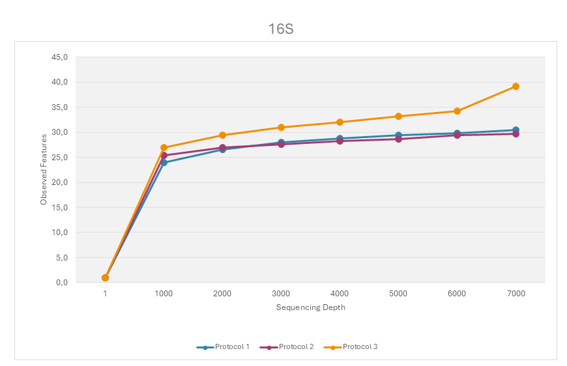
  •  
❌