❌

Normal view

Ukraine’s military robots are getting tires that can’t go flat

16 October 2026 at 16:02

Tough times can fuel innovation, and battle-hardened Ukraine has demonstrated that fact of life more than most places in recent years. Since Russia’s invasion in February 2022, the country has utilized drones and robotics in ways not before seen in large-scale warfare. More recently, Ukraine has introduced a variety of remotely controlled ground vehicles tasked with entering contested territory and resupplying areas or even evacuating wounded troops. But while those wheeled robots help keep soldiers off the front lines, they are also vulnerable. Their air-filled tires are particularly vulnerable, since they can be shot at or break when rolling over barbed wire, shrapnel or even rugged debris. To solve that issue, engineers from a pair of Ukrainian companies developed a new type of 3D-printable tire that doesn’t require any air at all. And it’s already being deployed on front lines. 

The airless wheel is the result of a collaboration between two Print&Live UA, and iSCALE 3D. Their design is proposed to be built for Uncrewed Ground Vehicles (UGV) that come in various shapes and sizes depending on their task. Instead of a rubber casing filled with pressurized air, these new wheels are 3D printed around a lightweight internal lattice made from durable elastomers and composite polymers. The lattice flexes and springs back over rough terrain, essentially doing the cushioning work that air pressure does in conventional tires, but  without the risk of a  sudden debilitating puncture. 

The tires also feature a rounded tread and enclosed sidewalls which are meant to keep mud, stones and ice from packing in. According to Print&Live UA and iSCALE 3D, the result is  a wheel set far lighter than Western airless alternatives and that keeps working even after taking some damage. Fewer blown out tires, they say, could mean more lives saved. 

“The most important mission of a UGV is not spectacular—it is bringing a wounded person back, or water, medicine and supplies forward,” the companies write on their websites. “Every immobilized vehicle puts people at risk. That is the real purpose of this development.”

“One puncture and the mission ends where the machine stops,” they add. 

a tire
The wheels are designed with enclosed sidewalls to keep mud, snow, or debris from sneaking in and causing damage. Image: Print&Live UA, and iSCALE 3D

No tire factory? No problem 

In addition to the airless design, the 3D printing process makes the new wheels more adaptable. Each set can be tinkered with and adjusted to best suit the type of vehicle they will be equipped on, as well as for the specific mission type they might engage in. Stiffness, shock absorption, and overall geometry can all be tweaked on a computer. The process requires large, industrial-scale printers most hobbyists won’t have in their garage, but it’s still a much smaller, nimbler approach than an entire factory built to roll out one specific product.

“Because the geometry is digital, stiffness and damping are programmed for each UGV type and payload, and a design upgrade is nothing more than a new file,” the companies write. 

The engineers also designed these wheels with the chaos of a battlefield in mind. Each two-piece rim set lets soldiers swap out a damaged tire without the tire-changing machines or presses a conventional repair would need. That flexibility means soldiers can repair or swap tires with simple hand tools in battlefield areas where full workshops aren’t available.

A new R&D hub for defense tech 

Airless UGV wheels are just the latest in a growing list of creative fixes forced by the Russia-Ukraine war. The constant need for better drones and robots has turbocharged the country’s tech sector, which has grown from a handful of defense companies before the invasion to hundreds today. Most of the companies building out the new hardware are Ukrainian, but the war has also attracted a number of American defense startups that have set up shop there, drawn in by the change to their designs in the real world. The country’s capital city  has attracted so much tech sector interest that some have even ascribed it the moniker: “Mil-Tech Valley.”

The post Ukraine’s military robots are getting tires that can’t go flat appeared first on Popular Science.
NASA’s Perseverance Mars rover sets distance record

13 October 2026 at 17:01

NASA’s Perseverance Mars rover has officially traveled 28.10 miles—farther across another planet’s surface than any other vehicle in history. Not only that, but the six-wheeled science lab accomplished this impressive feat almost entirely autonomously and in barely a third the time it took the previous recordholder.

“The original mission called for no more than 12.4 miles of driving. We’ve blown well past that,” Steven Lee, Perseverance and Curiosity project manager at NASA’s Jet Propulsion Laboratory, said in a statement.

Perseverance began operations on Mars on February 18, 2021, after landing in an ancient river delta selected for potential past microbial life called Jezero Crater. Since then, the rover has slowly but steadily made its way across the region, while conducting multiple sediment drilling surveys. These samples are then chemically analyzed using onboard laboratory equipment before the results are sent back to mission specialists at NASA.

Perseverance surpassed the previous travel record of 28.06 miles set by NASA’s Opportunity rover, before its communications with NASA ended on June 10, 2018. However, it took Opportunity nearly 15 years to accrue its distance while Perseverance exceeded the same mileage in less than six years, and on the 2,006th Martian day (sol) of its mission. Perseverance is currently traveling towards an area named Idubi through an expanse nicknamed “Lac de Charmes.” The region near Jezero Crater’s western rim hosts what may be the oldest landscape ever investigated in the solar system. Mars does not feature tectonic plates like Earth, which means its terrain is never eroded and subsumed into the planet’s substrates.

Mission engineers have not spent the last six years remotely steering Perseverance, either. The rover arrived on Mars equipped with a self-piloting system called AutoNav, which constructs 3D maps of the immediate surroundings to flag any potential hazards. AutoNav then charts a route between specific waypoints chosen by NASA specialists back home. Perseverance has completed 90 percent of its total excursion with AutoNav. Opportunity and its sibling rover, Spirit, only relied on a first version of the piloting system about five percent of the time.

Perseverance has a long road ahead of it, if all goes according to plan. In October, NASA approved the first mission extension that will continue the rover’s operations through about the end of 2028.

“With all mobility systems fully operational and favorable extended-ground-life test results, we expect Perseverance to keep adding to this record for many years to come,” added Lee.

The post NASA’s Perseverance Mars rover sets distance record appeared first on Popular Science.

Wavy-shaped homes could limit damage from hurricane winds

9 October 2026 at 20:45

As residents on the northern Gulf Coast brace for quickly strengthening Hurricane Isaias (a Category 3 storm as of Friday afternoon), many are likely eyeing their roofs and walls with nervous anticipation. The Congressional Budget Office estimates hurricane force winds and storm-related flooding collectively cost households in the United States some $34 billion every year. And while rounded corners, sloped walls and reinforced construction can help mitigate some wind damage, these additions are often expensive or impractical for developers looking to cut costs. Engineers at Florida A&M University and Florida State University think they’ve found a resourceful alternative, and it involves embracing the ocean’s own wavy aesthetic.  

For  a study recently published  in the journal Engineering Structures, the team built 3D-printed models of several low-rise buildings with wave shaped walls and roofs and tested them in a wind tunnel. The designs with the deepest waves, (in this case 10 percent of the building’s overall height) cut peak wind pressure near roof and wall corner by up to 60 percent. Those corners and edges are where damaging forces typically concentrate. Surprisingly simple designs like these could become increasingly attractive to develop in the coming years, as more and more communities brace themselves to endure stronger and more frequently occurring storms. 

“These nonconventional building shapes reduce the damage from worst-case severe weather scenarios,” Pedro Fernández-Cabán, a study co-author and Florida State University civil engineer, said in a statement. “It’s another tool for engineers and designers to protect against wind damage.” 

Bigger waves means better protection 

To test their idea, Fernández-Cabán and his colleagues started by 3D printing various models of low-rise buildings. Some of the buildings had wavy walls and roofs, while others were built with a more conventional baseline model with flat, straight surfaces. They made three wavy versions, with wave amplitudes of 5 percent, 7.5 percent, and 10 percent. The amplitude  measures the wave’s size in proportion to the building’s overall height in feet. So, for a 20-foot-tall building, a 10 percent amplitude would mean waves that extend about 2 feet.​​​​​​​​​​​​​​​​

Once the models were printed, the team then put them into a wind tunnel at the university. They measured wind pressure data on their surfaces as wind pelted the modelers from various directions. All of the wave-roofed models experienced reduced wind load compared to the flat version. The deepest wave model performed the best, reducing peak wind pressure near roof and wall corners by between 40 and 60 percent compared to the flat version. At least in theory, that means a building with that design could see significantly less damage when exposed to hurricane-force winds.

The diagram shows how curving structures can help prevent more destructing vortices from forming. Image: Pedro Fernández-Cabán.

The paper includes a useful diagram (above) that breaks down why this wavy design works. When wind flows over a flat surface like a roof, it separates at the leading edge and from a single large, swirling vortex. That creates a zone of low pressure, while higher pressure underneath the building pushes out against the surface. That leads to a suction like effect that, in extreme scenarios, can peel roofs off of a building. Over a wavy surface, the wind skips along like a stone across a lake, forming a series of smaller swirls instead of one big one. That disruption to the wind can prevent high-suction picks from forming. The result is a building that with less exposure to the strongest, points many damaging wind forces than a flat one. 

“Changing a building’s shape can significantly reduce the intensity of wind forces it has to withstand,” Fernández-Cabán said. 

The researchers caution that this study focused specifically on wind pressure on the model’s surfaces. They’re now running additional experiments to better understand how wind flows around the wavy structures and plan to use computer modeling to fine-tune the wave patterns and test other shapes. If that work bears out similar to  the early results, it could make wavy walls and rooms all the more attractive to architects and engineers looking for simple solutions to protect buildings in storm prone areas.

The post Wavy-shaped homes could limit damage from hurricane winds appeared first on Popular Science.

The world’s first nuclear clocks start ticking

7 October 2026 at 20:26

Timekeeping has officially entered its nuclear age. Two independent teams, one in Vienna, Austria and another in Beijing, China have built working thorium-229 nuclear clock prototypes. Rather than track changes in an atom’s electrons the way that current atomic clocks do, these nuclear versions use a laser that’s tuned to the frequency where a thorium nucleus flips between two energy states for potentially even more accurate time keeping. Scientists believe this new approach could one day make the clocks far more reliable than any existing atomic timekeeper. 

To put that in perspective, current atomic clocks can  keep time with an uncertainty of 1 second every 300 million years. Scientists predict that more advanced nuclear clocks could move that metric into the billions of years. That could open the door to probing some of the universe’s hardest-to-measure phenomena, like notoriously elusive dark matter. The Chinese clock and Austrian clock were detailed in a pair of studies published this week in the journal Nature.

“The great advantage of the new nuclear clock in Vienna is that, if you use atomic nuclei rather than atoms, much higher precision is possible in principle,” Thorsten Schumm, a study co-author and professor at the Vienna University of Technology, said in a statement.

a laser beam and a crystal
The thorium crystal and the laser beam. Image: TU Wien.

How nuclear clocks work 

The world’s network of atomic clocks is already mind-bogglingly accurate. They also underpin a slew of modern necessities, from GPS to internet communication. Atomic clocks work by tuning a laser to the exact frequency of light that makes an atom’s electron jump between two levels. 

Nuclear clocks, as the name suggests, go even deeper. They target jumps inside of an atom’s nucleus.  Lasers focus on vibrations from a single nucleus rather than the whole atom. For those who weren’t paying all that much attention in chemistry class, a nucleus is tens of thousands of times smaller than the atom surrounding  it.

a team working on a clock in a lab
Luca Toscani de Col (top right) working on the nuclear clock in the Vienna lab. Image: Matthias Heisler, TU Wien.

Keeping time in a nuclear clock requires keeping the laser tuned to the nucleus as it switches between states. This process is sometimes colloquially referred to as “squishing” the nucleus. Squishing atomic nuclei usually requires an enormous amount of energy. However, the isotope Thorium-229, is a rare exception, which is why both teams at Vienna University of Technology and Tsinghua University in Beijing built their clocks around it.

“The basic idea is simple: you have a laser and you have thorium,”  Schumm added. “The laser changes the energy state of the thorium nuclei, and the thorium nuclei are used to stabilize the frequency of the laser.”

Nuclear is still catching up to atomic 

These two prototype clocks are many years in the making. The thorium crystal used for both was grown separately, but around the same time. So far, testing reportedly shows the version in China is about six times as stable than the clock  in Vienna. The Vienna prototype, meanwhile, is reportedly the first nuclear clock that stabilizes itself the way atomic clocks do. Schumm recently told the South China Morning Post this parallel development has led to a  “fierce but friendly global competition.” 

Nuclear clocks may eventually far surpass their atomic forebears, but they aren’t there yet. Researchers estimate the new prototype may drift by about one second every 30 million years. That’s roughly 10 times worse than the cesium clocks that currently define the official second.

Still, researchers expect that stronger, more efficient lasers and better thorium crystals will make each new generation of nuclear clocks ever more accurate, until they eventually surpass atomic clocks altogether. Who manages to get their first remains to be determined. 

The post The world’s first nuclear clocks start ticking appeared first on Popular Science.

World’s largest steam locomotive returns to the rails for special holiday tour

7 October 2026 at 16:35

For the first time since 2019, Union Pacific’s Living Legend No. 844 will be hitting the rails with Big Boy No. 4014. These historic locomotives will be together for a special holiday tour this November. 

On November 21, the pair of steam locomotives will run during a fundraising tour from Greeley to Denver, Colorado. The trip will benefit the Make-A-Wish Foundation, with a donation from Union Pacific’s Community Ties Giving Program. The steam duo will also be on display to the public at Denver’s Union Station. Santa Claus and his elves will even be in the terminal handing out limited-edition gifts. Admission to this event is free and open to the public.

Tickets for the holiday fundraising tour to take a ride in vintage passenger cars pulled by Big Boy and No. 844 go on sale to patrons of the Union Pacific Railroad Museum on October 16. The general public can purchase any remaining tickets on October 19. Families can still visit Denver’s Union Station to view the locomotives free of charge.

Nicknamed the “Living Legend,” No. 844 is a famed high-speed passenger locomotive. It was built in 1944 and the last steam locomotive built for Union Pacific. It hauled some of the company’s most recognizable passenger trains, including the Overland Limited, Los Angeles Limited, Portland Rose, and Challenger. No. 844 is also the last Class I North American steam locomotive and never permanently retired from service. Instead, it was reassigned to freight service in Nebraska from 1957 to 1959, when diesel locomotives took over passenger service duties. Unlike nearly every other steam locomotive of its era, No. 844 escaped the scrap yard in 1960 and Union Pacific retained it for special service.

No. 844 was not scrapped in 1960 like other steam locomotives of its class. Image: Union Pacific.

No. 844 will chug alongside a more famous locomotive, Big Boy No. 4014. Big Boy is currently the world’s largest operating steam locomotive and one of only eight remaining Big Boys in existence and the only one still in operation. These powerful locomotives were constructed during World War II to transport heavy equipment to support the war effort. 

Earlier this year, Big Boy drew millions of spectators during a coast-to-coast journey celebrating the United States’ 250th birthday. The first leg began on March 29. Big Boy then traveled to several states including California, Utah, and New York. 

The steam locomotive celebrated the Fourth of July in Philadelphia, Pennsylvania, where the Declaration of Independence was written in 1776. Thousands of train enthusiasts braved temperatures of 102 degrees Fahrenheit (with a real-feel of 112 degrees) to catch a glimpse of the 133-foot-long and 1.2-million-pound train.

The post World’s largest steam locomotive returns to the rails for special holiday tour appeared first on Popular Science.

Needles turn rain into electricity

12 October 2026 at 12:00

For centuries, civilizations have harnessed energy from water. However, hydropower often requires large bodies of water to move heavy machinery, confining its use to rivers. But what if the electricity needed to light up your house could be generated from raindrops hitting its roof? 

To achieve this, scientists rely on electrical charges created when materials come into contact and then separate, a phenomenon called the triboelectric effect. As an example, rubbing a balloon against your hair gives them opposite charges, causing your hair to stand up and stick to the balloon. Scientists apply the same principle to make droplet-based triboelectric nanogenerators, or D-TENGS, where raindrops slide across negatively charged surfaces. As the droplets move, their positive charges gather near the surface, freeing up their negative charges. When the droplets reach a metal strip called an electrode, these negative charges flow into a circuit, generating electricity. However, water often remains on D-TENG electrode surfaces, blocking subsequent droplets and corroding the device.

Researchers at the China Three Gorges University and the Chinese Academy of Sciences approached this problem by modifying the shape of the electrodes used in D-TENGs. They proposed that a needle rather than a strip would help droplets detach quickly, allowing charge to flow into a device that uses inexpensive components. They called this design a needle electrode droplet-based triboelectric nanogenerator, or NED-TENG.

To build the NED-TENG, the researchers prepared a plastic film using a water-repellent polymer called polytetrafluoroethylene as the negatively charged surface. They inserted a copper wire through the center of the plastic film, protruding 3 millimeters (0.1 inches) from the front side to form the needle-shaped electrode exposed to raindrops. Meanwhile, they attached copper foil to the plastic film’s backside as a second electrode, completing the circuit. The team connected both electrodes to an instrument that measures electrical performance and mounted the components on an acrylic sheet, sealing it with waterproof tape.

To simulate raindrops, the team inclined the NED-TENG at 50° from a table and dispensed tap water drop by drop from 30 centimeters (12 inches) above its plastic film. Like conventional D-TENGs, the device generated electricity as droplets slid across the film and contacted the needle electrode. However, because the water touched only a small area of the needle, it easily slid off the NED-TENG, preventing the water from building up like in D-TENGs.

The researchers then evaluated and optimized the device using 2 metrics: the force driving charges through its circuit, or voltage, and how fast its charges transfer, or current. First, they compared the NED-TENG with a conventional D-TENG. The NED-TENG generated about 564 Volts (V) and 5 milliamperes (mA) of current, nearly twice the voltage and 3 times the current of the D-TENG, and enough to power small electronics like indicator lights.

Next, they varied the droplets’ release height to maximize electricity production. They found that increasing the release height from 10 to 30 centimeters (4 to 12 inches) increased both voltage and current, peaking at about 543 V and 4 mA. At greater heights, droplets splashed hard on impact, scattering the water and disrupting the charging process they observed in sliding droplets. 

Similarly, the researchers tested different device inclination angles, ranging from 10° to 70°. Their tests revealed that the device’s electrical performance increased at steeper angles and peaked at 50°, reaching 521 V and 3 mA. At steeper angles, droplets spent less time in contact with the surface, reducing electrical output. They explained that because triboelectric materials are highly sensitive, results can vary slightly between experiments, leading to individual peak values that are lower than the highest overall outputs. 

The researchers then explored how the technology might perform in a simulated rooftop installation. To reduce power fluctuations during real-world applications, they connected multiple NED-TENGs. They observed that 10 connected devices could fill a small energy-storage component within 2 minutes and power 200 LED lights.

Overall, the NED-TENGs shed water efficiently and generated more electricity than D-TENGs, while remaining simple to build. The team noted that future upscaled studies should examine how rooftop systems can direct rainwater onto the devices at optimal heights, and how droplets interact with their surfaces to improve long-term performance. With further development, these low-cost systems could turn rooftops into practical generators powered by everyday rainfall. 

The post Needles turn rain into electricity appeared first on Sciworthy.

Optogenetic therapy shows promise for vision restoration

8 October 2026 at 16:00

Retinitis pigmentosa is an inherited degenerative condition that destroys photoreceptors in the retina and can eventually lead to irreversible blindness. In a clinical trial first, an international research team has demonstrated that optogenetic therapy is safe to use and shows potential for restoring visual function in patients with late stages of this disorder.

In a first-in-human study in 2021, the collaboration – led by José-Alain Sahel from the University of Pittsburgh School of Medicine and Botond Roska from the Institute of Molecular and Clinical Ophthalmology Basel (IOB) – demonstrated that optogenetic therapy led to partial recovery of visual function in a blind patient with retinitis pigmentosa. This latest work, reported in the New England Journal of Medicine, expands the cohort to 10 participants.

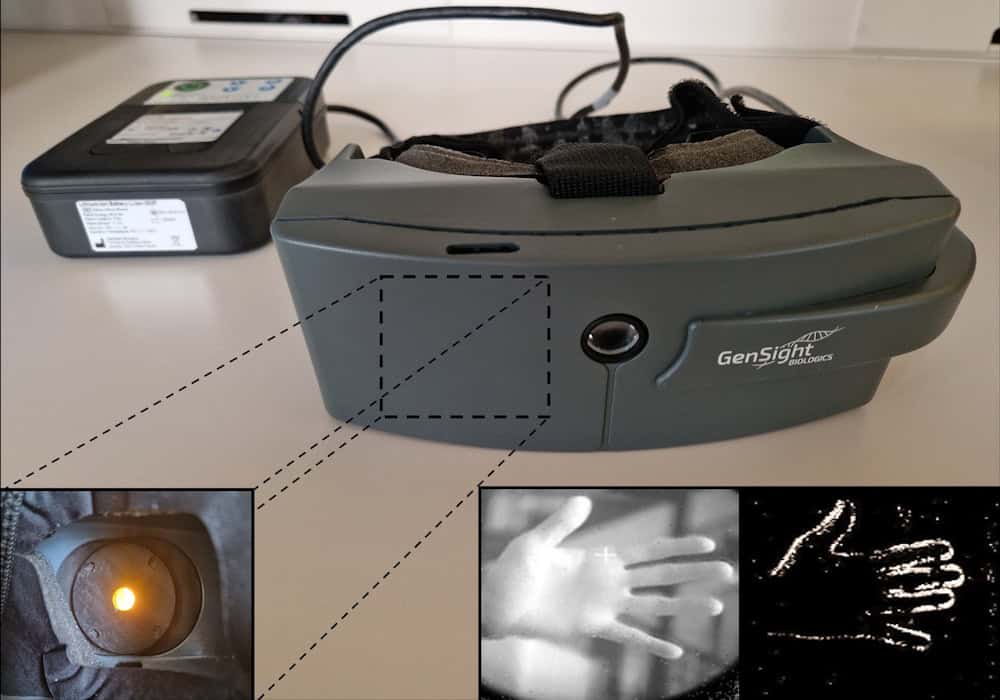
Optogenetics is a method that uses light to characterize and manipulate the activity of neurons in the brain – and which earlier this week won its inventors the 2026 Nobel Prize in Physiology or Medicine. The optogenetic therapy developed by Sahel, Roska and collaborators combines gene therapy that makes surviving ganglion cells (neurons in the retina) sensitive to light with special goggles that stimulate the altered cells.

“Although patients with retinitis pigmentosa lose their rod and cone cells, which normally detect light, many other cells within the retina can remain present for years after vision loss,” explains Sahel, director of the UPMC Vision Institute and first author on this study. “Optogenetics enables us to introduce a light-sensitive protein into these surviving cells, allowing them to respond to light and transmit visual information to the brain. The therapy bypasses the damaged photoreceptors and takes advantage of retinal circuits that remain intact.”

Sahel notes that retinitis pigmentosa can be caused by mutations in any one of hundreds of different genes, making optogenetic therapy a particularly suitable approach as it can potentially help regardless of the underlying mutation.

Safe to use

In the study, 10 participants with blindness due to advanced retinitis pigmentosa were injected in their worse-seeing eye with a gene that produces ChrimsonR – a light-sensitive protein with a peak response at around 590 nm (amber). The team divided the subjects into three dose-escalation groups, receiving 5.0 x 10¹⁰, 1.5 x 10¹¹ or 5.0 x 10¹¹ vector genomes per eye.

The primary aim was to evaluate the safety of the optogenetic therapy. The researchers observed 33 mild and moderate adverse ocular events in nine of the participants, such as temporary inflammation and increases in eye pressure, plus one severe event, which resolved within minutes after treatment. They concluded that, within the limits of the study, the treatment was safe.

Visual stimulation system
Visual stimulation system The specialized goggles (centre) send visual information to a processor (upper left) that converts the information into patterns of light. A projector within the glasses (lower left) sends these patterns back to the eye. Lower right: the system converts the image of a hand into a simplified light pattern that’s projected onto the retina. (Courtesy: Chloé Pagot, Streetlab, Paris)

Using the light-stimulating goggles, they then assessed the visual performance of treated eyes, before and after injection. The goggles contain a camera that detects changes in light intensities pixel-by-pixel and converts this visual data into pulses of amber light. This light is projected onto the eye to activate ChrimsonR in the modified retinal ganglion cells. Vision tests revealed that the treatment increased light sensitivity in seven of the 10 participants, by a factor of 2.0 to 62.3, with six patients showing a clinically meaningful improvement.

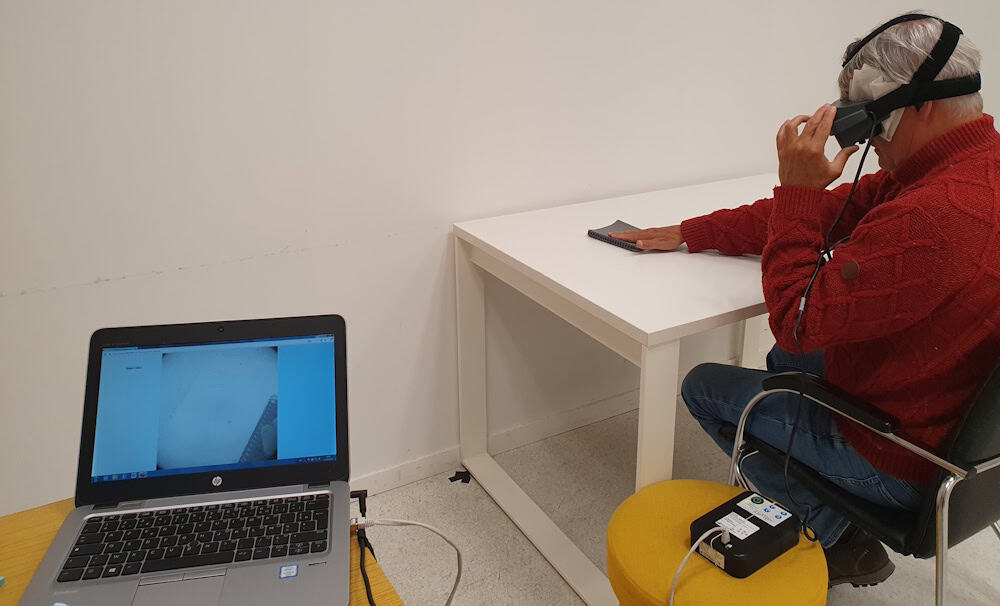
The patients also performed a series of tasks to detect, localize and touch a notebook and a staple-box. In the notebook task, five of eight participants had higher accuracy when wearing the goggles than when not wearing them, while four showed improved accuracy in the staple-box task. In a task determining the orientation of a single bar, accuracy was higher with the goggles in five of eight participants.

To provide an objective measurement of brain activity in response to light, the researchers obtained electroencephalographic (EEG) recordings in five patients performing two visual tests: detection of a tumbler placed in front of them (with the eyes open or closed); and passive viewing of periodic visual stimuli.

In the tumbler test, EEG decoding accuracy was higher with goggles than without when the eyes were open, but not when they were closed – implying a genuine improvement in visual processing rather than an artefact. The second test also showed increased decoding accuracy, which correlated with mean improvements in the notebook and staple-box tasks.

Visual behavioural test
Visual behavioural test After receiving optogenetic therapy, participants used a visual-stimulation system to complete tasks. Here, a participant reaches for a notebook. (Courtesy: Chloé Pagot, Streetlab, Paris)

A bright future

The changes in visual performance were consistent across multiple tasks and testing sessions, with responses observed in all three dose groups. Participants who spent longer being trained to use the goggles performed better in the visual behavioural tests. The researchers point out, however, that functional changes were modest: improving object detection and discrimination capabilities but not restoring normal sight. The small sample size also limited their ability to characterize treatment response.

Several projects are currently underway to further enhance the technology. This includes digital holographic goggles with an eye tracker being developed by the team of Valentina Emiliani at the Institut de la Vision in Paris. The system will project 20 µm-wide images that stimulate individual cells in the retina.

“With the eye tracker, we can make sure we are projecting exactly onto the area of the retina that we want. We’ve already developed a prototype, and it is moving forward,” says Sahel.

Elsewhere, University of Pittsburgh scientists are working with Roska’s group to develop cell-specific gene therapy vectors. “There are different types of cells: some respond to the onset of light, some to the offset of light, some to movement and direction,” Sahel explains. “We are trying to selectively stimulate the ‘on’ and the ‘off’, and discriminate the signal we are sending.”

“We are optimistic about advancing this approach toward future clinical trials,” he tells Physics World.

The post Optogenetic therapy shows promise for vision restoration appeared first on Physics World.

Inventors of optogenetics win Nobel Prize in Physiology or Medicine

5 October 2026 at 15:20

The 2026 Nobel Prize in Physiology or Medicine has been awarded to Karl Deisseroth, Peter Hegemann and Georg Nagel for “their discoveries concerning light-gated ion channels and optogenetics”.

Optogenetics is a method that uses light to characterize and manipulate the activity of neurons in a living brain. Hegemann and Nagel discovered the light-sensitive protein channelrhodopsin, while Deisseroth transformed the protein into a light-controlled switch for nerve cells.

“Optogenetics provides opportunities for mapping the brain in a way that we could once only dream of,” says Per Svenningsson, chair of the Nobel Committee for Physiology or Medicine.

From the pond to the brain

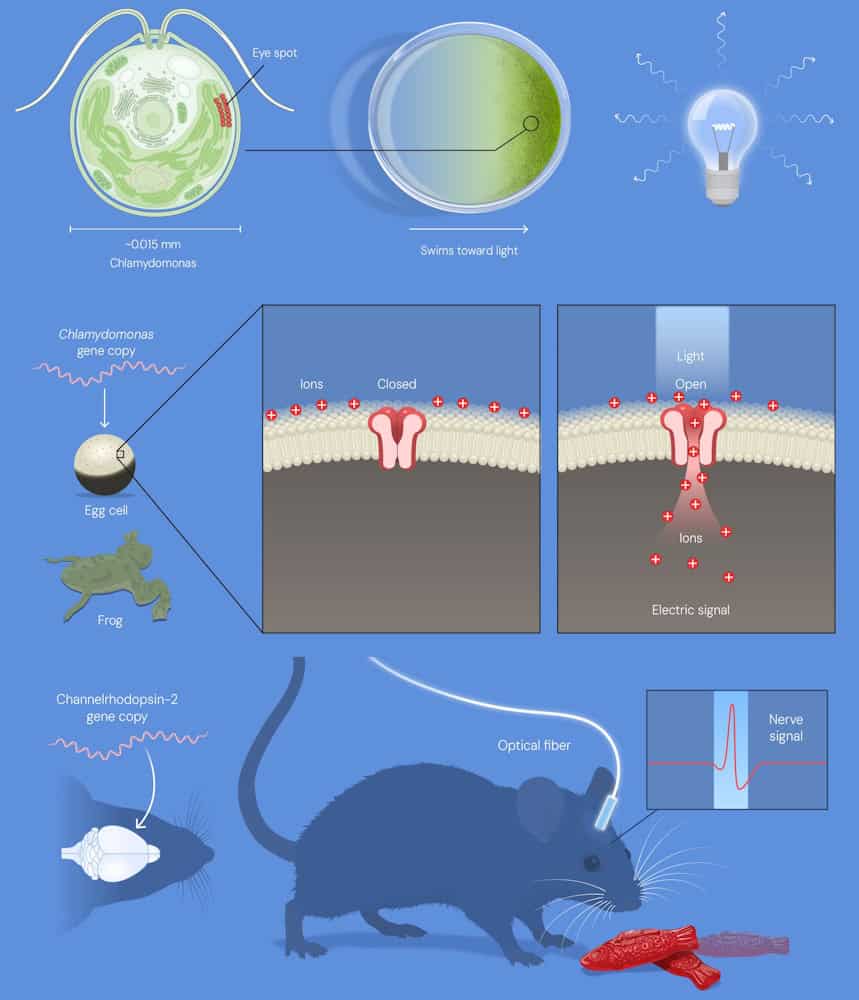
Speaking in the press conference following the announcement, neuroscientist Abdel El Manira from the Karolinska Institute described how the breakthrough began with the study of a single-cel­led green alga, Chlamydomonas, known for its ability to swim towards light using a tiny “eyespot” on its surface as a sensor. Hegemann was intrigued as to how this simple organism could transform light into action.

Prize-winning optogenetics research
Top to bottom: The algae Chlamydomonas senses light using its eyespot; Chlamydomonas genes in frog eggs, showing the ion channel proteins on the surface; activation of nerve cells in the brains of living mice. (Courtesy: © The Nobel Committee for Physiology or Medicine. Ill. Mattias Karlén)

Using electrical measurements to solve this mystery, Hegemann discovered that the eyespot contains a light-sensitive protein that almost instantly converts light into an electrical signal, enabling the alga to move. Hegemann next teamed up with Nagel, who used the gene for Chlamydomona to produce the protein in frog egg cells. They discovered that the protein itself was a light-gated ion channel that opens when exposed to light, allowing positively charged ions to flow into the cell and rapidly generate an electrical signal.

“Nagel and Hegemann realised exactly what they had found. They had just discovered the switch neuroscientists had long dreamed of – a light-gated ion channel they named channelrhodopsin,” says El Manira.

Appreciating the potential of this discovery, Deisseroth – at the time studying ways to establish causal links between specific brain circuits and behaviour – decided to test whether channelrhodopsin could be used as a switch to control the activity of neurons with light. By introducing the DNA encoding the protein (supplied by Nagel) into mammalian neurons and illuminating them with light, he observed a remarkable response: the neurons reacted on command, instantaneously and with millisecond precision.

The real test was whether channelrhodopsin could control neurons in living animals. Deisseroth and colleagues demonstrated that this was possible. By introducing the gene for channelrhodopsin into specific nerve cells in the brains of living mice and illuminating these cells via a thin optic fibre, they activated selected group of neurons and elicited a distinct behaviour.

“For the first time, causal links between specific brain circuits and behaviour had been achieved. The technology, which soon became known as optogenetics, transformed neuroscience,” notes El Manira. “Optogenetics was rapidly and widely adopted all over the world.”

Future medical potential

The field of optogenetics has now enabled researchers to establish causal links between neural activity and behaviour, identifying, for instance, neural circuits associated with pain, social behaviours, thirst, food consumption, reward and attention. Beyond the healthy brain, the technique also sheds light on how specific brain circuits can be disrupted and how this impacts psychiatric and neurological conditions.

And while optogenetics is primarily a tool for basic research and understanding of disease, optogenetic therapy is also showing early promise as a medical treatment. In particular, a landmark study has demonstrated partial recovery of visual function in a blind patient with retinitis pigmentosa, by insertion of a channelrhodopsin-like protein in their retina.

“In this disorder, retinitis pigmentosa, patients lose their photoreceptors, the rods and cones in the retina,” explains Svenningsson. “But there are still healthy cells in the retina and researchers have used optogenetics to stimulate these healthy cells and thereby activate the optic nerve and generate vision perception in the brain. This has been done and there are several clinical trials ongoing with this approach.”

Elsewhere, optogenetics is also under investigation for applications including control of spinal cord activity and bladder activity in small animals, inhibition of nerve pain and guidance of morphogenesis in a living embryo.

Friends together

Karl Deisseroth was born in 1971 and received his PhD and MD from Stanford University in the US, where he performed the work for which he was awarded the prize. He is currently an investigator at the Howard Hughes Medical Institute and professor at Stanford University.

Peter Hegemann was born in 1954 and received his PhD at the Max-Planck-Institute for Biochemistry in Martinsried, Germany, where he made his prize-awarded discoveries. He is now a senior professor of neuroscience at Humboldt University of Berlin, Germany.

Georg Nagel was born in 1953 and received his PhD at the University of Frankfurt, Germany. His prize awarded discoveries were made at Max Planck Institute for Biophysics in Frankfurt. He is currently professor of molecular plant physiology at the University of Würzburg, Germany.

Thomas Perlmann, secretary-general of the Nobel Assembly, described his call to the laureates earlier this morning: “All three were very surprised and all three said the same thing, that it was absolutely wonderful to receive the prize with the other two, called them ‘my friends’, and that it was such an honour to receive them together”.

  • Read about the use of organic dyes in optogenetics, in a book chapter co-authored by Peter Hegemann, now free to read on IOP Science.

SmarAct Group logo

SmarAct proudly supports Physics World‘s Nobel Prize coverage, advancing breakthroughs in science and technology through high-precision positioning, metrology and automation. Discover how SmarAct shapes the future of innovation at smaract.com.

The post Inventors of optogenetics win Nobel Prize in Physiology or Medicine appeared first on Physics World.

How do bacteria adapt to toxic metal waste?

1 October 2026 at 12:00

Electric vehicles (EVs) use high-powered rechargeable batteries to store electrical energy that powers their motors. Most EV batteries use a specific mixture of metals to hold the battery’s charge, called nanoscale lithiated nickel manganese cobalt oxides, aka NMC materials. NMC materials can store a large amount of energy, making them ideal for batteries, but the metals themselves can be toxic in soil and water if the batteries are not properly recycled.  

NMC batteries leave behind a specific combination of toxic metals, so researchers can study how bacteria respond to this waste when it enters the environment. By understanding how bacteria adapt to toxic metals, scientists hope to predict how new technologies like EV batteries will affect the environment. 

In 2019, a team of researchers from the University of Minnesota reported that a common soil bacterium called Shewanella oneidensis can rapidly evolve resistance to NMC materials, but they didn’t know how. True beneficial gene evolution usually develops over thousands of generations, but Shewanella oneidensis adapted much more quickly. The team recently conducted a follow-up study to determine the genetic mechanisms behind this bacterium’s unique metal resistance.

They started by analyzing the complete DNA sequences of 33 Shewanella colonies that were resistant to either pure NMC waste or individual metals like nickel and cobalt, using a process called whole-genome sequencing. They expected to find DNA mutations in genes that control how bacteria take up and expel toxic metals that would give the resistant Shewanella an advantage in surviving NMC metal toxicity. However, they didn’t find any DNA mutations in metal-related genes. Instead, they found that a specific DNA region was duplicated 10 to 15 times in all 33 NMC-resistant or metal-resistant colonies. This result suggested to the researchers that a temporary adaptation, not true gene evolution, was responsible for the bacteria’s metal resistance. 

The researchers wanted to know more about the duplicated DNA region in metal-resistant Shewanella, so they focused on 2 gene duplication mechanisms that might serve as temporary adaptations in Shewanella. The first mechanism directly duplicates DNA regions to create extra copies of a gene, via a process called gene duplication amplification. The second mechanism moves DNA segments, called mobile genetic elements, into different DNA sections to create extra copies of a gene. 

To test whether either of these mechanisms was causing the gene duplication in Shewanella, the team grew the bacteria in different liquid media containing only cobalt, only nickel, or cobalt and nickel together. The researchers used a technique that measures the exact amount of DNA in a given sequence, called quantitative polymerase chain reaction (qPCR), to calculate how many duplicated DNA regions were in each genome sequence. They found that neither cobalt nor nickel alone triggered DNA duplication. But the bacteria grown in the media with cobalt and nickel together had 8 additional copies of the DNA region. This suggested that something about the combination of nickel and cobalt triggered gene duplication. 

To determine whether this gene duplication only occurred with nickel and cobalt, the team substituted copper and zinc for nickel in the growth media. They exposed Shewanella cells to different combinations of these metals using a grid pattern in a 96-well plate, a technique called a checkerboard assay. Then they repeated the qPCR process to measure the duplicated DNA region. They found that no other combinations of metals triggered gene duplication, suggesting that nickel and cobalt are especially toxic together, and that the gene duplication responds to this combined toxicity.

Finally, the researchers identified the function of the duplicated DNA region. They found that one of the genes within the region turned on a special protein that pushes metal ions and other toxins out of the cell, called an efflux pump protein. The team hypothesized that this efflux pump protein was responsible for removing cobalt and nickel from the bacteria’s cells. To test this theory, they grew modified Shewanella cells without the efflux pump gene in media containing cobalt, nickel, or cobalt and nickel together. They found that the modified bacteria grew well in the nickel-only treatment, but didn’t grow in the cobalt-only or combined treatments, which indicated that the efflux pump protein is necessary for Shewanella to resist cobalt toxicity. 

Based on their experiments, the team concluded that nickel and cobalt together trigger a gene duplication event in Shewanella oneidensis. This gene duplication event increases the number of efflux proteins in Shewanella that can expel cobalt and underlies its unique NMC resistance. They suggested that future researchers study temporary adaptations similar to gene duplication in bacteria to track how they respond to electronic waste and other new technologies.

The post How do bacteria adapt to toxic metal waste? appeared first on Sciworthy.

Is nuclear waste safe underground?

24 September 2026 at 12:00

More than 90,000 tons of radioactive waste are stored on-site at nuclear power plants awaiting permanent disposal. Nuclear waste releases unstable forms of uranium and other elements, called radionuclides. Long-term exposure to radionuclides can cause cancer, so environmental safety regulations require that nuclear waste be made inaccessible for at least 1 million years. Thus, researchers are evaluating possible ways to store this waste permanently. 

One proposal is to store nuclear waste thousands of feet below ground in rock formations called deep geological repositories, or DGRs, to seal in radionuclides. Scientists can’t see into the future, so instead they look to the past to determine how well DRGs could work. A team of researchers from Canada recently analyzed uranium deposits that have existed for billions of years as an analog for how nuclear waste behaves deep underground.

Past researchers found that uranium deposits in ideal DGR conditions, with their protective casings intact, will stay contained for more than a billion years. However, these conditions require a stable geological environment. This team instead focused on uranium deposits in non-ideal conditions. They studied the Canadian Kiggavik uranium deposits, which occur in cracked bedrock approximately 500 meters (1,600 feet) below the surface. The team claimed these conditions are similar to DRGs with broken protective casings.

The team knew from previous work that most of the uranium minerals in the Kiggavik deposits are more than 274 million years old, but about 10% are less than 1 million years old. They found that these younger uranium minerals occurred alongside clay minerals surrounding the older uranium minerals and within open fractures. The researchers interpreted the older uranium as the source material of the younger uranium because of their proximity. They concluded that water must have infiltrated the deposits and interacted with older minerals, transporting uranium and forming new, younger minerals.

To determine the source of water infiltration, the researchers compared the chemistry of clay minerals formed alongside the younger uranium with modern snow in the Kiggavik region. They looked at the number of neutrons, or isotopes, in hydrogen atoms within the clay minerals, and found heavy values matching those of fresh water. These values indicated that snow or glacial meltwater was the source, rather than underlying bedrock or seawater. 

To determine when the water infiltrated over the last million years, the researchers used uranium-thorium dating to find when the radionuclides were mobilized. This dating method shows when uranium was removed from the original minerals by measuring how much its concentration was reduced by water infiltration. They found that the dates of these radionuclide mobilizations clustered into 5 separate water-infiltration events that occurred from 36 to 470 thousand years ago. 

Comparing these dates with existing climate records, the researchers found that the water infiltration events overlapped with periods when glaciers covered the ground surface. Normally, water can’t travel thousands of feet underground. But, like a hydraulic press, a glacier pushes water at its base downward. If the water encountered cracks in the ground, the pressure could inject it to the depth of the uranium deposit.

Next, the researchers wanted to measure how quickly radionuclides left the deposit. They measured the maximum distance between younger and older uranium minerals and used the age of the most recent water-infiltration event to estimate the fastest speed at which the radionuclides could have moved. They determined this maximum speed to be 0.0014 millimeters (0.000055 inches) per year. At that rate, they calculated it would take 360 million years for uranium radionuclides to travel 500 meters from a DGR at the same depth as the Kiggavik uranium deposits to the surface. This timescale far exceeds the necessary 1 million years for nuclear waste containment.

The team concluded that if glaciers were to return to Kiggavik, the uranium deposits wouldn’t experience substantial radionuclide movement, even in contact with glacial meltwater. Similarly, if a DGR has broken protective casings, radionuclides would be moving too slowly to reach the surface even if water leaked into it. They suggested their findings reduce constraints on viable DGR sites and could help ensure the long-term secure storage of nuclear waste.

The post Is nuclear waste safe underground? appeared first on Sciworthy.

❌