
❌

Normal view

Optogenetic therapy shows promise for vision restoration

8 October 2026 at 16:00

Retinitis pigmentosa is an inherited degenerative condition that destroys photoreceptors in the retina and can eventually lead to irreversible blindness. In a clinical trial first, an international research team has demonstrated that optogenetic therapy is safe to use and shows potential for restoring visual function in patients with late stages of this disorder.

In a first-in-human study in 2021, the collaboration – led by José-Alain Sahel from the University of Pittsburgh School of Medicine and Botond Roska from the Institute of Molecular and Clinical Ophthalmology Basel (IOB) – demonstrated that optogenetic therapy led to partial recovery of visual function in a blind patient with retinitis pigmentosa. This latest work, reported in the New England Journal of Medicine, expands the cohort to 10 participants.

Optogenetics is a method that uses light to characterize and manipulate the activity of neurons in the brain – and which earlier this week won its inventors the 2026 Nobel Prize in Physiology or Medicine. The optogenetic therapy developed by Sahel, Roska and collaborators combines gene therapy that makes surviving ganglion cells (neurons in the retina) sensitive to light with special goggles that stimulate the altered cells.

“Although patients with retinitis pigmentosa lose their rod and cone cells, which normally detect light, many other cells within the retina can remain present for years after vision loss,” explains Sahel, director of the UPMC Vision Institute and first author on this study. “Optogenetics enables us to introduce a light-sensitive protein into these surviving cells, allowing them to respond to light and transmit visual information to the brain. The therapy bypasses the damaged photoreceptors and takes advantage of retinal circuits that remain intact.”

Sahel notes that retinitis pigmentosa can be caused by mutations in any one of hundreds of different genes, making optogenetic therapy a particularly suitable approach as it can potentially help regardless of the underlying mutation.

Safe to use

In the study, 10 participants with blindness due to advanced retinitis pigmentosa were injected in their worse-seeing eye with a gene that produces ChrimsonR – a light-sensitive protein with a peak response at around 590 nm (amber). The team divided the subjects into three dose-escalation groups, receiving 5.0 x 10¹⁰, 1.5 x 10¹¹ or 5.0 x 10¹¹ vector genomes per eye.

The primary aim was to evaluate the safety of the optogenetic therapy. The researchers observed 33 mild and moderate adverse ocular events in nine of the participants, such as temporary inflammation and increases in eye pressure, plus one severe event, which resolved within minutes after treatment. They concluded that, within the limits of the study, the treatment was safe.
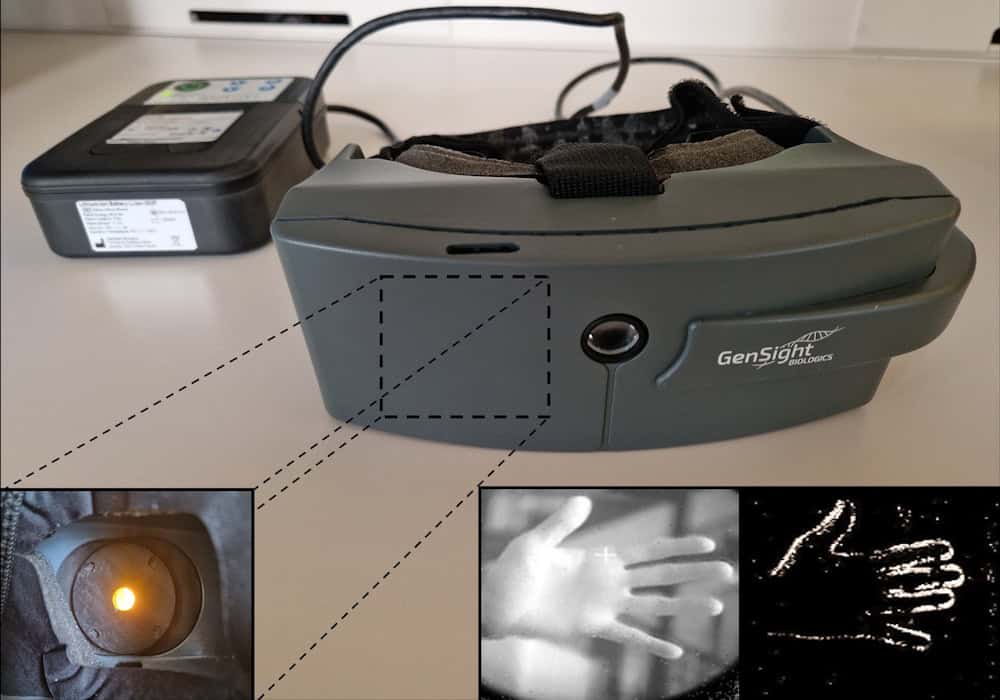
Visual stimulation system
Visual stimulation system The specialized goggles (centre) send visual information to a processor (upper left) that converts the information into patterns of light. A projector within the glasses (lower left) sends these patterns back to the eye. Lower right: the system converts the image of a hand into a simplified light pattern that’s projected onto the retina. (Courtesy: Chloé Pagot, Streetlab, Paris)

Using the light-stimulating goggles, they then assessed the visual performance of treated eyes, before and after injection. The goggles contain a camera that detects changes in light intensities pixel-by-pixel and converts this visual data into pulses of amber light. This light is projected onto the eye to activate ChrimsonR in the modified retinal ganglion cells. Vision tests revealed that the treatment increased light sensitivity in seven of the 10 participants, by a factor of 2.0 to 62.3, with six patients showing a clinically meaningful improvement.

The patients also performed a series of tasks to detect, localize and touch a notebook and a staple-box. In the notebook task, five of eight participants had higher accuracy when wearing the goggles than when not wearing them, while four showed improved accuracy in the staple-box task. In a task determining the orientation of a single bar, accuracy was higher with the goggles in five of eight participants.

To provide an objective measurement of brain activity in response to light, the researchers obtained electroencephalographic (EEG) recordings in five patients performing two visual tests: detection of a tumbler placed in front of them (with the eyes open or closed); and passive viewing of periodic visual stimuli.

In the tumbler test, EEG decoding accuracy was higher with goggles than without when the eyes were open, but not when they were closed – implying a genuine improvement in visual processing rather than an artefact. The second test also showed increased decoding accuracy, which correlated with mean improvements in the notebook and staple-box tasks.
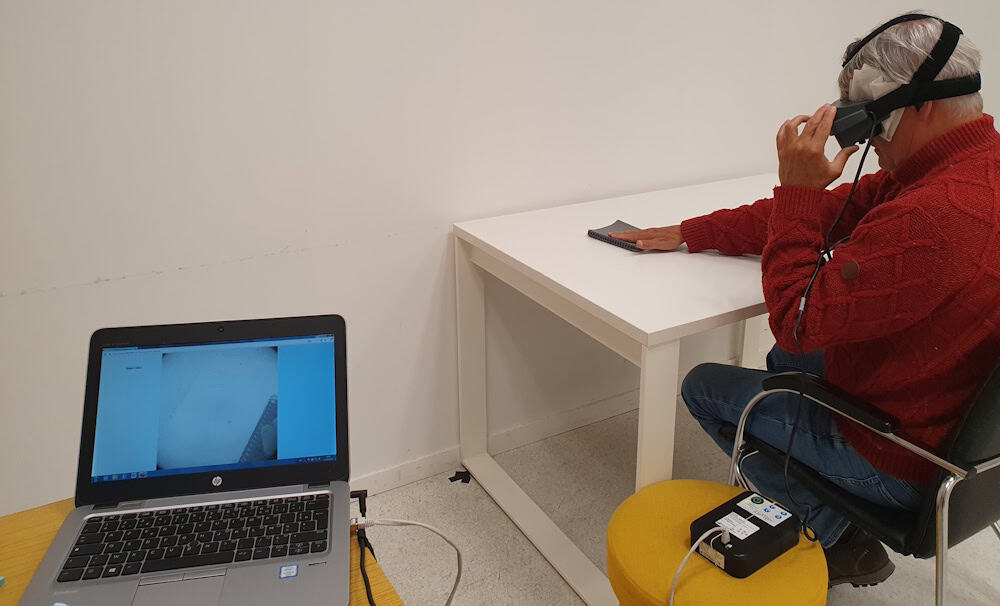
Visual behavioural test
Visual behavioural test After receiving optogenetic therapy, participants used a visual-stimulation system to complete tasks. Here, a participant reaches for a notebook. (Courtesy: Chloé Pagot, Streetlab, Paris)

A bright future

The changes in visual performance were consistent across multiple tasks and testing sessions, with responses observed in all three dose groups. Participants who spent longer being trained to use the goggles performed better in the visual behavioural tests. The researchers point out, however, that functional changes were modest: improving object detection and discrimination capabilities but not restoring normal sight. The small sample size also limited their ability to characterize treatment response.

Several projects are currently underway to further enhance the technology. This includes digital holographic goggles with an eye tracker being developed by the team of Valentina Emiliani at the Institut de la Vision in Paris. The system will project 20 µm-wide images that stimulate individual cells in the retina.

“With the eye tracker, we can make sure we are projecting exactly onto the area of the retina that we want. We’ve already developed a prototype, and it is moving forward,” says Sahel.

Elsewhere, University of Pittsburgh scientists are working with Roska’s group to develop cell-specific gene therapy vectors. “There are different types of cells: some respond to the onset of light, some to the offset of light, some to movement and direction,” Sahel explains. “We are trying to selectively stimulate the ‘on’ and the ‘off’, and discriminate the signal we are sending.”

“We are optimistic about advancing this approach toward future clinical trials,” he tells Physics World.

The post Optogenetic therapy shows promise for vision restoration appeared first on Physics World.

Tiny biodegradable stars enhance drug delivery to the skin

18 September 2026 at 09:30

Delivering drugs directly to the skin provides a targeted means of treating dermatological conditions while minimizing side effects. The approach is limited, however, by the stratum corneum – the skin’s outer layer – which acts as a barrier that can restrict the effectiveness of most topically applied drugs. To overcome this, a team at Georgia Tech has developed biodegradable “STAR particles” that use microscopic needles to painlessly puncture the skin and increase its absorption of medication.

“Very few drugs can be absorbed effectively into the skin, which means that many drugs in dermatology are given by mouth or injection,” explains team leader Mark Prausnitz. “This exposes the whole body to the drug, often causing side effects and reducing drug efficacy. STAR particles painlessly make micropores in the skin that allow drug that is rubbed on the skin to be absorbed. This targets drug delivery exactly to the site where it is needed.”

Previously, the researchers fabricated the STAR particles from a ceramic material (titania), which is safe to use on the skin, but not biodegradable, raising possible environmental concerns. In their latest work, reported in Advanced Healthcare Materials, they designed polymer STAR particles that dissolve or biodegrade after use, reducing their potential environmental impact.

STARs effectively create micropores

Prausnitz and colleagues created STAR particles from three polymers: water-soluble poly(vinyl alcohol) (PVA), enzyme-degradable cellulose acetate (CA) and hydrolysable polylactic acid (PLA). All three materials have previously been used to create microneedle patches, which enhance drug delivery but can generally only be used on small areas of skin.

“For dermatological conditions like eczema and psoriasis, patients need to treat skin with variable and sometimes large areas,” says Prausnitz. “STAR particles provide the power of a microneedle patch to increase skin permeability with the flexibility to apply them over large and variable areas by simply rubbing a gel or cream containing STAR particles on the skin.”

The researchers fabricated the polymer STAR particles using femtosecond laser micromachining to create star-shaped structures with sharp, well-defined microneedle tips and a tapered profile. They tested the ability of the various particles to puncture pig skin samples.

While PVA STAR particles cannot be applied using water-based vehicles, when suspended in non-aqueous formulations such as isopropyl palmitate (a non-toxic ingredient widely used in dermatology), they successfully punctured the skin. The STAR particles remained intact after use and the formulations worked equally well after storage for one week.

Similarly, CA and PLA STAR particles in water formulations demonstrated consistent skin-puncturing ability, even after a week’s storage, with no visible damage to the particles after application. The researchers note that titania STAR particles in water (examined as a control) generated more pores than the polymer particles, due to their higher hardness.

Drug delivery demonstration

The team next investigated how the STAR particles could enhance the delivery of three drugs – tacrolimus, methotrexate and copper tripeptide-1 – into pig skin samples.

Tacrolimus is used to treat inflammatory skin conditions and is soluble in non-aqueous solvents. After topical drug delivery, rubbing the skin with PVA STAR particles in isopropyl palmitate for 10 s or 30 s increased drug levels within the skin 1.7- or 3.2-fold, respectively, compared with control samples.

For CA STAR particles, the researchers examined methotrexate, which is commonly used for psoriasis treatment but cannot be delivered topically due to its very low skin permeability. Treatment with CA STAR particles for 10 or 30 s increased intradermal delivery of methotrexate 5.4- or 25.2-fold, respectively.

Finally, they used PLA STAR particles to deliver copper tripeptide-1, a skincare ingredient employed for anti-aging, wound healing and skin regeneration applications. The particles enhanced intradermal drug delivery 12.1- or 37-fold, after 10 or 30 s application, respectively.

Safety considerations

As the STAR particles are designed to create micropores in skin, it’s possible that they could unintentionally end up in other parts of the body, where the microneedles could cause damage. While this risk is likely small (as the STAR particles require forceful application to be effective), the water-soluble PVA STAR particles eliminate any potential risk as they rapidly dissolve upon contact with wet tissues.

The CA and PLA STAR particles will likely retain their structure immediately after use, but will eventually become blunt and weak upon enzymatic degradation or hydrolysis. Likewise, any potential environmental consequences of non-degradable STAR particles are reduced or eliminated with the water-soluble and biodegradable materials.

The team concludes that the biodegradable STAR particles address environmental and safety concerns while enhancing drug delivery to the skin. The approach paves the way for improved patient outcomes and broader applications, enabling delivery of hydrophilic drugs and larger molecules that are usually blocked by the stratum corneum barrier. Prausnitz tells Physics World that the research is primarily targeted at treatment of dermatological diseases that can spread over large areas of skin – such as psoriasis, eczema, vitiligo and allergic rashes – as well as cosmetic applications.

“We have licensed the STAR particle technology to a company that is preparing for a clinical trial next year using STAR particles to deliver siRNA as a novel eczema treatment,” he says. “At Georgia Tech, we are focused on advanced materials, manufacturing and formulations for the next generation of STAR particles.”

The post Tiny biodegradable stars enhance drug delivery to the skin appeared first on Physics World.

❌