This episode of the Physics World Weekly podcast features Ignacio Cirac, who has won the 2026 Isaac Newton Medal and Lecture for his “pioneering contributions that founded modern quantum information science, uniting profound theoretical insight, experimental vision, and exceptional scientific leadership shaping quantum physics and technology worldwide”.
Cirac is director of the theory division at the Max-Planck-Institute for Quantum Optics in Germany.
In conversation with Physics World’s Michael Banks, Cirac explains how an early interest in mathematics and science fiction drew him to quantum information – along with the field’s potential to create new technologies.
He talks about his collaboration in the 1990s with Peter Zoller to design quantum simulators and computers based on trapped-ion qubits. Cirac weighs up the pros and cons of the qubit technologies available today and highlights the benefits of systems based on Rydberg atoms.
Looking to the future, Cirac cautions against quantum hype and points out that it is still not clear how quantum technologies will be used in the future. He also calls on European academics to maintain their scientific excellence and for more money to be invested in the continent’s quantum industries.
This podcast is supported by American Elements, the world’s leading manufacturer of engineered and advanced materials. The company’s ability to scale laboratory breakthroughs to industrial production has contributed to many of the most significant technological advancements since 1990 – including LED lighting, smartphones, and electric vehicles.
Francis Halzen wins the 2026 Nobel Prize in Physics “for decisive contributions to the IceCube Neutrino Observatory and the discovery of high-energy neutrinos of astrophysical origin”.
The prize will be awarded in Stockholm, Sweden on 10 December and is worth SEK 12 million (about $1.2 million).
Born in Belgium, Halzen is based at the University of Wisconsin–Madison in the US. Nearly four decades ago Halzen realized that the ice at the South Pole could be used to detect cosmic neutrinos. The first attempt was called AMANDA, which was completed in 2000 but not large enough to be up to the task. It was expanded to create IceCube by the end of 2010.
IceCube comprises thousands of light detectors in a cubic kilometre of Antarctic ice. Occasionally a neutrino will interact with the ice and create particles that generate light as they travel through the ice. By tracking these particles, Halzen and colleagues can determine where in the sky the neutrino came from.
Speaking on the telephone shortly after the announcement Halzen said, “It was a great surprise and I didn’t expect it. It’s a great pleasure to hear about this prize.”
“This was an adventure”
He added, “When I reflect on this moment, I have to say how lucky I am. This was an adventure where success was not guaranteed, but we overcame many challenges. It was a long journey. I want to emphasize again how lucky I was to take contributions from collaborators. It feels strange. I hope it reflects on the courageous people who joined me on this project. Many talented people joined me on this journey.”
He was also thankful for the support of his university, “I was lucky to be in the right place [Wisconsin] when this idea [to build IceCube] came up.”
Commenting on whether neutrinos could be used to communicate with extra-terrestrial beings, Halzen quipped, “This has already been proposed by several friends of mine. It has been speculated that this would be an ideal way to communicate with aliens but I don’t think I will go there. I think we have enough realistic problems to deal with right now to make neutrino astronomy a reality.”
When asked what he will do for the rest of today, Halzen replied “I’m working on a proposal. I hope this prize will help get it approved.”
“Halzen had the idea together with a colleague in 1988 to use the ice at the South Pole as a medium to detect neutrinos,” said Mark Pearce, chair of the Nobel Committee for Physics, who is also an astroparticle physicist at KTH Royal Institute of Technology in Stockholm.
International collaboration
Pearce adds, “Halzen has spearheaded an international collaboration of more than 450 people from 58 institutions in 14 countries around the world to realize this enormous neutrino detector.”
Halzen is the first sole winner of the Nobel Prize in Physics since Georges Charpak won it in 1992, with Pierre-Gilles de Gennes being the previous lone laureate in 1991.
This is the fifth Nobel prize related to neutrinos. The first went to the discovery of the muon neutrino, which was recognized by the Nobel committee in 1988. It was followed by the first observation of the neutrino itself (1995), the detection of cosmic neutrinos (2002), and the discovery of neutrino oscillations – the fact that neutrinos can switch from one type to another – in 2015.
Pearce explains why physicists are so fascinated by the elusive subatomic particle: “The neutrino has such peculiar properties, the fact it interacts so infrequently in material, and in this case it’s a way of bringing information about distant cosmic sources that we are unable to acquire in other ways.”
Halzen was born in Tienen, Belgium, in 1944. He graduated with an MSc in physics from the University of Louvain in 1966 and then a PhD from the same university in 1969.
After a stint at the CERN particle-physics lab, he moved to the University of Wisconsin–Madison in 1972, where he also became the principal investigator on the AMANDA neutrino observatory in Antarctica and the IceCube project.
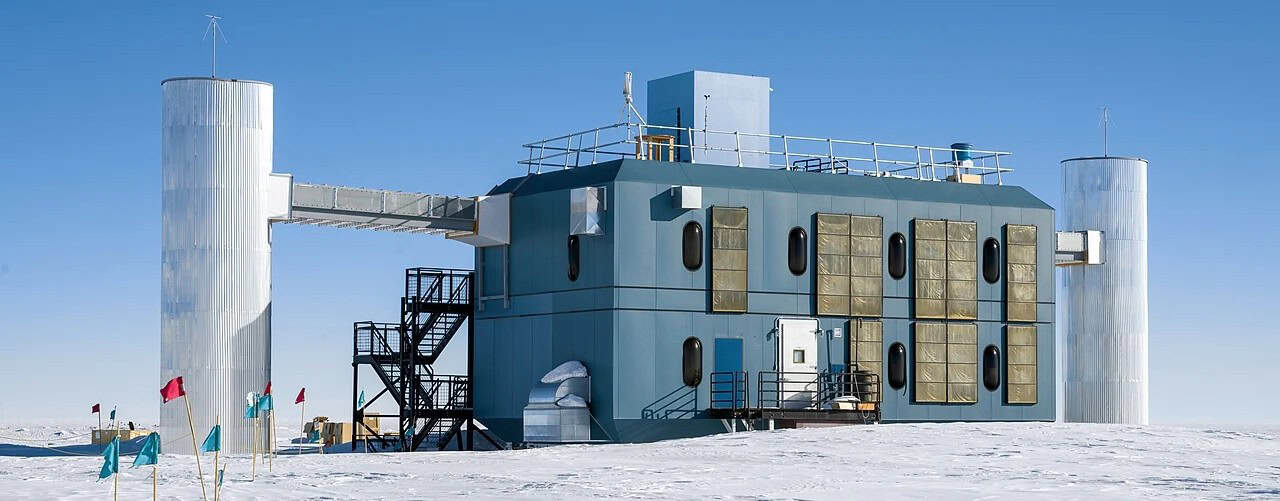
Tip of the iceberg A cubic-kilometre-sized neutrino detector lurks deep within the ice below the IceCube Laboratory building at the South Pole. (Courtesy: Christopher Michel/CC BY-SA 4.0)
IceCube was completed in late 2010. Then, it comprised 5160 digital optical modules suspended along 86 strings, each up to 2.5 km long and embedded under the ice at the Amundsen-Scott South Pole Station. The strings are spaced to create a total detector volume of a cubic kilometre. Neutrinos interact with matter only extremely weakly, so the array instead detects the tiny flashes of Cherenkov light produced when the neutrinos collide with hydrogen or oxygen nuclei inside the ice and create secondary particles. Under ideal circumstances, the detector signal can be used to work out where in the sky the neutrino came from.
In 2013 the IceCube Collaboration published details of its observation of 28 extremely high-energy particle events, created by neutrinos with energies of at least 30 TeV. The findings represented the first evidence for high-energy cosmic neutrinos, which originate from outside the solar system.
Two years later, IceCube confirmed the cosmic origin of high-energy neutrinos with an independent search in the Northern Hemisphere. This study examined muon neutrinos reaching IceCube through the Earth, using the planet to filter out the large background of atmospheric muons. Data analysis suggested that more than half of the 21 neutrinos detected above 100 TeV were of cosmic origin.
In 2018 IceCube, along with astronomers working on two gamma-ray telescopes, found compelling evidence that a known blazar – called TXS 0506+056a and located about 4 billion light-years from Earth – was a source of high-energy neutrinos detected by IceCube. This was an important milestone in multimessenger astronomy, whereby astronomical objects are studied by observing several different types of radiation.
Another breakthrough came in 2021 when IceCube was the first to spot an interaction called a Glashow resonance. This interaction was first predicted in 1960 and involves the collision of high-energy antineutrino with an electron to create a W boson. In 2022 the galaxy NGC 1068 was identified as a source of high-energy neutrinos and in 2023 IceCube showed that the Milky Way is also a source of high-energy neutrinos.
Earlier this year an upgrade of IceCube added more than 600 new light sensors in five new holes drilled in the ice near the centre of the detector.
In 2013 Halzen and his IceCube colleagues won the Physics World Breakthrough of the Year award. Hamish Johnston spoke to him about the experiment in this video:
Physics World is brought to you by IOP Publishing, which has a portfolio of more than 100 journals, around half of which are published jointly with or on behalf of partner societies and research organizations. Francis Halzen has published more than 150 papers with IOP Publishing and you can explore them here.
SmarAct proudly supports Physics World‘s Nobel Prize coverage, advancing breakthroughs in science and technology through high-precision positioning, metrology and automation. Discover how SmarAct shapes the future of innovation at smaract.com.
Abdus Salam shared the 1979 Nobel Prize in Physics with Sheldon Glashow and Steven Weinberg for “their contributions to the theory of the unified weak and electromagnetic interaction between elementary particles, including, inter alia, the prediction of the weak neutral current”.
What Salam had done was to incorporate the Higgs mechanism – co-discovered by his colleague at Imperial College London Tom Kibble – into electroweak theory, which unifies the electromagnetic and weak forces.
As the Imperial theorist Claudia de Rham said in a 2024 interview with Physics World, Salam’s work “changed the way we see the world by underlining the importance of symmetry and by showing how some forces – which may appear different – are actually linked”.
But Salam, who died in 1996 after suffering from a cruel neurodegnerative disease, did more than unify the weak and electromagnetic interactions. He also became the first – and so far the only – person from Pakistan to win a science-related Nobel prize, yet for a long time remained overlooked in his homeland.
Great minds
Salam was born on 29 January 1926 in the Punjabi city of Jhang in what was then British India. A child genius, he studied mathematics at Government College, Lahore, completing his master’s degree in 1946 with record marks (getting 765/850 or 90%).
Later that year Salam moved to the UK after winning a scholarship to study at St John’s College, Cambridge, studying initially mathematics and then physics, gaining a double first-class honours in 1949.
Back home, India was in turmoil, with a growing demand for independence from the British, and the Muslims seeking a homeland for themselves.
As a Muslim himself, Salam would no doubt have celebrated when Pakistan was created during the partition of India, with the country coming into existence at the stroke of midnight (0.00 a.m.) on 14 August 1947.
After completing his PhD in quantum electrodynamics at Cambridge in 1951, Salam returned to Pakistan, taking up a teaching post at Government College, keen to establish a research base in the fledgling country. But lacking journals, colleagues or any proper scientific infrastructure in Pakistan, Salam realized he would have to go abroad again.
“Either I must leave my country or leave physics,” he said. “And with great anguish I choose to leave my country.”
Upon winning a Nobel prize in 1979, Pakistan had existed for only 32 years, meaning it, along with Austria, is the joint 13th quickest nation to win a Nobel Prize in Physics, according to our Physics World infographic.
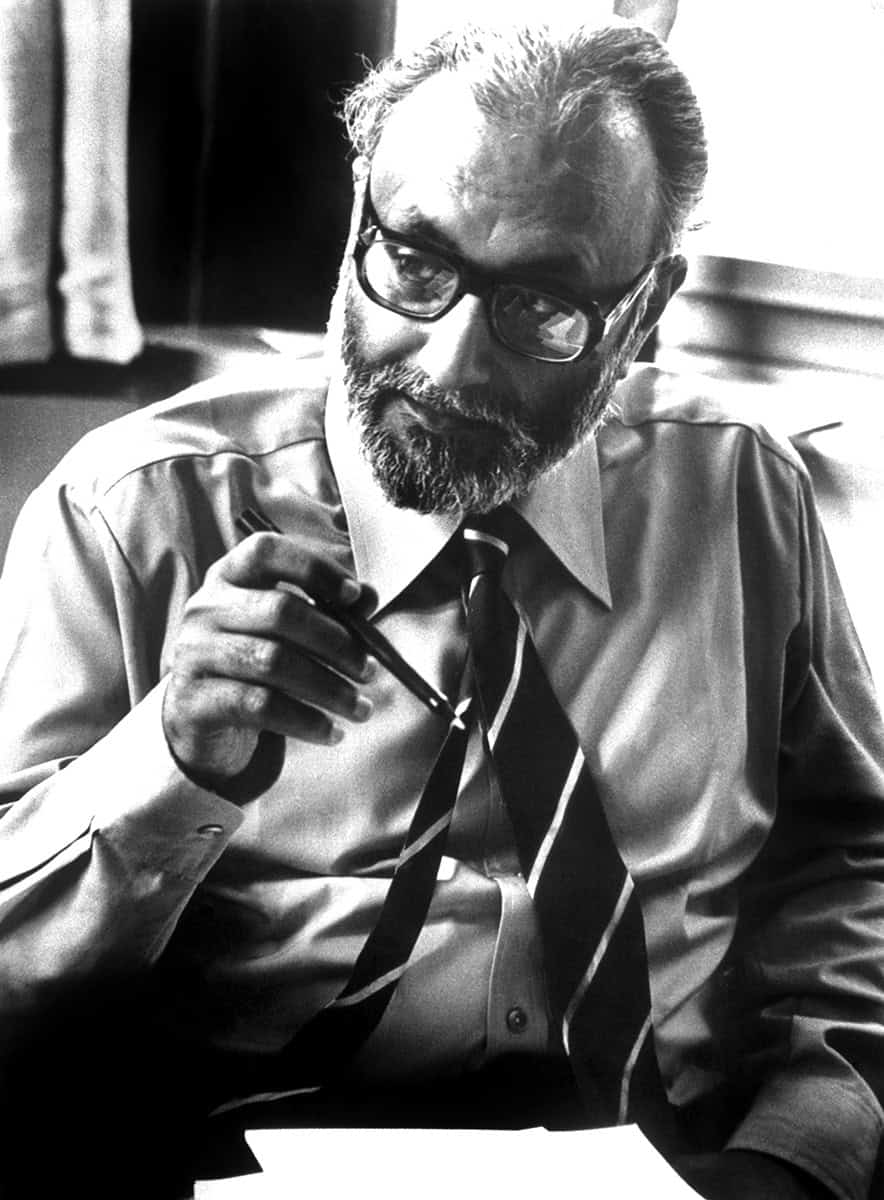
Genius in action A portrait of Abdus Salam taken in 1979. (Courtesy: Giovanni Montenero, ICTP Photo Archives)
At the official Nobel banquet in Stockholm on 10 December 1979, Salam thanked the Nobel Foundation and the Royal Swedish Academy of Sciences. “Pakistan,” he declared, “is deeply indebted to you for this.”
Yet back home, little was made of Salam’s impressive award. Most Pakistanis are Sunnis but Salam was an Ahmadi, part of a minor Islamic movement founded in the late 19th century by the religious leader Mirzā Ghulām Ahmad (1835–1908).
Such was the opposition in Pakistan to the Ahmadis that in 1974 the country’s parliament declared them non-Muslims – heretics essentially – and the constitution was altered to reflect that fact.
Pakistan’s decision to outcast the Ahmadis profoundly affected Salam. As he wrote in his diary: “Declared non Muslim. Cannot cope.” Having previously been largely a “cultural Muslim”, Salam now saw his religious beliefs re-awakened.
Belatedly, Pakistan did offer some formal recognition in the form of a two rupee stamp in 1998, but it is surprising the country has not done much more. In 2016 Physics World reported that then Pakistani prime minister Nawaz Sharif was going to rename the National Centre for Physics at Quaid-i-Azam University in Islamabad as the Professor Abdus Salam Centre for Physics – but, as far as I can tell, that has not taken place.
A few years ago Zakir Thaver and Omar Vandal produced a wonderful documentary film called Salam: the First ****** Nobel Laureate. Directed by the physicist Anand Kamalakar, it explores in detail the strange relationship between Salam and Pakistan, which surely should have done more to honour its greatest physicist.
I can’t imagine other countries doing so little for their first Nobel prize winners as Pakistan has for Salam.
SmarAct proudly supports Physics World‘s Nobel Prize coverage, advancing breakthroughs in science and technology through high-precision positioning, metrology and automation. Discover how SmarAct shapes the future of innovation at smaract.com.
Cyril Hilsum, a former president of the Institute of Physics (IOP), which publishes Physics World, died on 23 September at the age of 101. In the 1970s Hilsum made pioneering contributions to liquid crystals paving the way for TV and computer liquid-crystal displays that are still widely used today.
Hilsum was born on 17 May 1925 and completed a degree in physics at University College London in 1945. He then joined the Admiralty Research Laboratory in Teddington before working at the Services Electronics Research Laboratory in Baldock.
Throughout his career, Hilsum focused on developing commercial applications for many areas of his research including creating the UK’s first semiconductor laser.
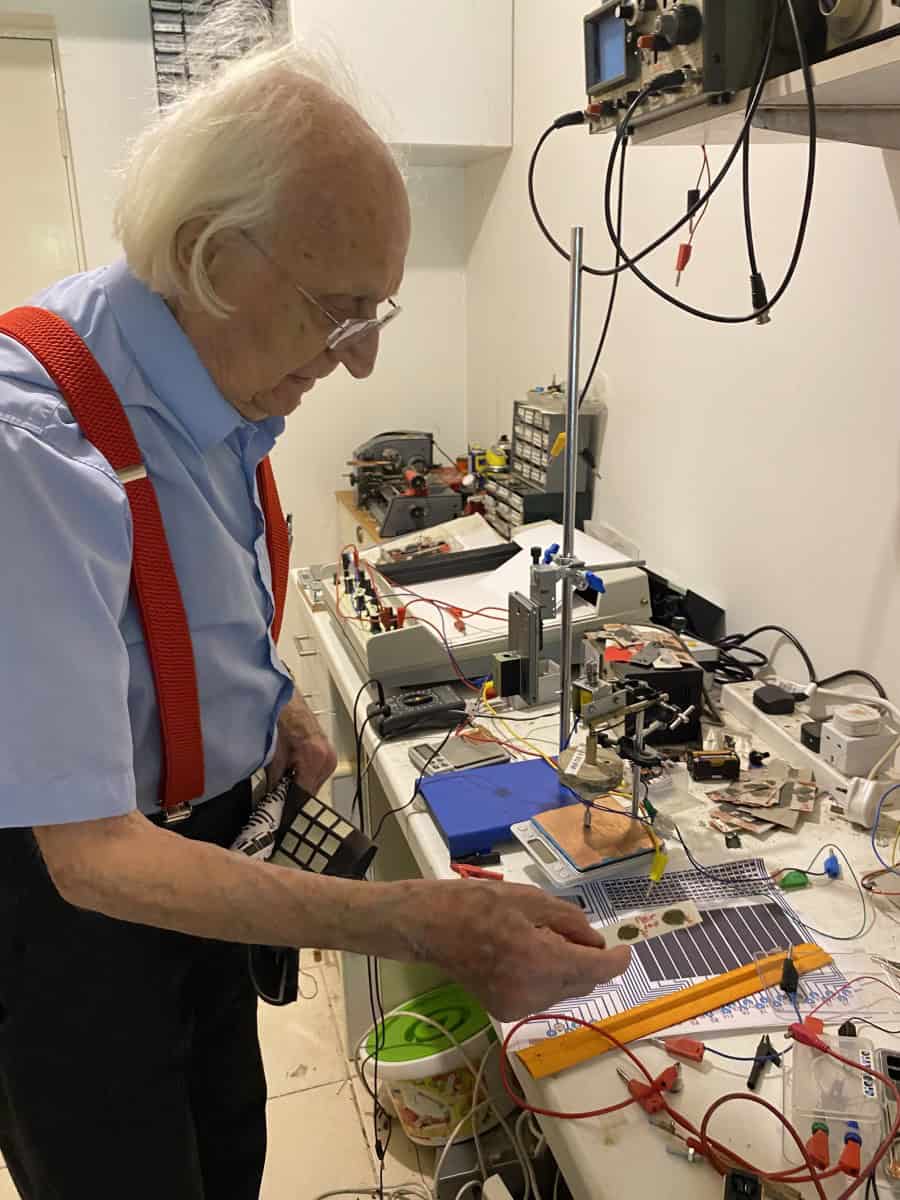
Hilsum built a lab in his house in Pinner where he made his final invention – an ink with sensors to conduct electricity. At the age of 97, this earned him the last of more than 70 patents. (courtesy: Lindsey Hilsum)
In 1964 he moved to the Royal Radar Research Establishment in Malvern, Worcestershire, developing the first microwave oscillator based on the negative resistance effect in the semiconductor gallium arsenide.
His work on miniature radar systems led to Claribel, a device that detected the trajectory of a bullet and could be used to locate snipers.
He also led a team that developed the first stable liquid crystals that could be used in flat panel displays, an invention that garnered £100m in royalties for the British government.
In 1983 Hilsum was appointed chief scientist of GEC Hirst Research Centre, where he later became research director two years later.
Hilsum officially retired in 1995 aged 70, but worked part-time as chief science officer for Infi-tex Ltd, which produces force sensors for use in textiles.
A life in science
Hilsum served as president of the IOP between 1988 and 1990, in which year he was also appointed a Commander of the Order of the British Empire (CBE) for his “services to the electrical and electronics industry”.
Over his career, Hilsum was honoured with many prizes including three awards from the IOP: the Max Born Prize in 1987, the Faraday Medal (1988) as well as the Richard Glazebrook Medal and Prize (1998).
In 2007 he was awarded the Royal Society’s Royal Medal “for his many outstanding contributions and for continuing to use his prodigious talents on behalf of industry, government and academe to this day”.
Hilsum also encouraged more women to have careers in physics and engineering. He sponsored the Karen Burt Award at the Women’s Engineering Society, which was named after his daughter, an engineer, who died in 1997 aged 42.
Former IOP president Frances Saunders, who worked in liquid-crystal displays, told Physics World that Hilsum was a “true pioneer in applied physics”, adding that as well as finding applications for such emerging technologies he always wanted to ensure that the underlying physics or material science was properly understood.
“What also made him stand out was his vision for where a technology might go – in the early developments of LCDs his vision was that the display would become the computer with the computer chips attached to the back of the display and interacted with via touch screens,” adds Saunders. “He was right, of course, as we now have tablets and smart phones that do just that.”

 Login

 This podcast is supported by American Elements, the world’s leading manufacturer of engineered and advanced materials. The company’s ability to scale laboratory breakthroughs to industrial production has contributed to many of the most significant technological advancements since 1990 – including LED lighting, smartphones, and electric vehicles.