❌

Normal view

New Geometric Toolkit Reveals Hidden CP-Violating Patterns in Meson Decays

11 October 2026 at 09:18

Neutral mesons, the fleeting particles that endlessly oscillate between matter and antimatter forms, have just acquired a strikingly new mathematical lens. In a theoretical study published in The European Physical Journal C, physicist Swarup Sangiri of the Indian Institute of Technology Kharagpur has constructed a fresh class of geometric objects, called connected sequential Bargmann invariants, that encode how two different decay channels of an entangled meson pair relate to one another inside the projective geometry of quantum states. The work extends an earlier framework and shows that when decay-projected states are wired directly into a cyclic chain of quantum overlaps, the resulting quantities behave in a fundamentally different way near the boundary where CP violation switches off.

To appreciate why this matters, it helps to recall what makes neutral meson systems so special. Particles such as the neutral kaon, the D meson, and the two neutral B mesons are produced as flavor eigenstates but propagate as mixtures of heavy and light eigenstates, conventionally written as combinations of the meson and its antiparticle with coefficients p and q. When the magnitudes of p and q differ, the two propagation eigenstates are no longer orthogonal, and this nonorthogonality is the hallmark of indirect CP violation, the subtle asymmetry between matter and antimatter that was famously discovered in kaons in 1964. Because any physical observable must be independent of arbitrary phase conventions attached to quantum states, the natural language for describing interference in these systems is one of rephasing-invariant quantities.

Bargmann invariants provide exactly that language. For a closed sequence of quantum states, the nth-order Bargmann invariant is the product of overlaps taken around the cycle, and it remains unchanged under independent phase redefinitions of each state. Its phase is a geometric phase, the kind of holonomy familiar from the Berry phase, accumulated along a closed loop in the space of rays. Earlier work had applied this machinery to correlated neutral meson decays, constructing third-order invariants that probe single-channel interference and fourth-order invariants that correlate two decay channels through the heavy and light propagation eigenstates. Those constructions linked the geometric picture to conventional flavor observables, including Jarlskog-type structures, without introducing any new phenomenological parameters.

The new study asks a deceptively simple question: what happens if the two decay-projected states themselves are connected directly inside the cyclic overlap chain? When one meson of an entangled pair, produced for example in the decay of a phi or Upsilon resonance, decays into a channel f, its partner is projected into a conditional state determined by the decay amplitudes. A second channel g prepares a different conditional state. The connected sequential fourth-order Bargmann invariant follows the loop from the heavy eigenstate to the f-conditioned state, then directly to the g-conditioned state through their mutual overlap, then to the light eigenstate, and finally back to the heavy one. The crucial new ingredient is the overlap between the two conditional states, a quantity built purely from the decay amplitudes that measures how similar the two post-selected meson states are in projective Hilbert space.

This change in connectivity has dramatic consequences for how the geometric quantities scale as CP violation becomes small. The previously studied disconnected fourth-order invariant, when normalized by the product of two third-order invariants, produced a ratio that blows up quadratically, scaling as the inverse square of the mixing asymmetry, the difference between the squared magnitudes of p and q. The connected sequential ratio, by contrast, carries only a single factor of that asymmetry in its denominator, so its enhancement near the CP-conserving limit is merely linear. Physically, replacing one propagation-mediated link with a direct overlap between the projected states removes one power of the heavy-light suppression, placing the two classes of geometric correlation in distinct scaling classes.

A second new ratio compares the sequential invariant directly with the disconnected one. This comparison ratio behaves in the opposite manner: it is proportional to the mixing asymmetry itself, vanishing in the exact CP-symmetric limit. Its behavior is governed by a competition between two effects, the shrinking of the heavy-light overlap on one side and the possible alignment of interference phases between the two decay channels on the other. When the conditional states prepared by the two channels become geometrically aligned, the suppression can be weakened, revealing that the connected structure is sensitive not only to mixing asymmetry but also to the relative coherence of the decay projections.

To make these statements precise, the analysis is carried out in terms of the standard rephasing-invariant interference parameters lambda, the products of the mixing ratio q over p and the ratios of decay amplitudes to their CP-conjugates. A systematic small-asymmetry expansion, with the squared magnitudes of p and q written as one half plus or minus a small parameter, shows that the sequential ratio depends explicitly on the phase difference between the two channels through the numerator structure. This dependence has no analogue in the disconnected construction, where the channels communicate only through the propagation eigenstates. It means the connected sequential geometry probes the relative orientation of the decay-conditioned rays themselves, a piece of interference information that conventional observables do not isolate on their own.

The geometric interpretation is perhaps the most elegant part of the story. Both the disconnected and the sequential fourth-order invariants involve the same four rays, the heavy and light propagation eigenstates and the two decay-projected states, yet they define different closed paths through projective Hilbert space. A Bargmann invariant depends not just on which states participate but on how they are stitched together, so rewiring the cycle produces a genuinely different geometric correlation. In the CP-conserving limit the heavy and light eigenstates become orthogonal, one link of every cycle collapses, and the entire cyclic structure degenerates, which is why the invariants vanish there. The formalism thus ties the very existence of these CP-sensitive geometric objects to the nonorthogonality of the propagation eigenstates.

Crucially for experiment, none of this requires new physics inputs. The sequential invariant and both ratios can be written entirely in terms of the mixing parameters and decay amplitudes already extracted from time-dependent flavor analyses at flavor factories such as the KLOE experiment with entangled kaons and the BABAR and Belle measurements with entangled B mesons. The framework simply reorganizes the same accessible information into cyclic geometric quantities. The neutral kaon system, with its small indirect CP violation and long-lived interference phenomena, is flagged as a particularly natural arena where the linear enhancement of the sequential ratio could be pronounced, with candidate channels including two-pion, semileptonic, and multi-pion final states. The B meson systems, including channels like B decays to J/psi kaons and to pion pairs, offer rich phase-dependent interference structures, while the D system, where both mixing and CP violation remain tiny in the Standard Model, could serve as a sensitive testing ground for small deviations from exact symmetry.

The study stops short of claiming a new dynamical observable. The author is careful to note that the sequential construction does not add an extra propagation stage in the manner of conventional cascade CP analyses; it is a reorganization of overlap geometry within a single meson system. Even so, the result establishes a hierarchy of Bargmann invariant structures, from single-channel triangles through disconnected quadrilaterals to directly connected sequential cycles, each capturing a different layer of CP-sensitive interference. As precision flavor physics continues to squeeze ever tighter constraints on the origins of matter-antimatter asymmetry, geometric tools of this kind may reveal correlation patterns hiding in plain sight within data that experiments already collect.

Subject of Research: Geometric Bargmann invariant structures and CP-sensitive interference in correlated neutral meson systems

Article Title: Connected sequential Bargmann invariants and (\mathcal CP~)-sensitive geometric correlation structures in neutral meson systems

Article References: Sangiri, S. (2026). Connected sequential Bargmann invariants and $$\mathcal CP~$$-sensitive geometric correlation structures in neutral meson systems. The European Physical Journal C, 86(9), Article 1056. https://doi.org/10.1140/epjc/s10052-026-16308-5

Image Credits: AI Generated

DOI: 10.1140/epjc/s10052-026-16308-5

Keywords: Bargmann invariants, neutral mesons, CP violation, geometric phase, quantum interference, meson mixing, projective Hilbert space, kaons, B mesons, rephasing invariance, entangled meson pairs, flavor physics

NASA Seeks US Industry Plans for Commercial Space Stations

9 October 2026 at 19:11
NASA insignia.
Credit: NASA

NASA is advancing American leadership in space by taking the next step toward a future where commercial space stations lead the way in low Earth orbit. On Friday, the agency released its final Request for Proposals inviting industry to submit plans for the next generation of commercial space stations.

β€œIn alignment with the President’s National Space Policy, NASA is committed to maintaining a sustained American presence in low Earth orbit long after the International Space Station retires,” said NASA Administrator Jared Isaacman. β€œWe will continue to need a place to conduct research, develop technologies, train crews, and prepare for missions to the Moon and Mars. Commercial space stations may provide that capability while creating new opportunities for American industry and allowing NASA to concentrate more of our resources on the near-impossible missions ahead.”

Building on the agency’s Ignition event earlier this year, NASA regularly has engaged with private industry to shape the agency’s future direction in low Earth orbit. This included publishing two Requests for Information in March to gather industry’s perspective on low Earth orbit destinations and transportation. The agency also published a draft Request for Proposals in July, followed by an industry day and one-on-one meetings that allowed interested companies to review and comment on the planned acquisition approach.

β€œWe’ve made it clear that NASA will never give up its presence in low Earth orbit,” said Isaacman. β€œSince Ignition, we have spent a lot of time listening to industry and working through what it will take to make this transition successful. The opportunity is significant, but the economics ultimately have to work. We want to see credible plans, strong technical execution, and companies prepared to invest in destinations that can serve NASA while developing additional customers and markets of their own.”

Proposals are due Tuesday, Dec. 8, with contract awards expected in spring 2027.

Under the solicitation, NASA outlines requirements for companies interested in designing, building, testing, certifying, and operating commercial low Earth orbit destinations capable of providing end-to-end destination and transportation services for human spaceflight use.

NASA intends to award firm-fixed-price, multi-award, indefinite-delivery/indefinite-quantity contracts supporting development, certification, and services for continued low Earth orbit research and exploration. This will allow NASA to select two or more contractors through early development, followed by a competitive task order for final design, test, and evaluation, as well as certification and services from one or more contractors.

Learn more about NASA’s missions on the agency’s website:

https://www.nasa.gov

-end-

George Alderman / Joshua Finch
Headquarters, Washington
202-358-1600
george.c.alderman@nasa.gov / joshua.a.finch@nasa.gov

Share

Details

Last Updated
Oct 09, 2026
Editor
Jessica Taveau

James Webb telescope pinpoints the most distant 'fast radio burst' ever seen

8 October 2026 at 19:00

Astronomers have detected the most distant burst of radio signals ever seen: an explosion that's emitting waves of energy from more than 10 billion light-years away.

The event, named FRB 20240304B, is known as a fast radio burst (FRB). Astronomers have detected thousands of FRBs before this. But because these events last only milliseconds, they are extremely difficult to study and their origin stories remain unclear.

In this case, however, astronomers managed to use a radio telescope array and the James Webb Space Telescope (JWST) to chart the event, with JWST narrowing down the precise host galaxy that FRB 20240304B came from. The study, published Thursday (Oct. 8) in the journal Science , sheds more light on a time when the universe was only about 3 billion years old, showing that FRBs arose early in our cosmos' history. The detection more than doubles the previous distance record for FRBs.

The JWST played an instrumental role in the discovery, study co-author Themiya Nanayakkara, a senior lecturer at the Sydney Institute for Astronomy, told Live Science in an email. The email was written in collaboration with study first author Manisha Caleb, a senior lecturer in astrophysics at the same university.

For example, JWST's observations showed that the host galaxy was smaller than expected, was "metal-poor" (had few elements besides hydrogen and helium), and was forming a lot of stars. These characteristics could offer new clues about the environments in which FRBs arise, giving more information about the mysterious events. Researchers suggest that this FRB may have been linked to a magnetar, a highly magnetic star core left after a supernova.

Zooming in with the James Webb telescope

The ancient FRB was initially detected with MeerKAT, an array of 64 radio telescopes in South Africa. Nanayakkara said MeerKAT revealed "both the detection of the fast radio burst and, importantly, a very precise position on the sky."

The researchers knew the FRB was far away because of the large dispersion of the radio signal, but initial searches with powerful ground-based telescopes, "saw essentially nothing; it looked like empty sky," the researchers told Live Science. "The most likely explanation was that the galaxy was simply too faint to be detected in those observations. That is where JWST became transformative."

An illustration of a series of colorful hexagons in front of a pink background

An illustration of a fast radio burst (FRB) being detected by the MeerKAT radio telescope array. (Image credit: Carl Knox - OzGrav, Swinburne University of Technology Background Image Credit: NASA, ESA, CSA, STScI, Themiya Nanayakkara (USYD) Background Image Processing Credit: Joseph DePasquale (STScI))

The science team successfully got time on JWST with a program called Director’s Discretionary Time, which is aimed at time-sensitive observations. The researchers started by using JWST's Near Infrared Camera to trace the radio signal and take a very deep image of the target region.

"Suddenly, there it was: a very faint galaxy almost exactly where we expected the host of the FRB to be," Nanayakkara said. The researchers then used JWST's Near Infrared Spectrograph to obtain a spectrum (wavelengths of light broken into different chemical signatures), which showed hydrogen and oxygen.

"These spectral features act like fingerprints: because we know the wavelengths at which they are produced in the laboratory, we can measure how much they have been shifted by the expansion of the universe," Nanayakkara explained. "That gave us a very precise redshift of about 2.15. We are therefore seeing this galaxy as it was when the universe was only around three billion years old, so roughly one-fifth of its current age."

Because the host galaxy is fairly young, it supports the idea that at least some FRBs are generated by magnetars, which are more likely to appear in spry galaxies where intense star formation is occurring, the team said.

The team plans to continue hunting for FRBs with JWST.

"We do not know what the sources will be yet," Nanayakkara said, as that depends on what pops up in the sky and is spotted by ground-based radio telescopes. "Once our radio telescopes find and localize a suitable new source, we can trigger the JWST observations. So it is quite exciting, because we really have no idea what we will find when we combine the power of these two types of telescopes."

The Milky Way is one galaxy β€” but it used to be thousands, new simulations reveal

8 October 2026 at 18:40

Long before it became the luminous spiral galaxy we call home, the Milky Way was a sprawling, chaotic swarm of thousands of small galaxies, new research shows.

The findings suggest that in the first 2 billion years after the Big Bang, the region of the universe that would become our galaxy was littered with thousands of smaller galaxies of many sizes and shapes. Over time, these galaxies collided and merged into the single galaxy in which we reside today.

"Looking at these results, it's very clear that the physics happening right after the Big Bang has direct impact on what we see today in the local universe," study co-author Harley Katz, an assistant professor of astronomy and astrophysics at the University of Chicago, said in a statement.

To understand more about the early universe, astronomers build sophisticated computer models that encode the laws of nature to see how the cosmos may have evolved. The new work, which is the result of three years of supercomputer simulations, is the most detailed tracing yet of how a galaxy like ours came to be. It also arrives just as astronomers need a stronger yardstick for what they're seeing in the early universe.

Megatron, the cosmic transformer

The James Webb Space Telescope (JWST) can peer farther into the early universe than any previous telescope, and its discoveries have often defied computer models. For instance, JWST found surprisingly bright early galaxies and a mysterious new class of compact galaxies dubbed "Little Red Dots." These anomalies demonstrate that current computer models need an update to handle the complex physics of the early universe, the researchers said.

To bridge that gap, the scientists built a new suite of supercomputer simulations they call Megatron. By tracing ancient gas, starlight and chemistry from 180 million years to 2 billion years after the Big Bang, Megatron predicts the distinct light signatures of its virtual galaxies, according to the statement. Because JWST collects the same type of spectral data across a similar span of cosmic time, scientists can directly cross-reference the simulation against real observations to pinpoint what the old models are missing, the team said.

The simulation also tracks how the universe's first stars formed, died and forged the essential elements that make life as we know it possible. By comparing the simulation with JWST observations of early galaxies and with the chemical traces left in ancient stars, scientists can better understand how those first stars enriched their surroundings, the researchers said.

"Together, these complementary observations allow us to test competing models of the first stars in ways that weren't previously possible," study co-author Martin Rey, a theoretical astrophysicist at the University of Bath in the U.K., said in a separate statement.

The scientists detailed their findings in one of the six papers the Megatron collaboration published Sept. 30 in The Open Journal of Astrophysics.

Assembling the Milky Way

The team's simulation begins 180 million years after the Big Bang, when the universe is devoid of stars and galaxies and holds only pristine gas. As the next 2 billion years pass,, the model captures how the very first stars light up the dark universe and kick off "cosmic dawn," eventually culminating in those stars' violent deaths. As they die, the stars spread newly forged heavy elements such as carbon, oxygen and iron into the surrounding gas, laying the building blocks for future stars and planets.

A glowing circular galaxy in deep space.

A simulated view of what the Milky Way may have looked like 12 billion years ago. The bands of light are remnants of a galaxy collision, one of the thousands of mergers that the new study says built our galaxy. (Image credit: Harley Katz/MEGATRON Collaboration)

The simulation ends 2 billion years after the Big Bang, but the Milky Way's mergers continued long after this point, and scientists are still discovering traces of the small galaxies that have joined it. The most recent massive merger, with the Sagittarius dwarf galaxy, began more than 6 billion years ago and is still unfolding.

The simulation results help scientists understand how certain physics parameters impact the early universe, and better match up JWST's observations with computer models. But it also highlights areas that need further study.

"But there are also things we're not getting right, which is interesting too β€” what are the parts we're still missing?" Katz said in the statement. "That can lead you into new directions and new questions."

Megatron team members in the U.K. are now developing the next generation of simulations, backed by dedicated time on the country's supercomputers. Those simulations will include more complex physics, such as active black holes, which JWST has revealed to be surprisingly common in the early universe, the researchers said.

How well do you know our home galaxy? Find out with our Milky Way quiz!

1,000-mile-long cloud that forms and vanishes on Mars every day obeys 'exotic physics' never seen on Earth

7 October 2026 at 18:08

A 1,000-mile-long (1,600 kilometers) Martian cloud that emerges and then quickly disappears from the Red Planet's sky nearly every day is even weirder than scientists realized. New simulations suggest that the eerie apparition can only be explained using "exotic physics" that have been theorized but never seen on Earth or anywhere else in the solar system.

The mysterious floating mass, dubbed the Arsia Mons Elongated Cloud (AMEC), frequently emerges above Arsia Mons, a 12-mile-tall (20 km) extinct volcano located in the Tharsis region, just south of the Red Planet's equator. The water vapor cloud was first spotted in 2018 by the European Space Agency's Mars Express orbiter and has since appeared nearly every morning throughout Mars' spring and summer, when increased solar radiation triggers strong surface winds. But it lasts only a few hours each day, before fully evaporating.

The AMEC can stretch up to 1,100 miles (1,800 km) long, around one-twelfth of Mars' circumference. For context, that is roughly twice the length of the U.K. or the distance between New York City and Miami.

Although the Red Planet is no stranger to giant dust clouds and occasional "iridescent streaks" of carbon dioxide, it is almost completely devoid of atmospheric water vapor. That makes it extremely rare for puffy, Earth-like clouds to form there, let alone ones so vast. As a result, scientists have struggled to explain this whacky weather.

But in a new study published Wednesday (Oct. 7) in the journal Nature Geoscience, researchers used Mars Express data to create new simulations in an effort to finally explain the AMEC. Initially, the team struggled to recreate the puzzling phenomenon. But when they abandoned traditional meteorological principles in favor of a more out-of-the-box explanation, they were eventually successful.

A top-down photo of the cloud next to Arsia Mons

The AMEC forms when summer winds push water vapor up and over the 12-mile-high slopes of Arsia Mons. But it only lasts for a couple of hours at a time. (Image credit: ESA/DLR/FU Berlin)

"To create the AMEC in our modelling, we found that we needed to include some exotic physics … physics that, while included in textbooks, is treated as theoretical and usually thought not to happen in nature," study first author Jorge HernΓ‘ndez-Bernal, a planetary scientist at the University of the Basque Country in Spain who was affiliated with Sorbonne University in Paris at the time of the study, said in a statement. "Once we included this physics in our simulations, the AMEC emerged just as we hoped."

"Wholly unexpected"

The AMEC is an orographic cloud, meaning it forms as strong winds push water vapor up and over a raised structure, such as a mountain. Similar clouds also exist on Earth, including the "Levanter" cloud, which occasionally forms above the Rock of Gibraltar in southern Europe. However, the Martian equivalent cannot be explained by the same processes that occur on our planet.

On Earth, clouds form via a process called heterogeneous nucleation, in which moist air cools and condenses into ice crystals that form around tiny atmospheric particles, such as dust, salt, pollen or soot. But while Mars has plenty of atmospheric dust, that's not what's happening there.

"For the AMEC, it seems that cloud formation takes place without needing any of this 'stuff' [in the air]," said HernΓ‘ndez-Bernal, who has been studying the AMEC for the past six years. "Water vapour turns directly into icy cloud particles without any middle step. It's akin to droplets of condensation appearing in the middle of a room, rather than on a window."

The researchers call this "homogeneous nucleation" and say it has never been seen before in a planetary atmosphere. "It's wholly unexpected," HernΓ‘ndez-Bernal added.

A blurry photo of Arsia Mons towering over the surface of Mars.

Arsia Mons is the second-tallest volcano on Mars behind Olympus Mons, but is twice as tall as Mount Everest. This image, captured by NASA's Odyssey orbiter, helps give a scale of how huge the Martian mountain really is. (Image credit: NASA/JPL-Caltech/ASU)

Other scientists previously predicted that homogeneous nucleation could occur in Earth's upper atmosphere or in the skies above Venus. However, this has been deemed highly unlikely because it requires humidity levels roughly 100,000 times greater than those on our planet's surface.

Given that modern-day Mars is almost completely devoid of water, it may seem unlikely that its humidity levels could reach such lofty heights. However, the Mars Express data tells a different story.

As wind rises up the slopes of Arsia Mons, which is more than twice as tall as Mount Everest, it creates a powerful wave that shoots air into the upper atmosphere at tremendous speed. The researchers calculated that the temperature of this air can drop by up to 54 degrees Fahrenheit (30 degrees Celsius) in just 10 minutes. This not only makes it easy to freeze but also greatly increases the humidity within the wave, allowing homogeneous nucleation to take place, the simulations show.

So where does all this water come from? Some of it is already in the atmosphere, but some likely originates at the summit of Arsia Mons, which is covered with a thick layer of frost, the researchers suggested.

"A big success"

The new simulations mark a big step forward in our understanding of the AMEC and wider Martian meteorology.

"We don't have nearly as much information about Mars' atmosphere as we do about Earth's, so reproducing the AMEC to this degree is a big success for the model," HernΓ‘ndez-Bernal said.

Two side-by-side photos of Mars as a crescent in space with the cloud stretching across its surface

Mars Express has been closely monitoring the AMEC since 2018. These photos show the cloud appearing over consecutive days in July 2020. (Image credit: ESA/GCP/UPV/EHU Bilbao)

The findings would not have been possible without the Mars Express orbiter, which used three instruments β€” the Visual Monitoring Camera, the High Resolution Stereo Camera and the OMEGA instrument β€” to map out how the AMEC takes shape and evolves every day. It is also one of the only Mars spacecraft that can see Arsia Mons in daylight.

"Mars Express discovered the AMEC, has followed up and monitored it for years, and is now helping reveal the secrets of its formation," Colin Wilson, the project scientist for Mars Express, who was not involved in the new study, said in the statement.

The discovery is also a reminder that, despite sharing the same basic principles, weather systems do not behave the same on other worlds as they do on Earth, which could have big implications for solar system exploration and the hunt for extraterrestrial life on distant exoplanets.

"While clouds on Earth and Mars seem to be governed by the same 'rules', understanding this exotic Martian cloud required exotic physics β€” and this may be true elsewhere in the cosmos," Wilson said.

'Completely unexpected': Astronomers spy never-before-seen 'phoenix planet' rising from the ashes of a dead star

7 October 2026 at 16:22

Astronomers have spotted a never-before-seen type of "phoenix planet" rising from the ashes of a dying alien sun. The discovery, which the scientists say was "completely unexpected," raises hopes that more of these reborn alien worlds could be lurking throughout the cosmos β€” and may offer a glimpse of our own solar system's fate.

The unnamed exoplanet was spotted circling the white dwarf HS 0209+0832, which is located roughly 270 light-years from Earth. White dwarfs are stellar remnants, sometimes dubbed "zombie stars," that form from the leftovers of massive red giants that run out of fuel before eventually collapsing into shriveled husks. HS 0209+0832 is a particularly young white dwarf, still burning at around 63,000 degrees Fahrenheit (35,000 degrees Celsius), which suggests it made this transition within the past few million years.

Scientists previously discovered some surprising heavy elements within the visible spectrum of HS 0209+0832, which was first captured by the Hubble Space Telescope in the late 1990s. These elements β€ͺ—‬ which included aluminium, titanium and nickel β€ͺ—‬ are not normally found inside white dwarfs, so their presence suggested that something unusual was going on. But until now, there was not enough data to figure out what.

In the new study, published Oct. 5 in the journal Nature Astronomy, researchers took a closer look at HS 0209+0832. Using some of Hubble's updated instruments and data from other observatories, the team captured a more detailed spectrum of the stellar zombie. This revealed a high concentration of additional heavy elements, including zinc and copper, as well as niobium, which has never been seen in a white dwarf before.

The researchers think these out-of-place elements were created during the death throes of the former red giant and later coalesced into a "second-generation" planet around the newly forged white dwarf. They suspect the atmosphere of this hypothetical planet is being stripped by the white dwarf's stellar winds, causing the rare elements to fall back onto the zombie star.

Four illustrations showing the stages of the star's life from main sequence star, to red dwarf, to white dwarf and then with an exoplanet companion

HS 0209+0832 was once a main-sequence star like the sun (top left) that ballooned into a red giant after it ran out of fuel (top right). Eventually, it collapsed into a white dwarf (bottom left), before an exoplanet emerged from the ashes of the red giant (bottom right). (Image credit: NASA, ESA, L. Hustak (STScI))

Follow-up observations then revealed a recurring dip in the brightness of HS 0209+0832, suggesting that an exoplanet was repeatedly passing in front of the undead star. Based on the alien world's orbit, which lasts approximately 4.4 Earth days, and the duration of its transits in front of the star, the team predicted that the planet is roughly the size of Jupiter. (Its close proximity to the white dwarf also supports the hypothesis that its atmosphere is being stripped away.)

"Second-generation planets are worlds that form out of the material a star casts off as it dies," study first author Jamie Williams, a doctoral candidate in astronomy and astrophysics at the University of Warwick in the U.K., said in a statement. "They're incredibly rare, and finding one around a white dwarf was completely unexpected. It's a bit like finding a planet that has risen from the ashes of the very star it once orbited."

"Completely unexpected"

This is not the first time astronomers have spotted an exoplanet around a white dwarf. For example, in 2019, some of the authors of the new study previously spotted an alien world surrounding the white dwarf WDJ0914+1914. However, in that case, they were confident that it was a first-generation world that somehow survived its star's fiery end.

But the heavy elements that seem to be falling onto HS 0209+0832 β€” and the relative lack of other elements common in first-generation planets, such as silicon and iron β€” suggest that's not what's happened for this recently detected world.

"This pattern of elements is a telltale sign of the 's-process,' a nuclear reaction that builds heavy elements inside dying stars during their bloated red giant phase," study co-author Nicholas Stone, an astronomer at the University of Wisconsin-Madison, said in the statement. "It's a chemical signature no ordinary, 'first-generation' planet should carry, which told us that this new planet was something different."

A graph showing the visiblespectrum of the white dwarf star

The elements in HS 0209+0832's visible spectra, strongly suggested that it was accreting material from a second-generation exoplanet. The transit data later confirmed this theory. (Image credit: Illustration: NASA, ESA, Leah Hustak (STScI))

Instead, the newly detected exoplanet likely formed directly from the material that was shed by the dying red giant after it expanded and before it collapsed in on itself.

Similar phoenix planets have been spotted alongside other stellar remnants, such as pulsars, which form when stars explode as supernovas. However, until now, such worlds have never been seen around a white dwarf.

Rising from the ashes

"What's remarkable about the planet around HS 0209+0832 is that this isn't a planet from somewhere else, or a survivor from the system's birth, it looks like it was built from the very material its own star cast off as it died," study co-author Boris GΓ€nsicke, an astrophysicist at the University of Warwick who also helped to discover the exoplanet around WDJ0914+1914 in 2019, said in the statement. "In a sense, this system has given birth to a new world using the foundations of the old one."

HS 0209+0832 may have once harbored other exoplanets when it was a red giant. But if they existed, these alien worlds likely perished in flames as the dying star ballooned β€” similar to what experts think will happen to Earth when the sun runs out of fuel and transitions into a red giant in around 5 billion years.

An artist's interpretation of what the new exoplanet may look like

HS 0209+0832's exoplanet likely has very little to no atmosphere left due to strong gusts of stellar wind stripping it away. (Image credit: Dr Snehalata Sahu/University of Warwick)

Once the sun has finished bulging, it will turn into a white dwarf too. The new discovery hints that our star could also host brand-new worlds after it has transformed, creating a sort of solar system 2.0.

"Finding this one example raises the question of how many more might be out there and might our own solar system host a second-generation planet formed from the ashes of our sun," GΓ€nsicke said.

However, more work is required to figure out exactly how the newfound exoplanet formed and, as a result, how likely this scenario is. The researchers suspect that another object, such as a lost stellar sibling, may have been required to create the new world.

"Forming the protoplanetary disc in this situation is not easy and helps explain why these planets are so rare," Williams said. "To form a disc of material necessary to birth a planet, HS 0209+0832 likely required a companion star that pulled the ejected material back into orbit, rather than letting it escape."

The Draconids, an unpredictable shower that can bring hundreds of meteors per minute, has begun

7 October 2026 at 12:00

The Draconids, one of the year's most unpredictable meteor showers, will peak this week. Although only a few "shooting stars" are expected, the shower has a history of producing spectacular meteor storms with little warning.

The Draconid meteor shower takes place Oct. 6-10 each year, peaking on Oct. 8-9, when around 10 "shooting stars" per hour are expected. Whereas most meteor showers are best seen after midnight or during the dark hours before dawn, the best time to view the Draconids is in the evening, according to Timeanddate.com, making it one of the more convenient meteor showers of the year. Just after dark Thursday (Oct. 8) will be the best time to look.

The Draconids are different from most other showers because their radiant β€” the point from which their meteors appear to originate β€” is in the constellation Draco, the Dragon, which is highest in the sky in the evening. It's also circumpolar in much of the Northern Hemisphere, so it never sets below the horizon. However, there's no need to stare directly at Draco, because meteors can appear anywhere in the sky.

This year, the Draconid meteor shower peaks at the perfect time of the month for dark skies. Because the new moon occurs Saturday (Oct. 10), there will be no significant moonlight when the Draconids reach maximum activity.

However, the Draconids are notoriously unpredictable; while just a handful of meteors per hour are expected, the shower can sometimes produce huge meteor storms. For example, during the Draconids' peak in 1933, Europe saw 500 meteors per minute, according to NASA, and during the 1946 peak, 50 to 100 meteors were seen per minute in the U.S.

The source of the Draconids is Comet 21P/Giacobini-Zinner, which was discovered in 1900 and orbits the sun every 6.6 years. It was last in the inner solar system in 2025 and will return in 2031.

Each October, Earth passes through streams of dust and debris left along the comet's orbit. When those tiny particles strike Earth's atmosphere, they heat up and vaporize, creating streaks of light in the night sky.

Most observers will probably see only a few Draconids this year, but with a meteor shower this unpredictable, it's always worth looking up. The best way to see the Draconids is with the naked eye, but a good pair of stargazing binoculars or a nice backyard telescope will help you enjoy the feast of fall skywatching events on the horizon. Amazon has great deals on skywatching gear this week, so it's a perfect time to get involved.

Earth is in the firing line of a strange new type of cosmic object, astronomers say

6 October 2026 at 21:41

Researchers have observed the strongest candidate yet for a "microblazar" β€” a dazzling object that has long been predicted to exist but never spotted.

Observations of microblazars would give astronomers closer views of black holes emitting powerful jets of energy and help them understand how these extreme objects behave.

Blazars are some of the most energetic objects in the universe. They are a type of quasar β€” a brightly glowing object fueled by a supermassive black hole stripping material from its host galaxy and then ejecting some of it in powerful, opposing jets of particles and radiation. To qualify as a blazar, one of those near-light-speed jets needs to point directly at Earth. Astronomers have previously discovered smaller versions of quasars, dubbed microquasars, and long theorized that there must be smaller versions of blazars as well.

Now, an international team led by astronomers in Spain, the Netherlands and Argentina has described a microblazar in a study accepted for publication in the journal Astronomy and Astrophysics.

"It is the first time that we have a serious candidate," Josep MartΓ­, an astronomer at the University of JaΓ©n in Spain and first author of the study, told Live Science.

The object, called IRAS 18293-0941, is located in our galaxy, about 12,000 light-years from Earth, and it's hidden behind a veil of dust. It is a binary system that includes a black hole that orbits a hot, gigantic star every 11 days. Matter from the star falls into the black hole, and some of this material is jettisoned into the surrounding environment in two opposing jets. One of those jets flares toward Earth.

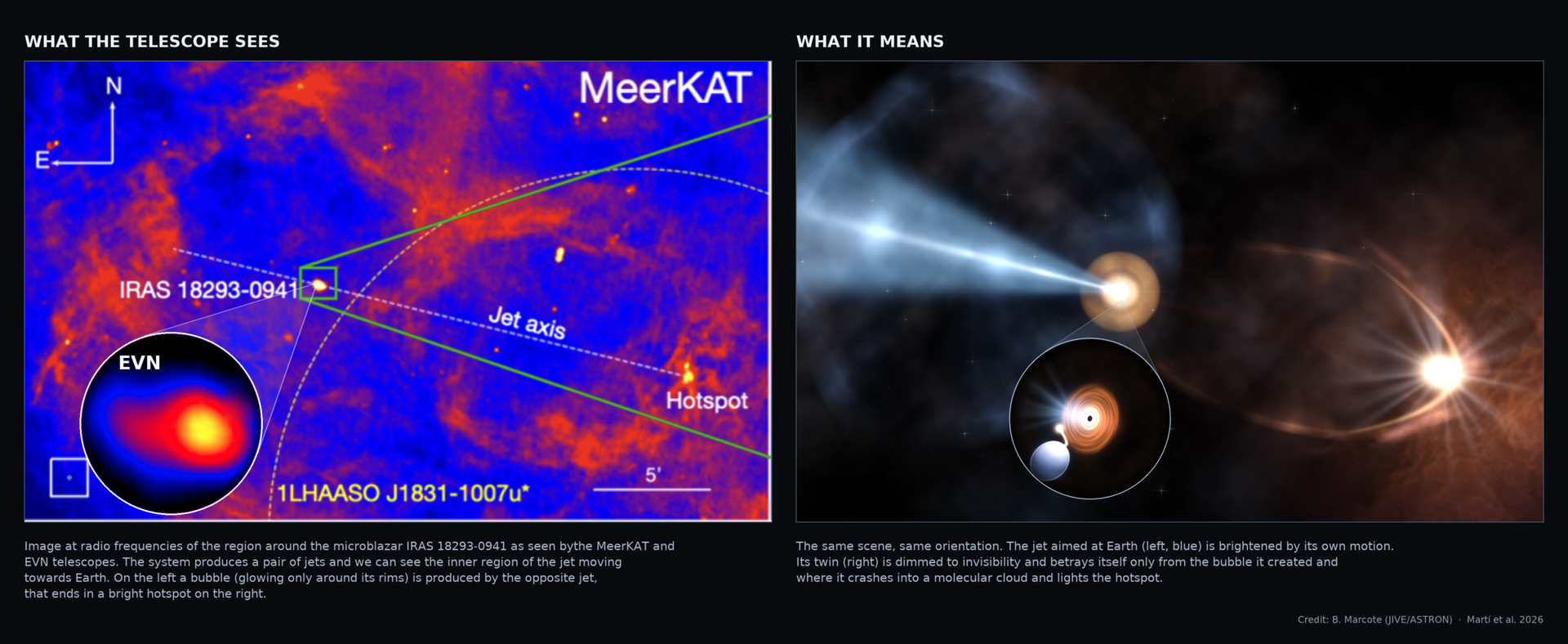
An image of a glowing ball of light against a dark background, with a heat map comparison next to it.

Comparison between the astronomical images of IRAS 18293-0941 (left) and the artist's impression (right). (Image credit: B. Marcote (JIVE/ASTRON).)

These objects, as well as microquasars in general, are tricky to observe, MartΓ­ said. "Because of stellar evolution, you need to catch the system at the right time," he added. "The microquasar phase of evolution is very short, and so it is difficult to find one in that phase."

Theorists predicted that microblazars would have special characteristics that should help define them. These features include powerful emissions across the electromagnetic spectrum, rapid changes in brightness (variability), and a hotspot behind them where its opposing jet heats up the interstellar medium in the opposite direction of Earth.

To observe IRAS 18293-0941, the study authors used a variety of instruments β€ͺ—‬ including the Calar Alto Astronomical Observatory in Spain, a network of radio astronomy telescopes called the European VLBI Network, and the MeerKAT radio telescope array in South Africa β€ͺ—‬ as well as archival data from the Very Large Array in New Mexico.

They found that IRAS 18293-0941 has all of the expected microblazar characteristics, except one β€ͺ—‬ variability. Microblazars have rapid variability, which means their brightness changes a lot in a short period, because one of the jets is facing Earth and small changes in brightness are amplified by an effect called Doppler boosting.

MartΓ­ said IRAS 18293βˆ’0941's lack of rapid variability could be explained by the dense cloud of gas surrounding it, which could smooth out quick fluctuations in brightness.

The researchers are currently investigating whether the observed area behind the microblazar is in fact a hotspot, study co-author Pedro Luque-Escamilla, an astronomer at the University of JaΓ©n, told Live Science.

Even with one of the expected features missing, this object is a promising candidate for the first known microblazar. "The claims and the results of the paper are sensible and there are no questionable hidden assumptions," Kinwah Wu, a theoretical astrophysicist at University College London who was not involved in the research, told Live Science in an email. "The source in this paper had shown signatures of interactions between the jets and the ambient material, which naturally leads to [particle] interaction."

Svetlana Jorstad, a senior research scientist at the Institute for Astrophysical Research at Boston University who was not involved in the research, told Live Science in an email that the new study was "very interesting, important and comprehensive."

Itumeleng Monageng, an astronomer at the University of Cape Town who was also not involved in the research, added that the team's observations "presents a previously overlooked mechanism for generating some of the highest energy emissions observed."

Microblazars "may power some of the universe's most energetic processes," Monageng told Live Science in an email.

MartΓ­, J., Luque-Escamilla, P. L., Marcote, B., Abaroa, L., Aguasca-Cabot, A., Combi, J. A., Romero, G. E., Paredes, J. M., GarcΓ­a, F., Fogantini, F., Saavedra, E. A., Del Ser, D., & Van Den Eijnden, J. (2026). A Galactic microblazar as a potential accelerator of ultra-high-energy particles. Astronomy and Astrophysics. https://doi.org/10.1051/0004-6361/202661105

See how much you know about black holes with our black hole quiz!

Jupiter will disappear behind the moon in a once-in-a-decade alignment tomorrow

5 October 2026 at 21:20

You may have watched the moon block out the sun during a solar eclipse, but have you ever seen it do that to a planet? Early Tuesday (Oct. 6) morning, skywatchers across much of eastern North America will have an opportunity to watch a crescent moon pass directly in front of Jupiter. The rare alignment won't happen again for 11 years.

During the event, known as a lunar occultation, Jupiter will disappear behind the moon for up to about an hour before suddenly reappearing. The occultation will be visible before dawn from much of the eastern and central U.S., Canada and the Caribbean, while parts of Africa will experience the event during daylight, according to In-The-Sky.org.

The moon will be a beautiful waning crescent, just 20% illuminated, and Jupiter will shine brightly alongside it. The pair will rise together in the east early Tuesday morning and gradually appear to move closer as the moon travels eastward against the background stars.

When the occultation begins, Jupiter will remain hidden behind the moon for roughly an hour. No telescope will be needed to watch Jupiter disappear and reappear. However, a pair of binoculars or a small telescope will make the event much more dramatic.

Through a telescope, Jupiter will look like a tiny disc rather than a point of light and will take about a minute to disappear completely behind the moon. An easy way to photograph the event is to use a smart telescope to image the moon. (Here's everything you need to know about lunar photography).

Below are the times when Jupiter will disappear and reappear in 10 major cities Tuesday morning, according to the International Occultation Timing Association.

  • Chicago: 3:22-4:17 a.m. CDT
  • Atlanta: 4:15-5:17 a.m. EDT
  • Detroit: 4:16-5:20 a.m. EDT
  • Miami: 4:20-5:09 a.m. EDT
  • Washington, D.C.: 4:20-5:24 a.m. EDT
  • Philadelphia: 4:22-5:26 a.m. EDT
  • New York: 4:23-5:27 a.m. EDT
  • Toronto: 4:25-5:22 a.m. EDT
  • Boston: 4:26-5:30 a.m. EDT
  • Montreal: 4:30-5:26 a.m. EDT

Outside the occultation path, Jupiter won't disappear at all. Instead, it will appear to be skimmed by the crescent moon β€” still a potentially spectacular sight that could produce some amazing photos. From across much of the world, the crescent moon and Jupiter will appear exceptionally close together.

The next lunar occultation of Jupiter visible from North America will occur on Nov. 27, 2037, according to When The Curves Line Up.

First photos from Smile spacecraft show Earth like you've never seen it before

4 October 2026 at 11:00

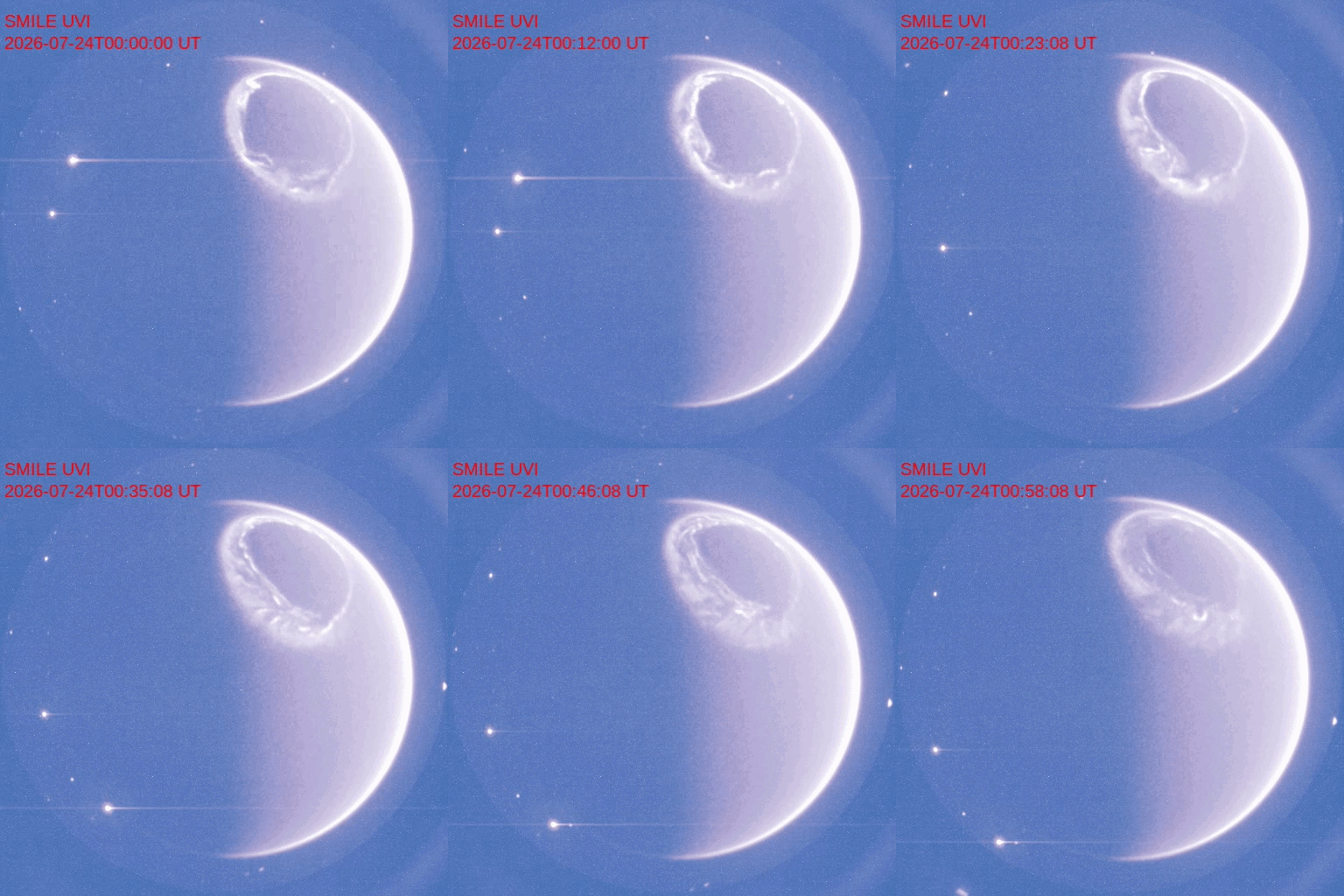
A gif showing a round sphere with glowing white dots around it

Earth glows like a half moon while a giant aurora writhes over the North Pole in this ultraviolet image from the new Smile spacecraft. (Image credit: ESA & CAS/Smile/UVI CC BY-SA 3.0 IGO)
Quick facts

What it is: An aurora on the sunlit side of Earth

Where it is: Over the North Pole, as seen from about 75,000 miles away

When it was shared: Sept. 30

The debut images from a new Earth-observing satellite have just given us a view of the impossible: giant auroras rippling over the North Pole in broad daylight.

Earth's auroras are one of our planet's signature wonders β€” a sight worth advertising in interstellar travel guides, alongside our perfect total solar eclipses, bright shooting stars and majestic blobfish. They are the beautiful result of electrical storms in the atmosphere, appearing when charged solar particles skate along Earth's magnetic-field lines and collide with light-emitting molecules near the poles. (Auroras do exist on other planets, but they are usually not in bright visible colors like ours.)

To human eyes, auroras come out only at night and rarely stray from the poles. That's what makes these first observations from the joint European-Chinese Smile mission, which officially began science operations this week, so special.

Captured in ultraviolet light, the stunning images show a huge, serpent-like ring of charged particles coiling around the North Pole in July 2026. In the foreground, Earth appears ghostly and featureless, glowing like a half moon. The aurora writhes around our planet's sunlit side, covering about a third of it, while Earth's dark nightside bleeds into the background sky. Far behind, bright stars fall like raindrops as Smile shifts subtly in its orbit.

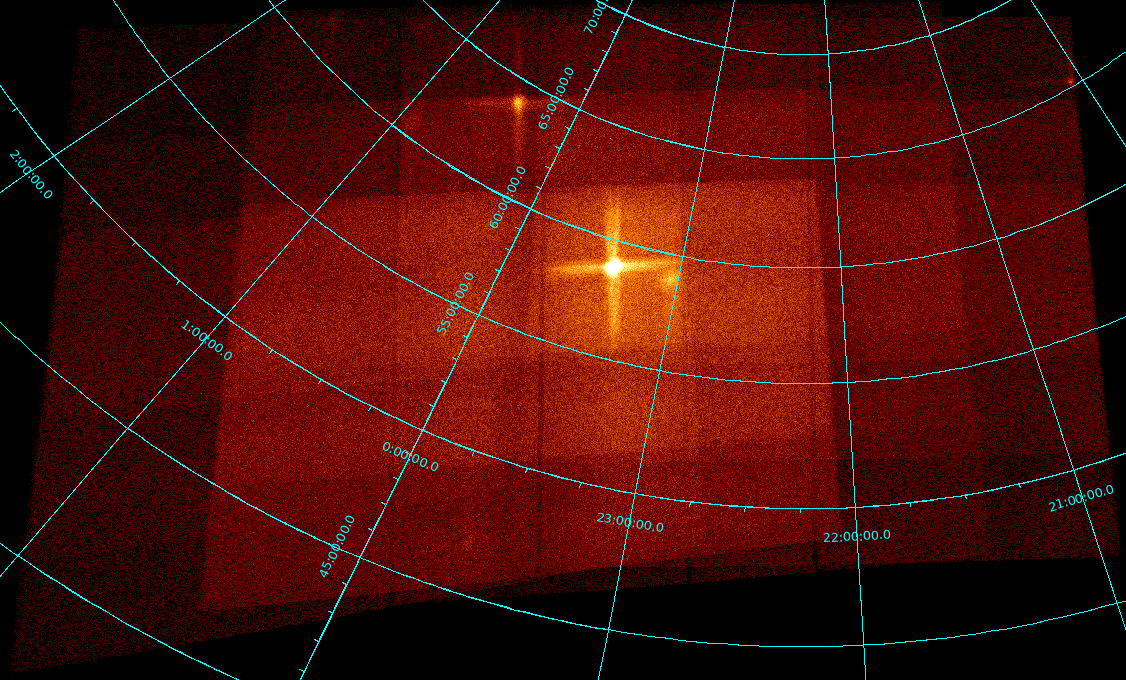
A spiderweb overlay is on top of a heat-map type image with red and orange colors.

Smile tested its soft X-ray imager on the light of the distant supernova remnant Cassiopeia A (center), located 11,000 light-years from Earth. (Image credit: ESA, CC BY-SA 3.0 IGOΒ )

The view alone is worth smiling about, but the new images also promise exciting science to come. Taken just two weeks after scientists first turned Smile's Ultraviolet Aurora Imager on, the observations show that the satellite's instruments are working as they should and that the joint European Space Agency (ESA) and Chinese Academy of Sciences mission can officially begin.

Launched on May 19, Smile will spend the next three years watching Earth from a highly elliptical orbit that takes it about 75,000 miles (121,000 kilometers) over the North Pole β€” about a third of the way to the moon. From there, Smile can observe the North Pole for a record-breaking 45 hours at a time, offering an unprecedented view of solar activity there.

In addition to the Ultraviolet Aurora Imager, Smile carries three more science instruments to detect X-rays, magnetic fields and light ions over Earth.

This week, scientists also tested the spacecraft's soft X-ray imager by pointing it at the distant supernova remnant Cassiopeia A, located about 11,000 light-years from Earth (image above). Although the camera is working fine, the detector is still picking up a bit too much light when aimed at Earth, so it will require a bit more calibration from scientists on the ground.

Could we ever create artificial gravity on a spaceship?

Among the many risks astronauts face during long-haul spaceflight, an extended stay in microgravity is one of the most consequential for long-term health, with effects on vision, bones, muscles and many other aspects of the body.

One solution might be artificial gravity —‬ some way to create forces similar to Earth's gravity on a spaceship, akin to the giant rotating ring from Stanley Kubrick's 1968 film "2001: A Space Odyssey."

But is that technology ever coming, or will it remain science fiction?

"There's really no reason it couldn't happen," Torin Clark, an associate professor of aerospace engineering at the University of Colorado Boulder, told Live Science. "From a technical perspective, this is something that could happen in the very near future."

In fact, artificial gravity has almost made its way to space before. The Centrifuge Accommodation Module was a planned 8.2-foot-wide (2.5 meters) centrifuge for the International Space Station (ISS), but the project was canceled in 2005 for budgetary reasons.

"[Artificial gravity] is one of those things β€ͺ—‬ like all of a sudden, it's super popular, and then all of the scientists at NASA and everybody … have a lot of funding to understand how to actually implement this, and then it just dies," Ana Diaz Artiles, an associate professor of aerospace engineering at Texas A&M University, told Live Science. "And then it comes back, and dies, and comes back. I've been going through a couple of these cycles in the time that I've been doing this."

Besides budgetary concerns, there are questions about how such a solution would be implemented.

"Everybody agrees it's a good thing to do. The problem is that we don't know how to implement it," Diaz Artiles said. "How much gravity do you need? How big does [the device] have to be? How long do you need it to be? And how long do you have to use this? Should we use continuous gravity or a short-radius centrifuge, something where you go in and out?"

Researchers have three main approaches for creating artificial gravity. One is the classic sci-fi idea: a giant ring that rotates passengers' entire living quarters so they live and work under forces similar to Earth's gravity.

"You have a relatively long radius, which means you don't have to spin very fast to create gravity," Diaz Artiles said. "But this is massive. You can't get all the parts up there in the same spacecraft β€” you need multiple spacecraft and to assemble everything. So, of course, you can see what a big endeavor this is."

A short-radius centrifuge is a more feasible option. It's essentially a tube with a radius of 6 to 10 feet (1.8 to 3 m) that spins to simulate gravity. A passenger sits or stands inside, with their head closest to the center of rotation, so the spin generates the strongest pull down toward their feet.

A woman walks on a treadmill in space.

Astronaut Sunita Williams, equipped with a bungee harness, exercises on the Treadmill Vibration Isolation System (TVIS) in the Zvezda Service Module of the International Space Station in 2006. (Image credit: NASA/Crew of Expedition 14, Public domain, via Wikimedia Commons)

Instead of allowing passengers to live in artificial gravity, this smaller device would be used in short daily sessions. "It's kind of like an exercise device," Diaz Artiles said. "In the ISS, you have a treadmill, you have this resistive exercise machine, so you go there for 30 minutes to do your exercise, and then you get out."

The final option is for spacecraft to create gravity via linear acceleration. This works in the same way that an accelerating car pushes passengers back into their seats, except the spacecraft would be oriented to push an astronaut's feet into the floor. To slow down, the spacecraft would turn around, firing its thrusters in the opposite direction to decelerate smoothly while maintaining a roughly similar gravity for its occupants.

"But then you need something like an engine that is able to accelerate all the time," Diaz Artiles said. "And propulsion-wise, I think we're not there yet."

Although a short-radius centrifuge is the most feasible approach in terms of both cost and engineering, it does have some drawbacks. For one, its fast spin can induce the Coriolis cross-coupled illusion β€ͺ—‬ a sensation of tilting or tumbling that happens when you tilt your head off-axis while rotating.

This is the effect that causes motion sickness, Clark said.

However, Clark and his team have found that people can build a tolerance to the sensation with training, simply by being in a slowly spinning centrifuge and gradually increasing the speed when they no longer feel the sensation.

"If you very slowly, incrementally increase the spin rate … and do that not just over one session but over multiple sessions across multiple days, as far as we could tell, anyone can be made to incrementally acclimate to the rotating environment [of] up to 20 to 30 rotations per minute," Clark said.

Would artificial gravity prevent harmful effects on the body?

But researchers still don't know how fast the centrifuge would need to rotate, or how long someone needs to spend inside it, to benefit. Long periods in microgravity can lead to bone and muscle loss, loss of aerobic fitness, blood clots, and visual issues from fluid shifts in the eyes. The hope is that artificial gravity could prevent those effects, but exactly how much gravity is necessary remains an open question.

Studies of people on head-down tilt bed rest β€ͺ—‬ the standard research method for simulating spaceflight deconditioning β€ͺ—‬ have found that 30 minutes a day in a centrifuge did prevent some loss of muscle function.

"Thirty minutes a day … maybe is not enough," Clark said. "Maybe an hour or even two hours a day, and maybe at higher G levels, would be beneficial."

But these studies are expensive and time-consuming. "It's very difficult," Diaz Artiles said. "I think people are interested in this concept, but we just don't have a good answer."

In the end, it's not a technological challenge that's keeping artificial gravity from being used in space; it's knowing the best way to employ it and securing the budget for it.

"We know how to do this. As humans, we have done more difficult things," Diaz Artiles said. "We need the money, but we also need to better understand the need."

See how much you know about human exploration into space with our spaceflight quiz!

❌