❌

Normal view

Pourquoi il est si difficile de déterminer l'âge d'un champignon ?

16 September 2026 at 14:22
Comment définir les contours d'un champignon et estimer sa longévité ? Des questions qui semblent simples, mais auxquelles la science peine encore à répondre. Rencontre avec Ayla Mongès, chercheuse en écologie fonctionnelle, qui tente de percer les mystères de ces organismes hors normes.

Está à procura da Inteligência Artificial no iOS 27? Siri AI não é para todos

16 September 2026 at 14:19

Ausente no lançamento na Europa por incompatibilidade regulatória, a nova Siri AI continua a confundir os utilizadores que fizeram o upgrade para o iOS 27, fora do território europeu.

The post Está à procura da Inteligência Artificial no iOS 27? Siri AI não é para todos appeared first on Tek Notícias.

Samsung Gallery verso Google Foto: pronta l’alternativa a OneDrive

16 September 2026 at 14:15

Samsung sembra aver già scelto il servizio che prenderà il posto di OneDrive all’interno dell’app Galleria. Dopo l’annuncio della fine della sincronizzazione diretta con il cloud di Microsoft, prevista per la fine di settembre, sono infatti comparsi i primi indizi di una nuova integrazione con Google Foto.

Sul Galaxy Store è stato individuato un servizio Samsung chiamato Gallery Cloud Sync. La descrizione parla della possibilità di effettuare il backup di foto e video su 'Google Cloud' e di ritrovarli sugli altri dispositivi. Il riferimento sembra essere proprio a Google Foto, che verrebbe quindi integrato direttamente nella Galleria Samsung

La funzione non è ancora disponibile pubblicamente, ma è già stato possibile attivarla in anteprima. Nelle impostazioni della Galleria compare una voce per collegare l'account Google, con l'indicazione dello spazio di archiviazione disponibile, la possibilità di scegliere quali album sincronizzare e alcune opzioni relative all'uso del Wi-Fi e del roaming.

Per chi utilizza oggi OneDrive il funzionamento dovrebbe quindi cambiare poco: foto e video continuerebbero a essere gestiti dalla Galleria Samsung, mentre il backup passerebbe dai server Microsoft a quelli Google. I contenuti sincronizzati risulterebbero poi accessibili anche tramite Google Foto.

Samsung ha già iniziato a rimuovere l'opzione OneDrive dalla Galleria per alcuni utenti. Chi ha già utilizzato il servizio Microsoft non perderà comunque le foto salvate nel cloud: semplicemente, una volta terminata l'integrazione, non saranno più visibili direttamente dalla Galleria Samsung e resteranno accessibili tramite OneDrive.

Al momento Samsung non ha ancora annunciato ufficialmente il debutto di Gallery Cloud Sync con Google Foto. Considerando però l'imminente fine dell'integrazione con OneDrive, il lancio potrebbe arrivare tra la fine di settembre e l'inizio di ottobre.


Il miglior smartphone pieghevole del momento? Samsung Galaxy Z Flip 7, compralo al miglior prezzo da Rimediashop.it a 691 euro.

CLICCA QUI PER CONTINUARE A LEGGERE

Pixel 11 Pro da 1TB, S26 Ultra e Apple Watch 11: le migliori offerte del 16 settembre

16 September 2026 at 14:05

Mercoledì 16 settembre parte con una selezione di offerte tech decisamente corposa, soprattutto tra Amazon e Unieuro. La giornata mette insieme smartphone di fascia alta, smartwatch appena arrivati sul mercato, auricolari true wireless, monitor gaming e qualche prodotto smart home.

Tra i prodotti più interessanti spiccano diversi tagli del Google Pixel 11 Pro, compresa la versione da 1TB proposta allo stesso prezzo del modello da 512GB, almeno al momento della rilevazione. Sempre in casa Google, da segnalare anche il Pixel 11 Pro XL e il più accessibile Pixel 10a, mentre Unieuro punta forte sui Samsung Galaxy S26 e Galaxy S26 Ultra, con prezzi finali particolarmente aggressivi grazie alla promozione con valutazione dell’usato.

Proprio nel caso delle offerte Unieuro è importante leggere bene le condizioni: per alcuni prodotti lo sconto indicato tiene conto di 300 euro applicati al checkout e della supervalutazione dell’usato, valida con ritiro in negozio. In almeno un caso è richiesta anche l’adesione a Unieuro Club.


Il miglior smartphone pieghevole del momento? Samsung Galaxy Z Flip 7, compralo al miglior prezzo da Rimediashop.it a 691 euro.

CLICCA QUI PER CONTINUARE A LEGGERE

Steam Deck 2 não vai subir de preço nem atrasar por crise de chips, garante Valve

16 September 2026 at 14:02

Com a crise de componentes e os preços dos dispositivos da Valve nas alturas, a companhia revelou oficialmente que nada disso impactará o lançamento do Steam Deck 2. Isso significa que os valores do portátil atual de US$ 789, do Steam Frame de US$ 1.059 e do Steam Machine por US$ 1.049 não são um novo padrão.

Ao IGN, o desenvolvedor da companhia, Pierre-Loup Griffais, revelou que os planos que já têm sobre o hardware “não mudaram muito” em relação às altas nas memórias RAM e armazenamentos, assim como datas. Claro, a fala carrega um “porém”: o aparelho não será lançado em breve, possivelmente após a conclusão dos aumentos.

“Falamos antes sobre como queremos garantir que haverá um salto de desempenho para algo similar ao ‘futuro Steam Deck’, acredito que continuamos a seguir o mesmo caminho”, afirmou o porta-voz.

O que ele realmente quer dizer? Eles só trarão um novo console portátil ao mundo quando notarem uma exigência maior por um produto de alta performance. Essa situação pode ocorrer apenas no instante em que esta crise chegar ao fim, logo eles não enxergam a forma que todo o caos nos hardwares pode impactar os negócios da Valve para o modelo.

A empresa já revelou trabalhar no Steam Deck 2, contudo é possível que o dispositivo ainda esteja em estágio embrionário. Ou seja, há chances de que já saibam como fazê-lo dar certo, no entanto podem aguardar por uma queda de valores e a possibilidade de produzi-lo em grande escala sem prejuízos.

valve-steam-frame

Nada mudou para a Valve

Griffais também explica que os planos seguem iguais aos que foram declarados no passado. Para ele, “no que temos trabalhado, conforme a experiência dos jogadores progride e o que o produto pretende construir, os objetivos são bem similares”. 

A declaração serve para acalmar o público que não deseja ver o Steam Deck 2 a preços estelares. Com um acréscimo expressivo no custo de vários hardwares, todos os produtos da sua linha tiveram de ser vendidos a preços elevados. 

No entanto, o cenário pode não ser um problema no momento em que o console portátil for lançado. Se levarmos em conta que as mudanças podem ocorrer apenas entre 2029 e 2030, talvez tudo isso já seja uma história que ficou para trás. 

Enquanto a Valve segue a passos lentos com o Steam Deck, quem trabalha com emulação surpreende cada vez mais com um salto surreal: emulador de PS5 faz Demon's Souls ir de 1 a 30 FPS em uma semana. 

{{WHATSAPP_CHANNEL}}

Get your teeth into the cutting edge of materials science

16 September 2026 at 14:00
Illustration of three teeth with various textures
Dental work Fitting false teeth, bridges and crowns requires an empirical understanding of how ceramics, metals and other materials interact. (Courtesy: Shutterstock/Ihnatovich Maryia)

My dentist, Dr Albora, told me I needed a new tooth. He made me bite down on a U-shaped tray filled with polyether, an elastomeric material that’s been used in dentistry for decades. I tried not to gag while the gooey stuff set. Albora then waggled it off and sent the imprint to a company on Long Island that makes false teeth. But as my tooth’s colouring was unusual, Dr Albora said I had to go there myself.

A week later I drove to Marotta Dental Studio, where Igor Binshteyn sat me in a chair, lifted my lip and inspected a tooth to the side of my upper jaw. He was helping to fabricate its replacement and needed to get the exact colour.

As Binshteyn finished, I remarked teasingly on the company’s car park, which was chock full. Do you need that many people to make false teeth? What could possibly be involved to make things smaller than the nail on my little finger?

Binshteyn laughed. “Follow me”.

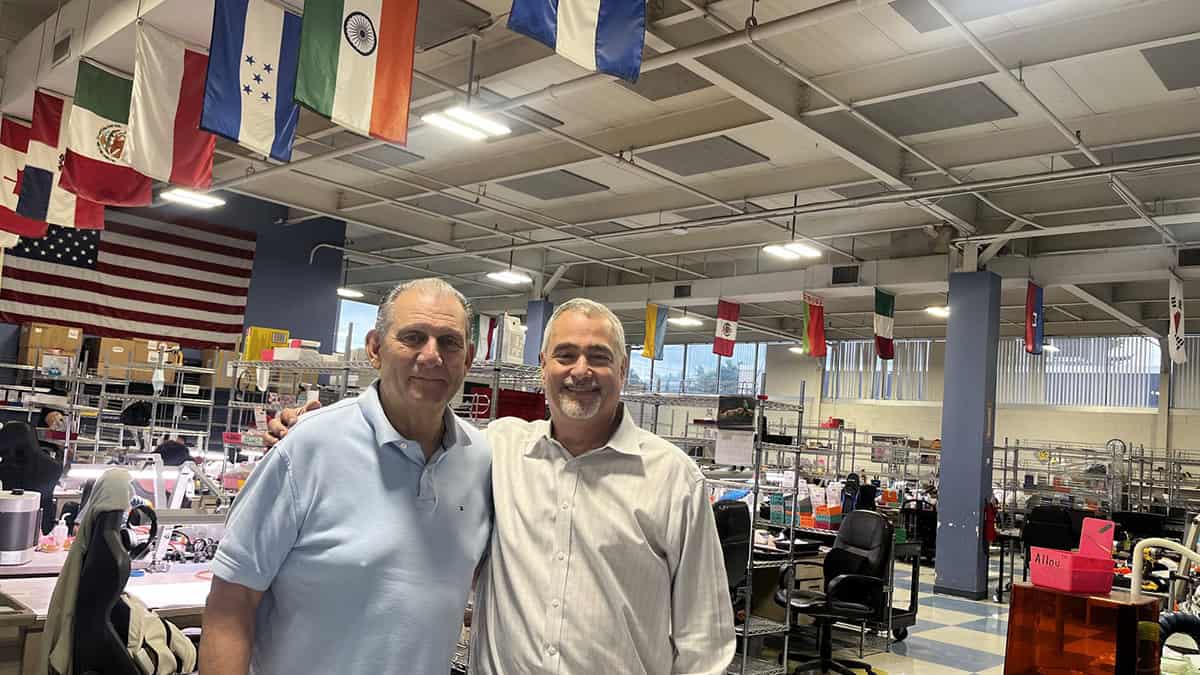
Dental workshop with Lenny Marotta and Steven Pigliacelli
Warm welcome Lenny Marotta (left), who founded Marotta Studio in 1981 and his brother-in-law and Marotta’s vice-president, Steven Pigliacelli in the lab. The flags are for the nationalities and national backgrounds of the 50 or so technicians working there. (Courtesy: Robert P Crease)

He opened a door to a huge undivided warehouse-like space about 1200 square metres in size. Some 50 people were working at lines of tables where the steady hum of conversation was punctuated by the noise of ovens, lathes and grinding machines; imagine the sounds of a metalworking shop in a busy train station.

“Do you want a tour?” Binshteyn said.

Of course I did.

Open wide

My tour guide was Marotta’s vice-president, Steven Pigliacelli, who teaches prosthodontics at New York University. A prosthodontist is a dental specialist who has completed dental school and, in the US, has had at least three additional years of advanced training to focus on restoring and replacing missing or damaged teeth. As I learned, prosthodontists must practice materials science.

The lab has two paths for making teeth, Pigliacelli explained, each with different materials and methods. The first is known as “porcelain-fused-to-metal”, or PFM. It begins with technicians applying gypsum – hydrated calcium sulphate – to create stone replicas of the jaw and teeth from the impressions given to them by dentists such as Albora.

Gypsum has different coefficients of expansion for different dental purposes, and textbook formulas give the amounts of liquid for each kind. But Marotta employees found that tiny amounts of water must be added or subtracted to the gypsum to compensate for things like humidity and temperature before the gypsum is used. “It took us months,” Pigliacelli explained, “to realize that how it’s shipped, how it’s stored, what season it is – all these affect the material.”

I watched as a technician sectioned a stone jaw replica to cut out a tooth, turn it into a master model called a die, and test it in an articulator that mimics jaw movements. I saw another wax that die, use a lost wax technique to create a solid gypsum frame, and cast a silver-palladium alloy. That creates the metal inner core for the tooth, called a coping, which is shaped and finished before porcelain is applied. Porcelain is baked onto the coping in another area of the lab.

“The metal and porcelain need closely matched coefficients of thermal expansion or the porcelain can separate from the metal,” Pagliacelli told me. “Every once in a while a company tells us ‘We’ve got this really cool new alloy!’, but we need to match the coefficients of expansion in the ceramic material. We’re working with sensitive materials for sensitive applications, and we have to experiment with and adapt them. This stuff about materials you don’t learn in school but work out in the lab.”

Smile for the camera

The second path to making a tooth involves scanning the teeth rather than waxing a die. The electronic files are worked on in the computer, printed out, reworked and rescanned, and milled by a CAD machine using materials such as zirconia – nicknamed “ceramic steel” – and EMAX, a lithium disilicate glass-ceramic. Zirconia is extremely hard and used for teeth that endure heavy grinding forces, while EMAX is more aesthetically pleasing and often used for front teeth.

“So we have two parallel paths, PFM and digital scans”, Pigliacelli said. “It’s usually a personal choice of the dentist”. But external pressures are driving a move away from PFM, he said. Five years ago the price of palladium – a key component of the PFM alloy – soared as it was increasingly used in devices to reduce auto and other emissions. “That’s cut down on the PSM market.”

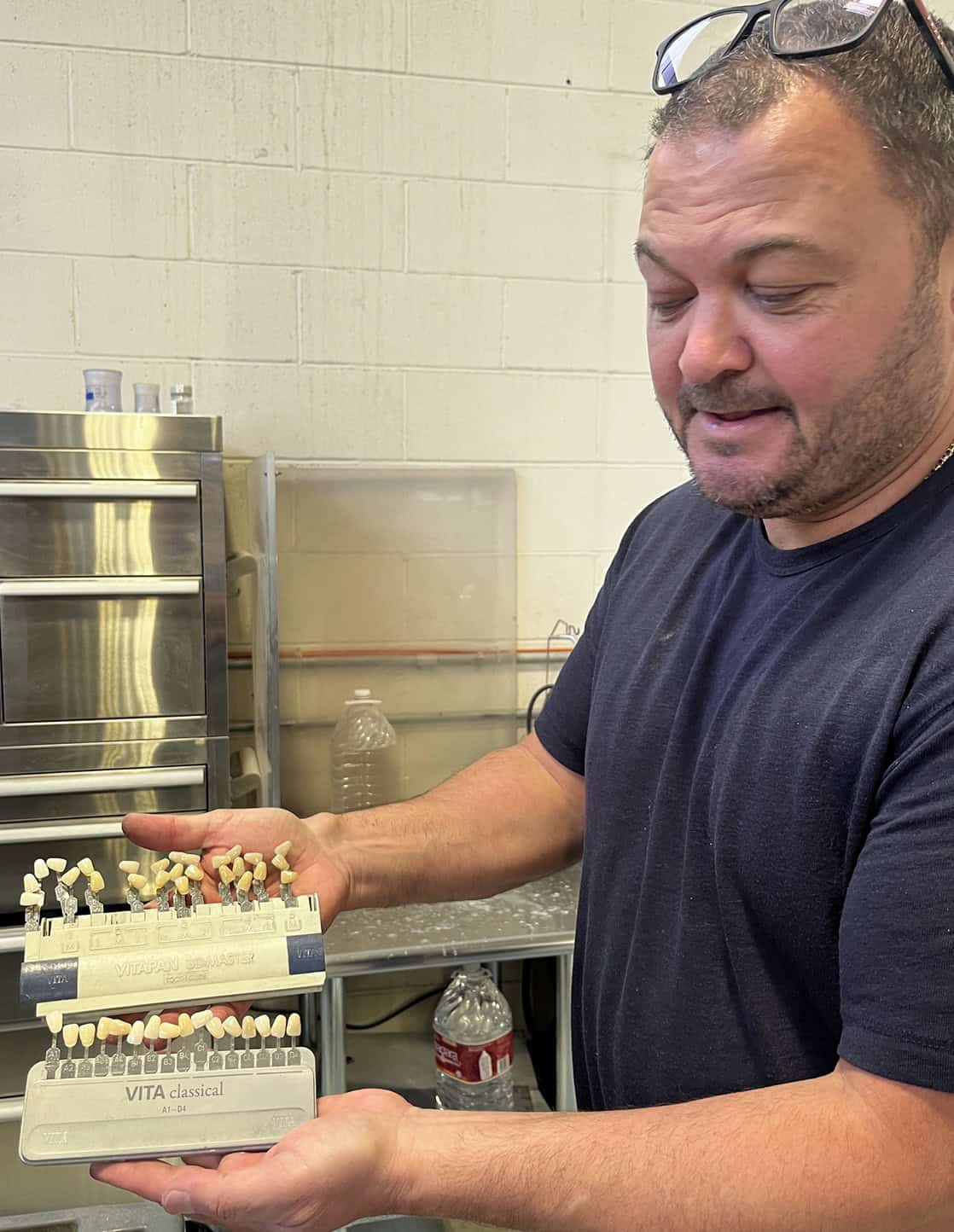
Igor showing teeth staining
Say cheese Igor Binshteyn shows off his tooth colour guide. (Courtesy: Robert P Crease)

In another corner of the lab I ran into Binshteyn again, who was using different porcelains and ceramic stains to create colours. “Teeth are not a solid colour,” he said, “but vary in shade from reddish near the gum line to lighter colours toward the biting edge. They also vary in translucency.” (Check this out yourself.) Furthermore, the colour of a tooth must match not its neighbours but the corresponding tooth on the other side of the mouth. To make a natural-looking tooth, Igor picks out a base colour and then layers in shades of porcelain.

As my lab tour went on, Pigliacelli showed me different materials for different applications. One challenge is making teeth for a person with bulimia, whose acidic oral environment can corrode dental materials. Other challenges arise with people who have had failed implants, or temporomandibular joint – or TMJ – a disorder involving jaw joints and muscles.

On the way out I met Lenny Marotta, Pigliacelli’s brother-in-law, who had founded Marotta Studio in 1981. Marotta is fascinated by the history of dental materials, which include bone, ivory, wood, gold and silver. He showed me his collection of early prosthodontic instruments, including milling machines, furnaces, hammers and air compressors.

Later, Marotta also pointed out a strange-looking oven. “That’s for processing vulcanite, a hardened rubber material widely used for dentures before modern plastics.” But he’s been unable to find a museum interested in old prosthodontic stuff. “Nobody knows we exist,” he complained.

The critical point

I’d assumed that materials science was required to make prosthetic teeth biocompatible, corrosion resistant, and able to withstand mechanical motions such as crushing, biting and grinding. I also knew that teeth have to be made economically enough to be widely available, aesthetic enough to be desirable, and versatile enough to withstand a variety of oral environments.

But I had no idea how much materials science was required to bring all these properties together.

Back in his office, Dr Albora installed the tooth and handed me a mirror. I had to pull up my lip to see it way on the side of my mouth. “I’d have to smile before somebody notices it,” I complained. “Well,” he said, “that’s for just in case you do.”

The post Get your teeth into the cutting edge of materials science appeared first on Physics World.

Apple Considers Return to Server Market, Has Talked With Nvidia to Use Network Tech

16 September 2026 at 14:00

Apple has been working on plans for an enterprise server using its own chips that could incorporate networking equipment from Nvidia, people familiar with the project said, as the Mac maker looks to capitalize on surging interest in its computers for AI.

Apple has been developing the server with plans to sell it to AI developers, other businesses and governments, the people said. The product under consideration would come in two versions—a smaller one with two of Apple’s planned M8 Ultra chips clustered together and a bigger one with four M8 Ultra chips. The M-series Ultra chips are Apple’s highest-performance chips and power products including the Mac Studio.

iTunes not transferring music

16 September 2026 at 13:52
recently purchased some songs online (not from Apple Music ). I transferred the songs to iTunes and was able to transfer all the songs to my iPhone X except one. I tried different things to get it to download, but it will not transfer to my iPhone !?!!? I tried transferring other songs that had previously been in my iTunes they transferred to my phone without any problems. It's just this one song that's giving me problems!!

Macbert

Democratic Allies Must Join Forces in the Race for UAP Disclosure

Since February 2026, the United States Department of War (DOW), under the direction of President Donald Trump, has released an unprecedented number of documents, videos, and firsthand witness accounts detailing the United States’ extensive history of encounters with unidentified anomalous phenomena, or “UAP.”

Despite the questions that remain, this initiative under the Presidential Unsealing and Reporting System for UAP Encounters (PURSUE) has been nothing short of historic. For more than 75 years, Americans pleading for the truth on the issue have been routinely ridiculed and even misled by their own government. It’s difficult to imagine the nation’s posture being anything other than one of obfuscation, secrecy, and resistance to transparency.

Documents, particularly those detailing reports from senior intelligence officials encountering “orbs”, are a stark departure from the U.S. government’s nearly century-long position of secrecy.

Lawmakers, however, have been left with more questions than answers. Who or what flies with such impunity over our sensitive military installations? Who owns this technology? Are they a threat to national security?

Across the Pacific, members of Japan’s National Diet are confronting the same questions. The May 2026 file releases from the U.S. DOW disclosed two unresolved UAP incidents from the U.S. Indo-Pacific Command. Japanese legislators only learned the details of these cases near their own territory after the American file release—not through any internal channels.

Democratic allies, it seems, face a shared challenge. For too long, elected officials in our respective nations have been denied adequate information about the phenomena operating in our common security environment. And in the U.S., whenever we are informed, it’s only through the preferred methods and timing of unelected bureaucrats deeply entrenched in our national security apparatus. In Japan, by contrast, the Ministry of Defense has stated that information may be made public when something arises that it determines should be explained.

But this raises a fundamental question: should the government alone decide what should be explained to the public?

If a grave national security threat truly exists, then elected representatives have been left with little choice but to entrust the security of their nations to the very institutions that have obscured the truth from us and even each other.

It is therefore incumbent upon us—Representatives solely accountable to the citizens of our respective nations—to work together and to seek the truth wherever we may find it; both for the good of our people and to defend against whatever threats we face from strategic competitors.

As mentioned above, among the files released by the U.S. DOW were highly significant firsthand reports from high-ranking officials in the Office of the Director of National Intelligence. The documents detail a search operation at a classified missile testing site in the Western United States, explicitly for aerial phenomena:

En route, ground teams reported spotting a UAP on FLIR [Forward Looking Infrared], describing it as “super-hot,” low to the ground, and moving east then south at high speed. The object then split into two and changed direction. Upon arrival, we scanned the area using NVG [Night Vision Goggles], FLIR, and the naked eye. The ground team suddenly radioed that the object had risen from the ground, approached within ten feet of the helicopter, dropped below us, and then sped away.

The documents were accompanied by what the DOW labeled as “related photos.”

Accounts such as these are hardly “proof” of anything, but for elected officials, they do cement the reality of our national security concerns. Missing from this account—or any account we have been allowed to access—is an answer to a fundamental question: What do the various U.S. government agencies believe these objects are? Are they merely civilian drones? Do they represent technology belonging to a foreign actor? And if someone within the government does know, who decides that elected officials shouldn’t?

Members of Japan’s UAP Parliamentary League, led by former Japanese Defense Minister Yasukazu Hamada, share similar concerns.

DOW data, released through the Pentagon’s All-domain Anomaly Resolution Office (AARO) in August of 2023, identified specific regions of Japan, particularly in the western and southern parts of the country, as being among the world’s notable hotspots for UAP reports.

One such instance occurred as recently as July of last year. Security guards at the Genkai Nuclear Power Station in Saga Prefecture observed three luminous objects in the sky above the facility. The lights remained visible for nearly two hours; long enough for local police to arrive and observe them. The police stated that what they themselves observed was an airplane, leaving a discrepancy between the two accounts. The incident was also recorded by Kyushu Electric Power’s security cameras, but the footage has not been made available even to members of the National Diet. Police have likewise declined to disclose related information on the grounds that the matter remains under investigation. As a result, elected lawmakers still lack access to the information necessary to independently assess the incident, and to this day, members of Japan’s National Diet have no answers.

Like their American counterparts, Japanese lawmakers have been left without the tools or information for proper oversight despite reports of UAP operating near critical infrastructure within restricted airspace.

It is no longer acceptable for elected representatives to be agnostic on this issue. Events such as these, along with countless videos now made publicly available, are more than mere optical illusions and cannot be dismissed on account of prosaic explanations like parallax effect. For many members of Congress and members of Japan’s UAP Parliamentary League, the evidence presented before us indicates an unknown technology.

Our understanding of what is technologically feasible in propulsion, the manipulation of physical matter, and even space-time itself is being challenged. From what we know, our current defense capabilities appear insufficient. Furthermore, the origin of these phenomena remains unknown—not only to the U.S. and Japan, but seemingly to other nations as well. China, for instance, recently established its own military body dedicated to investigating UAP, even supplementing human resources with artificial intelligence dedicated to tracking what the People’s Liberation Army refers to as “Unidentified Air Conditions.”

We are, by all indications, in a global arms race for technological supremacy, one that is rapidly rendering today’s weapons obsolete through advances in quantum technology, artificial intelligence, and drone warfare. UAP and whatever technology allows them to operate with apparent impunity over sensitive military and nuclear installations could redefine the competition.

If harnessed by democratic allies, breakthroughs could bolster deterrence and stability in the South China Sea. Conversely, failure to establish a coordinated effort among democratic allies could give China an unforeseen technological advantage over a future invasion of Taiwan, making an already difficult fight impossible.

U.S. global leadership, along with the territorial integrity of the Pacific are at stake. For members of Japan’s National Diet, UAP investigations are of great national importance—an issue that demands cross-party attention.

As for their American counterparts, it’s clear representatives can’t reach the truth through traditional pathways that amount to asking the Central Intelligence Agency ‘nicely.’ It stands to reason that close alliances with democratic allies like Japan may be the most viable pathway for disclosure.

Indeed, if our tools are limited in scope, perhaps new revelations made by democratic allies provide a unique leverage point. After all, it was the Trump administration’s disclosure under the PURSUE program that significantly increased pressure on Japan’s Defense Ministry to acknowledge its own previously undisclosed UAP-related activities.

This is why we, as elected representatives of our nations, have engaged the Emerging Technologies Interparliamentary Caucus (ETIC) as a platform for international dialogue regarding emerging technologies and the security threats presented by UAP. Comprised of representatives from across the globe, the ETIC presents a rare opportunity to ensure elected representatives are equipped to assess potential threats, safeguard our nations, and prepare for the realities of emerging technologies in the 21st century.

Whether the phenomena we are encountering originate from an adversary or something else entirely, democratic nations cannot afford to be complacent.

The people of our nations deserve answers, and we intend to find them.

Rep. Eric Burlison (R-MO-07) is the Chairman of the Subcommittee on Economic Growth, Energy Policy, and Regulatory Affairs. 

Yasukazu Hamada is a Member of the House of Representatives, Japan, Former Minister of Defense, and Chairman of the UAP Parliamentary League.  

Yoshiharu Asakawa is a Former Member of the House of Representatives, Japan, and Assistant to the Chairman of the UAP Parliamentary League.

Four ways to prevent AI killing us all within 10 years

16 September 2026 at 13:34

Two high-profile computer scientists from Princeton University, and coauthors of the book AI Snake Oil, have weighed in on the question of whether AI will kill us all by the end of the decade.

The pair have become well known for their work in separating fact from fiction in the AI world, and have now responded to an admission by Anthropic that there is a greater than 10% chance that AI could kill all humans within the next ten years …

more…

Land Rover Defender pick-up, c’è lo zampino di Stellantis: sorprenderà tutti

16 September 2026 at 13:30
In una fase di crisi di molti gruppi storici, <strong>Stellantis</strong> e Land Rover potrebbero unire le forze per la creazione di una <strong>Land Rover Defender</strong> pick-up realizzata negli Stati Uniti. La vettura a ruote alte diventerebbe il primo prodotto di una <strong>collaborazione </strong>che promette faville. JLR sta attraversando un periodo molto complesso, ma potrebbe sfruttare la sinergia comune per raggiungere dei nuovi traguardi.L’ipotesi di un modello a ruote alte, ancora non confermata, insieme a Stellantis punterebbe a una produzione nello stabilimento di Belvidere, in Illinois destinato alla creazione anche della prossima generazione di <a href="https://www.hdmotori.it/nuova-jeep-cherokee-2026-dimensioni-interni-motori-prezzi/">Jeep Cherokee</a>, per evitare dazi e sfruttare il know-how del colosso nato dalla <strong>fusione tra FCA e PSA</strong> in un segmento in grande ascesa. Andrebbe valutata la piattaforma, i motori e il grado di condivisione tecnica tra i due player del mercato.<h2>Il render del Defender pick-up</h2>Una <strong>Land Rover Defender pick-up</strong> prodotta negli Stati Uniti con il supporto di Stellantis fa pensare che qualcosa di importante bolle in pentola. Jaguar Land Rover e Stellantis, al momento, non hanno voluto lasciare alcuna dichiarazione sul progetto. Tutto è nato da un memorandum d’intesa non vincolante siglato nel maggio 2026, con il quale le due aziende hanno cominciato a valutare possibili collaborazioni per sviluppare sinergie per il mercato americano.In una fase in cui <a href="https://www.hdmotori.it/trump-dazi-auto-europee-25/">Trump</a> sta spingendo i major a investire sul territorio, il CEO di JLR, Pathamadai Balachandran Balaji, ha ammesso che l’accordo potrebbe portare risvolti positivi per il Gruppo negli Usa. Il direttore finanziario Richard Molyneux ha specificato la fine del 2026 come possibile termine per arrivare a <strong>un’intesa definitiva.</strong>[caption id="attachment_285911" align="alignnone" width="1200"]<img class="size-full wp-image-285911" src="https://www.hdmotori.it/app/uploads/2026/09/Stellantis-Defender-Pick-Up-1.jpg" alt="Land Rover Defender pick-up" width="1200" height="800" /> Il render del Defender pick-up[/caption]<h2>Perché Stellantis è il partner ideale?</h2>Il nuovo corso targato Antonio Filosa, CEO di Stellantis, pone al centro della strategia dei prossimi anni la produzione negli stabilimenti americani. Belvidere in Illinois resta uno dei candidati più accreditati. Per <a href="https://www.hdmotori.it/stellantis-intesa-jlr-usa/">JLR</a> la presenza negli Stati Uniti avrebbe un impatto importante in una fase critica. I Defender 90, 110 e 130 continuano a essere realizzati in Slovacchia. Negli Stati Uniti i modelli importanti sono soggetti alla famosa <strong>“Chicken Tax” del 25%.</strong>Stellantis vanta un lungo know-how nel segmento, con bestseller come Jeep Gladiator, Ram 1500 e ai pick-up heavy duty di RAM. Il colosso potrebbe sviluppare un modello con <strong>motori 2.0 Hurricane</strong> sino ai più grandi HEMI. La rappresentazione grafica creata da Sugar Design mostra un design robusto. Addio alla parte posteriore chiusa per lasciare spazio a un cassone piuttosto corto, pur conservando i tratti distintivi della Defender tradizionale come i passaruota pronunciati, l’impostazione verticale e la ruota di scorta collocata dietro l’abitacolo.[drivek_widget brand_id="land-rover" model_id="range-rover-sport"]

Il miglior smartphone pieghevole del momento? Samsung Galaxy Z Flip 7, compralo al miglior prezzo da Rimediashop.it a 691 euro.

CLICCA QUI PER CONTINUARE A LEGGERE

Home Assistant e tre casi di automazione smart con sensori da pochi euro

16 September 2026 at 13:15

Una casa intelligente non diventa davvero smart quando accende una lampadina con la voce, ma quando riesce a reagire in autonomia a quello che succede nell’ambiente. E per farlo non servono necessariamente dispositivi costosi: spesso bastano sensori Zigbee, Bluetooth o mmWave da pochi euro, collegati a una piattaforma come Home Assistant.

Una collega di xda-developers.com ha fatto proprio questo, utilizzando sensori economici per risolvere problemi meno banali della semplice accensione delle luci. Uno degli esempi riguarda un terrario per rettili, in cui temperatura e umidità devono rimanere entro intervalli precisi. Al posto di un controller dedicato da decine di euro, ha utilizzato un semplice termo-igrometro Bluetooth. I dati vengono raccolti localmente tramite un ESP32 configurato come proxy Bluetooth con ESPHome e inviati a Home Assistant, senza passare dal cloud del produttore. Così il sistema può attivare la nebulizzazione quando l’umidità scende sotto una certa soglia oppure interrompere l’alimentazione di un elemento riscaldante nel caso in cui la temperatura stesse diventando eccessiva.

Un altro caso interessante utilizza un sensore radar mmWave a 24 GHz per stabilire quando una stanza è vuota e avviare il robot aspirapolvere. Rispetto ai classici sensori PIR, i radar mmWave possono individuare anche variazioni molto piccole, perciò tornano utili per rilevare una persona immobile sul divano o un animale che dorme sul pavimento. L'automazione combina più informazioni prima di scattare: geolocalizzazione degli abitanti della casa e assenza di movimento rilevata dal radar per almeno 15 minuti. La pulizia parte quando entrambe le condizioni sono soddisfatte. E se qualcuno entra in stanza durante la pulizia, Home Assistant può mettere in pausa il robot e rimandarlo alla base. Il risultato è un sistema che evita di partire durante una riunione o di disturbare gli animali.


Il miglior smartphone pieghevole del momento? Samsung Galaxy Z Flip 7, compralo al miglior prezzo da Rimediashop.it a 691 euro.

CLICCA QUI PER CONTINUARE A LEGGERE

WhatsApp testa suporte a três contas e sincronização do papel de parede no iOS

16 September 2026 at 13:10

O WhatsApp está avaliando (na versão beta 26.37.10.15) a implementação do suporte ao acesso de até três contas simultâneas no mesmo dispositivo.

A opção de adicionar uma terceira conta é bem semelhante ao que já foi implementado pela Meta ao adicionar o suporte a uma segunda conta no mensageiro, exibindo a foto de perfil e o número de telefone para facilitar a identificação na hora de alternar entre os perfis.

Três contas no WhatsApp
Imagem: WABetaInfo

Sincronização do papel de parede

Outro recurso que a Meta avalia implementar (na versão beta 26.37.10.16) é a possibilidade de sincronizar para todos os participantes da conversa determinadas informações, como o papel de parede (ou os temas oferecidos pelo próprio WhatsApp) importado a partir da biblioteca de fotos do aparelho, além da cor dos balões de conversa.

A definição dessa configuração para todos os participantes da conversa permite que todos os usuários visualizem as interações de um jeito semelhante, tanto para conversas individuais do WhatsApp quanto para conversas em grupo (os usuários são alertados caso qualquer alteração nesse sentido seja feita).

Sincronização de temas, papéis de parede e cor de balão de conversa no WhatsApp
Imagem: WABetaInfo

A sincronização desses elementos também conta com a criptografia de ponta a ponta oferecida em outros recursos do aplicativo.


No momento, ambos os recursos estão sendo testados pelo WhatsApp e estão indisponíveis inclusive para quem utiliza a versão beta do app via TestFlight.

via WABetaInfo [1, 2]

❌